Luke 7:19

Greek (Tischendorf 8th ed.) Luke 7:19 appears in the Greek New Testament. The text above is from the Tischendorf 8th edition. Each word links to its Strong’s number and a concise gloss. Click any word for its full Thayer’s Greek Lexicon entry.
Download image
Cite this verse

Luke 7:19 (World English Bible). Public Domain. Lemma interlinear Bible study tool, https://lemma.gebible.app/v/luke/7/19.

Show BibTeX & RIS
BibTeX
RIS
English Translation
John, calling to himself two of his disciples, sent them to Jesus, saying, "Are you the one who is coming, or should we look for another?"
World English Bible · Public Domain
Download a study sheet

One document with this verse’s original text, its word-by-word gloss line, the meaning frame, cross-references with their text, attributed commentary, and full source and license credits — printable, and it pastes into notes with its structure intact.

This verse Autodidact and up

Study sheet (.html) Plain text (.txt)

A passage Seminary Student

Up to 50 verses in one chapter. A passage sheet keeps up to 6 commentary sources and 12 cross-references per verse, in the order this page ranks them, and says so on the sheet whenever that leaves anything out. Ask for a single verse and you get the Autodidact verse sheet above.

Everything on this page stays free to read, with no account — the sheet is a download of what is already on screen, not access to it.

Want to remove ads? Support Godless Engineer
Compare translations 3

The same verse in 3 English versions, stacked beneath the original-language interlinear above. Click any original word for its lexicon entry.

Each is an independent rendering of the whole verse — the interlinear is not word-aligned to these translations.

Highlighted words mark where these versions differ — a whole-verse word diff, not a word-by-word alignment.

  • World English Bible Public Domain
    John, calling to himself two of his disciples, sent them to Jesus, saying, "Are you the one who is coming, or should we look for another?"
  • King James Version Public Domain
    And John calling unto him two of his disciples sent them to Jesus, saying, Art thou he that should come? or look we for another?
  • unfoldingWord Literal Text CC BY-SA 4.0
    sent to the Lord to say, “Are you the one coming, or should we expect another?”

unfoldingWord Literal Text — © unfoldingWord, licensed CC BY-SA 4.0. Word-aligned USFM3 via Door43 (git.door43.org/unfoldingWord/en_ult).

Versions to compare (up to 4)

3 of 4 selected

Show all 19 translations

Every available English version of this verse, each an independent rendering of the whole verse.

  • World English Bible Public Domain
    John, calling to himself two of his disciples, sent them to Jesus, saying, "Are you the one who is coming, or should we look for another?"
  • Berean Standard Bible Public Domain
    So John called two of his disciples and sent them to ask the Lord, “Are You the One who was to come, or should we look for someone else?”
  • Majority Standard Bible Public Domain
    So John called two of his disciples and sent them to ask Jesus, “Are You the One who was to come, or should we look for someone else?”
  • King James Version Public Domain
    And John calling unto him two of his disciples sent them to Jesus, saying, Art thou he that should come? or look we for another?
  • American Standard Version (1901) Public Domain
    And John calling unto him two of his disciples sent them to the Lord, saying, Art thou he that cometh, or look we for another?
  • Revised Version (1885) Public Domain
    And John calling unto him two of his disciples sent them to the Lord, saying, Art thou he that cometh, or look we for another?
  • Geneva Bible (1599) Public Domain
    So Iohn called vnto him two certaine men of his disciples, and sent them to Iesus, saying, Art thou hee that should come, or shall we waite for another?
  • Douay-Rheims (1899) Public Domain
    And John called to him two of his disciples, and sent them to Jesus, saying: Art thou he that art to come; or look we for another?
  • Young's Literal Translation Public Domain
    and John having called near a certain two of his disciples, sent unto Jesus, saying, `Art thou he who is coming, or for another do we look?'
  • Literal Standard Version CC BY-SA 4.0
    and John having called near a certain two of his disciples, sent to Jesus, saying, “Are You He who is coming, or do we look for another?”
  • Unlocked Literal Bible CC BY-SA 4.0
    Then John called two of his disciples and sent them to the Lord to say, “Are you the one who is to come, or should we look for another?”
  • unfoldingWord Literal Text CC BY-SA 4.0
    sent to the Lord to say, “Are you the one coming, or should we expect another?”
  • Darby Bible Public Domain
    and John, having called two of his disciples, sent to Jesus, saying, Art *thou* he that is coming, or are we to wait for another?
  • World Messianic Bible Public Domain
    Yochanan, calling to himself two of his disciples, sent them to Yeshua, saying, “Are you the one who is coming, or should we look for another?”
  • Webster's Bible Public Domain
    And John calling two of his disciples sent them to Jesus, saying, Art thou he that should come? or look we for another?
  • Free Bible Version CC BY-SA 4.0
    John called two of his disciples and told them to go and see Jesus, and ask, “Are you the one we've been expecting, or should we wait for someone else?”
  • Bible in Basic English Public Domain
    Then John sent two of his disciples to the Lord, saying, Are you he who is to come, or are we waiting for another?
  • Text-Critical English NT CC BY 4.0
    So John called two of his disciples and sent them to ask Jesus, “Are yoʋ the one who is to come, or should we wait for another?”
  • Tyndale New Testament (1534) Public Domain
    And Iohn called vnto him.ii. of his disciples and sent the to Iesus sayinge: Arte thou he that shall come: or shall we loke for another?

Literal Standard Version (2020), Covenant Press — licensed CC BY-SA 4.0. Text via the HelloAO Bible API (eBible.org). Unlocked Literal Bible (unfoldingWord) — licensed CC BY-SA 4.0. Text via the HelloAO Bible API (eBible.org). unfoldingWord Literal Text — © unfoldingWord, licensed CC BY-SA 4.0. Word-aligned USFM3 via Door43 (git.door43.org/unfoldingWord/en_ult). Free Bible Version, Dr. Jonathan Gallagher — licensed CC BY-SA 4.0. Text via the HelloAO Bible API (eBible.org).

Word by word

More ways to search: Search by grammar → Find every occurrence → Compare this word →

Practice this passage: Drill this verse → Learn its vocabulary →

προσδοκῶμεν
prosdokáō
G4328
“to expect”
Verb, Present, Active, Indicative, 1st person, Plural
Part of Speech
Verb
Tense
Present
Voice
Active
Mood
Indicative
Person
1st person
Number
Plural
Full Thayer's Definition

Origin: from G4314 and dokeuo (to watch)

TDNT: 18:05,9

1. to expect (whether in thought, in hope, or in fear) 2. to look for, wait for
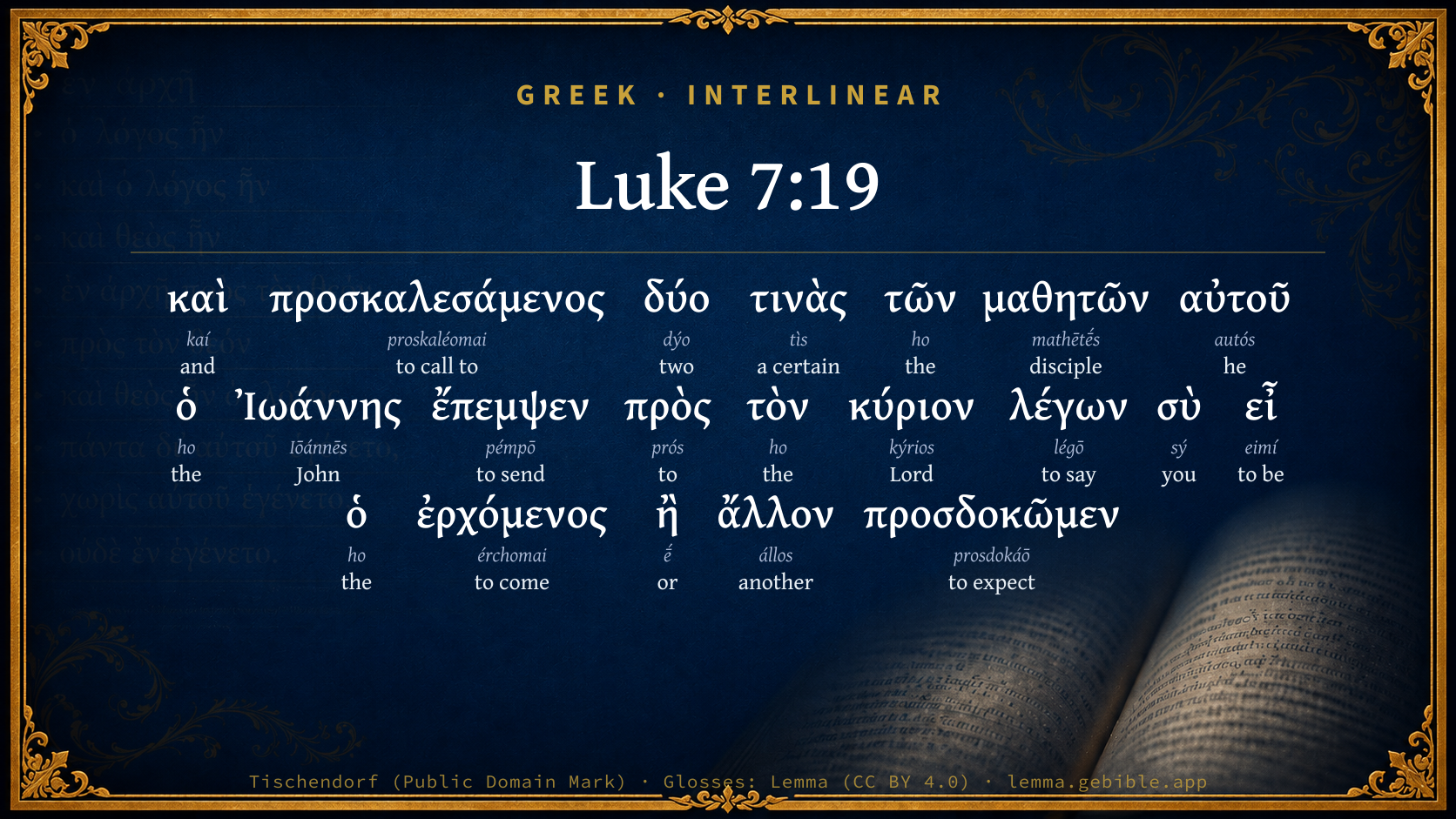
  1. καὶ kaí G2532 “and” Conjunction
  2. προσκαλεσάμενος proskaléomai G4341 “to call to” Verb, Aorist, Middle deponent, Participle, Nominative, Singular, Masculine
  3. δύο dýo G1417 “two” Adjective, Numeral (indeclinable)
  4. τινὰς tìs G5100 “a certain” Indefinite pronoun, Accusative, Plural, Masculine
  5. τῶν ho G3588 “the” Article, Genitive, Plural, Masculine
  6. μαθητῶν mathētḗs G3101 “disciple” Noun, Genitive, Plural, Masculine
  7. αὐτοῦ autós G846 “he” Personal pronoun, Genitive, Singular, Masculine
  8. ὁ ho G3588 “the” Article, Nominative, Singular, Masculine
  9. Ἰωάννης Iōánnēs G2491 “John” Noun, Nominative, Singular, Masculine
  10. ἔπεμψεν pémpō G3992 “to send” Verb, Aorist, Active, Indicative, 3rd person, Singular
  11. πρὸς prós G4314 “to” Preposition
  12. τὸν ho G3588 “the” Article, Accusative, Singular, Masculine
  13. κύριον kýrios G2962 “Lord” Noun, Accusative, Singular, Masculine
  14. λέγων légō G3004 “to say” Verb, Present, Active, Participle, Nominative, Singular, Masculine
  15. σὺ sý G4771 “you” Personal pronoun, 2nd person, Nominative, Singular
  16. εἶ eimí G1510 “to be” Verb, Present, Active, Indicative, 2nd person, Singular
  17. ὁ ho G3588 “the” Article, Nominative, Singular, Masculine
  18. ἐρχόμενος érchomai G2064 “to come” Verb, Present, Middle or Passive deponent, Participle, Nominative, Singular, Masculine
  19. ἢ ḗ G2228 “or” Particle
  20. ἄλλον állos G243 “another” Adjective, Accusative, Singular, Masculine

About this verse

These counts appear in no published source. They are computed here, from the morphology-tagged text and Lemma’s own curated glosses. What Lemma adds →

21
words
18
distinct lemmas
Gospels
section

Notable vocabulary

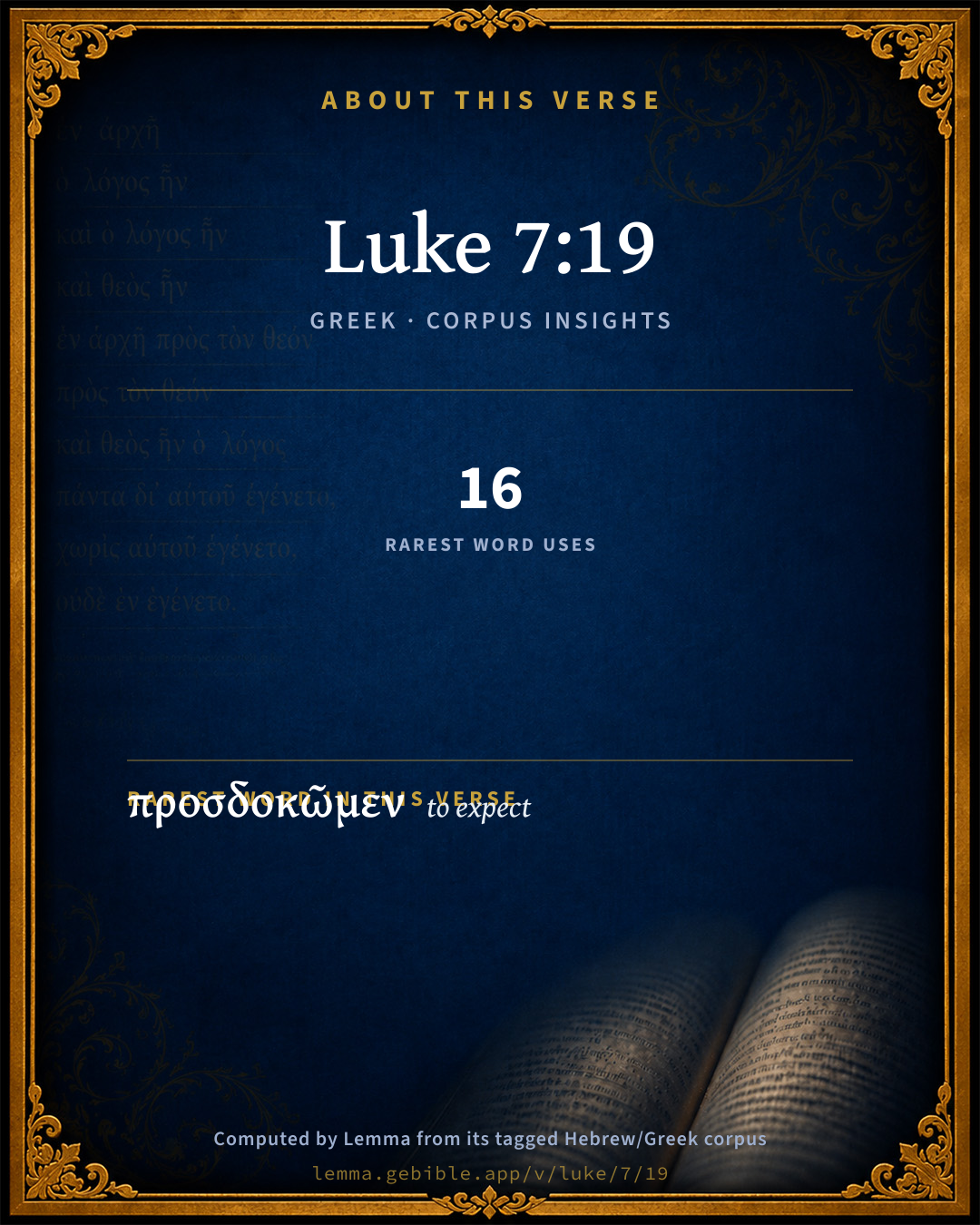
The rarest word here is προσδοκῶμεν to expect G4328 — appearing just 16 times in the whole Greek New Testament.

Shared distinctive vocabulary

προσδοκῶμεν to expect G4328 occurs in 15 verses of the Greek New Testament. Also found in:

Repetition

A word recurs within this verse:

Cross-references

22

Topical passages linked to Luke 7:19 in the Treasury of Scripture Knowledge — connected by theme and wording, ordered by reader-vote popularity; previews shown in the World English Bible.

  • Isaiah 9:6–7 For to us a child is born, to us a son is given; and the government shall be on his shoulder: and his name shall be called Wonderful, Counselor, Mighty God, Everlasting Father, Prince of Peace.
  • John 4:25 The woman said to him, "I know that Messiah comes," (he who is called Christ). "When he has come, he will declare to us all things."
  • Genesis 3:15 I will put enmity between you and the woman, and between your offspring and her offspring. He will bruise your head, and you will bruise his heel."
  • Genesis 22:18 In your seed will all the nations of the earth be blessed, because you have obeyed my voice."
  • Genesis 49:10 The scepter will not depart from Judah, Nor the ruler's staff from between his feet, Until he comes to whom it belongs. To him will the obedience of the peoples be.
  • Deuteronomy 18:15–18 Yahweh your God will raise up to you a prophet from the midst of you, of your brothers, like me; to him you shall listen;
  • Psalms 110:1–4 Yahweh says to my Lord, "Sit at my right hand, Until I make your enemies your footstool for your feet."
  • Isaiah 7:14 Therefore the Lord himself will give you a sign. Behold, the virgin will conceive, and bear a son, and shall call his name Immanuel.
  • Isaiah 11:1 There shall come forth a shoot out of the stock of Jesse, and a branch out of his roots shall bear fruit.
  • Isaiah 40:10–11 Behold, the Lord Yahweh will come as a mighty one, and his arm will rule for him: Behold, his reward is with him, and his recompense before him.
  • Isaiah 59:20–21 A Redeemer will come to Zion, and to those who turn from disobedience in Jacob, says Yahweh.
  • Jeremiah 23:5–6 Behold, the days come, says Yahweh, that I will raise to David a righteous Branch, and he shall reign as king and deal wisely, and shall execute justice and righteousness in the land.
  • Daniel 9:24–26 Seventy weeks are decreed on your people and on your holy city, to finish disobedience, and to make an end of sins, and to make reconciliation for iniquity, and to bring in everlasting righteousness, and to seal up vision and prophecy, and to anoint the most holy.
  • Micah 5:2 But you, Bethlehem Ephrathah, Being small among the clans of Judah, Out of you one will come forth to me that is to be ruler in Israel; Whose goings forth are from of old, from everlasting.
  • Haggai 2:7 and I will shake all nations. The precious things of all nations will come, and I will fill this house with glory, says Yahweh of Hosts.
  • Zechariah 9:9 Rejoice greatly, daughter of Zion! Shout, daughter of Jerusalem! Behold, your king comes to you! He is righteous, and having salvation; Lowly, and riding on a donkey, Even on a colt, the foal of a donkey.
  • Malachi 3:1–3 "Behold, I send my messenger, and he will prepare the way before me; and the Lord, whom you seek, will suddenly come to his temple; and the messenger of the covenant, whom you desire, behold, he comes!" says Yahweh of hosts.
  • Malachi 4:2 But to you who fear my name shall the sun of righteousness arise with healing in its wings. You will go out, and leap like calves of the stall.
  • Luke 10:1 Now after these things, the Lord also appointed seventy others, and sent them two by two ahead of him into every city and place, where he was about to come.
  • Acts 10:7–8 When the angel who spoke to him had departed, Cornelius called two of his household servants and a devout soldier of those who waited on him continually.
  • Joshua 2:1 Joshua the son of Nun sent out of Shittim two men as spies secretly, saying, Go, view the land, and Jericho. They went and came into the house of a prostitute whose name was Rahab, and lay there.
  • Revelation 11:3 I will give power to my two witnesses, and they will prophesy one thousand two hundred sixty days, clothed in sackcloth."

Cross-references courtesy of OpenBible.info (CC BY 4.0).

Where the printed editions differ

1 variant

Places in this verse where the major printed Greek editions disagree on the wording in a way that affects the translation — a comparison of editions, not a manuscript-by-manuscript collation. The editions are the modern critical texts (Nestlé-Aland 28/27, SBL, Westcott-Hort, Tregelles, Tyndale House) and the traditional texts behind the KJV (the Textus Receptus and the Byzantine/Majority text). It is not a claim about which reading is original.

  1. Different wording
    κύριον

    “Lord”

    In NA28NA27TynSBLWHTreg Not in TRByz

    Ἰησοῦν (Iēsoun) 'Jesus' occurs in traditional manuscripts (TR+Byz) instead of κύριον (kurion) 'Lord' in older manuscripts (NA28+NA27+Tyn+SBL+WH+Treg)

Textual data: Translators Amalgamated Greek New Testament (STEPBible TAGNT) · CC BY 4.0.

Commentary

Notes on Luke 7:19 from classic Christian and Jewish commentators (each source and its license shown beneath its notes). The classic Christian expositions comment on the surrounding passage and are grouped to its opening verse, so a note may address several verses; the Jewish commentaries on the Tanakh (Rashi and others) are per-verse, so they appear only where the commentator wrote on this verse.

Lemma curates 59 commentaries, every one of them public domain or Creative Commons licensed, each selected and text-cleaned for this edition rather than reprinted as found. About our sources →

Matthew Henry's Commentary

All this discourse concerning John Baptist, occasioned by his sending to ask whether he was the Messiah or no, we had, much as it is here related, Mt. 11:2-19.

I. We have here the message John Baptist sent to Christ, and the return he made to it. Observe,

1. The great thing we are to enquire concerning Christ is whether he be he that should come to redeem and save sinners, or whether we are to look for another, Luk 7:19, Luk 7:20. We are sure that God has promised that a Saviour shall come, an anointed Saviour; we are as sure that what he has promised he will perform in its season. If this Jesus be that promised Messiah, we will receive him, and will look for no other; but, if not, we will continue our expectations, and, though he tarry, will wait for him.

2. The faith of John Baptist himself, or at least of his disciples, wanted to be confirmed in this matter; for Christ had not yet publicly declared himself to be indeed the Christ, nay, he would not have his disciples, who knew him to be so, to speak of it, till the proofs of his being so were completed in his resurrection. The great men of the Jewish church had not owned him, nor had he gained any interest that was likely to set him upon the throne of his father David. Nothing of that power and grandeur was to be seen about him in which it was expected that the Messiah would appear; and therefore it is not strange that they should ask, Art thou the Messiah? not doubting but that, if he was not, he would direct them what other to look for.

3. Christ left it to his own works to praise him in the gates, to tell what he was and to prove it. While John's messengers were with him, he wrought many miraculous cures, in that same hour, which perhaps intimates that they staid but an hour with him; and what a deal of work did Christ do in a little time! Luk 7:21. He cured many of their infirmities and plagues in body, and of evil spirits that affected the mind either with frenzy or melancholy, and unto many that were blind he gave sight. He multiplied the cures, that there might be no ground left to suspect a fraud; and then (Luk 7:22) he bade them go and tell John what they had seen. And he and they might easily argue, as even the common people did (Joh 7:31), When Christ cometh, will he do more miracles than these which this man hath done? These cures, which they saw him work, were not only confirmations of his commission, but explications of it. The Messiah must come to cure a diseased world, to give light and sight to them that sit in darkness, and to restrain and conquer evil spirits. You see that Jesus does this to the bodies of people, and therefore must conclude this is he that should come to do it to the souls of people, and you are to look for no other. To his miracles in the kingdom of nature he adds this in the kingdom of grace (Luk 7:22), To the poor the gospel is preached, which they knew was to be done by the Messiah; for he was anointed to preach the gospel to the meek (Isa 61:1), and to save the souls of the poor and needy, Psa 72:13. Judge, therefore, whether you can look for any other that will more fully answer the characters of the Messiah and the great intentions of his coming.

4. He gave them an intimation of the danger people were in of being prejudiced against him, notwithstanding these evident proofs of his being the Messiah (Luk 7:23): Blessed is he whosoever shall not be offended in me, or scandalized at me. We are here in a state of trial and probation; and it is agreeable to such a state that, as there are sufficient arguments to confirm the truth to those that are honest and impartial in searching after it, and have their minds prepared to receive it, so there should be also objections, to cloud the truth to those that are careless, worldly, and sensual. Christ's education at Nazareth, his residence at Galilee, the meanness of his family and relations, his poverty, and the despicableness of his followers - these and the like were stumbling-blocks to many, which all the miracles he wrought could not help them over. He is blessed, for he is wise, humble, and well disposed, that is not overcome by these prejudices. It is a sign that God has blessed him, for it is by his grace that he is helped over these stumbling-stones; and he shall be blessed indeed, blessed in Christ.

II. We have here the high encomium which Christ gave of John Baptist; not while his messengers were present (lest he should seem to flatter him), but when they were departed (Luk 7:24), to make the people sensible of the advantages they had enjoyed in John's ministry, and were deprived of by his imprisonment. Let them now consider what they went out into the wilderness to see, who that was about whom there had been so much talk and such a great and general amazement. "Come," saith Christ, "I will tell you."

1. He was a man of unshaken self-consistence, a man of steadiness and constancy. He was not a reed shaken with the wind, first in one direction and then in another, shifting with every wind; he was firm as a rock, not fickle as a reed. If he could have bowed like a reed to Herod, and have complied with the court, he might have been a favourite there; but none of these things moved him.

2. He was a man of unparalleled self-denial, a great example of mortification and contempt of the world. He was not a man clothed in soft raiment, nor did he live delicately (Luk 7:25); but, on the contrary, he lived in a wilderness and was clad and fed accordingly. Instead of adorning and pampering the body, he brought it under, and kept it in subjection.

3. He was a prophet, had his commission and instructions immediately from God, and not of man or by man. He was by birth a priest, but that is never taken notice of; for his glory, as a prophet, eclipsed the honour of his priesthood. Nay, he was more, he was much more than a prophet (Luk 7:26), than any of the prophets of the Old Testament; for they spoke of Christ as at a distance, he spoke of him as at the door.

4. He was the harbinger and forerunner of the Messiah, and was himself prophesied of in the Old Testament (Luk 7:27): This is he of whom it is written (Mal 3:1), Behold, I send my messenger before thy face. Before he sent the Master himself, he sent a messenger, to give notice of his coming, and prepare people to receive him. Had the Messiah been to appear as a temporal prince, under which character the carnal Jews expected him, his messenger would have appeared either in the pomp of a general or the gaiety of a herald at arms; but it was a previous indication, plain enough, of the spiritual nature of Christ's kingdom, that the messenger he sent before him to prepare his way did it by preaching repentance and reformation of men's hearts and lives. Certainly that kingdom was not of this world which was thus ushered in.

5. He was, upon this account, so great, that really there was not a greater prophet than he. Prophets were the greatest that were born of women, more honourable than kings and princes, and John was the greatest of all the prophets. The country was not sensible what a valuable, what an invaluable, man it had in it, when John Baptist went about preaching and baptizing. And yet he that is least in the kingdom of God is greater than he. The least gospel minister, that has obtained mercy of the Lord to be skilful and faithful in his work, or the meanest of the apostles and first preachers of the gospel, being employed under a more excellent dispensation, are in a more honourable office than John Baptist. The meanest of those that follow the Lamb far excel the greatest of those that went before him. Those therefore who live under the gospel dispensation have so much the more to answer for.

III. We have here the just censure of the men of that generation, who were not wrought upon by the ministry either of John Baptist or of Jesus Christ himself.

1. Christ here shows what contempt was put upon John Baptist, while he was preaching and baptizing. (1.) Those who did show him any respect were but the common ordinary sort of people, who, in the eye of the gay part of mankind, were rather a disgrace to him than a credit, Luk 7:29. The people indeed, the vulgar herd, of whom it was said, This people, who know not the law, are cursed (Joh 7:49), and the publicans, men of ill fame, as being generally men of bad morals, or taken to be so, these were baptized with his baptism, and became his disciples; and these, though glorious monuments of divine grace, yet did not magnify John in the eye of the world; but by their repentance and reformation they justified God, justified his conduct and the wisdom of it in appointing such a one as John Baptist to be the forerunner of the Messiah: they hereby made it to appear that it was the best method that could be taken, for it was not in vain to them whatever it was to others. (2.) The great men of their church and nation, the polite and the politicians, that would have done him some credit in the eye of the world, did him all the dishonour they could; they heard him indeed, but they were not baptized of him, Luk 7:30. The Pharisees, who were most in reputation for religion and devotion, and the lawyers, who were celebrated for their learning, especially their knowledge of the scriptures, rejected the counsel of God against themselves; they frustrated it, they received the grace of God, by the baptism of John, in vain. God in sending that messenger among them had a kind purpose of good to them, designed their salvation by it, and, if they had closed with the counsel of God, it had been for themselves, they had been made for ever; but they rejected it, would not comply with it, and it was against themselves, it was to their own ruin; they came short of the benefit intended them, and not only so, but forfeited the grace of God, put a bar in their own door, and, by refusing that discipline which was to fit them for the kingdom of the Messiah, shut themselves out of it, and they not only excluded themselves, but hindered others, and stood in their way.

2. He here shows the strange perverseness of the men of that generation, in their cavils both against John and Christ, and the prejudices they conceived against them.

(1.) They made but a jesting matter of the methods God took to do them good (Luk 7:31): "Whereunto shall I liken the men of this generation? What can I think of absurd enough to represent them by? They are, then, like children sitting in the market-place, that mind nothing that is serious, but are as full of play as they can hold. As if God were but in jest with them, in all the methods he takes to do them good, as children are with one another in the market-place (Luk 7:32), they turn it all off with a banter, and are not more affected with it than with a piece of pageantry." This is the ruin of multitudes, they can never persuade themselves to be serious in the concerns of their souls. Old men, sitting in the sanhedrim, were but as children sitting in the market-place, and no more affected with the things that belonged to their everlasting peace than people are with children's play. O the amazing stupidity and vanity of the blind and ungodly world! The Lord awaken them out of their security.

(2.) They still found something or other to carp at. [1.] John Baptist was a reserved austere man, lived much in solitude, and ought to have been admired for being such a humble, sober, self-denying man, and hearkened to as a man of thought and contemplation; but this, which was his praise, was turned to his reproach. Because he came neither eating nor drinking, so freely, plentifully, and cheerfully, as others did, you say, "He has a devil; he is a melancholy man, he is possessed, as the demoniac whose dwelling was among the tombs, though he be not quite so wild." [2.] Our Lord Jesus was of a more free and open conversation; he came eating and drinking, Luk 7:34. He would go and dine with Pharisees, though he knew they did not care for him; and with publicans, though he knew they were no credit to him; yet, in hopes of doing good both to the one and the other, he conversed familiarly with them. By this it appears that the ministers of Christ may be of very different tempers and dispositions, very different ways of preaching and living, and yet all good and useful; diversity of gifts, but each given to profit withal. Therefore none must make themselves a standard to all others, nor judge hardly of those that do not do just as they do. John Baptist bore witness to Christ, and Christ applauded John Baptist, though they were the reverse of each other in their way of living. But the common enemies of them both reproached them both. The very same men that had represented John as crazed in his intellects, because he came neither eating nor drinking, represented our Lord Jesus as corrupt in his morals, because he came eating and drinking; he is a gluttonous man, and a wine-bibber. Ill-will never speaks well. See the malice of wicked people, and how they put the worst construction upon every thing they meet with in the gospel, and in the preachers and professors of it; and hereby they think to depreciate them, but really destroy themselves.

3. He shows that, notwithstanding this, God will be glorified in the salvation of a chosen remnant (Luk 7:35): Wisdom is justified of all her children. There are those who are given to wisdom as her children, and they shall be brought by the grace of God to submit to wisdom's conduct and government, and thereby to justify wisdom in the ways she takes for bringing them to that submission; for to them they are effectual, and thereby appear well chosen. Wisdom's children are herein unanimous, one and all, they have all a complacency in the methods of grace which divine wisdom takes, and think never the worse of them for their being ridiculed by some.

Matthew Henry's Commentary on the Whole Bible (1708–1710) — public domain (CC PDM 1.0). Text via the HelloAO Bible API.

The Biblical Illustrator

Joseph S. Exell

Luk_7:19-22

Art Thou He that should come, or look we for another?

--

Johns doubting message to Jesus

1. Much discussion has taken place concerning Johns doubt, whether it was real or affected; and if real, what was its cause? We believe there was doubt in the mind of the Baptist--serious doubt--arising out of no personal or petty source, but caused by the way in which the Messianic career of Jesus was developing itself.

2. This doubt was not in regard to the identity of the worker of the works reported to John with Jesus, but in regard to the nature of the works viewed as Messianic. But why should John stumble at those works, so full of the spirit of love and mercy? Just because they were works of mercy. These were not the sort of works he had expected Messiah to busy Himself with; at all events, so exclusively. Cf. Jonahs zeal for righteousness.

3. The reply sent back by Jesus to John amounted to this, that the sure marks that He was the coming One, the Christ, were just the very works which had awakened Johns surprise.

4. Having recounted rapidly His mighty works, Jesus appended the reflection, And blessed is he whosoever shall not be offended in Me. We are not to find in the words traces either of harshness towards John or of wounded feeling in the speaker. The tone of compassion rather than of severity is audible in the utterance. Jesus felt keenly how much John missed by being in such a state of mind that that in His own work which was most godlike was a stumbling-block to him. Translated into positive form the reflection means, Blessed are they to whom the mercy and the grace of which I am full, and whereof My ministry is the manifestation and outflow, are no stumbling-block, but rather worthy of all acceptation. (A. B. Bruce, D. D.)

The test of Christianity

1. Jesus deliberately declined to rest His claims upon any other grounds than the testimony of His Father, a testimony which shone in the truth of His words, and in the heavenly character of His mission.

2. If the Master Himself is willing, nay demands, to be judged by results, manifestly organizations and churches that claim to be called by His name must not shrink from the same test.

3. The only proof of your being in contact with the living Saviour, the only proof that you rightly apprehend and sincerely embrace Him, is the result in your own hearts and conduct. No religion is worth anything that is not a power. (E. W. Shalders, BA.)

Looking for another Christ

There are times when, through the disappointments and failures of our personal religious lives, it may be necessary to look for another Christ than the Christ we have already known.

1. There are some who have been restless for months, perhaps for years, about their sin. They have appealed to Christ again and again, and the peace of Christ has not come to them. They are tempted to put this question. Christ may reply by pointing them to the great triumphs of His mercy by which they are surrounded. Go to Christ with all your trouble, and with a clear and vivid remembrance of His death, and you cannot put this question.

2. There are some who feel that their Christian life has not had the power and brightness they hoped for. This, also, often arises from a defective knowledge of Christ. Perhaps you have forgotten that He is not only a Saviour, but a Prince, and that you must accept His law as the rule of your life, and strive to get His will done on earth as the will of God is done in heaven.

3. This question may be suggested by the general condition and history of the world, a large part of the world is still unsaved: the misery Jesus came to console still largely unconsoled. Do you look for another Christ? Can the contents of His revelation be anyhow enriched? Can there be more careful warnings, more glorious promises, more compassion, more gentleness and beauty, than there are in Him and His gospel?

4. We do not look for the coming of another Christ, but the Christ whom we know will come in another form, to complete in power and majesty the work which He began in weakness and in shame. (R. W. Dale, D. D.)

The answer of Jesus to John

It seems to me that here the Lord prescribes to His Church the answer she should give in all days when men rise up and question whether He comes from God, when men rise up to say to His Church, Are you the kingdom of God? are you the Divine society established upon earth to be the home of the new life, and the source of a wide-spreading influence? Are you the city set upon a hill that cannot be hid? When such questions are asked, the Church must be ready, not merely to give proofs of her ancient origin, her orthodox title-deeds drawn from the dusty safes of her theology, but she must be able to say, Look at my life, my work. See what I am doing for the poor, the destitute, the oppressed, and judge me as you find me. Can the Church of God, in these days, bear such an appeal as that? Can she say, Look at the asylums I nave founded and support for the poor, the lame, the halt, and the blind! Look at my children giving devoted labour in the lowest dens of your cities; at my sons faithfully striving for the truth in the halls of your legislature; and see in juster laws and a purer life, and a more brotherly relation between man and man, proofs of the power of my spirit, and of the truth of my labours? She must answer so, and so must you and I, when challenged to prove that we are of God. We hear a great deal in these days about answers to the infidel, about arguments philosophical, historical, and scientific, which shall have the power, in the hands of skilful men, of silencing the antagonist. But a better argument and a mightier that any of these, an argument that never fails, is that derived from the fruits and results of religion in the life. The man who reads your history with criticism, and meets your argument with argument, will bare his head and bow his neck before the spectacle of a holy and devoted life. That he sees is true, whatever else be false; that is of God, whatever becomes of books and institutions. (Bishop Moorhouse.)

The message of John the Baptist

I. THE MESSAGE. What did it mean?

1. To convince his disciples? Not suited to do it; suggesting doubtfulness in their master; impairing previous witness.

2. To reassure himself? At variance with

(1) his character, testimony, Divine assurance.

(2) Words of the Lord (Luk_7:24), aimed to prevent the supposition.

(3) The occasion. When he had heard the works of Christ--the last work being the raising of the dead.

3. Message not of uncertainty, but of impatience. Things do not go as the Baptist expected. The world left in doubt. Opinion taking wrong turn for want of distinct assertion. Works of Christ, but no proclamation of Christ. It ought to be made. The time is come. He the proper person to obtain it. He will demand it in the interests of all.

II. THE REPLY.

1. Answer.

(1) To what was said. The facts are sufficient answer.

(2) To what was meant. The method will not be changed. The Lord must choose His own course. Men must see and judge. Facts first, then assertions.

2. Warning. There is danger in this disposition--danger of questioning Gods methods; restlessness, dissatisfaction, diminution of attachment, failure of faith. (Canon T. D. Bernard.)

Moral evidence of Christianity superior to miracles

1. It is evident John did not clearly apprehend the spirituality of the kingdom Christ was to introduce. Like the apostles, he expected the kingdom of God would come with observation, instead of its being of a slow, quiet, spiritual growth. He looked for something more visible. There were the remains of the old dispensation mixed up with his ideas of its nature; too much of the Old Testament theocracy.

2. The remarkable manner in which the idea of the coming of Christ had taken possession of the minds of men at the time John sent his disciples to inquire respecting it. The familiar designation of the Messiah was the Comer. Him that is to come is but the common version of the worlds designation of the Messiah. The Comer, as if with Him came everything else desirable. The coming of all future good depended upon His coming.

3. I might notice the worlds slowness in recognizing Christ as the Messiah, and the circumstances which occasioned that slowness to admit His claim.

4. He proceeded to enforce His claim by evidence corresponding with His character, and their necessities, and by evidence alone, the result of which

He is prepared to wait (Luk_7:21-23). As if He had said, Go and tell John My kingdom is a spiritual kingdom, and the employment of other than spiritual means would be uncongenial and obstructive.

5. That our Lord not only employed evidence in contradistinction from worldly display and physical force, but that He presented to these inquirers and the multitude moral evidence as superior to miraculous.

I. CHRISTS PREACHING CONSISTED, IN A REMARKABLE DEGREE, OF DEEDS.

1. Thus on this occasion, the God-like reply to the inquiry, Art Thou He that should come? His deeds spoke. He entered into no argumentative defence of His claims--Actions speak louder than words. In the same hour He cured many of their infirmities and plagues, and of evil spirits; and unto many that were blind He gave sight. He left the stupendous miracles He had performed to speak for themselves (Psa_19:1-14.l-3). The heavens had done much, and now He is in the world to develop what the heavens could not declare. It was not to be expected that His more full manifestation would be verbal merely, or chiefly, for how can speech, which is but the symbol of thought, convey ideas of what thought cannot grasp respecting God, who is a spirit, immaterial, infinite, invisible, incomprehensible. Speech fails to do justice to the finite, the visible, the material, and comprehensible; to convey the greatest and best conceptions of our own minds.

2. Christs verbal teaching related especially to Himself. Each portion of it was either the vindication of acts He had performed, or an intimation of some purpose he was about to accomplish, or a development of the kingdom He was then establishing--relating to its nature, origin, character, or growth.

3. This distinctive and important fact supplies a reply to the following objections.

(1) The first objection we refer to, more frequently felt than expressed, relates to the greater fulness of evangelical doctrines in the Epistles than in the Gospels. Although the latter comprise the discourses and teaching of Christ Himself, we reply to this by saying, Christ came not so much to preach the gospel as to procure it, to establish and confirm it, to perform the deeds, the record of which constitutes the gospel.

(2) The second objection urged from the time of Celsus downwards is, that parallels to some of our Lords sayings are to be found in the writings of

Plato, Isocrates, and others. Hence it has been inferred, absurdly enough, that the gospel had been anticipated--that Christianity was not original. To which we reply, admitting the supposed resemblances, the wonder is that they are so extremely few--two or three mere maxims of morality, and these but the distant reverberations of Sinais echoes of the ancient and moral law. What is Christianity? Nothing but a few maxims of morality? We triumphantly point inquirers for Christianity to her spirit and her works--her resemblance to her Lord.

II. His WORKS WERE WONDERFUL. It is a frequent description given of God in the Old Testament, He only doeth wonderful things. To achieve wonders is the prerogative of God. He alone doeth wonders; and this called forth the grateful praises of His people. Not only is God the wonderworker, but strictly speaking, all that God does are wonders, only wonders. The atom is as an atom not less wonderful than a world. Both owe their origin to His creative power, and are impressed with the Divine signature. Was it strange then that when God was manifested in the flesh, that when He appeared amongst us, who was predicted as the wonderful, His works and deeds should be mighty signs and wonders. There was a sense in which He could do nothing which was not wonderful; His constitution made it impossible that anything ordinary could emanate from Him.

III. HIS WONDERS WERE MERCIES.

1. All His miracles were miracles of mercy. Nor was it necessary to alter His laws, imposed at the first on nature, they suffered no violence from His mercy; on the contrary, they harmonized with it. In giving sight to the blind, He was but restoring the eye to the use and exercise of its proper function. His power He used as a trust to be administered for mans good alone.

2. Besides the present happiness, His mercies conveyed in the physical and mental benefits, miraculously bestowed, they had a higher value, a symbolical meaning, pointing to spiritual necessities and supplies, to the things relating to our redemption.

3. His miracles demonstrated His power, and our interest in turning the elements of earth to account of spiritual uses, relating them to heaven. In opening the blind eye He denoted that He came to be the Light of the world, and that we need that the eye of the understanding should be open to receive that light. The greatest wonder was that of His incarnation. In comparison with this wonder, all mere acts of His power were less splendid. This was the long desired and promised wonder. The ancient tabernacle foreshadowed His tabernacling among men. The temple with its indwelling Shekinah symbolically predicted this. Every instance of union between God and man, and the union of soul and body, prefigured this infinitely more mysterious union of the Divine and human natures in His person.

IV. HIS MERCIES, like His acts, by which He replied to Johns disciples, WERE ANSWERS TO MANS NECESSITIES. This is only another mode of saying that the blessings of His redemption are fully adapted to mans exigencies. It might have been otherwise. His words might have been works; His works might have been wonders; His wonders might have been mercies; and yet, after all, there might have been a want of strict suitableness between our necessities and the mode of meeting them, but the text reminds us that His mercies and deeds are exactly suitable and fully answerable to the exigencies.

1. This correspondence admits of universal application. He comprehended the entire scheme of nature and Providence. No legitimate question on any natural subject can ever arise in the mind of man, which his Creator and Redeemer has not foreseen; to which He has not inserted an answer in the things which He has made. Ten thousand answers are silently awaiting the future questions which shall call them forth. At this moment, while we are assembled here, the Creator may be elsewhere exhibiting similar demonstrations of His perfections in reply to inquirers. In the amplitude of space, hosts of intelligent beings may be collected around the chaos of a world, wondering whether it will ever be restored to harmony and order; whether all creative acts are at an end, and while they are inquiring the fiat may go forth from the Creator again, as in the beginning, Let there be light, and the light of Divine power may kindle around them.

2. The lessons of the Old Testament are represented as replies. God was graciously pleased to allow Himself to be inquired of. His replies were called responses or oracles.

3. But now Christ had come as the living oracle; from Him the questions which human guilt and misery had never ceased to agitate, were to receive a full practical satisfactory reply.

V. A PRACTICAL CHRISTIANITY ALONE, A CHRISTIANITY EMBODIED IN DEEDS OF MERCY, ADEQUATELY ILLUSTRATES THE WORKS OF REDEMPTION BY CHRIST. Blessed is he, whosoever shall not be offended in Me. Our

Lord meant not that His wondrous works should end with Himself. All power was given to Him as Mediator and Head of the Church, as a centre of an ever-enlarging circle. From Him as the Head of all things to the Church all emanates. (J. Harris, D. D.)

The soul dependent on physical conditions

However good and great you may be in the Christian life, your soul will never be independent of physical conditions. I feel I am uttering a most practical, useful truth here, one that may give relief to a great many Christians who are worried and despondent at times. Doctor Rush, a monarch in medicine, after curing hundreds of cases of mental depression, himself fell sick and lost his religious hope, and he would not believe his pastor when the pastor told him that his spiritual depression was only a consequence of physical depression. Andrew Fuller, Themes Scott, William Cowper, Thomas Boston, David Brainard, Philip Melancthon, were mighty men for God, but all of them illustrations of the fact that a mans soul is not independent of his physical health. An eminent physician gave as his opinion that no man ever died a greatly triumphant death whose disease was below the diaphragm. Stackhouse, the learned Christian writer, says he does not think Saul was insane when David played the harp before him, but it was a hypochondria coming from inflammation of the liver. The Dean of Carlisle, one of the best men that ever lived, and one of the most useful, sat down and wrote: Though I have endeavoured to discharge my duty as well as I could, yet sadness and melancholy of heart stick close by and increase upon me. I tell nobody, but I am very much sunk indeed, and I wish I could have the relief of weeping as I used to. My days are exceedingly dark and distressing. In a word, Almighty God seems to hide His face, and I intrust the secret to hardly any earthly being. I know not what will become of me. There is, doubtless, a good deal of bodily affliction mingled with this, but it is not all so. I bless God, however, that I never lose sight of the Cross, and, though I should die without seeing any personal interest in the Redeemers merits, I hope that I shall be found at His feet. I will thank you for a word at your leisure. My door is bolted at the time I am writing this, for I am full of tears. (Dr. Talmage.)

Inactivity a cause of doubt

Doubt often comes from inactivity. We cannot give the philosophy of it, but this is the fact, that Christians who have nothing to do but to sit thinking of themselves, meditating, sentimentalising, are almost sure to become the prey to dark, blank misgivings. John the Baptist, struggling in the desert, needs no proof that Jesus is the Christ. John shut up became morbid and doubtful immediately.

We are mysteries, but here is the practical lesson of it all: for sadness, for suffering, for misgivings, there is no remedy but stirring and doing. (F. W. Robertson, M. A.)

Christ is the dispeller of doubt

During his earlier life Dr. Merle DAubigne, the Swiss historian of the Reformation, was grievously vexed with depressing doubts. He went to his old teacher for help. The shrewd old man refused to answer the young mans perplexities, saying, Were I to get you rid of these doubts, others would come. There is a shorter way of destroying them. Let Christ be really to you the Son of God the Saviour. Do His will. His light will dispel the clouds, and His Spirit will lead you into all truth. The old man was right, and the young DAubigne was wise enough to adopt his counsel. He hoisted anchor, and moved out of the region of fogs, and quietly anchored himself under the sunshine of Christs countenance. (Dr. Cuyler.)

Devotion to Christ a cure for despondency

Active devotion to Christs service is another cure for spiritual despondency. The faith-faculty gets numb by long inaction, just as a limb becomes numb and useless if it is not exercised. The love-power grows cold if it is not kept fired up. When faith and love both run low, the soul easily falls into an ague-fit. What you need is to get out of yourself into a sympathy with, and downright efforts for, the good of others. When a desponding Christian came to old Dr. Alexander for relief, the Doctor urged him to prayer. I do pray continually. What do you pray for? The young student said, I pray that the Lord would lift upon me the light of His countenance. Then, replied the sagacious veteran, go now and pray that He will use you for the conversion of souls. (Dr. Cuyler.)

To the poor the gospel is preached

The gospel preached to the poor

I. THE EXCELLENCY OF THIS LAW. A new development of a heaven-laid plan to enlighten the poor; to raise them in the scale of being; to sweeten and adorn their lot by the honours of intellectual culture, the comforts of social life, and the hopes of immortality. The wisdom of our text, as a poors law, excels all the contrivances of men. It does not so much provide for the poor as it prevents men from being poor. It cuts off the causes of poverty.

II. THE OBLIGATION IT LAYS UPON US. The way to the most effective sense of duty is by discovering the need and the worth of the thing that is enjoined; and is this a thing to be countermanded or opposed?: But if the argument from the goodness of precept seem too weak, let us view its peremptory demand. It is the will of our Saviour that none live in a Christian land without hearing the glad sound, that so all may walk in the light of His countenance.

III. How is THIS GOOD LAW OF OUR LAND TO BE FULFILLED.? (N. Paterson.)

Christs works

1. Our Saviours works were words.

2. His works were wonders.

3. His wonders were wonders of mercy.

4. His wonders of mercy were suited to the necessities of man.

5. The suitableness of His wonders of mercy to the necessities of man is a satisfactory proof of His Messiahship. (G. Brooks.)

The suitability of the gospel to the poor

The gospel is especially adapted to the poor, in respect of--

1. Their education.

2. Their resources.

3. Their opportunities.

4. Their prospects. (G. Brooks.)

A preacher to the poor

John Wesley always preferred the middling and lower classes to the wealthy. He said If I might choose I should still, as I have done hitherto, preach the gospel to the poor.

Trophies of the work of Christ

Before many a Popish shrine on the Continent one sees exhibited a great variety of crutches, together with wax models of arms, legs, and other limbs. These are supposed to represent the cures wrought by devotion at that altar--the memorials of the healing power of the saint. Poor, miserable superstition, all of it, and yet what a reminder to the believer in Jesus as to his duty and his privilege? Having pleaded at the feet of Jesus, we have found salvation; have we remembered to record this wonder of His hand? If we hung up memorials of all His matchless grace, what crutches and bandages and trophies of every sort should we pile together! Temper subdued, pride humbled, unbelief slain, sin cast down, sloth ashamed, carelessness rebuked. The cross has healed all manner of diseases, and its honours should be proclaimed with every rising and setting sun. (C. H. Spurgeon.)

Christianity and the poor

A celebrated doctor of divinity in London, who is now in heaven I have no doubt--a very excellent and godly man--gave notice one Sunday that he intended to visit all his people, and said,that in order to be able to get round and visit them and their families once in the year, he should take all the seatholders in order, A person well known to me, who was then a poor man, was delighted with the idea that the minister was coming to his house to see him, and about a week or two before he conceived it would be his turn his wife was very careful to sweep the hearth and keep the house tidy, and the man ran home early from work, hoping each night to find the Doctor there. This went on for a considerable time. He either forgot his promise, or grew weary in performing it, or for some other reason never went to this poor mans house; and the result was this, the man lost confidence in all preachers, and said, They care for the rich, but they do not care for us who are poor. That man never settled down to any one place of worship for many years, till at last he dropped into Exeter Hall and remained my hearer for years till Providence removed him. It was no small task to make him believe that any minister could be an honest man, and could impartially love both rich and poor. (C. H.Spurgeon.)

The Biblical Illustrator, edited by Joseph S. Exell (c. 1880s–1900s) — public domain. Text from a community e-Sword module.

Joseph Benson's Commentary

Luk 7:19-28. And John, calling unto him two of his disciples, sent them to Jesus, &c. — See this whole paragraph explained in the notes on Mat 11:2-11. To the poor the gospel is preached — Which is the greatest mercy and the greatest miracle of all.

Joseph Benson's Commentary on the Old and New Testaments (1811–1818) — public domain. Text from a community e-Sword module.

Bengel's Gnomon

Johann Albrecht Bengel

Luk 7:19. Προσκαλεσάμενος, having called to him) John had not disciples so frequently with him as the Saviour had.

Bengel's Gnomon of the New Testament — English translation (T&T Clark, Edinburgh, 1860) — public domain. Text from a community e-Sword module.

Expositor's Greek Testament

ed. W. Robertson Nicoll

Luk 7:19 . δύο , two; more explicit than Mt., who has διὰ τ . μαθητῶν . The δύο may be an editorial change made on the document, from which both drew. πρὸς τὸν κύριον ( Ἰησοῦν T. R.): a second instance of the use of the title “Lord” in Lk.’s narrative. σὺ εἶ , etc.: question as in Mk., with the doubtful variation, ἄλλον for ἕτερον .

The Expositor's Greek Testament, edited by W. Robertson Nicoll (1897–1910) — public domain. Text from a community e-Sword module.

Adam Clarke's Commentary

Verse 19. Art thou he that should come?] That is, to save. Art thou the promised Messiah? See Clarke on Mt 11:3.

Some have thought that this character of our Lord, ο ερχομενος, he who cometh, refers to the prophecy of Jacob, Ge 49:10, where he is called שילה Shiloh, which Grotius and others derive from שלה shalach, he sent: hence, as the time of the fulfilment of the prophecy drew nigh, he was termed, He who cometh, i.e. he who is just now ready to make his appearance in Judea. In Zec 9:9, a similar phrase is used, Behold, thy king COMETH unto thee-having SALVATION. This is meant of the Messiah only; therefore I think the words to save, are necessarily implied.

Adam Clarke's Commentary on the Bible (1810–1826) — public domain. Text from a community e-Sword/MySword module.

Ellicott's Commentary for English Readers

(19) Two of his disciples.—According to some MSS. of St. Matthew, which give simply, sent through His disciples, St. Luke’s account is the only one that gives the number of the disciples sent.

Sent them to Jesus.—Some of the best MSS. give, “to the Lord.” (See Note on Luk_7:13.)

A Bible Commentary for English Readers, edited by Charles John Ellicott (1878–1897) — public domain. Text from a community e-Sword module.

The Cambridge Bible for Schools and Colleges

gen. ed. J. J. S. Perowne

18-35. The Message from the Baptist.

19. John calling unto him two of his disciples] The Baptist was now in prison (Mat_11:2-6), but was not precluded from intercourse with his friends.

to Jesus] The reading of B and some other Uncials is “to the Lord.”

Art thou he that should come? or look we for another?] Rather, Art thou the coming [Messiah], or are we to expect another? “The Coming (One)” is a technical Hebrew term for the Messiah (Habba). This brief remarkable message is identical with that in St Matthew, except that St Luke uses allon (‘another’) and St Matthew heteron (‘a second,’ or

‘different one’). Probably however there is no significance in this variation, since the accurate classical meaning of heteros was partly obliterated. Probably too the messengers spoke in Aramaic. “The coming” is clearer in St Matthew, because he has just told us that John heard in prison the works of “the Christ” i.e. of the Messiah. Those who are shocked with the notion that the faith of the Baptist should even for a moment have wavered, suppose that (1) St John merely meant to suggest that surely the time had now come for the Messiah to reveal himself as the Messiah, and that his question was one rather of ‘increasing impatience’ than of ‘secret unbelief;’ or (2) that the message was sent solely to reassure John’s own disciples; or (3) that, as St Matthew here uses the phrase “the works of the Messiah” and not “of Jesus,” the Baptist only meant to ask ‘Art thou the same person as the Jesus to whom I bore testimony?’ These suppositions are excluded, not only by the tenor of the narrative but directly by Luk_7:23; (Mat_11:6). Scripture never presents the saints as ideally faultless, and therefore with holy truthfulness never conceals any sign of their imperfection or weakness. Nothing is more natural than that the Great Baptist—to whom had been granted but a partial revelation—should have felt deep anguish at the calm and noiseless advance of a Kingdom for which, in his theocratic and Messianic hopes, he had imagined a very different proclamation. Doubtless too his faith like that of Elijah (1Ki_19:4), of Job in his trials (Job_3:1), and of Jeremiah in prison (Jer_20:7), might be for a moment drowned by the tragic briefness, and disastrous eclipse of his own career; and he might hope to alleviate by this message the anguish which he felt when he contrasted the joyous brightness of our Lord’s Galilean ministry with the unalleviated gloom of his own fortress-prison among the black rocks at Makor. ‘If Jesus be indeed the promised Messiah,’ he may have thought, ‘why am I, His Forerunner, suffered to languish undelivered,—the victim of a wicked tyrant?’ The Baptist was but one of those many glorious saints whose careers God, in His mysterious Providence, has suffered to end in disaster and eclipse that He may shew us how small is the importance which we must attach to the judgment of men, or the rewards of earth. “We fools accounted his life madness, and his end to be without honour: how is he numbered among the children of God, and his lot is among the saints!” Wis_5:20. We may be quite sure that “in the fiery furnace God walked with His servant so that his spirit was not harmed, and having thus annealed his nature to the utmost that this earth can do, He took him hastily away and placed him among the glorified in Heaven.” Irving.

The Cambridge Bible for Schools and Colleges (gen. ed. J. J. S. Perowne; Cambridge University Press, 1878–1918) — public domain. Text from a community e-Sword module.

John Gill's Exposition

When the men were come to him,.... To Jesus; "those two men", as the Arabic version reads; "the disciples", as the Persic version; the same that John sent from the castle of Machaerus, where he was now a prisoner, to Christ, who was teaching in some city or town of Galilee:

they said, John the Baptist; so well known by his being the administrator of the ordinance of baptism:

hath sent us unto thee, saying, art thou he that should come, or look we for another? See Gill on Mat 11:3.

John Gill's Exposition of the Whole Bible (1746–1763) — public domain (CC PDM 1.0). Text via the HelloAO Bible API.

Trapp's Complete Commentary

John Trapp

19 And John calling unto him two of his disciples sent them to Jesus, saying, Art thou he that should come? or look we for another?

Ver. 19. Art thou he that should come] The soul resteth not till it pitch upon Christ. {See Trapp on "Mat 11:2"} {See Trapp on "Mat 11:3"}

John Trapp, A Commentary or Exposition upon All the Books of the Old and New Testament (1647–1656) — public domain. Text from a community e-Sword module.

Albert Barnes' Notes on the Bible

See this passage explained in Mat. 11:2-19.

Luk 7:29

The people - The common people.

That heard him - That heard “John.”

The publicans - The tax-gatherers, the worst kind of people, who had, however, been converted.

Justified God - Considered God as “just” or “right” in the counsel which he gave by John - to wit, in calling people to repentance, and in denouncing future wrath on the impenitent. Compare Mat 11:19.

Being baptized ... - They “showed” that they approved of the message of God by submitting to the ordinance which he commanded - the ordinance of baptism. This verse and the following are not to be considered as the words of “Luke,” but the continuation of the discourse of our Lord. He is saying what took place in regard to John. Among the common people he was approved and obeyed among the rich and learned he was despised.

Luk 7:30

But the Pharisees and lawyers rejected ... - It appears from Mat 3:7 that some of the Pharisees came to John to be baptized; but still this is entirely consistent with the supposition that the great mass of Pharisees and lawyers rejected him.

The counsel of God - The counsel of God toward them was the solemn admonition by John to “repent” and be baptized, and be prepared to receive the Messiah. This was the command or revealed will of God in relation to them. When it is said that they “rejected” the counsel of God, it does not mean that they could frustrate his purposes, but merely that they violated his commands. Men cannot frustrate the “real” purposes of God, but they can contemn his messages, they can violate his commands, and thus they can reject the counsel which he gives them, and treat with contempt the desire which he manifests for their welfare.

Against themselves - To their own hurt or detriment. God is wise and good. He knows what is best for us. He, therefore, that rejects what God commands, rejects it to his own injury. It “cannot” be well for any mortal to despise what God commands him to do.

Luk 7:31-35

See this passage explained in the notes at Mat 11:16-19. “And the Lord said.” This clause is wanting in almost all the manuscripts, and is omitted by the best critics.

Albert Barnes' Notes on the Bible (1834–1885) — public domain. Text from a community e-Sword/MySword module.

The Pulpit Commentary

And John calling unto him two of his disciples, sent them to Jesus, saying, Art thou he that should come? or look we for another? What, now, was in John the Baptist"s mind, when from his prison he sent his disciples to ask Jesus this anxious question? Disappointed in the career of Jesus, possibly himself partly forgotten, accustomed to the wild freedom of a desert-life, suffering from the hopeless imprisonment, had his faith begun to waver? or was the question put with a view of reassuring his own disciples, with the intention of giving these faithful followers of his an opportunity of convincing themselves of the power and real glory of Jesus? In other words, was it for his own sake or for his disciples" sakes that he sent to ask the question? Generally speaking, the second of these two conclusions that which ascribed the question to a desire on the part of John to help his disciples (which we will call B) was adopted by the expositors of the early Church. A good example of this school of interpretation is the following quotation from St. Jerome: "John does not put this question from ignorance, for he himself had proclaimed Christ to be "the Lamb of God." But as our Lord asked concerning the body of Lazarus, "Where have ye laid him?", (Joh_11:34) in order that they who answered the question might, by their own answer, be led to faith, so John, now about to be slain by Herod, sends his disciples to Jesus, in order that, by this occasion, they who were jealous of the fame of Jesus (Luk_9:14 Joh_3:26) might see his mighty works and believe in him, and that, while their master asked the question by them, they might hear the truth for themselves" (St. Jerome, quoted by Wordsworth). To the same effect wrote SS. Ambrose, Hilary, Chrysostom, Theophylact. Among the Reformers, Calvin, Beza, and Melancthon contended for this opinion respecting the Baptist"s message to Christ, and in our days Stier and Bishop Wordsworth. On the other hand, Tertullian among the Fathers, and nearly all the modern expositors, believe that the question of John was prompted by his own wavering faith a faltering no doubt shared in by his own disciples. This conclusion (which we will term A) is adopted, with slightly varying modifications, by Meyer, Ewald, Neander, Godet, Plumptre, Farrar, and Morrison. This way (A) generally adopted by the modern school of expositors of understanding the Baptist"s question to Jesus, is evidently the conclusion which would suggest itself to all minds who went to the story without any preconceived desire to purge the character of a great saint from what they imagine to be a blot; and we shall presently see that our Lord, in his answer to the question, where a rebuke is exquisitely veiled in a beatitude, evidently understood the forerunner"s question in this sense. It is thus ever the practice of Holy Scripture; while it tenderly and lovingly handles the characters of its heroes, it never flinches from the truth. We see God"s noblest saints, such as Moses and Elijah (John"s own prototype) in the Old Testament, Peter and Paul in the New Testament, depicted in this book of truth with all their faults; nothing is hid. Only one flawless character appears in its storied pages it is only the Master of Peter and Paul who never turns aside from the path of right.

Vers. 19-22. Human goodness and the permanency of the gospel.

We have here

I A CONSTANT CHARACTERISTIC OF HUMAN GOODNESS. HOW came John to send this message? Was he really doubtful he who had prepared the way of the Lord, who had baptized him, who had recognized in him the Lamb of God? Even so. Many ingenious theories account for it in some other way, but they do not satisfy. After all, was it surprising that John should begin to doubt? He had been lying in that lonely fortress by the Red Sea for some months; constitutionally active and energetic, he had been doomed to enforced idleness, and had had nothing to do but to form judgments of other people a very perilous position; what he heard about Jesus may very well have seemed strange and unsatisfactory to him. Our Lord"s method was very different from his own. He was living, as John had not done, in the very midst of the people; he was not drawing great crowds whom he excited to tempestuous feeling, but acting, with calm and deep wisdom, on smaller numbers; he was not living an ascetic life; he was not making any very great way according to ordinary human measurement; and John, writhing in captivity, and longing to be out and about in active work, allowed his mind to be affected, his belief to be disturbed, by what he heard and by what he did not hear. Nothing could be more natural, more human. This is human goodness all the world over. Nobility of spirit, self-sacrifice, devoutness, zeal, and infirmity, the partial subsidence of his faith. Who that knows the history of human goodness can be surprised at this? We must take this into the account in our estimate of good men. Infirmity is a constant element of human character. Perfection among the angels of God; perfection for ourselves further on among the glorified; meantime we may bestow our heartiest affection and our unstinted admiration upon those who are aspiring and endeavouring after the highest, but who sometimes fail to be all that they and we could wish that they were.

II THE BEST PROOFS OF THE DIVINE POWER AND VIRTUE. Christ adduced two powerful proofs that he was indeed the "One that should come.

1. The exercise of benignant power. In that same hour he healed many that came to be cured, and he said to John"s disciples, "Go and show your master what benignant power I am exercising; not smiting my enemies with blindness, but making the blind to see; not punishing the liar with leprosy, but pitying the poor leper and making him clean; not raining down fire from heaven on the obdurate, but calling back to life those who had entered the dark region of the dead; visiting the homes of men with health and life and joy.

2. Love for the lowly. "Go and tell John that I am caring much for those for whom men have not cared at all, instructing in heavenly wisdom those whom other teachers have left untaught, lifting up those whom other reformers have been content to leave upon the ground, making heirs of the outcast, making rich for ever the penniless and hopeless say that "the blind receive their sight, and the deaf hear," etc., and forget not to add that "to the poor the gospel is preached.

As these disciples came to our Master, so do some approach us now: they come with serious, earnest questioning. "Is the Christian system which we preach the system for our age? is it still the word we want? Or is not the world awaiting another doctrine, another method, another kingdom? Is Jesus Christ the Teacher for us, or do we look for another?" What is our reply?

1. Look at the benignant power of the gospel of Jesus Christ. Follow the broad, deep river of beneficence which took its rise at Bethlehem; see what it has been effecting through all these ages; consider what it has done, not only for the physical sufferer for the blind, for the lame, for the leper, for the lunatic but what it has done for the poor, for the slave, for the prisoner, for the savage, for the ignorant, for the little child, for woman; consider what it has done for the sorrowful, and for those laden and crushed with a sense of guilt; what it has done for the dying; consider how it has been enlightening and uplifting and transforming the minds and the lives of men; what a blessed beneficent power it has been exerting and is as capable as ever of exerting.

2. Look at the care which the gospel takes of the lowly. Consider the fact that wherever the truth of Christ has been preached in its purity and its integrity, man as man has been approached; all human souls have been treated as of equal and incalculable worth, the poor as well as the rich, the slave as well as his master, the illiterate as well as the learned, the unknown and untitled as well as the illustrious. The gospel has gone among the people, it has made its appeal to the multitude; it is "the common salvation; "it does not content itself with imposing a faith and a cultus upon the nation; it does not rest until it has permeated the entire people with the knowledge and the love of God, and wrought in them the practice of its own pure and lofty principles. Surely this is not a system for Galilee or Syria; this is not a doctrine for one age of the world; it is the ever-living truth of God. Christ is our Teacher, our Saviour, our Lord; we do not look for another. C.

The Pulpit Commentary (1880–1919), ed. H.D.M. Spence-Jones & Joseph S. Exell — public domain. Text from a community e-Sword module.

Cambridge Greek Testament for Schools and Colleges

19. ὁ Ἰωάννης. The Baptist was now in prison (Mat 11:2-6), but was not precluded from intercourse with his friends.

πρὸς τὸν κύριον. The reading of B and some other uncials. St Luke and St John use this title frequently to describe Jesus. The other two Synoptists do not; perhaps because to Jewish ears ὁ Κύριος was the recognised synonym of Jehovah.

σὺ εἶ ὁ ἐρχόμενος, ἢ ἂλλον προσδοκῶμεν; ‘Art thou the coming [Messiah], or are we to expect another?’ “The Coming (One)” is a technical Hebrew term for the Messiah (Habba). The title occurs in Luk 13:35, Luk 19:38; Joh 1:15; Joh 3:31; Rev 1:8, and is derived from Mal 3:1. This brief, remarkable message is identical with that in St Matthew, except that St Luke uses ἄλλον (‘another’), and St Matthew ἔτερον (‘a second,’ or ‘different one’). Probably, however, there is no significance in this variation, since the accurate classical meaning of ἔτερος was partly obliterated. Probably too the messengers spoke in Aramaic. “The Coming” is clearer in St Matthew, because he has just told us that John heard in prison the works of “the Christ,” i.e. of the Messiah. Those who are shocked with the notion that the faith of the Baptist should even for a moment have wavered, suppose that (1) St John merely meant to suggest that surely the time had now come for the Messiah to reveal himself as the Messiah, and that his question was one rather of ‘increasing impatience’ than of ‘secret unbelief;’ or (2) that the message was sent solely to reassure John’s own disciples; or (3) that, as St Matthew here uses the phrase ‘the works of the Messiah’ and not “of Jesus,” the Baptist only meant to ask ‘Art thou the same person as the Jesus to whom I bore testimony?’ These suppositions are excluded, not only by the tenor of the narrative but directly by Luk 7:23 (Mat 11:6). Scripture never presents the saints as ideally faultless, and therefore with holy truthfulness never conceals any sign of their imperfection or weakness. Nothing is more natural than that the Great Baptist—to whom had been granted but a partial revelation—should have felt deep anguish at the calm and noiseless advance of a Kingdom for which, in his theocratic and Messianic hopes, he had imagined a very different proclamation. Doubtless too his faith like that of Elijah (1Ki 19:4), of Job in his trials (Job 3:1), and of Jeremiah in prison (Jer 20:7), might be for a moment drowned by the tragic briefness, and disastrous eclipse of his own career; and he might hope to alleviate by this message the anguish which he felt when he contrasted the joyous brightness of our Lord’s Galilean ministry with the unalleviated gloom of his own fortress-prison among the black rocks at Makor. ‘If Jesus be indeed the promised Messiah,’ he may have thought, ‘why am I, His Forerunner, suffered to languish undelivered,—the victim of a wicked tyrant?’ The Baptist was but one of those many glorious saints whose careers God, in His mysterious Providence, has suffered to end in disaster and eclipse that He may shew us how small is the importance which we must attach to the judgment of men, or the rewards of earth. “We fools accounted his life madness, and his end to be without honour: how is he numbered among the children of God, and his lot is among the saints!” Wis 5:20. We may be quite sure that “in the fiery furnace God walked with His servant so that his spirit was not harmed, and having thus annealed his nature to the utmost that this earth can do, He took him hastily away and placed him among the glorified in Heaven.” Irving.

Cambridge Greek Testament for Schools and Colleges (Cambridge University Press, 1896; 21 vols, various authors incl. Carr, Maclear, Plummer, Farrar, Lumby, Moule, M. R. James, Simcox) — public domain. Text from a community e-Sword module.

International Critical Commentary

19. Σὺ εἶ ὁ ἐρχόμενος; “Art Thou (in emphatic contrast to ἕτερον) He that cometh,” i.e. whose coming is a matter of quite notorious certainty (3:16, 13:35, 19:38; Heb 10:37).

ἤ ἕτερον προσδοκῶμεν; “Or must we look for another, different in kind?” whereas ἄλλον might be another of the same kind (Lft. on Gal 1:6, Gal 1:7). The reading ἕτερον (א B L R X Ξ) is right, and is of taken from Mt. It is ἄλλον (A D) that is the corruption. For the delib. subj. comp. 3:10, 12, 14. See on 3:15.

The meaning of the question thus sent to Christ has been much discussed. 1. Chrysostom and other Fathers have suggested that the question was asked for the sake of John’s disciples, who needed strengthening or correcting in their beliefs. See Oxford Library of the Fathers, 10. p. 267, note e. Luther, Calvin, Beza, Grotius, Bengel, and others adopt this view. But the whole context is against it. Christ’s reply is addressed to John, not to the disciples; and it is not clear that the disciples even understood the message which they carried. 2. Weiss and other critics follow Tertullian (Marcion. iv. 18) in contending that John’s own faith was failing, because the career of Jesus did not seem to correspond with what he and the people had expected, and with what he had foretold (3:17). There is nothing incredible in this view; but the Baptist had had such a long and stern preparation for his work, and had received such convincing evidence that Jesus was the Messiah, that a failure in his faith is surprising. 3. Hase and others suggest that he was not failing in faith, but in patience. John was disappointed that Jesus did not make more progress, and he wished to urge Him on to take a more prominent and indisputable position. “If Thou do these things, manifest Thyself unto the world.” Perhaps John was also perplexed by the fact that one who could work such miracles did not set His forerunner free, nor “cleanse His threshing-floor” of such refuse as Antipas and Herodias. This view suits the context better than the second. John’s sending to Jesus is strong evidence that he was not seriously in doubt as to His Messiahship. For a false Christ would not have confessed that he was false; and what proof could the true Christ give more convincing than the voice from heaven and the visible descent of the Spirit? 4. The view of Strauss, that John had just begun to conjecture that Jesus is the Messiah, and that therefore this narrative is fatal to the story of his having baptiz Jesus and proclaimed Him as the Messiah, is answered by Hase (Gesch. Jesu, § 39, p. 388, ed. 1891). See also Hahn, 1. p. 475.

International Critical Commentary — older volumes (1896–1929), various authors — public domain. Text from a community e-Sword module.

Vincent's Word Studies in the New Testament

Marvin R. Vincent

Two [δυο τινας] . Lit, two certain ones. Rev., in margin, certain two. Art thou. The thou is emphatic. See on Mt 11:3.

Marvin R. Vincent, Word Studies in the New Testament (1887–1900) — public domain. Text from a community e-Sword/MySword module.

Lesson kit

Teaching starters — assembled from the data on this page, not authored interpretation. Every prompt links to the verse data it draws on. Edit before teaching.

Luke, in the Gospels, opens this verse with 21 words (18 distinct Greek lemmas). Its most distinctive word is prosdokáō (“to expect”). A historical commentator’s framing appears above. Read the whole chapter for the surrounding context.

Discussion questions

  1. The word prosdokáō carries the sense “to expect.” How does it shape the verse?
  2. Matthew 11:3 shares the word «to expect» with this verse. How do the two illuminate each other?
  3. “the” occurs 4× in this one verse. What is the effect of the repetition?
  4. These translations render this verse differently; the difference is in the English rendering, not the original. What questions does that raise?
  5. Reading how Matthew Henry's Commentary and The Biblical Illustrator read this verse, where do the two commentators agree and where do they part?

Things to notice

Reading settings

Reading text

Shown beneath each verse's original-language words.

Old Testament
Old Testament edition

Read the OT as the Masoretic Hebrew (MT) or the Greek Septuagint (LXX).

English shown for the Greek Septuagint (in the Hebrew ↔ Greek comparison).

Comparing translations? Open the Compare panel on any verse page to stack up to four side by side.