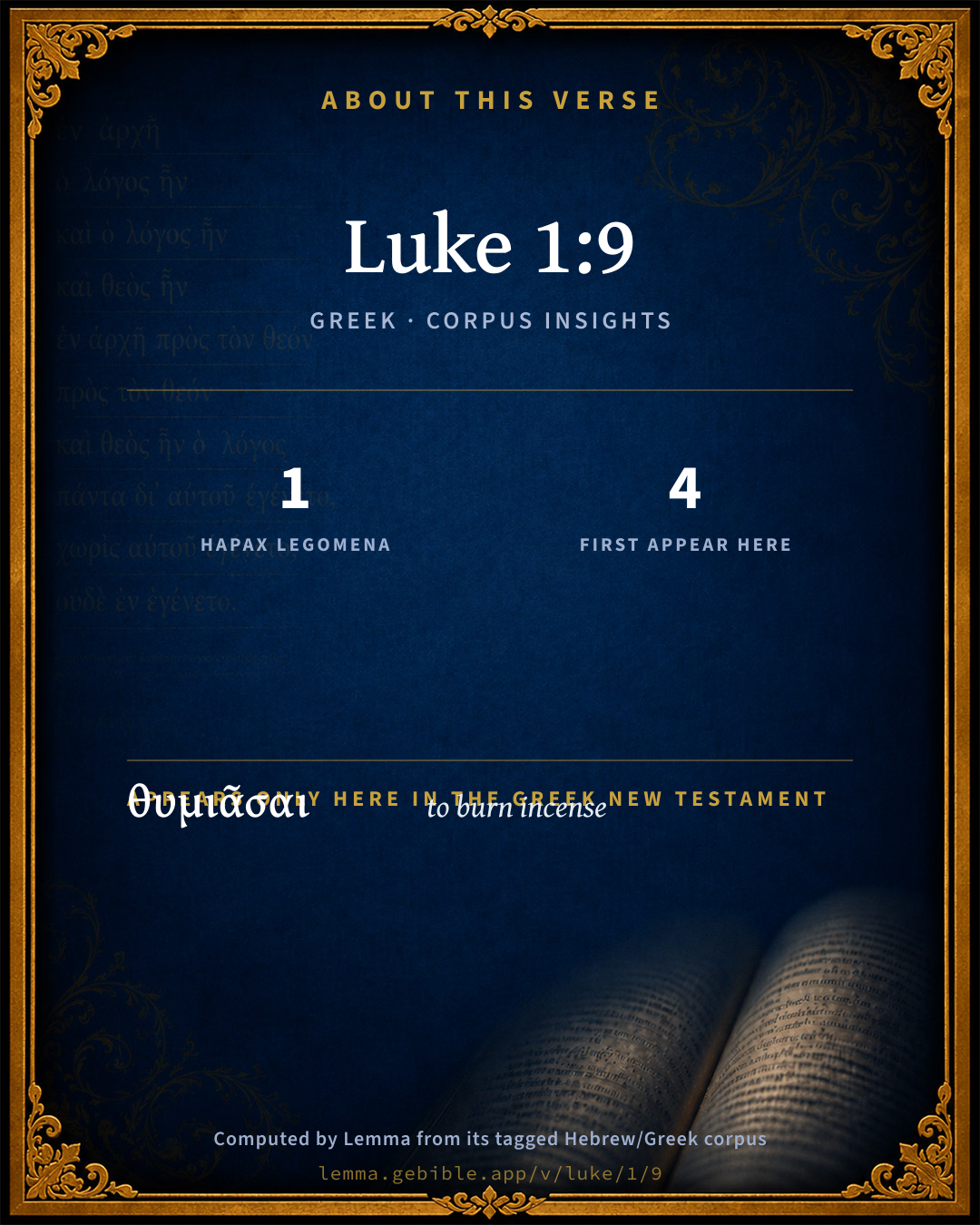
Luke 1:9

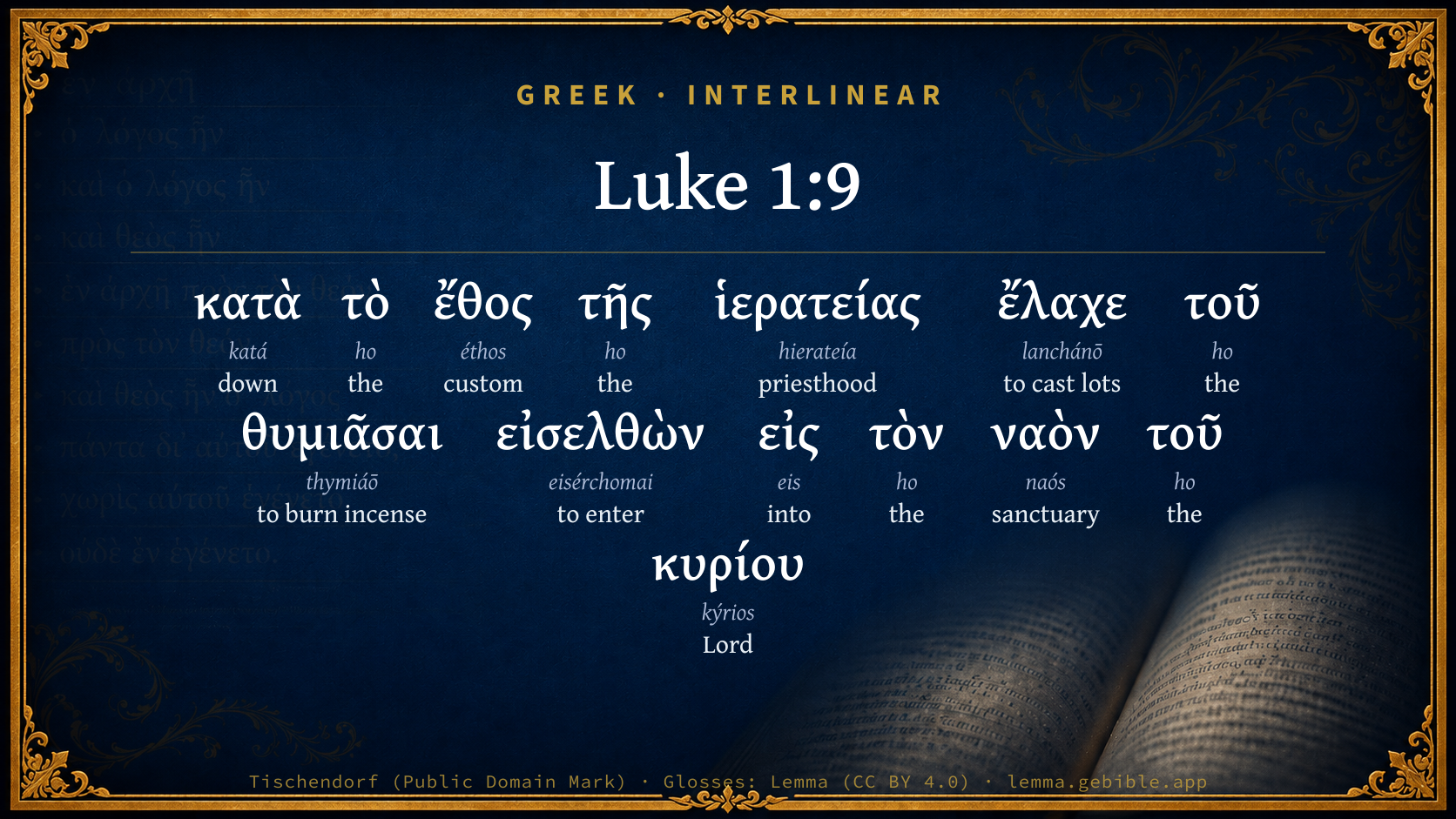
Greek (Tischendorf 8th ed.) Luke 1:9 appears in the Greek New Testament. The text above is from the Tischendorf 8th edition. Each word links to its Strong’s number and a concise gloss. Click any word for its full Thayer’s Greek Lexicon entry.
Download image
Cite this verse

Luke 1:9 (World English Bible). Public Domain. Lemma interlinear Bible study tool, https://lemma.gebible.app/v/luke/1/9.

Show BibTeX & RIS
BibTeX
RIS
English Translation
according to the custom of the priest's office, his lot was to enter into the temple of the Lord and burn incense.
World English Bible · Public Domain
Highlights
  • 1 hapax legomenon — only here in the Greek New Testament
  • 4 first appearances in the Greek New Testament
Full analysis ↓
Download a study sheet

One document with this verse’s original text, its word-by-word gloss line, the meaning frame, cross-references with their text, attributed commentary, and full source and license credits — printable, and it pastes into notes with its structure intact.

This verse Autodidact and up

Study sheet (.html) Plain text (.txt)

A passage Seminary Student

Up to 50 verses in one chapter. A passage sheet keeps up to 6 commentary sources and 12 cross-references per verse, in the order this page ranks them, and says so on the sheet whenever that leaves anything out. Ask for a single verse and you get the Autodidact verse sheet above.

Everything on this page stays free to read, with no account — the sheet is a download of what is already on screen, not access to it.

Want to remove ads? Support Godless Engineer
Compare translations 3

The same verse in 3 English versions, stacked beneath the original-language interlinear above. Click any original word for its lexicon entry.

Each is an independent rendering of the whole verse — the interlinear is not word-aligned to these translations.

Highlighted words mark where these versions differ — a whole-verse word diff, not a word-by-word alignment.

  • World English Bible Public Domain
    according to the custom of the priest's office, his lot was to enter into the temple of the Lord and burn incense.
  • King James Version Public Domain
    According to the custom of the priest's office, his lot was to burn incense when he went into the temple of the Lord.
  • unfoldingWord Literal Text CC BY-SA 4.0
    according to the custom of the priesthood, he came up by lot to enter into the temple of the Lord to burn incense.

unfoldingWord Literal Text — © unfoldingWord, licensed CC BY-SA 4.0. Word-aligned USFM3 via Door43 (git.door43.org/unfoldingWord/en_ult).

Versions to compare (up to 4)

3 of 4 selected

Show all 19 translations

Every available English version of this verse, each an independent rendering of the whole verse.

  • World English Bible Public Domain
    according to the custom of the priest's office, his lot was to enter into the temple of the Lord and burn incense.
  • Berean Standard Bible Public Domain
    he was chosen by lot, according to the custom of the priesthood, to enter the temple of the Lord and burn incense.
  • Majority Standard Bible Public Domain
    he was chosen by lot, according to the custom of the priesthood, to enter the temple of the Lord and burn incense.
  • King James Version Public Domain
    According to the custom of the priest's office, his lot was to burn incense when he went into the temple of the Lord.
  • American Standard Version (1901) Public Domain
    according to the custom of the priest's office, his lot was to enter into the temple of the Lord and burn incense.
  • Revised Version (1885) Public Domain
    according to the custom of the priest’s office, his lot was to enter into the temple of the Lord and burn incense.
  • Geneva Bible (1599) Public Domain
    According to the custome of the Priests office, his lot was to burne incense, when he went into the Temple of the Lord.
  • Douay-Rheims (1899) Public Domain
    According to the custom of the priestly office, it was his lot to offer incense, going into the temple of the Lord.
  • Young's Literal Translation Public Domain
    according to the custom of the priesthood, his lot was to make perfume, having gone into the sanctuary of the Lord,
  • Literal Standard Version CC BY-SA 4.0
    according to the custom of the priesthood, his lot was to make incense, having gone into the temple of the LORD,
  • Unlocked Literal Bible CC BY-SA 4.0
    According to the customary way of choosing which priest would serve, he had been chosen by lot to enter into the temple of the Lord to burn incense.
  • unfoldingWord Literal Text CC BY-SA 4.0
    according to the custom of the priesthood, he came up by lot to enter into the temple of the Lord to burn incense.
  • Darby Bible Public Domain
    it fell to him by lot, according to the custom of the priesthood, to enter into the temple of the Lord to burn incense.
  • World Messianic Bible Public Domain
    according to the custom of the priest’s office, his lot was to enter into the temple of the Lord and burn incense.
  • Webster's Bible Public Domain
    According to the custom of the priests' office, his lot was to burn incense when he went into the temple of the Lord.
  • Free Bible Version CC BY-SA 4.0
    he was chosen by lot according to priestly custom to enter the Temple of the Lord and burn incense.
  • Bible in Basic English Public Domain
    And as was the way of the priests, he had to go into the Temple to see to the burning of perfumes.
  • Text-Critical English NT CC BY 4.0
    he was chosen by lot, according to the custom of the priesthood, to enter the temple of the Lord and burn incense.
  • Tyndale New Testament (1534) Public Domain
    (accordinge to the custome of the prestes office) his lot was to bourne incence. And went into the temple of the Lorde

Literal Standard Version (2020), Covenant Press — licensed CC BY-SA 4.0. Text via the HelloAO Bible API (eBible.org). Unlocked Literal Bible (unfoldingWord) — licensed CC BY-SA 4.0. Text via the HelloAO Bible API (eBible.org). unfoldingWord Literal Text — © unfoldingWord, licensed CC BY-SA 4.0. Word-aligned USFM3 via Door43 (git.door43.org/unfoldingWord/en_ult). Free Bible Version, Dr. Jonathan Gallagher — licensed CC BY-SA 4.0. Text via the HelloAO Bible API (eBible.org).

Word by word

More ways to search: Search by grammar → Find every occurrence → Compare this word →

Practice this passage: Drill this verse → Learn its vocabulary →

θυμιᾶσαι
thymiáō
G2370
“to burn incense”
Verb, Aorist, Active, Infinitive
Part of Speech
Verb
Tense
Aorist
Voice
Active
Mood
Infinitive
Full Thayer's Definition

Origin: from a derivative of G2380 (in the sense of smoking)

TDNT: None

1. to burn incense
  1. κατὰ katá G2596 “down” Preposition
  2. τὸ ho G3588 “the” Article, Accusative, Singular, Neuter
  3. ἔθος éthos G1485 “custom” Noun, Accusative, Singular, Neuter
  4. τῆς ho G3588 “the” Article, Genitive, Singular, Feminine
  5. ἱερατείας hierateía G2405 “priesthood” Noun, Genitive, Singular, Feminine
  6. ἔλαχε lanchánō G2975 “to cast lots” Verb, Aorist, Active, Indicative, 3rd person, Singular
  7. τοῦ ho G3588 “the” Article, Genitive, Singular, Neuter
  8. εἰσελθὼν eisérchomai G1525 “to enter” Verb, Aorist, Active, Participle, Nominative, Singular, Masculine
  9. εἰς eis G1519 “into” Preposition
  10. τὸν ho G3588 “the” Article, Accusative, Singular, Masculine
  11. ναὸν naós G3485 “sanctuary” Noun, Accusative, Singular, Masculine
  12. τοῦ ho G3588 “the” Article, Genitive, Singular, Masculine
  13. κυρίου kýrios G2962 “Lord” Noun, Genitive, Singular, Masculine

About this verse

These counts appear in no published source. They are computed here, from the morphology-tagged text and Lemma’s own curated glosses. What Lemma adds →

14
words
10
distinct lemmas
Gospels
section

Notable vocabulary

1 hapax legomenon — a word that appears only here in the entire Greek New Testament:

  • θυμιᾶσαι to burn incense G2370

First appearance in Scripture

These words make their first canonical appearance in the Greek New Testament here:

  • ἔθος custom G1485
  • ἱερατείας priesthood G2405
  • ἔλαχε to cast lots G2975
  • θυμιᾶσαι to burn incense G2370

Shared distinctive vocabulary

ἱερατείας priesthood G2405 occurs in 2 verses of the Greek New Testament. Also found in:

Repetition

A word recurs within this verse:

Cross-references

8

Topical passages linked to Luke 1:9 in the Treasury of Scripture Knowledge — connected by theme and wording, ordered by reader-vote popularity; previews shown in the World English Bible.

  • 2 Chronicles 29:11 My sons, don't be negligent now; for Yahweh has chosen you to stand before him, to minister to him, and that you should be his ministers, and burn incense.
  • Exodus 30:7–8 Aaron shall burn incense of sweet spices on it every morning. When he tends the lamps, he shall burn it.
  • 1 Chronicles 23:13 The sons of Amram: Aaron and Moses; and Aaron was separated, that he should sanctify the most holy things, he and his sons, forever, to burn incense before Yahweh, to minister to him, and to bless in his name, forever.
  • Numbers 16:40 to be a memorial to the children of Israel, to the end that no stranger, who isn't of the seed of Aaron, comes near to burn incense before Yahweh; that he not be as Korah, and as his company: as Yahweh spoke to him by Moses.
  • 1 Samuel 2:28 and did I choose him out of all the tribes of Israel to be my priest, to go up to my altar, to burn incense, to wear an ephod before me? and did I give to the house of your father all the offerings of the children of Israel made by fire?
  • 2 Chronicles 26:16 But when he was strong, his heart was lifted up, so that he did corruptly, and he trespassed against Yahweh his God; for he went into the temple of Yahweh to burn incense on the altar of incense.
  • Hebrews 9:6 Now these things having been thus prepared, the priests go in continually into the first tabernacle, accomplishing the services,
  • 1 Chronicles 6:49 But Aaron and his sons offered on the altar of burnt offering, and on the altar of incense, for all the work of the most holy place, and to make atonement for Israel, according to all that Moses the servant of God had commanded.

Cross-references courtesy of OpenBible.info (CC BY 4.0).

Commentary

Notes on Luke 1:9 from classic Christian and Jewish commentators (each source and its license shown beneath its notes). The classic Christian expositions comment on the surrounding passage and are grouped to its opening verse, so a note may address several verses; the Jewish commentaries on the Tanakh (Rashi and others) are per-verse, so they appear only where the commentator wrote on this verse.

Lemma curates 59 commentaries, every one of them public domain or Creative Commons licensed, each selected and text-cleaned for this edition rather than reprinted as found. About our sources →

Joseph Benson's Commentary

Luk 1:9. His lot was to burn incense — “Because some parts of the sacred service were more honourable than others, both the priests and Levites divided the whole among them by lot. The Jews tell us, that there were three priests employed about the service of the incense; one who carried away the ashes left on the altar at the preceding service; another who brought a pan of burning coals from the altar of sacrifice, and, having placed it on the golden altar, departed; a third, who went in with the incense, sprinkled it on the burning coals, and, while the smoke ascended, made intercession for the people. This was the part that fell to Zacharias, and the most honourable in the whole service.” — Macknight. When he went into the temple of the Lord — As the original word here is not το ιερον, but τον ναον, it ought to have been rendered, the house, or sanctuary. The former word, properly signifying the temple, comprehended the whole edifice, with all its enclosures, piazzas, and other buildings; the latter included only what is termed, by way of eminence, the house, consisting of the vestibule, the holy place or sanctuary, and the most holy. The altar of incense, on which the perfumes were burned, was in the sanctuary; the people who were praying without, were in the temple, εν το ιερω, in the court of Israel, though not in what was strictly called the house of God. See note on Mat 21:12.

Joseph Benson's Commentary on the Old and New Testaments (1811–1818) — public domain. Text from a community e-Sword module.

Bengel's Gnomon

Johann Albrecht Bengel

Luk 1:9. Ἔλαχε, he was allotted the office) The functions of the priests were distributed by lot.[5]—τοῦ θυμιάσαι, of burning incense) Exo 30:1, etc.

[5] This was so, according to S. R. D. Crusius, Hypomn. P. I., p. 41, partly for the sake of order, partly to avoid contentions. Comp. 1Ch 24:4-5.—E. B.

Bengel's Gnomon of the New Testament — English translation (T&T Clark, Edinburgh, 1860) — public domain. Text from a community e-Sword module.

Expositor's Greek Testament

ed. W. Robertson Nicoll

Luk 1:9 . κατὰ τὸ ἔθος is to be connected with ἔλαχε : casting lots, the customary manner of settling who was to have the honour. εἰσελθὼν is to be connected with θυμιάσαι , not with ἔλαχε . The meaning is that entering the sanctuary was the necessary preliminary to offering incense: in one sense a superfluous remark (Hahn), yet worth making in view of the sacredness of the place. A great affair to get entrance into the ναός .

The Expositor's Greek Testament, edited by W. Robertson Nicoll (1897–1910) — public domain. Text from a community e-Sword module.

Geneva Bible (1599)

Geneva Bible translators

The Temple was one, and the Court another, for Zacharias went out of the Court or outward room, where all the people were, and therefore are said to be without, into the temple.

Geneva Bible (1599) marginal notes — public domain. Text via Bolls.life.

Jamieson, Fausset & Brown

Robert Jamieson, A. R. Fausset & David Brown

his lot was to burn incense--The part assigned to each priest in his week of service was decided by lot. Three were employed at the offering of incense--to remove the ashes of the former service; to bring in and place on the golden altar the pan filled with hot burning coals taken from the altar of burnt offering; and to sprinkle the incense on the hot coals; and, while the smoke of it ascended, to make intercession for the people. This was the most distinguished part of the service (Rev 8:3), and this was what fell to the lot of Zacharias at this time [LIGHTFOOT].

Jamieson, Fausset & Brown — Commentary Critical and Explanatory on the Whole Bible (1871) — public domain (CC PDM 1.0). Text via the HelloAO Bible API.

Adam Clarke's Commentary

Verse 9. His lot was, &c.] We are informed in the Talmud, that it was the custom of the priests to divide the different functions of the sacerdotal office among themselves by lot: and, in this case, the decision of the lot was, that Zacharias should at that time burn the incense before the Lord, in the holy place.

Adam Clarke's Commentary on the Bible (1810–1826) — public domain. Text from a community e-Sword/MySword module.

Ellicott's Commentary for English Readers

(9)His lot was to burn incense.—The order of the courses was, as has been said, one of rotation. The distribution of functions during the week was determined by lot. That of offering incense, symbolising, as it did, the priestly work of presenting the prayers of the people, and joining his own with them (Psa_141:2; Rev_5:8), was of all priestly acts the most distinctive (2Ch_26:18). At such a moment all the hopes of one who looked for the Christ as the consolation of Israel would gather themselves into one great intercession.

Into the temple of the Lord—i.e., the Holy Place, into which none but the priests might enter.

A Bible Commentary for English Readers, edited by Charles John Ellicott (1878–1897) — public domain. Text from a community e-Sword module.

The Cambridge Bible for Schools and Colleges

gen. ed. J. J. S. Perowne

9. his lot was to burn incense] Rather, he obtained by lot the duty of entering and burning incense. This was the loftiest and most coveted of priestly functions, Exo_30:1-10; Num_16:1-40. King Uzziah was smitten with leprosy for trying to usurp it (2Ch_26:18). Incense was a symbol of prayer (Psa_141:2; Heb_9:4; Rev_8:3-4), and Philo tells us that it was offered twice a day,—before the morning and after the evening sacrifice of a lamb.

into the temple] Rather, shrine or Holy Place. The golden altar of incense stood before the veil which separated the Holy Place from the Holy of Holies (Exo_30:6). The priest entered in white robes and with unsandalled feet with two attendants who retired when they had made everything ready. The people waited outside in the Court of Israel praying in deep silence till the priest who was sacrificing the evening lamb at the great altar of Burnt Offering in the Court gave a signal to his colleague in the shrine, perhaps by the tinkling of a bell (Exo_30:1-10; Psa_141:2; Mal_1:11). He then threw the incense on the fire of the golden altar, and its fragrant smoke rose with the prayers of the people. It was while performing this solemn function that John Hyrcanus also had received a divine intimation (Jos. Antt. xiii. 103).

The Cambridge Bible for Schools and Colleges (gen. ed. J. J. S. Perowne; Cambridge University Press, 1878–1918) — public domain. Text from a community e-Sword module.

John Gill's Exposition

According to the custom of the priest's office,.... In which, every man took his part in the execution of it by lot; and which was not an original settled law of God; but a custom, which, in process of time, through the number of the priests, took place, and prevailed: the occasion of it was this,

"at first, whoever would, might sweep the altar, or cleanse it----it happened that two alike ran, and came up to the ascent of the altar, and one thrust down the other, and he fell, and his leg was broke; and when the sanhedrim saw that they came into danger, they ordered that they should not cleanse the altar, but by lot (d).

And so likewise all other sorts of service were settled by lot:

his lot was to burn incense, when he went into the temple of the Lord; where was the altar of incense, and which was burnt upon it morning and evening; see Exo 30:1, and was typical of the continual intercession of Jesus Christ; and this part of service was assigned him by lot. The priests used to cast lots, what part they should take in the service of the temple, in the order of the course, to which they belonged (e),

"There were four lots there, and this was the first lot (i.e. to cleanse the altar); the second lot was, who should slay (the sacrifice,) who should sprinkle (the blood), who should remove the ashes from the innermost altar, who should cleanse the candlestick, who should bring the members (or parts of the sacrifice) to the ascent of the altar----the third lot was, ye new ones, to the incense come, and "cast lots"; and the fourth, ye new ones, with the old ones, who shall bring up the parts from the ascent of the altar to the altar.

And this was not only the case on the day of atonement, to which these rules belong; but every day in the daily service and sacrifice, when the same rules were observed, as appears from the rubric of the daily sacrifice: (f).

"the president said unto them (the priests), come and cast lots who shall slay, who shall sprinkle, who shall remove the ashes from the innermost altar, who shall remove the ashes from the candlestick, who shall bring up the parts to the ascent of the altar, &c.

Again, (g),

"he says to them, O ye new ones, to the incense come, and cast lots; and they cast lots, and he is worthy, whom he accounts worthy--and he that is accounted worthy of the incense, takes a vessel, and the vessel is like to a large golden bushel, that holds three kabs, and a bowl in the middle of it, full and heaped up with incense, with a cover, and a sort of a linen cloth put over it.

And it is afterwards said (h),

"he that is worthy of the incense, takes the bowl out of the vessel, and gives it to his friend, or he that is near to him; and if it is scattered from it, in the midst of it, he puts it into his fist; and they teach him, "saying", take care that thou dost not begin before thy face, that thou art not burnt: when he begins, he spreads it and goes out; and he that burns incense, may not do it, until the president says, burn incense.

The account Maimonides gives (i) of this matter, is as follows,

"all the services that they do every day, they do, by lot; and how do they do it? All the priests of the houses of the fathers, of the day, go into the paved chamber, after the pillar of the morning has ascended, and clothe themselves with the priestly garments; and the president who is over the lots is with them, and they stand in a circle; and the president takes a mitre from off the head of one of them, and goes round with it, and the man from whom he begins to number, and they cast lots, as has been explained----how do they cast lots? they stand in a circle, and agree upon a number, eighty, a hundred, or a thousand, or whatsoever number they may agree upon; and the president says to them, put out your fingers, and they put out their fingers, one, or two; and if one puts out three, they number him three; and they do not put out the thumb in the sanctuary, because of deceivers; for the thumb is short, and easy to be put out, and to bend; and he that puts out the thumb, they do not number for him: and the president begins to number from the man that is known, whose mitre he took off first, and he numbers by their fingers, and returns in the round, until he has perfected the number they agreed upon; and the man that completes the number with his finger, he is he that goes out by the first lot to service: and why does he number the number they agree upon, by their fingers that they put out, and does not number them by the men themselves? Because it is forbidden to number Israel, but by means of another thing; as it is said, Sa1 15:4 "And numbered them in Telaim". There were four lots they cast every day in the morning; the first lot; was, who should cleanse the altar: they cast lots, and he was worthy that was accounted worthy to cleanse it; and he sets the row in order, and brings up the two pieces of wood to the altar, and he brings in the censer full of fire, from the outer altar, to the golden altar, to burn incense upon it: and the second lot, thirteen were worthy of it, according to the order of their standing; how? the president says to them, put out your fingers, and he numbers in the way that has been explained; and he that goes out by the first lot, is he that slays the daily sacrifice of the morning; and the second that stands by his side, is he that receives the blood of the daily sacrifice, and sprinkles it; and the third that is next to the second, receives the ashes from the innermost altar, which is the altar of incense; and the fourth, that is by his side, cleanses the candlestick, and trims the lamps; and the fifth brings up the head of the daily sacrifice, and its leg to the ascent of the altar: and the sixth brings up the two shoulders; and the seventh brings up the extreme part of the backbone, and the other leg; and the eighth brings up the breast and the gullet; and the ninth brings up the two sides; and the tenth brings up the inwards; and the eleventh brings up the fine flour, and the drink offerings; and the twelfth brings up the things that were fried; and the thirteenth brings up the wine of the drink offerings: the third lot, the president says to them, "even" to all the men of the house of the father of that day, whoever has never burnt incense, let him come and "cast lots"; and they gather together to the president, and cast lots; and he that goes out by the lot first, he is he that is worthy to burn incense; the fourth lot, they all gather together, and cast lots to know who shall bring up the parts from the ascent of the altar, to the altar; they cast lots, and he is worthy who is accounted worthy: the daily evening sacrifice, they do not cast another lot for it; but every priest that is worthy of any service of the services of the morning, is worthy of the evening, except that of the incense; for they cast another lot for that in the evening; and every one may come, who has never burnt incense of the men of that house of the fathers, and cast lots for it; but if they have all of them burnt incense already, they all of them cast lots, in the morning, at the third lot; and he that is worthy of it in the morning, burns incense in the evening.

Hence it appears, that the burning of incense, as other parts of the priest's service, was by lot; and that they were new priests, or such who had never burnt incense, that cast lots for it: for it is a tradition (k), that no man ever burnt incense twice; the reason assigned for it is, because it makes a man rich; and therefore that every one might partake of the blessing in their turns, new ones were called unto it: whether Zacharias had ever burnt incense before, and whether he now did it in the morning or evening, is not certain,

(d) Misn. Yoma, c. 2. sect. 1, 2. (e) Ib. sect. 2, 3, 4. (f) Misn. Tamid. c. 3. sect. 1. (g) Ib. c. 5. sect. 2. 4. (h) Misn. Tamid. c. 6. sect. 3. (i) Hilchot Tamidin, c. 4. sect. 1, 2, 3, 4, 5, 6, 7. Vid. T. Bab. Yoma, fol. 25. 1. & Gloss in fol. 22. 1. & Maimon. & Bartenora in Misn. Yoma, c. 2. sect. 1. (k) T. Bab. Yoma, fol. 26. 1.

John Gill's Exposition of the Whole Bible (1746–1763) — public domain (CC PDM 1.0). Text via the HelloAO Bible API.

Trapp's Complete Commentary

John Trapp

9 According to the custom of the priest’s office, his lot was to burn incense when he went into the temple of the Lord.

Ver. 9. To burn incense] In the incense of prayer, how many sweet spices are burned together, by the fire of faith, as humility, love, &c.

John Trapp, A Commentary or Exposition upon All the Books of the Old and New Testament (1647–1656) — public domain. Text from a community e-Sword module.

Albert Barnes' Notes on the Bible

According to the custom of the priest’s office, his lot was. - The Jewish writers inform us that it was customary for the priests to divide their daily task by “lot.”

To burn incense - Incense is an aromatic or white rosin procured from trees, chiefly in Arabia. It is obtained by making incisions in the tree, and the gum flows out. It is distinguished for an especially pleasant “smell” when burned, and was therefore used in ancient worship. It was burned by the priest twice a day Exo 30:7, and it seems to have been emblematic of prayer and praise, or of the grateful offerings of the heart wafted toward heaven. The incense used in the temple was made of stacte, onycha, and galbanum Exo 30:34, with pure frankincense, and it was not lawful for this compound to be used elsewhere than in the house of God.

Into the temple - See the notes at Mat 21:12. The part of the temple where incense was burned was the “holy place.”

Albert Barnes' Notes on the Bible (1834–1885) — public domain. Text from a community e-Sword/MySword module.

Haydock's Catholic Bible Commentary

It was his lot. The priests drew lots for the different functions to be performed in the same week; and now it fell by lot to Zacharias, to burn or offer up incense, morning and evening, in that part of the temple called the holy, where was the altar of incense: Zacharias was in this part of the tabernacle. (Witham) --- See Exodus xxx. 6, 8.

George Leo Haydock (1774–1849), Haydock's Catholic Family Bible and Commentary, 1859 edition — public domain. Excludes Psalms (Douay-Rheims chapter numbering differs from Protestant) and Deuterocanonical books (Catholic canon only).

Whedon's Commentary on the Bible

Daniel D. Whedon

9. To burn the incense—The composition of the sacred incense for the altar (which the Jews were forbidden to make for private use) is given in Exo_30:34-38. It was in the performance of the service placed in a vase or cup, called the censer, upon the Golden Altar in the Holy Place, with burning coals beneath, producing by its smoke a powerful perfume, filling the Temple with its fragrance. As it was within the MOST HOLY, on the Sacred Ark, between the Cherubim, that God the King of Israel dwelt, whose house the Temple was, so the bread, the candlestick, and the incense were all, symbolically, furnishings for him.

Some have incorrectly supposed that Zacharias was High Priest. But that pontiff’s duty was to enter the MOST HOLY once a year to make expiation for the people; namely, on the great day of atonement.

Daniel D. Whedon (gen. ed.), Commentary on the Old and New Testaments (1874–1909) — public domain. Text from a community e-Sword module.

The Pulpit Commentary

His lot was to burn incense; more accurately, he obtained by lot the duty of entering and offering incense. The office of burning incense gave the priest to whom this important lot fell the right of entering the holy place. It was the most coveted of all the priestly duties. The Talmud says the priest who obtained the right to perform this high duty was not permitted to draw the lot a second time in the same week, and as the whole number of priests at this time was very large some say even as many as twenty thousand Farrar conjectures that it would never happen to the same priest twice in his lifetime to enter that sacred spot.

The Pulpit Commentary (1880–1919), ed. H.D.M. Spence-Jones & Joseph S. Exell — public domain. Text from a community e-Sword module.

The People's New Testament

B. W. Johnson

9. His lot was to enter into the temple. In the service of the sanctuary nothing was left to accident or to human arrangement. The lot determined who was to perform each separate portion of the sacred service, and especially who was each morning and evening to burn incense before the Lord. To burn incense. Burned on the altar of incense in the Holy Place morning and evening. To burn the incense was an office held so honorable that no one was allowed to perform it twice, since it brought the offering priest nearer the divine presence in the Holy of Holies than any other priestly act, and carried with it the richest blessing from on high, which all ought to have a chance of thus obtaining.

B. W. Johnson's The People's New Testament with Notes (1889–1891) — public domain. Electronic text from the Christian Classics Ethereal Library (CCEL) ThML edition.

Cambridge Greek Testament for Schools and Colleges

9. ἱερατείας. The word is used by Aristotle, and in Heb 7:5, but the more common and classic form is ἱερωσύνης.

ἔλαχε τοῦ θυμιᾶσαι. ‘He obtained by lot the duty of (entering and) burning incense.’ This was the loftiest and most coveted of priestly functions, Exo 30:1-10; Num 16:1-40; Deu 33:10. King Uzziah was smitten with leprosy for trying to usurp it (2Ch 26:18). Incense was a symbol of prayer (Psa 141:2; Heb 9:4; Rev 8:3-4), and Philo tells us that it was offered twice a day,—before the morning and after the evening sacrifice of a lamb. Incense was believed to atone, and the silent smoke of incense atoned for secret slander, T. B. Yoma, f. 44. 1; Wis 18:21; Sir 45:16. The ordinary construction after ἐγένετο would have been καὶ ἔλαχε as in Luk 5:1; Luk 5:12, Luk 9:51, &c., but St Luke more often omits the καί. The ἐγένετο is really pleonastic. Winer, E. T. p. 760. The τοῦ θυμιᾶσαι is governed by λαγχάνω as in ἔλαχε τοῦ βασιλεύειν. The word “custom” refers to the casting lots every day to see which priest was to burn the incense. The method of drawing lots is described in Yoma, f. 39. 1. Λαγχάνω may also be followed by the accusative as in Act 1:17; 2Pe 1:1. It was probably the morning offering at which Zacharias officiated.

εἰς τὸν ναόν. ‘Into the shrine or Holy Place.’ The golden altar of incense stood before the veil which separated the Holy Place from the Holy of Holies (Exo 30:6). The priest entered in white robes and with unsandalled feet with two attendants, who retired when they had made everything ready. The people waited outside in the Court of Israel praying in deep silence till the priest who was sacrificing the evening lamb at the great altar of Burnt Offering in the Court gave a signal to his colleague in the shrine, perhaps by the tinkling of a bell (Exo 30:1-10; Psa 141:2; Mal 1:11). He then threw the incense on the fire of the golden altar, and its fragrant smoke rose with the prayers of the people. It was while performing this solemn function that John Hyrcanus also had received a divine intimation (Jos. Antt. XIII. 103). The word εἰσελθὼν means strictly that the lot had fallen to him after entering the Sanctuary; but the meaning is that the lot gave him the right “to enter and to burn the incense” (as it is rendered in the R. V[28]). The participle must be taken in close connection with the infinitive. Winer, p. 443.

[28] R. V. Revised Version.

Cambridge Greek Testament for Schools and Colleges (Cambridge University Press, 1896; 21 vols, various authors incl. Carr, Maclear, Plummer, Farrar, Lumby, Moule, M. R. James, Simcox) — public domain. Text from a community e-Sword module.

Vincent's Word Studies in the New Testament

Marvin R. Vincent

His lot was [ελαχε] . Four lots were drawn to determine the order of the ministry of the day : the first, before daybreak, to designate the priests who were to cleanse the altar and prepare its fires; the second for the priest who was to offer the sacrifice and cleanse the candlestick and the altar of incense; the third for the priest who should burn incense; and the fourth appointing those who were to lay the sacrifice and meat offering on the altar, and pour out the drink offering. There are said to have been twenty thousand priests in Christ 's time, so that no priest would ever offer incense more than once.

Temple [ναον] . The sanctuary. See on Mt 4:5.

Burn incense [θυμιασαι] . Only here in New Testament. The incensing priest and his assistans went first to the altar of burnt offering, and filled a golden censer with incense, and placed burning coals from the altar in a golden bowl. As they passed into the court from the Holy Place they struck a large instrument called the Magrephah, which summoned all the ministers to their places. Ascending the steps to the holy place, the priests spread the coals on the golden altar, and arranged the incense, and the chief officiating priest was then left alone within the Holy Place to await the signal of the president to burn the incense. It was probably at this time that the angel appeared to Zacharias. When the signal was given, the whole multitude withdrew from the inner court, and fell down before the Lord. Silence pervaded the temple, while within, the clouds of incense rose up before Jehovah. (For a more detailed account see Edersheim, "The Temple, its Ministry," etc.).

Marvin R. Vincent, Word Studies in the New Testament (1887–1900) — public domain. Text from a community e-Sword/MySword module.

Lesson kit

Teaching starters — assembled from the data on this page, not authored interpretation. Every prompt links to the verse data it draws on. Edit before teaching.

Luke, in the Gospels, opens this verse with 14 words (10 distinct Greek lemmas). Its most distinctive word is thymiáō (“to burn incense”). A historical commentator’s framing appears above. Read the whole chapter for the surrounding context.

Discussion questions

  1. The word thymiáō carries the sense “to burn incense.” How does it shape the verse?
  2. 1 word here appears nowhere else in the Greek New Testament. Why might the author reach for such rare wording?
  3. 4 words make their first appearance in Scripture here. What does this debut establish?
  4. How does Hebrews 7:5, which shares the word «priesthood», read alongside this verse?
  5. What does the repetition of “the” (5× in this one verse) do in this verse?
  6. These translations render this verse differently; the difference is in the English rendering, not the original. What questions does that raise?
  7. Compare how Joseph Benson's Commentary and Bengel's Gnomon read this verse. Where do they agree or differ?

Things to notice

  • 1 word in this verse appears nowhere else in the Greek New Testament.
  • 4 words make their first canonical appearance in Scripture here.
  • These translations choose different wording for 8 words in this verse.
  • “the” occurs 5× in this single verse.
  • 10 distinct Greek lemmas span 14 words in this verse.

Reading settings

Reading text

Shown beneath each verse's original-language words.

Old Testament
Old Testament edition

Read the OT as the Masoretic Hebrew (MT) or the Greek Septuagint (LXX).

English shown for the Greek Septuagint (in the Hebrew ↔ Greek comparison).

Comparing translations? Open the Compare panel on any verse page to stack up to four side by side.