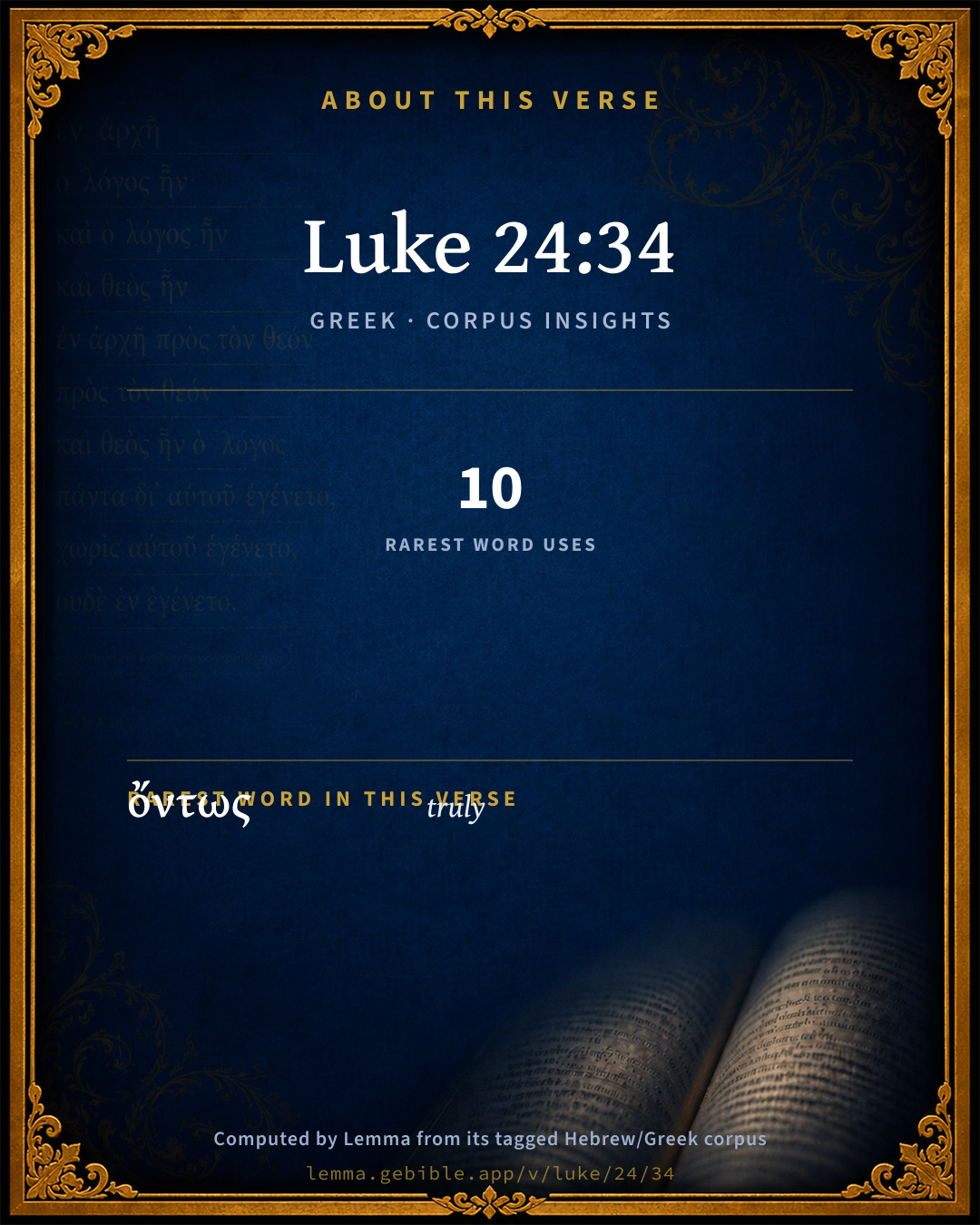
Luke 24:34

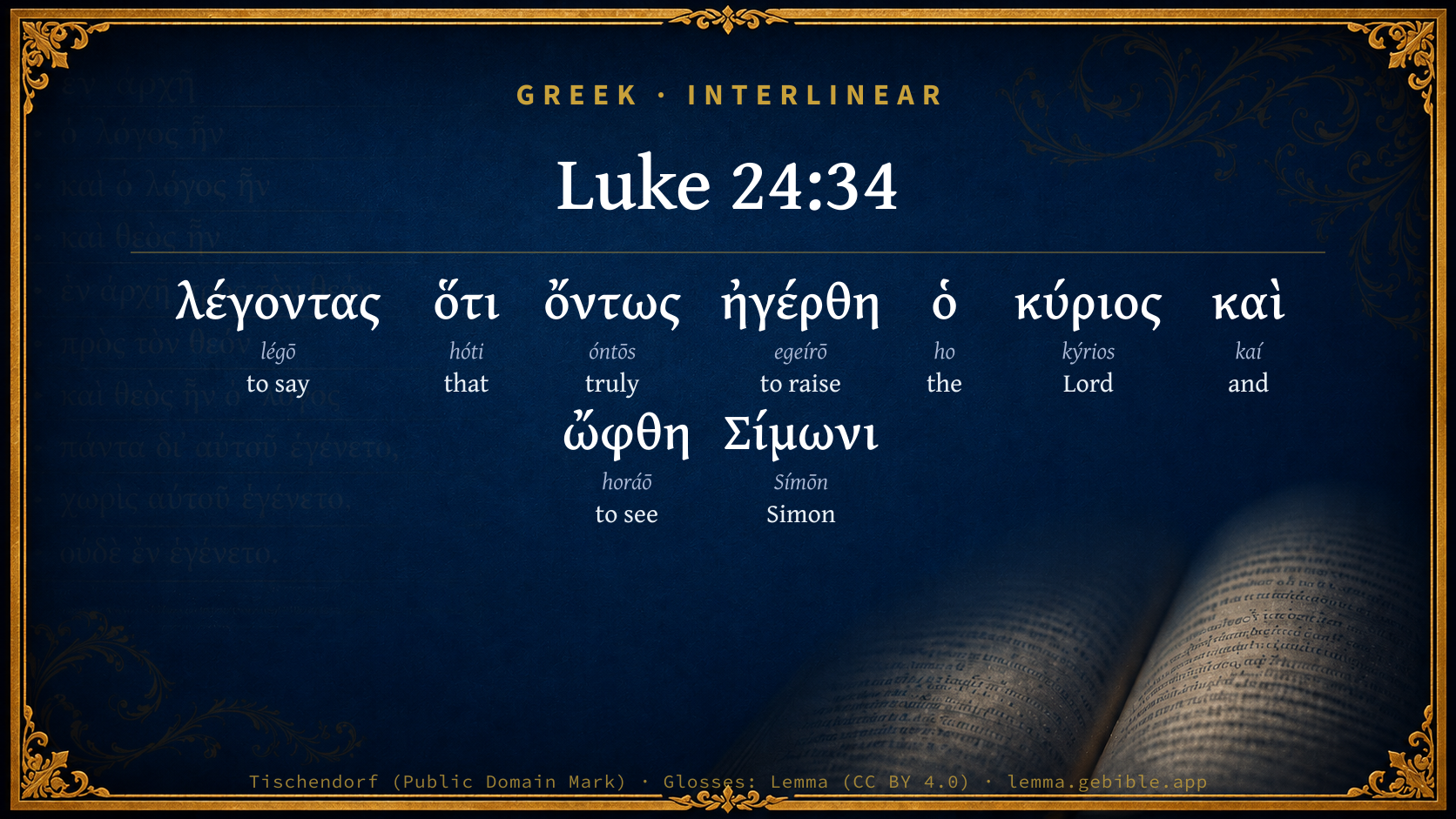
Greek (Tischendorf 8th ed.) Luke 24:34 appears in the Greek New Testament. The text above is from the Tischendorf 8th edition. Each word links to its Strong’s number and a concise gloss. Click any word for its full Thayer’s Greek Lexicon entry.
Download image
Cite this verse

Luke 24:34 (World English Bible). Public Domain. Lemma interlinear Bible study tool, https://lemma.gebible.app/v/luke/24/34.

Show BibTeX & RIS
BibTeX
RIS
English Translation
saying, "The Lord is risen indeed, and has appeared to Simon!"
World English Bible · Public Domain
Download a study sheet

One document with this verse’s original text, its word-by-word gloss line, the meaning frame, cross-references with their text, attributed commentary, and full source and license credits — printable, and it pastes into notes with its structure intact.

This verse Autodidact and up

Study sheet (.html) Plain text (.txt)

A passage Seminary Student

Up to 50 verses in one chapter. A passage sheet keeps up to 6 commentary sources and 12 cross-references per verse, in the order this page ranks them, and says so on the sheet whenever that leaves anything out. Ask for a single verse and you get the Autodidact verse sheet above.

Everything on this page stays free to read, with no account — the sheet is a download of what is already on screen, not access to it.

Want to remove ads? Support Godless Engineer
Compare translations 3

The same verse in 3 English versions, stacked beneath the original-language interlinear above. Click any original word for its lexicon entry.

Each is an independent rendering of the whole verse — the interlinear is not word-aligned to these translations.

Highlighted words mark where these versions differ — a whole-verse word diff, not a word-by-word alignment.

  • World English Bible Public Domain
    saying, "The Lord is risen indeed, and has appeared to Simon!"
  • King James Version Public Domain
    Saying, The Lord is risen indeed, and hath appeared to Simon.
  • unfoldingWord Literal Text CC BY-SA 4.0
    saying, “Truly the Lord has been raised, and he has been seen by Simon!”

unfoldingWord Literal Text — © unfoldingWord, licensed CC BY-SA 4.0. Word-aligned USFM3 via Door43 (git.door43.org/unfoldingWord/en_ult).

Versions to compare (up to 4)

3 of 4 selected

Show all 19 translations

Every available English version of this verse, each an independent rendering of the whole verse.

  • World English Bible Public Domain
    saying, "The Lord is risen indeed, and has appeared to Simon!"
  • Berean Standard Bible Public Domain
    and saying, “The Lord has indeed risen and has appeared to Simon!”
  • Majority Standard Bible Public Domain
    and saying, “The Lord has indeed risen and has appeared to Simon!”
  • King James Version Public Domain
    Saying, The Lord is risen indeed, and hath appeared to Simon.
  • American Standard Version (1901) Public Domain
    saying, The Lord is risen indeed, and hath appeared to Simon.
  • Revised Version (1885) Public Domain
    saying, The Lord is risen indeed, and hath appeared to Simon.
  • Geneva Bible (1599) Public Domain
    Which said, The Lord is risen in deede, and hath appeared to Simon.
  • Douay-Rheims (1899) Public Domain
    Saying: The Lord is risen indeed, and hath appeared to Simon.
  • Young's Literal Translation Public Domain
    saying -- `The Lord was raised indeed, and was seen by Simon;'
  • Literal Standard Version CC BY-SA 4.0
    saying, “The Lord was indeed raised, and was seen by Simon”;
  • Unlocked Literal Bible CC BY-SA 4.0
    saying, “The Lord is risen indeed, and has appeared to Simon.”
  • unfoldingWord Literal Text CC BY-SA 4.0
    saying, “Truly the Lord has been raised, and he has been seen by Simon!”
  • Darby Bible Public Domain
    saying, The Lord is indeed risen and has appeared to Simon.
  • World Messianic Bible Public Domain
    saying, “The Lord is risen indeed, and has appeared to Simon!”
  • Webster's Bible Public Domain
    Saying, The Lord is risen indeed, and hath appeared to Simon.
  • Free Bible Version CC BY-SA 4.0
    who said, “The Lord has really risen again! He has appeared to Simon.”
  • Bible in Basic English Public Domain
    And they said to them, The Lord has truly come back to life again, and Simon has seen him.
  • Text-Critical English NT CC BY 4.0
    saying, “The Lord is risen indeed and has appeared to Simon!”
  • Tyndale New Testament (1534) Public Domain
    which sayde: the Lorde is rysen in dede and hath apered to Simon.

Literal Standard Version (2020), Covenant Press — licensed CC BY-SA 4.0. Text via the HelloAO Bible API (eBible.org). Unlocked Literal Bible (unfoldingWord) — licensed CC BY-SA 4.0. Text via the HelloAO Bible API (eBible.org). unfoldingWord Literal Text — © unfoldingWord, licensed CC BY-SA 4.0. Word-aligned USFM3 via Door43 (git.door43.org/unfoldingWord/en_ult). Free Bible Version, Dr. Jonathan Gallagher — licensed CC BY-SA 4.0. Text via the HelloAO Bible API (eBible.org).

Word by word

More ways to search: Search by grammar → Find every occurrence → Compare this word →

Practice this passage: Drill this verse → Learn its vocabulary →

About this verse

These counts appear in no published source. They are computed here, from the morphology-tagged text and Lemma’s own curated glosses. What Lemma adds →

9
words
9
distinct lemmas
Gospels
section

Notable vocabulary

The rarest word here is ὄντως truly G3689 — appearing just 10 times in the whole Greek New Testament.

Shared distinctive vocabulary

ὄντως truly G3689 occurs in 10 verses of the Greek New Testament. Also found in:

Cross-references

3

Topical passages linked to Luke 24:34 in the Treasury of Scripture Knowledge — connected by theme and wording, ordered by reader-vote popularity; previews shown in the World English Bible.

  • 1 Corinthians 15:5 and that he appeared to Cephas, then to the twelve.
  • Mark 16:7 But go, tell his disciples and Peter, 'He goes before you into Galilee. There you will see him, as he said to you.'"
  • Luke 22:54–62 They seized him, and led him away, and brought him into the high priest's house. But Peter followed from a distance.

Cross-references courtesy of OpenBible.info (CC BY 4.0).

Commentary

Notes on Luke 24:34 from classic Christian and Jewish commentators (each source and its license shown beneath its notes). The classic Christian expositions comment on the surrounding passage and are grouped to its opening verse, so a note may address several verses; the Jewish commentaries on the Tanakh (Rashi and others) are per-verse, so they appear only where the commentator wrote on this verse.

Lemma curates 59 commentaries, every one of them public domain or Creative Commons licensed, each selected and text-cleaned for this edition rather than reprinted as found. About our sources →

MacLaren's Expositions of Holy Scripture

Alexander MacLaren

Luke

PETER ALONE WITH JESUS

Luk 24:34.

The other appearances of the risen Lord to individuals on the day of Resurrection are narrated with much particularity, and at considerable length. John gives us the lovely account of our Lord’s conversation with Mary Magdalene, Luke gives us in full detail the story of the interview with the two travellers on the road to Emmaus. Here is another appearance, known to ‘the eleven, and them that were with them’ on the Resurrection evening, and enumerated by Paul in his list of the appearances of the Lord, the account of which was the common gospel of himself and all the others, and yet deep silence is preserved in regard to it. No word escaped Peter’s lips as to what passed in the conversation between the denier and his Lord. That is very significant.

The other appearances of the risen Lord to individuals on the day of Resurrection suggest their own reasons. He appeared first to Mary Magdalene because she loved much. The love that made a timid woman brave, and the sorrow that filled her heart, to the exclusion of everything else, drew Jesus to her. The two on the road to Emmaus were puzzled, honest, painful seekers after truth. It was worth Christ’s while to spend hours of that day of Resurrection in clearing, questioning, and confirming sincere minds. Does not this other appearance explain itself? The brief spasm of cowardice and denial had changed into penitence when the Lord looked, and the bitter tears that fell were not only because of the denial, but because of the wound of that sharp arrow, the poisoned barb of which we are happy if we have not felt the thought-’He will never know how ashamed and miserable I am; and His last look was reproach, and I shall never see His face any more.’ To respond to, and to satisfy, love, to clear and to steady thought, to soothe the agony of a penitent, were worthy works for the risen Lord. I venture to think that such a record of the use of such a day bears historical truth on its very face, because it is so absolutely unlike what myth-making or hallucination, or the excited imagination of enthusiasts would have produced, if these had been the sources of the story of the Resurrection. But apart from that, I wish in this sermon to try to gather the suggestions that come to us from this interview, and from the silence which is observed concerning them.

With regard to-

I. The fact of the appearance itself.

We can only come into the position rightly to understand its precious significance, if we try to represent to ourselves the state of mind of the man to whom it was granted. I have already touched upon that; let me, in the briefest possible way, recapitulate. As I have said, the momentary impulse to the cowardly crime passed, and left a melted heart, true penitence, and profound sorrow. One sad day slowly wore away. Early on the next came the message which produced an effect on Peter so great, that the gospel, which in some sense is his gospel {I mean that ‘according to Mark’} alone contains the record of it-the message from the open grave: ‘Tell my disciples and Peter that I go before you into Galilee.’ There followed the sudden rush to the grave, when the feet made heavy by a heavy conscience were distanced by the light step of happy love, and ‘the other disciple did outrun Peter.’ The more impulsive of the two dashed into the sepulchre, just as he afterwards threw himself over the side of the boat, and floundered through the water to get to his Lord’s feet, whilst John was content with looking, just as he afterwards was content to sit in the boat and say, ‘It is the Lord.’ But John’s faith, too, outran Peter’s, and he departed ‘believing,’ whilst Peter only attained to go away ‘wondering.’ And so another day wore away, and at some unknown hour in it, Jesus stood before Peter alone.

What did that appearance say to the penitent man? Of course, it said to him what it said to all the rest, that death was conquered. It lifted his thoughts of his Master. It changed his whole atmosphere from gloom to sunshine, but it had a special message for him. It said that no fault, no denial, bars or diverts Christ’s love. Peter, no doubt, as soon as the hope of the Resurrection began to dawn upon him, felt fear contending with his hope, and asked himself, ‘If He is risen, will He ever speak to me again?’ And now here He is with a quiet look on His face that says, ‘Notwithstanding thy denial, see, I have come to thee.’

Ah, brethren! the impulsive fault of a moment, so soon repented of, so largely excusable, is far more venial than many of our denials. For a continuous life in contradiction to our profession is a blacker crime than a momentary fall, and they who, year in and year out, call themselves Christians, and deny their profession by the whole tenor of their lives, are more deeply guilty than was the Apostle, But Jesus Christ comes to us, and no sin of ours, no denial of ours, can bar out His lingering, His reproachful, and yet His restoring, love and grace. All sin is inconsistent with the Christian profession. Blessed be God; we can venture to say that no sin is incompatible with it, and none bars off wholly the love that pours upon us all. True; we may shut it out. True; so long as the smallest or the greatest transgression is unacknowledged and unrepented, it forms a non-conducting medium around us, and isolates us from the electric touch of that gracious love. But also true; it is there hovering around us, seeking an entrance. If the door be shut, still the knocking finger is upon it, and the great heart of the Knocker is waiting to enter. Though Peter had been a denier, because he was a penitent the Master came to him. No fault, no sin, cuts us off from the love of our Lord.

And then the other great lesson, closely connected with this, but yet capable of being treated separately for a moment, which we gather from the fact of the interview, is that Jesus Christ is always near the sorrowing heart that confesses its evil. He knew of Peter’s penitence, if I might so say, in the grave; and, therefore, risen, His feet hasted to comfort and to soothe him. As surely as the shepherd hears the bleat of the lost sheep in the snowdrift, as surely as the mother hears the cry of her child, so surely is a penitent heart a magnet which draws Christ, in all His potent fullness and tenderness, to itself. He that heard and knew the tears of the denier, and his repentance, when in the dim regions of the dead, no less hears and knows the first faint beginnings of sorrow for sin, and bends down from His seat on the right hand of God, saying, ‘I dwell in the high and holy place, with him also that is of a humble and contrite spirit, to revive the spirit of the humble, and to revive the heart of the contrite ones.’ No fault bars Christ’s love. Christ is ever near the penitent spirit; and whilst he is yet a great way off, He has compassion, and runs and falls on his neck and kisses him.

Now let us look at-

II. The interview of which we know nothing.

We know nothing of what did pass; we know what must have passed. There is only one way by which a burdened soul can get rid of its burden. There is only one thing that a conscience-stricken denier can say to his Saviour. And-blessed be God!-there is only one thing that a Saviour can say to a conscience-stricken denier. There must have been penitence with tears; there must have been full absolution and remission. And so we are not indulging in baseless fancies when we say that we know what passed in that conversation, of which no word ever escaped the lips of either party concerned. So then, with that knowledge, just let me dwell upon one or two considerations suggested.

One is that the consciousness of Christ’s love, uninterrupted by our transgression, is the mightiest power to deepen penitence and the consciousness of unworthiness. Do you not think that when the Apostle saw in Christ’s face, and heard from His lips, the full assurance of forgiveness, he was far more ashamed of himself than he had ever been in the hours of bitterest remorse? So long as there blends with the sense of my unworthiness any doubt about the free, full, unbroken flow of the divine love to me, my sense of my own unworthiness is disturbed. So long as with the consciousness of demerit there blends that thought-which often is used to produce the consciousness, viz., the dread of consequences, the fear of punishment-my consciousness of sin is disturbed. But sweep away fear of penalty, sweep away hesitation as to the divine love, then I am left face to face with the unmingled vision of my own evil, and ten thousand times more than ever before do I recognise how black my transgression has been; as the prophet puts it with profound truth, ‘Thou shalt be ashamed and confounded, and never open thy mouth any more, because of thy sins, when I am pacified towards thee for all that thou hast done.’ If you would bring a man to know how bad he is, do not brandish a whip before his face, or talk to him about an angry God. You may bray a fool in a mortar, and his foolishness will not depart from him. You may break a man down with these violent pestles, and you will do little more. But get him, if I may continue the metaphor, not into the mortar, but set him in the sunshine of the divine love, and that will do more than break, it will melt the hardest heart that no pestle would do anything but triturate. The great evangelical doctrine of full and free forgiveness through Jesus Christ produces a far more vital, vigorous, transforming recoil from transgression than anything besides. ‘Do we make void the law through faith? God forbid! Yea, we establish the law.’

Then, further, another consideration may be suggested, and that is that the acknowledgment of sin is followed by immediate forgiveness. Do you think that when Peter turned to his Lord, who had come from the grave to soothe him, and said, ‘I have sinned,’ there was any pause before He said, ‘and thou art forgiven’? The only thing that keeps the divine love from flowing into a man’s heart is the barrier of unforgiven, because unrepented, sin. So soon as the acknowledgment of sin takes away the barrier-of course, by a force as natural as gravitation-the river of God’s love flows into the heart. The consciousness of forgiveness may be gradual; the fact of forgiveness is instantaneous. And the consciousness may be as instantaneous as the fact, though it often is not. ‘I believe in the forgiveness of sins’; and I believe that a man, that you, may at one moment be held and bound by the chains of sin, and that at the next moment, as when the angel touched the limbs of this very Apostle in prison, the chains may drop from off ankles and wrists, and the prisoner may be free to follow the angel into light and liberty. Sometimes the change is instantaneous, and there is no reason why it should not be an instantaneous change, experienced at this moment, by any man or woman among us. Sometimes it is gradual. The Arctic spring comes with a leap, and one day there is thick-ribbed ice, and a few days after there are grass and flowers. A like swift transformation is within the limits of possibility for any of us, and-blessed be God! within the experience of a good many of us. There is no reason why it should not be that of each of us, as well as of this Apostle.

Then there is one other thought that I would suggest, viz., that the man who is led through consciousness of sin and experience of uninterrupted love which is forgiveness, is thereby led into a higher and a nobler life. Peter’s bitter fall, Peter’s gracious restoration, were no small part of the equipment which made him what we see him in the days after Pentecost-when the coward that had been ashamed to acknowledge his Master, and all whose impulsive and self-reliant devotion passed away before a flippant servant-girl’s tongue, stood before the rulers of Israel, and said: ‘Whether it be right in the sight of God to hearken unto you more than unto God, judge ye!’ The sense of sin, the assurance of pardon, shatter a man’s unwholesome self-confidence, and develop his self-reliance based upon his trust in Jesus Christ. The consciousness of sin, and the experience of pardon, deepen and make more operative in life the power of the divine love. Thus, the publicans and the harlots do go into the Kingdom of God many a time before the Pharisees. So let us all be sure that even our sins and faults may be converted into stepping stones to higher things.

III. Lastly, notice the deep silence in which this interview is shrouded.

I have already pointed to the occupations of that Resurrection day as bearing on their face the marks of veracity. It seems to me that if the story of the Resurrection is not history, the talk between the denier and the Master would have been a great deal too tempting a subject for romancers of any kind to have kept their hands off. If you read the apocryphal gospels you will see how eager they are to lay hold of any point in the true gospels, and spin a whole farrago of rubbish round about it. And do you think they could ever have let this incident alone without spoiling it by expanding it, and putting all manner of vulgarities into their story about it? But the men who told the story were telling simple facts, and when they did not know anything they said nothing.

But why did not Peter say anything about it? Because nobody had anything to do with it but himself and his Master. It was his business, and no one else’s. The other scene by the lake reinstated him in his office, and it was public because it concerned others also; but what passed when he was restored to his faith was of no concern to any one but the Restorer and the restored. And so, dear friends, a religion which has a great deal to say about its individual experiences is in very slippery places. The less you think about your emotions, and eminently the less you talk about them, the sounder, the truer, and the purer they will be. Goods in a shop-window get fly-blown very quickly, and lose their lustre. All the deep secrets of a man’s life, his love for his Lord, the way by which he came to Him, his penitence for his sin, like his love for his wife, had better speak in deeds than in words to others. Of course while that is true on one side, we are not to forget the other side. Reticence as to the secret things of my own personal experience is never to be extended so as to include silence as to the fact of my Christian profession. Sometimes it is needful, wise, and Christlike for a man to lift the corner of the bridal curtain, and let in the day to some extent, and to say, ‘Of whom I am chief, but I obtained mercy.’ Sometimes there is no such mighty power to draw others to the faith which we would fain impart, as to say, ‘Whether this Man be a sinner or no, I know not; but one thing I know, that whereas I was blind now I see.’ Sometimes-always-a man must use his own personal experience, cast into general forms, to emphasise his profession, and to enforce his appeals. So very touchingly, if you will turn to Peter’s sermons in the Acts, you will find that he describes himself there {though he does not hint that it is himself} when he appeals to his countrymen, and says, ‘Ye denied the Holy One and the Just.’ The personal allusion would make his voice vibrate as he spoke, and give force to the charge. Similarly, in the letter which goes by his name-the second of the two Epistles of Peter-there is one little morsel of evidence that makes one inclined to think that it is his, notwithstanding the difficulties in the way, viz., that he sums up all the sins of the false teachers whom he is denouncing in this: ‘Denying the Lord that bought them.’ But with these limitations, and remembering that the statement is not one to be unconditionally and absolutely put, let the silence with regard to this interview teach us to guard the depths of our own Christian lives.

Now, dear brethren, have you ever gone apart with Jesus Christ, as if He and you were alone in the world? Have you ever spread out all your denials and faults before Him? Have you ever felt the swift assurance of His forgiving love, covering over the whole heap, which dwindles as His hand lies upon it? Have you ever felt the increased loathing of yourselves which comes with the certainty that He has passed by all your sins? If you have not, you know very little about Christ, or about Christianity {if I may use the abstract word} or about yourselves; and your religion, or what you call your religion, is a very shallow and superficial and inoperative thing. Do not shrink from being alone with Jesus Christ. There is no better place for a guilty man, just as there is no better place for an erring child than its mother’s bosom. When Peter had caught a dim glimpse of what Jesus Christ was, he cried: ‘Depart from me, for I am a sinful man, O Lord!’ When he knew his Saviour and himself better, he clung to Him because he was so sinful. Do the same, and He will say to you: ‘Son, thy sins be forgiven thee; Daughter, thy faith hath made thee whole. Go in peace, and be whole of thy plague.’

Alexander MacLaren, Expositions of Holy Scripture (1904–1910) — public domain. Text from a community e-Sword module.

Tyndale Open Study Notes

Tyndale Open Resources

24:34 Peter: This appearance to Simon Peter is not narrated in the Gospels, but Paul independently confirms it in 1 Cor 15:5.

Tyndale Open Study Notes — © Tyndale Open Resources, licensed CC BY-SA 4.0. Text via the HelloAO Bible API.

Bengel's Gnomon

Johann Albrecht Bengel

Luk 24:34. Λέγοντας, saying) Appearances had taken place on both sides, whereby they to whom they had been vouchsafed mutually confirmed one another. So the distinct appearances to Paul on the one hand, and to Ananias on the other, mutually confirmed one another, Act 9:10; Act 9:12; and to Cornelius and Peter respectively, Luk 10:3; Luk 10:10; and to Moses and to Aaron, Exo 4:27-28.—ὄντως, in very deed) They cast away their former doubt, but not completely; for in Luk 24:37, “they are affrighted at His appearance as if they had seen a ghost.” Mar 16:13 [They (the two) went, and told it to the residue; neither believed they them].

Bengel's Gnomon of the New Testament — English translation (T&T Clark, Edinburgh, 1860) — public domain. Text from a community e-Sword module.

Meyer's Critical & Exegetical Commentary

Heinrich August Wilhelm Meyer

Luk_24:34-35. Λέγοντας] belongs to τοὺς ἕνδεκα καὶ τοὺς σὺν αὐτοῖς, who in a body met them as they arrived with the cry: ἠγέρθη ὁ κύριος κ.τ.λ. On the discrepancy with Mar_16:13, see on the passage.

ἠγέρθη and ὤφθη are placed first with triumphant emphasis, as contrasted with what is narrated at Luk_24:11-12. The appearance to Peter, which Luke has not related further (but see 1Co_15:5), took place in the interval, after what is contained in Luk_24:12. Apparitiones utrimque factae, quibus se invicem confirmabant illi, quibus obtigerant, Bengel.

Σίμωνι] at that time the name which was still the general favourite in the circle of the disciples. According to Langes fancy, the apostle after his fall laid aside his name of Peter, as a priest his consecrated robe, and an officer his sword. Jesus Himself named him, indeed, before and after his fall, almost exclusively Simon (Mat_17:25; Mar_14:37; Luk_22:31; Joh_21:15). In Luk_22:34, Πέτρε has a special significance.

Moreover, Luk_24:34 ought to have forbidden the assumption that Luke distinguishes the two disciples who went to Emmaus above the apostles (Hilgenfeld).

Luk_24:35. καὶ αὐτοί] and they on their part, as contrasted with those who were assembled.

ἐν τῇ κλάσει] not: in the breaking, but at the time of the breaking. See on Luk_24:31.

Meyer — Critical and Exegetical Commentary on the New Testament — English translation by Peter Christie, edited by Frederick Crombie (T&T Clark, 1880) — public domain. Text from a community e-Sword module.

Expositor's Greek Testament

ed. W. Robertson Nicoll

Luk 24:34 . λέγοντας : the apostolic company have their story to tell: a risen Lord seen by one of their number. The two from Emmaus would not be sorry that they had been forestalled. It would be a welcome confirmation of their own experience. On the other hand, the company in Jerusalem would be glad to hear their tale for the same reason. So they told it circumstantially ( τὰ ἐν τῇ ὁδῷ , Luk 24:35 ).

The Expositor's Greek Testament, edited by W. Robertson Nicoll (1897–1910) — public domain. Text from a community e-Sword module.

Adam Clarke's Commentary

Verse 34. Saying, The Lord is risen indeed] The meaning here is, that these two disciples found the apostles, and those who were with them, unanimously testifying that Christ had risen from the dead. It is not the two disciples to whom we are to refer the word λεγοντας, saying; but to the body of the disciples. See the note on Mr 16:12.

Adam Clarke's Commentary on the Bible (1810–1826) — public domain. Text from a community e-Sword/MySword module.

Ellicott's Commentary for English Readers

(34) The Lord is risen indeed, and hath appeared to Simon.—Of the manifestation thus referred to, we have no other record in the Gospels. It occupies, however, a prominent place in those which St. Paul enumerates (1Co_15:5), and takes its place among the phenomena which indicates St. Paul’s acquaintance with the substance of St. Luke’s Gospel. What passed at the meeting we can only reverently imagine. Before the Passion, the Lord had “turned and looked” on Peter with a glance of tender and sorrowful reproof (Luk_22:61). Now, we may believe, He met the repentant eager disciple with the full assurance of pardon.

A Bible Commentary for English Readers, edited by Charles John Ellicott (1878–1897) — public domain. Text from a community e-Sword module.

The Cambridge Bible for Schools and Colleges

gen. ed. J. J. S. Perowne

34. hath appeared to Simon] The same appearance, to Simon alone, is mentioned in 1Co_15:5, but there is not even a tradition as to the details. (The passage in 1Co_15:4-8 is the earliest written allusion to the facts of the Resurrection.)

The Cambridge Bible for Schools and Colleges (gen. ed. J. J. S. Perowne; Cambridge University Press, 1878–1918) — public domain. Text from a community e-Sword module.

John Gill's Exposition

And as they thus spake,.... While the two disciples, that came from Emmaus, were giving the above relation; just as they had finished it, and had scarcely done speaking:

Jesus himself stood in the midst of them; the apostles; who were assembled together in a certain house, the doors being shut for fear of the Jews; and it was on the evening of the same day Christ rose from the dead, and late at night; see Joh 20:19 and without hearing the doors opened, or the sound of the feet of Jesus, and without seeing him come in, and approach unto them, he, in a moment, at once, stood in the middle of them, as if he had immediately rose up out of the earth before them; and so the Persic version renders it, "Jesus rose up out the midst of them": by his power he opened the and secretly let himself in, and shut them again at once; and by the agility of his body moved so swiftly, that he was not discerned until he was among them, where he stood to be seen, and known by them; whereby he made that good in a corporeal sense, which he had promised in a spiritual sense, Mat 18:20 and was an emblem of his presence in his churches, and with his ministers, to the end of the world.

And saith unto them, peace be unto you; which was an usual form of salutation among the Jews; See Gill on Joh 20:19. The Vulgate Latin, and all the Oriental versions add, "I am he, fear not"; but this clause is not in the Greek copies.

John Gill's Exposition of the Whole Bible (1746–1763) — public domain (CC PDM 1.0). Text via the HelloAO Bible API.

Trapp's Complete Commentary

John Trapp

34 Saying, The Lord is risen indeed, and hath appeared to Simon.

Ver. 34. Appeared to Simon] 1Co 15:5. To Peter Christ appeared individually; because as he offended more heinously than the rest of the disciples, so he was more grievously troubled.

John Trapp, A Commentary or Exposition upon All the Books of the Old and New Testament (1647–1656) — public domain. Text from a community e-Sword module.

Albert Barnes' Notes on the Bible

Saying - The eleven said this.

Hath appeared to Simon - To Peter. It is not known precisely when this happened, as the time and place are not mentioned. Paul has referred to it in 1Co 15:5, from which it appears that he appeared to “Cephas or Peter” before he did to any other of the apostles. This was a mark of special love and favor, and particularly, after Peter’s denial, it showed how ready he was to pardon, and how willing to impart comfort to those who are penitent, though their sins are great.

Albert Barnes' Notes on the Bible (1834–1885) — public domain. Text from a community e-Sword/MySword module.

Whedon's Commentary on the Bible

Daniel D. Whedon

34. Saying—This word refers to the eleven and them that were with them. Hath appeared to Simon—Of this appearance to Peter we have no narrative. But that the fact was known to the apostolic Church is evident from 1Co_15:5-7.

Daniel D. Whedon (gen. ed.), Commentary on the Old and New Testaments (1874–1909) — public domain. Text from a community e-Sword module.

John Wesley's Explanatory Notes

The Lord hath appeared to Simon - Before he was seen of the twelve apostles, 1 Cor. xv, 5. He had, in his wonderful condescension and grace, taken an opportunity on the former part of that day (though where, or in what manner, is not recorded) to show himself to Peter, that he might early relieve his distresses and fears, on account of having so shamefully denied his Master.

John Wesley, Explanatory Notes Upon the Whole Bible (1754–1765) — public domain. Text via the GEBible commentary corpus.

Cambridge Greek Testament for Schools and Colleges

34. Σίμωνι. The same appearance, to Simon alone, is mentioned in 1Co 15:5, but there is not even a tradition as to the details. (The passage in 1Co 15:4-8 is the earliest written allusion to the facts of the Resurrection.)

Cambridge Greek Testament for Schools and Colleges (Cambridge University Press, 1896; 21 vols, various authors incl. Carr, Maclear, Plummer, Farrar, Lumby, Moule, M. R. James, Simcox) — public domain. Text from a community e-Sword module.

Alford’s Greek Testament

Henry Alford

34.] This appearance to Simon (i.e. Peter—the other Simon would not be thus named without explanation: see ch. 5:3 ff.) is only hinted at here,—but is asserted again, 1Co 15:5, in immediate connexion with that which here follows. It is not clear whether it took place before or after that on the way to Emmaus.

Henry Alford, The Greek Testament (1849–1861) — public domain. Text from a community e-Sword module.

International Critical Commentary

34. λέγοντας. This was the statement with which the assembled disciples greeted the two from Emmaus. The appendix to Mk. cannot be reconciled with this. There we are told that, so far from the two being met by news that the Lord was risen, their own story was not believed (16:13).

ὤφθη Σίμωνι. There is no other mention of this manifestation in the Gospels; but S. Paul quotes it in the first rank as evidence of the Resurrection (1Co 15:5): and this coincidence between the Evangelist and the Apostle cannot well be accidental. It conlirms the belief that this Gospel is the work of one who was intimate with S. Paul. For ὤφθη see on 22:43, This manifestation apparently took place after the two had started for Emmaus and before the disciples assembled at Jerusalem. The Apostle “most in need of comfort was the first to receive it.” But Lange is fanciful when he adds, “We here learn that after his fall Peter named himself, and was named in the Church, Simon, not Peter” (L. of C. iii. p. 387). See on 6:14.

International Critical Commentary — older volumes (1896–1929), various authors — public domain. Text from a community e-Sword module.

Vincent's Word Studies in the New Testament

Marvin R. Vincent

Is risen [ηγερθη] - appeared [ωφθη] . Both aorists. The Lord rose and appeared. So Wyc. See on appeared, ch. 22 43.

Marvin R. Vincent, Word Studies in the New Testament (1887–1900) — public domain. Text from a community e-Sword/MySword module.

Lesson kit

Teaching starters — assembled from the data on this page, not authored interpretation. Every prompt links to the verse data it draws on. Edit before teaching.

Luke, in the Gospels, opens this verse with 9 words (9 distinct Greek lemmas). Its most distinctive word is óntōs (“truly”). A historical commentator’s framing appears above. Read the whole chapter for the surrounding context.

Discussion questions

  1. What does “truly” (óntōs) contribute to the verse as a whole?
  2. Mark 11:32 shares the word «truly» with this verse. How do the two illuminate each other?
  3. These translations render this verse differently. What is at stake in choosing one wording over another?
  4. Reading how MacLaren's Expositions of Holy Scripture and Tyndale Open Study Notes read this verse, where do the two commentators agree and where do they part?

Things to notice

Reading settings

Reading text

Shown beneath each verse's original-language words.

Old Testament
Old Testament edition

Read the OT as the Masoretic Hebrew (MT) or the Greek Septuagint (LXX).

English shown for the Greek Septuagint (in the Hebrew ↔ Greek comparison).

Comparing translations? Open the Compare panel on any verse page to stack up to four side by side.