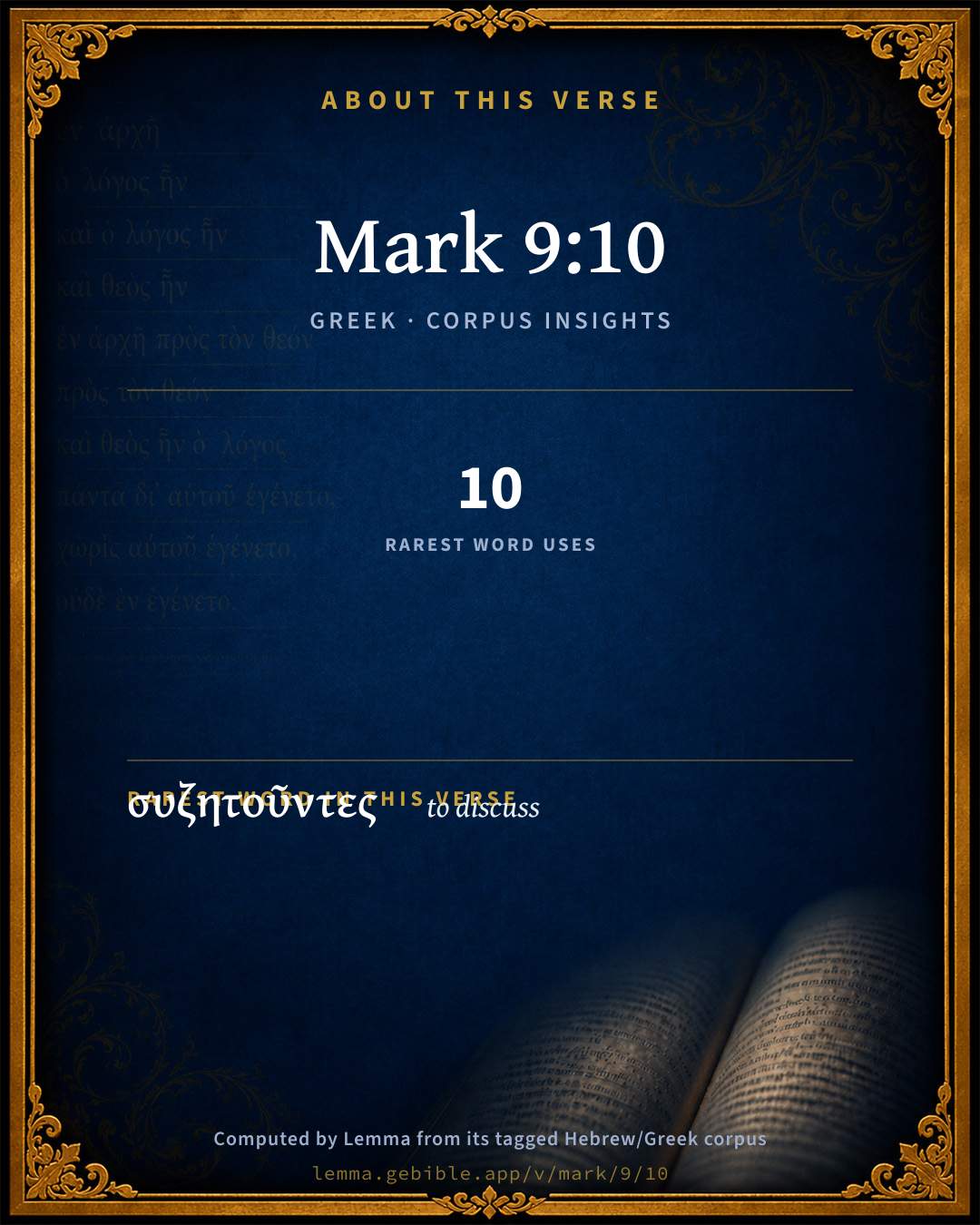
Mark 9:10

Greek (Tischendorf 8th ed.) Mark 9:10 appears in the Greek New Testament. The text above is from the Tischendorf 8th edition. Each word links to its Strong’s number and a concise gloss. Click any word for its full Thayer’s Greek Lexicon entry.
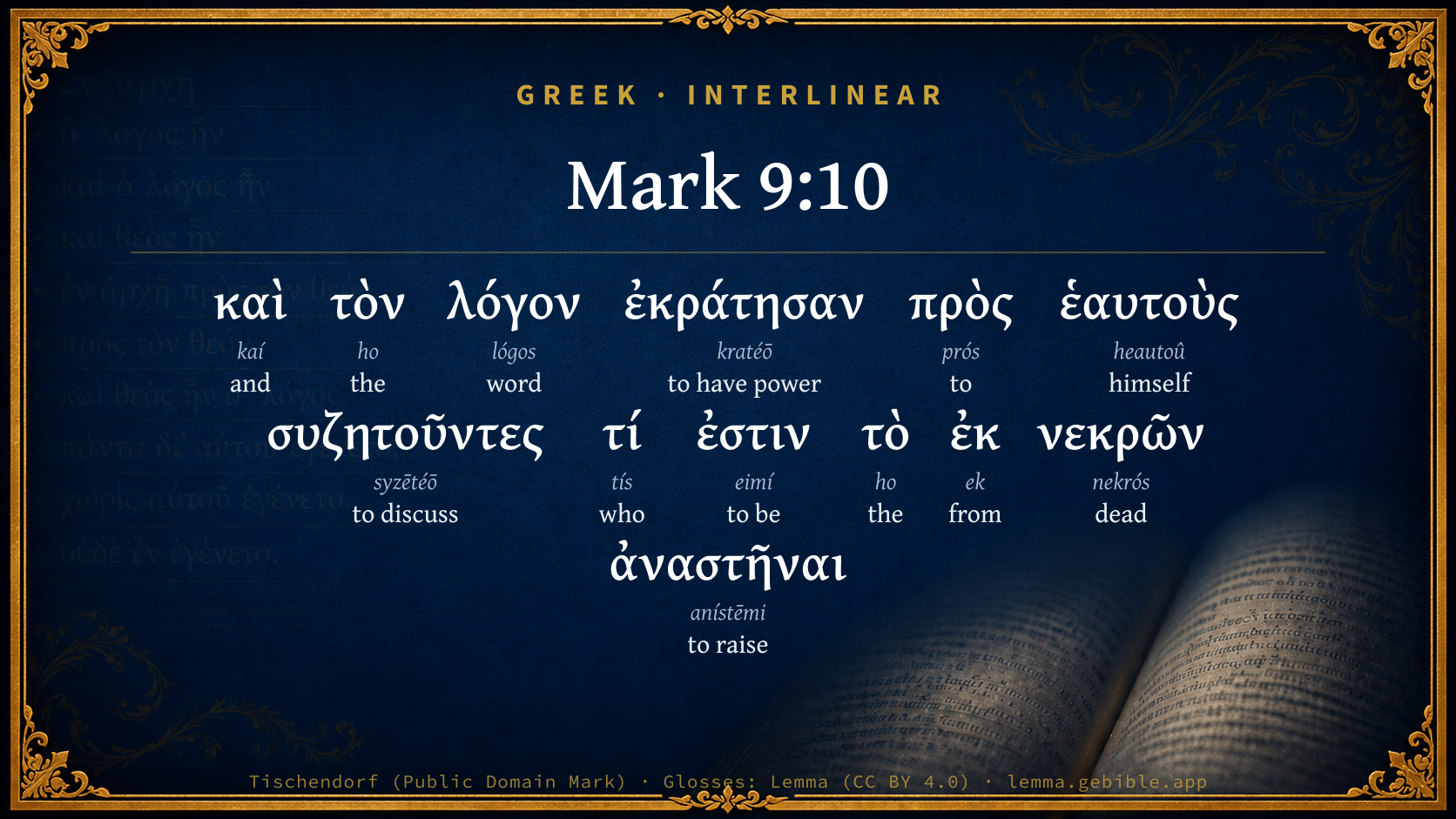
Download image
Cite this verse

Mark 9:10 (World English Bible). Public Domain. Lemma interlinear Bible study tool, https://lemma.gebible.app/v/mark/9/10.

Show BibTeX & RIS
BibTeX
RIS
English Translation
They kept this saying to themselves, questioning what the "rising from the dead" meant.
World English Bible · Public Domain
Download a study sheet

One document with this verse’s original text, its word-by-word gloss line, the meaning frame, cross-references with their text, attributed commentary, and full source and license credits — printable, and it pastes into notes with its structure intact.

This verse Autodidact and up

Study sheet (.html) Plain text (.txt)

A passage Seminary Student

Up to 50 verses in one chapter. A passage sheet keeps up to 6 commentary sources and 12 cross-references per verse, in the order this page ranks them, and says so on the sheet whenever that leaves anything out. Ask for a single verse and you get the Autodidact verse sheet above.

Everything on this page stays free to read, with no account — the sheet is a download of what is already on screen, not access to it.

Want to remove ads? Support Godless Engineer
Compare translations 3

The same verse in 3 English versions, stacked beneath the original-language interlinear above. Click any original word for its lexicon entry.

Each is an independent rendering of the whole verse — the interlinear is not word-aligned to these translations.

Highlighted words mark where these versions differ — a whole-verse word diff, not a word-by-word alignment.

  • World English Bible Public Domain
    They kept this saying to themselves, questioning what the "rising from the dead" meant.
  • King James Version Public Domain
    And they kept that saying with themselves, questioning one with another what the rising from the dead should mean.
  • unfoldingWord Literal Text CC BY-SA 4.0
    And they kept the word to themselves, discussing together what it is “to rise from the dead.”

unfoldingWord Literal Text — © unfoldingWord, licensed CC BY-SA 4.0. Word-aligned USFM3 via Door43 (git.door43.org/unfoldingWord/en_ult).

Versions to compare (up to 4)

3 of 4 selected

Show all 19 translations

Every available English version of this verse, each an independent rendering of the whole verse.

  • World English Bible Public Domain
    They kept this saying to themselves, questioning what the "rising from the dead" meant.
  • Berean Standard Bible Public Domain
    So they kept this matter to themselves, discussing what it meant to rise from the dead.
  • Majority Standard Bible Public Domain
    So they kept this matter to themselves, discussing what it meant to rise from the dead.
  • King James Version Public Domain
    And they kept that saying with themselves, questioning one with another what the rising from the dead should mean.
  • American Standard Version (1901) Public Domain
    And they kept the saying, questioning among themselves what the rising again from the dead should mean.
  • Revised Version (1885) Public Domain
    And they kept the saying, questioning among themselves what the rising again from the dead should mean.
  • Geneva Bible (1599) Public Domain
    So they kept that matter to themselues, and demaunded one of another, what the rising from the dead againe should meane?
  • Douay-Rheims (1899) Public Domain
    And they asked him, saying: Why then do the Pharisees and scribes say that Elias must come first?
  • Young's Literal Translation Public Domain
    and the thing they kept to themselves, questioning together what the rising out of the dead is.
  • Literal Standard Version CC BY-SA 4.0
    and the thing they kept to themselves, questioning together what the rising out of the dead is.
  • Unlocked Literal Bible CC BY-SA 4.0
    So they kept the matter to themselves, but they discussed among themselves what “rising from the dead” could mean.
  • unfoldingWord Literal Text CC BY-SA 4.0
    And they kept the word to themselves, discussing together what it is “to rise from the dead.”
  • Darby Bible Public Domain
    And they kept that saying, questioning among themselves, what rising from among [the] dead was.
  • World Messianic Bible Public Domain
    They kept this saying to themselves, questioning what the “rising from the dead” meant.
  • Webster's Bible Public Domain
    And they kept that saying with themselves, questioning one with another what the rising from the dead should mean.
  • Free Bible Version CC BY-SA 4.0
    They kept this to themselves, but they did argue with each other over what it meant to rise from the dead.
  • Bible in Basic English Public Domain
    And they kept the saying, questioning among themselves what the coming back from the dead might be.
  • Text-Critical English NT CC BY 4.0
    So they kept the matter to themselves, discussing what this “rising from the dead” could mean.
  • Tyndale New Testament (1534) Public Domain
    And they kepte that sayinge with them and demaunded one of a nother what that rysinge from deeth agayne shuld meane?

Literal Standard Version (2020), Covenant Press — licensed CC BY-SA 4.0. Text via the HelloAO Bible API (eBible.org). Unlocked Literal Bible (unfoldingWord) — licensed CC BY-SA 4.0. Text via the HelloAO Bible API (eBible.org). unfoldingWord Literal Text — © unfoldingWord, licensed CC BY-SA 4.0. Word-aligned USFM3 via Door43 (git.door43.org/unfoldingWord/en_ult). Free Bible Version, Dr. Jonathan Gallagher — licensed CC BY-SA 4.0. Text via the HelloAO Bible API (eBible.org).

Word by word

More ways to search: Search by grammar → Find every occurrence → Compare this word →

Practice this passage: Drill this verse → Learn its vocabulary →

συζητοῦντες
syzētéō
G4802
“to discuss”
Verb, Present, Active, Participle, Nominative, Plural, Masculine
Part of Speech
Verb
Tense
Present
Voice
Active
Mood
Participle
Case
Nominative
Number
Plural
Gender
Masculine
Full Thayer's Definition

Origin: from G4862 and G2212

TDNT: 19:27,1

1. to seek or examine together 2. in the NT to discuss, dispute, question
  1. καὶ kaí G2532 “and” Conjunction
  2. τὸν ho G3588 “the” Article, Accusative, Singular, Masculine
  3. λόγον lógos G3056 “word” Noun, Accusative, Singular, Masculine
  4. ἐκράτησαν kratéō G2902 “to have power” Verb, Aorist, Active, Indicative, 3rd person, Plural
  5. πρὸς prós G4314 “to” Preposition
  6. ἑαυτοὺς heautoû G1438 “himself” Reflexive pronoun, 3rd person, Accusative, Plural, Masculine
  7. τί tís G5101 “who” Interrogative pronoun, Nominative, Singular, Neuter
  8. ἐστιν eimí G1510 “to be” Verb, Present, Active, Indicative, 3rd person, Singular
  9. τὸ ho G3588 “the” Article, Nominative, Singular, Neuter
  10. ἐκ ek G1537 “from” Preposition
  11. νεκρῶν nekrós G3498 “dead” Adjective, Genitive, Plural, Masculine
  12. ἀναστῆναι anístēmi G450 “to raise” Verb, Aorist, Active, Infinitive

About this verse

These counts appear in no published source. They are computed here, from the morphology-tagged text and Lemma’s own curated glosses. What Lemma adds →

13
words
12
distinct lemmas
Gospels
section

Notable vocabulary

The rarest word here is συζητοῦντες to discuss G4802 — appearing just 10 times in the whole Greek New Testament.

Shared distinctive vocabulary

συζητοῦντες to discuss G4802 occurs in 10 verses of the Greek New Testament. Also found in:

Repetition

A word recurs within this verse:

Cross-references

13

Topical passages linked to Mark 9:10 in the Treasury of Scripture Knowledge — connected by theme and wording, ordered by reader-vote popularity; previews shown in the World English Bible.

  • Acts 17:18 Some of the Epicurean and Stoic philosophers also were conversing with him. Some said, "What does this babbler want to say?" Others said, "He seems to be advocating foreign deities," because he preached Jesus and the resurrection.
  • John 2:19–22 Jesus answered them, "Destroy this temple, and in three days I will raise it up."
  • John 16:17–19 Some of his disciples therefore said to one another, "What is this that he says to us, 'A little while, and you won't see me, and again a little while, and you will see me;' and, 'Because I go to the Father?'"
  • Luke 18:33–34 They will scourge and kill him. On the third day, he will rise again."
  • Luke 24:7–8 saying that the Son of Man must be delivered up into the hands of sinful men, and be crucified, and the third day rise again?"
  • Luke 24:25–27 He said to them, "Foolish men, and slow of heart to believe in all that the prophets have spoken!
  • John 12:16 His disciples didn't understand these things at first, but when Jesus was glorified, then they remembered that these things were written about him, and that they had done these things to him.
  • John 12:33–34 But he said this, signifying by what kind of death he should die.
  • John 16:29–30 His disciples said to him, "Behold, now you speak plainly, and speak no figures of speech.
  • Genesis 37:11 His brothers envied him; but his father kept this saying in mind.
  • Matthew 16:22 Peter took him aside, and began to rebuke him, saying, "Far be it from you, Lord! This will never be done to you."
  • Mark 9:32 But they didn't understand the saying, and were afraid to ask him.
  • Luke 2:50–51 They didn't understand the saying which he spoke to them.

Cross-references courtesy of OpenBible.info (CC BY 4.0).

Commentary

Notes on Mark 9:10 from classic Christian and Jewish commentators (each source and its license shown beneath its notes). The classic Christian expositions comment on the surrounding passage and are grouped to its opening verse, so a note may address several verses; the Jewish commentaries on the Tanakh (Rashi and others) are per-verse, so they appear only where the commentator wrote on this verse.

Lemma curates 59 commentaries, every one of them public domain or Creative Commons licensed, each selected and text-cleaned for this edition rather than reprinted as found. About our sources →

The Biblical Illustrator

Joseph S. Exell

Mar_9:10

What the rising from the dead should mean.

The Resurrection: its moral meanings

Men heard them gladly, because they preached the resurrection; and because the truth was so purely human as well as purely Divine, it overran and mastered the world.

I. It seems to explain mans place is the creation. Mans position at the head of this creation places him on the threshold of a higher creation, in which the true sphere of his royalty lies. Such a world as this is too small, too poor, to be the home and the realm of his manhood; its true function is to train him for his royalty beyond. The risen man, by rising, enlarged quite infinitely the field of mans vision, activity, interest, and hope. The risen man explained every propulsive movement and yearning in mans nature-all his kinglike form and instinct: while the weakness, the poverty, the pain, the dread, belonged to his mortal and transitory sphere. Men heard the doctrine gladly, for they saw the true form and stature of the human in the man Christ Jesus; in the risen Christ Gods idea of humanity was for evermore unveiled.

II. It seemed to unfold the meaning of the mystery of matter-the mortal body in which the soul finds itself enshrined, or, as it is ceaselessly tempted to cry, entombed. The mystery of embodiment is the essential mystery which perplexes and bewilders the world. Men found it hard to see how there could be fair room for the flesh in any scheme of the world which should include the rule of a wise, righteous, and beneficent Lord. The gospel of Jesus and the resurrection flashes at once a flood of light on man and on his constitution. There is One, a man, bone of our bone, flesh of our flesh, who has borne the body through death, who took it again joyfully when death had slain its mortality, and bore it with Him to the spiritual and eternal world. The revelation of a glorified human body in the world behind the veil was the sanctification, not of the body only, but also of all material things on this side the veil; it was the sign from heaven that they were originally and essentially not of the devil, but of God. We cannot in these days measure the range of that emancipation-man freed from the tormenting thought that he bore a devilish part about with him, a body which could never be tamed to a true subjection, never trained to a Divine use.

III. It seemed to cast light on the still deeper and darker mystery of evil; it explained the meaning by unveiling the end of mans moral discipline. It proclaimed, as nothing else that we can conceive of could proclaim, Gods mastery over all that was dark and malign in nature and in life. Thenceforth man could fight the battle in hope, and was saved. It was the flashing out of a victorious force over sin and death, which lit up the world and made it radiant with hope, when the apostles preached through Jesus the resurrection from the dead. (J. B. Brown, B. A.)

Questionings concerning the resurrection set at rest

I see the force of all this; I admit that the death and burial of a seed, while it suggests the bare possibility of man surviving that dissolution which we call death, by no means raises the presumption that it is so to the height of a proof. All we can say is that there are certain analogies for it from plant life, and other analogies against it from animal life; and who can tell which way it will ultimately turn? It is at this stage of the argument that the resurrection of Jesus Christ comes in to decide our wavering minds. Until Easter day we stand with the disciples, questioning what the resurrection of the dead should mean; but now we question no longer. In this respect we are as the contemporaries of Columbus were when he boldly set sail from Palos in August, 1492, and in less than three months set at rest the problem of ages. His return from the voyage to the Bahamas turned presumption into proof. It was no longer a question on which sides might be taken. In a sense it was now set at rest. It admitted no further argument. Those who continued obstinate, and held out for the old opinion, as some of Columbus contemporaries did, in spite of evidence to the contrary, could only be left to their own obstinacy. (J. B. Heard, M. A.)

The Biblical Illustrator, edited by Joseph S. Exell (c. 1880s–1900s) — public domain. Text from a community e-Sword module.

Tyndale Open Study Notes

Tyndale Open Resources

9:10 Only after the fact did the three disciples understand what Jesus meant by “rising from the dead.”

Tyndale Open Study Notes — © Tyndale Open Resources, licensed CC BY-SA 4.0. Text via the HelloAO Bible API.

Bengel's Gnomon

Johann Albrecht Bengel

Mar 9:10. Ἐκράτησαν, they laid hold of) They received with attention, and did not treat with neglect.—τί ἐστι, what is) They did not so much feel difficulty respecting the thesis [the position or conclusion], as they did respecting the hypothesis [the foundation or assumption on which the conclusion was made to rest]. [In fact, to those who had no idea that Christ must die, any discourse concerning His resurrection seemed out of place.—V. g.]

Bengel's Gnomon of the New Testament — English translation (T&T Clark, Edinburgh, 1860) — public domain. Text from a community e-Sword module.

Expositor's Greek Testament

ed. W. Robertson Nicoll

Mar 9:10 . τὸν λόγον ἐκράτησαν , they kept the word; i.e. , if the verb be taken in the sense of Mar 7:3-4 ; Mar 7:8 , gave heed to the Master’s prohibition of speech concerning what had just happened, at least till after the resurrection strictly complied with His wish. If we connect πρὸς ἑαυτοὺς with ἐκράτ ., the meaning will be: they kept the saying to (with) themselves (A. V [73] ), or rather, taking λόγον in the sense of “thing,” they kept the matter what had happened to themselves: did not speak about it. The sense is the same in effect, but the latter is perhaps the better connection of words, as if πρὸς ἑ . were intended to go with συζητοῦντες it would more naturally have come after it. τί ἐστι τὸ , etc.: the reference to the resurrection in the prohibition of the Master puzzled and troubled the three disciples: resurrection His own, and soon, in our time; but that implies death ; whereof, indeed, He lately spoke to us, but how hard to receive! Peter’s resistance, sympathised with by his brethren, not yet overcome. They speak of it to one another, though not again to the Master.

[73] Authorised Version.

The Expositor's Greek Testament, edited by W. Robertson Nicoll (1897–1910) — public domain. Text from a community e-Sword module.

Geneva Bible (1599)

Geneva Bible translators

They questioned not together touching the general resurrection which shall be in the latter day, but they understood not what he meant by that which he spake of his own peculiar resurrection.

Even very hardly as it were.

Geneva Bible (1599) marginal notes — public domain. Text via Bolls.life.

Adam Clarke's Commentary

Verse 10. And they kept that saying] This verse is wanting in two MSS. and one of the Itala.

What the rising from the dead should mean.] Ὁταν εκ νεκρων αναϚῃ, When he should arise from the dead, is the reading of D, six others, Syriac, all the Persic, Vulgate, all the Itala, and Jerome. Griesbach approves of it.

There is nothing that answers to this verse either in Matthew or Luke.

Adam Clarke's Commentary on the Bible (1810–1826) — public domain. Text from a community e-Sword/MySword module.

Ellicott's Commentary for English Readers

(10) And they kept that saying with themselves.—We again note what we may describe as a characteristic touch, analysing the mental condition of the disciples in relation to their Master’s teaching.

A Bible Commentary for English Readers, edited by Charles John Ellicott (1878–1897) — public domain. Text from a community e-Sword module.

The Cambridge Bible for Schools and Colleges

gen. ed. J. J. S. Perowne

10. questioning one with another] St Mark alone mentions the perplexity which this language of their Lord occasioned to the Apostles. It was not the question of the resurrection generally, but of His resurrection, and the death, so abhorrent to their prejudices, that rendered it possible and necessary, which troubled them.

The Cambridge Bible for Schools and Colleges (gen. ed. J. J. S. Perowne; Cambridge University Press, 1878–1918) — public domain. Text from a community e-Sword module.

John Gill's Exposition

And they kept that saying with themselves,.... "They retained it in their own mind", as the Persic version renders it; "they kept it close", as Luke says, Luk 9:36, among themselves, and acquainted no man with it: and which refers either to the whole of Christ's charge, relating to the vision on the mount; or else only to what he said about his resurrection from the dead; and which they took notice of particularly, and laid hold upon, as the word will bear to be rendered; and so the Ethiopic version does render it, "and they observed his saying"; what he last said concerning the son of man's rising from the dead;

questioning with one other what the rising from the dead should mean: they inquired, disputed, and reasoned with one another, what should be the meaning of such an expression: not that they were ignorant of the general resurrection of the dead; for this was the hope of Israel, and the general sense of the Jewish nation: but they did not know what he meant by his particular rising from the dead: whether he meant it in a literal sense, which supposed his death; and that though he had lately told them of, they knew not how to reconcile to the notions they had of a long and flourishing temporal kingdom of the Messiah; or whether he meant a and interest, in such manner as they expected.

John Gill's Exposition of the Whole Bible (1746–1763) — public domain (CC PDM 1.0). Text via the HelloAO Bible API.

Trapp's Complete Commentary

John Trapp

10 And they kept that saying with themselves, questioning one with another what the rising from the dead should mean.

Ver. 10. And they kept that saying] With much ado they kept it (as the word εκρατησαν imports), for the rest of the disciples were very inquisitive, likely, what was said and done in the mount. A friend that can both keep counsel and give counsel is worth his weight in gold.

John Trapp, A Commentary or Exposition upon All the Books of the Old and New Testament (1647–1656) — public domain. Text from a community e-Sword module.

Haydock's Catholic Bible Commentary

The Jews here confound the two comings of Jesus Christ. The Baptist, in the spirit of Elias, will precede the first, and Elias in person, the second coming of Christ.

George Leo Haydock (1774–1849), Haydock's Catholic Family Bible and Commentary, 1859 edition — public domain. Excludes Psalms (Douay-Rheims chapter numbering differs from Protestant) and Deuterocanonical books (Catholic canon only).

Whedon's Commentary on the Bible

Daniel D. Whedon

10. Should mean — Will he literally die, or is it a figure of speech? If figurative, what does it mean? If real, why should it take place, and what will become of us? Will he truly rise again? What if he should not? What then becomes of his past miracles and teachings? And how are we to explain this dazzling transfiguration? It is wonderful how completely the crucifixion of Jesus swept from the disciples’ minds all hope of his resurrection, so that they could scarce believe it when it took place. See notes on Mar_16:10-11.

Daniel D. Whedon (gen. ed.), Commentary on the Old and New Testaments (1874–1909) — public domain. Text from a community e-Sword module.

The Pulpit Commentary

Vers. 10, 11. Questioning among themselves what the rising again from the dead should mean; that is, his own rising from the dead, of which our Lord had just been speaking. No doubt the general resurrection at the end of the world was an article of faith with which the disciples were familiar. But they could not understand, when he spake of his own immediate rising from the dead. So their perplexities led them at last to ask him the question; or rather to make the remark to him, The scribes say that Elijah must first come; with a view to obtaining some clearer understanding. They had just seen Elijah in the Transfiguration, and they had seen him disappear. They wondered why he should have departed. They thought, it may be, that he ought to have remained, that he might be the forerunner of Christ and of his kingdom and glory, according to the prophecy of Malachi. (Mal_4:6) This the scribes taught; but they erred in the confusion of times, for they did not distinguish the first coming of Christ in the flesh from his second advent to judgment. The thought upon the mind of the disciples appears to have been this: They heard Christ speak of his own resurrection as close at hand, and they had seen the type of it in his transfiguration; and they thought that immediately after that, Christ"s kingdom would come, and he would reign gloriously. Why, then, had not Elijah remained, that he might be his precursor? St. Matthew (Mat_17:13) tells us that our Lord"s words which follow showed the disciples that when he said that Elijah was to come first and restore all things, he meant them to understand" that he spake unto them of John the Baptist." Upon the question of a future coming of Elijah, it seems safest to confess our ignorance. The prophecy of Malachi was no doubt in part fulfilled in the coming of John the Baptist; but it would be rash to affirm that it may not receive another and more literal fulfillment before the second advent. A host of ancient Christian expositors have held that Elijah will appear in person before the second advent of Christ. St. Augustine, in his "City of God" (20:29), says, "Not without reason do we hope that before the coming of our Judge and Savior Elias will come, because we have good reason to believe that he is now alive; for, as Holy Scripture distinctly informs us, he gas taken up from this life in a chariot of fire. When, therefore, he is come he shall give a spiritual explanation of the Law which the Jews at present understand carnally, and will turn the hearts of the fathers to the children, and the children to the fathers; that is, the Jews who are the children will understand the Law in the same sense as their fathers the prophets understood it." Indeed, this is one of the principal reasons assigned by the Fathers for this appearance of Elijah, that he may convert the Jews.

The Pulpit Commentary (1880–1919), ed. H.D.M. Spence-Jones & Joseph S. Exell — public domain. Text from a community e-Sword module.

Cambridge Greek Testament for Schools and Colleges

10. τὸν λόγον ἐκράτησαν. They kept the saying; they not only remembered it but obeyed it; cf. Mar 7:3-4; Mar 7:8.

πρὸς ἑαυτούς. Amphibolous, but better taken with συνζητοῦντες (R.V.) than with ἐκράτησαν. Syr-Sin. has “reasoning with themselves.” They would be familiar with the idea of rising from the dead, but the special resurrection of the Son of Man perplexed them. Syr-Sin. has “What is this word that He said, When He is risen from the dead?” [2083] and Lat.-Vet. have ὅταν ἐκ νεκρῶν ἀναστῇ for τὸ ἐκ ν. ἀναστῆναι. The ἐστί reproduces their wording; “what His rising again from the dead is.” This questioning is omitted by Mt., who again refrains from recording the Apostles’ want of intelligence; cf. Mar 6:52, Mar 9:6, Mar 10:24.

[2083] Codex Bezae. 6th cent. Has a Latin translation (d) side by side with the Greek text, and the two do not quite always agree. Presented by Beza to the University Library of Cambridge in 1581. Remarkable for its frequent divergences from other texts. Contains Mark, except Mar 16:15-20, which has been added by a later hand. Photographic facsimile, 1899.

Cambridge Greek Testament for Schools and Colleges (Cambridge University Press, 1896; 21 vols, various authors incl. Carr, Maclear, Plummer, Farrar, Lumby, Moule, M. R. James, Simcox) — public domain. Text from a community e-Sword module.

Alford’s Greek Testament

Henry Alford

10. τ. λ. ἐκράτ.] Not, ‘they kept the command:’—for συνζητ. explains it to mean kept secret the saying, as in ref. Dan.

τί ἐστιν τὸ ἐκ ν. ἀν. does not refer to the Resurrection generally, for it was an article of Jewish belief, and connected with the times of the Messiah;—but to His Resurrection as connected with His Death; the whole was enigmatical to them.

Henry Alford, The Greek Testament (1849–1861) — public domain. Text from a community e-Sword module.

International Critical Commentary

10. τὸν λόγον ἐκράτησαν—not to be connected with πρὸς ἐαυτοὺς,—they kept the saying to themselves, which does not give ἐκράτησαν a proper meaning, and does not accord with the fact that Jesus restricted his announcement of the resurrection only to the twelve, not to the three; nor is it to be translated, they kept the saying, in the sense of obedience; but the meaning is, they seized this word about the resurrection, it clung to them, they did not let go of it.1 πρὸς ἑαυτοὺς συνζητοῦντες τί ἐστι τὸ ἐκ νεκρῶν ἀναστῆναι,2—questioning among themselves what the rising from the dead is. Not what the resurrection means in general, which they as orthodox Jews at this time would know well enough; but what it meant in the case of Jesus, involving, as it did, his death.

International Critical Commentary — older volumes (1896–1929), various authors — public domain. Text from a community e-Sword module.

Lesson kit

Teaching starters — assembled from the data on this page, not authored interpretation. Every prompt links to the verse data it draws on. Edit before teaching.

Mark, in the Gospels, opens this verse with 13 words (12 distinct Greek lemmas). Its most distinctive word is syzētéō (“to discuss”). A historical commentator’s framing appears above. Read the whole chapter for the surrounding context.

Discussion questions

  1. How does “to discuss” (syzētéō) shape what this verse is saying?
  2. How does Mark 1:27, which shares the word «to discuss», read alongside this verse?
  3. What does the repetition of “the” (2× in this one verse) do in this verse?
  4. The translations on this page render this verse differently — a whole-verse word diff, not a word-by-word alignment. What might account for the different wordings?
  5. Compare how The Biblical Illustrator and Tyndale Open Study Notes read this verse. Where do they agree or differ?

Things to notice

Reading settings

Reading text

Shown beneath each verse's original-language words.

Old Testament
Old Testament edition

Read the OT as the Masoretic Hebrew (MT) or the Greek Septuagint (LXX).

English shown for the Greek Septuagint (in the Hebrew ↔ Greek comparison).

Comparing translations? Open the Compare panel on any verse page to stack up to four side by side.