

Mark 6:36
Greek (Tischendorf 8th ed.) Mark 6:36 appears in the Greek New Testament. The text above is from the Tischendorf 8th edition. Each word links to its Strong’s number and a concise gloss. Click any word for its full Thayer’s Greek Lexicon entry.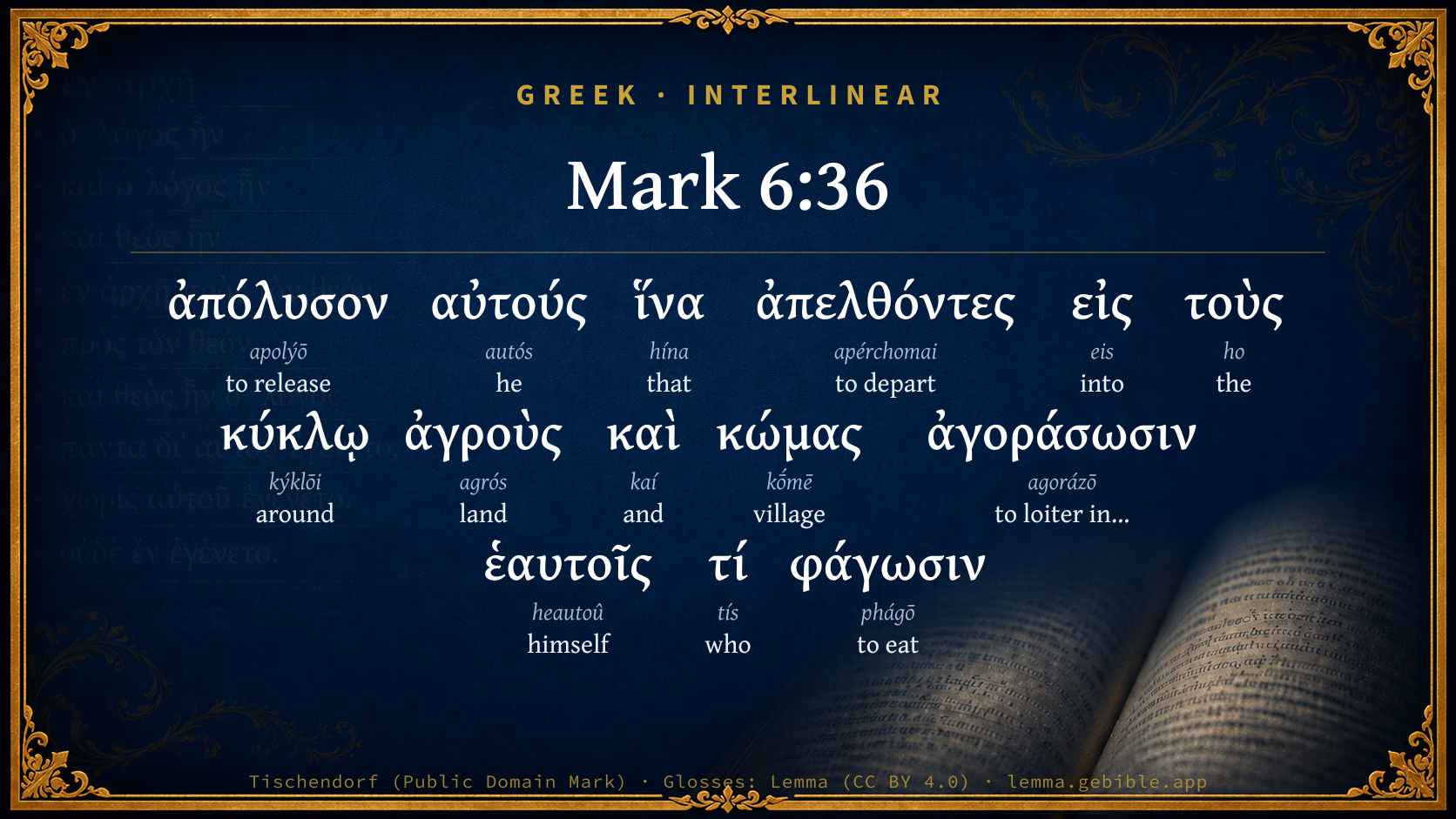
Send them away, that they may go into the surrounding country and villages, and buy themselves bread, for they have nothing to eat."
Download a study sheet
One document with this verse’s original text, its word-by-word gloss line, the meaning frame, cross-references with their text, attributed commentary, and full source and license credits — printable, and it pastes into notes with its structure intact.
This verse Autodidact and up
A passage Seminary Student
Up to 50 verses in one chapter. A passage sheet keeps up to 6 commentary sources and 12 cross-references per verse, in the order this page ranks them, and says so on the sheet whenever that leaves anything out. Ask for a single verse and you get the Autodidact verse sheet above.
Everything on this page stays free to read, with no account — the sheet is a download of what is already on screen, not access to it.
Compare translations 3
The same verse in 3 English versions, stacked beneath the original-language interlinear above. Click any original word for its lexicon entry.
Each is an independent rendering of the whole verse — the interlinear is not word-aligned to these translations.
Highlighted words mark where these versions differ — a whole-verse word diff, not a word-by-word alignment.
-
World English Bible Public Domain
Send them away, that they may go into the surrounding country and villages, and buy themselves bread, for they have nothing to eat."
-
King James Version Public Domain
Send them away, that they may go into the country round about, and into the villages, and buy themselves bread: for they have nothing to eat.
-
unfoldingWord Literal Text CC BY-SA 4.0
Send them away so that, having gone away into the surrounding countryside and villages, they might buy something for themselves they might eat.”
unfoldingWord Literal Text — © unfoldingWord, licensed CC BY-SA 4.0. Word-aligned USFM3 via Door43 (git.door43.org/unfoldingWord/en_ult).
Show all 19 translations
Every available English version of this verse, each an independent rendering of the whole verse.
-
World English Bible Public Domain
Send them away, that they may go into the surrounding country and villages, and buy themselves bread, for they have nothing to eat."
-
Berean Standard Bible Public Domain
Dismiss the crowd so they can go to the surrounding countryside and villages and buy themselves something to eat.”
-
Majority Standard Bible Public Domain
Dismiss the crowd so they can go to the surrounding countryside and villages and buy themselves food, for they have nothing to eat.”
-
King James Version Public Domain
Send them away, that they may go into the country round about, and into the villages, and buy themselves bread: for they have nothing to eat.
-
American Standard Version (1901) Public Domain
send them away, that they may go into the country and villages round about, and buy themselves somewhat to eat.
-
Revised Version (1885) Public Domain
send them away, that they may go into the country and villages round about, and buy themselves somewhat to eat.
-
Geneva Bible (1599) Public Domain
Let them depart, that they may goe into the countrey and townes about, and buy them bread: for they haue nothing to eate.
-
Douay-Rheims (1899) Public Domain
Send them away, that going into the next villages and towns, they may buy themselves meat to eat.
-
Young's Literal Translation Public Domain
let them away, that, having gone away to the surrounding fields and villages, they may buy to themselves loaves, for what they may eat they have not.'
-
Literal Standard Version CC BY-SA 4.0
let them away, that having gone away into the surrounding fields and villages, they may buy loaves for themselves, for they do not have what they may eat.”
-
Unlocked Literal Bible CC BY-SA 4.0
Send them away so that they may go into the nearby countryside and villages to buy something to eat for themselves.”
-
unfoldingWord Literal Text CC BY-SA 4.0
Send them away so that, having gone away into the surrounding countryside and villages, they might buy something for themselves they might eat.”
-
Darby Bible Public Domain
send them away that they may go into the country and villages around, and buy themselves bread, for they have not anything they can eat.
-
World Messianic Bible Public Domain
Send them away, that they may go into the surrounding country and villages and buy themselves bread, for they have nothing to eat.”
-
Webster's Bible Public Domain
Send them away, that they may go into the country around, and into the villages, and buy themselves bread: for they have nothing to eat.
-
Free Bible Version CC BY-SA 4.0
You should tell the people to go and buy themselves something to eat in the villages and countryside nearby.”
-
Bible in Basic English Public Domain
Send them away, so that they may go into the country and small towns round about, and get some food for themselves.
-
Text-Critical English NT CC BY 4.0
Send the people away so that they can go into the surrounding countryside and villages and buy themselves some bread, for they have nothing to eat.”
-
Tyndale New Testament (1534) Public Domain
let the departe that they maye goo into the countrey rounde about and into the tounes and bye the breed: for they have nothinge to eate.
Literal Standard Version (2020), Covenant Press — licensed CC BY-SA 4.0. Text via the HelloAO Bible API (eBible.org). Unlocked Literal Bible (unfoldingWord) — licensed CC BY-SA 4.0. Text via the HelloAO Bible API (eBible.org). unfoldingWord Literal Text — © unfoldingWord, licensed CC BY-SA 4.0. Word-aligned USFM3 via Door43 (git.door43.org/unfoldingWord/en_ult). Free Bible Version, Dr. Jonathan Gallagher — licensed CC BY-SA 4.0. Text via the HelloAO Bible API (eBible.org).
Word by word
More ways to search: Search by grammar → Find every occurrence → Compare this word →
Practice this passage: Drill this verse → Learn its vocabulary →
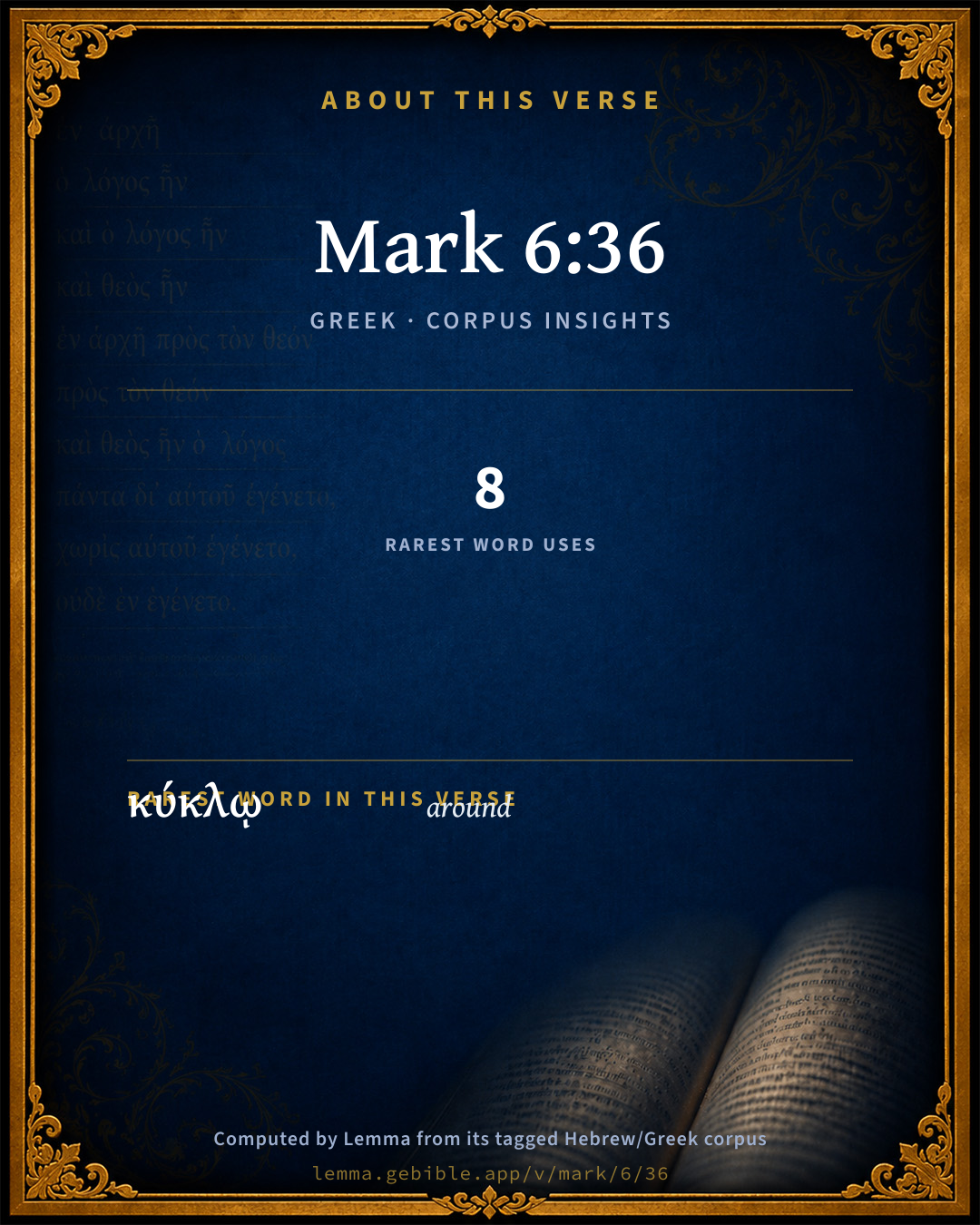
- Appears 8× in the Greek New Testament
- First appears at Mark 3:34
- Part of Speech
- Noun
- Case
- Dative
- Number
- Singular
- Gender
- Masculine
Full Thayer's Definition
- ἀπόλυσον apolýō G630 “to release” Verb, Aorist, Active, Imperative, 2nd person, Singular
- αὐτούς autós G846 “he” Personal pronoun, Accusative, Plural, Masculine
- ἵνα hína G2443 “that” Conjunction
- ἀπελθόντες apérchomai G565 “to depart” Verb, Aorist, Active, Participle, Nominative, Plural, Masculine
- εἰς eis G1519 “into” Preposition
- τοὺς ho G3588 “the” Article, Accusative, Plural, Masculine
- κύκλῳ kýklōi G2945 “around” Noun, Dative, Singular, Masculine
- ἀγροὺς agrós G68 “land” Noun, Accusative, Plural, Masculine
- καὶ kaí G2532 “and” Conjunction
- κώμας kṓmē G2968 “village” Noun, Accusative, Plural, Feminine
- ἀγοράσωσιν agorázō G59 “to loiter in marketplace” Verb, Aorist, Active, Subjunctive, 3rd person, Plural
- ἑαυτοῖς heautoû G1438 “himself” Reflexive pronoun, 3rd person, Dative, Plural, Masculine
- τί tís G5101 “who” Interrogative pronoun, Accusative, Singular, Neuter
- φάγωσιν phágō G5315 “to eat” Verb, Aorist, Active, Subjunctive, 3rd person, Plural
About this verse
These counts appear in no published source. They are computed here, from the morphology-tagged text and Lemma’s own curated glosses. What Lemma adds →
- 14
- words
- 14
- distinct lemmas
- Gospels
- section
Cross-references
3Topical passages linked to Mark 6:36 in the Treasury of Scripture Knowledge — connected by theme and wording, ordered by reader-vote popularity; previews shown in the World English Bible.
- Matthew 15:23 But he answered her not a word. His disciples came and begged him, saying, "Send her away; for she cries after us."
- Mark 3:21 When his friends heard it, they went out to seize him: for they said, "He is insane."
- Mark 5:31 His disciples said to him, "You see the multitude pressing against you, and you say, 'Who touched me?'"
Cross-references courtesy of OpenBible.info (CC BY 4.0).
Where the printed editions differ
2 variantsPlaces in this verse where the major printed Greek editions disagree on the wording in a way that affects the translation — a comparison of editions, not a manuscript-by-manuscript collation. The editions are the modern critical texts (Nestlé-Aland 28/27, SBL, Westcott-Hort, Tregelles, Tyndale House) and the traditional texts behind the KJV (the Textus Receptus and the Byzantine/Majority text). It is not a claim about which reading is original.
-
Extra text
ἄρτους γὰρ
“loaves for”
In TRByz Not in NA28NA27TynSBLWHTregἄρτους γὰρ (artous gar) 'loaves for' is only in traditional manuscripts (TR+Byz)
-
Extra text
οὐκ ἔχουσιν.
“not they have.”
In TRByz Not in NA28NA27TynSBLWHTregοὐκ ἔχουσιν. (ouk echousin) 'not they have.' is only in traditional manuscripts (TR+Byz)
Textual data: Translators Amalgamated Greek New Testament (STEPBible TAGNT) · CC BY 4.0.
Lesson kit
Teaching starters — assembled from the data on this page, not authored interpretation. Every prompt links to the verse data it draws on. Edit before teaching.
Mark, in the Gospels, opens this verse with 14 words (14 distinct Greek lemmas). Its most distinctive word is kýklōi (“around”). A historical commentator’s framing appears above. Read the whole chapter for the surrounding context.
Discussion questions
- The word kýklōi carries the sense “around.” How does it shape the verse?
- Mark 3:34 shares the word «around» with this verse. How do the two illuminate each other?
- These translations render this verse differently; the difference is in the English rendering, not the original. What questions does that raise?
- Reading how Bengel's Gnomon and Ellicott's Commentary for English Readers read this verse, where do the two commentators agree and where do they part?
Things to notice
- These translations choose different wording for 14 words in this verse.
- 14 distinct Greek lemmas span 14 words in this verse.
Commentary
Notes on Mark 6:36 from classic Christian and Jewish commentators (each source and its license shown beneath its notes). The classic Christian expositions comment on the surrounding passage and are grouped to its opening verse, so a note may address several verses; the Jewish commentaries on the Tanakh (Rashi and others) are per-verse, so they appear only where the commentator wrote on this verse.
Lemma curates 59 commentaries, every one of them public domain or Creative Commons licensed, each selected and text-cleaned for this edition rather than reprinted as found. About our sources →
Bengel's Gnomon
Johann Albrecht Bengel
Bengel's Gnomon of the New Testament — English translation (T&T Clark, Edinburgh, 1860) — public domain. Text from a community e-Sword module.
Ellicott's Commentary for English Readers
A Bible Commentary for English Readers, edited by Charles John Ellicott (1878–1897) — public domain. Text from a community e-Sword module.
The Cambridge Bible for Schools and Colleges
gen. ed. J. J. S. Perowne
The Cambridge Bible for Schools and Colleges (gen. ed. J. J. S. Perowne; Cambridge University Press, 1878–1918) — public domain. Text from a community e-Sword module.
John Gill's Exposition
John Gill's Exposition of the Whole Bible (1746–1763) — public domain (CC PDM 1.0). Text via the HelloAO Bible API.
Trapp's Complete Commentary
John Trapp
John Trapp, A Commentary or Exposition upon All the Books of the Old and New Testament (1647–1656) — public domain. Text from a community e-Sword module.
Cambridge Greek Testament for Schools and Colleges
Cambridge Greek Testament for Schools and Colleges (Cambridge University Press, 1896; 21 vols, various authors incl. Carr, Maclear, Plummer, Farrar, Lumby, Moule, M. R. James, Simcox) — public domain. Text from a community e-Sword module.
International Critical Commentary
International Critical Commentary — older volumes (1896–1929), various authors — public domain. Text from a community e-Sword module.