

Mark 6:51
Greek (Tischendorf 8th ed.) Mark 6:51 appears in the Greek New Testament. The text above is from the Tischendorf 8th edition. Each word links to its Strong’s number and a concise gloss. Click any word for its full Thayer’s Greek Lexicon entry.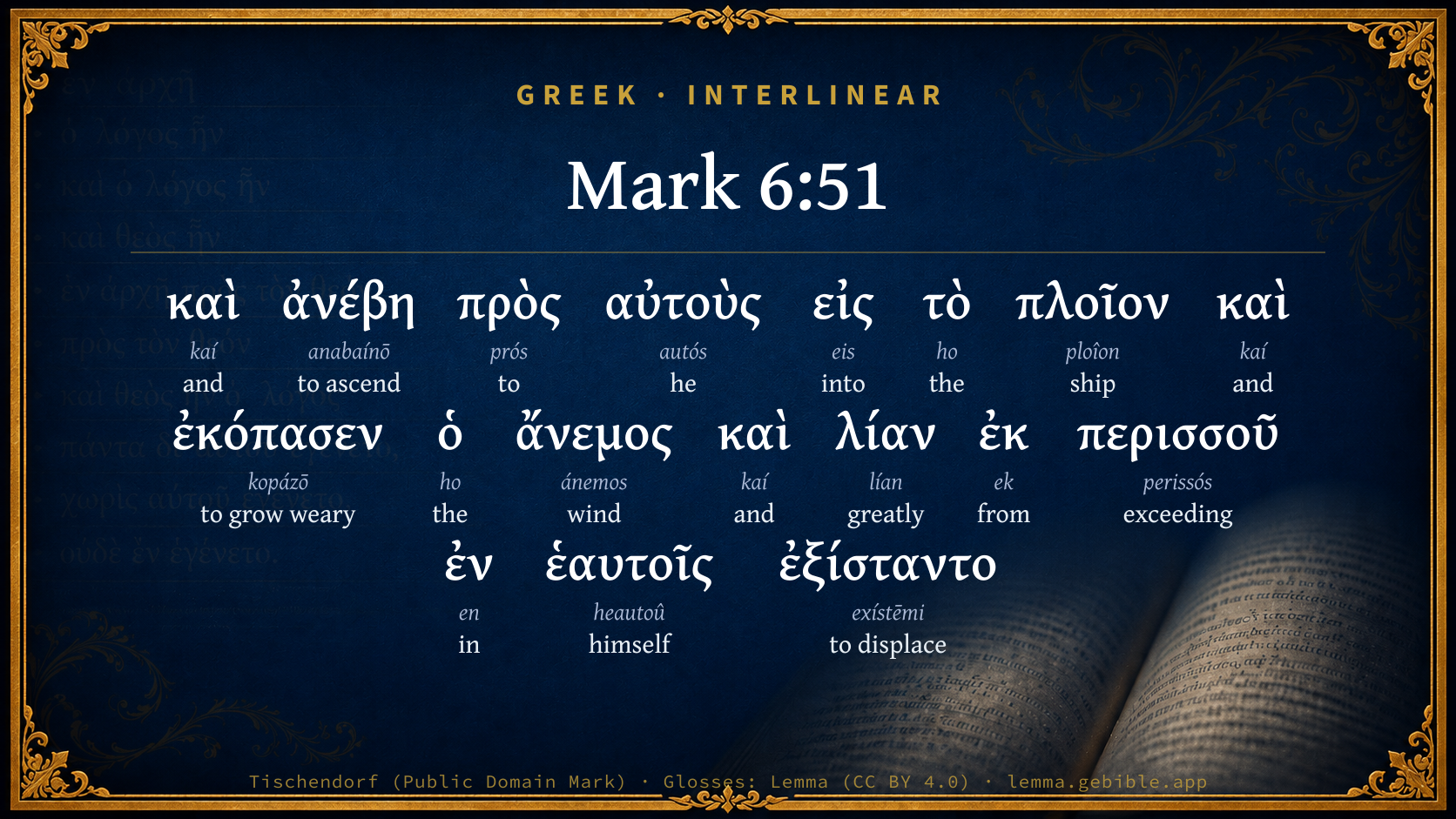
He got into the boat with them; and the wind ceased, and they were very amazed among themselves, and marveled;
Download a study sheet
One document with this verse’s original text, its word-by-word gloss line, the meaning frame, cross-references with their text, attributed commentary, and full source and license credits — printable, and it pastes into notes with its structure intact.
This verse Autodidact and up
A passage Seminary Student
Up to 50 verses in one chapter. A passage sheet keeps up to 6 commentary sources and 12 cross-references per verse, in the order this page ranks them, and says so on the sheet whenever that leaves anything out. Ask for a single verse and you get the Autodidact verse sheet above.
Everything on this page stays free to read, with no account — the sheet is a download of what is already on screen, not access to it.
Compare translations 3
The same verse in 3 English versions, stacked beneath the original-language interlinear above. Click any original word for its lexicon entry.
Each is an independent rendering of the whole verse — the interlinear is not word-aligned to these translations.
Highlighted words mark where these versions differ — a whole-verse word diff, not a word-by-word alignment.
-
World English Bible Public Domain
He got into the boat with them; and the wind ceased, and they were very amazed among themselves, and marveled;
-
King James Version Public Domain
And he went up unto them into the ship; and the wind ceased: and they were sore amazed in themselves beyond measure, and wondered.
-
unfoldingWord Literal Text CC BY-SA 4.0
And he got into the boat with them, and the wind ceased, and they were very amazed within themselves.
unfoldingWord Literal Text — © unfoldingWord, licensed CC BY-SA 4.0. Word-aligned USFM3 via Door43 (git.door43.org/unfoldingWord/en_ult).
Show all 19 translations
Every available English version of this verse, each an independent rendering of the whole verse.
-
World English Bible Public Domain
He got into the boat with them; and the wind ceased, and they were very amazed among themselves, and marveled;
-
Berean Standard Bible Public Domain
Then He climbed into the boat with them, and the wind died down. And the disciples were utterly astounded,
-
Majority Standard Bible Public Domain
Then He climbed into the boat with them, and the wind died down. And the disciples were utterly astounded beyond measure, and were marveling.
-
King James Version Public Domain
And he went up unto them into the ship; and the wind ceased: and they were sore amazed in themselves beyond measure, and wondered.
-
American Standard Version (1901) Public Domain
And he went up unto them into the boat; and the wind ceased: and they were sore amazed in themselves;
-
Revised Version (1885) Public Domain
And he went up unto them into the boat; and the wind ceased: and they were sore amazed in themselves;
-
Geneva Bible (1599) Public Domain
Then he went vp vnto them into the ship, and the winde ceased, and they were much more amased in them selues, and marueiled.
-
Douay-Rheims (1899) Public Domain
And he went up to them into the ship, and the wind ceased: and they were far more astonished within themselves:
-
Young's Literal Translation Public Domain
And he went up unto them to the boat, and the wind lulled, and greatly out of measure were they amazed in themselves, and were wondering,
-
Literal Standard Version CC BY-SA 4.0
And He went up to them into the boat, and the wind stilled, and greatly out of measure they were amazed in themselves, and were wondering,
-
Unlocked Literal Bible CC BY-SA 4.0
He got into the boat with them, and the wind ceased blowing. They were completely amazed.
-
unfoldingWord Literal Text CC BY-SA 4.0
And he got into the boat with them, and the wind ceased, and they were very amazed within themselves.
-
Darby Bible Public Domain
And he went up to them into the ship, and the wind fell. And they were exceedingly beyond measure astonished in themselves and wondered;
-
World Messianic Bible Public Domain
He got into the boat with them; and the wind ceased, and they were very amazed among themselves, and marveled;
-
Webster's Bible Public Domain
And he went up to them into the boat; and the wind ceased: and they were greatly amazed in themselves beyond measure, and wondered.
-
Free Bible Version CC BY-SA 4.0
He went over to them and climbed into the boat, and the wind died down. They were totally shocked,
-
Bible in Basic English Public Domain
And he went to them into the boat, and the wind went down, and they were full of wonder in themselves;
-
Text-Critical English NT CC BY 4.0
Then he got into the boat with them, and the wind ceased. And they were utterly and completely amazed and in awe;
-
Tyndale New Testament (1534) Public Domain
And he went vp vnto them into the shippe and the wynde ceased and they were sore amased in them selves beyonde measure and marveyled.
Literal Standard Version (2020), Covenant Press — licensed CC BY-SA 4.0. Text via the HelloAO Bible API (eBible.org). Unlocked Literal Bible (unfoldingWord) — licensed CC BY-SA 4.0. Text via the HelloAO Bible API (eBible.org). unfoldingWord Literal Text — © unfoldingWord, licensed CC BY-SA 4.0. Word-aligned USFM3 via Door43 (git.door43.org/unfoldingWord/en_ult). Free Bible Version, Dr. Jonathan Gallagher — licensed CC BY-SA 4.0. Text via the HelloAO Bible API (eBible.org).
Word by word
More ways to search: Search by grammar → Find every occurrence → Compare this word →
Practice this passage: Drill this verse → Learn its vocabulary →
- Appears 3× in the Greek New Testament
- First appears at Matthew 14:32
- Part of Speech
- Verb
- Tense
- Aorist
- Voice
- Active
- Mood
- Indicative
- Person
- 3rd person
- Number
- Singular
Full Thayer's Definition
- καὶ kaí G2532 “and” Conjunction
- ἀνέβη anabaínō G305 “to ascend” Verb, Aorist, Active, Indicative, 3rd person, Singular
- πρὸς prós G4314 “to” Preposition
- αὐτοὺς autós G846 “he” Personal pronoun, Accusative, Plural, Masculine
- εἰς eis G1519 “into” Preposition
- τὸ ho G3588 “the” Article, Accusative, Singular, Neuter
- πλοῖον ploîon G4143 “ship” Noun, Accusative, Singular, Neuter
- καὶ kaí G2532 “and” Conjunction
- ἐκόπασεν kopázō G2869 “to grow weary” Verb, Aorist, Active, Indicative, 3rd person, Singular
- ὁ ho G3588 “the” Article, Nominative, Singular, Masculine
- ἄνεμος ánemos G417 “wind” Noun, Nominative, Singular, Masculine
- καὶ kaí G2532 “and” Conjunction
- λίαν lían G3029 “greatly” Adverb
- ἐκ ek G1537 “from” Preposition
- περισσοῦ perissós G4053 “exceeding” Adjective, Genitive, Singular, Neuter
- ἐν en G1722 “in” Preposition
- ἑαυτοῖς heautoû G1438 “himself” Reflexive pronoun, 3rd person, Dative, Plural, Masculine
- ἐξίσταντο exístēmi G1839 “to displace” Verb, Imperfect, Middle, Indicative, 3rd person, Plural
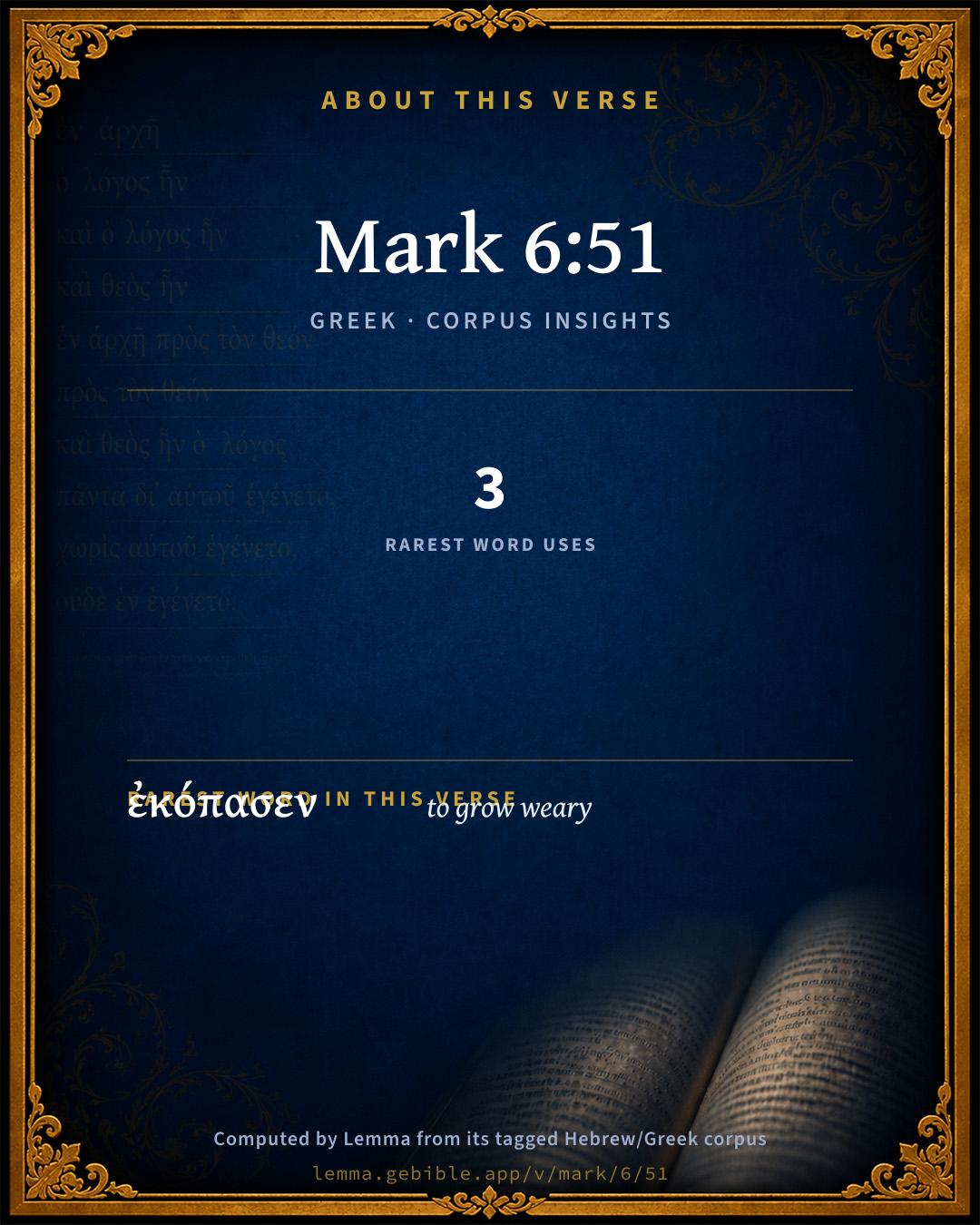
About this verse
These counts appear in no published source. They are computed here, from the morphology-tagged text and Lemma’s own curated glosses. What Lemma adds →
- 18
- words
- 15
- distinct lemmas
- Gospels
- section
Cross-references
13Topical passages linked to Mark 6:51 in the Treasury of Scripture Knowledge — connected by theme and wording, ordered by reader-vote popularity; previews shown in the World English Bible.
- Psalms 93:3–4 The floods have lifted up, Yahweh, The floods have lifted up their voice. The floods lift up their waves.
- Mark 4:39 He awoke, and rebuked the wind, and said to the sea, "Peace! Be still!" The wind ceased, and there was a great calm.
- Mark 7:37 They were astonished beyond measure, saying, "He has done all things well. He makes even the deaf hear, and the mute speak!"
- John 6:21 They were willing therefore to receive him into the boat. Immediately the boat was at the land where they were going.
- Psalms 107:28–30 Then they cry to Yahweh in their trouble, And he brings them out of their distress.
- Matthew 8:26–27 He said to them, "Why are you fearful, oh you of little faith?" Then he got up, rebuked the wind and the sea, and there was a great calm.
- Matthew 14:28–32 Peter answered him and said, "Lord, if it is you, command me to come to you on the waters."
- Mark 1:27 They were all amazed, so that they questioned among themselves, saying, "What is this? A new teaching? For with authority he commands even the unclean spirits, and they obey him!"
- Mark 2:12 He arose, and immediately took up the mat, and went out in front of them all; so that they were all amazed, and glorified God, saying, "We never saw anything like this!"
- Mark 4:41 They were greatly afraid, and said to one another, "Who then is this, that even the wind and the sea obey him?"
- Mark 6:32 They went away in the boat to a desert place by themselves.
- Luke 8:24–25 They came to him, and awoke him, saying, "Master, master, we are dying!" He awoke, and rebuked the wind and the raging of the water, and they ceased, and it was calm.
- Mark 5:42 Immediately the girl rose up, and walked, for she was twelve years old. They were amazed with great amazement.
Cross-references courtesy of OpenBible.info (CC BY 4.0).
Where the printed editions differ
1 variantPlaces in this verse where the major printed Greek editions disagree on the wording in a way that affects the translation — a comparison of editions, not a manuscript-by-manuscript collation. The editions are the modern critical texts (Nestlé-Aland 28/27, SBL, Westcott-Hort, Tregelles, Tyndale House) and the traditional texts behind the KJV (the Textus Receptus and the Byzantine/Majority text). It is not a claim about which reading is original.
-
Extra text
καὶ ἐθαύμαζον·
“and were marveling;”
In TRByz Not in NA28NA27TynSBLWHTregκαὶ ἐθαύμαζον· (kai ethaumazon) 'and were marveling;' is only in traditional manuscripts (TR+Byz)
Textual data: Translators Amalgamated Greek New Testament (STEPBible TAGNT) · CC BY 4.0.
Lesson kit
Teaching starters — assembled from the data on this page, not authored interpretation. Every prompt links to the verse data it draws on. Edit before teaching.
Mark, in the Gospels, opens this verse with 18 words (15 distinct Greek lemmas). Its most distinctive word is kopázō (“to grow weary”). A historical commentator’s framing appears above. Read the whole chapter for the surrounding context.
Discussion questions
- How does “to grow weary” (kopázō) shape what this verse is saying?
- How does Matthew 14:32, which shares the word «to grow weary», read alongside this verse?
- What does the repetition of “and” (3× in this one verse) do in this verse?
- These translations render this verse differently. What is at stake in choosing one wording over another?
- Compare how Tyndale Open Study Notes and Expositor's Greek Testament read this verse. Where do they agree or differ?
Things to notice
- These translations choose different wording for 13 words in this verse.
- “and” occurs 3× in this single verse.
- 15 distinct Greek lemmas span 18 words in this verse.
Commentary
Notes on Mark 6:51 from classic Christian and Jewish commentators (each source and its license shown beneath its notes). The classic Christian expositions comment on the surrounding passage and are grouped to its opening verse, so a note may address several verses; the Jewish commentaries on the Tanakh (Rashi and others) are per-verse, so they appear only where the commentator wrote on this verse.
Lemma curates 59 commentaries, every one of them public domain or Creative Commons licensed, each selected and text-cleaned for this edition rather than reprinted as found. About our sources →
Tyndale Open Study Notes
Tyndale Open Resources
Tyndale Open Study Notes — © Tyndale Open Resources, licensed CC BY-SA 4.0. Text via the HelloAO Bible API.
Expositor's Greek Testament
ed. W. Robertson Nicoll
The Expositor's Greek Testament, edited by W. Robertson Nicoll (1897–1910) — public domain. Text from a community e-Sword module.
Geneva Bible (1599)
Geneva Bible translators
Geneva Bible (1599) marginal notes — public domain. Text via Bolls.life.
The Cambridge Bible for Schools and Colleges
gen. ed. J. J. S. Perowne
The Cambridge Bible for Schools and Colleges (gen. ed. J. J. S. Perowne; Cambridge University Press, 1878–1918) — public domain. Text from a community e-Sword module.
John Gill's Exposition
John Gill's Exposition of the Whole Bible (1746–1763) — public domain (CC PDM 1.0). Text via the HelloAO Bible API.
The Pulpit Commentary
The Pulpit Commentary (1880–1919), ed. H.D.M. Spence-Jones & Joseph S. Exell — public domain. Text from a community e-Sword module.
unfoldingWord translationNotes
Door43 World Missions Community
unfoldingWord translationNotes — © Distant Shores Media and the Door43 World Missions Community, licensed CC BY-SA 4.0. Source: git.door43.org/Door43/en_tn.
Cambridge Greek Testament for Schools and Colleges
Cambridge Greek Testament for Schools and Colleges (Cambridge University Press, 1896; 21 vols, various authors incl. Carr, Maclear, Plummer, Farrar, Lumby, Moule, M. R. James, Simcox) — public domain. Text from a community e-Sword module.
International Critical Commentary
International Critical Commentary — older volumes (1896–1929), various authors — public domain. Text from a community e-Sword module.
Vincent's Word Studies in the New Testament
Marvin R. Vincent
Marvin R. Vincent, Word Studies in the New Testament (1887–1900) — public domain. Text from a community e-Sword/MySword module.