

Mark 4:15
Greek (Tischendorf 8th ed.) Mark 4:15 appears in the Greek New Testament. The text above is from the Tischendorf 8th edition. Each word links to its Strong’s number and a concise gloss. Click any word for its full Thayer’s Greek Lexicon entry.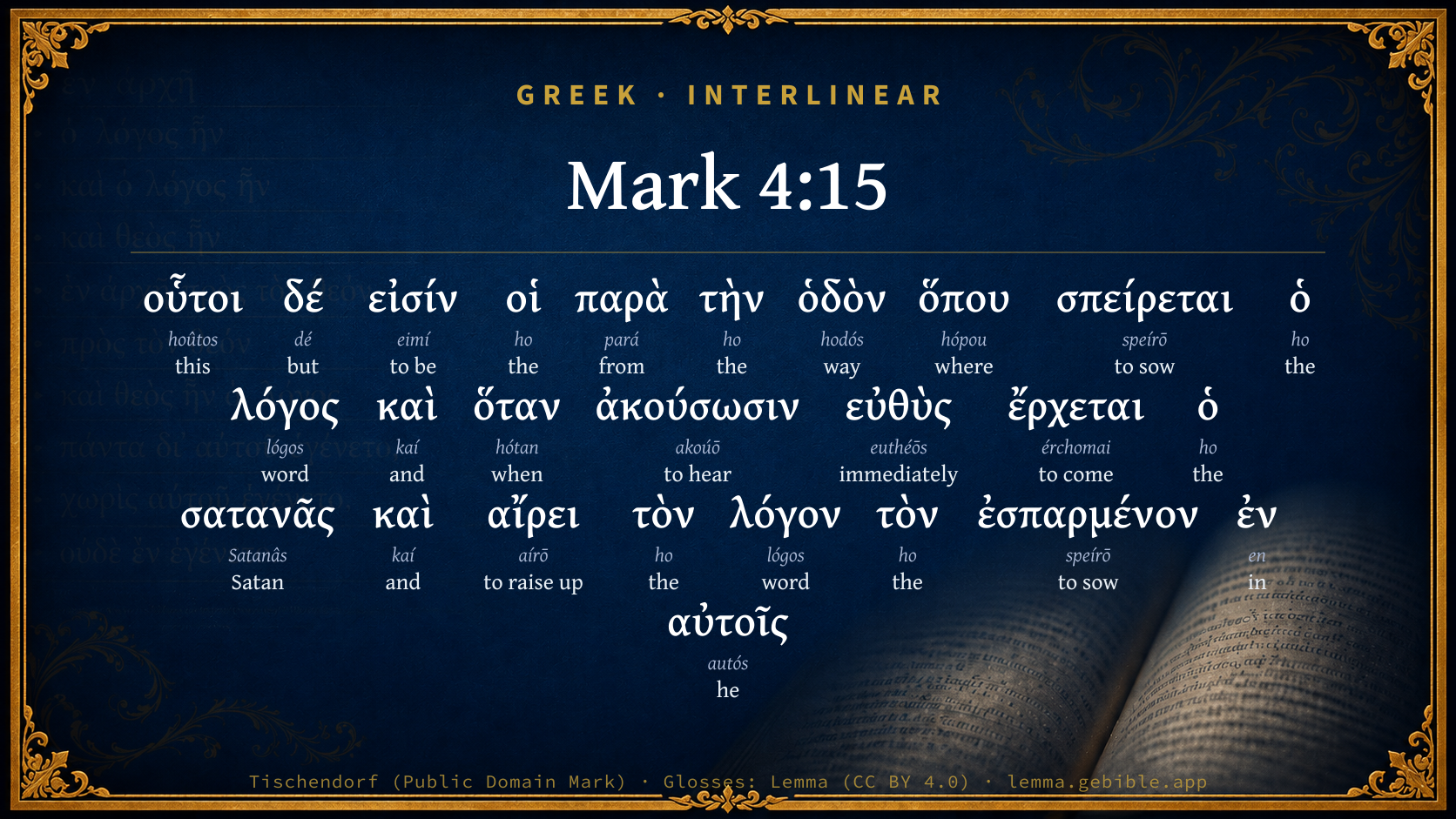
These are the ones by the road, where the word is sown; and when they have heard, immediately Satan comes, and takes away the word which has been sown in them.
Download a study sheet
One document with this verse’s original text, its word-by-word gloss line, the meaning frame, cross-references with their text, attributed commentary, and full source and license credits — printable, and it pastes into notes with its structure intact.
This verse Autodidact and up
A passage Seminary Student
Up to 50 verses in one chapter. A passage sheet keeps up to 6 commentary sources and 12 cross-references per verse, in the order this page ranks them, and says so on the sheet whenever that leaves anything out. Ask for a single verse and you get the Autodidact verse sheet above.
Everything on this page stays free to read, with no account — the sheet is a download of what is already on screen, not access to it.
Compare translations 3
The same verse in 3 English versions, stacked beneath the original-language interlinear above. Click any original word for its lexicon entry.
Each is an independent rendering of the whole verse — the interlinear is not word-aligned to these translations.
Highlighted words mark where these versions differ — a whole-verse word diff, not a word-by-word alignment.
-
World English Bible Public Domain
These are the ones by the road, where the word is sown; and when they have heard, immediately Satan comes, and takes away the word which has been sown in them.
-
King James Version Public Domain
And these are they by the way side, where the word is sown; but when they have heard, Satan cometh immediately, and taketh away the word that was sown in their hearts.
-
unfoldingWord Literal Text CC BY-SA 4.0
Now these are the ones beside the road, where the word is being sown, but whenever they have heard it, Satan immediately comes and takes away the word that was sown in them.
unfoldingWord Literal Text — © unfoldingWord, licensed CC BY-SA 4.0. Word-aligned USFM3 via Door43 (git.door43.org/unfoldingWord/en_ult).
Show all 19 translations
Every available English version of this verse, each an independent rendering of the whole verse.
-
World English Bible Public Domain
These are the ones by the road, where the word is sown; and when they have heard, immediately Satan comes, and takes away the word which has been sown in them.
-
Berean Standard Bible Public Domain
Some are like the seeds along the path, where the word is sown. As soon as they hear it, Satan comes and takes away the word that was sown in them.
-
Majority Standard Bible Public Domain
Some are like the seeds along the path, where the word is sown. As soon as they hear it, Satan comes and takes away the word that was sown in their hearts.
-
King James Version Public Domain
And these are they by the way side, where the word is sown; but when they have heard, Satan cometh immediately, and taketh away the word that was sown in their hearts.
-
American Standard Version (1901) Public Domain
And these are they by the way side, where the word is sown; and when they have heard, straightway cometh Satan, and taketh away the word which hath been sown in them.
-
Revised Version (1885) Public Domain
And these are they by the way side, where the word is sown; and when they have heard, straightway cometh Satan, and taketh away the word which hath been sown in them.
-
Geneva Bible (1599) Public Domain
And these are they that receiue the seede by the wayes side, in whome the worde is sowen: but when they haue heard it, Satan commeth immediatly, and taketh away the worde that was sowen in their heartes.
-
Douay-Rheims (1899) Public Domain
And these are they by the way side, where the word is sown, and as soon as they have heard, immediately Satan cometh and taketh away the word that was sown in their hearts.
-
Young's Literal Translation Public Domain
and these are they by the way where the word is sown: and whenever they may hear, immediately cometh the Adversary, and he taketh away the word that hath been sown in their hearts.
-
Literal Standard Version CC BY-SA 4.0
and these are they by the way where the word is sown: and whenever they may hear, Satan immediately comes, and he takes away the word that has been sown in their hearts.
-
Unlocked Literal Bible CC BY-SA 4.0
These are the ones that fall beside the road, where the word was sown, but when they hear it, Satan immediately comes and takes away the word that was sown in them.
-
unfoldingWord Literal Text CC BY-SA 4.0
Now these are the ones beside the road, where the word is being sown, but whenever they have heard it, Satan immediately comes and takes away the word that was sown in them.
-
Darby Bible Public Domain
and these are they by the wayside where the word is sown, and when they hear, immediately Satan comes and takes away the word that was sown in them.
-
World Messianic Bible Public Domain
The ones by the road are the ones where the word is sown; and when they have heard, immediately Satan comes and takes away the word which has been sown in them.
-
Webster's Bible Public Domain
And these are they by the way-side, where the word is sown; but when they have heard, Satan cometh immediately, and taketh away the word that was sown in their hearts.
-
Free Bible Version CC BY-SA 4.0
The seeds on the path where the word is sown illustrate those who hear the message, but then Satan immediately comes along and takes away the word that's been sown in them.
-
Bible in Basic English Public Domain
And these are they by the wayside, where the word is planted; and when they have given ear, the Evil One comes straight away and takes away the word which has been planted in them.
-
Text-Critical English NT CC BY 4.0
Now some people are like the seed along the path, where the word is sown. When they hear, Satan immediately comes and takes away the word that is sown in their hearts.
-
Tyndale New Testament (1534) Public Domain
And they that are by the wayes syde where the worde is sowen are they to whom assone as they have herde it Satha cometh immediatly and takith awaye the worde that was sowe in their hertes.
Literal Standard Version (2020), Covenant Press — licensed CC BY-SA 4.0. Text via the HelloAO Bible API (eBible.org). Unlocked Literal Bible (unfoldingWord) — licensed CC BY-SA 4.0. Text via the HelloAO Bible API (eBible.org). unfoldingWord Literal Text — © unfoldingWord, licensed CC BY-SA 4.0. Word-aligned USFM3 via Door43 (git.door43.org/unfoldingWord/en_ult). Free Bible Version, Dr. Jonathan Gallagher — licensed CC BY-SA 4.0. Text via the HelloAO Bible API (eBible.org).
Word by word
More ways to search: Search by grammar → Find every occurrence → Compare this word →
Practice this passage: Drill this verse → Learn its vocabulary →
- Appears 36× in the Greek New Testament
- First appears at Matthew 4:10
- Part of Speech
- Noun
- Case
- Nominative
- Number
- Singular
- Gender
- Masculine
Full Thayer's Definition
- οὗτοι hoûtos G3778 “this” Demonstrative pronoun, Nominative, Plural, Masculine
- δέ dé G1161 “but” Conjunction
- εἰσίν eimí G1510 “to be” Verb, Present, Active, Indicative, 3rd person, Plural
- οἱ ho G3588 “the” Article, Nominative, Plural, Masculine
- παρὰ pará G3844 “from” Preposition
- τὴν ho G3588 “the” Article, Accusative, Singular, Feminine
- ὁδὸν hodós G3598 “way” Noun, Accusative, Singular, Feminine
- ὅπου hópou G3699 “where” Adverb
- σπείρεται speírō G4687 “to sow” Verb, Present, Passive, Indicative, 3rd person, Singular
- ὁ ho G3588 “the” Article, Nominative, Singular, Masculine
- λόγος lógos G3056 “word” Noun, Nominative, Singular, Masculine
- καὶ kaí G2532 “and” Conjunction
- ὅταν hótan G3752 “when” Conjunction
- ἀκούσωσιν akoúō G191 “to hear” Verb, Aorist, Active, Subjunctive, 3rd person, Plural
- εὐθὺς euthéōs G2112 “immediately” Adverb
- ἔρχεται érchomai G2064 “to come” Verb, Present, Middle or Passive deponent, Indicative, 3rd person, Singular
- ὁ ho G3588 “the” Article, Nominative, Singular, Masculine
- σατανᾶς Satanâs G4567 “Satan” Noun, Nominative, Singular, Masculine
- καὶ kaí G2532 “and” Conjunction
- αἴρει aírō G142 “to raise up” Verb, Present, Active, Indicative, 3rd person, Singular
- τὸν ho G3588 “the” Article, Accusative, Singular, Masculine
- λόγον lógos G3056 “word” Noun, Accusative, Singular, Masculine
- τὸν ho G3588 “the” Article, Accusative, Singular, Masculine
- ἐσπαρμένον speírō G4687 “to sow” Verb, Perfect, Passive, Participle, Accusative, Singular, Masculine
- ἐν en G1722 “in” Preposition
- αὐτοῖς autós G846 “he” Personal pronoun, Dative, Plural, Masculine
About this verse
These counts appear in no published source. They are computed here, from the morphology-tagged text and Lemma’s own curated glosses. What Lemma adds →
- 26
- words
- 18
- distinct lemmas
- Gospels
- section
Shared distinctive vocabulary
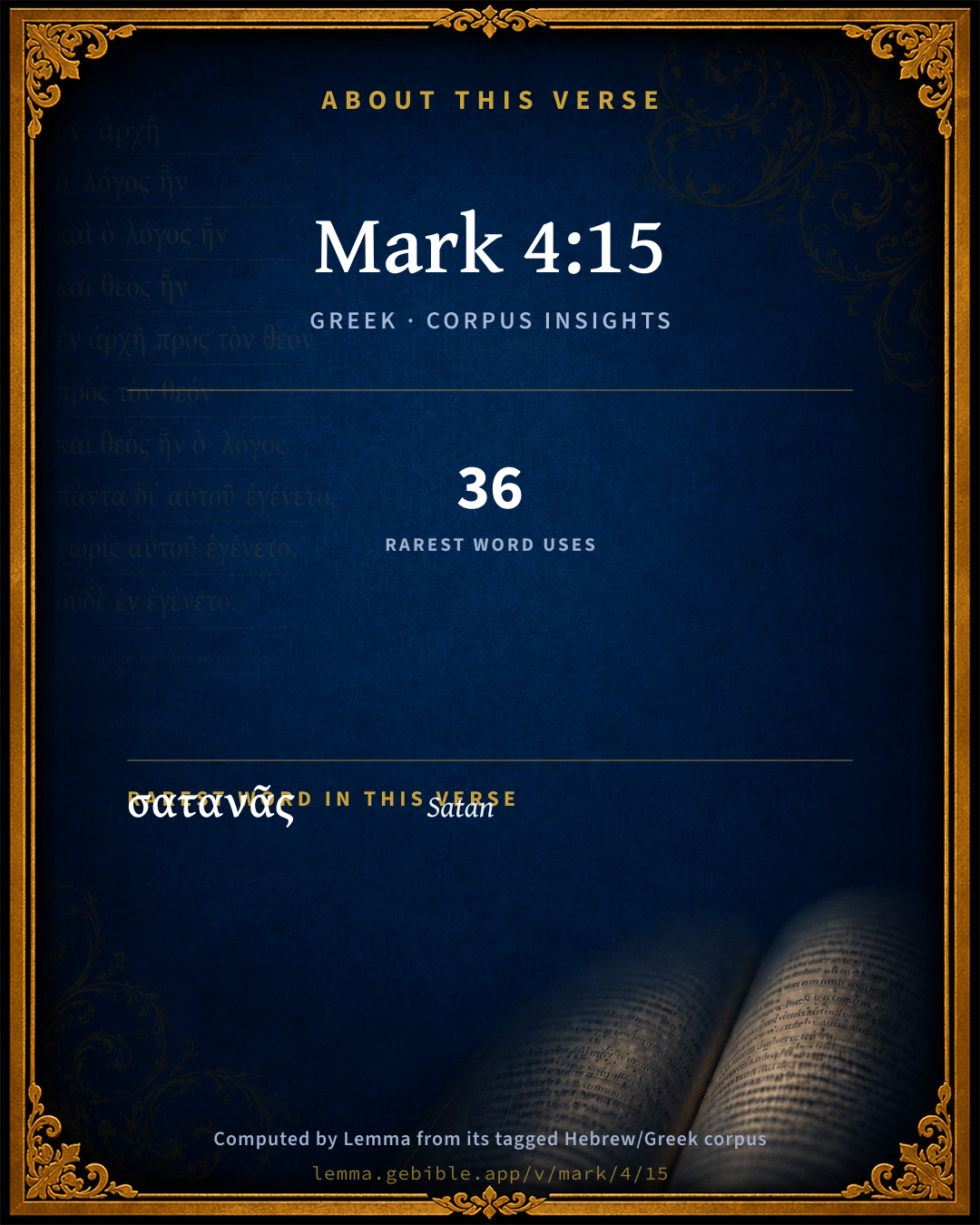
σατανᾶς Satan G4567 occurs in 33 verses of the Greek New Testament. Also found in:
Cross-references
26Topical passages linked to Mark 4:15 in the Treasury of Scripture Knowledge — connected by theme and wording, ordered by reader-vote popularity; previews shown in the World English Bible.
- 1 Peter 5:8 Be sober and self-controlled. Be watchful. Your adversary the devil, walks around like a roaring lion, seeking whom he may devour.
- Matthew 13:19 When anyone hears the word of the Kingdom, and doesn't understand it, the evil one comes, and snatches away that which has been sown in his heart. This is what was sown by the roadside.
- Mark 4:4 and it happened, as he sowed, some seed fell by the road, and the birds came and devoured it.
- Luke 8:12 Those along the road are those who hear, then the devil comes, and takes away the word from their heart, that they may not believe and be saved.
- 2 Corinthians 2:11 that no advantage may be gained over us by Satan; for we are not ignorant of his schemes.
- 2 Corinthians 4:3–4 Even if our Gospel is veiled, it is veiled in those who perish;
- Isaiah 53:1 Who has believed our message? and to whom has the arm of Yahweh been revealed?
- Luke 14:18–19 They all as one began to make excuses. "The first said to him, 'I have bought a field, and I must go and see it. Please have me excused.'
- Acts 5:3 But Peter said, "Ananias, why has Satan filled your heart to lie to the Holy Spirit, and to keep back part of the price of the land?
- Job 1:6–12 Now it happened on the day when the sons of God came to present themselves before Yahweh, that Satan also came among them.
- Matthew 22:5 But they made light of it, and went their ways, one to his own farm, another to his merchandise,
- 2 Thessalonians 2:9 even he whose coming is according to the working of Satan with all power and signs and lying wonders,
- Hebrews 2:1 Therefore we ought to pay greater attention to the things that were heard, lest perhaps we drift away.
- Revelation 20:2–3 He seized the dragon, the old serpent, which is the devil and Satan, who deceives the whole inhabited earth, and bound him for a thousand years,
- Revelation 20:7 And after the thousand years, Satan will be released from his prison,
- Revelation 20:10 The devil who deceived them was thrown into the lake of fire and sulfur, where the beast and the false prophet are also. They will be tormented day and night forever and ever.
- Genesis 19:14 Lot went out, and spoke to his sons-in-law, who were pledged to marry his daughters, and said, "Get up! Get out of this place, for Yahweh will destroy the city." But he seemed to his sons-in-law to be joking.
- Zechariah 3:1 He showed me Joshua the high priest standing before the angel of Yahweh, and Satan standing at his right hand to be his adversary.
- Matthew 4:10 Then Jesus said to him, "Get behind me, Satan! For it is written, 'You shall worship the Lord your God, and him only shall you serve.'"
- Acts 26:31–32 When they had withdrawn, they spoke one to another, saying, "This man does nothing worthy of death or of bonds."
- Revelation 12:9 The great dragon was thrown down, the old serpent, he who is called the devil and Satan, the deceiver of the whole world. He was thrown down to the earth, and his angels were thrown down with him.
- Acts 17:18–20 Some of the Epicurean and Stoic philosophers also were conversing with him. Some said, "What does this babbler want to say?" Others said, "He seems to be advocating foreign deities," because he preached Jesus and the resurrection.
- Acts 17:32 Now when they heard of the resurrection of the dead, some mocked; but others said, "We want to hear you again concerning this."
- Acts 25:19–20 but had certain questions against him about their own religion, and about one Jesus, who was dead, whom Paul affirmed to be alive.
- Hebrews 12:16 lest there be any sexually immoral person, or profane person, as Esau, who sold his birthright for one meal.
- Acts 18:14–17 But when Paul was about to open his mouth, Gallio said to the Jews, "If indeed it were a matter of wrong or of wicked crime, you Jews, it would be reasonable that I should bear with you;
Cross-references courtesy of OpenBible.info (CC BY 4.0).
Where the printed editions differ
1 variantPlaces in this verse where the major printed Greek editions disagree on the wording in a way that affects the translation — a comparison of editions, not a manuscript-by-manuscript collation. The editions are the modern critical texts (Nestlé-Aland 28/27, SBL, Westcott-Hort, Tregelles, Tyndale House) and the traditional texts behind the KJV (the Textus Receptus and the Byzantine/Majority text). It is not a claim about which reading is original.
-
Extra text
ταῖς καρδίαις
“<the> hearts”
In TRByz Not in NA28NA27TynSBLWHTregταῖς καρδίαις (tais kardiais) ' hearts' is only in traditional manuscripts (TR+Byz)
Textual data: Translators Amalgamated Greek New Testament (STEPBible TAGNT) · CC BY 4.0.
Lesson kit
Teaching starters — assembled from the data on this page, not authored interpretation. Every prompt links to the verse data it draws on. Edit before teaching.
Mark, in the Gospels, opens this verse with 26 words (18 distinct Greek lemmas). Its most distinctive word is Satanâs (“Satan”). A historical commentator’s framing appears above. Read the whole chapter for the surrounding context.
Discussion questions
- What does “Satan” (Satanâs) contribute to the verse as a whole?
- How does Matthew 4:10, which shares the word «Satan», read alongside this verse?
- What does the repetition of “to sow” (2× in this one verse) do in this verse?
- These translations render this verse differently; the difference is in the English rendering, not the original. What questions does that raise?
- Compare how Bengel's Gnomon and Expositor's Greek Testament read this verse. Where do they agree or differ?
Things to notice
- These translations choose different wording for 17 words in this verse.
- “to sow” occurs 2× in this single verse.
- 18 distinct Greek lemmas span 26 words in this verse.
Commentary
Notes on Mark 4:15 from classic Christian and Jewish commentators (each source and its license shown beneath its notes). The classic Christian expositions comment on the surrounding passage and are grouped to its opening verse, so a note may address several verses; the Jewish commentaries on the Tanakh (Rashi and others) are per-verse, so they appear only where the commentator wrote on this verse.
Lemma curates 59 commentaries, every one of them public domain or Creative Commons licensed, each selected and text-cleaned for this edition rather than reprinted as found. About our sources →
Bengel's Gnomon
Johann Albrecht Bengel
Bengel's Gnomon of the New Testament — English translation (T&T Clark, Edinburgh, 1860) — public domain. Text from a community e-Sword module.
Expositor's Greek Testament
ed. W. Robertson Nicoll
The Expositor's Greek Testament, edited by W. Robertson Nicoll (1897–1910) — public domain. Text from a community e-Sword module.
Adam Clarke's Commentary
Adam Clarke's Commentary on the Bible (1810–1826) — public domain. Text from a community e-Sword/MySword module.
Ellicott's Commentary for English Readers
A Bible Commentary for English Readers, edited by Charles John Ellicott (1878–1897) — public domain. Text from a community e-Sword module.
The Cambridge Bible for Schools and Colleges
gen. ed. J. J. S. Perowne
The Cambridge Bible for Schools and Colleges (gen. ed. J. J. S. Perowne; Cambridge University Press, 1878–1918) — public domain. Text from a community e-Sword module.
John Gill's Exposition
John Gill's Exposition of the Whole Bible (1746–1763) — public domain (CC PDM 1.0). Text via the HelloAO Bible API.
Whedon's Commentary on the Bible
Daniel D. Whedon
Daniel D. Whedon (gen. ed.), Commentary on the Old and New Testaments (1874–1909) — public domain. Text from a community e-Sword module.
The Pulpit Commentary
The Pulpit Commentary (1880–1919), ed. H.D.M. Spence-Jones & Joseph S. Exell — public domain. Text from a community e-Sword module.
Cambridge Greek Testament for Schools and Colleges
Cambridge Greek Testament for Schools and Colleges (Cambridge University Press, 1896; 21 vols, various authors incl. Carr, Maclear, Plummer, Farrar, Lumby, Moule, M. R. James, Simcox) — public domain. Text from a community e-Sword module.
International Critical Commentary
International Critical Commentary — older volumes (1896–1929), various authors — public domain. Text from a community e-Sword module.