Mark 4:24

Greek (Tischendorf 8th ed.) Mark 4:24 appears in the Greek New Testament. The text above is from the Tischendorf 8th edition. Each word links to its Strong’s number and a concise gloss. Click any word for its full Thayer’s Greek Lexicon entry.
Download image
Cite this verse

Mark 4:24 (World English Bible). Public Domain. Lemma interlinear Bible study tool, https://lemma.gebible.app/v/mark/4/24.

Show BibTeX & RIS
BibTeX
RIS
English Translation
He said to them, "Take heed what you hear. With whatever measure you measure, it will be measured to you, and more will be given to you who hear.
World English Bible · Public Domain
Download a study sheet

One document with this verse’s original text, its word-by-word gloss line, the meaning frame, cross-references with their text, attributed commentary, and full source and license credits — printable, and it pastes into notes with its structure intact.

This verse Autodidact and up

Study sheet (.html) Plain text (.txt)

A passage Seminary Student

Up to 50 verses in one chapter. A passage sheet keeps up to 6 commentary sources and 12 cross-references per verse, in the order this page ranks them, and says so on the sheet whenever that leaves anything out. Ask for a single verse and you get the Autodidact verse sheet above.

Everything on this page stays free to read, with no account — the sheet is a download of what is already on screen, not access to it.

Want to remove ads? Support Godless Engineer
Compare translations 3

The same verse in 3 English versions, stacked beneath the original-language interlinear above. Click any original word for its lexicon entry.

Each is an independent rendering of the whole verse — the interlinear is not word-aligned to these translations.

Highlighted words mark where these versions differ — a whole-verse word diff, not a word-by-word alignment.

  • World English Bible Public Domain
    He said to them, "Take heed what you hear. With whatever measure you measure, it will be measured to you, and more will be given to you who hear.
  • King James Version Public Domain
    And he said unto them, Take heed what ye hear: with what measure ye mete, it shall be measured to you: and unto you that hear shall more be given.
  • unfoldingWord Literal Text CC BY-SA 4.0
    And he was saying to them, “Watch what you hear. With the measure by which you measure, it will be measured to you, and it will be added to you.

unfoldingWord Literal Text — © unfoldingWord, licensed CC BY-SA 4.0. Word-aligned USFM3 via Door43 (git.door43.org/unfoldingWord/en_ult).

Versions to compare (up to 4)

3 of 4 selected

Show all 19 translations

Every available English version of this verse, each an independent rendering of the whole verse.

  • World English Bible Public Domain
    He said to them, "Take heed what you hear. With whatever measure you measure, it will be measured to you, and more will be given to you who hear.
  • Berean Standard Bible Public Domain
    He went on to say, “Pay attention to what you hear. With the measure you use, it will be measured to you, and even more will be added to you.
  • Majority Standard Bible Public Domain
    He went on to say, “Pay attention to what you hear. With the measure you use, it will be measured to you, and even more will be added to you who hear.
  • King James Version Public Domain
    And he said unto them, Take heed what ye hear: with what measure ye mete, it shall be measured to you: and unto you that hear shall more be given.
  • American Standard Version (1901) Public Domain
    And he said unto them, Take heed what ye hear: with what measure ye mete it shall be measured unto you; and more shall be given unto you.
  • Revised Version (1885) Public Domain
    And he said unto them, Take heed what ye hear: with what measure ye mete it shall be measured unto you: and more shall be given unto you.
  • Geneva Bible (1599) Public Domain
    And he said vnto them, Take heede what ye heare. With what measure ye mete, it shall be measured vnto you: and vnto you that heare, shall more be giuen.
  • Douay-Rheims (1899) Public Domain
    And he said to them: Take heed what you hear. In what measure you shall mete, it shall be measured to you again, and more shall be given to you.
  • Young's Literal Translation Public Domain
    And he said to them, `Take heed what ye hear; in what measure ye measure, it shall be measured to you; and to you who hear it shall be added;
  • Literal Standard Version CC BY-SA 4.0
    And He said to them, “Take heed what you hear; in what measure you measure, it will be measured to you; and to you who hear it will be added;
  • Unlocked Literal Bible CC BY-SA 4.0
    He said to them, “Pay attention to what you hear, for the measure you use will be measured to you, and more will be added to you.
  • unfoldingWord Literal Text CC BY-SA 4.0
    And he was saying to them, “Watch what you hear. With the measure by which you measure, it will be measured to you, and it will be added to you.
  • Darby Bible Public Domain
    And he said to them, Take heed what ye hear; with what measure ye mete, it shall be meted to you; and there shall be [more] added to you.
  • World Messianic Bible Public Domain
    He said to them, “Take heed what you hear. With whatever measure you measure, it will be measured to you; and more will be given to you who hear.
  • Webster's Bible Public Domain
    And he said to them, Take heed what ye hear: With the measure which ye give, it shall be measured to you: and to you that hear shall more be given.
  • Free Bible Version CC BY-SA 4.0
    Pay attention to what you're hearing,” he told them, “for you will be given according to how much you want to receive, measure for measure.
  • Bible in Basic English Public Domain
    And he said to them, Take care what you give ear to: in the same measure as you give you will get, and more will be given to you.
  • Text-Critical English NT CC BY 4.0
    Then he said to them, “Consider what you hear. With the measure you use it will be measured to you, and more will be added to you who hear.
  • Tyndale New Testament (1534) Public Domain
    And he sayde vnto them: take hede what ye heare. With what measure ye mete with the same shall it be measured vnto you agayne. And vnto you that heare shall more be geve.

Literal Standard Version (2020), Covenant Press — licensed CC BY-SA 4.0. Text via the HelloAO Bible API (eBible.org). Unlocked Literal Bible (unfoldingWord) — licensed CC BY-SA 4.0. Text via the HelloAO Bible API (eBible.org). unfoldingWord Literal Text — © unfoldingWord, licensed CC BY-SA 4.0. Word-aligned USFM3 via Door43 (git.door43.org/unfoldingWord/en_ult). Free Bible Version, Dr. Jonathan Gallagher — licensed CC BY-SA 4.0. Text via the HelloAO Bible API (eBible.org).

Word by word

More ways to search: Search by grammar → Find every occurrence → Compare this word →

Practice this passage: Drill this verse → Learn its vocabulary →

μετρεῖτε
metréō
G3354
“to measure”
Verb, Present, Active, Indicative, 2nd person, Plural
Part of Speech
Verb
Tense
Present
Voice
Active
Mood
Indicative
Person
2nd person
Number
Plural
Full Thayer's Definition

Origin: from G3358

TDNT: 14:32,6

1. to measure, to measure out or off a. any space or distance with a measurer's reed or rule b. metaph. to judge according to any rule or standard, to estimate 2. to measure out, mete out to, i.e. to give by measure
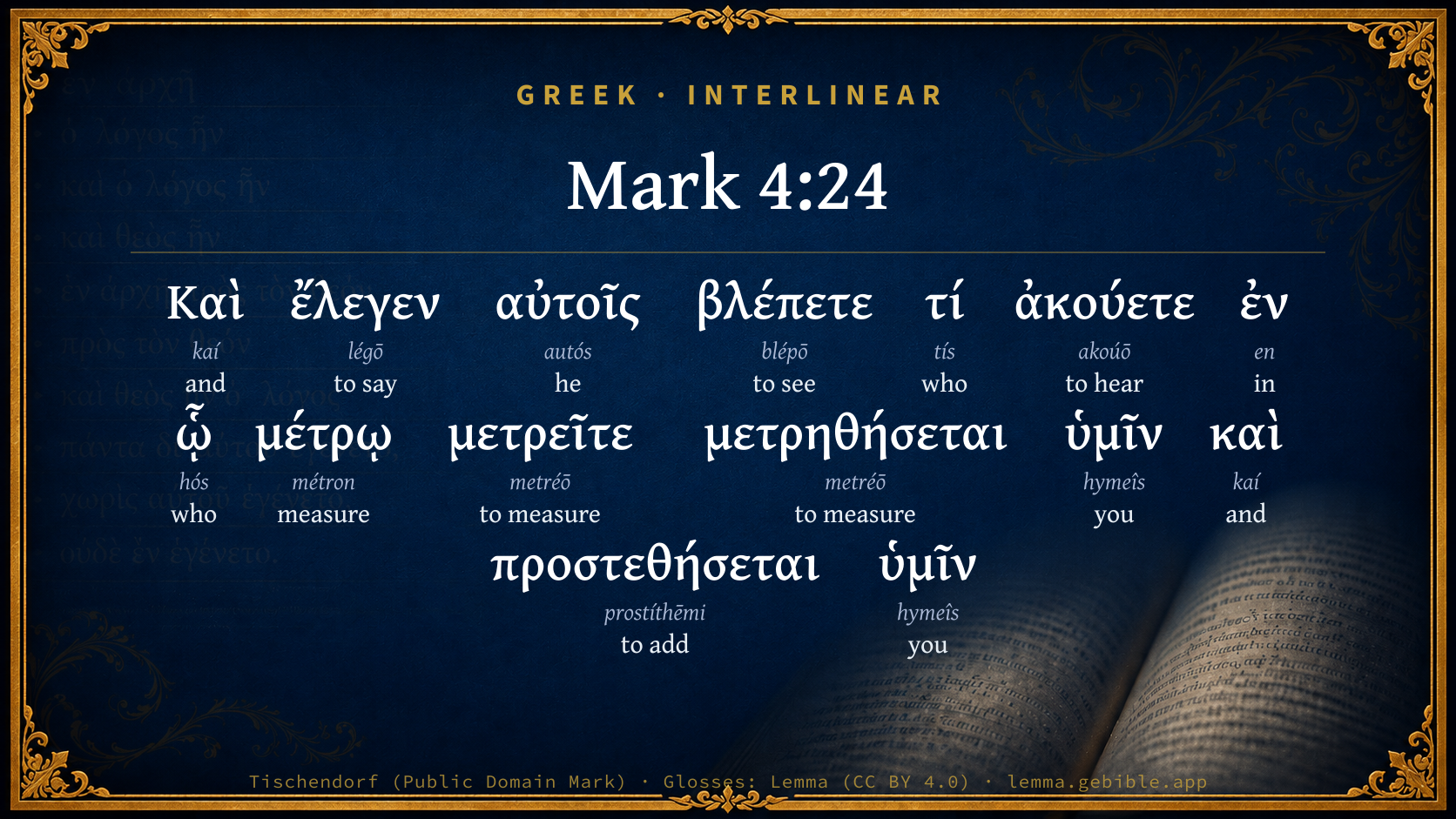
  1. Καὶ kaí G2532 “and” Conjunction
  2. ἔλεγεν légō G3004 “to say” Verb, Imperfect, Active, Indicative, 3rd person, Singular
  3. αὐτοῖς autós G846 “he” Personal pronoun, Dative, Plural, Masculine
  4. βλέπετε blépō G991 “to see” Verb, Present, Active, Imperative, 2nd person, Plural
  5. τί tís G5101 “who” Interrogative pronoun, Accusative, Singular, Neuter
  6. ἀκούετε akoúō G191 “to hear” Verb, Present, Active, Indicative, 2nd person, Plural
  7. ἐν en G1722 “in” Preposition
  8. ᾧ hós G3739 “who” Relative pronoun, Dative, Singular, Neuter
  9. μέτρῳ métron G3358 “measure” Noun, Dative, Singular, Neuter
  10. μετρηθήσεται metréō G3354 “to measure” Verb, Future, Passive, Indicative, 3rd person, Singular
  11. ὑμῖν hymeîs G5210 “you” Personal pronoun, 2nd person, Dative, Plural
  12. καὶ kaí G2532 “and” Conjunction
  13. προστεθήσεται prostíthēmi G4369 “to add” Verb, Future, Passive, Indicative, 3rd person, Singular
  14. ὑμῖν hymeîs G5210 “you” Personal pronoun, 2nd person, Dative, Plural

About this verse

These counts appear in no published source. They are computed here, from the morphology-tagged text and Lemma’s own curated glosses. What Lemma adds →

15
words
12
distinct lemmas
Gospels
section

Notable vocabulary

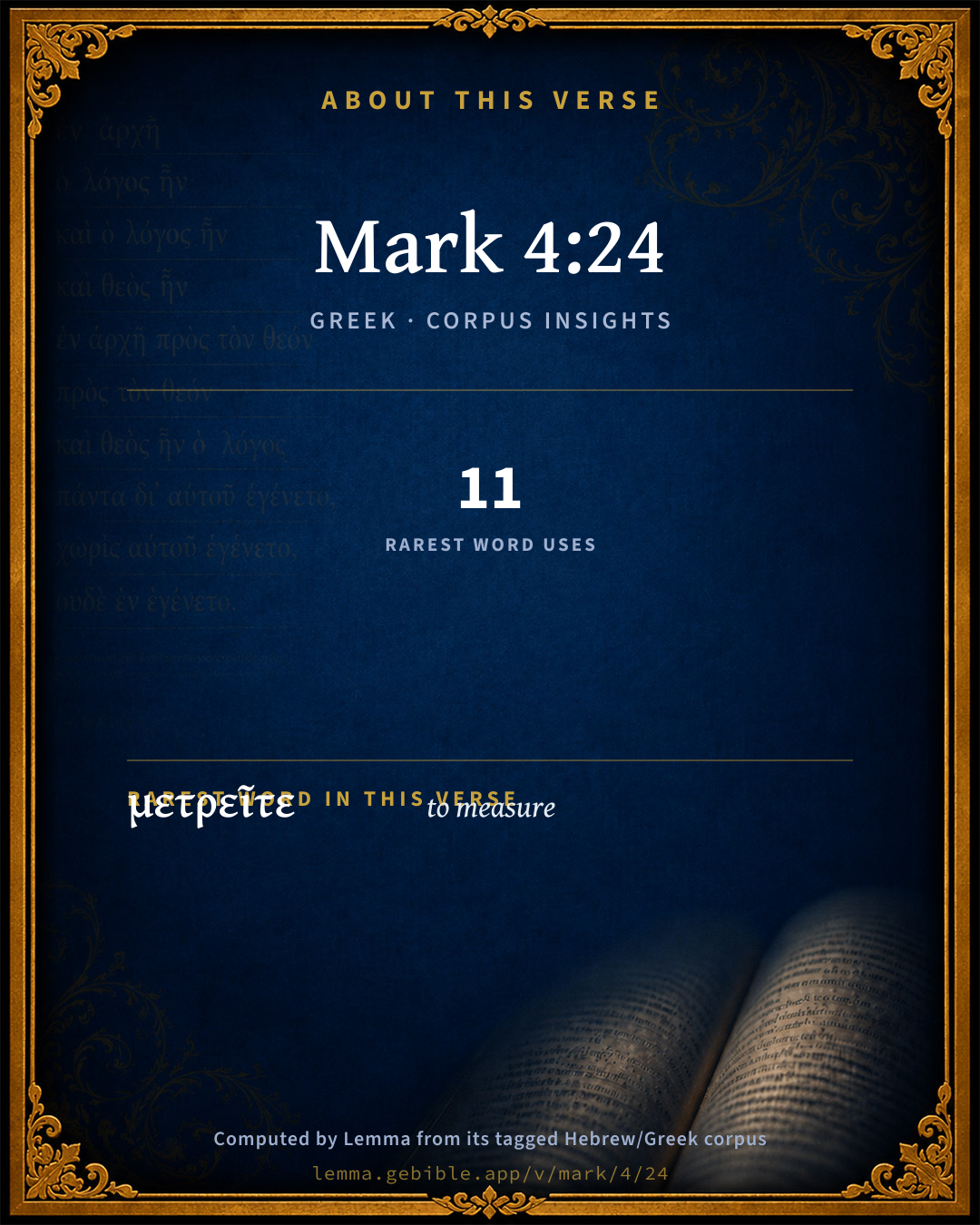
The rarest word here is μετρεῖτε to measure G3354 — appearing just 11 times in the whole Greek New Testament.

Shared distinctive vocabulary

μετρεῖτε to measure G3354 occurs in 9 verses of the Greek New Testament. Also found in:

Repetition

Words recur within this verse:

  • μετρεῖτε to measure G3354 ×2
  • Καὶ and G2532 ×2
  • ὑμῖν you G5210 ×2

Cross-references

15

Topical passages linked to Mark 4:24 in the Treasury of Scripture Knowledge — connected by theme and wording, ordered by reader-vote popularity; previews shown in the World English Bible.

  • Hebrews 2:1 Therefore we ought to pay greater attention to the things that were heard, lest perhaps we drift away.
  • Luke 8:18 Be careful therefore how you hear. For whoever has, to him will be given; and whoever doesn't have, from him will be taken away even that which he thinks he has."
  • Matthew 7:2 For with whatever judgment you judge, you will be judged; and with whatever measure you measure, it will be measured to you.
  • 2 Corinthians 9:6 Remember this: he who sows sparingly will also reap sparingly. He who sows bountifully will also reap bountifully.
  • Acts 17:11 Now these were more noble than those in Thessalonica, in that they received the word with all readiness of the mind, examining the Scriptures daily to see whether these things were so.
  • John 10:27 My sheep hear my voice, and I know them, and they follow me.
  • Proverbs 19:27 If you stop listening to instruction, my son, You will stray from the words of knowledge.
  • Luke 6:37–38 Don't judge, And you won't be judged. Don't condemn, And you won't be condemned. Set free, And you will be set free.
  • Isaiah 55:3 Turn your ear, and come to me; hear, and your soul shall live: and I will make an everlasting covenant with you, even the sure mercies of David.
  • John 5:25 Most assuredly, I tell you, the hour comes, and now is, when the dead will hear the Son of God's voice; and those who hear will live.
  • Mark 9:7 A cloud came, overshadowing them, and a voice came out of the cloud, "This is my beloved Son. Listen to him."
  • John 10:16 I have other sheep, which are not of this fold. I must bring them also, and they will hear my voice. They will become one flock with one shepherd.
  • 2 Peter 2:1–3 But there also arose false prophets among the people, as among you also there will be false teachers, who will secretly bring in destructive heresies, denying even the Master who bought them, bringing on themselves swift destruction.
  • 1 Peter 2:2 as newborn babes, long for the pure milk of the Word, that you may grow thereby,
  • 1 John 4:1 Beloved, don't believe every spirit, but test the spirits, whether they are of God, because many false prophets have gone out into the world.

Cross-references courtesy of OpenBible.info (CC BY 4.0).

Where the printed editions differ

1 variant

Places in this verse where the major printed Greek editions disagree on the wording in a way that affects the translation — a comparison of editions, not a manuscript-by-manuscript collation. The editions are the modern critical texts (Nestlé-Aland 28/27, SBL, Westcott-Hort, Tregelles, Tyndale House) and the traditional texts behind the KJV (the Textus Receptus and the Byzantine/Majority text). It is not a claim about which reading is original.

  1. Extra text
    τοῖς ἀκούουσιν.

    “who are hearing:.”

    In TRByz Not in NA28NA27TynSBLWHTreg

    τοῖς ἀκούουσιν. (tois akouousin) 'who are hearing:.' is only in traditional manuscripts (TR+Byz)

Textual data: Translators Amalgamated Greek New Testament (STEPBible TAGNT) · CC BY 4.0.

Commentary

Notes on Mark 4:24 from classic Christian and Jewish commentators (each source and its license shown beneath its notes). The classic Christian expositions comment on the surrounding passage and are grouped to its opening verse, so a note may address several verses; the Jewish commentaries on the Tanakh (Rashi and others) are per-verse, so they appear only where the commentator wrote on this verse.

Lemma curates 59 commentaries, every one of them public domain or Creative Commons licensed, each selected and text-cleaned for this edition rather than reprinted as found. About our sources →

Tyndale Open Study Notes

Tyndale Open Resources

4:24 Those who listen and respond will be given more understanding, but those outside (4:11-12) will have greater darkness (2 Cor 3:14-16).

Tyndale Open Study Notes — © Tyndale Open Resources, licensed CC BY-SA 4.0. Text via the HelloAO Bible API.

Bengel's Gnomon

Johann Albrecht Bengel

Mar 4:24. Βλέπετε τί ἀκούετε, See [take heed], what ye hear) The seeing organ, which is the more noble sense, directs and modifies the impressions of the hearing: it is the eye, not the ear, that can move itself.—τί, what) We are hearing the word, which is the word of God; account that as a high privilege: Or else the what is to be resolved into the how of Luke: see to it, what kind of a hearing you render to the word.—ἐν ᾧ μέτρῳ, with what measure) The measure alluded to is the heart, with its capabilities, desires, anxiety to impart blessings received to others, and obedience.—προστεθήσεται, it shall be added [more shall be given]) That ye may be not only hearers, but partakers.—τοῖς) as concerns the hearers;[39] comp. on Rom 2:8, as respects such datives. [Engl. Vers. makes the dat. follow προστεθ., “more shall be given to you that fear.”]

[39] The margin of both editions had left the reader to decide as to the omission of this clause, τοῖς ἀκούουσιν. The Gnomon and Vers. Germ. retain it.—E. B.

BCDGLΔc Vulg. omit it. However A, with Rec. Text, supports it.—ED.

Bengel's Gnomon of the New Testament — English translation (T&T Clark, Edinburgh, 1860) — public domain. Text from a community e-Sword module.

Meyer's Critical & Exegetical Commentary

Heinrich August Wilhelm Meyer

Mar_4:24-25. Comp. Luk_8:18.

βλέπετε] Be heedful as to what ye hear; how important it is rightly to understand what is delivered to you by me!

ἐν ᾧ μέτρῳ κ.τ.λ.] A ground of encouragement to heedfulness. It is otherwise in Mat_7:2. In our passage the relation of heedfulness to the knowledge thereby to be attained is described. Euthymius Zigabenus well says: ἐν ᾧ μέτρῳ μετρεῖτε τὴν προσοχὴν, ἐν τῷ αὐτῷ μετρηθήσεται ὑμῖν ἡ γνῶσις, τουτέστιν· ὅσην εἰσφέρετε προσοχὴν, τοσαύτη παραχεθήσεται ὑμῖν γνῶσις, καὶ οὐ μόνον ἐν τῷ τοσαύτη παρασχεθήσεται ὑμῖν γνῶσις, καὶ οὐ μόνον ἐν τῷ αὐτῷ μέτρῳ, ἀλλὰ καὶ πλέον.

Mar_4:25. Reason assigned for the foregoing καὶ προστεθήσεται. The application of the proverbial saying (comp. Mat_13:12; Mat_25:29) is: For if ye (through heedfulness) have become rich in knowledge, ye shall continually receive still larger accession to this riches (that is just the προσ τεθήσεται); but if ye (through heedlessness) are poor in knowledge, ye shall also lose even your little knowledge. Euthymius Zigabenus erroneously refers δοθήσεται only to the γνῶσις, and ἔχῃ to the προσοχήν. So also Theophylact.

Meyer — Critical and Exegetical Commentary on the New Testament — English translation by Peter Christie, edited by Frederick Crombie (T&T Clark, 1880) — public domain. Text from a community e-Sword module.

Expositor's Greek Testament

ed. W. Robertson Nicoll

Mar 4:24 . βλέπετε , etc., take heed what you hear or how ( πῶς , Lk.), see that ye hear to purpose. ἐν ᾧ μέτρῳ , etc. = careful hearing pays, the reward of attention is knowledge ( ἐν ᾧ μέτρῳ μετρεῖτε τὴν προσοχὴν ἐν τῷ αὐτῷ μετρηθήσεται ὑμῖν ἡ γνῶσις , Euthy. Zig.). In Mat 7:2 the apothegm is applied to judging. Such moral maxims admit of many applications. The idea of measuring does not seem very appropriate here. Holtz. (H. C.) thinks Mar 4:24 interrupts the connection. προστεθήσεται implies that the reward will be out of proportion to the virtue; the knowledge acquired to the study devoted to the subject. There shall be given over and above, not to those who hear (T. R., τοῖς ἀκούουσιν ), but to those who think on what they hear. This thought introduces Mar 4:25 , which, in this connection, means: the more a man thinks the more he will understand, and the less a man thinks the less his power of understanding will become. “Whoso hath attention, knowledge will be given to him, and from him who hath not, the seed of knowledge will be taken. For as diligence causes that seed to grow, negligence destroys it,” Euthy.

The Expositor's Greek Testament, edited by W. Robertson Nicoll (1897–1910) — public domain. Text from a community e-Sword module.

Geneva Bible (1599)

Geneva Bible translators

The more liberally that we communicate such gifts as God hath given us with our brethren, the more bountiful will God be toward us.

Geneva Bible (1599) marginal notes — public domain. Text via Bolls.life.

Adam Clarke's Commentary

Verse 24. And unto you that hear shall more be given.] This clause is wanting in DG, Coptic, and four copies of the Itala; and in others, where it is extant, it is variously written. Griesbach has left it out of the text, and supposes it to be a gloss, Whosoever hath, to him shall be given.

Adam Clarke's Commentary on the Bible (1810–1826) — public domain. Text from a community e-Sword/MySword module.

Ellicott's Commentary for English Readers

(24) With what measure ye mete.—See Note on Mat_7:2. The proverb furnishes a good illustration of what has just been said as to our Lord’s method of presenting the same truth under different aspects. In the Sermon on the Mount it appears as the law of retribution, which brings pardon to those who pardon, judgment without mercy to those who show no mercy. Here the law works in another region. With the measure with which we mete our knowledge, God will. in His bounty, bestow more knowledge upon us. The old maxim, Docendo disces (“Thou wilt learn by teaching”), becomes here more than the lesson of experience, and is one with the divine law of equity.

A Bible Commentary for English Readers, edited by Charles John Ellicott (1878–1897) — public domain. Text from a community e-Sword module.

The Cambridge Bible for Schools and Colleges

gen. ed. J. J. S. Perowne

24. with what measure ye mete] According to the measure of your ability and diligence as hearers, ye shall receive instruction, and be enabled to preach to others.

The Cambridge Bible for Schools and Colleges (gen. ed. J. J. S. Perowne; Cambridge University Press, 1878–1918) — public domain. Text from a community e-Sword module.

John Gill's Exposition

But when the fruit is brought forth,.... Unto perfection, and is fully ripe; signifying that when grace is brought to maturity, and faith is performed with power, and the good work begun is perfected; then, as the husbandman,

immediately he putteth the sickle; and cuts it down, and gathers it in;

because the harvest is come; at death or at the end of the world, which the harvest represents: when all the elect of God are called by grace, and grace in them is brought to its perfection, and they have brought forth all the fruit they were ordained to bear, they will then be all gathered in; either by Christ himself who comes into his garden, and gathers his lilies by death; or by the angels, the reapers, at the close of time, who will gather the elect from the four winds; or the ministers of the Gospel, who shall come again with joy, bringing their sheaves with them; being able to observe with pleasure a greater increase, and more fruit of their labours, than they knew of, or expected.

John Gill's Exposition of the Whole Bible (1746–1763) — public domain (CC PDM 1.0). Text via the HelloAO Bible API.

Trapp's Complete Commentary

John Trapp

24 And he said unto them, Take heed what ye hear: with what measure ye mete, it shall be measured to you: and unto you that hear shall more be given.

Ver. 24. Take heed what you hear] As the husbandman is very curious in the choice of his seed.

With what measure you mete] i.e. As you mete to God in duty, so will God mete to you in mercy, Son 1:3.

Shall more be given] sc. If you bring with you a loan of your former hearings. He that hears as he ought, every time he hears he grows something more rich: he picks up the gospel’s pearls, and presents them to God the next time, that he may have more. The good soul cannot be without some daily comings in from Christ.

John Trapp, A Commentary or Exposition upon All the Books of the Old and New Testament (1647–1656) — public domain. Text from a community e-Sword module.

Albert Barnes' Notes on the Bible

Take heed what ye hear - Or, consider well what you hear. Make a good improvement of it.

With what measure ye mete ... - You shall be treated according to the use you make of your opportunities of learning. If you consider it well, and make a good improvement of what you hear, you shall be well rewarded. If not, your reward shall be small. This is a proverbial expression. See it explained in the notes at Mat 7:1-2.

Mete - Measure. With what measure ye measure.

Unto you that hear - To you who are “attentive,” and who improve what you hear.

Albert Barnes' Notes on the Bible (1834–1885) — public domain. Text from a community e-Sword/MySword module.

Haydock's Catholic Bible Commentary

Pay attention then to what you hear this day, that you may retain it, and communicate it to others, you brethren; for as you measure to others, so shall it be meted unto you; yes, more shall be given to you, who receive the word of God, if you be attentive to preserve it yourselves, and to communicate it to your brethren. (Bible de Vence)

George Leo Haydock (1774–1849), Haydock's Catholic Family Bible and Commentary, 1859 edition — public domain. Excludes Psalms (Douay-Rheims chapter numbering differs from Protestant) and Deuterocanonical books (Catholic canon only).

Matthew Poole's English Annotations

Whoso considereth the connection of these words,

with what measure ye mete, &c., with the first words in the verse,

Take heed what ye hear, and compares the former with the parallel texts, Mat 7:2; Luk 6:38, will wonder what the force should be of the argument. For in both the parallel texts the latter words in this verse seem to be used as an argument to persuade them to justice and charity towards men, from the punishments of the violations of the law concerning them, by way of retaliation. Nor are there any sins so ordinarily as those of that kind so punished. But they can have no such force here, following those words, Take heed what ye hear. But, as I said before, there is nothing more usual than diverse applications of the same common saying, or proverbial expression. The saying is true, whether it be understood of men or of God, As we deal with God, so will God deal with us.

Take heed what ye hear. Luke saith, how ye hear. Take heed what ye hear; as much as, Take heed to what you hear, that you may receive the word not as seed by the way side, or in thorny or stony ground, but as in good ground. This seemeth rather to be the sense of our Saviour, than to give a caution by these words to men to examine what they hear, searching the Scriptures whether what they hear doth agree with them, though that also be the duty of all conscientious persons, as appeareth from Act 17:11 For saith our Saviour, God will deal with you as to his providence as you deal with him. If you allow the word of God but a little hearing, you shall reap from it heard little profit and advantage; this appeareth to be the sense from the following words.

And unto you that hear shall more be given; that is, unto you that hear, so as you attend, understand, believe, hearken, and obey, God will give further knowledge of Divine mysteries.

For he that hath, to him shall be given, &c.: another general proverbial expression; See Poole on "Mat 13:12", "Mat 25:29".

Matthew Poole's English Annotations on the Holy Bible (1683–1685) — public domain. Text from a community e-Sword/MySword module.

Whedon's Commentary on the Bible

Daniel D. Whedon

24. Shall be measured to you — In proportion to our earnest listening to the word, and listening with the heart, does God measure out our profit. Much is said nowadays about good preaching, and it is doubtless important. But far more important is good listening. The poorest Gospel preaching, well listened to, is better than eloquence merely enjoyed as a pleasant song that dies with the last sweet note.

Daniel D. Whedon (gen. ed.), Commentary on the Old and New Testaments (1874–1909) — public domain. Text from a community e-Sword module.

The Pulpit Commentary

Take heed what ye hear. Attend, that is, to these words which ye hear from me, that ye may understand them, and commit them to memory, and so be able to communicate them effectually to others. Let none of my words escape you. Our Lord bids us to pay the greatest attention to his words, and so to digest them that we may be able to teach them to others. With what measure ye mete it shall be measured unto you: and more shall be given unto you. Our Lord"s meaning is clearly this: If you freely and plentifully communicate and preach my doctrine to others, you shall receive a corresponding reward. Nay, you shall have a return in far more abundant measure. For thus the fountains, the more water they pour out below, so much the more do they receive from above. Here, then, is great encouragement to all faithful teachers of the Word, of whatever kind; that by how much they give to others in teaching them, by so much the more shall they receive of wisdom and grace from Christ; according to those words of the apostle, "He that soweth bountifully shall reap also bountifully". (2Co_9:6)

Vers. 24, 25. " Measure for measure;" or, the law of equity in its relation to Divine knowledge.

A wider law (Mat_7:2) with special application to spiritual learning. One of the phases of the exactitude of relation between God and man, which yet admits of grace and blessing.

I THE WORD OF GOD MUST BE RIGHTLY ATTENDED TO IN ORDER TO ITS BEING UNDERSTOOD. There is no process of mere mechanical transfer of truth into the nature of man. Experience and progress in truth are subject to the conditions of all intellectual inquiry, and also to special moral ones.

II ACCORDING TO THE PROPORTION OF HEARING WILL BE THE SPIRITUAL BENEFIT.

1. It is to the use of faculties, and not to their mere possession, the reward attaches.

2. The communication of truth is therefore a spiritual discipline. "Quicquid recipitur, recipitur ad modum recipientis." Obedience is the gateway of knowledge. "Holding the truth in unrighteousness," we shall sooner or later lose it; holding it "in a pure conscience" and a willing spirit, we shall advance to the fullness of truth. M.

The Pulpit Commentary (1880–1919), ed. H.D.M. Spence-Jones & Joseph S. Exell — public domain. Text from a community e-Sword module.

John Wesley's Explanatory Notes

Take heed what ye hear - That is, attend to what you hear, that it may have its due influence upon you. With what measure you mete - That is, according to the improvement you make of what you have heard, still further assistance shall be given. And to you that hear - That is, with improvement.

John Wesley, Explanatory Notes Upon the Whole Bible (1754–1765) — public domain. Text via the GEBible commentary corpus.

Kretzmann's Popular Commentary

Paul E. Kretzmann

A further warning:

v. 24. And He said unto them, Take heed what ye hear: with what measure ye mete, it shall be measured to you; and unto you that hear shall more be given.

v. 25. For he that hath, to him shall be given; and he that hath not, from him shall be taken even that which he hath.

Christ here uses some proverbial sayings, quoted by Him elsewhere, in a new connection, Mat 7:2; Mat 13:12. The disciples, and especially the Twelve, were now hearing, being instructed for their work as evangelists, as preachers of the Gospel. Two people may hear the same saying in an entirely different way, with a great difference as to the amount of benefit obtained. It is essential, therefore, that they keep their eyes open and watch what they hear; for careful hearing pays. The reward given to them by Christ will exceed the measure of attention if they are faithful. A Christian that studies his Bible attentively, with the object of finding in it Jesus, the Savior, Joh 5:39, will be surprised by the measure of grace and understanding that will be given to him. The pastor and teacher that searches diligently will almost be overwhelmed by the mass of appropriate material that will be at his command. But a Christian that makes no headway in Bible knowledge will find even the little head knowledge that has still remained with him dull and commonplace; the pastor that does not grow in knowledge or the Scriptures will find himself growing shallow in his sermons and dull in his application. It is the judgment of God upon the indifferent and upon the lazy. "Whoso hath attention, knowledge will be given to him; and from him who hath not the seed of knowledge will be taken. For as diligence causes that seed to grow, negligence destroys it."

Paul E. Kretzmann, Popular Commentary of the Bible (1921–1924) — public domain. Text from a community e-Sword module.

The People's New Testament

B. W. Johnson

24. Take heed what you hear. Luke 8:18 says, “How you hear.” Both admonitions are very important. Our ears should be deaf to evil counsel. We should hear attentively, earnestly and devoutly the word of the Lord.

B. W. Johnson's The People's New Testament with Notes (1889–1891) — public domain. Electronic text from the Christian Classics Ethereal Library (CCEL) ThML edition.

unfoldingWord translationNotes

Door43 World Missions Community

He said to them

"Jesus said to the crowd"

for the measure you use

Possible meanings are 1) Jesus is talking about a literal measure and giving generously to others or 2) this is a metaphor in which Jesus speaks of "understanding" as if it were "measuring." (See: Metaphor)

will be measured to you, and more will be added to you.

This can be stated in active form. AT: "God will measure that amount for you, and he will add it to you" (See: Active or Passive)

to him will be given more ... even what he has will be taken

This can be stated in active form. AT: "to him God will give more ... from him God will take away" or "God will give more to him ... God will take away from him" (See: Active or Passive)

unfoldingWord translationNotes — © Distant Shores Media and the Door43 World Missions Community, licensed CC BY-SA 4.0. Source: git.door43.org/Door43/en_tn.

Cambridge Greek Testament for Schools and Colleges

24. [773][774][775][776][777][778] omit τοῖς ἀκούουσιν.

[773] Codex Sinaiticus. 4th cent. Discovered by Tischendorf in 1859 at the Monastery of St Katharine on Mount Sinai. Now at St Petersburg. The whole Gospel, ending at Mar 16:8. Photographic facsimile, 1911.

[774] Codex Vaticanus. 4th cent., but perhaps a little later than א. In the Vatican Library almost since its foundation by Pope Nicolas V., and one of its greatest treasures. The whole Gospel, ending at Mar 16:8. Photographic facsimile, 1889.

[775] Codex Ephraemi. 5th cent. A palimpsest: the original writing has been partially rubbed out, and the works of Ephraem the Syrian have been written over it; but a great deal of the original writing has been recovered; of Mark we have Mar 1:17 to Mar 6:31, Mar 8:5 to Mar 12:29, Mar 13:19 to Mar 16:20. In the National Library at Paris.

[776] Codex Bezae. 6th cent. Has a Latin translation (d) side by side with the Greek text, and the two do not quite always agree. Presented by Beza to the University Library of Cambridge in 1581. Remarkable for its frequent divergences from other texts. Contains Mark, except Mar 16:15-20, which has been added by a later hand. Photographic facsimile, 1899.

[777] Codex Regius. 8th cent. An important witness. At Paris. Contains Mar 1:1 to Mar 10:15; Mar 10:30 to Mar 15:1; Mar 15:20 to Mar 16:20, but the shorter ending is inserted between Mar 16:8 and Mar 16:9, showing that the scribe preferred it to the longer one.

[778] Codex Sangallensis. 9th or 10th cent. Contains the Gospels nearly complete, with an interlinear Latin translation. The text of Mark is specially good, agreeing often with CL. At St Gall.

24. καὶ ἔλεγεν. The imperf. may be conversational, or it may introduce another caution which He used to give them. Mt. omits.

Βλέπετε. Not quite in the same sense as in Mar 4:12, nor yet as in Mar 13:5; Mar 13:9; Mar 13:23; Mar 13:33, where it means “take heed,” “be on your guard.” Here it is rather Heed, “look at it carefully and see that you understand it.” A.V. and R.V. have “take heed,” which is misleading. Cf. Mar 7:14. Sight, the nobler sense, directs hearing—oculus, non auris, se movet (Beng.)—is not quite the point.

ἐν ᾧ μέτρῳ. “The spiritual profit which you receive from what you hear will depend upon your attention to it and apprehension of it: you will get proportionate return (μετρηθήσεται ὑμῖν), and you will receive a generous addition to it” (προστεθήσεται ὑμῖν). The disciple who heeds what he hears is bounteously repaid. This saying, like the one in Mar 4:22, seems to have been proverbial, and it is applied in quite other ways elsewhere (Mat 7:2; Luk 6:38). “Let the wise man hear and increase in learning” (Pro 1:5); his insight will increase by being used. Bede says that he who loves the word will receive the power to understand what he loves; Euthymius, that the measure of one’s προσοχή is the measure of one’s γνῶσις. On the use of the passive to avoid using the Name of God see Dalman, Words, p. 224.

Cambridge Greek Testament for Schools and Colleges (Cambridge University Press, 1896; 21 vols, various authors incl. Carr, Maclear, Plummer, Farrar, Lumby, Moule, M. R. James, Simcox) — public domain. Text from a community e-Sword module.

Alford’s Greek Testament

Henry Alford

24.] προστ. ὑμῖν (see var. readd.), more shall be added, i.e. more knowledge: so : ἐν ᾧ μέτρῳ μετρεῖτε τὴν προσοχήν, ἐν τῷ αὐτῷ μετρηθήσεται ὑμῖν ἡ γνῶσις, τουτέστιν, ὅσην εἰσφέρετε προσοχήν, τοσαύτη παρασχεθήσεται ὑμῖν γνῶσις, καὶ οὐ μόνον ἐν τῷ αὐτῷ μέτρῳ, ἀλλὰ καὶ πλέον. ὃς ἂν ἔχῃ προσοχήν, δωθήσεται αὐτῷ γνῶσις, κ. ὅς οὐκ ἔχει, καὶ ὅ ἔχει σπέρμα γνώσεως ἀρθήσεται ἀπʼ αὐτοῦ. καθάπερ γὰρ ἡ σπουδὴ αὔξει τὸ τοιοῦτον, οὕτω καὶ ἡ ῥᾳθυμία διαφθείρει. ἐν τῷ κατὰ Ματθαῖον δὲ τρόπον ἕτερον ἐῤῥήθησαν ταῦτα, καὶ κατʼ ἄλλην ἔννοιαν.

Henry Alford, The Greek Testament (1849–1861) — public domain. Text from a community e-Sword module.

International Critical Commentary

24. Καὶ ἔλεγεν αὐτοῖς—and he said to them. See note on v. 21. βλέπετε τί ἀκούετε—Consider what you hear. Not beware what you hear, be on your guard against hearing anything prejudicial to others. This meaning has been given to the words, because of a misunderstanding of the proverb which follows, which has been taken to mean here, as in Mat 7:2, that men will treat you as you treat them. But this leaves the whole thing without any connection with the rest of the discourse, utterly irrelevant. Whereas it is evident that ἀκουέτω and ἀκούετε go together. And v. 25 is connected with this by γὰρ. Some meaning must be found for this, therefore, that will justify this connection. The meaning Consider what you hear is apposite to the connection with a parable which shows the consequences of inconsiderate hearing.

ἑν ᾧ μέτρῳ μετρεῖτε, μετρηθήσεται ὑμῖν—in what measure you measure it will be measured to you. As we have seen, the meaning of this familiar proverb in Mat 7:2 does not fit here. In this passage, it means, Whatever measure you use yourself will be the one in which truth will be measured out to you. If a man accustoms himself to small measures of truth, small measures will be dealt out to him, and vice versa. καὶ προστεθήσεται ὑμῖν—and it shall be increased to you. This is commonly interpreted to mean that not only the same, but a larger measure will be dealt out to them. But this is inconsistent with the statement that in what measure they measure it will be measured to them. προστεθήσεται as well as μετρηθήσεται is modified by ἐν ᾧ μέτρῳ μετρεῖτε. In what measure you measure it shall be measured and increased to you. The measure and increase of their knowledge will both be proportioned to their own measures. Whatever they present will be filled.

Omit τοῖς ἀκούουσιν, who hear, after ὑμῖν, Tisch. Treg. WH. RV. א BCDL Δ 102, etc. Latt. Memph.

International Critical Commentary — older volumes (1896–1929), various authors — public domain. Text from a community e-Sword module.

Lesson kit

Teaching starters — assembled from the data on this page, not authored interpretation. Every prompt links to the verse data it draws on. Edit before teaching.

Mark, in the Gospels, opens this verse with 15 words (12 distinct Greek lemmas). Its most distinctive word is metréō (“to measure”). A historical commentator’s framing appears above. Read the whole chapter for the surrounding context.

Discussion questions

  1. What does “to measure” (metréō) contribute to the verse as a whole?
  2. How does Matthew 7:2, which shares the word «to measure», read alongside this verse?
  3. What does the repetition of “to measure” (2× in this one verse) do in this verse?
  4. These translations render this verse differently; the difference is in the English rendering, not the original. What questions does that raise?
  5. Compare how Tyndale Open Study Notes and Bengel's Gnomon read this verse. Where do they agree or differ?

Things to notice

  • These translations choose different wording for 14 words in this verse.
  • “to measure” occurs 2× in this single verse.
  • 12 distinct Greek lemmas span 15 words in this verse.

Reading settings

Reading text

Shown beneath each verse's original-language words.

Old Testament
Old Testament edition

Read the OT as the Masoretic Hebrew (MT) or the Greek Septuagint (LXX).

English shown for the Greek Septuagint (in the Hebrew ↔ Greek comparison).

Comparing translations? Open the Compare panel on any verse page to stack up to four side by side.