Mark 4:9

Greek (Tischendorf 8th ed.) Mark 4:9 appears in the Greek New Testament. The text above is from the Tischendorf 8th edition. Each word links to its Strong’s number and a concise gloss. Click any word for its full Thayer’s Greek Lexicon entry.
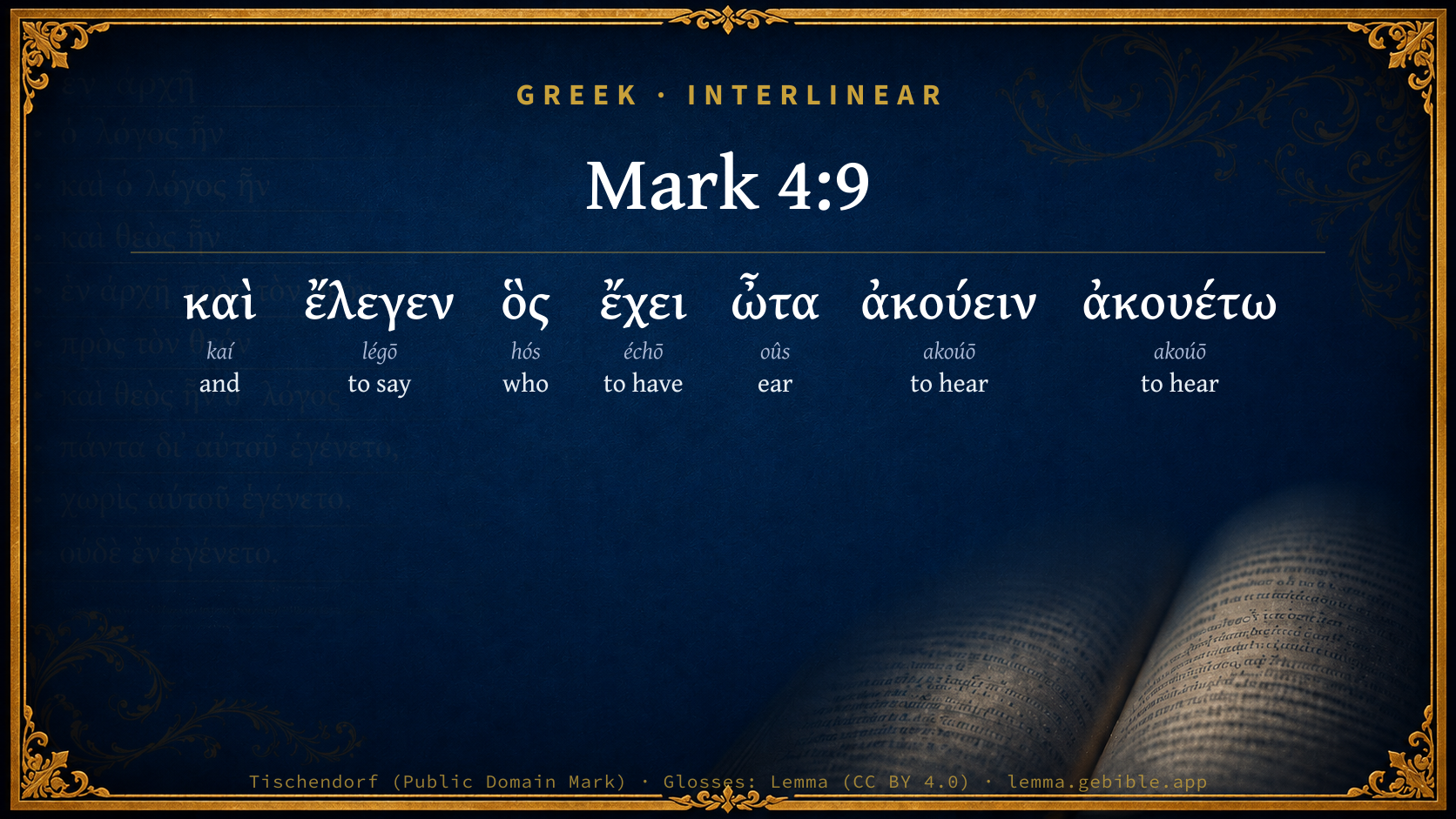
Download image
Cite this verse

Mark 4:9 (World English Bible). Public Domain. Lemma interlinear Bible study tool, https://lemma.gebible.app/v/mark/4/9.

Show BibTeX & RIS
BibTeX
RIS
English Translation
He said, "Whoever has ears to hear, let him hear."
World English Bible · Public Domain
Download a study sheet

One document with this verse’s original text, its word-by-word gloss line, the meaning frame, cross-references with their text, attributed commentary, and full source and license credits — printable, and it pastes into notes with its structure intact.

This verse Autodidact and up

Study sheet (.html) Plain text (.txt)

A passage Seminary Student

Up to 50 verses in one chapter. A passage sheet keeps up to 6 commentary sources and 12 cross-references per verse, in the order this page ranks them, and says so on the sheet whenever that leaves anything out. Ask for a single verse and you get the Autodidact verse sheet above.

Everything on this page stays free to read, with no account — the sheet is a download of what is already on screen, not access to it.

Want to remove ads? Support Godless Engineer
Compare translations 3

The same verse in 3 English versions, stacked beneath the original-language interlinear above. Click any original word for its lexicon entry.

Each is an independent rendering of the whole verse — the interlinear is not word-aligned to these translations.

Highlighted words mark where these versions differ — a whole-verse word diff, not a word-by-word alignment.

  • World English Bible Public Domain
    He said, "Whoever has ears to hear, let him hear."
  • King James Version Public Domain
    And he said unto them, He that hath ears to hear, let him hear.
  • unfoldingWord Literal Text CC BY-SA 4.0
    And he was saying, “Whoever has ears to hear, let him hear!”

unfoldingWord Literal Text — © unfoldingWord, licensed CC BY-SA 4.0. Word-aligned USFM3 via Door43 (git.door43.org/unfoldingWord/en_ult).

Versions to compare (up to 4)

3 of 4 selected

Show all 19 translations

Every available English version of this verse, each an independent rendering of the whole verse.

  • World English Bible Public Domain
    He said, "Whoever has ears to hear, let him hear."
  • Berean Standard Bible Public Domain
    Then Jesus said, “He who has ears to hear, let him hear.”
  • Majority Standard Bible Public Domain
    Then Jesus said, “He who has ears to hear, let him hear.”
  • King James Version Public Domain
    And he said unto them, He that hath ears to hear, let him hear.
  • American Standard Version (1901) Public Domain
    And he said, Who hath ears to hear, let him hear.
  • Revised Version (1885) Public Domain
    And he said, Who hath ears to hear, let him hear.
  • Geneva Bible (1599) Public Domain
    Then he said vnto them, He that hath eares to heare, let him heare.
  • Douay-Rheims (1899) Public Domain
    And he said: He that hath ears to hear, let him hear.
  • Young's Literal Translation Public Domain
    And he said to them, `He who is having ears to hear -- let him hear.'
  • Literal Standard Version CC BY-SA 4.0
    And He said to them, “He who is having ears to hear—let him hear.”
  • Unlocked Literal Bible CC BY-SA 4.0
    Then he said, “Whoever has ears to hear, let him hear!”
  • unfoldingWord Literal Text CC BY-SA 4.0
    And he was saying, “Whoever has ears to hear, let him hear!”
  • Darby Bible Public Domain
    And he said, He that has ears to hear, let him hear.
  • World Messianic Bible Public Domain
    He said, “Whoever has ears to hear, let him hear.”
  • Webster's Bible Public Domain
    And he said to them, He that hath ears to hear, let him hear.
  • Free Bible Version CC BY-SA 4.0
    If you have ears to hear, listen to what I'm saying.”
  • Bible in Basic English Public Domain
    And he said to them, Whoever has ears, let him give ear.
  • Text-Critical English NT CC BY 4.0
    Then he said, “He who has ears to hear, let him hear.”
  • Tyndale New Testament (1534) Public Domain
    And he sayde vnto them: he that hath eares to heare let him heare.

Literal Standard Version (2020), Covenant Press — licensed CC BY-SA 4.0. Text via the HelloAO Bible API (eBible.org). Unlocked Literal Bible (unfoldingWord) — licensed CC BY-SA 4.0. Text via the HelloAO Bible API (eBible.org). unfoldingWord Literal Text — © unfoldingWord, licensed CC BY-SA 4.0. Word-aligned USFM3 via Door43 (git.door43.org/unfoldingWord/en_ult). Free Bible Version, Dr. Jonathan Gallagher — licensed CC BY-SA 4.0. Text via the HelloAO Bible API (eBible.org).

Word by word

More ways to search: Search by grammar → Find every occurrence → Compare this word →

Practice this passage: Drill this verse → Learn its vocabulary →

About this verse

These counts appear in no published source. They are computed here, from the morphology-tagged text and Lemma’s own curated glosses. What Lemma adds →

7
words
6
distinct lemmas
Gospels
section

Shared distinctive vocabulary

ὦτα ear G3775 occurs in 34 verses of the Greek New Testament. Also found in:

Repetition

A word recurs within this verse:

  • ἀκούειν to hear G191 ×2

Cross-references

10

Topical passages linked to Mark 4:9 in the Treasury of Scripture Knowledge — connected by theme and wording, ordered by reader-vote popularity; previews shown in the World English Bible.

  • Matthew 11:15 He who has ears to hear, let him hear.
  • Mark 4:23–24 If any man has ears to hear, let him hear."
  • Revelation 3:22 He who has an ear, let him hear what the Spirit says to the assemblies."
  • Mark 7:14–15 He called all the multitude to himself, and said to them, "Hear me, all of you, and understand.
  • Luke 8:18 Be careful therefore how you hear. For whoever has, to him will be given; and whoever doesn't have, from him will be taken away even that which he thinks he has."
  • Revelation 3:6 He who has an ear, let him hear what the Spirit says to the assemblies.
  • Revelation 3:13 He who has an ear, let him hear what the Spirit says to the assemblies.
  • Matthew 13:9 He who has ears to hear, let him hear."
  • Matthew 15:10 He summoned the multitude, and said to them, "Hear, and understand.
  • Mark 4:3 "Listen! Behold, the farmer went out to sow,

Cross-references courtesy of OpenBible.info (CC BY 4.0).

Commentary

Notes on Mark 4:9 from classic Christian and Jewish commentators (each source and its license shown beneath its notes). The classic Christian expositions comment on the surrounding passage and are grouped to its opening verse, so a note may address several verses; the Jewish commentaries on the Tanakh (Rashi and others) are per-verse, so they appear only where the commentator wrote on this verse.

Lemma curates 59 commentaries, every one of them public domain or Creative Commons licensed, each selected and text-cleaned for this edition rather than reprinted as found. About our sources →

The Cambridge Bible for Schools and Colleges

gen. ed. J. J. S. Perowne

9. He that hath ears to hear] These solemn words are found in the three Gospels. Our Lord is recorded to have used them on six occasions; (1) Mat_11:15; (2) Mat_13:43; (3) Mar_4:9; (4) Mar_4:23; (5) Mar_7:16; (6) Luk_14:35. They are not found in St John’s Gospel, but occur eight times in the Book of Rev_2:7; Rev_2:11; Rev_2:17; Rev_2:29; Rev_3:6; Rev_3:13; Rev_3:22; Rev_13:9.

The Cambridge Bible for Schools and Colleges (gen. ed. J. J. S. Perowne; Cambridge University Press, 1878–1918) — public domain. Text from a community e-Sword module.

The Biblical Illustrator

Joseph S. Exell

Mar_4:9

He that hath ears to hear.

The duty of consideration explained and enforced

1. Our Lord evidently meant, by the language of the text, to remind His hearers that it was an apologue, fable, or parable He had been delivering.

2. By this mode of expression they were further reminded that the several truths veiled under this parable were most interesting and important.

3. The direct purport of the exhortation was, to persuade them to consider what they had heard.

4. He in effect tells them that if they were not benefited by what they heard the fault was rather in their will than their understanding. Who hath ears to hear, let him hear.

I. Let us consider the duty our Saviour inculcates on those to whom the Word is preached.

1. Let us take care to digest properly in our own minds the subject on which we mean to discourse to others.

2. Care also is to be taken about the manner, as well as the matter, of our discourse.

3. That we should look well to our aims and views in discoursing of the great things of God.

4. That our dependence should be firmly placed on the gracious and seasonable influences of the Holy Spirit. And now, thus prepared, we have a right, be our audience who they may, to adopt the language of our Master, and with authority to say, Who hath ears to hear, let him hear. Upon the grounds of common sense as well as religion, we may demand their most serious attention. First, some kind of preparation previous to our hearing the Word. Secondly, how we ought to behave ourselves in the house of God.

Thirdly, a duty lying upon us after we have heard the Word. Recollection is what I mean, together with self-application and prayer.

1. Avoid as much as possible everything that may tend to dissipate the mind, and render it incapable of consideration and recollection.

2. Be not fond of hearing more than you can retain and digest. There is such a thing as intemperance in regard of the mind as well as the body: and if excessive eating may be as hurtful to the constitution as excessive abstinence, it is also true of the mind, that the hearing more than is fit may be very nearly as injurious as the not hearing at all. A great abundance of instruction poured into the ear, without sufficient intermission for reflection and practice, is extremely prejudicial: it confounds the judgment, overburdens the memory, and so jades the mind as to render it incapable of recollecting afterwards what it had heard, and of calmly deliberating thereon.

3. The making a point of retiring at the close of the day, for the purpose of recollection and prayer.

II. To enforce what has been said with suitable motives. And our first argument shall be taken, First, from the decency and fitness of the thing itself. Secondly, let me remind you of the particular obligations you owe to those whose ministrations you attend. Thirdly, it is to be remembered that preaching is a Divine institution; and that they who are called to dispense the gospel, have, by virtue of that call, a claim to the attention of those to whom they are sent. Fourthly, from the momentous nature of the business itself on which we are sent to you. Fifthly, the necessity of consideration in order to our profiting by the Word. Sixthly, there are many obstructions in the way of this duty, the recollection of which ought to have the force of an argument to excite and animate us to it. Seventhly, the authority that enjoins this duty upon us adds infinite weight to all that has been said. Eighthly, and lastly, from the advantage to be expected from consideration. (S. Stennett, D. D.)

A man who did not wish to hear the sermon

An innkeeper, addicted to intemperance, on hearing of the particularly pleasing mode of singing at a church some miles distant, went one Sunday to gratify his curiosity, but with a resolution not to hear a word of the sermon. Having with difficulty found admission into a narrow, open pew, as soon as the hymn before sermon was sung, which he heard with great attention, he secured both his ears against the sermon with his forefingers. He had not been in this position many minutes, before the prayer finished, and the sermon commenced with a powerful appeal to the consciences of his hearers, of the necessity of attending to the things which belonged to their eternal peace; and the minister, addressing them solemnly, said: He that hath ears to hear, let him hear. Just the moment before these words were pronounced, a fly having fastened on the face of the innkeeper, and stung him sharply, he drew one of his fingers from his ear and struck off the painful visitant. At that very moment the words, He that hath ears to hear, let him hear, pronounced with great solemnity, entered the ear that was opened, like a clap of thunder. It struck him with irresistible force: he kept his hand from returning to his ear, and, feeling an impression he had never known before, he presently withdrew the other finger, and listened with deep attention to the discourse which followed. A salutary change was produced on him. He abandoned his former evil ways, became truly serious, and for many years went, in all weather, six miles to the church where his soul was awakened from its spiritual slumber. After about eighteen years faithful and close walk with God, he died, rejoicing in the hope of that glory which he now enjoys.

Hearing the gospel not to be vitiated by a faulty faculty

The eye, indeed, is seldom blinded to exclude the most trifling object that might afford us pleasure, and the ear is never shut to anything that might contribute to our amusement; yet reason is often hoodwinked to the precepts of virtue, and our consciences are suffered to slumber and to sleep, while we follow the gratifications of appetite and passion. Thus it was that many, fettered with prejudice and superstition, blinded by ignorance and pride, or enslaved to the world, could hear the Son of God Himself inculcate the sublimest truths, and teach the most important duties, with insulting scorn or listless indifference. Against such dreadful perversion and abuse of the talent entrusted to our care let us be ever on our guard. Let us consider that, on the duo improvement of our faculties, from the benefits of experience, and the discipline of religion, every real blessing is founded. (J. Howlett, B. D.)

Hearing the gospel not to be vitiated by moral insensibility

Perhaps you hear with comfort and satisfaction those vices forbidden of which you are in no danger, from inclination, from your natural constitution, or from some peculiar circumstance of life. When you are old, you might with pleasure listen to such admonitions as chiefly regard the errors of the young; and while in the full enjoyment of happiness and prosperity, you might, with a degree of self-approbation, join in the condemnation of such wickedness and disorder as relate only to the wretched and the poor. On such occasions, perhaps, you will allow the Word of God to resemble a two-edged sword, and to speak with power. But say, are you so willing to hear it, when it calls aloud against some darling vice? when it arraigns your favourite indulgences, or curtails you of sinful pleasures? (J. Howlett, B. D.)

Hearing the gospel constant

Farther, if we are really interested in those things which belong unto our peace, we should endeavour to make that interest uniform and constant. It should extend to all our actions; it should be the rule and measure of our conduct; and its influence should be felt as a gentle, but powerful, corrective throughout the whole system of life. As for those casual emotions which arise only during the moments of exhortation, or those frail resolutions which are formed only when no temptation is near, and which, in the conflux of worldly passions and pleasures, are as soon lost as the brook that mingles with the ocean, of what avail are they? (J. Howlett, B. D.)

Heedful hearing

I. Let us seek, in the beginning, to discriminate and classify the ordinary hearers of the Word as they show themselves in the sight of the preacher.

1. For one class, he would be sure to see the listless hearers. He might discover in various parts of the audience room those whose countenances would defy all study. They are perfect blanks. No more life appears than there would be discovered in a gallery of statuary. Some will be asleep. Some there will be who hear the sound of the words, but so inattentively and unintelligently that nothing is regarded as it passes their ears. The sentences fall on their organs like the ordinary ticking of a clock; they disturb no sensibility whatsoever. We should judge that they attracted no attention of any sort if it were not that the eyes flash up suddenly with an eager curiosity if, for some reason, the sound happens to stop.

2. Next, this visitor in the pulpit would notice the criticising hearers.

3. Yet a third class might be singled out: the suspicious bearers. These are continually on the look-out, not exactly, in our times, for heterodoxy, but for eccentricities. They are afraid the preacher will say something inconsistent with the established views they cherish.

4. Then there is a fourth class: the distributing hearers. Some most devout people always listen for the sake of the rest of the congregation.

II. Let us seek now, in the second place, to discriminate and classify the ordinary hearers of the Word as they appear in the sight of the world at large. Here comes in the question as to results rather than mere behaviour. We fall back upon the parable of the sower; it was given as our Saviours illustration of the effect of the truth as it is thrown upon human hearts like seed upon different soils.

1. To begin with, there are the wayside hearers. Let us read over the old story, and lay alongside of the description at once our Lords interpretation. (See Mar_4:4; Mar_4:15.)

King Agrippa (Act_26:28) is instanced to us as an example. He went with great pomp to hear the Apostle Paul preach. That earnest and powerful pleader laid the truth on his heart, as if he would plough and harrow it into his life. But the devils birds were near to pick up the seed. Pride came with her glittering pinions, and chirped in his ear, Thou art a king, but who is this tent-maker? Lust croaked behind Pride, and had something to say about giving up Berenice. So they came one after another, picked up the grain, and flew away.

2. Then our Lord mentions the stony ground hearers, and afterwards tells His disciples what He means. (See Mar_4:5; Mar_4:15.)

Paul had some of these hearers among his converts in Galatia (Gal_5:7). Christ had some among His followers in Galilee: their earth was only surface soil (Joh_6:66).

3. Next, our Lord classifies the thorn-choked hearers. A peculiar kind of thorn in that country grows suddenly and rankly, and seems to love the borders of wheat fields (Mar_4:7; Mar_4:18). Demass history has been offered us for an illustration of this short-lived sort of emotion, in one melancholy sentence of Pauls Second Epistle to Timothy (2Ti_4:10). Perhaps the saddest of all experiences we have to meet is found in this watching of people who promise so much but who come to so little.

4. Then our Saviour speaks of the good-ground hearers in the parable. But for such, seed-sowing would be a failure. (See Mar_4:8; Mar_4:20.)

The great source of comfort to a preacher of the gospel is found here; the principal field of his labour is good ground. He is sustained by two promises, one about the seed (Isa_55:10-11), and one about the sower (Psa_126:5-6).

III. Let us now, in the third place, look upon those who hear the Word as they appear in the sight of God. (C. S. Robinson, D. D.)

The Biblical Illustrator, edited by Joseph S. Exell (c. 1880s–1900s) — public domain. Text from a community e-Sword module.

Bengel's Gnomon

Johann Albrecht Bengel

Mar 4:9. Ἔλεγεν, He said) Frequent pauses are interposed in the case of the weightiest discourses like this: Mar 4:13; Mar 4:21; Mar 4:24; Mar 4:26; Mar 4:30.

Bengel's Gnomon of the New Testament — English translation (T&T Clark, Edinburgh, 1860) — public domain. Text from a community e-Sword module.

Expositor's Greek Testament

ed. W. Robertson Nicoll

Mar 4:9 . καὶ ἔλεγεν : this phrase is wanting in Mt., and the summons to reflection is more pithily expressed there = who hath ears let him hear. The summons implies that understanding is possible even for those without.

The Expositor's Greek Testament, edited by W. Robertson Nicoll (1897–1910) — public domain. Text from a community e-Sword module.

Adam Clarke's Commentary

Verse 9. And he said - He that hath ears to hear, let him hear.] The Codex Bezae, later Syriac in the margin, and seven copies of the Itala, add, και ὁ συνιων συνιετω, and whoso understandeth, let him understand.

Adam Clarke's Commentary on the Bible (1810–1826) — public domain. Text from a community e-Sword/MySword module.

John Gill's Exposition

And when he was alone,.... After the multitude was dismissed, and he either remained in the ship, or left it, and retired to some private place, it may be to Simon's house in Capernaum. The Syriac, Persic, and Ethiopic versions read, "when they were alone"; meaning as follows,

they that were about him with the twelve; that is, such disciples of his, who, besides the twelve, constantly attended him; perhaps those who now were, or hereafter were the seventy disciples. The Vulgate Latin reads, "the twelve that were with him". In Beza's most ancient copy it is read, "his disciples"; and to this agrees the Persic version; and so the other evangelists, Matthew and Luke, relate, that his disciples came and

asked of him the parable; the meaning of it, and why he chose this way of speaking to the people, Mat 13:10, though that word may include others besides the twelve.

John Gill's Exposition of the Whole Bible (1746–1763) — public domain (CC PDM 1.0). Text via the HelloAO Bible API.

Trapp's Complete Commentary

John Trapp

9 And he said unto them, He that hath ears to hear, let him hear.

Ver. 9. He that hath ears, &c.] A form of speech to stir up attention; like the Athenian, Ακουσατε, ανδρες; and our Oyez, from the French. Our Saviour cried and said so, saith St Luke.

John Trapp, A Commentary or Exposition upon All the Books of the Old and New Testament (1647–1656) — public domain. Text from a community e-Sword module.

The Pulpit Commentary

And he said, Who hath ears to hear, let him hear. St. Luke (Luk_8:8) bus a stronger word than (elegen) "he said." He (Luk_8:8) has (efwnei) "he cried." Our Lord uses this expression, "he that hath ears to hear," etc, when the subject-matter is figurative or obscure, as though to rouse the attention of his hearers. He has "ears to hear" who diligently attends to the words of Christ, that he may ponder and obey them. Many heard him out of curiosity, that they might bear something new, or learned, or brilliant; not that they might lay to heart the things which they heard, and endeavor to practice them in their lives. And so it is with those who go to hear sermons on account of the fame of the preacher, and not that they may learn to amend their lives; and thus the words of Jehovah to Ezekiel (Eze_33:32) are fulfilled, "And, lo, thou art unto them as a very lovely song of one that hath a pleasant voice, and can play well on an instrument: for they hear thy words, but they do them not."

The Pulpit Commentary (1880–1919), ed. H.D.M. Spence-Jones & Joseph S. Exell — public domain. Text from a community e-Sword module.

Godbey's Commentary on the New Testament

William B. Godbey

JOHN WINDS UP THE OLD DISPENSATION

“For all the prophets and the law prophesied unto John. And if you wish to receive him, this is Elijah who is to come.” (Mal 3:1) “Let the one having ears to hear, hear.” Though all have physical ears, they never can hear the voice of God and the music of heaven till Jesus speaks the Ephthatha, “Be thou opened.” The above Scriptures settle all questions as to the boundaries of the dispensations, showing clearly that John the Baptist did actually wind up the Mosaic dispensation, being the last of the prophets and the greatest of all.

William B. Godbey, Commentary on the New Testament (1896–1900) — public domain. Text from a community e-Sword module.

Cambridge Greek Testament for Schools and Colleges

9. [695][696][697][698][699][700][701] omit αὐτοῖς.

[695] Codex Sinaiticus. 4th cent. Discovered by Tischendorf in 1859 at the Monastery of St Katharine on Mount Sinai. Now at St Petersburg. The whole Gospel, ending at Mar 16:8. Photographic facsimile, 1911.

[696] Codex Alexandrinus. 5th cent. Brought by Cyril Lucar, Patriarch of Constantinople, from Alexandria, and afterwards presented by him to King Charles I. in 1628. In the British Museum. The whole Gospel. Photographic facsimile, 1879.

[697] Codex Vaticanus. 4th cent., but perhaps a little later than א. In the Vatican Library almost since its foundation by Pope Nicolas V., and one of its greatest treasures. The whole Gospel, ending at Mar 16:8. Photographic facsimile, 1889.

[698] Codex Ephraemi. 5th cent. A palimpsest: the original writing has been partially rubbed out, and the works of Ephraem the Syrian have been written over it; but a great deal of the original writing has been recovered; of Mark we have Mar 1:17 to Mar 6:31, Mar 8:5 to Mar 12:29, Mar 13:19 to Mar 16:20. In the National Library at Paris.

[699] Codex Bezae. 6th cent. Has a Latin translation (d) side by side with the Greek text, and the two do not quite always agree. Presented by Beza to the University Library of Cambridge in 1581. Remarkable for its frequent divergences from other texts. Contains Mark, except Mar 16:15-20, which has been added by a later hand. Photographic facsimile, 1899.

[700] Codex Regius. 8th cent. An important witness. At Paris. Contains Mar 1:1 to Mar 10:15; Mar 10:30 to Mar 15:1; Mar 15:20 to Mar 16:20, but the shorter ending is inserted between Mar 16:8 and Mar 16:9, showing that the scribe preferred it to the longer one.

[701] Codex Sangallensis. 9th or 10th cent. Contains the Gospels nearly complete, with an interlinear Latin translation. The text of Mark is specially good, agreeing often with CL. At St Gall.

9. ἔλεγεν. Perhaps this concluding appeal, corresponding to the opening Ἀκούετε, was uttered more than once. Cf. Mar 4:23; Luk 14:35; Mat 11:15; Mat 13:43. Deu 29:4 may be the basis. In Rev. we have the sing., ὁ ἔχων οὖς Rev 2:7; Rev 2:11; Rev 2:17; Rev 2:29, Rev 3:6; Rev 3:13; Rev 3:22), and there, as in the Gospels, the appeal is made by Christ. Rev 13:9 is an exception.

Cambridge Greek Testament for Schools and Colleges (Cambridge University Press, 1896; 21 vols, various authors incl. Carr, Maclear, Plummer, Farrar, Lumby, Moule, M. R. James, Simcox) — public domain. Text from a community e-Sword module.

International Critical Commentary

9. Και ἔλεγεν, ὃς ἔχει ὦτα ἀκούειν, ἀκουέτω—And he said, He who hath ears to hear, let him hear. This is a familiar expression of our Lord’s used by him to call attention to what is especially worth hearing. Ye who have ears, prepare to use them now.

Omit αὐτοῖς, to them, after ἔλεγεν, Tisch. Treg. WH. RV. א ABCDL Δ Latt. Memph. Syrr. etc. ὃς ἔχει, instead of ὁ ἔχων, Tisch. Treg. WH. RV. א BC* D Δ.

International Critical Commentary — older volumes (1896–1929), various authors — public domain. Text from a community e-Sword module.

Lesson kit

Teaching starters — assembled from the data on this page, not authored interpretation. Every prompt links to the verse data it draws on. Edit before teaching.

Mark, in the Gospels, opens this verse with 7 words (6 distinct Greek lemmas). Its most distinctive word is oûs (“ear”). A historical commentator’s framing appears above. Read the whole chapter for the surrounding context.

Discussion questions

  1. What does “ear” (oûs) contribute to the verse as a whole?
  2. Matthew 10:27 shares the word «ear» with this verse. How do the two illuminate each other?
  3. “to hear” occurs 2× in this one verse. What is the effect of the repetition?
  4. These translations render this verse differently. What is at stake in choosing one wording over another?
  5. Reading how The Cambridge Bible for Schools and Colleges and The Biblical Illustrator read this verse, where do the two commentators agree and where do they part?

Things to notice

  • These translations choose different wording for 4 words in this verse.
  • “to hear” occurs 2× in this single verse.
  • 6 distinct Greek lemmas span 7 words in this verse.

Reading settings

Reading text

Shown beneath each verse's original-language words.

Old Testament
Old Testament edition

Read the OT as the Masoretic Hebrew (MT) or the Greek Septuagint (LXX).

English shown for the Greek Septuagint (in the Hebrew ↔ Greek comparison).

Comparing translations? Open the Compare panel on any verse page to stack up to four side by side.