Mark 8:16

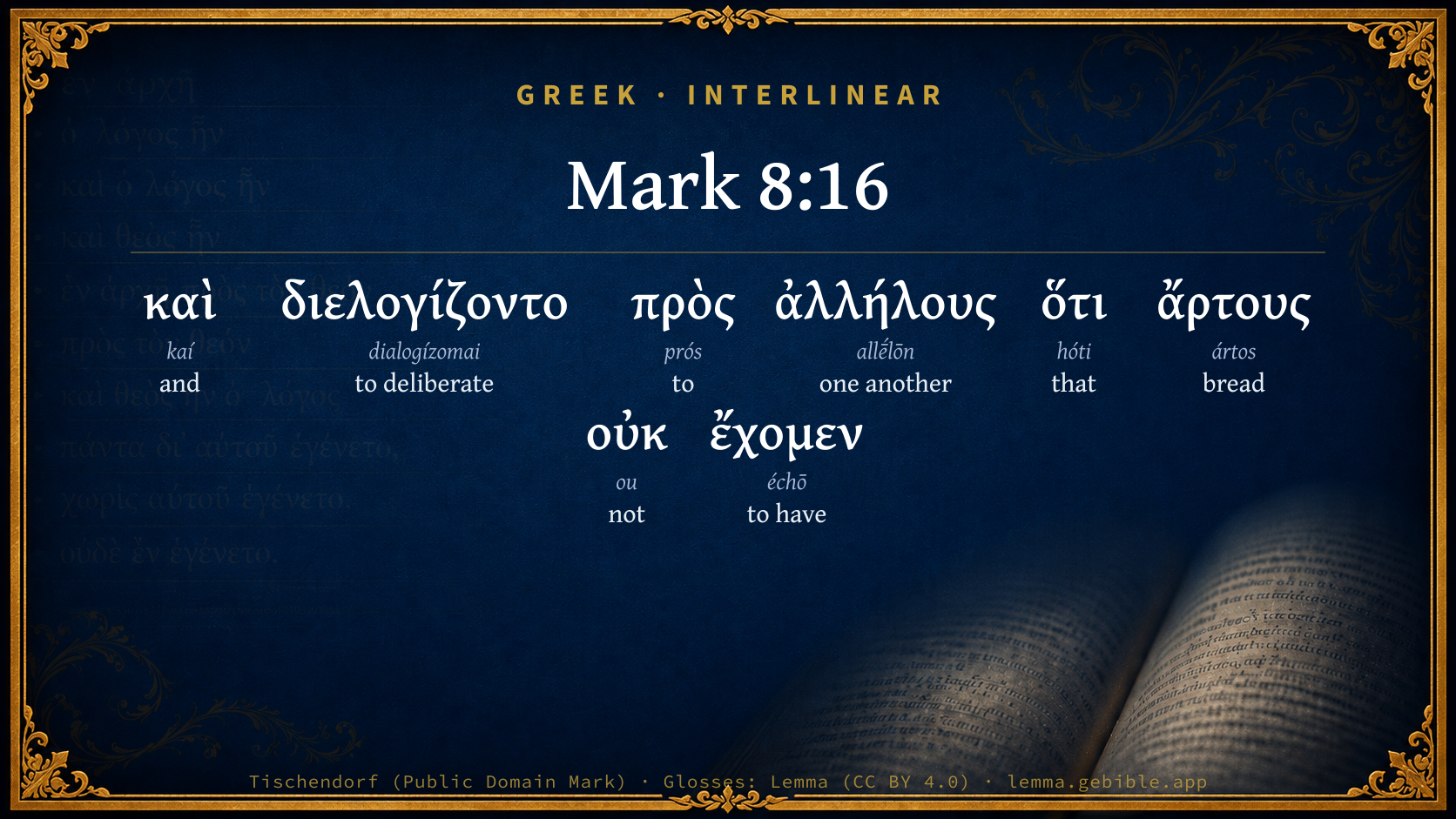
Greek (Tischendorf 8th ed.) Mark 8:16 appears in the Greek New Testament. The text above is from the Tischendorf 8th edition. Each word links to its Strong’s number and a concise gloss. Click any word for its full Thayer’s Greek Lexicon entry.
Download image
Cite this verse

Mark 8:16 (World English Bible). Public Domain. Lemma interlinear Bible study tool, https://lemma.gebible.app/v/mark/8/16.

Show BibTeX & RIS
BibTeX
RIS
English Translation
They reasoned with one another, saying, "It's because we have no bread."
World English Bible · Public Domain
Download a study sheet

One document with this verse’s original text, its word-by-word gloss line, the meaning frame, cross-references with their text, attributed commentary, and full source and license credits — printable, and it pastes into notes with its structure intact.

This verse Autodidact and up

Study sheet (.html) Plain text (.txt)

A passage Seminary Student

Up to 50 verses in one chapter. A passage sheet keeps up to 6 commentary sources and 12 cross-references per verse, in the order this page ranks them, and says so on the sheet whenever that leaves anything out. Ask for a single verse and you get the Autodidact verse sheet above.

Everything on this page stays free to read, with no account — the sheet is a download of what is already on screen, not access to it.

Want to remove ads? Support Godless Engineer
Compare translations 3

The same verse in 3 English versions, stacked beneath the original-language interlinear above. Click any original word for its lexicon entry.

Each is an independent rendering of the whole verse — the interlinear is not word-aligned to these translations.

Highlighted words mark where these versions differ — a whole-verse word diff, not a word-by-word alignment.

  • World English Bible Public Domain
    They reasoned with one another, saying, "It's because we have no bread."
  • King James Version Public Domain
    And they reasoned among themselves, saying, It is because we have no bread.
  • unfoldingWord Literal Text CC BY-SA 4.0
    And they were reasoning with each other that they have no loaves.

unfoldingWord Literal Text — © unfoldingWord, licensed CC BY-SA 4.0. Word-aligned USFM3 via Door43 (git.door43.org/unfoldingWord/en_ult).

Versions to compare (up to 4)

3 of 4 selected

Show all 19 translations

Every available English version of this verse, each an independent rendering of the whole verse.

  • World English Bible Public Domain
    They reasoned with one another, saying, "It's because we have no bread."
  • Berean Standard Bible Public Domain
    So they began to discuss with one another the fact that they had no bread.
  • Majority Standard Bible Public Domain
    So they began to discuss this with one another, saying, “It is because we have no bread.”
  • King James Version Public Domain
    And they reasoned among themselves, saying, It is because we have no bread.
  • American Standard Version (1901) Public Domain
    And they reasoned one with another, saying, We have no bread.
  • Revised Version (1885) Public Domain
    And they reasoned one with another, saying, We have no bread.
  • Geneva Bible (1599) Public Domain
    And they reasoned among themselues, saying, It is, because we haue no bread.
  • Douay-Rheims (1899) Public Domain
    And they reasoned among themselves, saying: Because we have no bread.
  • Young's Literal Translation Public Domain
    and they were reasoning with one another, saying -- `Because we have no loaves.'
  • Literal Standard Version CC BY-SA 4.0
    and they were reasoning with one another, saying, “Because we have no loaves.”
  • Unlocked Literal Bible CC BY-SA 4.0
    The disciples reasoned with each other, “It is because we have no bread.”
  • unfoldingWord Literal Text CC BY-SA 4.0
    And they were reasoning with each other that they have no loaves.
  • Darby Bible Public Domain
    And they reasoned with one another, [saying], It is because we have no bread.
  • World Messianic Bible Public Domain
    They reasoned with one another, saying, “It’s because we have no bread.”
  • Webster's Bible Public Domain
    And they reasoned among themselves, saying, It is because we have no bread.
  • Free Bible Version CC BY-SA 4.0
    “He's saying that because we don't have any bread,” they concluded.
  • Bible in Basic English Public Domain
    And they said to one another, We have no bread.
  • Text-Critical English NT CC BY 4.0
    So they discussed this with one another, saying, “He must have said this because we have no bread.”
  • Tyndale New Testament (1534) Public Domain
    And they reasoned amonge the selves sayinge: we have no breed

Literal Standard Version (2020), Covenant Press — licensed CC BY-SA 4.0. Text via the HelloAO Bible API (eBible.org). Unlocked Literal Bible (unfoldingWord) — licensed CC BY-SA 4.0. Text via the HelloAO Bible API (eBible.org). unfoldingWord Literal Text — © unfoldingWord, licensed CC BY-SA 4.0. Word-aligned USFM3 via Door43 (git.door43.org/unfoldingWord/en_ult). Free Bible Version, Dr. Jonathan Gallagher — licensed CC BY-SA 4.0. Text via the HelloAO Bible API (eBible.org).

Word by word

More ways to search: Search by grammar → Find every occurrence → Compare this word →

Practice this passage: Drill this verse → Learn its vocabulary →

About this verse

These counts appear in no published source. They are computed here, from the morphology-tagged text and Lemma’s own curated glosses. What Lemma adds →

8
words
8
distinct lemmas
Gospels
section

Notable vocabulary

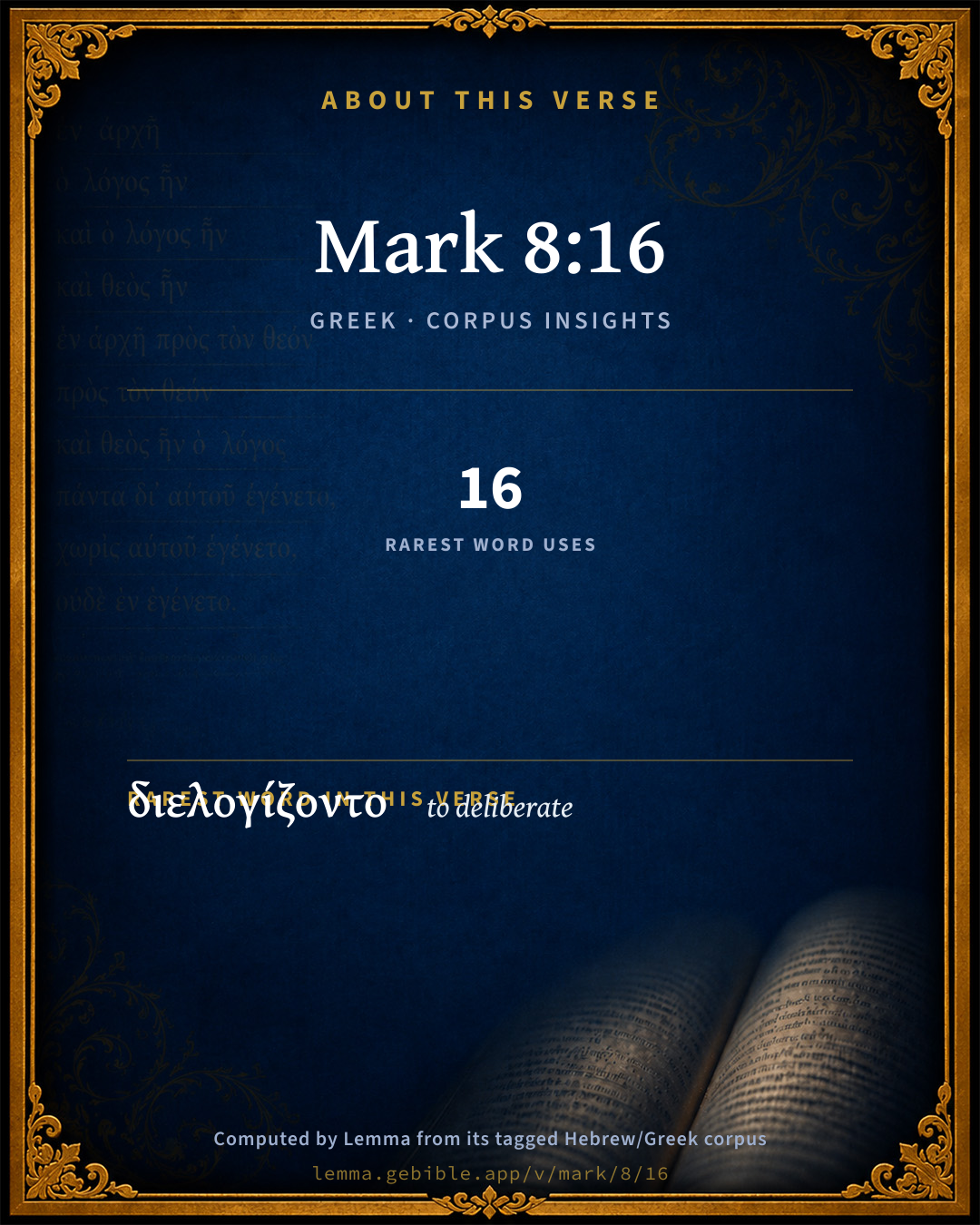
The rarest word here is διελογίζοντο to deliberate G1260 — appearing just 16 times in the whole Greek New Testament.

Shared distinctive vocabulary

διελογίζοντο to deliberate G1260 occurs in 15 verses of the Greek New Testament. Also found in:

Cross-references

3

Topical passages linked to Mark 8:16 in the Treasury of Scripture Knowledge — connected by theme and wording, ordered by reader-vote popularity; previews shown in the World English Bible.

  • Matthew 16:7–8 They reasoned among themselves, saying, "We brought no bread."
  • Luke 9:46 There arose an argument among them about which of them was the greatest.
  • Luke 20:5 They reasoned with themselves, saying, "If we say, 'From heaven,' he will say, 'Why didn't you believe him?'

Cross-references courtesy of OpenBible.info (CC BY 4.0).

Where the printed editions differ

1 variant

Places in this verse where the major printed Greek editions disagree on the wording in a way that affects the translation — a comparison of editions, not a manuscript-by-manuscript collation. The editions are the modern critical texts (Nestlé-Aland 28/27, SBL, Westcott-Hort, Tregelles, Tyndale House) and the traditional texts behind the KJV (the Textus Receptus and the Byzantine/Majority text). It is not a claim about which reading is original.

  1. Different wording
    ἔχουσιν.

    “they have.”

    In NA28NA27TynSBLWHTreg Not in TRByz

    ἔχομεν (echomen) 'we have' occurs in traditional manuscripts (TR+Byz) instead of ἔχουσιν. (echousin) 'they have.' in older manuscripts (NA28+NA27+Tyn+SBL+WH+Treg)

Textual data: Translators Amalgamated Greek New Testament (STEPBible TAGNT) · CC BY 4.0.

Commentary

Notes on Mark 8:16 from classic Christian and Jewish commentators (each source and its license shown beneath its notes). The classic Christian expositions comment on the surrounding passage and are grouped to its opening verse, so a note may address several verses; the Jewish commentaries on the Tanakh (Rashi and others) are per-verse, so they appear only where the commentator wrote on this verse.

Lemma curates 59 commentaries, every one of them public domain or Creative Commons licensed, each selected and text-cleaned for this edition rather than reprinted as found. About our sources →

The Biblical Illustrator

Joseph S. Exell

Mar_8:16-21

And they reasoned among themselves.

Nine sharp and pointed questions, turning the minds of the disciples back upon their own experience

Their reasonings very plainly and painfully proved how very little real benefit they had yet derived from intercourse with Christ. What a display of ignorance, forgetfulness, and unbelief! So it always has been in the history of Gods dealings with men. And so it is now, among ourselves, notwithstanding all the superior advantages we enjoy. How often do all of us misunderstand the meaning of our Masters words! How often do we distrust His Providence! And why is this? The main reason is that we are forgetful of the lessons of experience. Like the first disciples, we do not thoughtfully and prayerfully ponder what He has taught us, and what He has done for us. Consider the days of old. Remember all the way which the Lord thy God hath led thee. Gather up into the basket of memory all the fragments of the past, carry them along with you, and make use of them day by day as occasion may require. (A. Thomson.)

Seeing, hearing, and understanding

The first time I went to a Christian missionary, said a Chinese evangelist, I took my eyes. I stared at his hat, his umbrella, his coat, his shoes, the shape of his nose, and the colour of his skin and hair; but I heard not a word. The next time I took my ears as well as my eyes, and was astonished to hear the foreigner talk Chinese. The third time, with eyes and ears intent, God touched my heart, and I understood the gospel.

How is it that ye do not understand?-

Understanding prevented

With the disciples, as with the rich youth, it was things that prevented the Lord from being understood. Because of possession the young man had not a suspicion of the grandeur of the call with which Jesus honoured him. He thought he was hardly dealt with to be offered a patent of heavens nobility-he was so very rich! Things filled his heart; things blocked up his windows; things barricaded his door; so that the very God could not enter. His soul was not empty, swept, and garnished, but crowded with meanest idols, among which his spirit crept about upon its knees, wasting on them the gazes that belonged to his fellows and his Master. The disciples were a little further on than he; they left all and followed the Lord; but neither had they yet got rid of things. The paltry solitariness of a loaf was enough to hide the Lord from them, to make them unable to understand Him. Why, having forgotten, could they not trust? Surely if He had told them that for His sake they must go all day without food, they would not have minded! but they lost sight of God, and were as if either He did not see, or did not care for them. In the former case it was the possession of wealth, in the latter the not having more than a loaf, that rendered incapable of receiving the Word of the Lord: the evil principle was precisely the same. If it be things that slay you, what matter whether things you have, or things you have not? The youth, not trusting in God, the source of his riches, cannot brook the word of His Son, offering him better riches, more direct from the heart of the Father. The disciples, forgetting who is Lord of the harvests of the earth, cannot understand His Word, because filled with the fear of a days hunger. He did not trust in God as having given; they did not trust in God as ready to give. We are like them when, in any trouble, we do not trust Him. It is hard on God, when His children will not let Him give; when they carry themselves so that He must withhold His hand, lest He harm them. To take no care that they acknowledge whence their help comes, would be to leave them worshippers of idols, trusters in that which is not. (G. Macdonald, LL. D.)

The lessons of trivial loss

Let me suggest some possible parallels between ourselves and the disciples, maundering over their one loaf-with the Bread of Life at their side in the boat. We, too, dull our understandings with trifles, fill the heavenly spaces with phantoms, waste the heavenly time with hurry. To those who possess their souls in patience come the heavenly visions. When I trouble myself over a trifle, even a trifle confessed-the loss of some little article, say-spurring my memory, and hunting the house, not from immediate need, but from dislike of loss; when a book has been borrowed of me and not returned, and I have forgotten the borrower, and fret over the missing volume, while there are thousands on my shelves, from which the moments thus lost might gather treasures, holding relation with neither moth, nor rust, nor thief; am I not like the disciples? Am I not a fool whenever loss troubles me more than recovery would gladden? God would have me wise, and smile at the trifle. Is it not time I lost a few things when I care for them so unreasonably? This losing of things is of the mercy of God; it comes to teach us to let them go. Or have I forgotten a thought that came to me, which seemed of the truth, and a revealment to my heart? I wanted to keep it, to have it, to use it by and by, and it is gone! I keep trying and trying to call it back, feeling a poor man till that thought be recovered-to be far more lost, perhaps in a notebook, into which I shall never look again to find it! I forget that it is live things God cares about-live truths, not things set down in a book, or in a memory, or embalmed in the joy of knowledge, but things lifting up the heart, things active in an active will. True, my lost thought might have so worked; but had I faith in God, the Maker of thought and memory, I should know that, if the thought was a truth, and so alone worth anything, it must come again; for it is in God-so, like the dead, not beyond my reach; kept for me, I shall have it again. (G. Macdonald, LL. D.)

The Biblical Illustrator, edited by Joseph S. Exell (c. 1880s–1900s) — public domain. Text from a community e-Sword module.

Tyndale Open Study Notes

Tyndale Open Resources

8:16 The disciples completely missed the point of Jesus’ warning (8:15) and forgot that because Jesus was with them, their supply of bread was irrelevant.

Tyndale Open Study Notes — © Tyndale Open Resources, licensed CC BY-SA 4.0. Text via the HelloAO Bible API.

Expositor's Greek Testament

ed. W. Robertson Nicoll

Mar 8:16 . πρὸς ἀλλήλους . Mt. has ἐν ἑαυτοῖς . The mind of Jesus was profoundly preoccupied with the ominous demand of the sign-seekers, and the disciples might talk quietly to each other unnoticed by Him.

The Expositor's Greek Testament, edited by W. Robertson Nicoll (1897–1910) — public domain. Text from a community e-Sword module.

Geneva Bible (1599)

Geneva Bible translators

They that have their minds fixed on earthly things, are utterly blind in heavenly things, although they be never so plainly set forth unto them.

Geneva Bible (1599) marginal notes — public domain. Text via Bolls.life.

John Gill's Exposition

And they reasoned among themselves,.... Upon Christ's giving this caution, and recollecting with themselves, that they had forgot to buy any provisions, and take with them:

saying, it is because we have no bread; that he says these words; tacitly chiding and reproving us, for our want of thought and care; See Gill on Mat 16:7.

John Gill's Exposition of the Whole Bible (1746–1763) — public domain (CC PDM 1.0). Text via the HelloAO Bible API.

Trapp's Complete Commentary

John Trapp

16 And they reasoned among themselves, saying, It is because we have no bread.

Ver. 16. {See Trapp on "Mat 16:7"}

John Trapp, A Commentary or Exposition upon All the Books of the Old and New Testament (1647–1656) — public domain. Text from a community e-Sword module.

The Pulpit Commentary

According to the most approved readings, this verse should be read thus: And they reasoned one with another, saying, We have no bread. There is something very artless and simple in this narrative. Our Lord speaks of" leaven;" and the mention of this word reminds the disciples that they had forgotten to bring bread with them in the boat; and fearing lest Christ should direct them, according to his wont, to land on some desert shore, they were in some anxiety how they might obtain what they would need; and so they disputed among themselves; one, it may be, throwing the blame upon another.

The Pulpit Commentary (1880–1919), ed. H.D.M. Spence-Jones & Joseph S. Exell — public domain. Text from a community e-Sword module.

unfoldingWord translationNotes

Door43 World Missions Community

It is because we have no bread

In this statement, it may be helpful to state that "it" refers to what Jesus had said. AT: "He must have said that because we have no bread" (See: Assumed Knowledge and Implicit Information)

no bread

The word "no" is an exaggeration. The disciples did have one loaf of bread (Mark 8:14), but that was not much different from having no bread at all. AT: "very little bread" (See: Hyperbole and Generalization)

Why are you reasoning about not having bread?

Here Jesus is mildly rebuking his disciples because they should have understood what he had been talking about. This can be written as a statement. AT: "You should not be thinking that I am talking about actual bread." (See: Rhetorical Question)

Do you not yet perceive? Do you not understand?

These questions have the same meaning and are used together to emphasize that they do not understand. This can be written as one question or as a statement. AT: "Do you not yet understand?" or "You should perceive and understand by now the things I say and do." (See: Parallelism and Rhetorical Question)

Have your hearts become so dull?

Here "hearts" is a metonym for a person's mind. The phrase "hearts become so dull" is a metaphor for not being able or willing to understand something. Jesus uses a question to scold the disciples. This can be written as a statement. AT: "Your thinking has become so dull!" or "You are so slow to understand what I mean!" (See: Metonymy and Metaphor and Rhetorical Question)

translationWords

disciple

bread

Jesus

understand

heart

unfoldingWord translationNotes — © Distant Shores Media and the Door43 World Missions Community, licensed CC BY-SA 4.0. Source: git.door43.org/Door43/en_tn.

Cambridge Greek Testament for Schools and Colleges

16. [1641][1642][1643][1644] omit λέγοντες after ἀλλήλους.

[1641] Codex Sinaiticus. 4th cent. Discovered by Tischendorf in 1859 at the Monastery of St Katharine on Mount Sinai. Now at St Petersburg. The whole Gospel, ending at Mar 16:8. Photographic facsimile, 1911.

[1642] Codex Vaticanus. 4th cent., but perhaps a little later than א. In the Vatican Library almost since its foundation by Pope Nicolas V., and one of its greatest treasures. The whole Gospel, ending at Mar 16:8. Photographic facsimile, 1889.

[1643] Codex Bezae. 6th cent. Has a Latin translation (d) side by side with the Greek text, and the two do not quite always agree. Presented by Beza to the University Library of Cambridge in 1581. Remarkable for its frequent divergences from other texts. Contains Mark, except Mar 16:15-20, which has been added by a later hand. Photographic facsimile, 1899.

[1644] Codex Regius. 8th cent. An important witness. At Paris. Contains Mar 1:1 to Mar 10:15; Mar 10:30 to Mar 15:1; Mar 15:20 to Mar 16:20, but the shorter ending is inserted between Mar 16:8 and Mar 16:9, showing that the scribe preferred it to the longer one.

16. διελογίζοντο πρὸς ἀλλ. ὅτι. Cf. Mar 11:31. The ὅτι is recitative not causal. See crit. note.

Cambridge Greek Testament for Schools and Colleges (Cambridge University Press, 1896; 21 vols, various authors incl. Carr, Maclear, Plummer, Farrar, Lumby, Moule, M. R. James, Simcox) — public domain. Text from a community e-Sword module.

International Critical Commentary

16. Καὶ διελογίζοντο πρὸς ἀλλήλους, Ὅτι ἄρτους οὐκ ἔχομεν (ἔχουσιν)—And they reasoned with each other, (it is) because we have (or they have) no bread. Probably, with either ἔχομεν or ἔχουσιν, ὅτι is causal, and there is an ellipsis of the principal clause.

Omit λέγοντες, saying, after πρὸς ἀλλήλους, Tisch. Treg. WH. א BD 1, 28, 209, mss. Lat. Vet. ἔχουσιν, instead of ἔχομεν, Treg. WH. RV.marg. B 1, 28, 209, two mss. Lat. Vet. Memph., also D mss. Lat. Vet. (quod panes non haberent).

The disciples were themselves so blind spiritually, that they attributed a material sense to Christ’s spiritual sayings. They thought that he was warning them, in the very spirit of the Pharisees themselves, against food contaminated by them. Their thoughts were on their neglect to take bread, and so leaven, or yeast, suggested to them bread.

International Critical Commentary — older volumes (1896–1929), various authors — public domain. Text from a community e-Sword module.

Lesson kit

Teaching starters — assembled from the data on this page, not authored interpretation. Every prompt links to the verse data it draws on. Edit before teaching.

Mark, in the Gospels, opens this verse with 8 words (8 distinct Greek lemmas). Its most distinctive word is dialogízomai (“to deliberate”). A historical commentator’s framing appears above. Read the whole chapter for the surrounding context.

Discussion questions

  1. The word dialogízomai carries the sense “to deliberate.” How does it shape the verse?
  2. Matthew 16:7 shares the word «to deliberate» with this verse. How do the two illuminate each other?
  3. The translations on this page render this verse differently — a whole-verse word diff, not a word-by-word alignment. What might account for the different wordings?
  4. Reading how The Biblical Illustrator and Tyndale Open Study Notes read this verse, where do the two commentators agree and where do they part?

Things to notice

Reading settings

Reading text

Shown beneath each verse's original-language words.

Old Testament
Old Testament edition

Read the OT as the Masoretic Hebrew (MT) or the Greek Septuagint (LXX).

English shown for the Greek Septuagint (in the Hebrew ↔ Greek comparison).

Comparing translations? Open the Compare panel on any verse page to stack up to four side by side.