Mark 8:18

Greek (Tischendorf 8th ed.) Mark 8:18 appears in the Greek New Testament. The text above is from the Tischendorf 8th edition. Each word links to its Strong’s number and a concise gloss. Click any word for its full Thayer’s Greek Lexicon entry.
Download image
Cite this verse

Mark 8:18 (World English Bible). Public Domain. Lemma interlinear Bible study tool, https://lemma.gebible.app/v/mark/8/18.

Show BibTeX & RIS
BibTeX
RIS
English Translation
Having eyes, don't you see? Having ears, don't you hear? Don't you remember?
World English Bible · Public Domain
Download a study sheet

One document with this verse’s original text, its word-by-word gloss line, the meaning frame, cross-references with their text, attributed commentary, and full source and license credits — printable, and it pastes into notes with its structure intact.

This verse Autodidact and up

Study sheet (.html) Plain text (.txt)

A passage Seminary Student

Up to 50 verses in one chapter. A passage sheet keeps up to 6 commentary sources and 12 cross-references per verse, in the order this page ranks them, and says so on the sheet whenever that leaves anything out. Ask for a single verse and you get the Autodidact verse sheet above.

Everything on this page stays free to read, with no account — the sheet is a download of what is already on screen, not access to it.

Want to remove ads? Support Godless Engineer
Compare translations 3

The same verse in 3 English versions, stacked beneath the original-language interlinear above. Click any original word for its lexicon entry.

Each is an independent rendering of the whole verse — the interlinear is not word-aligned to these translations.

Highlighted words mark where these versions differ — a whole-verse word diff, not a word-by-word alignment.

  • World English Bible Public Domain
    Having eyes, don't you see? Having ears, don't you hear? Don't you remember?
  • King James Version Public Domain
    Having eyes, see ye not? and having ears, hear ye not? and do ye not remember?
  • unfoldingWord Literal Text CC BY-SA 4.0
    Having eyes, do you not see? And having ears, do you not hear? And do you not remember?

unfoldingWord Literal Text — © unfoldingWord, licensed CC BY-SA 4.0. Word-aligned USFM3 via Door43 (git.door43.org/unfoldingWord/en_ult).

Versions to compare (up to 4)

3 of 4 selected

Show all 19 translations

Every available English version of this verse, each an independent rendering of the whole verse.

  • World English Bible Public Domain
    Having eyes, don't you see? Having ears, don't you hear? Don't you remember?
  • Berean Standard Bible Public Domain
    ‘Having eyes, do you not see? And having ears, do you not hear?’ And do you not remember?
  • Majority Standard Bible Public Domain
    ‘Having eyes, do you not see? And having ears, do you not hear?’ And do you not remember?
  • King James Version Public Domain
    Having eyes, see ye not? and having ears, hear ye not? and do ye not remember?
  • American Standard Version (1901) Public Domain
    Having eyes, see ye not? and having ears, hear ye not? and do ye not remember?
  • Revised Version (1885) Public Domain
    Having eyes, see ye not? and having ears, hear ye not? and do ye not remember?
  • Geneva Bible (1599) Public Domain
    Haue yee eyes, and see not? and haue yee eares, and heare not? and doe ye not remember?
  • Douay-Rheims (1899) Public Domain
    Having eyes, see you not? and having ears, hear you not? neither do you remember.
  • Young's Literal Translation Public Domain
    Having eyes, do ye not see? and having ears, do ye not hear? and do ye not remember?
  • Literal Standard Version CC BY-SA 4.0
    Having eyes, do you not see? And having ears, do you not hear? And do you not remember?
  • Unlocked Literal Bible CC BY-SA 4.0
    You have eyes, do you not see? You have ears, do you not hear? Do you not remember?
  • unfoldingWord Literal Text CC BY-SA 4.0
    Having eyes, do you not see? And having ears, do you not hear? And do you not remember?
  • Darby Bible Public Domain
    Having eyes, see ye not? and having ears, hear ye not? and do ye not remember?
  • World Messianic Bible Public Domain
    Having eyes, don’t you see? Having ears, don’t you hear? Don’t you remember?
  • Webster's Bible Public Domain
    Having eyes, see ye not? and having ears, hear ye not? and do ye not remember?
  • Free Bible Version CC BY-SA 4.0
    You've got eyes to see, haven't you? And ears to hear?
  • Bible in Basic English Public Domain
    Having eyes, do you not see? and having ears, have you no hearing? and have you no memory?
  • Text-Critical English NT CC BY 4.0
    Having eyes do you not see, and having ears do you not hear? Do you not remember?
  • Tyndale New Testament (1534) Public Domain
    Have ye eyes and se not? and have ye eares and heare not? Do ye not remember?

Literal Standard Version (2020), Covenant Press — licensed CC BY-SA 4.0. Text via the HelloAO Bible API (eBible.org). Unlocked Literal Bible (unfoldingWord) — licensed CC BY-SA 4.0. Text via the HelloAO Bible API (eBible.org). unfoldingWord Literal Text — © unfoldingWord, licensed CC BY-SA 4.0. Word-aligned USFM3 via Door43 (git.door43.org/unfoldingWord/en_ult). Free Bible Version, Dr. Jonathan Gallagher — licensed CC BY-SA 4.0. Text via the HelloAO Bible API (eBible.org).

Word by word

More ways to search: Search by grammar → Find every occurrence → Compare this word →

Practice this passage: Drill this verse → Learn its vocabulary →

μνημονεύετε
mnēmoneúō
G3421
“to remember”
Verb, Present, Active, Indicative, 2nd person, Plural
Part of Speech
Verb
Tense
Present
Voice
Active
Mood
Indicative
Person
2nd person
Number
Plural
Full Thayer's Definition

Origin: from a derivative of G3420

TDNT: 15:22,6

1. to be mindful of, to remember, to call to mind a. to think of and feel for a person or thing b. to hold in memory, keep in mind 2. to make mention of
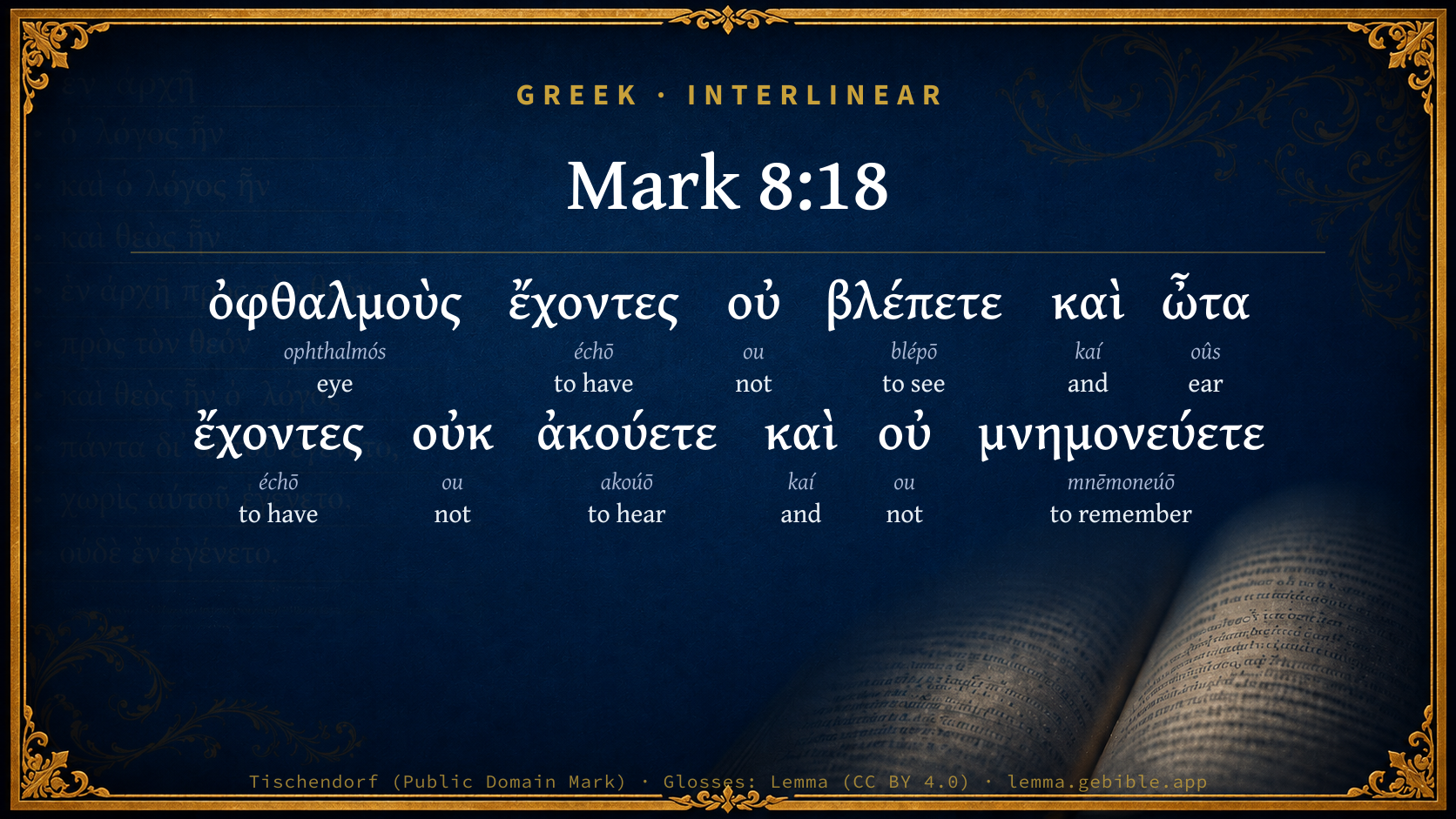
  1. ὀφθαλμοὺς ophthalmós G3788 “eye” Noun, Accusative, Plural, Masculine
  2. ἔχοντες échō G2192 “to have” Verb, Present, Active, Participle, Nominative, Plural, Masculine
  3. οὐ ou G3756 “not” Particle, Negative
  4. βλέπετε blépō G991 “to see” Verb, Present, Active, Indicative, 2nd person, Plural
  5. καὶ kaí G2532 “and” Conjunction
  6. ὦτα oûs G3775 “ear” Noun, Accusative, Plural, Neuter
  7. ἔχοντες échō G2192 “to have” Verb, Present, Active, Participle, Nominative, Plural, Masculine
  8. οὐκ ou G3756 “not” Particle, Negative
  9. ἀκούετε akoúō G191 “to hear” Verb, Present, Active, Indicative, 2nd person, Plural
  10. καὶ kaí G2532 “and” Conjunction
  11. οὐ ou G3756 “not” Particle, Negative

About this verse

These counts appear in no published source. They are computed here, from the morphology-tagged text and Lemma’s own curated glosses. What Lemma adds →

12
words
8
distinct lemmas
Gospels
section

Notable vocabulary

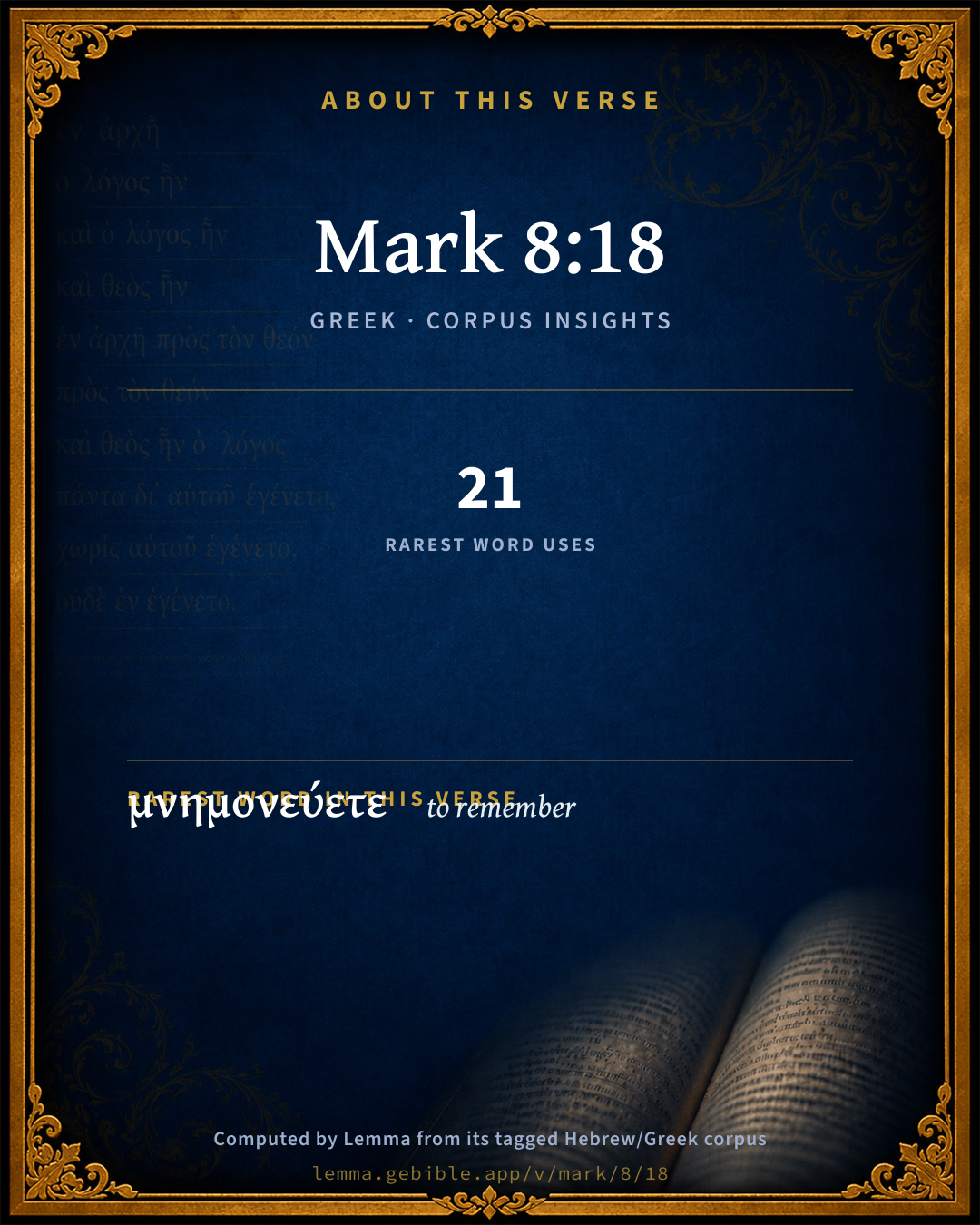
The rarest word here is μνημονεύετε to remember G3421 — appearing just 21 times in the whole Greek New Testament.

Shared distinctive vocabulary

μνημονεύετε to remember G3421 occurs in 21 verses of the Greek New Testament. Also found in:

Repetition

Words recur within this verse:

  • ἔχοντες to have G2192 ×2
  • οὐ not G3756 ×3
  • καὶ and G2532 ×2

Cross-references

14

Topical passages linked to Mark 8:18 in the Treasury of Scripture Knowledge — connected by theme and wording, ordered by reader-vote popularity; previews shown in the World English Bible.

  • Acts 28:26–27 saying, 'Go to this people, and say, In hearing, you will hear, But will in no way understand. In seeing, you will see, But will in no way perceive.
  • Matthew 13:14–15 In them the prophecy of Isaiah is fulfilled, which says, 'By hearing you will hear, And will in no way understand; Seeing you will see, And will in no way perceive:
  • Jeremiah 5:21 Hear now this, foolish people, and without understanding; who have eyes, and don't see; who have ears, and don't hear:
  • Mark 4:12 that 'seeing they may see, and not perceive; and hearing they may hear, and not understand; lest perhaps they should turn again, and their sins should be forgiven them.'"
  • Ezekiel 12:2 Son of man, you dwell in the midst of the rebellious house, who have eyes to see, and don't see, who have ears to hear, and don't hear; for they are a rebellious house.
  • John 12:40 "He has blinded their eyes and he hardened their heart, Lest they should see with their eyes, And perceive with their heart, And would turn, And I would heal them."
  • Isaiah 6:9–10 He said, "Go, and tell this people, 'You hear indeed, But don't understand; And you see indeed, But don't perceive.'
  • Isaiah 42:18–20 Hear, you deaf; and look, you blind, that you may see.
  • Romans 11:8 According as it is written, "God gave them a spirit of stupor, eyes that they should not see, and ears that they should not hear, to this very day."
  • Psalms 115:5–8 They have mouths, but they don't speak; They have eyes, but they don't see;
  • Isaiah 44:18 They don't know, neither do they consider: for he has shut their eyes, that they can't see; and their hearts, that they can't understand.
  • Deuteronomy 29:4 but Yahweh has not given you a heart to know, and eyes to see, and ears to hear, to this day.
  • Psalms 69:23 Let their eyes be darkened, so that they can't see. Let their backs be continually bent.
  • 2 Peter 1:12 Therefore I will not be negligent to remind you of these things, though you know them, and are established in the present truth.

Cross-references courtesy of OpenBible.info (CC BY 4.0).

Commentary

Notes on Mark 8:18 from classic Christian and Jewish commentators (each source and its license shown beneath its notes). The classic Christian expositions comment on the surrounding passage and are grouped to its opening verse, so a note may address several verses; the Jewish commentaries on the Tanakh (Rashi and others) are per-verse, so they appear only where the commentator wrote on this verse.

Lemma curates 59 commentaries, every one of them public domain or Creative Commons licensed, each selected and text-cleaned for this edition rather than reprinted as found. About our sources →

MacLaren's Expositions of Holy Scripture

Alexander MacLaren

Mark

THE PATIENT TEACHER, AND THE SLOW SCHOLARS

THE RELIGIOUS USES OF MEMORY

Mar 8:18.

The disciples had misunderstood our Lord’s warning ‘against the leaven of the Pharisees,’ which they supposed to have been occasioned by their neglect to bring with them bread. Their blunder was like many others which they committed, but it seems to have singularly moved our Lord, who was usually so patient with His slow scholars. The swift rain of questions, like bullets rattling against a cuirass, of which my text is one, shows how much He was moved, if not to impatience or anger, at least to wonder.

But what I wish particularly to notice is that He traces the disciples’ slowness of perception and distrust mainly to forgetfulness. There was a special reason for that, of course, in that the two miracles of the feeding the multitude, one of which had just before occurred, ought to have delivered them from any uneasiness, and to have led them to apprehend His higher meaning.

But there is a wider reason for the collocation of questions than this. There is no better armour against distrust, nor any surer purge of our spiritual sight, than religious remembrance. So my text falls in with what I hope are, or at any rate should be, thoughts which are busy in many of our hearts now. Every Sunday is the last Sunday of a year. But we are influenced by the calendar, even though there is nothing in reality to correspond with the apparent break, and though time runs on in a continuous course. I would fain say a word or two now which may fit in with thoughts that are wholesome for us always, but, I suppose, come with most force to most of us at such a date as this. And, if you will let me, I will put my observations in the form of exhortations.

I. First of all, then, remember and be thankful.

There are few of us who have much time for retrospect, and there is a very deep sense in which it is wise to ‘forget the things that are behind,’ for the remembrance of them may burden us with a miserable entail of failure; may weaken us by vain regrets, may unfit us for energetic action in the living and available present. But oblivion is foolish, if it is continual, and a remembered past has treasures in it which we can little afford to lose.

Chiefest of these is the power of memory, when applied to our own past lives, to bring out, more clearly than was possible while that past was being lived, the perception of the ever-present care and working of our Father, God. It is hard to recognise Him in the bustle and hurry of our daily lives, and the meaning of each event can only be seen when it is seen in its relation to the rest of a life. Just as a landscape, which we may look at without the smallest perception of its beauty, becomes another thing when the genius of a painter puts it on canvas, and its symmetry and proportion become more manifest, and an ethereal clearness broods over it, and its colours are seen to be deeper than our eyes had discerned, so the common events of life, trivial and insignificant while they are passing, become, when painted on the canvas of memory, nobler and greater, and we understand them more completely than we can do whilst we are living in them.

We need to be at the goal in order to judge of the road. The parts are only explicable when we see the whole. The full interpretation of to-day is reserved for eternity. But, by combining and massing and presenting the consequences of the apparently insignificant and isolated events of the past, memory helps us to a clearer perception of God, and a better understanding of our own lives, On the mountain-summit a man can look down all along the valley by which he has wearily plodded, and understand the meaning of the divergences in the road, and the rough places do not look quite so rough when their proportion to the whole is a little more clearly in his view.

Only, brethren, if we are wisely to exercise remembrance, and to discover God in the lives which, whilst they are passing, had little perception of Him, we must take into account what the meaning of all life is-that is, to make men of us after the pattern of His will.

‘Not enjoyment, and not sorrow,

Is our destined end or way.’

But the growth of Christlike and God-pleasing character is the divine purpose, and should be the human aim, of all lives. Our tasks, our joys, our sorrows, our gains, our losses-these are all but the scaffolding, and the scaffolding is only there in order that, course upon course, may rise the temple-palace of a spirit, devoted to, shaped and inhabited by, our Father, God.

So I venture to say that thankful remembrance should exclude no single incident, however bitter, however painful, of any life. There is a remembrance of vanished hands, of voices for ever stilled, which is altogether wrong and weakening. There is a regret, a vain regret which comes with memory for some of us, that interferes with thankfulness.

But it is possible-and, if we understand that the meaning of all is to make us Godlike, it is not hard-to remember vanished joys, and to confer upon them by remembrance a kind of gentle immortality. And, thus remembered, they are ennobled; for all the gross material body of them, as it were, is got rid of, and only the fine spirit is left. The roses bloom, and over bloom, and drop, but a poignant perfume is distilled from the fallen petals. The departed are greatened by distance; when they are gone we recognise the ‘angels’ that we ‘entertained unawares’: and that recognition is no illusion, but it is the disclosure of their real character, to which they were sometimes untrue, and we were often blind. Therefore I say, ‘Thou shalt remember all the way by which the Lord thy God hath led thee,’ and in the thankfulness include departed joys, vanished hands, present sorrows, the rough places as well as the smooth, the crooked things as well as the straight.

II. Secondly, let me say, remember and repent.

Memory is not wise unless it is, so to speak, the sergeant-at-arms of Conscience, and brings our past before the bar of that judge within, and puts into the hands of that judge the law of the Lord by which to estimate our deeds. We all have been making up our accounts to the 31st of December-or are going to do it to-morrow. And what I plead for is that we should take stock of our own characters and aims, and sum up our accounts with duty and with God.

We look back upon a past, of which God gave us the warp and we had to put in the woof. The warp is all bright and pure. The threads that have crossed it from our shuttles are many of them very dark, and all of them stained in some part. So, dear brethren, let us take the year that has gone, and spread them out by the agency of this servant of the court, Memory, before the supreme judge, Conscience.

Let us remember that we may be warned and directed. We shall understand the true moral character of our actions a great deal better when we look back upon them calmly, and when all the rush of temptation and the reducing whispers of our own weak wills are silenced. There is nothing more terrible, in one aspect, there is nothing more salutary and blessed in another, than the difference between the front and the back view of any temptation to which we yield-all radiant and beautiful on the hither side, and when we get past it and look back at it, all hideous. Like some of those painted canvases upon the theatre-stage: seen from this side, with the delusive brilliancy of the footlights thrown upon them, they look beautiful works of art; seen at the back, dirty and cobwebbed canvas, all splashes and spots and uglinesses. Let us be thankful if memory can show us the reverse side of the temptations that on the near side were so seductive.

It is when you see your life in retrospect that you understand the significance of the single deeds in it. We are so apt to isolate our actions that we are startled-and it is a wholesome shock-when we see how, without knowing it, we have dropped into a habit. When each temptation comes, as the moments are passing, we say, ‘Oh, just this once, just this once.’ And the ‘onces’ come nearer and nearer together; and what seem to be distinctly separated points, coalesce into a line; and the acts that we thought isolated we find out to our horror-our wholesome horror-have become a chain that binds and holds us. Look back over the year, and drag its events to the bar of Conscience, and I shall be surprised if you do not discover that you have fallen into wrong habits that you never dreamed had dominion over you. So, I say, remember and repent.

Brethren, I do not wish to exaggerate, I do not wish to urge upon you one-sided views of your character or conduct. I give all credit to many excellences, many acts of sacrifice, many acts of service; and yet I say that the main reason why any of us have a good opinion of ourselves is because we have no knowledge of ourselves; and that the safest attitude for all of us, in looking back over what we have made of life, is, hands on mouths, and mouths in dust, and the cry coming from them, ‘Unclean! unclean!’ A little mud in a stream may not be perceptible when you take a wine-glassful of it and look at it, but if you saw a river-full or a lake-full you would soon discover the taint. Summon up the past year to the sessions of silent thought, and let the light of God’s will pour in upon it, and you will find how dark has been the flow of the river of your lives.

The best use which the memory can serve for us is that it should drive us closer to Jesus Christ, and make us cling more closely to Him. That past can be cancelled, these multitudinous sins can be forgiven. Memory should be one of the strongest strands in the cord that binds our helplessness to the all-forgiving and all-cleansing Christ.

III. Lastly, let me say, remember and hope.

Memory and Hope are twins. The latter can only work with the materials supplied by the former. Hope could paint nothing on the blank canvas of the future unless its palette were charged by Memory. Memory brings the yarn which Hope weaves.

Our thankful remembrance of a past which was filled and moulded by God’s perpetual presence and care ought to make us sure of a future which will in like manner be moulded. ‘Thou hast been my help’-if we can say that, then we may confidently pray, and be sure of the answer, ‘Leave me not nor forsake me, O God of my salvation.’ And if we feel, as memory teaches us to feel, that God has been working for us, and with us, we can say with another Psalmist: ‘Thy mercy, O Lord, endureth for ever. Forsake not the work of Thine own hands’; and we can rise to his confidence, ‘The Lord with perfect that which concerneth me.’

Our remembrance, even of our imperfections and our losses and our sorrows, may minister to our hope. For surely the life of every man on earth, but most eminently the life of a Christian man, is utterly unintelligible, a mockery and a delusion and an incredibility, if there be a God at all, unless it prophesies of a region in which imperfection will be ended, aspirations will be fulfilled, desires will be satisfied. We have so much, that unless we are to have a great deal more, we had better have had nothing. We have so much, that if there be a God at all, we must have a great deal more. The new moon, with a ragged edge, ‘even in its imperfection beautiful,’ is a prophet of the complete resplendent orb. ‘On earth the broken arc, in heaven the perfect round.’

Further, the memory of defeat may be the parent of the hope of victory. The stone Ebenezer, ‘Hitherto hath the Lord helped us,’ was set up to commemorate a victory that had been won on the very site where Israel, fighting the same foes, had once been beaten. There is no remembrance of failure so mistaken as that which takes the past failure as certain to be repeated in the future. Surely, though we have fallen seventy times seven-that is 490, is it not?-at the 491st attempt we may, and if we trust in God we shall, succeed.

So, brethren, let us set our faces to a new year with thankful remembrance of the God who has shaped the past, and will mould the future. Let us remember our failures, and learn wisdom and humility and trust in Christ from our sins. Let us set our ‘hope on God, and not forget the works of God, but keep His commandments.’

Alexander MacLaren, Expositions of Holy Scripture (1904–1910) — public domain. Text from a community e-Sword module.

Expositor's Greek Testament

ed. W. Robertson Nicoll

Mar 8:18 repeats in reference to the Twelve the hard saying uttered concerning the multitude on the day of the parables (Mar 4:12 ). In Mar 8:19-20 Jesus puts the Twelve through their catechism in reference to the recent feedings, and then in Mar 8:21 (according to reading in [69] ) asks in the tone of a disappointed Master: How do you not understand? If we may emphasise the imperfect tense of ἔλεγεν , He said this over and over again, half speaking to them, half to Himself; another of Mk.’s realistic features. All this shows how much the Twelve needed special instruction, and it is obviously Mk.’s aim to make this prominent. Desire for leisure to attend to their instruction is in his narrative the key to the excursions in the direction of Tyre and Sidon and to Caesarea Philippi.

[69] Codex Vaticanus (sæc. iv.), published in photographic facsimile in 1889 under the care of the Abbate Cozza-Luzi.

The Expositor's Greek Testament, edited by W. Robertson Nicoll (1897–1910) — public domain. Text from a community e-Sword module.

John Gill's Exposition

Having eyes, see ye not?.... Meaning perhaps both the eyes of their bodies, and of their understandings: they had bodily eyes, and with them saw the miracles he wrought, and yet took little notice of them; and the eyes of their understandings were enlightened by Christ, and yet saw things but very darkly:

and having ears, hear ye not? They had their natural hearing, and yet made but little use of it; and did not so diligently attend to the sound of Christ's words: and though they had spiritual ears given them to hear, yet were very dull of, understanding, and taking in things:

and do ye not remember? the interpretation of parables formerly given, and the miracles of the loaves lately wrought.

John Gill's Exposition of the Whole Bible (1746–1763) — public domain (CC PDM 1.0). Text via the HelloAO Bible API.

Trapp's Complete Commentary

John Trapp

18 Having eyes, see ye not? and having ears, hear ye not? and do ye not remember?

Ver. 18. Do ye mot remember] All is lost that is not well laid up in this pot of manna, the sanctified memory, 1Co 15:2.

John Trapp, A Commentary or Exposition upon All the Books of the Old and New Testament (1647–1656) — public domain. Text from a community e-Sword module.

unfoldingWord translationNotes

Door43 World Missions Community

You have eyes, do you not see? You have ears, do you not hear? Do you not remember?

Jesus continues to mildly rebuke his disciples. These questions can be written as statements. AT: "You have eyes, but you do not understand what you see. You have ears, but you do not understand what you hear. You should remember." (See: Rhetorical Question)

the five thousand

This refers to the 5,000 people Jesus fed. AT: "the 5,000 people" (See: Metonymy and Numbers)

how many baskets full of broken pieces of bread did you take up

It may be helpful to state when they collected the baskets of pieces. AT: "how many baskets full of broken pieces of bread did you collect after everyone finished eating" (See: Assumed Knowledge and Implicit Information)

translationWords

bread

unfoldingWord translationNotes — © Distant Shores Media and the Door43 World Missions Community, licensed CC BY-SA 4.0. Source: git.door43.org/Door43/en_tn.

Cambridge Greek Testament for Schools and Colleges

18. ὀφθαλμοὺς ἔχοντες. From Jer 5:21; Eze 12:2. This also is omitted in Mt. Cf. Oxyrh. Logia 3, ὅτι τυφλοί εἰσιν τῇ καρδίᾳ αὐτῶν καὶ οὐ βλέπουσιν, πτωχοὶ καὶ οὐκ οἴδασιν τὴν πτωχίαν.

καὶ οὐ μνημονεύετε. This may be an independent sentence; either And do ye not remember? (A.V., R.V.), or “And ye do not remember.” More probably it is the principal clause of the sentence which follows, taken interrogatively; Do ye not remember when I brake … how many … ye took up?

Cambridge Greek Testament for Schools and Colleges (Cambridge University Press, 1896; 21 vols, various authors incl. Carr, Maclear, Plummer, Farrar, Lumby, Moule, M. R. James, Simcox) — public domain. Text from a community e-Sword module.

International Critical Commentary

18, 19. Tisch. punctuates these verses so that they read, Having eyes do you not see, and having ears do you not hear, and do you not remember, when I broke the five loaves among the five thousand, and how many baskets full of fragments you took up? WH. read, Having eyes do you not see, and having ears do you not hear? And do you not remember, when I broke the five loaves among the five thousand, how many baskets full of fragments you took up? This latter punctuation is the most probable.

Insert καὶ before πόσους, Tisch. א CDM Δ 1, 33, mss. of Latt.

By his reference to the miracles of feeding the five thousand, and the four thousand, Jesus means to remind them that he has shown them his ability to provide for their lack of bread in an emergency, so that they need not fix their thoughts on that, nor think that his mind is occupied with it. The question about the baskets of broken pieces is intended to suggest the bounty of the provision made. It is noticeable that the distinction between σπυρίδες and κόφινοι in the two miracles is kept up here in Jesus` allusion to them.

International Critical Commentary — older volumes (1896–1929), various authors — public domain. Text from a community e-Sword module.

Lesson kit

Teaching starters — assembled from the data on this page, not authored interpretation. Every prompt links to the verse data it draws on. Edit before teaching.

Mark, in the Gospels, opens this verse with 12 words (8 distinct Greek lemmas). Its most distinctive word is mnēmoneúō (“to remember”). A historical commentator’s framing appears above. Read the whole chapter for the surrounding context.

Discussion questions

  1. The word mnēmoneúō carries the sense “to remember.” How does it shape the verse?
  2. Matthew 16:9 shares the word «to remember» with this verse. How do the two illuminate each other?
  3. “to have” occurs 2× in this one verse. What is the effect of the repetition?
  4. These translations render this verse differently; the difference is in the English rendering, not the original. What questions does that raise?
  5. Reading how MacLaren's Expositions of Holy Scripture and Expositor's Greek Testament read this verse, where do the two commentators agree and where do they part?

Things to notice

  • These translations choose different wording for 3 words in this verse.
  • “to have” occurs 2× in this single verse.
  • 8 distinct Greek lemmas span 12 words in this verse.

Reading settings

Reading text

Shown beneath each verse's original-language words.

Old Testament
Old Testament edition

Read the OT as the Masoretic Hebrew (MT) or the Greek Septuagint (LXX).

English shown for the Greek Septuagint (in the Hebrew ↔ Greek comparison).

Comparing translations? Open the Compare panel on any verse page to stack up to four side by side.