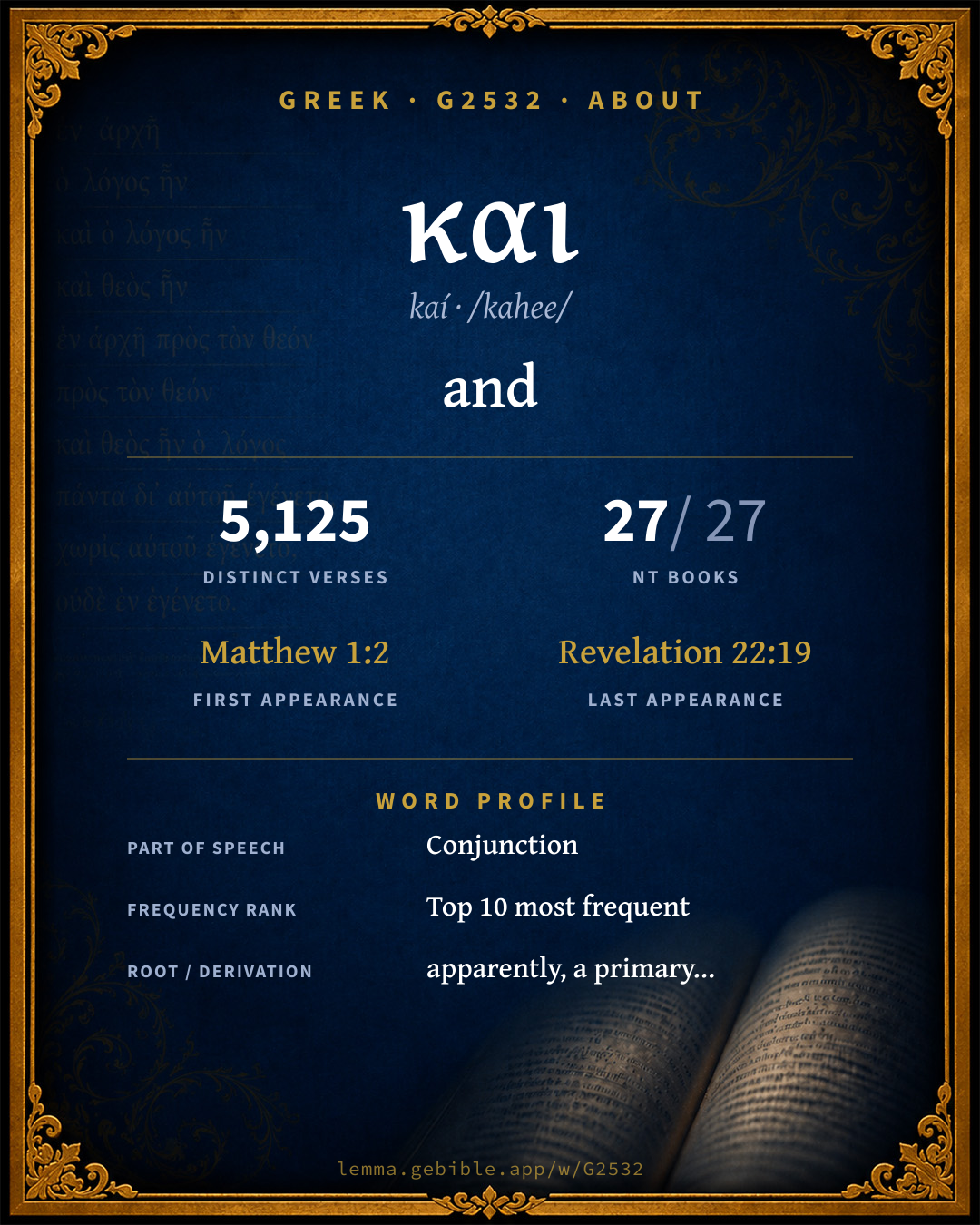
καί
and
Full lexicon entry — Thayer's Greek Lexicon
From Thayer's Greek Lexicon
Where this word appears
Grammar key — what these labels mean
Part of speech
- Conjunction
- A joining word linking words or clauses.
Page 3 of 4 — showing verses 401–600 of 660 distinct verses where G2532 appears in the Book of Acts. Click any verse to open its interlinear word-by-word view. Verse text shown in the World English Bible for context — . Each verse’s Greek form is shown with its reference; the English is not keyword-highlighted, since the data carries no word-level English alignment. Use “Compare translations” on any verse to read it across multiple English versions. This concordance covers the Greek New Testament; Septuagint (Greek Old Testament) occurrences of this word are not indexed here.
Acts
- Acts 16:13 καὶ conj On the Sabbath day we went forth outside of the city by a riverside, where we supposed there was a place of prayer, and we sat down, and spoke to the women who had come together.
- Acts 16:14 καί conj A certain woman named Lydia, a seller of purple, of the city of Thyatira, one who worshiped God, heard us; whose heart the Lord opened to listen to the things which were spoken by Paul.
- Acts 16:15 καὶ καὶ conj conj When she and her household were baptized, she begged us, saying, "If you have judged me to be faithful to the Lord, come into my house, and stay." So she persuaded us.
- Acts 16:17 καὶ conj Following Paul and us, she cried out, "These men are servants of the Most High God, who proclaim to us the way of salvation!"
- Acts 16:18 καὶ καὶ conj conj She was doing this for many days. But Paul, becoming greatly annoyed, turned and said to the spirit, "I charge you in the name of Jesus Christ to come out of her!" It came out that very hour.
- Acts 16:19 καὶ conj But when her masters saw that the hope of their gain was gone, they seized Paul and Silas, and dragged them into the marketplace before the rulers.
- Acts 16:20 καὶ conj When they had brought them to the magistrates, they said, "These men, being Jews, are agitating our city,
- Acts 16:21 καὶ conj and set forth customs which it is not lawful for us to accept or to observe, being Romans."
- Acts 16:22 καὶ καὶ conj conj The multitude rose up together against them, and the magistrates tore their clothes off of them, and commanded them to be beaten with rods.
- Acts 16:24 καὶ conj who, having received such a charge, threw them into the inner prison, and secured their feet in the stocks.
- Acts 16:25 καὶ conj But about midnight Paul and Silas were praying and singing hymns to God, and the prisoners were listening to them.
- Acts 16:26 καὶ conj Suddenly there was a great earthquake, so that the foundations of the prison were shaken; and immediately all the doors were opened, and everyone's bonds were loosened.
- Acts 16:27 καὶ conj The jailer, being roused out of sleep and seeing the prison doors open, drew his sword and was about to kill himself, supposing that the prisoners had escaped.
- Acts 16:29 καὶ καὶ conj conj He called for lights and sprang in, and, fell down trembling before Paul and Silas,
- Acts 16:30 καὶ conj and brought them out and said, "Sirs, what must I do to be saved?"
- Acts 16:31 καὶ καὶ conj conj They said, "Believe in the Lord Jesus Christ, and you will be saved, you and your household."
- Acts 16:32 καὶ conj They spoke the word of the Lord to him, and to all who were in his house.
- Acts 16:33 καὶ καὶ καὶ conj conj conj He took them the same hour of the night, and washed their stripes, and was immediately baptized, he and all his household.
- Acts 16:34 καὶ conj He brought them up into his house, and set food before them, and rejoiced greatly, with all his household, having believed in God.
- Acts 16:37 καὶ conj But Paul said to them, "They have beaten us publicly, without a trial, men who are Romans, and have cast us into prison! Do they now release us secretly? No, most assuredly, but let them come themselves and bring us out!"
- Acts 16:39 καὶ καὶ conj conj and they came and begged them. When they had brought them out, they asked them to depart from the city.
- Acts 16:40 καὶ καὶ conj conj They went out of the prison, and entered into Lydia's house. When they had seen the brothers, they encouraged them, and departed.
- Acts 17:1 καὶ conj Now when they had passed through Amphipolis and Apollonia, they came to Thessalonica, where there was a synagogue of the Jews.
- Acts 17:2 καὶ conj Paul, as was his custom, went in to them, and for three Sabbath days reasoned with them from the Scriptures,
- Acts 17:3 καὶ καὶ καὶ conj conj conj explaining and demonstrating that the Christ had to suffer and rise again from the dead, and saying, "This Jesus, whom I proclaim to you, is the Christ."
- Acts 17:4 καί καὶ καὶ conj conj conj Some of them were persuaded, and joined Paul and Silas, of the devout Greeks a great multitude, and not a few of the chief women.
- Acts 17:5 καὶ καὶ καὶ conj conj conj But the unpersuaded Jews took along some wicked men from the marketplace, and gathering a crowd, set the city in an uproar. Assaulting the house of Jason, they sought to bring them out to the people.
- Acts 17:6 καί καὶ conj conj When they didn't find them, they dragged Jason and certain brothers before the rulers of the city, crying, "These who have turned the world upside down have come here also,
- Acts 17:7 καὶ conj whom Jason has received. These all act contrary to the decrees of Caesar, saying that there is another king, Jesus!"
- Acts 17:8 καὶ conj The multitude and the rulers of the city were troubled when they heard these things.
- Acts 17:9 καὶ καὶ conj conj When they had taken security from Jason and the rest, they let them go.
- Acts 17:10 καὶ conj The brothers immediately sent Paul and Silas away by night to Beroea. When they arrived, they went into the Jewish synagogue.
- Acts 17:12 καὶ καὶ conj conj Many of them therefore believed; also of the prominent Greek women, and not a few men.
- Acts 17:13 καὶ καὶ conj conj But when the Jews of Thessalonica had knowledge that the word of God was proclaimed by Paul at Beroea also, they came there likewise, agitating the multitudes.
- Acts 17:14 καὶ conj Then the brothers immediately sent out Paul to go as far as to the sea, and Silas and Timothy still stayed there.
- Acts 17:15 καὶ καὶ conj conj But those who escorted Paul brought him as far as Athens. Receiving a commandment to Silas and Timothy that they should come to him very quickly, they departed.
- Acts 17:17 καὶ καὶ conj conj So he reasoned in the synagogue with the Jews and the devout persons, and in the marketplace every day with those who met him.
- Acts 17:18 καὶ καὶ καί καὶ conj conj conj conj Some of the Epicurean and Stoic philosophers also were conversing with him. Some said, "What does this babbler want to say?" Others said, "He seems to be advocating foreign deities," because he preached Jesus and the resurrection.
- Acts 17:21 καὶ conj Now all the Athenians and the strangers living there spent their time in nothing else, but either to tell or to hear some new thing.
- Acts 17:23 καὶ καὶ conj conj For as I passed along, and observed the objects of your worship, I found also an altar with this inscription: 'TO AN UNKNOWN GOD.' What therefore you worship in ignorance, this I announce to you.
- Acts 17:24 καὶ καὶ conj conj The God who made the world and all things in it, he, being Lord of heaven and earth, doesn't dwell in temples made with hands,
- Acts 17:25 καὶ καὶ conj conj neither is he served by men's hands, as though he needed anything, seeing he himself gives to all life and breath, and all things.
- Acts 17:26 καὶ conj He made from one blood every nation of men to dwell on all the surface of the earth, having determined appointed seasons, and the boundaries of their dwellings,
- Acts 17:27 καὶ conj that they should seek the Lord, if perhaps they might reach out for him and find him, though he is not far from each one of us.
- Acts 17:28 καὶ καὶ καί καὶ conj conj conj conj 'For in him we live, and move, and have our being.' As some of your own poets have said, 'For we are also his offspring.'
- Acts 17:29 καὶ conj Being then the offspring of God, we ought not to think that the Divine Nature is like gold, or silver, or stone, engraved by art and design of man.
- Acts 17:32 καὶ conj Now when they heard of the resurrection of the dead, some mocked; but others said, "We want to hear you again concerning this."
- Acts 17:34 καὶ καὶ καὶ conj conj conj But certain men joined with him, and believed, among whom also was Dionysius the Areopagite, and a woman named Damaris, and others with them.
- Acts 18:2 καὶ καὶ conj conj He found a certain Jew named Aquila, a man of Pontus by race, who had recently come from Italy, with his wife Priscilla, because Claudius had commanded all the Jews to depart from Rome. He came to them,
- Acts 18:3 καὶ καὶ conj conj and because he practiced the same trade, he lived with them and worked, for by trade they were tent makers.
- Acts 18:4 καὶ conj He reasoned in the synagogue every Sabbath, and persuaded Jews and Greeks.
- Acts 18:5 καὶ conj But when Silas and Timothy came down from Macedonia, Paul was compelled by the Spirit, testifying to the Jews that Jesus was the Christ.
- Acts 18:6 καὶ conj When they opposed him and blasphemed, he shook out his clothing and said to them, "Your blood be on your own heads! I am clean. From now on, I will go to the Gentiles!"
- Acts 18:7 καὶ conj He departed there, and went into the house of a certain man named Justus, one who worshiped God, whose house was next door to the synagogue.
- Acts 18:8 καὶ καὶ conj conj Crispus, the ruler of the synagogue, believed in the Lord with all his house. Many of the Corinthians, when they heard, believed and were baptized.
- Acts 18:9 καὶ conj The Lord said to Paul in the night by a vision, "Don't be afraid, but speak and don't be silent;
- Acts 18:10 καὶ conj for I am with you, and no one will attack you to harm you, for I have many people in this city."
- Acts 18:11 καὶ conj He lived there a year and six months, teaching the word of God among them.
- Acts 18:12 καὶ conj But when Gallio was proconsul of Achaia, the Jews with one accord rose up against Paul and brought him before the judgment seat,
- Acts 18:15 καὶ καὶ conj conj but if they are questions about words and names and your own law, look to it yourselves. For I don't want to be a judge of these matters."
- Acts 18:16 καὶ conj He drove them from the judgment seat.
- Acts 18:17 καὶ conj Then all the Greeks laid hold on Sosthenes, the ruler of the synagogue, and beat him before the judgment seat. Gallio didn't care about any of these things.
- Acts 18:18 καὶ καὶ conj conj Paul, having stayed after this many more days, took his leave of the brothers, and sailed from there for Syria, together with Priscilla and Aquila. He shaved his head in Cenchreae, for he had a vow.
- Acts 18:21 καὶ conj but taking his leave of them, and saying, "I must by all means keep this coming feast in Jerusalem, but I will return again to you if God wills," he set sail from Ephesus.
- Acts 18:22 καὶ καὶ conj conj When he had landed at Caesarea, he went up and greeted the assembly, and went down to Antioch.
- Acts 18:23 καὶ καὶ conj conj Having spent some time there, he departed, and went through the region of Galatia, and Phrygia, in order, establishing all the disciples.
- Acts 18:25 καὶ καὶ conj conj This man had been instructed in the way of the Lord; and being fervent in spirit, he spoke and taught accurately the things concerning Jesus, although he knew only the baptism of John.
- Acts 18:26 καὶ καὶ conj conj He began to speak boldly in the synagogue. But when Priscilla and Aquila heard him, they took him aside, and explained to him the way of God more accurately.
- Acts 19:1 καὶ conj It happened that, while Apollos was at Corinth, Paul, having passed through the upper country, came to Ephesus, and found certain disciples.
- Acts 19:6 καὶ καὶ conj conj When Paul had laid his hands on them, the Holy Spirit came on them, and they spoke with other languages and prophesied.
- Acts 19:8 καὶ conj He entered into the synagogue, and spoke boldly for a period of three months, reasoning and persuading about the things concerning the Kingdom of God.
- Acts 19:9 καὶ conj But when some were hardened and disobedient, speaking evil of the Way before the multitude, he departed from them, and separated the disciples, reasoning daily in the school of Tyrannus.
- Acts 19:10 καὶ conj This continued for two years, so that all those who lived in Asia heard the word of the Lord Jesus, both Jews and Greeks.
- Acts 19:12 καὶ καὶ conj conj so that even handkerchiefs or aprons were carried away from his body to the sick, and the evil spirits went out.
- Acts 19:13 καὶ conj But some of the itinerant Jews, exorcists, took on themselves to name over those who had the evil spirits the name of the Lord Jesus, saying, "We adjure you by Jesus whom Paul preaches."
- Acts 19:15 καὶ conj The evil spirit answered, "Jesus I know, and Paul I know, but who are you?"
- Acts 19:16 καὶ καὶ conj conj The man in whom the evil spirit was leaped on them, and overpowered them, and prevailed against them, so that they fled out of that house naked and wounded.
- Acts 19:17 καὶ καὶ καὶ conj conj conj This became known to all, both Jews and Greeks, who lived at Ephesus. Fear fell on them all, and the name of the Lord Jesus was magnified.
- Acts 19:18 καὶ conj Many also of those who had believed came, confessing, and declaring their deeds.
- Acts 19:19 καὶ καὶ conj conj Many of those who practiced magical arts brought their books together and burned them in the sight of all. They counted the price of them, and found it to be fifty thousand pieces of silver.
- Acts 19:20 καὶ conj So the word of the Lord was growing and becoming mighty.
- Acts 19:21 καὶ καὶ conj conj Now after these things had ended, Paul determined in the spirit, when he had passed through Macedonia and Achaia, to go to Jerusalem, saying, "After I have been there, I must also see Rome."
- Acts 19:22 καὶ conj Having sent into Macedonia two of those who ministered to him, Timothy and Erastus, he himself stayed in Asia for a while.
- Acts 19:25 καὶ conj whom he gathered together, with the workmen of like occupation, and said, "Sirs, you know that by this business we have our wealth.
- Acts 19:26 καὶ καὶ conj conj You see and hear, that not at Ephesus alone, but almost throughout all Asia, this Paul has persuaded and turned away many people, saying that they are no gods, that are made with hands.
- Acts 19:27 καὶ καὶ καὶ conj conj conj Not only is there danger that this our trade come into disrepute, but also that the temple of the great goddess Artemis will be counted as nothing, and her majesty destroyed, whom all Asia and the world worships."
- Acts 19:28 καὶ conj When they heard this they were filled with anger, and cried out, saying, "Great is Artemis of the Ephesians!"
- Acts 19:29 καὶ καὶ conj conj The whole city was filled with confusion, and they rushed with one accord into the theater, having seized Gaius and Aristarchus, men of Macedonia, Paul's companions in travel.
- Acts 19:31 καὶ conj Certain also of the Asiarchs, being his friends, sent to him and begged him not to venture into the theater.
- Acts 19:32 καὶ conj Some therefore cried one thing, and some another, for the assembly was in confusion. Most of them didn't know why they had come together.
- Acts 19:35 καὶ conj When the town clerk had quieted the multitude, he said, "You men of Ephesus, what man is there who doesn't know that the city of the Ephesians is temple-keeper of the great goddess Artemis, and of the image which fell down from Zeus?
- Acts 19:36 καὶ conj Seeing then that these things can't be denied, you ought to be quiet, and to do nothing rash.
- Acts 19:38 καὶ καὶ conj conj If therefore Demetrius and the craftsmen who are with him have a matter against anyone, the courts are open, and there are proconsuls. Let them press charges against one another.
- Acts 19:40 καὶ conj For indeed we are in danger of being accused concerning this day's riot, there being no cause. Concerning it, we wouldn't be able to give an account of this commotion."
- Acts 19:41 καὶ conj When he had thus spoken, he dismissed the assembly.
- Acts 20:1 καὶ conj After the uproar had ceased, Paul sent for the disciples, took leave of them, and departed to go into Macedonia.
- Acts 20:2 καὶ conj When he had gone through those parts, and had encouraged them with many words, he came into Greece.
- Acts 20:4 καὶ καὶ καὶ καὶ conj conj conj conj These accompanied him as far as Asia: Sopater of Beroea; Aristarchus and Secundus of the Thessalonians; Gaius of Derbe; Timothy; and Tychicus and Trophimus of Asia.
- Acts 20:6 καὶ conj We sailed away from Philippi after the days of Unleavened Bread, and came to them at Troas in five days, where we stayed seven days.
- Acts 20:9 καὶ conj A certain young man named Eutychus sat in the window, weighed down with deep sleep. As Paul spoke still longer, being weighed down by his sleep, he fell down from the third story, and was taken up dead.
- Acts 20:10 καὶ conj Paul went down, and fell upon him, and embracing him said, "Don't be troubled, for his life is in him."
- Acts 20:11 καὶ καὶ conj conj When he had gone up, and had broken bread, and eaten, and had talked with them a long while, even until break of day, he departed.
- Acts 20:12 καὶ conj They brought the boy in alive, and were greatly comforted.
- Acts 20:19 καὶ καὶ conj conj serving the Lord with all humility, with many tears, and with trials which happened to me by the plots of the Jews;
- Acts 20:20 καὶ καὶ conj conj how I didn't shrink from declaring to you anything that was profitable, teaching you publicly and from house to house,
- Acts 20:21 καὶ καὶ conj conj testifying both to Jews and to Greeks repentance toward God, and faith toward our Lord Jesus.
- Acts 20:22 καὶ conj Now, behold, I go bound by the Spirit to Jerusalem, not knowing what will happen to me there;
- Acts 20:23 καὶ conj except that the Holy Spirit testifies in every city, saying that bonds and afflictions wait for me.
- Acts 20:24 καὶ conj But these things don't count; nor do I hold my life dear to myself, so that I may finish my race with joy, and the ministry which I received from the Lord Jesus, to fully testify to the Gospel of the grace of God.
- Acts 20:25 καὶ conj Now, behold, I know that you all, among whom I went about preaching the Kingdom of God, will see my face no more.
- Acts 20:28 καὶ conj Take heed, therefore, to yourselves, and to all the flock, in which the Holy Spirit has made you overseers, to shepherd the assembly of the Lord and God which he purchased with his own blood.
- Acts 20:30 καὶ conj Men will arise from among your own selves, speaking perverse things, to draw away the disciples after them.
- Acts 20:31 καὶ conj Therefore watch, remembering that for a period of three years I didn't cease to admonish everyone night and day with tears.
- Acts 20:32 καὶ καὶ καὶ conj conj conj Now, brothers, I entrust you to God, and to the word of his grace, which is able to build up, and to give you the inheritance among all those who are sanctified.
- Acts 20:34 καὶ conj You yourselves know that these hands ministered to my necessities, and to those who were with me.
- Acts 20:36 καὶ conj When he had spoken these things, he knelt down and prayed with them all.
- Acts 20:37 καὶ conj They all wept a lot, and fell on Paul's neck and kissed him,
- Acts 21:2 καὶ conj Having found a ship crossing over to Phoenicia, we went aboard, and set sail.
- Acts 21:3 καὶ καὶ conj conj When we had come in sight of Cyprus, leaving it on the left hand, we sailed to Syria, and landed at Tyre, for there the ship was to unload her cargo.
- Acts 21:5 καὶ καὶ conj conj When it happened that we had accomplished the days, we departed and went on our journey. They all, with wives and children, brought us on our way until we were out of the city. Kneeling down on the beach, we prayed.
- Acts 21:6 καὶ conj After saying goodbye to each other, we went on board the ship, and they returned home again.
- Acts 21:7 καὶ conj When we had finished the voyage from Tyre, we arrived at Ptolemais. We greeted the brothers, and stayed with them one day.
- Acts 21:8 καὶ conj On the next day, we, who were Paul's companions, departed, and came to Caesarea. We entered into the house of Philip the evangelist, who was one of the seven, and stayed with him.
- Acts 21:11 καὶ καὶ καὶ καὶ conj conj conj conj Coming to us, and taking Paul's belt, he bound his own feet and hands, and said, "Thus says the Holy Spirit: 'So will the Jews at Jerusalem bind the man who owns this belt, and will deliver him into the hands of the Gentiles.'"
- Acts 21:12 καὶ conj When we heard these things, both we and they of that place begged him not to go up to Jerusalem.
- Acts 21:13 καὶ καὶ καὶ conj conj conj Then Paul answered, "What are you doing, weeping and breaking my heart? For I am ready not only to be bound, but also to die at Jerusalem for the name of the Lord Jesus."
- Acts 21:16 καὶ conj Some of the disciples from Caesarea also went with us, bringing one Mnason of Cyprus, an early disciple, with whom we would stay.
- Acts 21:19 καὶ conj When he had greeted them, he reported one by one the things which God had worked among the Gentiles through his ministry.
- Acts 21:20 καὶ conj They, when they heard it, glorified God. They said to him, "You see, brother, how many thousands there are among the Jews of those who have believed, and they are all zealous for the law.
- Acts 21:24 καὶ καὶ καὶ conj conj conj Take them, and purify yourself with them, and pay their expenses for them, that they may shave their heads. Then all will know that there is no truth in the things that they have been informed about you, but that you yourself also walk keeping the law.
- Acts 21:25 καὶ καὶ καὶ conj conj conj But concerning the Gentiles who believe, we have written our decision that they should observe no such thing, except that they should keep themselves from food offered to idols, from blood, from strangled things, and from sexual immorality."
- Acts 21:27 καὶ conj When the seven days were almost completed, the Jews from Asia, when they saw him in the temple, stirred up all the multitude and laid hands on him,
- Acts 21:28 καὶ καὶ καὶ καὶ conj conj conj conj crying out, "Men of Israel, help! This is the man who teaches all men everywhere against the people, and the law, and this place. Moreover, he also brought Greeks into the temple, and has defiled this holy place!"
- Acts 21:30 καὶ καὶ καὶ conj conj conj All the city was moved, and the people ran together. They seized Paul and dragged him out of the temple. Immediately the doors were shut.
- Acts 21:32 καὶ καὶ conj conj Immediately he took soldiers and centurions, and ran down to them. They, when they saw the chief captain and the soldiers, stopped beating Paul.
- Acts 21:33 καὶ καὶ καὶ conj conj conj Then the commanding officer came near, arrested him, commanded him to be bound with two chains, and inquired who he was and what he had done.
- Acts 21:38 καὶ conj Aren't you then the Egyptian, who before these days stirred up to sedition and led out into the wilderness the four thousand men of the Assassins?"
- Acts 22:1 καὶ conj "Brothers and fathers, listen to the defense which I now make to you."
- Acts 22:2 καὶ conj When they heard that he spoke to them in the Hebrew language, they were even more quiet. He said,
- Acts 22:4 καὶ καὶ conj conj I persecuted this Way to the death, binding and delivering into prisons both men and women.
- Acts 22:5 καὶ καὶ καὶ καὶ conj conj conj conj As also the high priest and all the council of the elders testify, from whom also I received letters to the brothers, and traveled to Damascus to bring them also who were there to Jerusalem in bonds to be punished.
- Acts 22:6 καὶ conj It happened that, as I made my journey, and came close to Damascus, about noon, suddenly there shone from the sky a great light around me.
- Acts 22:7 καὶ conj I fell to the ground, and heard a voice saying to me, 'Saul, Saul, why are you persecuting me?'
- Acts 22:13 καὶ conj came to me, and standing by me said to me, 'Brother Saul, receive your sight!' In that very hour I looked up at him.
- Acts 22:14 καὶ καὶ conj conj He said, 'The God of our fathers has appointed you to know his will, and to see the Righteous One, and to hear a voice from his mouth.
- Acts 22:15 καὶ conj For you will be a witness for him to all men of what you have seen and heard.
- Acts 22:16 καὶ καὶ conj conj Now why do you wait? Arise, be baptized, and wash away your sins, calling on the name of the Lord.'
- Acts 22:17 καὶ conj "It happened that, when I had returned to Jerusalem, and while I prayed in the temple, I fell into a trance,
- Acts 22:18 καὶ καὶ conj conj and saw him saying to me, 'Hurry and get out of Jerusalem quickly, because they will not receive testimony concerning me from you.'
- Acts 22:19 καὶ conj I said, 'Lord, they themselves know that I imprisoned and beat in every synagogue those who believed in you.
- Acts 22:20 καὶ καὶ καὶ καὶ conj conj conj conj When the blood of Stephen, your witness, was shed, I also was standing by, and consenting to his death, and guarding the cloaks of those who killed him.'
- Acts 22:21 καὶ conj "He said to me, 'Depart, for I will send you out far from here to the Gentiles.'"
- Acts 22:22 καὶ conj They listened to him until he said that; then they lifted up their voice, and said, "Rid the earth of this fellow, for he isn't fit to live!"
- Acts 22:23 καὶ καὶ conj conj As they cried out, and threw off their cloaks, and threw dust into the air,
- Acts 22:25 καὶ conj When they had tied him up with thongs, Paul asked the centurion who stood by, "Is it lawful for you to scourge a man who is a Roman, and not found guilty?"
- Acts 22:28 καὶ conj The commanding officer answered, "I bought my citizenship for a great price." Paul said, "But I was born a Roman."
- Acts 22:29 καὶ καὶ conj conj Immediately those who were about to examine him departed from him, and the commanding officer also was afraid when he realized that he was a Roman, because he had bound him.
- Acts 22:30 καὶ καὶ καὶ conj conj conj But on the next day, desiring to know the truth about why he was accused by the Jews, he freed him from the bonds, and commanded the chief priests and all the council to come together, and brought Paul down and set him before them.
- Acts 23:3 καὶ καὶ conj conj Then Paul said to him, "God will strike you, you whitewashed wall! Do you sit to judge me according to the law, and command me to be struck contrary to the law?"
- Acts 23:6 καὶ conj But when Paul perceived that the one part were Sadducees and the other Pharisees, he cried out in the council, "Men and brothers, I am a Pharisee, a son of Pharisees. Concerning the hope and resurrection of the dead I am being judged!"
- Acts 23:7 καὶ καὶ conj conj When he had said this, an argument arose between the Pharisees and Sadducees, and the assembly was divided.
- Acts 23:9 καὶ conj A great clamor arose, and some of the scribes of the Pharisees part stood up, and contended, saying, "We find no evil in this man. But if a spirit or angel has spoken to him, let's not fight against God!"
- Acts 23:11 καὶ conj The following night, the Lord stood by him, and said, "Cheer up, Paul, for as you have testified about me at Jerusalem, so you must testify also at Rome."
- Acts 23:14 καὶ conj They came to the chief priests and the elders, and said, "We have bound ourselves under a great curse, to taste nothing until we have killed Paul.
- Acts 23:16 καὶ conj But Paul's sister's son heard of their lying in wait, and he came and entered into the barracks and told Paul.
- Acts 23:18 καὶ conj So he took him, and brought him to the commanding officer, and said, "Paul, the prisoner, summoned me and asked me to bring this young man to you, who has something to tell you."
- Acts 23:19 καὶ conj The commanding officer took him by the hand, and going aside, asked him privately, "What is it that you have to tell me?"
- Acts 23:21 καὶ conj Therefore don't yield to them, for more than forty men lie in wait for him, who have bound themselves under a curse neither to eat nor to drink until they have killed him. Now they are ready, looking for the promise from you."
- Acts 23:23 Καὶ καὶ καὶ conj conj conj He called to himself two of the centurions, and said, "Prepare two hundred soldiers to go as far as Caesarea, with seventy horsemen, and two hundred men armed with spears, at the third hour of the night."
- Acts 23:27 καὶ conj "This man was seized by the Jews, and was about to be killed by them, when I came with the soldiers and rescued him, having learned that he was a Roman.
- Acts 23:30 καὶ conj When I was told that the Jews lay in wait for the man, I sent him to you immediately, charging his accusers also to bring their accusations against him before you. Farewell."
- Acts 23:33 καὶ καὶ conj conj When they came to Caesarea and delivered the letter to the governor, they also presented Paul to him.
- Acts 23:34 καὶ καὶ conj conj When the governor had read it, he asked what province he was from. When he understood that he was from Cilicia, he said,
- Acts 23:35 καὶ conj "I will hear you fully when your accusers also arrive." He commanded that he be kept in Herod's palace.
- Acts 24:1 καὶ conj After five days, the high priest, Ananias, came down with certain elders and an orator, one Tertullus. They informed the governor against Paul.
- Acts 24:3 καὶ καὶ conj conj we accept it in all ways and in all places, most excellent Felix, with all thankfulness.
- Acts 24:5 καὶ conj For we have found this man to be a plague, an instigator of insurrections among all the Jews throughout the world, and a ringleader of the sect of the Nazarenes.
- Acts 24:6 καὶ καὶ conj conj He even tried to profane the temple, and we arrested him.
- Acts 24:9 καὶ conj The Jews also joined in the attack, affirming that these things were so.
- Acts 24:12 καὶ conj In the temple they didn't find me disputing with anyone or stirring up a crowd, either in the synagogues, or in the city.
- Acts 24:14 καὶ conj But this I confess to you, that after the Way, which they call a sect, so I serve the God of our fathers, believing all things which are according to the law, and which are written in the prophets;
- Acts 24:15 καὶ καὶ conj conj having hope toward God, which these also themselves look for, that there will be a resurrection of the dead, both of the just and unjust.
- Acts 24:16 καὶ καὶ conj conj Herein I also practice always having a conscience void of offense toward God and men.
- Acts 24:17 καὶ conj Now after some years, I came to bring gifts for the needy to my nation, and offerings;
- Acts 24:19 καὶ conj They ought to have been here before you, and to make accusation, if they had anything against me.
- Acts 24:23 καὶ conj He ordered the centurion that Paul should be kept in custody, and should have some privileges, and not to forbid any of his friends to serve him or to visit him.
- Acts 24:24 καὶ conj But after some days, Felix came with Drusilla, his wife, who was a Jewess, and sent for Paul, and heard him concerning the faith in Christ Jesus.
- Acts 24:25 καὶ καὶ conj conj As he reasoned about righteousness, self-control, and the judgment to come, Felix was terrified, and answered, "Go your way for this time, and when it is convenient for me, I will summon you."
- Acts 24:26 καὶ καὶ conj conj Meanwhile, he also hoped that money would be given to him by Paul, that he might release him. Therefore also he sent for him more often, and talked with him.
- Acts 25:2 καὶ καὶ conj conj Then the high priest and the principal men of the Jews informed him against Paul, and they begged him,
- Acts 25:7 καὶ conj When he had come, the Jews who had come down from Jerusalem stood around him, bringing against him many and grievous charges which they could not prove,
- Acts 25:10 καὶ conj But Paul said, "I am standing before Caesar's judgment seat, where I ought to be tried. I have done no wrong to the Jews, as you also know very well.
- Acts 25:11 καὶ conj For if I have done wrong, and have committed anything worthy of death, I don't refuse to die; but if none of those things is true that they accuse me of, no one can give me up to them. I appeal to Caesar!"
- Acts 25:13 καὶ conj Now when some days had passed, Agrippa the King and Bernice arrived at Caesarea, and greeted Festus.
- Acts 25:15 καὶ conj about whom, when I was at Jerusalem, the chief priests and the elders of the Jews informed me, asking for a sentence against him.
- Acts 25:19 καὶ conj but had certain questions against him about their own religion, and about one Jesus, who was dead, whom Paul affirmed to be alive.
- Acts 25:22 καὶ conj Agrippa said to Festus, "I also would like to hear the man myself." "Tomorrow," he said, "you shall hear him."
- Acts 25:23 καὶ καὶ καὶ καὶ conj conj conj conj So on the next day, when Agrippa and Bernice had come with great pomp, and they had entered into the place of hearing with the commanding officers and principal men of the city, at the command of Festus, Paul was brought in.
- Acts 25:24 καί καὶ καὶ conj conj conj Festus said, "King Agrippa, and all men who are here present with us, you see this man, about whom all the multitude of the Jews petitioned me, both at Jerusalem and here, crying that he ought not to live any longer.
- Acts 25:26 καὶ conj Of whom I have no certain thing to write to my lord. Therefore I have brought him forth before you, and especially before you, King Agrippa, that, after examination, I may have something to write.
About this entry
At a glance — auto-summarized from this page’s data, not written by a person. Every figure links to its source below. This summary describes the numbers; it doesn’t interpret them.
At its core, και (kaí) means “and.” Scripture first uses it in Matthew 1:2. With 5,125 verses in 27 books, it is one of the most common word in the Greek New Testament. Sharing its root, it stands alongside καγω, καιγε and καιπερ. Each statement above links to its evidence; the full detail follows below.
Gloss history
Strong's 1890 vs modern scholarship

About this word
Strong's G2532 catalogs a Greek word from the Greek New Testament.
These counts are not copied from any lexicon or concordance. They are computed here, from the morphology-tagged Greek New Testament. What Lemma adds →
- 5,125
- distinct verses
- The word appears in 5,125 distinct verses.
- 27 / 27
- NT books
- The word appears in 27 of 27 New Testament books.
- #2
- by frequency
- Top 10 most frequent Greek words (rank 2 of 5,347 Greek words by occurrence).
View all 5,125 occurrences in the concordance →
By section of the New Testament
By traditional corpus
Conventional, traditional groupings — biblical authorship is debated, so this is a traditional corpus grouping, not an authorship claim. Some books belong to more than one corpus (Luke is in both the Gospels and the Lukan corpus, and so on), so these shares overlap and need not total 100%. Each figure is a share of the word’s 5,125 distinct verses.
- Gospels 2,619 verses · 51%
- Lukan (Luke–Acts) 1,489 verses · 29%
- Pauline corpus 1,026 verses · 20%
- Johannine 995 verses · 19%
- Revelation 370 verses · 7%
- General (Catholic) Epistles 277 verses · 5%
- Hebrews 173 verses · 3%
How translations render this word
Counts come from each version’s own published word-to-Strong’s tagging or interlinear alignment — an approximate guide to how each version renders this word, not a word-level alignment the data otherwise carries. Because each total is that version’s own tagged count, the per-version totals vary from one another and need not match the appearance or distinct-verse counts above. These counts may also differ from a printed concordance because Lemma counts each distinctly tagged rendering and does not collapse phrase taggings into a single head-word total. This is a fixed set of word-tagged versions (KJV, ASV, BSB, ULT) and does not change with the reading translation you choose elsewhere. Each version’s license is shown beside its name below (and on Sources).
- King James Version: And 8,097×, Also 500×, Even 101×
- American Standard Version: And 7,750×, Also 433×, Even 110×
- Berean Standard Bible: And 5,240×, Then 278×, Also 156×
- unfoldingWord Literal Text: And 7,949×, Also 596×, But 132×
King James Version Public Domain
Renders G2532 across 9,091 tagged occurrences — most commonly:
Plus other, less common renderings. Plus 72 renderings that appear only once — usually multi-word phrases or single function words the recovered tagging swept in, not distinct renderings. Not rendered by a distinct English word in 156 further occurrences.
American Standard Version Public Domain
Renders G2532 across 8,928 tagged occurrences — most commonly:
Plus other, less common renderings. Plus 227 renderings that appear only once — usually multi-word phrases or single function words the recovered tagging swept in, not distinct renderings. Not rendered by a distinct English word in 83 further occurrences.
Berean Standard Bible Public Domain
Renders G2532 across 6,415 tagged occurrences — most commonly:
Plus other, less common renderings. Plus 44 renderings that appear only once — usually multi-word phrases or single function words the recovered tagging swept in, not distinct renderings. Not rendered by a distinct English word in 2,467 further occurrences.
unfoldingWord Literal Text CC BY-SA 4.0
Renders G2532 across 9,016 tagged occurrences — most commonly:
Plus other, less common renderings. Plus 20 renderings that appear only once — usually multi-word phrases or single function words the recovered tagging swept in, not distinct renderings. Not rendered by a distinct English word in 3 further occurrences.
Senses in Thayer's
The 1 sense Thayer's distinguishes for this word, in lexicon order (not ranked by frequency or importance). The full entry — with sub-senses — is in the Lexicon Entry tab.
- and, also, even, indeed, but Frequency count based on 1894 Scrivener Greek New Testament.
Word origin
Origin: apparently, a primary particle, having a copulative and sometimes also a cumulative force
Apparently a primary particle having a copulative and sometimes also a cumulative force; and also even so then too etc.; often used in connection (or composition) with other particles or small words : - and also both but even for if indeed likewise moreover or so that then therefore when yea yet.
— Strong’s Exhaustive Concordance (1890), public domain.
Forms in the corpus
The 5 distinct written forms G2532 takes in the Greek New Testament, most frequent first — each parse links to that case’s occurrences in the concordance.
| Form | Parsing | Example | Uses |
|---|---|---|---|
| καὶ kaì | Conjunction | Matthew 1:2 | 8,661 |
| Καὶ Kaì | Conjunction | Matthew 4:21 | 274 |
| καί kaí | Conjunction | Matthew 15:4 | 29 |
| Καί Kaí | Conjunction | Luke 19:39 | 4 |
| και kai | Conjunction | John 7:53 | 1 |
Same root — word family
Other Thayer's entries built from the same root as G2532, grouped by Strong’s listed origin. These share a root / origin per the lexicon — not necessarily a shared meaning. Each links to that word’s own entry.
Derived from this word
- καγω kagṓ G2504 and I
- καιγε kaíge G2534 and indeed
- καιπερ kaíper G2539 although
- καιτοι kaítoi G2543 and yet
- κακει kakeî G2546 and there
- κακειθεν kakeîthen G2547 of place
- κακεινος kakeînos G2548 and he
- καν kán G2579 and if
Compare all same-root words → Showing 4 of 9 — not the complete family. They share a root, not necessarily a meaning.
Septuagint usage
The same Greek word και appears 47,643 times in the Greek Old Testament (Septuagint), across 18,587 verses in 38 books.
- 47,643
- LXX occurrences
- Tagged occurrences of this Greek word in the Septuagint.
- 18,587
- verses
- Distinct Septuagint verses containing this word.
- 38 / 39
- OT books
- The word appears in 38 of the 39 Old Testament books.
Sample Septuagint occurrences
- Genesis 1:1 καί
- Exodus 1:3 καί
- Leviticus 1:1 καί
- Numbers 1:1 καί
- Deuteronomy 1:1 καί
- Joshua 1:1 καί
- Judges 1:1 καί
- Ruth 1:1 καί
- 1 Samuel 1:1 καί
- 2 Samuel 1:1 καί
- 1 Kings 1:1 καί
- 2 Kings 1:1 καί
Septuagint occurrences (same lexeme)
Every verse where the same Strong’s number (G2532) appears in the Greek Septuagint — showing the first 50 of 18,587. Verse text shown in the World English Bible for context; the Greek form is the matched word — the English is not keyword-highlighted.
- Genesis 1:1 καί In the beginning God created the heavens and the earth.
- Genesis 1:2 καί Now the earth was formless and empty. Darkness was on the surface of the deep. God's Spirit was hovering over the surface of the waters.
- Genesis 1:3 καί God said, "Let there be light," and there was light.
- Genesis 1:4 καί God saw the light, and saw that it was good. God divided the light from the darkness.
- Genesis 1:5 καί God called the light Day, and the darkness he called Night. There was evening and there was morning, one day.
- Genesis 1:6 καί God said, "Let there be an expanse in the midst of the waters, and let it divide the waters from the waters."
- Genesis 1:7 καί God made the expanse, and divided the waters which were under the expanse from the waters which were above the expanse, and it was so.
- Genesis 1:8 καί God called the expanse sky. There was evening and there was morning, a second day.
- Genesis 1:9 καί God said, "Let the waters under the sky be gathered together to one place, and let the dry land appear," and it was so.
- Genesis 1:10 καί God called the dry land Earth, and the gathering together of the waters he called Seas. God saw that it was good.
- Genesis 1:11 καί God said, "Let the earth put forth grass, herbs yielding seed, and fruit trees bearing fruit after their kind, with its seed in it, on the earth," and it was so.
- Genesis 1:12 καί The earth brought forth grass, herbs yielding seed after their kind, and trees bearing fruit, with its seed in it, after their kind: and God saw that it was good.
- Genesis 1:13 καί There was evening and there was morning, a third day.
- Genesis 1:14 καί God said, "Let there be lights in the expanse of sky to divide the day from the night; and let them be for signs, and for seasons, and for days and years;
- Genesis 1:15 καί and let them be for lights in the expanse of sky to give light on the earth," and it was so.
- Genesis 1:16 καί God made the two great lights: the greater light to rule the day, and the lesser light to rule the night. He also made the stars.
- Genesis 1:17 καί God set them in the expanse of sky to give light to the earth,
- Genesis 1:18 καί and to rule over the day and over the night, and to divide the light from the darkness. God saw that it was good.
- Genesis 1:19 καί There was evening and there was morning, a fourth day.
- Genesis 1:20 καί God said, "Let the waters swarm with swarms of living creatures, and let birds fly above the earth in the open expanse of sky."
- Genesis 1:21 καί God created the large sea creatures, and every living creature that moves, with which the waters swarmed, after their kind, and every winged bird after its kind. God saw that it was good.
- Genesis 1:22 καί God blessed them, saying, "Be fruitful, and multiply, and fill the waters in the seas, and let birds multiply on the earth."
- Genesis 1:23 καί There was evening and there was morning, a fifth day.
- Genesis 1:24 καί God said, "Let the earth bring forth living creatures after their kind, cattle, creeping things, and animals of the earth after their kind," and it was so.
- Genesis 1:25 καί God made the animals of the earth after their kind, and the cattle after their kind, and everything that creeps on the ground after its kind. God saw that it was good.
- Genesis 1:26 καί God said, "Let us make man in our image, after our likeness: and let them have dominion over the fish of the sea, and over the birds of the sky, and over the cattle, and over all the earth, and over every creeping thing that creeps on the earth."
- Genesis 1:27 καί God created man in his own image. In God's image he created him; male and female he created them.
- Genesis 1:28 καί God blessed them. God said to them, "Be fruitful, multiply, fill the earth, and subdue it. Have dominion over the fish of the sea, over the birds of the sky, and over every living thing that moves on the earth."
- Genesis 1:29 καί God said, "Behold, I have given you every herb yielding seed, which is on the surface of all the earth, and every tree, which bears fruit yielding seed. It will be your food.
- Genesis 1:30 καί To every animal of the earth, and to every bird of the sky, and to everything that creeps on the earth, in which there is life, I have given every green herb for food." And it was so.
- Genesis 1:31 καί God saw everything that he had made, and, behold, it was very good. There was evening and there was morning, the sixth day.
- Genesis 2:1 καί The heavens and the earth were finished, and all the host of them.
- Genesis 2:2 καί On the seventh day God finished his work which he had made; and he rested on the seventh day from all his work which he had made.
- Genesis 2:3 καί God blessed the seventh day, and made it holy, because he rested in it from all his work which he had created and made.
- Genesis 2:4 καί This is the history of the generations of the heavens and of the earth when they were created, in the day that Yahweh God made earth and the heavens.
- Genesis 2:5 καί No plant of the field was yet in the earth, and no herb of the field had yet sprung up; for Yahweh God had not caused it to rain on the earth. There was not a man to till the ground,
- Genesis 2:6 καί but a mist went up from the earth, and watered the whole surface of the ground.
- Genesis 2:7 καί Yahweh God formed man from the dust of the ground, and breathed into his nostrils the breath of life; and man became a living soul.
- Genesis 2:8 καί Yahweh God planted a garden eastward, in Eden, and there he put the man whom he had formed.
- Genesis 2:9 καί Out of the ground Yahweh God made every tree to grow that is pleasant to the sight, and good for food; the tree of life also in the midst of the garden, and the tree of the knowledge of good and evil.
- Genesis 2:12 καί and the gold of that land is good. There is aromatic resin and the onyx stone.
- Genesis 2:13 καί The name of the second river is Gihon: the same river that flows through the whole land of Cush.
- Genesis 2:14 καί The name of the third river is Hiddekel: this is the one which flows in front of Assyria. The fourth river is the Euphrates.
- Genesis 2:15 καί Yahweh God took the man, and put him into the garden of Eden to dress it and to keep it.
- Genesis 2:16 καί Yahweh God commanded the man, saying, "Of every tree of the garden you may freely eat:
- Genesis 2:17 καί but of the tree of the knowledge of good and evil, you shall not eat of it: for in the day that you eat of it you will surely die."
- Genesis 2:18 καί Yahweh God said, "It is not good that the man should be alone; I will make him a helper suitable for him."
- Genesis 2:19 καί Out of the ground Yahweh God formed every animal of the field, and every bird of the sky, and brought them to the man to see what he would call them. Whatever the man called every living creature, that was its name.
- Genesis 2:20 καί The man gave names to all cattle, and to the birds of the sky, and to every animal of the field; but for man there was not found a helper suitable for him.
- Genesis 2:21 καί Yahweh God caused a deep sleep to fall on the man, and he slept; and he took one of his ribs, and closed up the flesh in its place.
These are occurrences of the same Greek lexeme (G2532) in the Septuagint — not a translation of any one Hebrew word. The store carries no word-level Hebrew↔Greek alignment, so no Hebrew original is asserted here. Counts come from the recovered LXX Strong's tagging — high-frequency vocabulary is well covered, while rare or late forms may be untagged — so they reflect tagged occurrences and may slightly undercount.