Acts 18:4

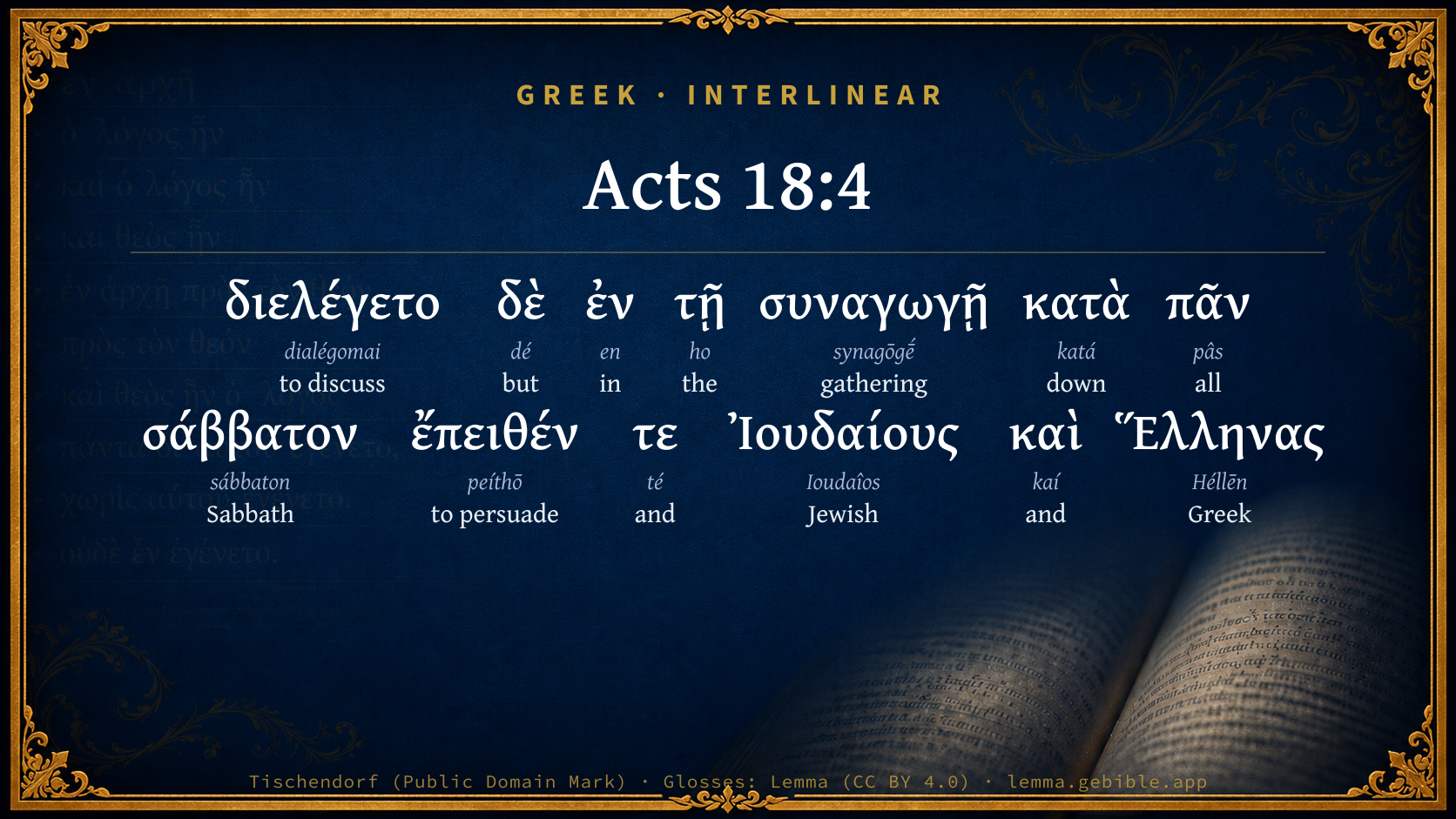
Greek (Tischendorf 8th ed.) Acts 18:4 appears in the Greek New Testament. The text above is from the Tischendorf 8th edition. Each word links to its Strong’s number and a concise gloss. Click any word for its full Thayer’s Greek Lexicon entry.
Download image
Cite this verse

Acts 18:4 (World English Bible). Public Domain. Lemma interlinear Bible study tool, https://lemma.gebible.app/v/acts/18/4.

Show BibTeX & RIS
BibTeX
RIS
English Translation
He reasoned in the synagogue every Sabbath, and persuaded Jews and Greeks.
World English Bible · Public Domain
Download a study sheet

One document with this verse’s original text, its word-by-word gloss line, the meaning frame, cross-references with their text, attributed commentary, and full source and license credits — printable, and it pastes into notes with its structure intact.

This verse Autodidact and up

Study sheet (.html) Plain text (.txt)

A passage Seminary Student

Up to 50 verses in one chapter. A passage sheet keeps up to 6 commentary sources and 12 cross-references per verse, in the order this page ranks them, and says so on the sheet whenever that leaves anything out. Ask for a single verse and you get the Autodidact verse sheet above.

Everything on this page stays free to read, with no account — the sheet is a download of what is already on screen, not access to it.

Want to remove ads? Support Godless Engineer
Compare translations 3

The same verse in 3 English versions, stacked beneath the original-language interlinear above. Click any original word for its lexicon entry.

Each is an independent rendering of the whole verse — the interlinear is not word-aligned to these translations.

Highlighted words mark where these versions differ — a whole-verse word diff, not a word-by-word alignment.

  • World English Bible Public Domain
    He reasoned in the synagogue every Sabbath, and persuaded Jews and Greeks.
  • King James Version Public Domain
    And he reasoned in the synagogue every sabbath, and persuaded the Jews and the Greeks.
  • unfoldingWord Literal Text CC BY-SA 4.0
    And he was reasoning in the synagogue on every Sabbath, persuading both Jews and Greeks.

unfoldingWord Literal Text — © unfoldingWord, licensed CC BY-SA 4.0. Word-aligned USFM3 via Door43 (git.door43.org/unfoldingWord/en_ult).

Versions to compare (up to 4)

3 of 4 selected

Show all 19 translations

Every available English version of this verse, each an independent rendering of the whole verse.

  • World English Bible Public Domain
    He reasoned in the synagogue every Sabbath, and persuaded Jews and Greeks.
  • Berean Standard Bible Public Domain
    Every Sabbath he reasoned in the synagogue, trying to persuade Jews and Greeks alike.
  • Majority Standard Bible Public Domain
    Every Sabbath he reasoned in the synagogue, trying to persuade Jews and Greeks alike.
  • King James Version Public Domain
    And he reasoned in the synagogue every sabbath, and persuaded the Jews and the Greeks.
  • American Standard Version (1901) Public Domain
    And he reasoned in the synagogue every sabbath, and persuaded Jews and Greeks.
  • Revised Version (1885) Public Domain
    And he reasoned in the synagogue every sabbath, and persuaded Jews and Greeks.
  • Geneva Bible (1599) Public Domain
    And he disputed in the Synagogue euery Sabbath day, and exhorted the Iewes, and the Grecians.
  • Douay-Rheims (1899) Public Domain
    And he reasoned in the synagogue every sabbath, bringing in the name of the Lord Jesus; and he persuaded the Jews and the Greeks.
  • Young's Literal Translation Public Domain
    and he was reasoning in the synagogue every sabbath, persuading both Jews and Greeks.
  • Literal Standard Version CC BY-SA 4.0
    and he was reasoning in the synagogue every Sabbath, persuading both Jews and Greeks.
  • Unlocked Literal Bible CC BY-SA 4.0
    So Paul reasoned in the synagogue every Sabbath. He persuaded both Jews and Greeks.
  • unfoldingWord Literal Text CC BY-SA 4.0
    And he was reasoning in the synagogue on every Sabbath, persuading both Jews and Greeks.
  • Darby Bible Public Domain
    And he reasoned in the synagogue every sabbath, and persuaded Jews and Greeks.
  • World Messianic Bible Public Domain
    He reasoned in the synagogue every Sabbath and persuaded Jews and Greeks.
  • Webster's Bible Public Domain
    And he reasoned in the synagogue every sabbath, and persuaded the Jews and the Greeks.
  • Free Bible Version CC BY-SA 4.0
    He debated in the synagogue every Sabbath, convincing both Jews and Greeks.
  • Bible in Basic English Public Domain
    And every Sabbath he had discussions in the Synagogue, turning Jews and Greeks to the faith.
  • Text-Critical English NT CC BY 4.0
    Every Sabbath he reasoned in the synagogue and tried to persuade both Jews and Greeks.
  • Tyndale New Testament (1534) Public Domain
    And he preached in the synagoge every saboth daye and exhorted the Iewes and the gentyls.

Literal Standard Version (2020), Covenant Press — licensed CC BY-SA 4.0. Text via the HelloAO Bible API (eBible.org). Unlocked Literal Bible (unfoldingWord) — licensed CC BY-SA 4.0. Text via the HelloAO Bible API (eBible.org). unfoldingWord Literal Text — © unfoldingWord, licensed CC BY-SA 4.0. Word-aligned USFM3 via Door43 (git.door43.org/unfoldingWord/en_ult). Free Bible Version, Dr. Jonathan Gallagher — licensed CC BY-SA 4.0. Text via the HelloAO Bible API (eBible.org).

Word by word

More ways to search: Search by grammar → Find every occurrence → Compare this word →

Practice this passage: Drill this verse → Learn its vocabulary →

διελέγετο
dialégomai
G1256
“to discuss”
Verb, Imperfect, Middle or Passive deponent, Indicative, 3rd person, Singular
Part of Speech
Verb
Tense
Imperfect
Voice
Middle or Passive deponent
Mood
Indicative
Person
3rd person
Number
Singular
Full Thayer's Definition

Origin: middle voice from G1223 and G3004

TDNT: 03:33,2

1. to think different things with one's self, mingle thought with thought a. to ponder, revolve in mind 2. to converse, discourse with one, argue, discuss
  1. δὲ dé G1161 “but” Conjunction
  2. ἐν en G1722 “in” Preposition
  3. τῇ ho G3588 “the” Article, Dative, Singular, Feminine
  4. συναγωγῇ synagōgḗ G4864 “gathering” Noun, Dative, Singular, Feminine
  5. κατὰ katá G2596 “down” Preposition
  6. πᾶν pâs G3956 “all” Adjective, Accusative, Singular, Neuter
  7. σάββατον sábbaton G4521 “Sabbath” Noun, Accusative, Singular, Neuter
  8. ἔπειθέν peíthō G3982 “to persuade” Verb, Imperfect, Active, Indicative, 3rd person, Singular
  9. τε té G5037 “and” Particle
  10. Ἰουδαίους Ioudaîos G2453 “Jewish” Adjective, Accusative, Plural, Masculine
  11. καὶ kaí G2532 “and” Conjunction
  12. Ἕλληνας Héllēn G1672 “Greek” Noun, Accusative, Plural, Masculine

About this verse

These counts appear in no published source. They are computed here, from the morphology-tagged text and Lemma’s own curated glosses. What Lemma adds →

13
words
13
distinct lemmas
Acts
section

Notable vocabulary

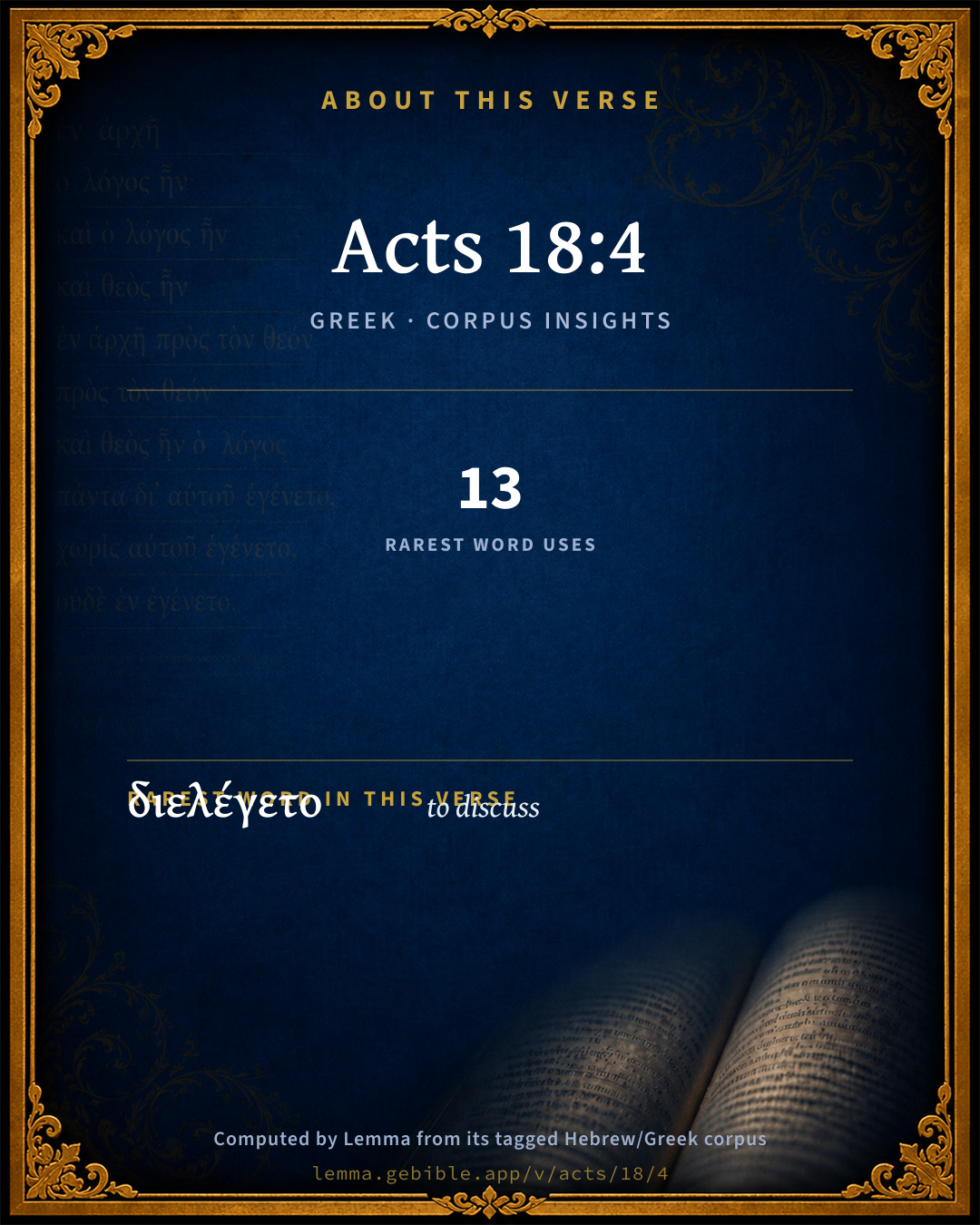
The rarest word here is διελέγετο to discuss G1256 — appearing just 13 times in the whole Greek New Testament.

Shared distinctive vocabulary

διελέγετο to discuss G1256 occurs in 13 verses of the Greek New Testament. Also found in:

Cross-references

14

Topical passages linked to Acts 18:4 in the Treasury of Scripture Knowledge — connected by theme and wording, ordered by reader-vote popularity; previews shown in the World English Bible.

  • 2 Corinthians 5:11 Knowing therefore the fear of the Lord, we persuade men, but we are revealed to God; and I hope that we are revealed also in your consciences.
  • Acts 17:17 So he reasoned in the synagogue with the Jews and the devout persons, and in the marketplace every day with those who met him.
  • Acts 28:23 When they had appointed him a day, many people came to him at his lodging. He explained to them, testifying about the Kingdom of God, and persuading them concerning Jesus, both from the law of Moses and from the prophets, from morning until evening.
  • 2 Chronicles 32:11 Does not Hezekiah persuade you, to give you over to die by famine and by thirst, saying, Yahweh our God will deliver us out of the hand of the king of Assyria?
  • Luke 4:16 He came to Nazareth, where he had been brought up. He entered, as was his custom, into the synagogue on the Sabbath day, and stood up to read.
  • Luke 16:31 "He said to him, 'If they don't listen to Moses and the prophets, neither will they be persuaded if one rises from the dead.'"
  • Acts 13:14–14:1 But they, passing on from Perga, came to Antioch of Pisidia. They went into the synagogue on the Sabbath day, and sat down.
  • Acts 17:1–3 Now when they had passed through Amphipolis and Apollonia, they came to Thessalonica, where there was a synagogue of the Jews.
  • Acts 17:11 Now these were more noble than those in Thessalonica, in that they received the word with all readiness of the mind, examining the Scriptures daily to see whether these things were so.
  • Acts 18:13 saying, "This man persuades men to worship God contrary to the law."
  • Acts 19:8 He entered into the synagogue, and spoke boldly for a period of three months, reasoning and persuading about the things concerning the Kingdom of God.
  • Acts 19:26 You see and hear, that not at Ephesus alone, but almost throughout all Asia, this Paul has persuaded and turned away many people, saying that they are no gods, that are made with hands.
  • Acts 26:28 Agrippa said to Paul, "With a little persuasion are you trying to make me a Christian?"
  • Genesis 9:27 God enlarge Japheth, Let him dwell in the tents of Shem; Let Canaan be his servant."

Cross-references courtesy of OpenBible.info (CC BY 4.0).

Commentary

Notes on Acts 18:4 from classic Christian and Jewish commentators (each source and its license shown beneath its notes). The classic Christian expositions comment on the surrounding passage and are grouped to its opening verse, so a note may address several verses; the Jewish commentaries on the Tanakh (Rashi and others) are per-verse, so they appear only where the commentator wrote on this verse.

Lemma curates 59 commentaries, every one of them public domain or Creative Commons licensed, each selected and text-cleaned for this edition rather than reprinted as found. About our sources →

Joseph Benson's Commentary

Act 18:4. And he reasoned in the synagogue, &c. — The Jews being numerous in Corinth, Paul, according to his custom, began his ministry in the synagogue; and persuaded — That is, endeavoured to persuade; the Jews and Greeks — It is probable that most of these Greeks, since they attended the Jewish synagogue, were a kind of proselytes. It is possible, however, that some of them might not be such, but Gentiles, who were drawn out of curiosity to attend in the synagogue (though they did not commonly worship there) to hear such an extraordinary preacher as Paul was, especially considering the miracles which he wrought at Corinth, and to which he so often refers in the two epistles afterward written to the church formed there.

Joseph Benson's Commentary on the Old and New Testaments (1811–1818) — public domain. Text from a community e-Sword module.

Tyndale Open Study Notes

Tyndale Open Resources

18:4-6 Once again Paul followed his custom of preaching to the Jews first, and then reaching out to Gentiles after he met with rejection and opposition (13:42-49; see 3:25-26; 26:20; Rom 1:16; 2:10; 3:29, 30; 4:9-12). • Paul probably wrote his letters to the Thessalonian Christians after Silas and Timothy came down from Macedonia with a report of how things were going there (see 1 Thes 3:6; 2 Thessalonians Book Introduction, “Setting”).

Tyndale Open Study Notes — © Tyndale Open Resources, licensed CC BY-SA 4.0. Text via the HelloAO Bible API.

Expositor's Greek Testament

ed. W. Robertson Nicoll

Act 18:4 . διελέγετο δὲ … ἔπειθέ τε : “and he used to discourse … and tried to persuade,” so Ramsay, marking the imperfects, see also Hackett’s note. Ἐλληνας : proselytes, since they are represented as in the synagogue, cf. Act 14:1 . The heathen are not addressed until Act 18:6 . McGiffert considers that this notice of work in the synagogue is untrustworthy (p. 268) and at variance with the fact that in St. Paul’s own Epistles there is no hint of it, but cf. 1Co 9:20 , words which we may reasonably suppose had a special application to Corinth, or the Apostle would scarcely have so expressed himself. It would have been strange if in such a commercial centre there had been no Jewish synagogue.

The Expositor's Greek Testament, edited by W. Robertson Nicoll (1897–1910) — public domain. Text from a community e-Sword module.

Geneva Bible (1599)

Geneva Bible translators

The truth ought always to be freely uttered, yet notwithstanding the doctrine may be so moderated, as occasion of the profit that the people take thereby, shall require.

Exhorted so that he persuaded, and so the word signifieth.

Geneva Bible (1599) marginal notes — public domain. Text via Bolls.life.

Jamieson, Fausset & Brown

Robert Jamieson, A. R. Fausset & David Brown

the Greeks--that is, Gentile proselytes; for to the heathen, as usual, he only turned when rejected by the Jews (Act 18:6).

Jamieson, Fausset & Brown — Commentary Critical and Explanatory on the Whole Bible (1871) — public domain (CC PDM 1.0). Text via the HelloAO Bible API.

Adam Clarke's Commentary

Verse 4. He reasoned in the synagogue every Sabbath] Discoursed at large concerning Jesus as the Messiah, proving this point from their own Scriptures, collated with the facts of our Lord's life, c.

And persuaded the Jews and the Greeks.] Many, both Jews and proselytes, were convinced of the truth of his doctrine. Among his converts was Epenetus, the first fruit of his labour in Achaia, Ro 16:5 and the family of Stephanas was the next; and then Crispus and Caius, or Gaius; all of whom the apostle himself baptized, 1Co 1:14-16. See Clarke on Ac 18:8.

Adam Clarke's Commentary on the Bible (1810–1826) — public domain. Text from a community e-Sword/MySword module.

John Calvin's Commentaries

4. He disputed in the synagogue It is a wonder how that crept in which is in the Latin books, that Paul put in the name of Christ: unless it were because some reader would supply the want of the general sentence. For Luke setteth down two things in this place: to wit, that Paul disputed among the Jews; secondly, that he began more plainly to profess Christ after that Silas and Timotheus were come. And though it be likely that he began to speak of Christ even at the first entrance, because he could not omit the principal point of the heavenly doctrine, yet that doth not hinder but that he might use some other manner of disputation. Therefore I take [πειθειν] that is, to persuade, for to induce by little and little. For, in my judgment, Luke doth signify, that forasmuch as the Jews did handle the law coldly and foolishly, Paul spake of the corrupt and wicked nature of man, of the necessity of grace of the Redeemer which was promised, of the means to obtain salvation, that he might awake them; for this is a fit and brief preparation unto Christ. Again, when he saith that he was forced in spirit to teach that Jesus was Christ, his meaning is, that he was enforced with greater vehemency to intreat and speak of Christ freely and openly. So that we see that Paul did not utter all things at one time, but he tempered his doctrine as occasion did serve.

And because like moderation is profitable at this day, it is convenient for faithful teachers wisely to consider where to begin, lest a preposterous and confused order do hinder the proceeding of doctrine. Furthermore, though there were ferventness enough in Paul, yet it is no inconvenient thing that he was made more courageous by some new help, not that he was encouraged by shame, or the hope which he reposed in his fellows, but because he considered that this help was sent him, as it were, from heaven. But this forcing in the spirit is not taken for a violent or external impulsion, (as they say, ) as those which were called Phoebades and frantic men were wont to be carried away with devilish madness; but there was more ferventness added unto the wonted inspiration of the Spirit which was in Paul, so that he was moved with new power of God, and yet did he of his own accord follow the Spirit as his guide. Whereas Paul did testify that Jesus is Christ, I expound it thus: when he had thoroughly taught the Jews concerning the office of the Redeemer, he declared by testimonies of Scripture that this is he which was to be hoped for, because all those things agree to him which the law and the prophets attribute to Christ. Therefore, he did not simply affirm, but using a solemn testification, he proved Jesus, the Son of Mary, to be that Christ who should be the Mediator between God and men, that he might restore the world from destruction to life.

John Calvin's Commentaries (1540-1563) — public domain. Text from the Calvin Translation Society English edition (1840s-50s) via the Christian Classics Ethereal Library (ccel.org). Calvin's coverage is partial (roughly two-thirds of the Bible); uncommented books and verses are honest gaps, never fabricated. The 19th-century editor's footnotes and remarks are omitted so the notes are faithfully Calvin's own voice.

Ellicott's Commentary for English Readers

(4) He persuaded the Jews and the Greeks.—It is necessary to remind the reader that the latter word does not mean Greek-speaking Jews, or proselytes in the full sense of the word, but, as elsewhere (see Note on Act_11:22), is used for those who were Gentiles by birth, and who, though worshipping in the synagogue, had not accepted circumcision.

(4) So far we have found reasons for the vow. But taken by itself, the vow would seem to have involved a continuous growth of hair rather than cropping it. How was that act connected with the vow? A probable answer to the question is found in the Apostle’s language as to social customs in matters of this kind, in 1Co_11:14. He condemns long hair as effeminate. But the Nazarite vow led to long hair as its natural consequence, and there was, therefore, the risk that while practising a rigorous austerity, he might seem to outside observers to be adopting an unmanly refinement. At Corinth men would, perhaps, know what his act meant, but in the regions to which he was now going it was wise to guard against the suspicion by a modification of the vow, such as Jewish law allowed.

Cenchreæ was, as has been said, the eastern harbour of Corinth on the Saronic Gulf. Rom_16:1 indicates the existence of an organised Church there. The warm language of gratitude in which St. Paul speaks of Phœbe, the deaconess of the Church there, is best explained by supposing that she had ministered to him as such when he was suffering from bodily pain or infirmity, and this, in its turn, may afford another probable explanation of the vow.

A Bible Commentary for English Readers, edited by Charles John Ellicott (1878–1897) — public domain. Text from a community e-Sword module.

The Cambridge Bible for Schools and Colleges

gen. ed. J. J. S. Perowne

4. and persuaded the Jews and the Greeks] There are no articles in the original and they are omitted in the Revised Version. No doubt, as in other Gentile cities, the religion of the Jews in Corinth gained the attention of many among the Gentiles, who as proselytes or inclining thereto would form part of the Sabbath audience in the synagogue. According to his rule St Paul addressed himself to the Jews first.

The Cambridge Bible for Schools and Colleges (gen. ed. J. J. S. Perowne; Cambridge University Press, 1878–1918) — public domain. Text from a community e-Sword module.

John Gill's Exposition

And he reasoned in the synagogue every sabbath,.... In Corinth there was a synagogue of the Jews, in which they met together for worship on the seventh day of the week, which was their sabbath; and hither Paul went, and took the opportunity of reasoning with them out of the Scriptures, concerning Christ, his person, and offices, his incarnation, obedience, sufferings, and death, and about redemption and salvation by him: we may observe the diligence, industry, and indefatigableness of the apostle; on the sabbath day he went to the synagogue, and preached Christ to those who there attended; and on the weekdays he laboured with his own hands. Beza's most ancient copy, and the Vulgate Latin version add here, "interposing the name of the Lord Jesus"; frequently making mention of his name, or calling upon it, and doing miracles in it.

And persuaded the Jews and the Greeks; this was the effect of his reasoning, and the success that attended it; some, both of the Jews, who were so by birth, as well as religion, and of the Greeks, or Gentiles, who were Jewish proselytes, and attended synagogue worship, were convinced by his arguments, and were induced to believe the truth of his doctrine, and to embrace it; or at least he endeavoured to persuade them that they were lost sinners, and that there was salvation for them in Christ, and in him only.

John Gill's Exposition of the Whole Bible (1746–1763) — public domain (CC PDM 1.0). Text via the HelloAO Bible API.

Trapp's Complete Commentary

John Trapp

4 And he reasoned in the synagogue every sabbath, and persuaded the Jews and the Greeks.

Ver. 4. Persuaded the Jews] Men may speak persuasively, but God only can persuade. Gen 9:27, Japheth’s children were to be won by persuasion. Therefore Christ sent forth to them not soldiers, but fishers, who might work upon them docendo non ducendo, monendo non minaudo, by informing them, not by enforcing them.

John Trapp, A Commentary or Exposition upon All the Books of the Old and New Testament (1647–1656) — public domain. Text from a community e-Sword module.

Albert Barnes' Notes on the Bible

And he reasoned ... - See the notes on Act 17:2.

Albert Barnes' Notes on the Bible (1834–1885) — public domain. Text from a community e-Sword/MySword module.

Haydock's Catholic Bible Commentary

Introducing the name of the Lord Jesus. These words are found in few Greek copies, and so are omitted in the Protestant translation. (Witham)

George Leo Haydock (1774–1849), Haydock's Catholic Family Bible and Commentary, 1859 edition — public domain. Excludes Psalms (Douay-Rheims chapter numbering differs from Protestant) and Deuterocanonical books (Catholic canon only).

Matthew Poole's English Annotations

He reasoned in the synagogue; or argued and disputed, giving his reasons out of Scripture, and answering their objections.

And persuaded the Jews; not only using cogent arguments, but, as some understand the verb, such as did prevail upon them.

And the Greeks; not such as were of the Jewish race, and after the dispersion used the Scripture in the Greek tongue; but such as were Gentile Greeks, Greeks by descent.

Matthew Poole's English Annotations on the Holy Bible (1683–1685) — public domain. Text from a community e-Sword/MySword module.

Whedon's Commentary on the Bible

Daniel D. Whedon

4. Persuaded—Fresh from his disheartening failure at Athens, and burdened with the uncertainty lest his first three Churches in Europe, namely, Philippi, Thessalonica, and Berea, should also prove failures, and so his whole ministry turn out a failure, the apostle on his first entrance into the formidable city of Corinth is in spirit intimidated and lifeless. So he describes his own feelings to the Corinthians (1Co_2:1-4) and to the Thessalonians, (1Th_3:6-8.) Residing with Aquila, he goes to the synagogue and there, under depression and alone, rather persuades with gentle reserve, and conciliates the kindly feelings of the Jews.

Daniel D. Whedon (gen. ed.), Commentary on the Old and New Testaments (1874–1909) — public domain. Text from a community e-Sword module.

The Pulpit Commentary

Jews and Greeks for the Jews and the Greeks, A.V. Observe again the influence of the synagogue upon the Greek population. Reasoned. (see Act_17:2, Act_17:17, note)

Vers. 4-17. The testimony.

The kernel of the gospel is the truth that Jesus was the Christ. He was the Person spoken of by all the prophets as to come. Jesus of Nazareth, the son of Mary, born in the reign of Augustus Caesar, and crucified in that of Tiberius; known to his contemporaries in Judaea and Galilee as a Teacher and a Prophet, known to later ages by the Gospels which record his life and death and resurrection from the dead; is God"s Christ. He came into the world, in accordance with the eternal purpose of God, to be the Teacher, the Savior, the Judge, the Lord, the King of the whole earth, the Head of the human race. He fulfilled in his own person all the predictions of the prophets; he accomplished by his work all that God had in store for the redemption of the sons of men. Whatever the Holy Ghost spoke of the Godhead, of the priesthood, of the sacrifice, of the reign, of the glorious kingdom of Messiah, has its fulfillment in the Lord Jesus. The truth, therefore, that Jesus was the Christ is the kernel of the whole gospel. But further, this is either a fact or it is not a fact. There is no cloudland of uncertain existence, no matter of doubtful disputation or of fluctuating opinion. Those who have told us these things are witnesses of what they knew, not disputers about what they thought. What they have delivered to us is their testimony. We must either accept it as true or reject it as false. It has met with both treatments in the world, and, whether believed or disbelieved, has been a potent factor in men"s behavior. When believed, it has made the kind of man that Paul was, the kind of men and women that Aquila and Priscilla were. It has made men pure, holy, upright, patient, meek, kind, unselfish, self-denying, laboring for the good of others rather than for their own gain; with affections set on heavenly more than on earthly things; conscientious, true, faithful to their word; to be trusted and relied upon; great benefactors to their race, full of love to mankind. When disbelieved, it has not simply been set aside as a thing unworthy of credit, but it has set in action the most malignant passions in the human breast. Envy and jealousy, hatred and malice, have blazed up in all their fury against the authors and abettors of this testimony. You would think, judging by the fierce rage of the opponents, that there could not be a greater crime against humanity than to teach men to love God, to abstain from all evil, and to live in peace and good will towards one another. Judging by the rage of the opponents, you would think that a greater wrong could not be done to men than to tell them of life and rest and happiness in the eternal reach beyond the grave, as encouragements to patient well doing on this side the grave. Jews and heathens, so unlike one another in everything else, were exactly alike in their reception of this testimony. The Jews blasphemed and cursed and persecuted, and brought for punishment before the Roman tribunals those who gave testimony for Christ; the heathen, tolerant of every form of idolatry, let loose fire and sword and wild beast against the harmless disciples of the Lord Jesus. The accomplished philosopher, Marcus Aurelius, gave Justin Martyr to the executioner and Polycarp to the flames, with as little scruple as Nero tortured his Christian subjects at Rome. The scornful hatred of Tacitus for the pestilential superstition of the Christian was as bitter as the scurrilous wit of Lucian. In our own day many tongues are let loose against the testimony. New philosophers, new exponents of the physical laws by which the world consists, new pretenders to superior wisdom and wider intelligence in the various departments of human knowledge, however differing among themselves in the fundamental principles of their several schemes, agree in the scornful rejection of "the testimony of Jesus Christ." The Church meanwhile pursues her unwavering course. She holds in her hand the lamp of that truth which she did not invent, but which she received from God. That lamp sheds forth its heavenly light, whether men receive it or whether they shut it out from their hearts and walk on in darkness. For that truth the Church is ready now, as she ever was, to endure the scorn and hatred of mankind or to suffer imprisonment and death. Her office is to testify that Jesus is the Christ. By the grace of God she will continue that testimony until the Lord comes, and her witness to the absent is swallowed up in her adoration of the present, in visible power and glory.

The Pulpit Commentary (1880–1919), ed. H.D.M. Spence-Jones & Joseph S. Exell — public domain. Text from a community e-Sword module.

Burkitt's Expository Notes on the New Testament

William Burkitt

Observe here, How vehemently desirous the holy apostle was to plant a Christian church at Corinth, and to bring the Jews of Corinth to embrace the gospel: He was pressed in spirit, and testified, that is, reasoned with them with great vehemency and earnestness of affection, as well as with great judgment, concerning the Messias.

Observe, 2. That the Jewish synagogue at Corinth was the preaching place that St. Paul made choice of, hoping to gather the beginnings of his Christian church out of the converted Jews: He reasoned in the synagogue every sabbath-day. Still the apostle kept to his commission, to preach the gospel first to the Jews, and afterwards, upon their rejection, to the Gentiles.

Observe, 3. The blasphemous opposition which the Jews made to the doctrine of the gospel: They opposed themselves, and blasphemed; that is, they opposed his doctrine, reviled his person, and blasphemed Christ, whom that apostle preached.

Observe, 4. How the holy apostle clears himself of the blood of those Jews, whom he had now preached the gospel unto: He said, your blood be upon your own hands; I am clean.

The faithful ministers of Christ shall never have the blood of a perishing people laid to their charge; they having warned them of their damnable state, and discovered the way of life and salvation to them, deliver their own souls; whilst the people which they preached to, die in their sins, and for their sins.

William Burkitt's Expository Notes on the New Testament (1700–1703) — public domain. Text from a community e-Sword module.

Godbey's Commentary on the New Testament

William B. Godbey

4. Felicitously, there is a large synagogue of Jews at Corinth, and it is too far from Northern Greece for his persecutors to follow him. So he works all the week and preaches every Sabbath in the synagogue.

William B. Godbey, Commentary on the New Testament (1896–1900) — public domain. Text from a community e-Sword module.

McGarvey & Pendleton's Commentaries

J. W. McGarvey

4, 5. Notwithstanding all the discouragements of his situation, he devoted the Sabbaths, and whatever portion of the week his manual labor would permit, to the great work. (4) " But he discoursed every Sabbath in the synagogue, and persuaded both Jews and Greeks. (5) And when Silas and Timothy came down from Macedonia, Paul was pressed in spirit, and testified to the Jews that Jesus is the Christ. " It will be recollected by the reader, that Silas and Timothy, whose arrival is here mentioned, had tarried in Berea, and that Paul had sent back word to them, by the brethren who conducted him to Athens, to rejoin him as soon as possible. He had also "waited for them in Athens," before his speech in the Areopagus. We would suppose, from Luke's narrative, that they failed to overtake him there, and now first rejoined him in Corinth. But Paul supplies an incident in the First Epistle to the Thessalonians, which corrects this supposition. He says: "When we could no longer forbear, we thought it good to be left alone in Athens, and sent Timothy to establish you and to comfort you concerning your faith." This shows that Timothy, at least, had actually rejoined him in Athens, and had been sent back to learn the condition of the congregation in Thessalonica. His present arrival in Corinth, therefore, was not from his original stay in Berea; but from a recent visit to Thessalonica. Probably Silas had remained till now in Berea.

The arrival of Silas and Timothy brings us to a new period in the life of Paul, the period of his letter-writing. We have already made some use of his epistles to throw light upon the somewhat elliptical narrative before us; but we shall henceforth have them as cotemporary documents, and will be able to fill up from them many blanks in Paul's personal history. The First Epistle to the Thessalonians was written from Corinth soon after the arrival of Timothy, as is proved by the concurrence of the two facts, that, on the return of Silas and Timothy, as seen in the text, just quoted, they found Paul in Corinth, and that, in the epistle itself, Paul speaks of their arrival as having just taken place at the time of writing. Several statements in this epistle throw additional light upon the state of Paul's feelings during his first labors in Corinth. He was not only "pressed in spirit," as stated by Luke, "in weakness, in fear, and in much trembling," as he himself says to the Corinthians but he was racked with uncontrollable anxiety concerning the brethren in Thessalonica, for whom he would have been willing to sacrifice his own life, and who were now suffering the severest persecution. The good report brought from them by Silas and Timothy gave him much joy, but it was joy in the midst of distress. He says: "When Timothy came to us from you, and brought us good tidings of your faith and love, and that you have remembrance of us always, desiring greatly to see us, as we also to see you, therefore, brethren, we were comforted over you in all our affliction and distress by your faith: for now we live, if you stand fast in the Lord." It was, therefore, with a zeal newly kindled from almost utter despair, by their good report from Thessalonica and the arrival of his fellow-laborers, that he now so "earnestly testified to the Jews that Jesus is the Christ."

J. W. McGarvey (with Philip Y. Pendleton), Commentaries on the New Testament (The Fourfold Gospel, 1914; Acts; and the epistles) — public domain. Text from a community e-Sword/MySword module.

The People's New Testament

B. W. Johnson

4. He reasoned in the synagogue every sabbath. While toiling six days in the week in this strange city, on the Sabbath, according to his custom, he preached.

B. W. Johnson's The People's New Testament with Notes (1889–1891) — public domain. Electronic text from the Christian Classics Ethereal Library (CCEL) ThML edition.

unfoldingWord translationNotes

Door43 World Missions Community

General Information:

Silas and Timothy rejoin Paul.

So Paul reasoned

"So Paul debated" or "So Paul discussed." He gave reasons. This means that rather than just preaching, Paul talked and interacted with the people.

He persuaded both Jews and Greeks

Possible meanings are 1) "He caused both Jews and Greeks to believe" or 2) "He kept trying to persuade the Jews and the Greeks."

Paul was compelled by the Spirit

This can be stated in active form. AT: "the Spirit compelled Paul" (See: Active or Passive)

shook out his garment

This is a symbolic action to indicate that Paul will no longer try to teach the Jews there about Jesus. He is leaving them to God's judgment. (See: Symbolic Action)

May your blood be upon your own heads

Here "blood" stands for the guilt of their actions. Here "heads" refers to the whole person. Paul tells the Jews they are solely responsible for the judgment they will face for their stubbornness if they refuse to repent. AT: "You alone bear the responsibility for your punishment for sin" (See: Metonymy and Synecdoche)

translationWords

Paul

synagogue

Sabbath

Jew

Greek

Silas

Timothy

Macedonia

Holy Spirit

testimony

Jesus

Christ

blood

head

innocent

Gentile

unfoldingWord translationNotes — © Distant Shores Media and the Door43 World Missions Community, licensed CC BY-SA 4.0. Source: git.door43.org/Door43/en_tn.

Cambridge Greek Testament for Schools and Colleges

4. ἔπειθέν τε Ἰουδαίους καὶ Ἕλληνας, and persuaded both Jews and Greeks. No doubt as in other Gentile cities, the religion of the Jews in Corinth gained the attention of many among the Gentiles, who as proselytes or inclining thereto might form part of the Sabbath audience in the synagogue. According to his rule St Paul addressed himself to the Jews first.

Cambridge Greek Testament for Schools and Colleges (Cambridge University Press, 1896; 21 vols, various authors incl. Carr, Maclear, Plummer, Farrar, Lumby, Moule, M. R. James, Simcox) — public domain. Text from a community e-Sword module.

Lesson kit

Teaching starters — assembled from the data on this page, not authored interpretation. Every prompt links to the verse data it draws on. Edit before teaching.

Acts, in the Acts, opens this verse with 13 words (13 distinct Greek lemmas). Its most distinctive word is dialégomai (“to discuss”). A historical commentator’s framing appears above. Read the whole chapter for the surrounding context.

Discussion questions

  1. The word dialégomai carries the sense “to discuss.” How does it shape the verse?
  2. Mark 9:34 shares the word «to discuss» with this verse. How do the two illuminate each other?
  3. The translations on this page render this verse differently — a whole-verse word diff, not a word-by-word alignment. What might account for the different wordings?
  4. Reading how Joseph Benson's Commentary and Tyndale Open Study Notes read this verse, where do the two commentators agree and where do they part?

Things to notice

Reading settings

Reading text

Shown beneath each verse's original-language words.

Old Testament
Old Testament edition

Read the OT as the Masoretic Hebrew (MT) or the Greek Septuagint (LXX).

English shown for the Greek Septuagint (in the Hebrew ↔ Greek comparison).

Comparing translations? Open the Compare panel on any verse page to stack up to four side by side.