
Acts 22:23

Greek (Tischendorf 8th ed.) Acts 22:23 appears in the Greek New Testament. The text above is from the Tischendorf 8th edition. Each word links to its Strong’s number and a concise gloss. Click any word for its full Thayer’s Greek Lexicon entry.
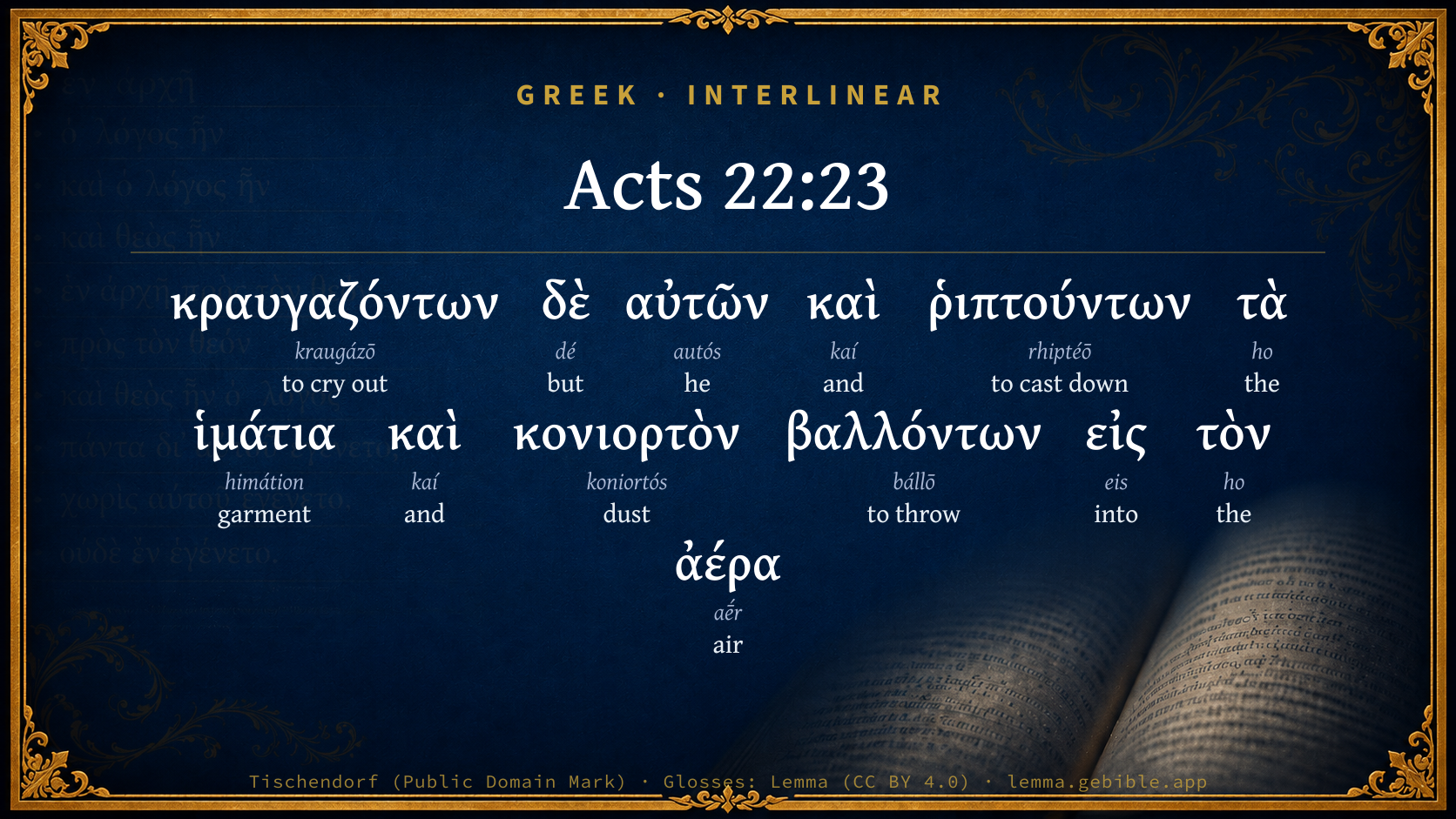
Download image
Cite this verse

Acts 22:23 (World English Bible). Public Domain. Lemma interlinear Bible study tool, https://lemma.gebible.app/v/acts/22/23.

Show BibTeX & RIS
BibTeX
RIS
English Translation
As they cried out, and threw off their cloaks, and threw dust into the air,
World English Bible · Public Domain
Highlights
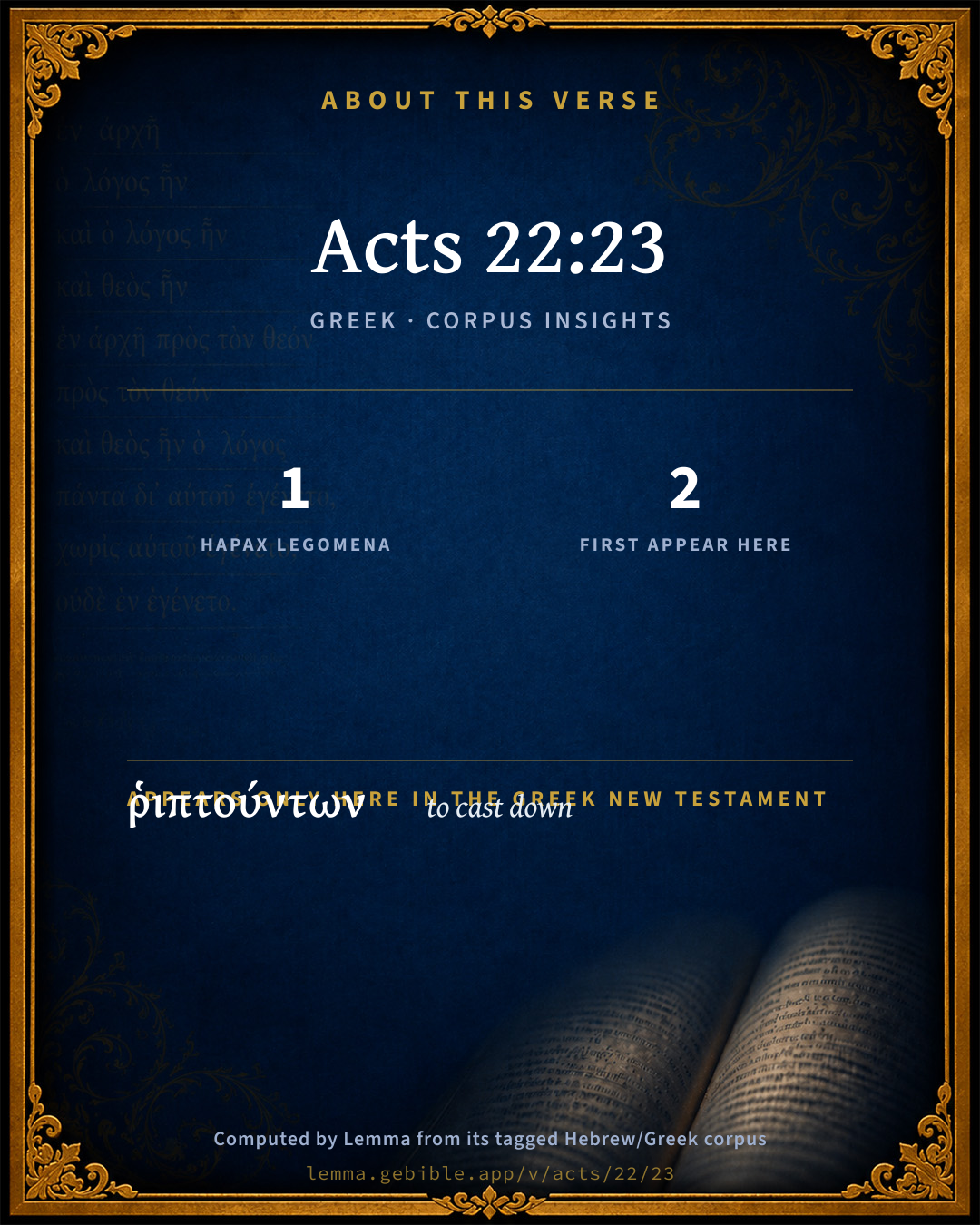
  • 1 hapax legomenon — only here in the Greek New Testament
  • 2 first appearances in the Greek New Testament
Full analysis ↓
Download a study sheet

One document with this verse’s original text, its word-by-word gloss line, the meaning frame, cross-references with their text, attributed commentary, and full source and license credits — printable, and it pastes into notes with its structure intact.

This verse Autodidact and up

Study sheet (.html) Plain text (.txt)

A passage Seminary Student

Up to 50 verses in one chapter. A passage sheet keeps up to 6 commentary sources and 12 cross-references per verse, in the order this page ranks them, and says so on the sheet whenever that leaves anything out. Ask for a single verse and you get the Autodidact verse sheet above.

Everything on this page stays free to read, with no account — the sheet is a download of what is already on screen, not access to it.

Want to remove ads? Support Godless Engineer
Compare translations 3

The same verse in 3 English versions, stacked beneath the original-language interlinear above. Click any original word for its lexicon entry.

Each is an independent rendering of the whole verse — the interlinear is not word-aligned to these translations.

Highlighted words mark where these versions differ — a whole-verse word diff, not a word-by-word alignment.

  • World English Bible Public Domain
    As they cried out, and threw off their cloaks, and threw dust into the air,
  • King James Version Public Domain
    And as they cried out, and cast off their clothes, and threw dust into the air,
  • unfoldingWord Literal Text CC BY-SA 4.0
    And as they were shouting and casting off outer garments, and throwing dust into the air,

unfoldingWord Literal Text — © unfoldingWord, licensed CC BY-SA 4.0. Word-aligned USFM3 via Door43 (git.door43.org/unfoldingWord/en_ult).

Versions to compare (up to 4)

3 of 4 selected

Show all 19 translations

Every available English version of this verse, each an independent rendering of the whole verse.

  • World English Bible Public Domain
    As they cried out, and threw off their cloaks, and threw dust into the air,
  • Berean Standard Bible Public Domain
    As they were shouting and throwing off their cloaks and tossing dust into the air,
  • Majority Standard Bible Public Domain
    As they were crying out and throwing off their cloaks and tossing dust into the air,
  • King James Version Public Domain
    And as they cried out, and cast off their clothes, and threw dust into the air,
  • American Standard Version (1901) Public Domain
    And as they cried out, and threw off their garments, and cast dust into the air,
  • Revised Version (1885) Public Domain
    And as they cried out, and threw off their garments, and cast dust into the air,
  • Geneva Bible (1599) Public Domain
    And as they cried and cast off their clothes, and threw dust into the aire,
  • Douay-Rheims (1899) Public Domain
    And as they cried out and threw off their garments, and cast dust into the air,
  • Young's Literal Translation Public Domain
    And they crying out and casting up their garments, and throwing dust into the air,
  • Literal Standard Version CC BY-SA 4.0
    And they crying out and casting up their garments, and throwing dust into the air,
  • Unlocked Literal Bible CC BY-SA 4.0
    As they were shouting, throwing off their cloaks, and throwing dust into the air,
  • unfoldingWord Literal Text CC BY-SA 4.0
    And as they were shouting and casting off outer garments, and throwing dust into the air,
  • Darby Bible Public Domain
    And as they were crying, and throwing away their clothes, and casting dust into the air,
  • World Messianic Bible Public Domain
    As they cried out, threw off their cloaks, and threw dust into the air,
  • Webster's Bible Public Domain
    And as they cried out, and cast off their clothes, and threw dust into the air,
  • Free Bible Version CC BY-SA 4.0
    They screamed and tore off their coats and threw dust into the air.
  • Bible in Basic English Public Domain
    And while they were crying out, and pulling off their clothing, and sending dust into the air,
  • Text-Critical English NT CC BY 4.0
    As they were crying out, throwing off their cloaks and flinging dust into the air,
  • Tyndale New Testament (1534) Public Domain
    And as they cryed and cast of their clothes and thrue dust into the ayer

Literal Standard Version (2020), Covenant Press — licensed CC BY-SA 4.0. Text via the HelloAO Bible API (eBible.org). Unlocked Literal Bible (unfoldingWord) — licensed CC BY-SA 4.0. Text via the HelloAO Bible API (eBible.org). unfoldingWord Literal Text — © unfoldingWord, licensed CC BY-SA 4.0. Word-aligned USFM3 via Door43 (git.door43.org/unfoldingWord/en_ult). Free Bible Version, Dr. Jonathan Gallagher — licensed CC BY-SA 4.0. Text via the HelloAO Bible API (eBible.org).

Word by word

More ways to search: Search by grammar → Find every occurrence → Compare this word →

Practice this passage: Drill this verse → Learn its vocabulary →

ῥιπτούντων
rhiptéō
G4495
“to cast down”
Verb, Present, Active, Participle, Genitive, Plural, Masculine
Part of Speech
Verb
Tense
Present
Voice
Active
Mood
Participle
Case
Genitive
Number
Plural
Gender
Masculine
Full Thayer's Definition

Origin: from a derivative of G4496

TDNT: 6:991,*

1. to cast, throw 2. throw down 3. to cast forward or before 4. to set down (with the suggestion of haste and want of care) 5. to throw to the ground, prostrate
  1. κραυγαζόντων kraugázō G2905 “to cry out” Verb, Present, Active, Participle, Genitive, Plural, Masculine
  2. δὲ dé G1161 “but” Conjunction
  3. αὐτῶν autós G846 “he” Personal pronoun, Genitive, Plural, Masculine
  4. καὶ kaí G2532 “and” Conjunction
  5. τὰ ho G3588 “the” Article, Accusative, Plural, Neuter
  6. ἱμάτια himátion G2440 “garment” Noun, Accusative, Plural, Neuter
  7. καὶ kaí G2532 “and” Conjunction
  8. κονιορτὸν koniortós G2868 “dust” Noun, Accusative, Singular, Masculine
  9. βαλλόντων bállō G906 “to throw” Verb, Present, Active, Participle, Genitive, Plural, Masculine
  10. εἰς eis G1519 “into” Preposition
  11. τὸν ho G3588 “the” Article, Accusative, Singular, Masculine
  12. ἀέρα aḗr G109 “air” Noun, Accusative, Singular, Masculine

About this verse

These counts appear in no published source. They are computed here, from the morphology-tagged text and Lemma’s own curated glosses. What Lemma adds →

13
words
11
distinct lemmas
Acts
section

Notable vocabulary

1 hapax legomenon — a word that appears only here in the entire Greek New Testament:

  • ῥιπτούντων to cast down G4495

First appearance in Scripture

These words make their first canonical appearance in the Greek New Testament here:

  • ῥιπτούντων to cast down G4495
  • ἀέρα air G109

Shared distinctive vocabulary

κονιορτὸν dust G2868 occurs in 5 verses of the Greek New Testament. Also found in:
Repetition

Words recur within this verse:

Cross-references

5

Topical passages linked to Acts 22:23 in the Treasury of Scripture Knowledge — connected by theme and wording, ordered by reader-vote popularity; previews shown in the World English Bible.

  • 2 Samuel 16:13 So David and his men went by the way; and Shimei went along on the hill-side over against him, and cursed as he went, and threw stones at him, and cast dust.
  • Ecclesiastes 10:3 Yes also, when the fool walks by the way, his understanding fails him, and he says to everyone that he is a fool.
  • Acts 7:53 You received the law as it was ordained by angels, and didn't keep it!"
  • Acts 7:58 They threw him out of the city, and stoned him. The witnesses placed their garments at the feet of a young man named Saul.
  • Acts 26:11 Punishing them often in all the synagogues, I tried to make them blaspheme. Being exceedingly enraged against them, I persecuted them even to foreign cities.

Cross-references courtesy of OpenBible.info (CC BY 4.0).

Commentary

Notes on Acts 22:23 from classic Christian and Jewish commentators (each source and its license shown beneath its notes). The classic Christian expositions comment on the surrounding passage and are grouped to its opening verse, so a note may address several verses; the Jewish commentaries on the Tanakh (Rashi and others) are per-verse, so they appear only where the commentator wrote on this verse.

Lemma curates 59 commentaries, every one of them public domain or Creative Commons licensed, each selected and text-cleaned for this edition rather than reprinted as found. About our sources →

Joseph Benson's Commentary

Act 22:23-24. And as they cried out — In this furious manner; and cast — Or tore; off their clothes — In token of indignation and horror at this pretended blasphemy: or, as Dr. Whitby thinks, as in the case of Stephen, that they might be ready to stone him; and threw dust into the air — Through vehemence of rage, which they knew not how to give vent to; the chief captain — Not knowing the particulars of what had passed, but perceiving, by the effect, that Paul had rather exasperated than appeased them by the apology which he had been permitted to make, commanded that he should be brought into the castle, and — As no witnesses were produced in a regular way to give information against him, he bade that he should be examined by scourging — In order that he might get to know by his own confession, since he could not learn it any other way; wherefore they cried so against him — That the Romans used this method of scourging to compel real or supposed criminals to make confession, is proved by Dr. Lardner, and several other learned writers.

Joseph Benson's Commentary on the Old and New Testaments (1811–1818) — public domain. Text from a community e-Sword module.

Tyndale Open Study Notes

Tyndale Open Resources

22:23 The crowd’s yelling, throwing off their coats, and tossing handfuls of dust into the air were probably ritual responses to perceived blasphemy. They opposed and tried to thwart Paul’s words that suggested the inclusion of Gentiles (22:21). Cp. Luke 4:16-30.

Tyndale Open Study Notes — © Tyndale Open Resources, licensed CC BY-SA 4.0. Text via the HelloAO Bible API.

Bengel's Gnomon

Johann Albrecht Bengel

Act 22:23. Κονιορτὸν βαλλόντων, as they threw dust into the air) with most violent agitation of mind.

Bengel's Gnomon of the New Testament — English translation (T&T Clark, Edinburgh, 1860) — public domain. Text from a community e-Sword module.

Meyer's Critical & Exegetical Commentary

Heinrich August Wilhelm Meyer

Act_22:23. They cast off their clothes, and hurled dust in the air (as a symbol of throwing stones),both as the signal of a rage ready and eager personally to execute the αἶρε ἀπὸ τῆς γῆς τὸν τοιοῦτον! The objection of de Wette, that in fact Paul was in the power of the tribune, counts for nothing, as the gesture of the people was only a demonstration of their own vehement desire. Chrysostom took it, unsuitably as regards the sense and the words, of shaking out their garments (τὰ ἱμάτια ἐκτινάσσοντες κονιορτὸν ἔβαλον· ὥστε χαλεπωτέραν γενέσθαι τὴν στάσιν τοῦτο ποιοῦσιν, ἢ καὶ φοβῆσαι βουλόμενοι τὸν ἄρχοντα). Wetstein, Heinrichs, Kuinoel, Hackett, and others explain it of waving their garments, by which means those at a distance signified their assent to the murderous exclamations of those standing near; and the throwing of the dust at all was only signum tumultus. But the text contains nothing of a distinction between those standing near and those at a distance, and hence this view arbitrarily mutilates and weakens the unity and life of the scene. The ῥίπτ. τ. ἱμάτ. is not to be explained from the waving of garments in Lucian, de saltat. 83 (but see the emendation of the passage in Bast, ad Aristaenet. epp. p. 580, ed. Boisson.); Ovid, Amor. iii. 2. 74 (when it is a token of approbation, see Wetstein); butin connection with the cry of extermination that had just gone beforefrom the laying aside of their garments with a view to the stoning (Act_22:20; Act_7:58), to which, as was well known, the Jews were much inclined (Act_5:26, Act_14:19; Joh_10:31 ff.). On ῥίπτειν τὰ ἱμάτ., comp. Plat. Rep. p. 473 E; Xen. Anab. i. 5. 8.

Meyer — Critical and Exegetical Commentary on the New Testament — English translation by Peter Christie, edited by Frederick Crombie (T&T Clark, 1880) — public domain. Text from a community e-Sword module.

Expositor's Greek Testament

ed. W. Robertson Nicoll

Act 22:23 . κραυγαζόντων δὲ ( τε , Weiss, Wendt, W.H [369] ), only here in Acts ( cf. Luk 4:41 , but doubtful: W.H [370] read κράζοντα ), six times in St. John, and four times in his narrative of the Passion of the cries of the Jewish multitude, cf. especially Act 19:15 , so too in Est 3:13Est 3:13 , in classical Greek rare (Dem.), used by Epict., Diss. , iii., 4, 4, of the shouts in the theatres. ῥιπτ . τὰ ἱμἁτια : not throwing off their garments as if preparing to stone Paul (for which Zöckler compares Act 7:58 , and see Plato, Rep. , 474 A), for the fact that the Apostle was in the custody of the Romans would have prevented any such purpose. The verb may be used as a frequentative, ῥιπτεῖν , jactare , ῥίπτειν , jacere , while some of the old grammarians associate with it a suggestion of earnestness or effort, others of contempt, Grimm-Thayer, sub v. (for the form in LXX cf. Dan., Theod., ix., 18, 20). The word here rather means “tossing about their garments,” a manifestation of excitement and uncontrollable rage, cf. Ovid, Am. , iii., 2, 74, and also instances in Wetstein, cf. Chrys., who explains ῥιπτάζοντες , ἐκτινάσσοντες . Dean Farrar refers to Pal. Expln. Fund , 1879, p, 77, for instances of the sudden excitability of Oriental crowds, and for similar illustrations see Hackett, in loco. κονιορτὸν βαλλ .: best taken as another sign of the same rage and fury, a similar demonstration; this is preferable to the supposition that they threw dust into the air to signify that they would throw stones if they could. εἰς τὸν ἀέρα seems to imply the interpretation adopted; the dust could scarcely have been aimed at Paul, for he was out of reach; but see 2Sa 16:13 .

[369] Westcott and Hort’s The New Testament in Greek: Critical Text and Notes.

[370] Westcott and Hort’s The New Testament in Greek: Critical Text and Notes.

The Expositor's Greek Testament, edited by W. Robertson Nicoll (1897–1910) — public domain. Text from a community e-Sword module.

Geneva Bible (1599)

Geneva Bible translators

The description of a seditious hurly-burly, and of an harebrained and mad multitude.

Geneva Bible (1599) marginal notes — public domain. Text via Bolls.life.

Adam Clarke's Commentary

Verse 23. Cast off their clothes] Bishop Pearce supposes that shaking their upper garments is all that is meant here; and that it was an ancient custom for men to do so when highly pleased or greatly irritated; but it is likely that some of them were now actually throwing off their clothes, in order to prepare to stone Paul.

Threw dust into the air] In sign of contempt, and by way of execration. Shimei acted so, in order to express his contempt of David, 2Sa 16:13, where it is said, he cursed him as he went, and threw stones at him; or, as the margin, he dusted him with dust. Their throwing dust in the air was also expressive of extraordinary rage and vindictive malice. The apostle, being guarded by the Roman soldiers, was out of the power of the mob; and their throwing dust in the air not only showed their rage, but also their vexation that they could not get the apostle into their power. It is still used as a token of hostility and defiance. M. Denon, (Travels in Egypt, vol. iii. p. 98,) on coming down the Nile to Cairo, stopped at the ancient city of Antinoe, to examine its ruins. "Being desirous of obtaining a view of the whole of these ruins, we ascended a little hill, and soon perceived the inhabitants of the modern village assembling behind an opposite eminence: scarcely had we come over against them than, supposing our intentions to be hostile, they called out for assistance, and threw dust into the air, in token of defiance. The alarm spread, and they began firing upon us."

Adam Clarke's Commentary on the Bible (1810–1826) — public domain. Text from a community e-Sword/MySword module.

Ellicott's Commentary for English Readers

(23) Cast off their clothes, and threw dust into the air.—The latter gesture would seem to have been a natural relief, as with other Oriental nations, to the violence of uncontrolled passion. It may be, however, that the handfuls of dust were aimed at the Apostle as a sign of loathing (comp. Notes on Act_18:6; Mat_10:14); and if we take the English version, the “casting off” their outer garments looked very much like preparing for the act of stoning, as in Act_7:58. The verb may, however, mean only that they “shook their garments,” as St. Paul had done in Act_18:6, and so the two gestures might be parts of the same act. On the whole, the latter view seems the more probable.

A Bible Commentary for English Readers, edited by Charles John Ellicott (1878–1897) — public domain. Text from a community e-Sword module.

The Cambridge Bible for Schools and Colleges

gen. ed. J. J. S. Perowne

23. cast off their clothes] i.e. the loose upper robe, which could easily be laid aside, and which in such an excitement would interfere with their movements. Compare the conduct of the crowd when our Lord rode into Jerusalem, and also the behaviour of Jehu’s friends, 2Ki_9:13.

and threw dust into the air] Compare the action of Shimei, 2Sa_16:13, where the marginal rendering shews that the dust was thrown at David. Perhaps it may have been meant in the present case to be thrown at St Paul, who was above the crowd, at the top of the stairs. The attempt to reach him with what they threw was futile, but it shewed what they would fain have done. For a like action as a sign of grief cp. Job_2:12.

The Cambridge Bible for Schools and Colleges (gen. ed. J. J. S. Perowne; Cambridge University Press, 1878–1918) — public domain. Text from a community e-Sword module.

John Gill's Exposition

And as they bound him with thongs,.... To a pillar, in order to be scourged, according to the Roman manner (d). Nor was the Jewish form of scourging much unlike, and perhaps might be now used, which was this; when they scourge anyone they bind both his hands to a pillar, here and there --and they do not strike him standing nor sitting, but inclining (e); for the pillar to which he was bound was fixed in the ground, and so high as for a man to lean upon (f); and some say it was two cubits, and others a cubit and a half high (g): and the word here used signifies an extension, or distension; perhaps the stretching out of the arms to the pillar, and a bending forward of the whole body, which fitly expresses the stooping inclining posture of the person scourged, and was a very proper one for such a punishment: now as they were thus fastening him with thongs to the pillar, and putting him in this position,

Paul said unto the centurion that stood by; to see the soldiers execute the orders received from the chief captain:

is it lawful for you to scourge a man that is a Roman, and uncondemned? Though the apostle puts this by way of question, yet he knew full well what the Roman laws were in such cases; he did not put this through ignorance, or for information, but to let them know who he was, and to put them in mind of these laws, and of their duty; for, according to the Porcian law, Roman citizens were not to be beaten (h). Hence, says (i) Cicero,

"it is a heinous sin to bind a Roman citizen, it is wickedness to beat him, it is next to parricide to kill him, and what shall I say to crucify him?''

And, according to the Valerian law, it was not lawful for magistrates to condemn a Roman without hearing the cause, and pleading in it; and such condemned persons might appeal to the populace (k).

(d) Lipsius de Cruce, l. 2. c. 4. (e) Misna Maccot, c. 3. sect. 12, 13. (f) Bartenora in ib. (g) Yom Tob in ib. (h) Cicero pro Rabirio Orat. 18. (i) In Verrem Orat. 10. (k) Pompon. Laetus de Legibus, p. 157.

John Gill's Exposition of the Whole Bible (1746–1763) — public domain (CC PDM 1.0). Text via the HelloAO Bible API.

Trapp's Complete Commentary

John Trapp

23 And as they cried out, and cast off their clothes, and threw dust into the air,

Ver. 23. And as they cried] A graphic description of their unreasonable rage and rout. Well might our Saviour say, Beware of men acted and agitated by the devil, Mat 10:17; and St Paul pray to be delivered from absurd and wicked men, 2Th 3:2, as bad as those beasts that he encountered at Ephesus, 1Co 15:32. Let a bear robbed of her whelps meet a man rather than a fry of furious fools in their folly, Pro 17:12.

John Trapp, A Commentary or Exposition upon All the Books of the Old and New Testament (1647–1656) — public domain. Text from a community e-Sword module.

Albert Barnes' Notes on the Bible

Cast off their clothes - Their outer garments. Probably they did it now intending to stone him, Act 7:58.

And threw dust into the air - As expressive of them abhorrence and indignation. This was a striking exhibition of rage and malice. Paul was guarded by Roman soldiers so that they could not injure him; and their only way of expressing their wrath was by menaces and threats, and by these tokens of furious indignation. Thus, Shimei expressed his indignation against David by cursing him, throwing stones at him, and casting dust, 2Sa 16:13.

Albert Barnes' Notes on the Bible (1834–1885) — public domain. Text from a community e-Sword/MySword module.

Haydock's Catholic Bible Commentary

Threw off their garments. Or pulling them open to shew themselves ready to stone him. (Witham) --- This is nicely descriptive of the fury of a populace, who, when unable to vent their rage in some more effectual way, indignantly throw into the air, and against the object of their indignation, such harmless trifles as dust, clothes, &c. (Menochius)

George Leo Haydock (1774–1849), Haydock's Catholic Family Bible and Commentary, 1859 edition — public domain. Excludes Psalms (Douay-Rheims chapter numbering differs from Protestant) and Deuterocanonical books (Catholic canon only).

Matthew Poole's English Annotations

Cast off their clothes; they that stoned the blasphemer cast off their upper garments, that they might be the readier to do that execution, and carry the heavier stones; as Act 7:58. They might also cast or rend them off, in sign of grief and detestation of Paul’s (supposed) blasphemy.

Threw dust into the air; out of raging madness, having no stones at present in that place to throw at him; or stamping on the ground first with their feet, and taking thence the loosened earth, threw it up, to show that Paul had sinned against heaven, and provoked the God who dwells there; and that he was not worthy to tread on the earth, which, as well as they could, they took from him.

Matthew Poole's English Annotations on the Holy Bible (1683–1685) — public domain. Text from a community e-Sword/MySword module.

Whedon's Commentary on the Bible

Daniel D. Whedon

23. Cast off their clothes—In their insanity they forget that Paul is safe from their power in Roman hands, and throw off their clothes to inflict upon him the fate of Stephen.

Daniel D. Whedon (gen. ed.), Commentary on the Old and New Testaments (1874–1909) — public domain. Text from a community e-Sword module.

The Pulpit Commentary

Threw off their garments for east off their clothes, A.V.; east for threw, A.V. Threw off their garments. Either "wild signs of fury, gestures by which they gave to understand that they would gladly accomplish the cry, "Away with him from the earth! (Lunge), tokens of applause and consent at the sentiment of the cry (see the passages quoted by Kuinoel, Thwn ejkrotei tosion "The proconsul applauded Proairesius the rhetorician by shaking his purple robe," Eunapius, "Life of the Emperor Julian;" "The whole theatre raved together, and leaped, and shouted, and threw off their garments (taptoun)," Lucian, "De Salt,"); or (so Meyer) signifying that they were ready to stone the culprit (see ver. 20).

Vers. 23-30. The earthly and the heavenly citizenship.

The most interesting and the most distinctively Christian truth contained in this passage is that which we gain by contrasting the citizenship of ancient Rome with that of the kingdom of Christ. But we may also let these verses remind us of

I THE INHUMANITY OF HEATHENISM. "The chief captain... bade that he should be examined by scourging; that he might know," etc. (ver. 24). What an inhuman and brutal procedure to extract evidence or confession by scourging by cruel, relentless laceration of the body! It is painful to think how, in this as in many another respect, departure from God meant distance from all justice and benignity. It is, indeed, all too true that pagan law passed on many of its usages to Christian legislature, and that down to even recent times harsh and stern things have dishonored the statute-books of Christian lands; but these have been

(1) diametrically opposed to the spirit of Jesus Christ,

(2) implicitly condemned by his words, and

(3) have been (or are being) disowned and disestablished by his followers.

II THE EXCELLENCY OF HUMAN LAW AND DISCIPLINE. Utterly defective as Roman law was, it shone in brilliant contrast with Jewish frenzy. How pitiable, not to say contemptible, the crowd crying out, rending their clothes, flinging dust in the air, in their uncontrollable passion (ver. 23)! Excellent, indeed, as compared with this, the rate custody of the Roman soldiery (ver. 24), the immediate regard paid to his claim of citizenship (vers. 26-29), the determination of the chief captain to bring Paul before the council in a legitimate and orderly way (ver. 30). With all defects and severities, law and discipline are immeasurably superior to the violent excitements of an incensate and ungovernable mob.

III THE RECTITUDE OF CLAIMING INDIVIDUAL RIGHTS. The man who is perpetually asserting his rights is a man as far, in spirit, from the likeness of Jesus Christ as he is far, in fact, from the enjoyment of the esteem of man. God blesses him as little as man loves him. But obviously there are times when it is not only our right but our duty to assert our claims. Paul did so here (ver. 25), and most justifiably; there was no reason why he should suffer and be weakened by suffering when he could escape by making a lawful claim. We do well to be self-assertive so long as we do not acquire the spirit of selfishness and do not give the impression of being self-centered. We do well, when we act thus with a distinct view to the benefit of others, to our own spiritual well-being, or to the extension of the kingdom of Christ.

IV THE EARTHLY AND HEAVENLY CITIZENSHIP. (Vers. 27, 28.) Paul acceded to the citizenship in virtue of his birth; he was free born. The chief captain obtained it by purchase. Others gained it by valuable military or civil service, or by favor of some illustrious man. Entrance into the kingdom of God cannot be gained thus.

(1) Not by birth, (Joh_1:13)

(2) nor by purchase, (Act_8:20)

(3) nor by the favor of man, (Joh_1:13)

(4) nor by meritorious behavior, (Eph_2:9)

do we become citizens of the spiritual kingdom and heirs of eternal life. It is rather by the influence of the Spirit of God upon and within us, (Joh_3:5) and by our appropriate and corresponding action in response by penitence of spirit and humble faith in a Divine Savior, (Act_20:21) that we become true subjects of the great King, and have our names entered on that blessed roll which is the Book of Life. C.

The Pulpit Commentary (1880–1919), ed. H.D.M. Spence-Jones & Joseph S. Exell — public domain. Text from a community e-Sword module.

John Wesley's Explanatory Notes

They rent their garments - In token of indignation and horror at this pretended blasphemy, and cast dust into the air - Through vehemence of rage, which they knew not how to vent.

John Wesley, Explanatory Notes Upon the Whole Bible (1754–1765) — public domain. Text via the GEBible commentary corpus.

McGarvey & Pendleton's Commentaries

J. W. McGarvey

See notes on verse 22

J. W. McGarvey (with Philip Y. Pendleton), Commentaries on the New Testament (The Fourfold Gospel, 1914; Acts; and the epistles) — public domain. Text from a community e-Sword/MySword module.

Cambridge Greek Testament for Schools and Colleges

23. ῥιπτούτων τὰ ἱμάτια, casting off their clothes, i.e. the loose upper robe which could easily be laid aside, and which in such an excitement would interfere with their movements. Compare the conduct of the crowd when our Lord rode into Jerusalem, and also the behaviour of Jehu’s friends, 2Ki 9:13. Such loose parts of the dress were rolled up for carrying and thus progress in a crowd was made more easy.

καὶ κονιορτὸν βαλλόντων εἰς τὸν ἀέρα, and casting dust into the air. With this compare the action of Shimei, 2Sa 16:13, where the marginal rendering shews that the dust was thrown at David. Perhaps it may have been meant in the present case to be thrown at St Paul, who was above the crowd, at the top of the stairs. The attempt to reach him with what they threw was futile, but it shewed what they would fain have done. For a like action as a sign of grief, cf. Job 2:12.

Cambridge Greek Testament for Schools and Colleges (Cambridge University Press, 1896; 21 vols, various authors incl. Carr, Maclear, Plummer, Farrar, Lumby, Moule, M. R. James, Simcox) — public domain. Text from a community e-Sword module.

Alford’s Greek Testament

Henry Alford

23. ῥιπτούντων] Not ‘flinging off their garments,’ as preparing to stone him, or even as representing the action of such preparation: the former would be futile, as he was in the custody of the tribune,—the latter absurd, and not borne out by any known habit of the Jews: but shaking, jactitantes, their garments, as shaking off the dust, abominating such an expression and him who uttered it. The casting dust into the air was part of the same gesture. Chrys. explains it, ῥιπτάζοντες, ἐκτινάσσοντες.

Henry Alford, The Greek Testament (1849–1861) — public domain. Text from a community e-Sword module.

Lesson kit

Teaching starters — assembled from the data on this page, not authored interpretation. Every prompt links to the verse data it draws on. Edit before teaching.

Acts, in the Acts, opens this verse with 13 words (11 distinct Greek lemmas). Its most distinctive word is rhiptéō (“to cast down”). A historical commentator’s framing appears above. Read the whole chapter for the surrounding context.

Discussion questions

  1. What does “to cast down” (rhiptéō) contribute to the verse as a whole?
  2. This verse holds 1 word here found nowhere else in the Greek New Testament. What might the rare word draw attention to?
  3. 2 words here appear for the first time in Scripture. What is being introduced at this debut?
  4. Matthew 10:14 shares the word «dust» with this verse. How do the two illuminate each other?
  5. “and” occurs 2× in this one verse. What is the effect of the repetition?
  6. These translations render this verse differently; the difference is in the English rendering, not the original. What questions does that raise?
  7. Reading how Joseph Benson's Commentary and Tyndale Open Study Notes read this verse, where do the two commentators agree and where do they part?

Things to notice

  • 1 word in this verse appears nowhere else in the Greek New Testament.
  • 2 words make their first canonical appearance in Scripture here.
  • These translations choose different wording for 11 words in this verse.
  • “and” occurs 2× in this single verse.
  • 11 distinct Greek lemmas span 13 words in this verse.

Reading settings

Reading text

Shown beneath each verse's original-language words.

Old Testament
Old Testament edition

Read the OT as the Masoretic Hebrew (MT) or the Greek Septuagint (LXX).

English shown for the Greek Septuagint (in the Hebrew ↔ Greek comparison).

Comparing translations? Open the Compare panel on any verse page to stack up to four side by side.