
Acts 19:31

Greek (Tischendorf 8th ed.) Acts 19:31 appears in the Greek New Testament. The text above is from the Tischendorf 8th edition. Each word links to its Strong’s number and a concise gloss. Click any word for its full Thayer’s Greek Lexicon entry.
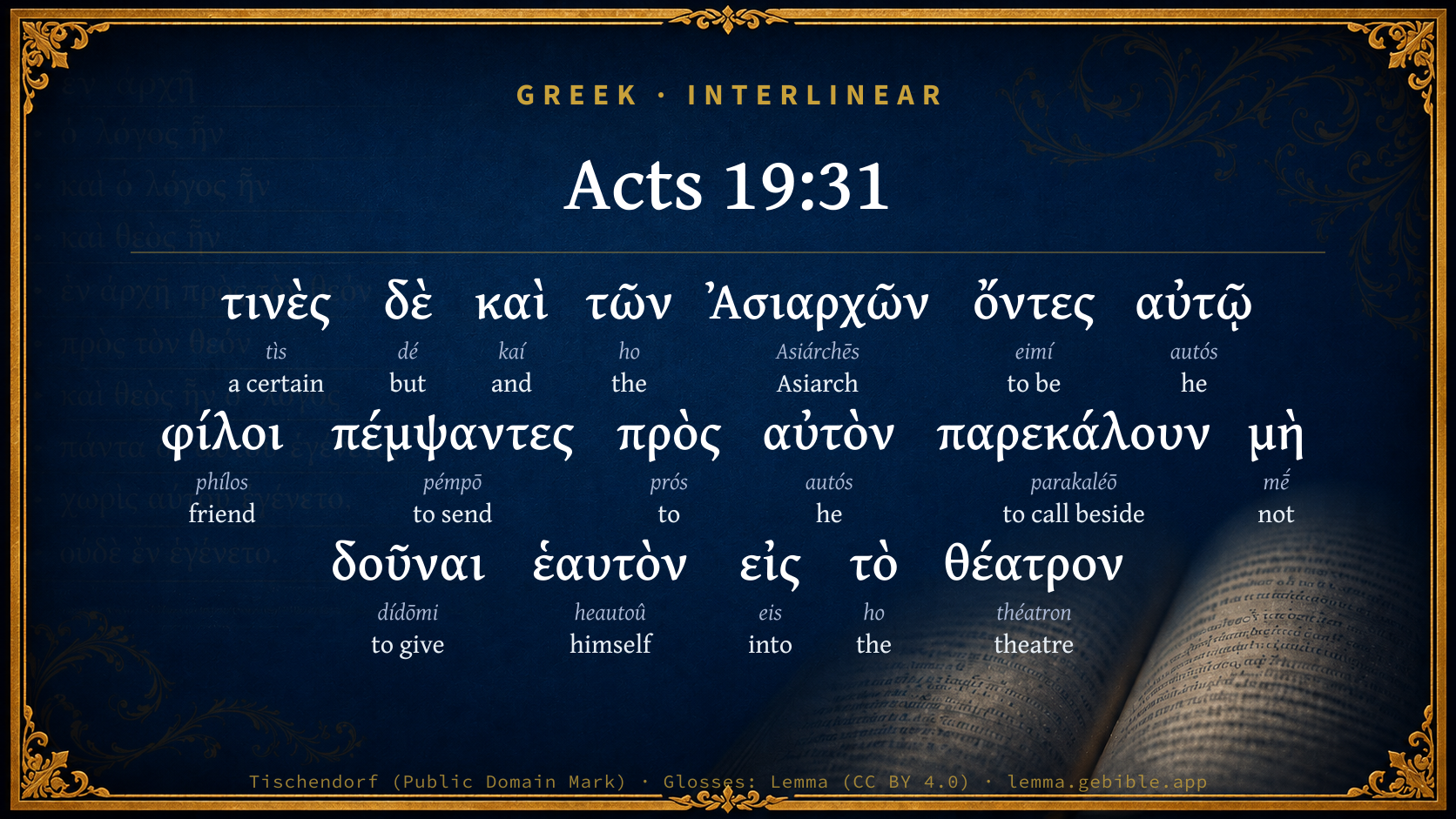
Download image
Cite this verse

Acts 19:31 (World English Bible). Public Domain. Lemma interlinear Bible study tool, https://lemma.gebible.app/v/acts/19/31.

Show BibTeX & RIS
BibTeX
RIS
English Translation
Certain also of the Asiarchs, being his friends, sent to him and begged him not to venture into the theater.
World English Bible · Public Domain
Highlights
  • 1 hapax legomenon — only here in the Greek New Testament
  • 1 first appearance in the Greek New Testament
Full analysis ↓
Download a study sheet

One document with this verse’s original text, its word-by-word gloss line, the meaning frame, cross-references with their text, attributed commentary, and full source and license credits — printable, and it pastes into notes with its structure intact.

This verse Autodidact and up

Study sheet (.html) Plain text (.txt)

A passage Seminary Student

Up to 50 verses in one chapter. A passage sheet keeps up to 6 commentary sources and 12 cross-references per verse, in the order this page ranks them, and says so on the sheet whenever that leaves anything out. Ask for a single verse and you get the Autodidact verse sheet above.

Everything on this page stays free to read, with no account — the sheet is a download of what is already on screen, not access to it.

Want to remove ads? Support Godless Engineer
Compare translations 3

The same verse in 3 English versions, stacked beneath the original-language interlinear above. Click any original word for its lexicon entry.

Each is an independent rendering of the whole verse — the interlinear is not word-aligned to these translations.

Highlighted words mark where these versions differ — a whole-verse word diff, not a word-by-word alignment.

  • World English Bible Public Domain
    Certain also of the Asiarchs, being his friends, sent to him and begged him not to venture into the theater.
  • King James Version Public Domain
    And certain of the chief of Asia, which were his friends, sent unto him, desiring him that he would not adventure himself into the theatre.
  • unfoldingWord Literal Text CC BY-SA 4.0
    And also some of the Asiarchs, being friends to him, sending to him, were urging him not to give himself into the theater.

unfoldingWord Literal Text — © unfoldingWord, licensed CC BY-SA 4.0. Word-aligned USFM3 via Door43 (git.door43.org/unfoldingWord/en_ult).

Versions to compare (up to 4)

3 of 4 selected

Show all 19 translations

Every available English version of this verse, each an independent rendering of the whole verse.

  • World English Bible Public Domain
    Certain also of the Asiarchs, being his friends, sent to him and begged him not to venture into the theater.
  • Berean Standard Bible Public Domain
    Even some of Paul’s friends who were officials of the province of Asia sent word to him, begging him not to venture into the theatre.
  • Majority Standard Bible Public Domain
    Even some of Paul’s friends who were officials of the province of Asia sent word to him, begging him not to venture into the theatre.
  • King James Version Public Domain
    And certain of the chief of Asia, which were his friends, sent unto him, desiring him that he would not adventure himself into the theatre.
  • American Standard Version (1901) Public Domain
    And certain also of the Asiarchs, being his friends, sent unto him and besought him not to adventure himself into the theatre.
  • Revised Version (1885) Public Domain
    And certain also of the chief officers of Asia, being his friends, sent unto him, and besought him not to adventure himself into the theatre.
  • Geneva Bible (1599) Public Domain
    Certaine also of the chiefe of Asia which were his friendes, sent vnto him, desiring him that hee woulde not present him selfe in the Common place.
  • Douay-Rheims (1899) Public Domain
    And some also of the rulers of Asia, who were his friends, sent unto him, desiring that he would not venture himself into the theatre.
  • Young's Literal Translation Public Domain
    and certain also of the chief men of Asia, being his friends, having sent unto him, were entreating him not to venture himself into the theatre.
  • Literal Standard Version CC BY-SA 4.0
    and also some of the chief men of Asia, being his friends, having sent to him, were pleading [with] him not to venture into the theater himself.
  • Unlocked Literal Bible CC BY-SA 4.0
    Also, some of the officials of the province of Asia who were his friends sent him a message strongly requesting him not to enter the theater.
  • unfoldingWord Literal Text CC BY-SA 4.0
    And also some of the Asiarchs, being friends to him, sending to him, were urging him not to give himself into the theater.
  • Darby Bible Public Domain
    and some of the Asiarchs also, who were his friends, sent to him and urged him not to throw himself into the theatre.
  • World Messianic Bible Public Domain
    Certain also of the Asiarchs, being his friends, sent to him and begged him not to venture into the theater.
  • Webster's Bible Public Domain
    And certain of the chief of Asia, who were his friends, sent to him, desiring him that he would not adventure himself into the theater.
  • Free Bible Version CC BY-SA 4.0
    Some of the provincial officials, who were Paul's friends, also sent a message begging him not to go into the amphitheater.
  • Bible in Basic English Public Domain
    And some of the rulers of Asia, being his friends, sent to him, requesting him seriously not to put himself in danger by going into the theatre.
  • Text-Critical English NT CC BY 4.0
    Even some of the provincial officials of Asia, who were friends of Paul, sent word to him, begging him not to venture into the amphitheater.
  • Tyndale New Testament (1534) Public Domain
    Certayne also of the chefe of Asia which were his frendes sent vnto him desyrynge him that he wolde not preace into the comen hall.

Literal Standard Version (2020), Covenant Press — licensed CC BY-SA 4.0. Text via the HelloAO Bible API (eBible.org). Unlocked Literal Bible (unfoldingWord) — licensed CC BY-SA 4.0. Text via the HelloAO Bible API (eBible.org). unfoldingWord Literal Text — © unfoldingWord, licensed CC BY-SA 4.0. Word-aligned USFM3 via Door43 (git.door43.org/unfoldingWord/en_ult). Free Bible Version, Dr. Jonathan Gallagher — licensed CC BY-SA 4.0. Text via the HelloAO Bible API (eBible.org).

Word by word

More ways to search: Search by grammar → Find every occurrence → Compare this word →

Practice this passage: Drill this verse → Learn its vocabulary →

Ἀσιαρχῶν
Asiárchēs
G775
“Asiarch”
Noun, Genitive, Plural, Masculine
Part of Speech
Noun
Case
Genitive
Number
Plural
Gender
Masculine
Full Thayer's Definition

Origin: from G773 and G746

TDNT: None

1. an Asiarch, President of Asia.
  1. τινὲς tìs G5100 “a certain” Indefinite pronoun, Nominative, Plural, Masculine
  2. δὲ dé G1161 “but” Conjunction
  3. καὶ kaí G2532 “and” Conjunction
  4. τῶν ho G3588 “the” Article, Genitive, Plural, Masculine
  5. ὄντες eimí G1510 “to be” Verb, Present, Active, Participle, Nominative, Plural, Masculine
  6. αὐτῷ autós G846 “he” Personal pronoun, Dative, Singular, Masculine
  7. φίλοι phílos G5384 “friend” Adjective, Nominative, Plural, Masculine
  8. πέμψαντες pémpō G3992 “to send” Verb, Aorist, Active, Participle, Nominative, Plural, Masculine
  9. πρὸς prós G4314 “to” Preposition
  10. αὐτὸν autós G846 “he” Personal pronoun, Accusative, Singular, Masculine
  11. παρεκάλουν parakaléō G3870 “to call beside” Verb, Imperfect, Active, Indicative, 3rd person, Plural
  12. μὴ mḗ G3361 “not” Particle, Negative
  13. δοῦναι dídōmi G1325 “to give” Verb, Aorist, Active, Infinitive
  14. ἑαυτὸν heautoû G1438 “himself” Reflexive pronoun, 3rd person, Accusative, Singular, Masculine
  15. εἰς eis G1519 “into” Preposition
  16. τὸ ho G3588 “the” Article, Accusative, Singular, Neuter
  17. θέατρον théatron G2302 “theatre” Noun, Accusative, Singular, Neuter

About this verse

These counts appear in no published source. They are computed here, from the morphology-tagged text and Lemma’s own curated glosses. What Lemma adds →

18
words
16
distinct lemmas
Acts
section

Notable vocabulary

1 hapax legomenon — a word that appears only here in the entire Greek New Testament:

  • Ἀσιαρχῶν Asiarch G775

First appearance in Scripture

This word makes its first canonical appearance in the Greek New Testament here:

  • Ἀσιαρχῶν Asiarch G775

Shared distinctive vocabulary

θέατρον theatre G2302 occurs in 3 verses of the Greek New Testament. Also found in:
Repetition

Words recur within this verse:

  • τῶν the G3588 ×2
  • αὐτῷ he G846 ×2

Cross-references

4

Topical passages linked to Acts 19:31 in the Treasury of Scripture Knowledge — connected by theme and wording, ordered by reader-vote popularity; previews shown in the World English Bible.

  • Acts 19:10 This continued for two years, so that all those who lived in Asia heard the word of the Lord Jesus, both Jews and Greeks.
  • Proverbs 16:7 When a man's ways please Yahweh, He makes even his enemies to be at peace with him.
  • Acts 16:6 When they had gone through the region of Phrygia and Galatia, they were forbidden by the Holy Spirit to speak the word in Asia.
  • Acts 21:12 When we heard these things, both we and they of that place begged him not to go up to Jerusalem.

Cross-references courtesy of OpenBible.info (CC BY 4.0).

Commentary

Notes on Acts 19:31 from classic Christian and Jewish commentators (each source and its license shown beneath its notes). The classic Christian expositions comment on the surrounding passage and are grouped to its opening verse, so a note may address several verses; the Jewish commentaries on the Tanakh (Rashi and others) are per-verse, so they appear only where the commentator wrote on this verse.

Lemma curates 59 commentaries, every one of them public domain or Creative Commons licensed, each selected and text-cleaned for this edition rather than reprinted as found. About our sources →

Tyndale Open Study Notes

Tyndale Open Resources

19:31 Some of the officials of the province (Greek Asiarchai, “rulers of Asia”): The “Asiarchs” were the appointed leaders in the Roman province of Asia. They served as civic benefactors and usually championed the emperor cult. Some of these officials in high places were friends of Paul—Luke highlights that Christianity was attractive to people of high standing in society.

Tyndale Open Study Notes — © Tyndale Open Resources, licensed CC BY-SA 4.0. Text via the HelloAO Bible API.

Bengel's Gnomon

Johann Albrecht Bengel

Act 19:31. Τῶν Ἀσιαρχῶν, of the rulers of Asia) those who administered the affairs of state, and were at that time over the sacred rites of Diana.

Bengel's Gnomon of the New Testament — English translation (T&T Clark, Edinburgh, 1860) — public domain. Text from a community e-Sword module.

Expositor's Greek Testament

ed. W. Robertson Nicoll

Act 19:31 . Ἀσιαρχῶν : “the chief officers of Asia,” R.V., cf. Γαλατάρχης , Βιθυνιάρχης , Συριάρχης , etc.; Mommsen, Röm. Gesch. , v., 318 (Knabenbauer), officers, i.e. , of the province of Asia, and so provincial, not merely municipal officers. Each province united in an association for the worship of Rome and the Empire, hence Κοινὸν Ἀσίας , of which the Asiarchs would probably be the high priests. But in addition to their religious office the Asiarchs were called upon to provide games, partly if not solely at their own expense, and to preside over them. These festivals were called Κοινὰ Ἀσίας ἐν Σμύρνῃ , Λαοδικείᾳ , κ . τ . λ . It is doubtful whether the office was annual, or whether it was held for four years; but as an Asiarch still retained his title after his term of office had expired, there may evidently have been in Ephesus several Asiarchs, although only one was actually performing his duties ( cf. the title ἀρχιερεῖς amongst the Jews, Act 4:6 ; Act 4:23 ). If there were a sort of Council of Asiarchs, this Council may well have assembled when the Κοινὰ Ἀσίας were being held, and this might have been the case at Ephesus in the narrative before us; such a festival would have brought together a vast crowd of pilgrims and worshippers actuated with zeal for the goddess, and ready to side with Demetrius and his followers. The title was one of great dignity and repute, as is evident from inscriptions which commemorate in various cities the names of those who had held the office. Whether the Asiarchs were in any sense high priests has been disputed, but see Polycarp, Mart., cf. Act 12:2 ; Act 12:21 ; on the whole subject “Asiarch” (Ramsay), Hastings’ B.D. and B.D. 2 ; St. Ignatius and St. Polycarp , ii., p. 987, Lightfoot; Renan, Saint Paul , p. 353; Wendt, p. 318; O. Holtzmann, Neutest. Zeitgeschichte , p. 102. φίλοι : not only does the notice show that St. Paul had gained at least the toleration of some of the leading men of the province, but that the attitude of the imperial authorities was not unfriendly. We cannot of course suppose with Zimmermann that the Asiarchs were friendly because the Apostle had been less opposed to the imperial cultus than to that of Diana, and that so far the Asiarchs stood with him on common ground. See Ramsay, Church in the Roman Empire , on the probable attitude of the priests, and cf. chap. 14 δοῦναι ἑαυτὸν : only here in N.T., cf. Polyb., v., 14, 9, the expression involves the thought of danger, so in A. and R.V.

The Expositor's Greek Testament, edited by W. Robertson Nicoll (1897–1910) — public domain. Text from a community e-Sword module.

Geneva Bible (1599)

Geneva Bible translators

There ought to be in all Christians and especially in the Ministers, an invincible constancy, which may not by any storms or assaults be overcome, which notwithstanding must suffer itself modestly to be governed by wisdom.

Geneva Bible (1599) marginal notes — public domain. Text via Bolls.life.

Jamieson, Fausset & Brown

Robert Jamieson, A. R. Fausset & David Brown

And certain of the chief of Asia--literally, "And certain also of the Asiarchs." These were wealthy and distinguished citizens of the principal towns of the Asian province, chosen annually, and ten of whom were selected by the proconsul to preside over the games celebrated in the month of May (the same month which Romanism dedicates to the Virgin). It was an office of the highest honor and greatly coveted. Certain of these, it seems, were favorably inclined to the Gospel, at least were Paul's "friends," and knowing the passions of a mob, excited during the festivals, "sent (a message) to him desiring him not to adventure himself into the theater."

Jamieson, Fausset & Brown — Commentary Critical and Explanatory on the Whole Bible (1871) — public domain (CC PDM 1.0). Text via the HelloAO Bible API.

Adam Clarke's Commentary

Verse 31. Certain of the chief of Asia] Τινες των Ασιαρχων; Some of the Asiarchs. The Asiarchs were those to whom the care and regulation of the public games were intrusted: they were a sort of high priests, and were always persons of considerable riches and influence. These could not have been Christians; but they were what the sacred text states them to have been, αυτω φιλοι, his friends; and foreseeing that Paul would be exposed to great danger if he went into the theatre, amidst such a tumultuous assembly, they sent a message to him, entreating him not to go into danger so apparent. Query: Did he not go, and fight with these wild beasts at Ephesus? 1Co 15:32.

Adam Clarke's Commentary on the Bible (1810–1826) — public domain. Text from a community e-Sword/MySword module.

Ellicott's Commentary for English Readers

(31) And certain of the chiefs of Asia, which were his friends.—Better, Asiarchs. The title was an official one, applied to the presidents of the games, who were selected from the chief cities of the province. The office was an annual one. They were ten in number, and the proconsul nominated one of them as president. Their duties led them now to one city, now to another, according as games or festivals were held, now at Ephesus, now at Colophon, or Smyrna. As connected both with the theatre and with the worship of Artemis, they were probably officially informed of the occasion of the tumult. If, as seems probable from 1Co_5:6-8, that Epistle was written at, or about, the time of the Passover, we may place the tumult at some period in the spring, when the people were keeping or expecting the great festival in honour of Artemis, in the month, named after the goddess, Artemision, spreading over parts of April and May (Boeckh. Corp. Inscript. Græc. 2954), and were therefore more than usually open to excited appeals like that of Demetrius. This would also account for the presence of the Asiarchs at Ephesus.

There is something significant in the fact that the Asiarchs were St. Paul’s friends. The manliness, tact, and courtesy which tempered his zeal and boldness, seem always to have gained for him the respect of men in authority: Sergius Paulus (Act_13:7), Gallio (Act_18:14-17), Festus and Agrippa (Act_25:9; Act_26:28; Act_26:32), the centurion Julius (Act_27:3; Act_27:43). The Asiarchs, too, from different motives, took the same course as the disciples. They knew that his appearance would only excite the passions of the crowd, be perilous to himself, and increase the disturbance in the city.

A Bible Commentary for English Readers, edited by Charles John Ellicott (1878–1897) — public domain. Text from a community e-Sword module.

The Cambridge Bible for Schools and Colleges

gen. ed. J. J. S. Perowne

31. And certain of the chief of Asia, which were his friends] The Greek is one word, literally “Asiarchs.” These were officers in the various cities of proconsular Asia, who were appointed to preside over the games and religious festivals. The Rev. Ver. is “And certain also of the chief officers of Asia, being his friends.” In Ephesus, these officers would be men of some importance, for in addition to the other games over which they would preside, the whole month of May was sacred to Artemis, being called Artemision, and was given up to festivals in honour of the city’s idol. We read of an Asiarch at Smyrna in the narrative of the martyrdom of Polycarp (Euseb. H. E. iv. 15).

It would seem, from the fact that some of these prominent officials were friends to St Paul, that though presiding over the games and festivals for the satisfaction of the populace, they had no great care for Artemis or her worship.

sent unto him, desiring him that he would not adventure himself into the theatre] The original says more than “desiring.” The Greek word is of frequent occurrence in the Gospels and is generally rendered “beseech,” which the Rev. Ver. has given here: sent unto him and besought him. The fuller rendering marks better the personal interest these officers had in the Apostle’s safety, and we gather from the narrative that they knew where he was, though the mob had not found him.

The Cambridge Bible for Schools and Colleges (gen. ed. J. J. S. Perowne; Cambridge University Press, 1878–1918) — public domain. Text from a community e-Sword module.

John Gill's Exposition

And when the town clerk had appeased the people,.... Caused them to cease their loud outcry, so as that he could be heard. This person seems to have been more than a "town clerk", as we render it; or a common "scribe", as the Vulgate Latin, Arabic, and Ethiopic versions render it; rather as the Syriac version, "a chief man of the city"; the Septuagint interpreters in Exo 5:6 use the word for the Egyptian officers that were over the Israelites; and the Babylonians used to call the priest of (a) Isis by this name; and according to some learned men, this man's office was to register the conquerors' names, and their rewards in the theatre; and who was chosen into this office by the people, and was a man of some considerable authority, as it is very apparent by what follows that this man was:

he said, ye men of Ephesus, what man is there that knoweth not how that the city of the Ephesians is a worshipper of the great goddess Diana? the word "Neocorus", translated "worshipper", signifies an officer in the temple, one that looked after it, beautified and adorned it; for "Neocorus" is from which signifies to beautify (b); though some etymologists would have the word to signify to sweep and clean, as if this officer was a sexton; rather, he answered to a churchwarden, and to this agrees the Syriac version; though this office belonged not to a single person, but to a city. Now to be a worshipper of Diana, was not peculiar to the city of Ephesus, as appears from Act 19:27 but to be Neocorus, a sacrist to the goddess, was a favour granted to some cities, and accounted a great honour; some had it twice, some thrice, some four times:

and of the image which fell down from Jupiter; or "of Diopetes"; so the Palladium, or image of Pallas, was called, because it was supposed to fall down from heaven, which Diomedes and Ulysses are said to take away from Troy; and here it seems to be something distinct from the goddess Diana, and her image, and may design another deity worshipped along with her, and by them, since they make mention of more gods, Act 19:26. The Vulgate Latin version takes it to be the same with Diana, reading the words in connection with the preceding, "and the offspring of Jupiter"; she being said to be his daughter by Latona, as before observed; and the Ethiopic version understands it of her image, rendering them thus, "and of that molten image which was sent from Jupiter the great god"; and more expressly the Syriac version, which reads, "and of her image which fell from heaven"; and so was not made with the hands of men, and could not be objected to on that account, or denied to be a deity; and this the people might be the rather induced to believe, since it had been in the temple before the memory of any man. The Arabic version, reading these words in connection with the beginning of the next verse, gives a very different sense, "but neither indeed they that fell from heaven contradict the faith of this thing"; as if it was to be understood of the fallen angels, of which it can hardly be thought Demetrius had any knowledge. This image, Pliny says (c), it was doubted of what it was made; some said of the vine tree, others of ebony; but Athenagoras says, the old image of Diana of the Ephesians was made of olive (d).

(a) Alex. ab Alex. l. 2. c. 8. (b) Scholiast. Aristoph ad Nubes, p. 125. col. 2. (c) Nat. Hist. l. 16. c. 40. (d) Legatis pro Christianis, p. 17.

John Gill's Exposition of the Whole Bible (1746–1763) — public domain (CC PDM 1.0). Text via the HelloAO Bible API.

Trapp's Complete Commentary

John Trapp

31 And certain of the chief of Asia, which were his friends, sent unto him, desiring him that he would not adventure himself into the theatre.

Ver. 31. Certain of the chief of Asia] Not rulers, but priests, saith Beza, whose office was to set forth stage players in honour of the gods. These, though bad enough, had some good affection to the Christian religion, and cautioned Paul not to come into the theatre. Christ finds some friends among the worst of men.

John Trapp, A Commentary or Exposition upon All the Books of the Old and New Testament (1647–1656) — public domain. Text from a community e-Sword module.

Albert Barnes' Notes on the Bible

Certain of the chief of Asia - τῶν Ἀσιαρχῶν tōn Asiarchōn. Of the Asiarchs. These were persons who presided over sacred things and over the public games. It was their business to see that the proper services of religion were observed, and that proper honor was rendered to the Roman emperor in the public festivals, at the games, etc. They were annually elected, and their election was confirmed at Rome before it was valid They held a common council at the principal city within their province, as at Ephesus, Smyrna, Sardis, etc., to consult and deliberate about the interests committed to their charge in their various provinces (Kuinoel and Schleusner). Probably they were assembled on such an occasion now; and during their remaining there they had heard Paul preach, and were friendly to his views and doctrines.

Which were his friends - It does not appear from ibis that they were Christian converts; but they probably had feelings of respect toward him, and were disposed to defend him and his cause. Perhaps, also, there might have existed a personal acquaintance and attachment.

Would not adventure - Would not risk his life in the tumult, and under the excited feelings of the multitude.

Albert Barnes' Notes on the Bible (1834–1885) — public domain. Text from a community e-Sword/MySword module.

Haydock's Catholic Bible Commentary

Some also of the rulers of Asia. They are called friends to St. Paul, but it is uncertain whether they were Christians, or others, who favoured him, and wished him well. (Witham)

George Leo Haydock (1774–1849), Haydock's Catholic Family Bible and Commentary, 1859 edition — public domain. Excludes Psalms (Douay-Rheims chapter numbering differs from Protestant) and Deuterocanonical books (Catholic canon only).

Matthew Poole's English Annotations

Certain of the chief of Asia; such as had the oversight of the plays and shows in honour of their idol gods, and were usually their priests; and were of four countries; from whence they had their names of Asiarchs, Bithynarchs, Syriarchs, and Cappadociarchs. Whosoever these were, the providence of God is to be adored, who could out of his greatest enemies raise up deliverers for his servants.

Matthew Poole's English Annotations on the Holy Bible (1683–1685) — public domain. Text from a community e-Sword/MySword module.

Whedon's Commentary on the Bible

Daniel D. Whedon

31. Chief of Asia—Asiarchs. So the rulers of different provinces were called Syriarchs, Cypriarchs, etc. These were wealthy and honourable citizens who were elected to preside over the sacred rites and to institute public games, which, however, they were to do at their own expense. The president or the college of Asiarchs was styled High Priest, precisely the same title in the Greek as belonged to the supreme Jewish pontiff. The citizen who had once been Asiarch, permanently retained the honorary title, so that these noble friends of Paul may have been only men of Asiarch dignity. It is altogether probable, officials of Artemis as they were, that, like the more elevated minds of the age, they secretly disbelieved the divinity of the goddess; and if they were not Christians, coincided more with Paul’s monotheism than with the superstition of the populace.

Daniel D. Whedon (gen. ed.), Commentary on the Old and New Testaments (1874–1909) — public domain. Text from a community e-Sword module.

The Pulpit Commentary

Certain also for certain, A.V. (the more natural order would be, and certain of the chief officers of Asia also); chief officers for chief, A.V.; being for which were, A.V.; and besought him not to for desiring him that he would not, A.V. Chief Officers of Asia. The Greek word is Asiarchs (jAsiarcai). The Asiarchs, ten in number, were officers annually chosen from all the cities of Proconsular Asia, to preside over all sacred rites, and to provide at their own expense the public games in honor of the gods and of the deity of the emperor. This necessitated their being men of high rank and great wealth, and Schleusner adds that they were priests. The name Asiarch is formed like Luciarchai, Syriarchai, Phoenicharchai, etc. We have here another striking proof of the enormous influence of Paul"s preaching in Asia, that some of these very officers who were chosen to preside over the sacred rites of the gods, and to advance their honor by public games, were now on Paul"s side.

The Pulpit Commentary (1880–1919), ed. H.D.M. Spence-Jones & Joseph S. Exell — public domain. Text from a community e-Sword module.

John Wesley's Explanatory Notes

The principal officers of Asia - The Asian priests, who presided over the public games, which they were then celebrating in honour of Diana.

John Wesley, Explanatory Notes Upon the Whole Bible (1754–1765) — public domain. Text via the GEBible commentary corpus.

McGarvey & Pendleton's Commentaries

J. W. McGarvey

See notes on verse 30

J. W. McGarvey (with Philip Y. Pendleton), Commentaries on the New Testament (The Fourfold Gospel, 1914; Acts; and the epistles) — public domain. Text from a community e-Sword/MySword module.

Cambridge Greek Testament for Schools and Colleges

31. τινὲς δὲ καὶ τῶν Ἀσιαρχῶν, ὄντες αὐτῷ φίλοι, and certain also of the chief officers of Asia, being his friends. The Ἀσιαρχαί were officers in the various cities of proconsular Asia, appointed to preside over the games and religious festivals. In Ephesus these men would be of much importance, for in addition to the other games over which they would preside, the whole month of May was sacred to Artemis, being called Artemision, and was given up to festivals in honour of the city’s idol. We read of an Asiarch at Smyrna in the narrative of the martyrdom of Polycarp (Euseb. H. E. iv. 15).

It would seem, from the fact that some of these prominent officials were friends to St Paul, that though presiding over the games and festivals for the satisfaction of the populace, they had no great care for Artemis or her worship.

πέμψαντες πρὸς αὐτὸν παρεκάλουν, sent unto him and besought him. παρακαλέω generally = beseech. The use of such a word indicates the personal interest these officers felt in the Apostle’s safety. We also gather from the narrative that they knew where Paul was, though the mob had failed to find him.

Cambridge Greek Testament for Schools and Colleges (Cambridge University Press, 1896; 21 vols, various authors incl. Carr, Maclear, Plummer, Farrar, Lumby, Moule, M. R. James, Simcox) — public domain. Text from a community e-Sword module.

Alford’s Greek Testament

Henry Alford

31. Ἀσιαρχῶν] The Asiarchæ were officers elected by the cities of the province of Asia to preside over their games and religious festivals. Of these it would be natural that the one who for the time presided would bear the title of ὁ Ἀσιάρχος: cf. H. E. iv. 15: but no more is known of such presidency. Wetst. quotes several inscriptions and coins in which the name occurs, and cites many analogous names of like officers elsewhere: Ciliciarcha, Syriarcha, Phœniciarcha, Helladarcha, &c. The Asiarch Philip at Smyrna is mentioned by Eusebius (H. E. iv. 15) as presiding in the amphitheatre at the martyrdom of Polycarp. These Ephesian games in honour of Artemis took place in May, which whole month (another singular coincidence with the practices of idolatrous Christendom) was sacred to, and named Artemisian after, the goddess. In Boeckh, Inscr. 2954, we have the decree ὅλον τὸν μῆνα τὸν ἐπώνυμον τοῦ θείου ὀνόματος εἶναι ἱερὸν καὶ ἀνακεῖσθαι τῇ θεῷ, ἄγεσθαι δὲ ἐπʼ αὐταῖς (scil. τοῦ μηνὸς ἡμέραις) τὰς ἑορτὰς καὶ τὴν τῶν Ἀρτεμισίων πανήγυριν. C. and H. ii. 95.

δοῦναι] Kypke remarks: ‘latet in phrasi, quod periculum Paulo in theatro immineat.’ E. V. adventure himself; an excellent translation.

Henry Alford, The Greek Testament (1849–1861) — public domain. Text from a community e-Sword module.

Vincent's Word Studies in the New Testament

Marvin R. Vincent

Of the chief officers of Asia [των ασιαρχων] . The Asiarchs. These were persons chosen from the province of Asia, on account of their influence and wealth, to preside at the public games and to defray their expenses.

Marvin R. Vincent, Word Studies in the New Testament (1887–1900) — public domain. Text from a community e-Sword/MySword module.

Lesson kit

Teaching starters — assembled from the data on this page, not authored interpretation. Every prompt links to the verse data it draws on. Edit before teaching.

Acts, in the Acts, opens this verse with 18 words (16 distinct Greek lemmas). Its most distinctive word is Asiárchēs (“Asiarch”). A historical commentator’s framing appears above. Read the whole chapter for the surrounding context.

Discussion questions

  1. What does “Asiarch” (Asiárchēs) contribute to the verse as a whole?
  2. 1 word here appears nowhere else in the Greek New Testament. Why might the author reach for such rare wording?
  3. This is the first place “Asiarch” appears in Scripture (first appears here). What does its debut here establish?
  4. How does Acts 19:29, which shares the word «theatre», read alongside this verse?
  5. What does the repetition of “the” (2× in this one verse) do in this verse?
  6. These translations render this verse differently; the difference is in the English rendering, not the original. What questions does that raise?
  7. Compare how Tyndale Open Study Notes and Bengel's Gnomon read this verse. Where do they agree or differ?

Things to notice

  • 1 word in this verse appears nowhere else in the Greek New Testament.
  • 1 word makes its first canonical appearance in Scripture here.
  • These translations choose different wording for 20 words in this verse.
  • “the” occurs 2× in this single verse.
  • 16 distinct Greek lemmas span 18 words in this verse.

Reading settings

Reading text

Shown beneath each verse's original-language words.

Old Testament
Old Testament edition

Read the OT as the Masoretic Hebrew (MT) or the Greek Septuagint (LXX).

English shown for the Greek Septuagint (in the Hebrew ↔ Greek comparison).

Comparing translations? Open the Compare panel on any verse page to stack up to four side by side.