Acts 19:9

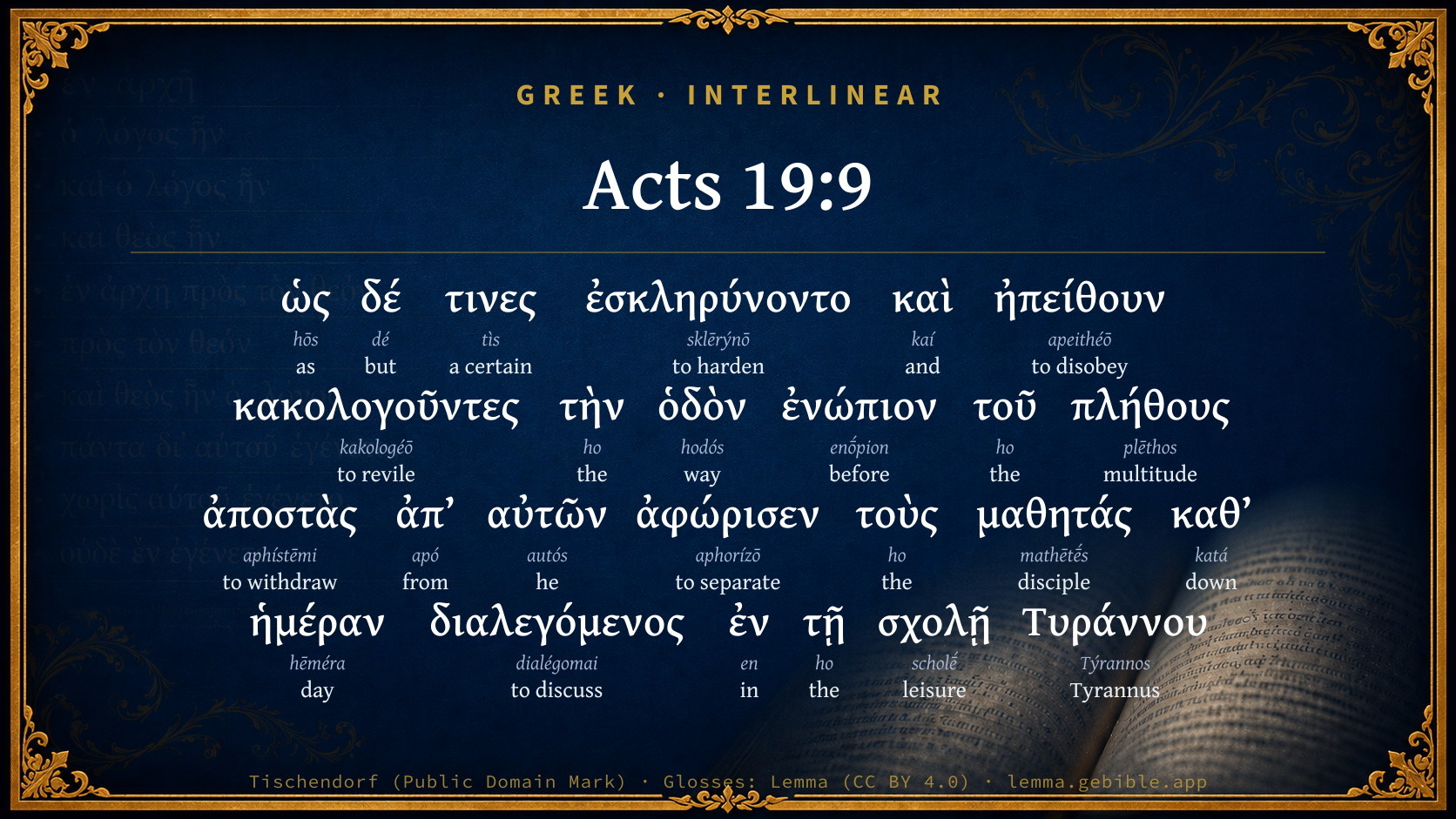
Greek (Tischendorf 8th ed.) Acts 19:9 appears in the Greek New Testament. The text above is from the Tischendorf 8th edition. Each word links to its Strong’s number and a concise gloss. Click any word for its full Thayer’s Greek Lexicon entry.
Download image
Cite this verse

Acts 19:9 (World English Bible). Public Domain. Lemma interlinear Bible study tool, https://lemma.gebible.app/v/acts/19/9.

Show BibTeX & RIS
BibTeX
RIS
English Translation
But when some were hardened and disobedient, speaking evil of the Way before the multitude, he departed from them, and separated the disciples, reasoning daily in the school of Tyrannus.
World English Bible · Public Domain
Highlights
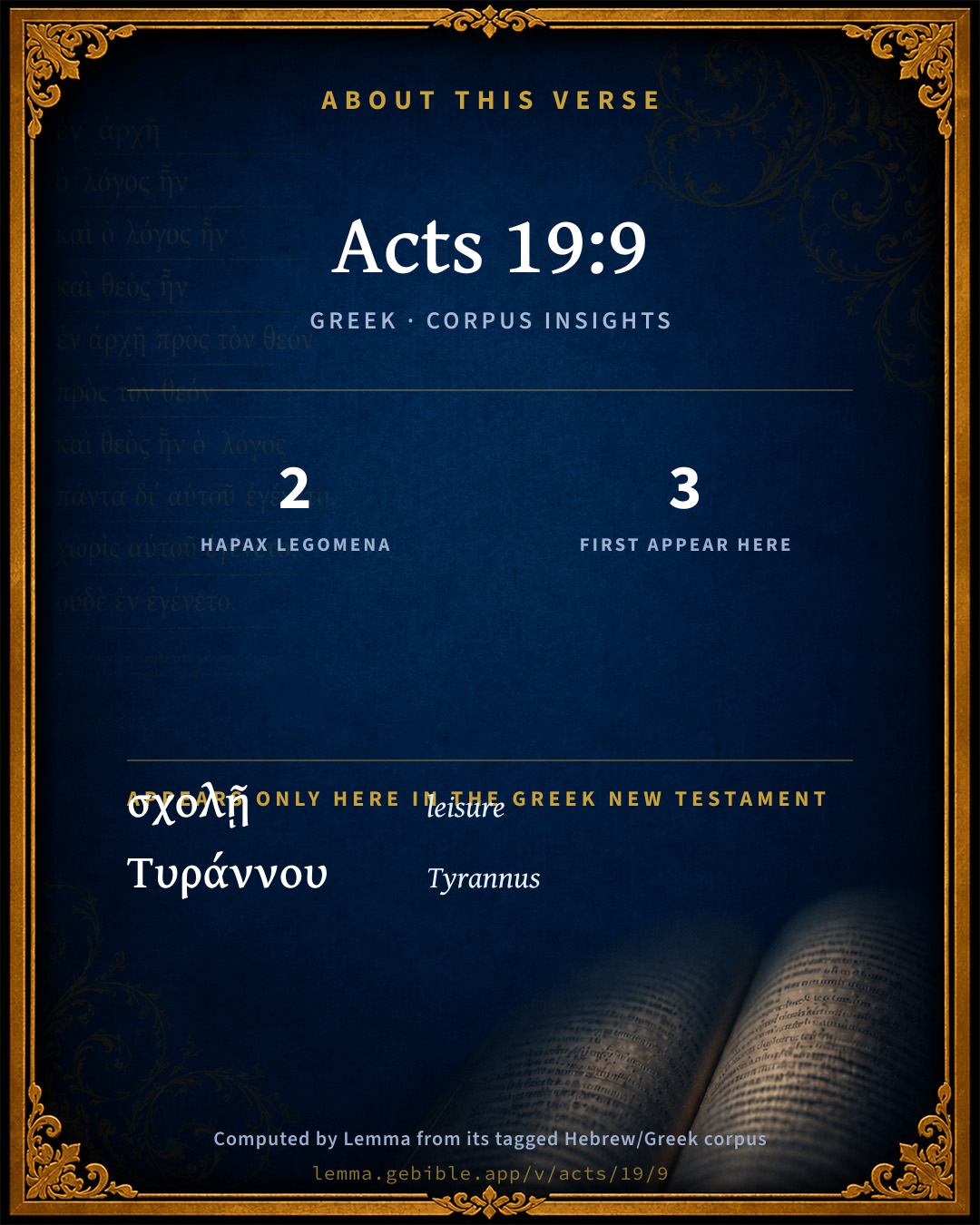
  • 2 hapax legomena — only here in the Greek New Testament
  • 3 first appearances in the Greek New Testament
Full analysis ↓
Download a study sheet

One document with this verse’s original text, its word-by-word gloss line, the meaning frame, cross-references with their text, attributed commentary, and full source and license credits — printable, and it pastes into notes with its structure intact.

This verse Autodidact and up

Study sheet (.html) Plain text (.txt)

A passage Seminary Student

Up to 50 verses in one chapter. A passage sheet keeps up to 6 commentary sources and 12 cross-references per verse, in the order this page ranks them, and says so on the sheet whenever that leaves anything out. Ask for a single verse and you get the Autodidact verse sheet above.

Everything on this page stays free to read, with no account — the sheet is a download of what is already on screen, not access to it.

Want to remove ads? Support Godless Engineer
Compare translations 3

The same verse in 3 English versions, stacked beneath the original-language interlinear above. Click any original word for its lexicon entry.

Each is an independent rendering of the whole verse — the interlinear is not word-aligned to these translations.

Highlighted words mark where these versions differ — a whole-verse word diff, not a word-by-word alignment.

  • World English Bible Public Domain
    But when some were hardened and disobedient, speaking evil of the Way before the multitude, he departed from them, and separated the disciples, reasoning daily in the school of Tyrannus.
  • King James Version Public Domain
    But when divers were hardened, and believed not, but spake evil of that way before the multitude, he departed from them, and separated the disciples, disputing daily in the school of one Tyrannus.
  • unfoldingWord Literal Text CC BY-SA 4.0
    But when some were being hardened and disobeying, speaking evil of the Way before the multitude, departing from them, he separated the disciples, reasoning each day in the school of Tyrannus.

unfoldingWord Literal Text — © unfoldingWord, licensed CC BY-SA 4.0. Word-aligned USFM3 via Door43 (git.door43.org/unfoldingWord/en_ult).

Versions to compare (up to 4)

3 of 4 selected

Show all 19 translations

Every available English version of this verse, each an independent rendering of the whole verse.

  • World English Bible Public Domain
    But when some were hardened and disobedient, speaking evil of the Way before the multitude, he departed from them, and separated the disciples, reasoning daily in the school of Tyrannus.
  • Berean Standard Bible Public Domain
    But when some of them stubbornly refused to believe and publicly maligned the Way, Paul took his disciples and left the synagogue to conduct daily discussions in the lecture hall of Tyrannus.
  • Majority Standard Bible Public Domain
    But when some of them stubbornly refused to believe and publicly maligned the Way, Paul took his disciples and left the synagogue to conduct daily discussions in the lecture hall of a man named Tyrannus.
  • King James Version Public Domain
    But when divers were hardened, and believed not, but spake evil of that way before the multitude, he departed from them, and separated the disciples, disputing daily in the school of one Tyrannus.
  • American Standard Version (1901) Public Domain
    But when some were hardened and disobedient, speaking evil of the Way before the multitude, he departed from them, and separated the disciples, reasoning daily in the school of Tyrannus.
  • Revised Version (1885) Public Domain
    But when some were hardened and disobedient, speaking evil of the Way before the multitude, he departed from them, and separated the disciples, reasoning daily in the school of Tyrannus.
  • Geneva Bible (1599) Public Domain
    But when certaine were hardened, and disobeyed, speaking euill of the way of God before the multitude, hee departed from them, and separated the disciples, and disputed dayly in the schoole of one Tyrannus.
  • Douay-Rheims (1899) Public Domain
    But when some were hardened, and believed not, speaking evil of the way of the Lord, before the multitude, departing from them, he separated the disciples, disputing daily in the school of one Tyrannus.
  • Young's Literal Translation Public Domain
    and when certain were hardened and were disbelieving, speaking evil of the way before the multitude, having departed from them, he did separate the disciples, every day reasoning in the school of a certain Tyrannus.
  • Literal Standard Version CC BY-SA 4.0
    and when certain were hardened and were disbelieving, speaking evil of The Way before the multitude, having departed from them, he separated the disciples, reasoning every day in the school of a certain Tyrannus.
  • Unlocked Literal Bible CC BY-SA 4.0
    But when some Jews were hardened and disobedient, they began to speak evil of the Way before the crowd. So Paul left them and took the disciples from him, reasoning with them every day in the lecture hall of Tyrannus.
  • unfoldingWord Literal Text CC BY-SA 4.0
    But when some were being hardened and disobeying, speaking evil of the Way before the multitude, departing from them, he separated the disciples, reasoning each day in the school of Tyrannus.
  • Darby Bible Public Domain
    But when some were hardened and disbelieved, speaking evil of the way before the multitude, he left them and separated the disciples, reasoning daily in the school of Tyrannus.
  • World Messianic Bible Public Domain
    But when some were hardened and disobedient, speaking evil of the Way before the multitude, he departed from them and separated the disciples, reasoning daily in the school of Tyrannus.
  • Webster's Bible Public Domain
    But when divers were hardened, and believed not, but spoke evil of that way before the multitude, he departed from them, and separated the disciples, disputing daily in the school of one Tyrannus.
  • Free Bible Version CC BY-SA 4.0
    But some of them were stubborn, and refused to accept. They denounced the Way to the crowd. So Paul gave up on them and left the synagogue, taking the believers with him. Then he had discussions every day at the lecture hall of Tyrannus.
  • Bible in Basic English Public Domain
    But because some of the people were hard-hearted and would not give hearing, saying evil words about the Way before the people, he went away from them, and kept the disciples separate, reasoning every day in the school of Tyrannus.
  • Text-Critical English NT CC BY 4.0
    But some became hardened and refused to believe, speaking evil of the Way in front of the congregation. So Paul left them and took the disciples with him, reasoning daily in the lecture hall of a man named Tyrannus.
  • Tyndale New Testament (1534) Public Domain
    When dyvers wexed harde herted and beleved not but spake evyll of the waye and that before the multitude: he departed from them and seperated the disciples. And disputed dayly in the scole of one called Tyranus.

Literal Standard Version (2020), Covenant Press — licensed CC BY-SA 4.0. Text via the HelloAO Bible API (eBible.org). Unlocked Literal Bible (unfoldingWord) — licensed CC BY-SA 4.0. Text via the HelloAO Bible API (eBible.org). unfoldingWord Literal Text — © unfoldingWord, licensed CC BY-SA 4.0. Word-aligned USFM3 via Door43 (git.door43.org/unfoldingWord/en_ult). Free Bible Version, Dr. Jonathan Gallagher — licensed CC BY-SA 4.0. Text via the HelloAO Bible API (eBible.org).

Word by word

More ways to search: Search by grammar → Find every occurrence → Compare this word →

Practice this passage: Drill this verse → Learn its vocabulary →

σχολῇ
scholḗ
G4981
“leisure”
Noun, Dative, Singular, Feminine
Part of Speech
Noun
Case
Dative
Number
Singular
Gender
Feminine
Full Thayer's Definition

Origin: probably feminine of a presumed derivative of the alternate of G2192

TDNT: None

1. freedom from labour 2. a place where there is leisure for anything, a school
  1. ὡς hōs G5613 “as” Adverb
  2. δέ dé G1161 “but” Conjunction
  3. τινες tìs G5100 “a certain” Indefinite pronoun, Nominative, Plural, Masculine
  4. ἐσκληρύνοντο sklērýnō G4645 “to harden” Verb, Imperfect, Passive, Indicative, 3rd person, Plural
  5. καὶ kaí G2532 “and” Conjunction
  6. ἠπείθουν apeithéō G544 “to disobey” Verb, Imperfect, Active, Indicative, 3rd person, Plural
  7. κακολογοῦντες kakologéō G2551 “to revile” Verb, Present, Active, Participle, Nominative, Plural, Masculine
  8. τὴν ho G3588 “the” Article, Accusative, Singular, Feminine
  9. ὁδὸν hodós G3598 “way” Noun, Accusative, Singular, Feminine
  10. ἐνώπιον enṓpion G1799 “before” Adverb
  11. τοῦ ho G3588 “the” Article, Genitive, Singular, Neuter
  12. πλήθους plēthos G4128 “multitude” Noun, Genitive, Singular, Neuter
  13. ἀποστὰς aphístēmi G868 “to withdraw” Verb, Aorist, Active, Participle, Nominative, Singular, Masculine
  14. ἀπ’ apó G575 “from” Preposition
  15. αὐτῶν autós G846 “he” Personal pronoun, Genitive, Plural, Masculine
  16. ἀφώρισεν aphorízō G873 “to separate” Verb, Aorist, Active, Indicative, 3rd person, Singular
  17. τοὺς ho G3588 “the” Article, Accusative, Plural, Masculine
  18. μαθητάς mathētḗs G3101 “disciple” Noun, Accusative, Plural, Masculine
  19. καθ’ katá G2596 “down” Preposition
  20. ἡμέραν hēméra G2250 “day” Noun, Accusative, Singular, Feminine
  21. διαλεγόμενος dialégomai G1256 “to discuss” Verb, Present, Middle or Passive deponent, Participle, Nominative, Singular, Masculine
  22. ἐν en G1722 “in” Preposition
  23. τῇ ho G3588 “the” Article, Dative, Singular, Feminine
  24. Τυράννου Týrannos G5181 “Tyrannus” Noun, Genitive, Singular, Masculine

About this verse

These counts appear in no published source. They are computed here, from the morphology-tagged text and Lemma’s own curated glosses. What Lemma adds →

25
words
22
distinct lemmas
Acts
section

Notable vocabulary

2 hapax legomena — words that appear only here in the entire Greek New Testament:

  • σχολῇ leisure G4981
  • Τυράννου Tyrannus G5181

First appearance in Scripture

These words make their first canonical appearance in the Greek New Testament here:

  • ἐσκληρύνοντο to harden G4645
  • σχολῇ leisure G4981
  • Τυράννου Tyrannus G5181

Shared distinctive vocabulary

κακολογοῦντες to revile G2551 occurs in 4 verses of the Greek New Testament. Also found in:

Repetition

A word recurs within this verse:

Cross-references

38

Topical passages linked to Acts 19:9 in the Treasury of Scripture Knowledge — connected by theme and wording, ordered by reader-vote popularity; previews shown in the World English Bible.

  • Acts 19:23 About that time there arose no small stir concerning the Way.
  • Acts 9:2 and asked for letters from him to the synagogues of Damascus, that if he found any who were of the Way, whether men or women, he might bring them bound to Jerusalem.
  • Acts 18:6–8 When they opposed him and blasphemed, he shook out his clothing and said to them, "Your blood be on your own heads! I am clean. From now on, I will go to the Gentiles!"
  • Acts 14:4 But the multitude of the city was divided. Part sided with the Jews, and part with the apostles.
  • 2 Peter 2:12 But these, as unreasoning creatures, born natural animals to be taken and destroyed, speaking evil in matters about which they are ignorant, will in their destroying surely be destroyed,
  • Acts 7:51 "You stiff-necked and uncircumcised in heart and ears, you always resist the Holy Spirit! As your fathers did, so you do.
  • Acts 13:45–46 But when the Jews saw the multitudes, they were filled with jealousy, and contradicted the things which were spoken by Paul, and blasphemed.
  • Acts 22:4 I persecuted this Way to the death, binding and delivering into prisons both men and women.
  • Romans 9:18 So then, he has mercy on whom he desires, and he hardens whom he desires.
  • Romans 11:7 What then? That which Israel seeks for, that he didn't obtain, but the chosen ones obtained it, and the rest were hardened.
  • 1 Timothy 6:5 constant friction of people of corrupt minds and destitute of the truth, who suppose that godliness is a means of gain. Withdraw yourself from such.
  • Hebrews 3:13 but exhort one another day by day, so long as it is called "today;" lest any one of you be hardened by the deceitfulness of sin.
  • 2 Peter 2:2 Many will follow their immoral ways, and as a result, the way of the truth will be maligned.
  • Jude 1:10 But these speak evil of whatever things they don't know. What they understand naturally, like the creatures without reason, in these things are they destroyed.
  • 2 Kings 17:14 Notwithstanding, they would not hear, but hardened their neck, like the neck of their fathers, who didn't believe in Yahweh their God.
  • 2 Chronicles 30:8 Now don't you be stiff-necked, as your fathers were; but yield yourselves to Yahweh, and enter into his sanctuary, which he has sanctified forever, and serve Yahweh your God, that his fierce anger may turn away from you.
  • 2 Chronicles 36:16 but they mocked the messengers of God, and despised his words, and scoffed at his prophets, until the wrath of Yahweh arose against his people, until there was no remedy.
  • Nehemiah 9:16–17 But they and our fathers dealt proudly and hardened their neck, and didn't listen to your commandments,
  • Nehemiah 9:29 and testified against them, that you might bring them again to your law. Yet they dealt proudly, and didn't listen to your commandments, but sinned against your ordinances, (which if a man do, he shall live in them), and withdrew the shoulder, and hardened their neck, and would not hear.
  • Psalms 95:8 Don't harden your heart, as at Meribah, As in the day of Massah in the wilderness,
  • Proverbs 8:34 Blessed is the man who hears me, Watching daily at my gates, Waiting at my door posts.
  • Isaiah 8:14 He shall be for a sanctuary; but for a stone of stumbling and for a rock of offense to both the houses of Israel, for a gin and for a snare to the inhabitants of Jerusalem.
  • Jeremiah 7:26 yet they didn't listen to me, nor inclined their ear, but made their neck stiff: they did worse than their fathers.
  • Jeremiah 19:15 Thus says Yahweh of Hosts, the God of Israel, Behold, I will bring on this city and on all its towns all the evil that I have pronounced against it; because they have made their neck stiff, that they may not hear my words.
  • Matthew 15:14 Leave them alone. They are blind guides of the blind. If the blind guide the blind, both will fall into a pit."
  • Matthew 16:4 An evil and adulterous generation seeks after a sign, and there will be no sign given to it, except the sign of the prophet Jonah." He left them, and departed.
  • Matthew 26:55 In that hour Jesus said to the multitudes, "Have you come out as against a robber with swords and clubs to seize me? I sat daily in the temple teaching, and you didn't arrest me.
  • Luke 12:51–53 Do you think that I have come to give peace in the earth? I tell you, no, but rather division.
  • John 12:40 "He has blinded their eyes and he hardened their heart, Lest they should see with their eyes, And perceive with their heart, And would turn, And I would heal them."
  • Acts 11:26 When he had found him, he brought him to Antioch. It happened, that for a whole year they were gathered together with the assembly, and taught many people. The disciples were first called Christians in Antioch.
  • Acts 17:4 Some of them were persuaded, and joined Paul and Silas, of the devout Greeks a great multitude, and not a few of the chief women.
  • Acts 19:30 When Paul wanted to enter in to the people, the disciples didn't allow him.
  • Acts 20:31 Therefore watch, remembering that for a period of three years I didn't cease to admonish everyone night and day with tears.
  • Acts 24:21 unless it is for this one thing that I cried standing among them, 'Concerning the resurrection of the dead I am being judged before you today!'"
  • Acts 28:22 But we desire to hear from you what you think. For, as concerning this sect, it is known to us that everywhere it is spoken against."
  • 2 Timothy 1:15 This you know, that all who are in Asia turned away from me; of whom are Phygelus and Hermogenes.
  • 2 Timothy 3:5 holding a form of godliness, but having denied the power thereof. Turn away from these, also.
  • 2 Timothy 4:2 preach the word; be urgent in season and out of season; reprove, rebuke, and exhort, with all patience and teaching.

Cross-references courtesy of OpenBible.info (CC BY 4.0).

Commentary

Notes on Acts 19:9 from classic Christian and Jewish commentators (each source and its license shown beneath its notes). The classic Christian expositions comment on the surrounding passage and are grouped to its opening verse, so a note may address several verses; the Jewish commentaries on the Tanakh (Rashi and others) are per-verse, so they appear only where the commentator wrote on this verse.

Lemma curates 59 commentaries, every one of them public domain or Creative Commons licensed, each selected and text-cleaned for this edition rather than reprinted as found. About our sources →

The Biblical Illustrator

Joseph S. Exell

Act_19:9

Disputing daily in the school of one Tyrannus.

The school of Tyrannus

The Greek word for school had a somewhat interesting history. Originally meaning leisure, it was applied to leisure as bestowed on study, then, as here, to the place in which study was pursued; lastly, as in our phrase, the school of Zeno or Epicurus, as a collective term for the followers of a conspicuous teacher. In this case it was probably a lecture room which, as the private property of the owner, was lent or let to the apostle. Of the Tyrannus here mentioned nothing more is known with certainty, but the name is connected with one or two interesting coincidences that are more or less suggestive. Like its Latin equivalent, Rex, it was not uncommon among the class of slaves or freedmen. It is found in the Columbarium of the household of Livia on the Appian Way, and as belonging to one who is described as a Medicus or physician. Both names and professions in this class were very commonly hereditary, and the hypothesis that this Tyrannus was also a physician, and that as such he may have known St. Luke, or possibly may have been among the Jews whom the decree of Claudius (Act_18:2) had driven from Rome, and so shared the fate of Aquila and Priscilla, fits in with and explains the facts recorded. An unconverted teacher of philosophy or rhetoric was not likely to have lent his class room to a preacher of the new faith. (Dean Plumptre.)

The school house of Ephesus

1. Here is Paul in a school house in which the learning of the day was taught. But Paul makes up his mind they need some religion there, and so he goes into it; and daily for two years he gave lectures on Christianity.

I. If the Word of God was appropriate for the public school of Ephesus, why not for public schools elsewhere? Higher than university, than Legislative hall, than Presidential chair, is the common school of this country, because it provides the orators, the painters, the poets, the legislators, the judges, the presidents; dropping upon a million homes the benediction of light and refinement. So queenly a system must be affianced to the king of books, the Bible. This union has given us all we have of culture and refinement. After you put a building up, it is a poor thing to pull out the cornerstone. Suppose I should go to the architect of this building and say, You have no right to be here today. Why, he would reply, I built it. And people would gather around and say, If anybody has a right to be here, he has. Now, my friends, the Word of God is the architect, the foundation, the pillars, the capstone of the great common school system, and there shall be no political nor demoniacal power on earth or hell to expel it.

II. Yet a determined effort is being made to expel it. In support of this it is said--

1. It does not make any difference. What is the reading of half a dozen verses of a chapter in a school? I go into an apothecarys store with a prescription. In making it up the chemist takes one liquid, then another, and then a third, and finally he takes out a small phial, and drops into the general admixture one or two drops. I say to him, Why do you waste time by putting in those drops? Oh, he says, this is the most important part of the prescription. This changes the entire nature of the thing. Without it, it would be death; with it, it will be cure and life. Now you come up to the common school admixture, and you say: There is a quart of arithmetic, and there are two gills of geography, and a pint of grammar, and what is just one or two drops of Scriptural reading going to do? I say it is the most important part of the prescription. It changes the whole nature of everything. Untold blessings depend on the Bible staying where it is. Untold disorder follow upon its being thrust out.

2. The common school was intended only to give secular education. I reply that it is to develop our children so that they shall be prepared for the duties of life. Suppose a man should go to a gymnasium, and say to the manager, I wish you would make that little finger more agile, and strong, and healthy; and develop the toe of the right foot. Why, he would say, You must be insane. If I take you in my institution, I purpose to develop your entire physical organism, and then of course your hand and foot will get the benefit of it. But I cant undertake to treat just the foot and hand. Now you come up to the common school, and you say, Give us secular education, but dont give us religious education. In other words, touch only the tip end of this complex nature; dont get up into the region of the soul: give the children reading, writing, and arithmetic. Ah, we cannot educate our children in this infinitesimal manner. Do you think a man is prepared for the duties of life merely because because he can cipher, or is a good penman? The biggest thief in New York understands arithmetic, and can wield a very skilful pen when it is to put somebody elses name at the foot of a money draft. What this country wants is the pressure of a high moral obligation on her young people, and that you can get from no book except the Bible. The rights of our Jewish and Roman Catholic fellow citizens will be invaded. Well, look at that little urchin! Before him stands the teacher, inflicting him with these oppressive words, Blessed are the pure in heart, for they shall see God; Blessed are the merciful, for they shall obtain mercy. Alas! for the defenceless little Jewish and Roman Catholic children, crushed under the Beatitudes. Besides this, the Bible is the most unsectarian Book in the world. Wyckliffe, and Coverdale, and Matthew translated the Bible in the Roman Catholic Church; and our translation is substantially the same thing. The Bible in the schools does not propose to proselyte. The Bible taught in a Presbyterian Church may get a Presbyterian twist, or taught in a Roman Catholic Church may get a Roman Catholic twist; but the Bible as read in our schools without note or comment, will get no such twist. And then neither Romanists nor Jews have any objection to the Bible as such. Who then want it expelled chiefly? Well, the men who are loose in religious notions, or loose in morals, or base politicians, and for good reasons. (T. De Witt Talmage, D. D.)

At school

(childrens sermon):--Do you not pity the poor children who had to go to the school of one Tyrannus? But whenever a schoolmaster is found to be tyrannous nowadays, people write to the newspapers, and Tyrannus is forced to become a little less tyrannous, and the children have a better time of it. You have all to go to some school, but there are some things you can learn not set down in bill, but are worth a very great deal. There, e.g., is--

I. Punctuality. Never be late for school or for anything. God is very punctual. If the sun was late all the clocks would be wrong, and people would be greatly put about; and when you are late mother is put about, and teacher, and yourself; and when attendance marks are read, you wish you had been punctual. Learn the habit of being punctual in all things. If you make but a little mistake in multiplication, that mistake goes on multiplying itself. An unpunctual person puts many other people wrong.

II. Honour. Honour and honesty come from the same word. Now I daresay you would not steal anything with your hands. But did you never at school look over another and copy his answer? That was not honourable--it was dishonest. Learn to be honourable at school. Your teacher is trusting you. Never do mean things. Even when the teacher does not see you, God does. It is good to be clever, but it is better still to be good.

III. Courage. Is not it strange that anyone should need courage to say what is true? You would think it needed more courage to say what was wrong, for he would be very bold who would say that two and two made five. He would not need to be very bold, who said that two and two made four. Yes; but that only shows how far we have all got wrong through sin, that most people are afraid to say what is right. Say boldly when a thing is wrong, that it is wrong, and when it is right, that it is right, and stand by it.

IV. Kindness. Think of others; think of teacher; sometimes he is worried and troubled, or sometimes she has a headache. And try to have a kind way with the other children. Learn kindness in the school, and when you come into the world you will find this to be one of the best lessons you ever learnt in your life, for it is in lovingkindness the spirit of Jesus grows up. (J. R. Howatt.)

The Biblical Illustrator, edited by Joseph S. Exell (c. 1880s–1900s) — public domain. Text from a community e-Sword module.

Bengel's Gnomon

Johann Albrecht Bengel

Act 19:9. Ὡς—πλήθους, when—before the multitude) A cause for just separation is public revilings against the truth.—ἀποστὰς, having withdrawn) He left their synagogue to them, content with a smaller school, and a more select number: ἀποστὰς ἀφώρισε, having withdrawn he separated: by his act he influenced other good men; [and so he secured them against the stumbling-block thrown in their way by the evil-speakers.—V. g.]—καθʼ ἡμέραν, daily) not merely on the Sabbath or Lord’s day.—σχολῇ, the school) instead of the synagogue.

Bengel's Gnomon of the New Testament — English translation (T&T Clark, Edinburgh, 1860) — public domain. Text from a community e-Sword module.

Meyer's Critical & Exegetical Commentary

Heinrich August Wilhelm Meyer

Act_19:9. But when some were hardened and refused belief, he severed himself from them (from the synagogue) and separated the Christians, (henceforth) discoursing daily in the school of a certain Tyrannus. Tyrannus (the same name in Apollod. ii. 4. 5; Boeckh, Corp. Inscr. 1732; 2Ma_4:40; Joseph. Antt. xvi. 10. 3, Bell. i. 26. 3; and among the Rabbis טורנום, see Drusius in loc.) is usually considered (as by Lange and Baumgarten, comp. Ewald, p. 516) as a Gentile rhetorician, who had as a public sophist possessed a lecture-room, and is perhaps identical with the one described by Suidas: Τύραννος· σοφιστὴς περὶ στάσεων κ. διαιρέσεως λόγου βιβλία δέκα. But as the text does not indicate a transition of the apostle wholly to the Gentiles (see, on the other hand, Act_18:6-7, Act_13:46), but merely a separation from the synagogue, and as in the new place of instruction (σχολή, a teaching-room, often in Plutarch, etc.), Ἰουδαῖοι (and these are named first, Act_19:10) continued to hear him; as, in fine, Tyrannus, had he been a Gentile, would have to be conceived of as σεβόμενος τὸν θεόν, like Justus, Act_18:7,an essential point, which Luke (comp. Act_18:7) would hardly have left unnoticed: the opinion of Hammond is to be preferred, that Tyrannus is to be considered as a Jewish teacher who had a private synagogue, בית מדדש (in Beth Midrasch docuerunt traditiones atque earum expositiones, Babyl. Berac. f. 17. 1; see Lightf. ad Matth. p. 253 f.; Vitringa, Synag. p. 137). Paul with his Christians withdrew from the public synagogue to the private synagogue of Tyrannus, where he and his doctrine were more secure from public annoyance. The objection, that it would have been inconsistency to pass from the synagogue to a Rabbinical school (Baumgarten), is of no weight, as there were also Rabbins like Gamaliel, and Tyrannus must be considered, at all events, as at least inclined to Christianity.

τ. ὁδόν] see on Act_9:2, Act_18:25.

Meyer — Critical and Exegetical Commentary on the New Testament — English translation by Peter Christie, edited by Frederick Crombie (T&T Clark, 1880) — public domain. Text from a community e-Sword module.

Expositor's Greek Testament

ed. W. Robertson Nicoll

Act 19:9 . ἐσκληρύνοντο : only here and in Rom 9:18 , but four times in Hebrews, three times as a quotation from Psa 95:8 , and once in direct reference to that passage, Act 3:13 , cf. Exo 7:3 , Deu 2:30 , etc. In Sir 30:12 it is found as here with ἀπειθέω , cf. also Clem. Rom., li., 3, 5. ἠπείθ .: “were disobedient,” R.V., unbelief is manifested in disobedience, Westcott, Hebrews , pp. 87, 97, cf. Ign., Magn. , viii., 2; Polyc., Phil. , ii., 1. τὴν ὁδὸν : “the Way,” see on Act 9:2 . κακολ ., Mar 9:39 , used by our Lord of speaking evil of Him, Mat 15:4 , and Mar 7:10 , as a quotation from Exo 21:17 ; in LXX five times, and once in same sense in Mal 4:1Mal 4:1 . ἀποστὰς : as in Act 18:7 , at Corinth; verb only in Luke and Paul, except Heb 3:12 , see Friedrich, p. 7, and above on Act 15:38 , seven times in N.T. with ἀπό and a genitive as here. ἀφώρισε : except Mat 13:49 ; Mat 25:32 (2), only in Luke and Paul, cf. Luk 6:22 , Act 13:2 , Rom 1:1 , 2Co 6:17 , quotation, Gal 1:15 ; Gal 2:12 ; cf. Grimm-Thayer for different shades of meaning, both in a good and bad sense, in classical Greek and also in LXX frequently. It is evidently presupposed that as in Act 18:26 there were still disciples who held fast to the common worship of a Jewish community in the synagogue. καθʼ ἡμέραν : on the days when synagogue worship was held, and so the separation was complete. ἐν σχολῇ Τυράννου τινός , see critical note. We cannot tell whether reference is made to the lecture-hall of some heathen sophist hired by Paul or to the Beth Hammidrash kept by a Jew. Others have thought that Tyrannus, like Titius Justus, Act 18:7 , may have been “a proselyte of the gate,” but if so, one might expect it to be signified as in the case of Justus. The name was common enough, Jos., Ant. , xvi., 10, 3; B. J. , i., 26, 3; 2Ma 4:40 , and see Plumptre’s note, in loco . Overbeck’s view is quite possible, that the expression referred to the standing name of the place, so called from its original owner, cf. Hort, Judaistic Christianity , p. 93. Probably, if we take the first-mentioned view, in teaching in such a school or lecture-hall the Apostle himself would appear to the people at large as one of the rhetors or travelling sophists of the time, Ramsay, St. Paul , pp. 246, 271 (so McGiffert, p. 285, who regards the notice as taken from a trustworthy source). For instances of the use of σχολή as a school of the philosophers for teaching and lecturing see Wetstein, in loco, cf. Latin, auditorium , Zöckler compares St. Augustine’s lecture-hall in Rome before his conversion.

The Expositor's Greek Testament, edited by W. Robertson Nicoll (1897–1910) — public domain. Text from a community e-Sword module.

Geneva Bible (1599)

Geneva Bible translators

By this word Way, the Hebrews understand any kind of life, and here it is taken for Christianity.

For a man to separate himself and others from infidels which are utterly desperate, it is not to divide the Church, but rather to unite it and make it one.

This was a man’s proper name.

Geneva Bible (1599) marginal notes — public domain. Text via Bolls.life.

Jamieson, Fausset & Brown

Robert Jamieson, A. R. Fausset & David Brown

when divers--"some."

were hardened, &c.--implying that others, probably a large number, believed.

spake evil of that way before the multitude, he departed--from the synagogue, as at Corinth (Act 18:7).

and separated the disciples--withdrawing to a separate place of meeting, for the sake both of the converts already made, and the unsophisticated multitude.

disputing--"discoursing" or "discussing."

daily in the school--or lecture hall.

of one Tyrannus--probably a converted teacher of rhetoric or philosophy.

Jamieson, Fausset & Brown — Commentary Critical and Explanatory on the Whole Bible (1871) — public domain (CC PDM 1.0). Text via the HelloAO Bible API.

Adam Clarke's Commentary

Verse 9. When divers were hardened] τινες, When some of them were hardened; several no doubt felt the power of Divine truth, and yielded consent. Our term divers, one of the most bald in our language, has too general a meaning for this place.

Behold the effect of the word of God! It is a savour of life unto life, or death unto death, according as it is received or rejected. The twelve men mentioned above received it affectionately, and they were made partakers of the Holy Ghost; the others were hardened, for they refused to believe; and they calumniated the doctrine, and became Satan's preachers among the multitude, to prejudice them against Christ and his religion.

Separated the disciples] Paul, and those converted under his ministry, had doubtless been in the habit of attending public worship in the synagogue: but, on the persecuting conduct of these Jews; he and his converts wholly withdrew from the synagogue, and took a place for themselves; and constantly afterwards held their own meetings at a school room, which they hired no doubt for the purpose.

The school of one Tyrannus.] For σχολη, the school, one MS. has συναγωγη, the synagogue; and, for Tyrannus, some have Tyrannios. Some have considered the original word as being an epithet, rather than the name of a person; and think that a prince or nobleman is intended, because τυραννος, tyrant, is taken in this sense: but this is a most unlikely conjecture. It appears that the person in question was a schoolmaster, and that he lent or hired his room to the apostles; and that they preached daily in it to as many, both Jews and Gentiles, as chose to attend. It is very likely that Tyrannus was a Jew, and was at least well affected to the Christian cause; for we have many proofs that individuals among them kept schools for the instruction of their youth; besides the schools or academies kept by the more celebrated rabbins. See Schoettgen and Vitringa. The school of Tyrannus might have been such a place as Exeter Hall, and such like places for public and especially for extraordinary religious meetings in London.

Adam Clarke's Commentary on the Bible (1810–1826) — public domain. Text from a community e-Sword/MySword module.

John Calvin's Commentaries

9. Seeing their hearts were hardened. We do not read that Paul was heard so patiently and so favorably by the Jews at any place as at Ephesus at his first coming. For whereas others raising tumults did drive him away, he was requested by these to tarry longer. Now, after that he had endeavored, by the space of three months, to erect the kingdom of God among them, the ungodliness and stubbornness of many doth show itself. For Luke saith that they were hardened; and surely such is the power of the heavenly doctrine that it doth either make the reprobate mad or else more obstinate; and that not of nature, but accidentally, as they say, because, when they be urged by the truth, their secret poison breaketh out.

Luke addeth that they spake evil of the way before the people. For the contemners of the gospel do resist that deadlily among others which they will not embrace. And this do they to no other end, save only because they be desirous (if it can be) to have all men partners in their impiety. It is well known that every ordinance is understood by this word way; but here it is referred unto the gospel of Christ. Now, Luke saith that Paul departed from them, and did separate the brethren, by which example we are taught, that when we have experience of desperate and incurable stubbornness, we must lose our labor no longer. Therefore, Paul admonisheth Titus to avoid a man that is an heretic, after once or twice admonition (Titus 3:10). For the word of God is unjustly blasphemed, if it be cast to dogs and swine. Also, we must provide for the weak, lest through wicked backbitings and slandering of sound doctrine, their godliness be subverted. Therefore, Paul did separate the disciples, lest the goats should with their stink infect the flock of sheep; secondly, that the pure worshippers of God might make profession freely.

Disputing daily. This place showeth how continual Paul’s diligence was in teaching; and that they be too churlish and dainty who are straightway weary of learning. For we see how few come daily, who are ready and apt to hear. And though he had a particular care for the household flock which he had gathered as into a sheepfold, yet he doth not suffer strangers to be destitute of his industry; but continuing the course of his disputation, he trieth whether he can find any which are apt to be taught. He calleth it the school of Tyrannus, meaning no such man as had gotten the government of Asia; for the Romans bare rule throughout all Asia, but it is to be thought that the school was built at the charge of one Tyrannus, and given to the city. Therefore, the faithful did use a public place, which bare the name of the builder, where they had their assemblies.

John Calvin's Commentaries (1540-1563) — public domain. Text from the Calvin Translation Society English edition (1840s-50s) via the Christian Classics Ethereal Library (ccel.org). Calvin's coverage is partial (roughly two-thirds of the Bible); uncommented books and verses are honest gaps, never fabricated. The 19th-century editor's footnotes and remarks are omitted so the notes are faithfully Calvin's own voice.

Ellicott's Commentary for English Readers

(9) When divers were hardened and believed not.—Better (the verb implying continuous action), when some were growing hardened and disobedient.

Spake evil of that way before the multitude.—Better, as before, of the way. (See Note on Act_9:2.) The unbelieving Jews acted at Ephesus as at Thessalonica, and tried to wreak their hatred against St. Paul by stirring up suspicion among the Gentiles, especially, as before, among those of the lower class, who were always ready for a tumult.

Disputing daily in the school of one Tyrannus.—The Greek word for “school” had a somewhat interesting history. Originally meaning “leisure,” it was applied to leisure as bestowed on study, then, as here, to the place in which study was pursued; lastly, as in our phrase, “the school of Zeno or Epicurus,” as a collective term for the followers of a conspicuous teacher. In this case, it was probably a lecture-room which, as the private property of the owner, was lent or let to the Apostle.

Of the Tyrannus here mentioned nothing more is known with certainty, but the name is connected with one or two interesting coincidences that are more or less suggestive. Like its Latin equivalent, Rex it was not uncommon among the class of slaves or freed-men. It is found in the Columbarium of the household of Livia on the Appian Way, and as belonging to one who is described as a Medicus or physician. Both names and professions in this class were very commonly hereditary, and the hypothesis that this Tyrannus was also a physician, and that, as such, he may have known St. Luke, or, possibly, may have been among the Jews whom the decree of Claudius (Act_18:2) had driven from Rome, and so shared the faith of Aquila and Priscilla, fits in with and explains the facts recorded. An unconverted teacher of philosophy or rhetoric was not likely to have lent his class-room to a preacher of the new faith. (See also Note on Act_19:12.)

A Bible Commentary for English Readers, edited by Charles John Ellicott (1878–1897) — public domain. Text from a community e-Sword module.

The Cambridge Bible for Schools and Colleges

gen. ed. J. J. S. Perowne

9. But when divers were hardened, and believed not] Perhaps there may be a little gain to those unfamiliar with older English in putting (as Rev. Ver.) “some” for “divers,” there seems to be none in giving “and disobedient” instead of “and believed not.” The original looks back to the verb “persuade” in the previous verse. The Apostle tried to persuade, these men refused to be persuaded. That seems better expressed by the A. V.

but spake [better, speaking] evil of that [the] way before the multitude] The evil speaking is the final manifestation of the hardening. The Apostle continued his exhortations to stony-hearted hearers for three months, but when their obstinacy changed into malignity he left them. “The way” was soon given as a distinctive name to “the Christian religion.” See note on Act_9:2 and cf. below Act_19:23.

It was not mere opposition to the arguments of the Apostle which these Jews employed, they took occasion to excite the crowds of the city against him. And it would seem from Act_19:33, where the Jews attempt to put forward a spokesman in the tumult, that they wished the heathen populace to understand that Paul was not approved of by his own nationality.

he departed from them] i.e. ceased to take part in the public services at the synagogue.

and separated the disciples] The Christian part of the congregation, with any of the Jews who were more interested than the rest in his teaching.

disputing [Better, reasoning] daily] The verb is the same as in the previous verse. Among these more sympathizing hearers, he would only have to set forward the arguments for the faith which he preached unto them. His teaching now could go on constantly, and was not confined to the synagogue times of service.

in the school of one Tyrannus] The best authorities omit “one.” The teacher, whether a heathen or a Jew, was a man well known. Otherwise we can conceive no reason for the mention of a proper name. As the name is Greek, some have thought that the place meant was the lecture-room of a philosophic teacher; others, thinking that St Paul would hardly have chosen such a place for his preaching, have preferred to consider it a Jewish school or Beth-Hammidrash, in which his Jewish hearers would be more willing to assemble. Since the listeners are described, in the next verse, as being partly Jews, and partly Greeks, it is impossible to arrive at a conclusion. No doubt the Jews in Ephesus were numerous enough to render such “schools” necessary for their education, and in their intercourse with Gentiles they not unfrequently adopted a Gentile name in addition to their Jewish one. So Tyrannus may have been a Jew.

The Cambridge Bible for Schools and Colleges (gen. ed. J. J. S. Perowne; Cambridge University Press, 1878–1918) — public domain. Text from a community e-Sword module.

John Gill's Exposition

And this continued by the space of two years,.... Reckoning from the end of the three months, which had been spent in teaching in the synagogue:

so that all they which dwelt in Asia; in the lesser Asia, called the proconsular Asia, of which Ephesus was the chief city:

heard the word of the Lord Jesus, both Jews and Greeks; these, as they came to Ephesus, whether on account of religion, the Asiatic Jews to their synagogue, and the Greeks or Gentiles to the famous temple of Diana, or on account of trade and business, or for the sake of seeing this place, had the opportunity of hearing the Apostle Paul preach, concerning the person, offices, and grace of Christ; and dispute and reason concerning the more abstruse and difficult points of the Christian religion, in the above school, for two years together; so that the word of the Lord went out from hence, and was spread in all the cities and towns in Asia.

John Gill's Exposition of the Whole Bible (1746–1763) — public domain (CC PDM 1.0). Text via the HelloAO Bible API.

Trapp's Complete Commentary

John Trapp

9 But when divers were hardened, and believed not, but spake evil of that way before the multitude, he departed from them, and separated the disciples, disputing daily in the school of one Tyrannus.

Ver. 9. But when divers were hardened] Hardness of heart is either natural or habitual: and this again is increased either by doing (that is, by resisting the word of God), or by suffering it to pass by us without amendment of life.

He departed from them and separated] So did Zuinglius and Luther separate from the Papists for like reason. It was laid to Luther’s charge that he was an apostate. Confitetur se esse apostatam, sed beatum et sanctum, qui fidem diabolo datam non servavit. An apostate he confessed himself; but one that had fallen off from the devil only.

In the school of one Tyrannus] In one ancient copy it is added, "From the fifth hour to the tenth hour:" so indefatigable a preacher was Paul, a very χαλκεντερος, or iron-sides. He had a golden wit in an iron body, as one saith of Julius Scaliger.

John Trapp, A Commentary or Exposition upon All the Books of the Old and New Testament (1647–1656) — public domain. Text from a community e-Sword module.

Albert Barnes' Notes on the Bible

But when divers - When some were hardened.

Were hardened - When their hearts were hardened, and they became violently opposed to the gospel. When the truth made no impression on them. The word “harden,” as applied to the heart, is often used to denote “insensibility, and opposition to the gospel.”

But spake evil of that way - Of the gospel - the way, path, or manner in which God saves people. See Act 16:17; Act 18:26; Mat 7:13-14.

Separated the disciples - Removed them from the influence and society of those who were seeking to draw them away from the faith. This is often the best way to prevent the evil influence of others. Christians, if they wish to preserve their minds calm and peaceful; if they wish to avoid the agitations of conflict, and the temptations of those who would lead them astray, should withdraw from their society, and seek the fellowship of their Christian brethren.

Disputing daily - This is not a happy translation. The word used here διαλεγόμενος dialegomenos does not of necessity denote “disputation or contention,” but is often used in a good sense of “reasoning” Act 17:2; Act 18:4, Act 18:19; Act 24:25, or of “public preaching,” Act 20:7, Act 20:9. It is used in this sense here, and denotes that Paul taught publicly, or reasoned on the subject of religion in this place.

In the school of one Tyrannus - Who this Tyrannus was is not known. It is probable that he was a Jew, who was engaged in this employment, and who might not be unfavorably disposed toward Christians. In his school, or in the room which he occupied for teaching, Paul instructed the people when he was driven from the synagogue. Christians at that time had no churches, and they were obliged to assemble in any place where it might be convenient to conduct public worship.

Albert Barnes' Notes on the Bible (1834–1885) — public domain. Text from a community e-Sword/MySword module.

Matthew Poole's English Annotations

Divers were hardened; the sun hardeneth what it doth not soften, and causeth a stench from dunghills, as well as a sweet smell from the mountains of spices; and Christ is for the falling, as well as for the rising of many.

That way; so the doctrine of the gospel is called, by reason of its excellency above other ways. By way the Hebrews understand any course or means to an end. Hence we read of the way of peace, the way of salvation, the way of the Lord.

He departed from them; not frequenting any more the synagogue of the Jews, where they met only with contradiction of their doctrine, and blasphemy against their Saviour.

Tyrannus; some have taken this word appellatively, as denoting some great man, or ruler, who maintained a school, or place for instruction; but it is rather a proper name of some private teacher amongst them: for the Jews had not only public schools, where their consisteries did meet, but private schools, where their law was taught.

Matthew Poole's English Annotations on the Holy Bible (1683–1685) — public domain. Text from a community e-Sword/MySword module.

Whedon's Commentary on the Bible

Daniel D. Whedon

9. School of one Tyrannus—Ephesus was a Greek city; literature, philosophy, poetry, and rhetoric flourished here. Driven from the synagogue, therefore, the apostle took to the school; doubtless a school of a Greek rhetorician. Here he found a roomy apartment and full congregations.

Daniel D. Whedon (gen. ed.), Commentary on the Old and New Testaments (1874–1909) — public domain. Text from a community e-Sword module.

The Pulpit Commentary

Some for divers, A.V.; disobedient for believed not, A.V.; (hJpeiqoun, as Act_14:2 Act_17:5, T.R.) speaking for but spake, A.V.; the Way for that way, A.V.; reasoning for disputing, A.V.; Tyrannus for one Tyrannus, A.V. Were hardened; or, hardened themselves. Whether considered as active or middle, the hardening their minds against the reception of the truth was just as voluntary an action as that of one who shuts his eyes that he may not see the light. For the use of sklhrunein (Hebrew hvqhi, applied to the heart or the neck), see Rom_9:18; Heb_3:8, 15 4:7 passages all founded upon the LXX of Psa_94:8. See also Exo_7:22 Exo_8:19; and Ecc 30:11, where, as here, disobedience is the consequence of being hardened. Mhpote sklhrunqeish soi, "Lest being hardened he disobey thee. " The A.V., by leaving out "were" before "disobedient," and translating as if "hardened" and "disobedient" were two adjectives, destroys this consequence. Speaking evil of; kakologountev. (see Mat_15:4; Mar_9:39) frequent in the LXX as the rendering of Leqi, (1Sa_3:13) which is otherwise rendered by kakwv eipein," as in Lev_20:9. It is nearly synonymous with blasfhmain. The Way. (as ver. 23; see Act_9:2, note) They would speak evil of the gospel by describing it as a blasphemy against God and against Moses, as contrary to the Law, as subversive of all the customs and traditions of the Jews, and so on. He departed. jApostas is more than simply "departing;" it implies a withdrawal and separation front fellowship with them, as in 1Ti_6:5 (A.V.) "From such withdraw thyself;" Ecc_7:2, "Depart from the unjust". (comp. Luk_13:27) Separated the disciples. Hitherto the converted Jews at Ephesus had continued to join their unconverted brethren in the worship of the synagogue; now Paul withdrew them and separated them. (ajfwrise, Gal_2:10) The school of Tyrannus; scolh, leisure; then, "the employment of leisure," as especially in philosophic discussions and the like; thirdly, the "place" were such discussions were held, a school. It is uncertain whether Tyrannus was a Gentile well known at the time (without the tinov), who kept a lecture room for philosophic discussions or lectures on rhetoric, or whether he was a Jew who held a private school or meeting in his house a beth-midrash as was not uncommon in largo towns where many Jews were (Light foot, vol. 3. p. 236). Beth-midrash The Jewish divinity school, where their doctors disputed of the more high and difficult matters of the Law" (Index to Lightfoot"s Works). It was commonly the upper room in the house of a rabbi (Lightfoot, on Act_2:13, vol. 8:363), whence "house of rabbis "was synonymous with beth-midrash, house of discussion. The name Tyrannus occurs in RAPC 2Ma 4:40; Josephus, "Ant. Jud:," 16:10:4; "Bell Jud:," 1:26:6, of an officer in Herod"s bodyguard, who might be a Jew or a Greek; and a certain Tyrannus is described by Suidas as a sophist and an author, possibly the same as is here spoken of. Lightfoot, Meyer, Alford, and others think that the Tyrannus here spoken of was a Jew; Lange, Olshausen, Howson, Farrar, Lewin, etc., think he was a Greek philosopher or rhetorician. Some think that "the school of Tyrannus" was the name of the lecture-room from some former teacher (see Renan. p. 345).

Vers. 9, 10. The shelter awhile of young converts.

We must be conscious, in reading this passage, of something approaching a new point of departure on the part of Paul. He was not the man hitherto to shrink from either the malice of the synagogue or the uproar of the market-hall. But there were reasons why, with so long a stay at Ephesus, the company of the disciples should be "separated, and some foreshadowing be now given, under the continued supervision of Paul, of what should come to be the form of an individual Christian Church. And we have here the nucleus of this. We are reminded of the Church of Christ, as existing in any individual place, that it should be answerable to find

I A HOME OF SOME SAFETY FOR DISCIPLES. Such a home should be able to show:

1. Shelter from the "hardened" world; the world that does not believe, and resolutely will not believe; the world that, being thus disposed as to itself, is also manifestly disposed to disturb the belief and peace of those who do believe, seeking to enter in to ravage "the flock". (Act_20:29) This it was abundantly easy to do in the synagogue by every kind of dishonest quibble and disputatious debate. It should not be by any means so possible within the fold of the Church.

2. Teaching of the truth. The truth should be certain of being obtained here, and the teacher should be competent. He will teach, not by force of authority, but by persuasion of the truth. He will be listened to and esteemed because he shall prove his word, and prove it to be a word of power.

1. Sympathizing companionship. It is needed

1. for prayer and the exercises of religion;

2. for daily social life;

3. for the stimulating of religious purpose and work.

II AN OPEN DOOR OF ENTRANCE AND A WELCOME FOR THE WORLD.

1. Nothing more dishonors the place of the Church of Christ, or disowns all that is most characteristic of his Spirit, than exclusiveness.

2. The door of entrance is to be large enough to admit not only the honest seekers, not only those who already show the signs of penitence, not only those by nature humble and meek, but all who will enter the worst, the most unpromising. These cannot, indeed, enter into the Church itself of Christ; but even to them welcome may be given to the place of the Church, that "haply they may be born" again therein. If, indeed, they enter and stay to show themselves the disturbers of disciples and the resolutely "hardened," we have here our authority how to proceed. But otherwise let them be free to enter within the walls of Zion. Let them there hear the Word and, if needs be, debate it. Let them be free to hear the prayers and join the songs of disciples; for "much people" for Christ may be amongst them. This is at least one of the ways by which the world is to be gained for Christ. It does not, indeed, exempt the Church from missionary and "aggressive" work work which probably, in the more settled ecclesiastical state of our own country, has been lamentably overlooked. But it appears that it was the method by which, during "the space of two years, all they which dwelt in Asia heard the Word of the Lord Jesus, both Jews and Greeks." When the world"s turbulent streams dash by that river, full and deep and peaceful, of the city of God, the very contrast will arrest attention and arouse reflection in not a few. B.

The first Christian congregation.

St. Paul had before this taken a room near the synagogue at Corinth, but it seems that this case at Ephesus represents the first distinct effort to form a Christian congregation, with its own order and officers, as separate from the synagogue. Now St. Paul casts himself free of Judaism; the time had come for separation, and for arranging a distinctly Christian organization. The school of Tyrannus was a public hall for lecturing and discussion. Canon Farrar says, There must have been many an anxious hour, many a bitter struggle, many an exciting debate, before the Jews finally adopted a tone, not only of decided rejection, but even of so fierce an opposition, that St. Paul was forced once more, as at Corinth, openly to secede from their communion. We do not sufficiently estimate the pain which such circumstances must have caused to him. His life was so beset with trials, that each trial, however heavy in itself, is passed over amid a multitude that were still more grievous. But we must remember that St. Paul, though a Christian, still regarded himself as a true Israelite, and he must have felt, at least as severely as a Luther or a Whitefield, this involuntary alienation from the religious communion of his childhood." We do but suggest three lines of thought; the treatment of them will depend upon the standpoint of the preacher.

I SEPARATION AS AFFECTING THE IDEA OF THE CHURCH. Several distinct conceptions of Christ"s Church on earth are found established among Christian people. Show how the idea of separation stands related to each; and how the Church, as a whole, ought to stand to any separated members.

II SEPARATION AS AFFECTING THE FELLOWSHIP OF CHRISTIANS. Show that as fellowship depends on common Christian life and interests, we may reasonably expect it to triumph over differences in modes of worship, places of worship, and even over diversities of opinion.

III SEPARATION AS AFFECTING THE RELATIONS OF MINISTERS TO SECTIONS. Especially point out the peril of overestimating the point of division, and setting it in undue prominence in public teaching. A minister may preach sectional opinion rather than the whole counsel of God. R.T.

The Pulpit Commentary (1880–1919), ed. H.D.M. Spence-Jones & Joseph S. Exell — public domain. Text from a community e-Sword module.

John Wesley's Explanatory Notes

The way - The Christian way of worshipping God. He departed - Leaving them their synagogue to themselves. Discoursing daily - Not on the Sabbath only, in the school of one Tyrannus - Which we do not find was any otherwise consecrated, than by preaching the Gospel there.

John Wesley, Explanatory Notes Upon the Whole Bible (1754–1765) — public domain. Text via the GEBible commentary corpus.

Godbey's Commentary on the New Testament

William B. Godbey

9. This Tyrannus, who received Paul and his meeting, after his expulsion from the synagogue, was evidently one of Paul’s Jewish converts, keeping a private synagogue in the city.

William B. Godbey, Commentary on the New Testament (1896–1900) — public domain. Text from a community e-Sword module.

McGarvey & Pendleton's Commentaries

J. W. McGarvey

See notes on verse 8

J. W. McGarvey (with Philip Y. Pendleton), Commentaries on the New Testament (The Fourfold Gospel, 1914; Acts; and the epistles) — public domain. Text from a community e-Sword/MySword module.

The People's New Testament

B. W. Johnson

9. When divers were hardened. As soon as they began to raise scenes of strife in the synagogue, he ceased to teach there. He removed the disciples from the synagogue, forming a separate body, and taught daily in the school of one Tyrannus. Either a place where lectures were given on Greek philosophy, or, as some have supposed, a rabbinical school. One Greek New Testament manuscript says he taught “from the sixth to the tenth hour,” specifying the hours that he had the use of the building.

B. W. Johnson's The People's New Testament with Notes (1889–1891) — public domain. Electronic text from the Christian Classics Ethereal Library (CCEL) ThML edition.

Cambridge Greek Testament for Schools and Colleges

9. τινός omitted with אAB. Vulg. has ‘cujusdam.’

9. ὡς δέ τινες ἐσκληρύνοντο καὶ ἠπείθουν, but when divers were hardened, and believed not, that is, refused the persuasion spoken of in the previous verse. The same two verbs are found together in Sir 30:11 of the training of a son, θλάσον τὰς πλευρὰς αὐτοῦ ὡς ἔστι νήπιος μήποτε σκληρυνθεὶς ἀπειθήσῃ σοι.

κακολογοῦντες τὴν ὁδὸν ἐνώπιον τοῦ πλήθυς, speaking evil of the Way before the multitude. The evil speaking is the final manifestation of the hardening. The Apostle continued his exhortations to stonyhearted hearers for three months, but when their obstinacy changed into malignity he left them, ἡ ὁδός was soon given as a distinctive name to ‘the Christian religion.’ See note on Act 9:2 and cf. below Act 19:23.

It was not mere opposition to the arguments of the Apostle which these Jews employed, they took occasion to excite the crowds of the city against him. And it would seem from Act 19:33, where the Jews attempt to put forward a spokesman in the tumult, that they wished the heathen populace to believe that Paul was not approved of by his own nationality.

ἀποστὰς ἀπ’ αὐτῶν, departing from them, i.e. ceasing to take part any longer in the services at the synagogue, through which the evil speaking had been aroused.

ἀφώρισεν τοὺς μαθητάς, he separated the disciples. The Christian part of the congregation, with any of the Jews who were attracted more than the rest by his teaching.

διαλεγόμενος, reasoning (as in Act 19:8). Among these more sympathizing hearers, he would only have to set forward the arguments for the faith which he preached unto them. His teaching now could go on constantly (καθ’ ἡμέραν), and was not confined to the synagogue times of service.

ἐν τῇ σχολῇ Τυράννου, in the school of Tyrannus. This teacher, whether a heathen or a Jew, was a man well known. Otherwise we can conceive no reason for the mention of a proper name. As the name is Greek, some have thought that the place meant was the lecture-room of a philosophic teacher; others, thinking that St Paul would hardly have chosen such a place for his preaching, have preferred to consider it a Jewish school or Beth-Hammidrash, in which his Jewish hearers would be more willing to assemble. Since the listeners are described, in the next verse, as being partly Jews, and partly Greeks, it is impossible to arrive at a conclusion. No doubt the Jews in Ephesus were numerous enough to render such ‘schools’ necessary for their education, and in their intercourse with Gentiles they not unfrequently adopted a Gentile name in addition to their Jewish one. So Tyrannus may have been a Jew.

Cambridge Greek Testament for Schools and Colleges (Cambridge University Press, 1896; 21 vols, various authors incl. Carr, Maclear, Plummer, Farrar, Lumby, Moule, M. R. James, Simcox) — public domain. Text from a community e-Sword module.

Alford’s Greek Testament

Henry Alford

9.] Probably the school of Tyrannus was a private synagogue (called Beth Midrasch by the Jews), where he might assemble the believing Jews quietly, and also invite the attendance of Gentiles to hear the word. But it is also possible that, as commonly supposed, Tyrannus may have been a Gentile sophist. The name occurs as a proper name, 2 Macc. 4:40 Ed-vat. (Αυρανου ),—and with τινος (see var. readd.).

Henry Alford, The Greek Testament (1849–1861) — public domain. Text from a community e-Sword module.

Lesson kit

Teaching starters — assembled from the data on this page, not authored interpretation. Every prompt links to the verse data it draws on. Edit before teaching.

Acts, in the Acts, opens this verse with 25 words (22 distinct Greek lemmas). Its most distinctive word is scholḗ (“leisure”). A historical commentator’s framing appears above. Read the whole chapter for the surrounding context.

Discussion questions

  1. How does “leisure” (scholḗ) shape what this verse is saying?
  2. This verse holds 2 words here found nowhere else in the Greek New Testament. What might the rare words draw attention to?
  3. 3 words here appear for the first time in Scripture. What is being introduced at this debut?
  4. Matthew 15:4 shares the word «to revile» with this verse. How do the two illuminate each other?
  5. “the” occurs 4× in this one verse. What is the effect of the repetition?
  6. These translations render this verse differently. What is at stake in choosing one wording over another?
  7. Reading how The Biblical Illustrator and Bengel's Gnomon read this verse, where do the two commentators agree and where do they part?

Things to notice

  • 2 words in this verse appear nowhere else in the Greek New Testament.
  • 3 words make their first canonical appearance in Scripture here.
  • These translations choose different wording for 16 words in this verse.
  • “the” occurs 4× in this single verse.
  • 22 distinct Greek lemmas span 25 words in this verse.

Reading settings

Reading text

Shown beneath each verse's original-language words.

Old Testament
Old Testament edition

Read the OT as the Masoretic Hebrew (MT) or the Greek Septuagint (LXX).

English shown for the Greek Septuagint (in the Hebrew ↔ Greek comparison).

Comparing translations? Open the Compare panel on any verse page to stack up to four side by side.