
Acts 24:23

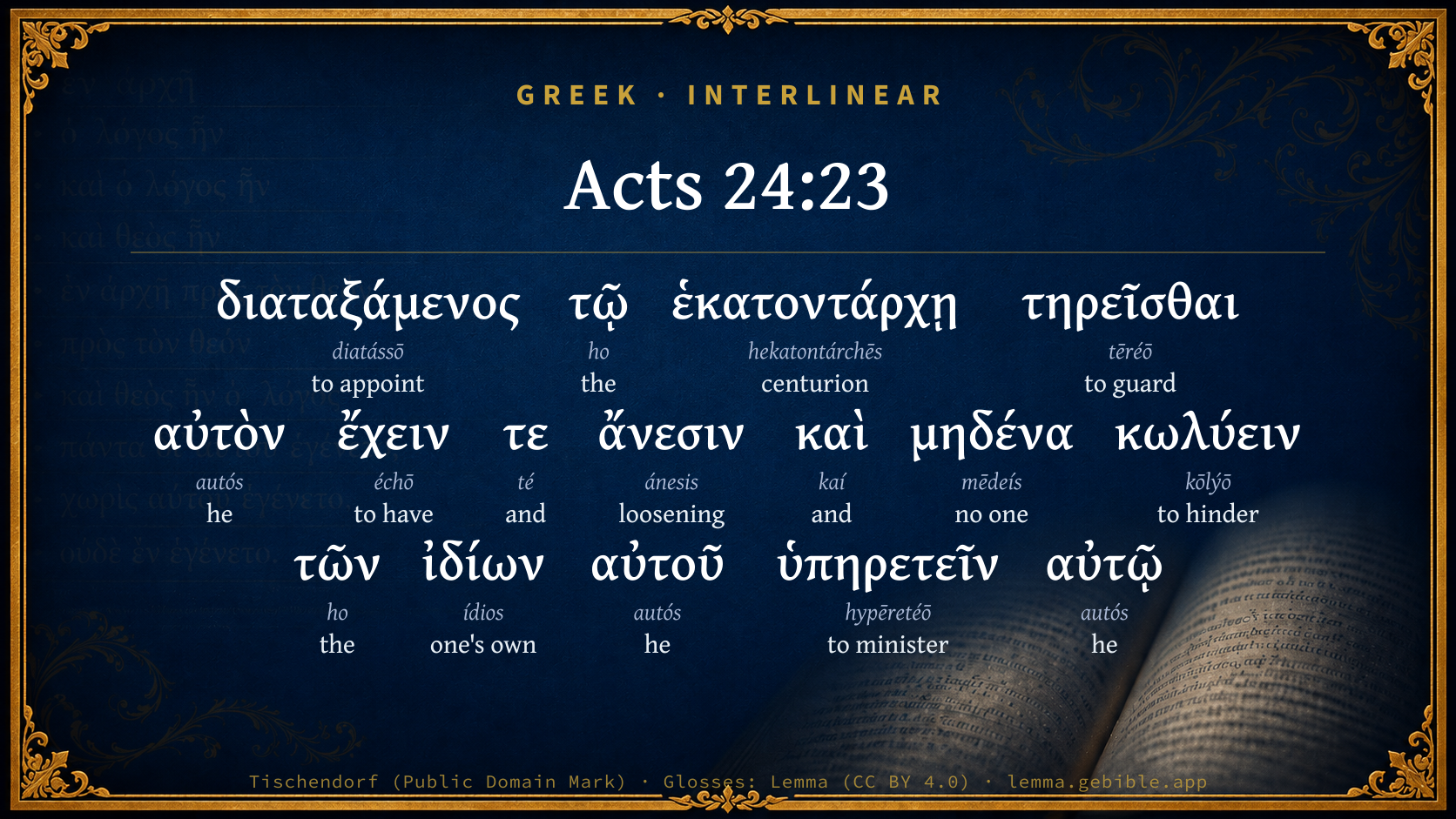
Greek (Tischendorf 8th ed.) Acts 24:23 appears in the Greek New Testament. The text above is from the Tischendorf 8th edition. Each word links to its Strong’s number and a concise gloss. Click any word for its full Thayer’s Greek Lexicon entry.
Download image
Cite this verse

Acts 24:23 (World English Bible). Public Domain. Lemma interlinear Bible study tool, https://lemma.gebible.app/v/acts/24/23.

Show BibTeX & RIS
BibTeX
RIS
English Translation
He ordered the centurion that Paul should be kept in custody, and should have some privileges, and not to forbid any of his friends to serve him or to visit him.
World English Bible · Public Domain
Highlights
  • 1 first appearance in the Greek New Testament
Full analysis ↓
Download a study sheet

One document with this verse’s original text, its word-by-word gloss line, the meaning frame, cross-references with their text, attributed commentary, and full source and license credits — printable, and it pastes into notes with its structure intact.

This verse Autodidact and up

Study sheet (.html) Plain text (.txt)

A passage Seminary Student

Up to 50 verses in one chapter. A passage sheet keeps up to 6 commentary sources and 12 cross-references per verse, in the order this page ranks them, and says so on the sheet whenever that leaves anything out. Ask for a single verse and you get the Autodidact verse sheet above.

Everything on this page stays free to read, with no account — the sheet is a download of what is already on screen, not access to it.

Want to remove ads? Support Godless Engineer
Compare translations 3

The same verse in 3 English versions, stacked beneath the original-language interlinear above. Click any original word for its lexicon entry.

Each is an independent rendering of the whole verse — the interlinear is not word-aligned to these translations.

Highlighted words mark where these versions differ — a whole-verse word diff, not a word-by-word alignment.

  • World English Bible Public Domain
    He ordered the centurion that Paul should be kept in custody, and should have some privileges, and not to forbid any of his friends to serve him or to visit him.
  • King James Version Public Domain
    And he commanded a centurion to keep Paul, and to let him have liberty, and that he should forbid none of his acquaintance to minister or come unto him.
  • unfoldingWord Literal Text CC BY-SA 4.0
    commanding the centurion to guard him and for him to have freedom and to forbid none of his own to minister to him.

unfoldingWord Literal Text — © unfoldingWord, licensed CC BY-SA 4.0. Word-aligned USFM3 via Door43 (git.door43.org/unfoldingWord/en_ult).

Versions to compare (up to 4)

3 of 4 selected

Show all 19 translations

Every available English version of this verse, each an independent rendering of the whole verse.

  • World English Bible Public Domain
    He ordered the centurion that Paul should be kept in custody, and should have some privileges, and not to forbid any of his friends to serve him or to visit him.
  • Berean Standard Bible Public Domain
    He ordered the centurion to keep Paul under guard, but to allow him some freedom and permit his friends to minister to his needs.
  • Majority Standard Bible Public Domain
    He ordered the centurion to keep Paul under guard, but to allow him some freedom and permit his friends to come and minister to his needs.
  • King James Version Public Domain
    And he commanded a centurion to keep Paul, and to let him have liberty, and that he should forbid none of his acquaintance to minister or come unto him.
  • American Standard Version (1901) Public Domain
    And he gave order to the centurion that he should be kept in charge, and should have indulgence; and not to forbid any of his friends to minister unto him.
  • Revised Version (1885) Public Domain
    And he gave order to the centurion that he should be kept in charge, and should have indulgence; and not to forbid any of his friends to minister unto him.
  • Geneva Bible (1599) Public Domain
    Then hee commanded a Centurion to keepe Paul, and that he should haue ease, and that he should forbid none of his acquaintance to minister vnto him, or to come vnto him.
  • Douay-Rheims (1899) Public Domain
    And he commanded a centurion to keep him, and that he should be easy, and that he should not prohibit any of his friends to minister unto him.
  • Young's Literal Translation Public Domain
    having given also a direction to the centurion to keep Paul, to let `him' also have liberty, and to forbid none of his own friends to minister or to come near to him.
  • Literal Standard Version CC BY-SA 4.0
    having also given a direction to the centurion to keep Paul, to let [him] also have liberty, and to forbid none of his own friends to minister or to come near to him.
  • Unlocked Literal Bible CC BY-SA 4.0
    Then he commanded the centurion that Paul should be kept under guard, but to have some freedom so that none of his friends would be prevented from attending to his needs.
  • unfoldingWord Literal Text CC BY-SA 4.0
    commanding the centurion to guard him and for him to have freedom and to forbid none of his own to minister to him.
  • Darby Bible Public Domain
    ordering the centurion to keep him, and that he should have freedom, and to hinder none of his friends to minister to him.
  • World Messianic Bible Public Domain
    He ordered the centurion that Paul should be kept in custody and should have some privileges, and not to forbid any of his friends to serve him or to visit him.
  • Webster's Bible Public Domain
    And he commanded a centurion to keep Paul, and to let him have liberty, and that he should forbid none of his acquaintance to minister, or come to him.
  • Free Bible Version CC BY-SA 4.0
    He ordered the centurion to keep Paul in custody but to allow him some measure of freedom and to let Paul's friends care for him without interference.
  • Bible in Basic English Public Domain
    And he gave orders to the captain to keep Paul under his control, and to let him have everything he had need of; and not to keep his friends from coming to see him.
  • Text-Critical English NT CC BY 4.0
    Then he ordered the centurion to keep Paul in custody, but to allow him a certain measure of freedom and not to prevent his own people from attending to his needs or visiting him.
  • Tyndale New Testament (1534) Public Domain
    And he commaunded an vndercaptayne to kepe Paul and that he shuld have rest and that he shuld forbyd none of his aquayntauce to minister vnto him or to come vnto him.

Literal Standard Version (2020), Covenant Press — licensed CC BY-SA 4.0. Text via the HelloAO Bible API (eBible.org). Unlocked Literal Bible (unfoldingWord) — licensed CC BY-SA 4.0. Text via the HelloAO Bible API (eBible.org). unfoldingWord Literal Text — © unfoldingWord, licensed CC BY-SA 4.0. Word-aligned USFM3 via Door43 (git.door43.org/unfoldingWord/en_ult). Free Bible Version, Dr. Jonathan Gallagher — licensed CC BY-SA 4.0. Text via the HelloAO Bible API (eBible.org).

Word by word

More ways to search: Search by grammar → Find every occurrence → Compare this word →

Practice this passage: Drill this verse → Learn its vocabulary →

ὑπηρετεῖν
hypēretéō
G5256
“to minister”
Verb, Present, Active, Infinitive
Part of Speech
Verb
Tense
Present
Voice
Active
Mood
Infinitive
Full Thayer's Definition

Origin: from G5257

TDNT: 16:50,1

1. to act as a rower, to row 2. to minister, render services
  1. διαταξάμενος diatássō G1299 “to appoint” Verb, Aorist, Middle, Participle, Nominative, Singular, Masculine
  2. τῷ ho G3588 “the” Article, Dative, Singular, Masculine
  3. ἑκατοντάρχῃ hekatontárchēs G1543 “centurion” Noun, Dative, Singular, Masculine
  4. τηρεῖσθαι tēréō G5083 “to guard” Verb, Present, Passive, Infinitive
  5. αὐτὸν autós G846 “he” Personal pronoun, Accusative, Singular, Masculine
  6. ἔχειν échō G2192 “to have” Verb, Present, Active, Infinitive
  7. τε té G5037 “and” Particle
  8. ἄνεσιν ánesis G425 “loosening” Noun, Accusative, Singular, Feminine
  9. καὶ kaí G2532 “and” Conjunction
  10. μηδένα mēdeís G3367 “no one” Adjective, Accusative, Singular, Masculine, Negative
  11. κωλύειν kōlýō G2967 “to hinder” Verb, Present, Active, Infinitive
  12. τῶν ho G3588 “the” Article, Genitive, Plural, Masculine
  13. ἰδίων ídios G2398 “one's own” Adjective, Genitive, Plural, Masculine
  14. αὐτοῦ autós G846 “he” Personal pronoun, Genitive, Singular, Masculine
  15. αὐτῷ autós G846 “he” Personal pronoun, Dative, Singular, Masculine

About this verse

These counts appear in no published source. They are computed here, from the morphology-tagged text and Lemma’s own curated glosses. What Lemma adds →

16
words
13
distinct lemmas
Acts
section

Notable vocabulary

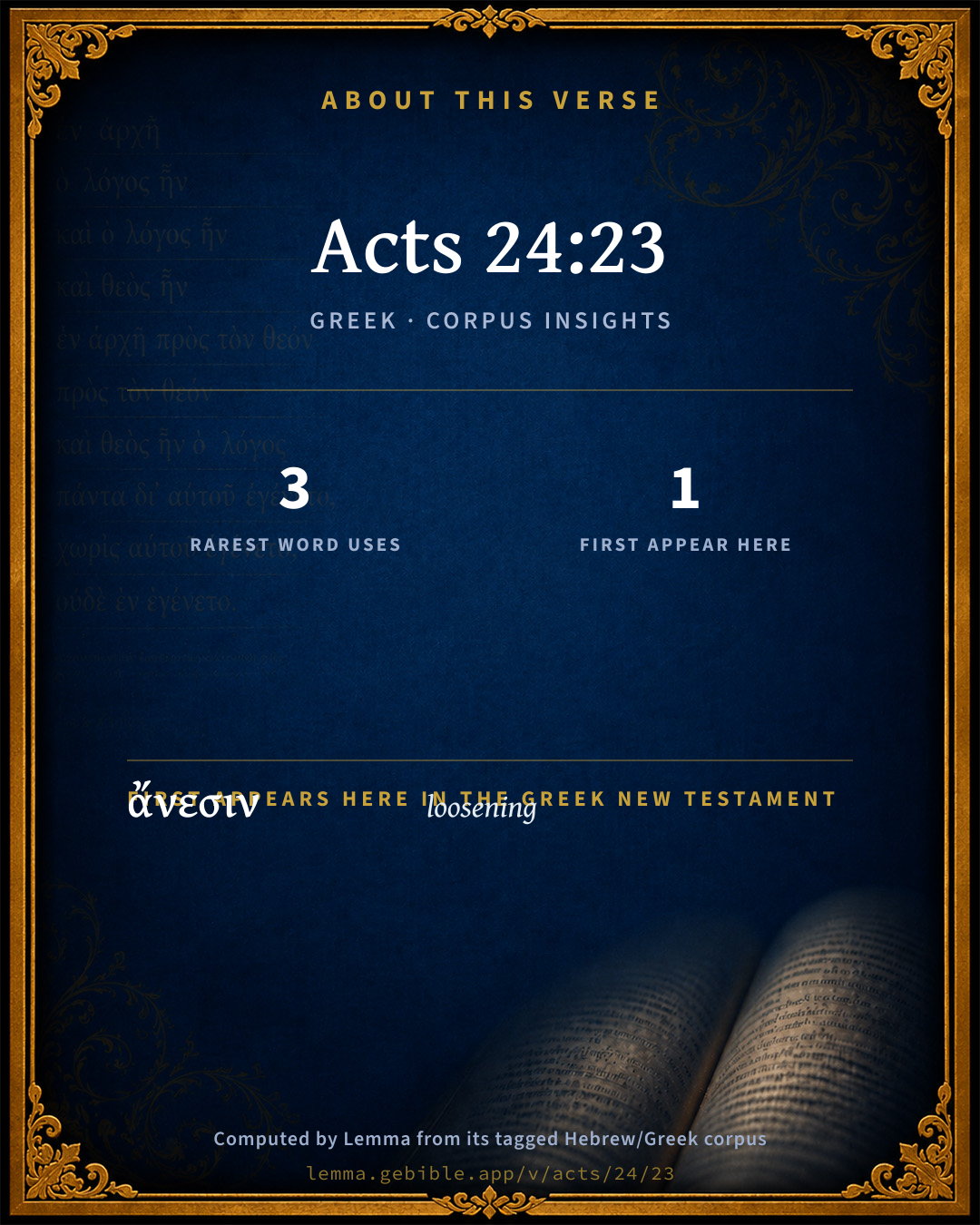
The rarest word here is ὑπηρετεῖν to minister G5256 — appearing just 3 times in the whole Greek New Testament.

First appearance in Scripture

This word makes its first canonical appearance in the Greek New Testament here:

  • ἄνεσιν loosening G425

Shared distinctive vocabulary

ὑπηρετεῖν to minister G5256 occurs in 3 verses of the Greek New Testament. Also found in:
Repetition

Words recur within this verse:

  • αὐτὸν he G846 ×3
  • τῷ the G3588 ×2

Cross-references

8

Topical passages linked to Acts 24:23 in the Treasury of Scripture Knowledge — connected by theme and wording, ordered by reader-vote popularity; previews shown in the World English Bible.

  • Acts 27:3 The next day, we touched at Sidon. Julius treated Paul kindly, and gave him permission to go to his friends and refresh himself.
  • Acts 28:16 When we entered into Rome, the centurion delivered the prisoners to the captain of the guard, but Paul was allowed to stay by himself with the soldier who guarded him.
  • Proverbs 16:7 When a man's ways please Yahweh, He makes even his enemies to be at peace with him.
  • Acts 21:8–14 On the next day, we, who were Paul's companions, departed, and came to Caesarea. We entered into the house of Philip the evangelist, who was one of the seven, and stayed with him.
  • Acts 23:16 But Paul's sister's son heard of their lying in wait, and he came and entered into the barracks and told Paul.
  • Acts 23:35 "I will hear you fully when your accusers also arrive." He commanded that he be kept in Herod's palace.
  • Acts 24:26 Meanwhile, he also hoped that money would be given to him by Paul, that he might release him. Therefore also he sent for him more often, and talked with him.
  • Acts 28:31 preaching the Kingdom of God, and teaching the things concerning the Lord Jesus Christ with all boldness, without hinderance.

Cross-references courtesy of OpenBible.info (CC BY 4.0).

Where the printed editions differ

2 variants

Places in this verse where the major printed Greek editions disagree on the wording in a way that affects the translation — a comparison of editions, not a manuscript-by-manuscript collation. The editions are the modern critical texts (Nestlé-Aland 28/27, SBL, Westcott-Hort, Tregelles, Tyndale House) and the traditional texts behind the KJV (the Textus Receptus and the Byzantine/Majority text). It is not a claim about which reading is original.

  1. Different wording
    αὐτὸν,

    “him,”

    In NA28NA27TynSBLWHTreg Not in TRByz

    Παῦλον (Paulon) 'Paul' occurs in traditional manuscripts (TR+Byz) instead of αὐτὸν, (auton) 'him,' in older manuscripts (NA28+NA27+Tyn+SBL+WH+Treg)

  2. Extra text
    ἢ προσέρχεσθαι

    “or to come near”

    In TRByz Not in NA28NA27TynSBLWHTreg

    ἢ προσέρχεσθαι (ē proserchesthai) 'or to come near' is only in traditional manuscripts (TR+Byz)

Textual data: Translators Amalgamated Greek New Testament (STEPBible TAGNT) · CC BY 4.0.

Commentary

Notes on Acts 24:23 from classic Christian and Jewish commentators (each source and its license shown beneath its notes). The classic Christian expositions comment on the surrounding passage and are grouped to its opening verse, so a note may address several verses; the Jewish commentaries on the Tanakh (Rashi and others) are per-verse, so they appear only where the commentator wrote on this verse.

Lemma curates 59 commentaries, every one of them public domain or Creative Commons licensed, each selected and text-cleaned for this edition rather than reprinted as found. About our sources →

Tyndale Open Study Notes

Tyndale Open Resources

24:23 It was in keeping with the proper treatment of a Roman citizen to give him some freedom and allow his friends to visit him and take care of his needs.

Tyndale Open Study Notes — © Tyndale Open Resources, licensed CC BY-SA 4.0. Text via the HelloAO Bible API.

Bengel's Gnomon

Johann Albrecht Bengel

Act 24:23. Τηρεῖσθαι, that he should be kept) be secured in safety.—ἄνεσιν, rest) Thus he was able to propagate the Gospel. The Jews were annoyed at this, but could not prevent it.

Bengel's Gnomon of the New Testament — English translation (T&T Clark, Edinburgh, 1860) — public domain. Text from a community e-Sword module.

Meyer's Critical & Exegetical Commentary

Heinrich August Wilhelm Meyer

Act_24:23. Διαταξ.] belongs, like εἰπών, to ἀνεβάλετο, and (yet τέ has preponderant testimony against it) having given orders. Comp. κελεύσας, Act_23:35.

τηρεῖσθαι αὐτὸν κ.τ.λ.] that he should be kept in custody and should have relaxation. He was to have rest (requiem, Vulgate), to be spared all annoyance. Comp. Plat. Pol. ix. p. 590 B: χαλάσει τε καὶ ἀνέσει. Polyb. i. 66. 10 : ἄνεσις καὶ σχολή. Joseph. Antt. xviii. 6. 10 : φυλακὴ μὲν γὰρ καὶ τήρησις ἦν, μετὰ μέντοι ἀνέσεως τῆς εἰς τὴν δίαιταν. So correctly also Wieseler, p. 381. Usually ἄνεσιν is understood of release from chains, custodia libera, φυλακὴ ἄδεσμος (Arrian. ii. 15. 7; see on it, Geib, Gesch. d. Rôm. Criminalprocesses, p. 562 f.); but without indication of this special reference in the text, and against Act_24:27. From τῷ ἑκατοντάρχῃ it is rather to be inferred that the present custody was the usual custodia militaris, in which, however, Paul was to be treated with mildness and to be left without other molestation.

καὶ μηδένα κωλύειν] the construction is active: and that he (the centurion) should hinder no one.

τῶν ἰδίων αὐτοῦ] is not to be understood of the Jewish servants of the procurator, but of those belonging to the apostle. They were his friends and disciples, among whom were perhaps also relatives (Act_23:16). They were allowed to be at hand and serviceable for the satisfaction of his wants.

Meyer — Critical and Exegetical Commentary on the New Testament — English translation by Peter Christie, edited by Frederick Crombie (T&T Clark, 1880) — public domain. Text from a community e-Sword module.

Expositor's Greek Testament

ed. W. Robertson Nicoll

Act 24:23 . τηρεῖσθαι : that he should he kept in charge as a prisoner; not middle as in A.V. ἔχειν τε ἄνεσιν : “and should have indulgence,” R.V., not “liberty,” A.V., word only elsewhere in Paul in N.T., 2Co 2:13 ; 2Co 7:5 ; 2Co 8:13 , 2Th 1:7 , cf. also Sir 26:10 , 1Es 4:62 . From Act 24:27 it appears that the prisoner was still bound, but the indulgence involved a custodia liberior , and extended to food, and the visits of friends, and remission from the severer form of custody, cf. Jos., Ant. , xviii., 6, 7, 10, where Agrippa has similar indulgence in his imprisonment at Rome, but is still chained. μηδένα κωλύειν τῶν ἰδίων , cf. Act 4:23 , Luke, Aristarchus, perhaps Trophimus, cf. Jos., Ant. , xviii, u. s. , for the same indulgence; change of subject to centurion in κωλύειν . ὑπηρετεῖν , Act 13:36 , Act 20:34 .

The Expositor's Greek Testament, edited by W. Robertson Nicoll (1897–1910) — public domain. Text from a community e-Sword module.

Geneva Bible (1599)

Geneva Bible translators

God is a most faithful keeper of his servants, and the force of the truth is wonderful, even amongst men which are otherwise profane.

Geneva Bible (1599) marginal notes — public domain. Text via Bolls.life.

Adam Clarke's Commentary

Verse 23. He commanded a centurion to keep Paul] He gave him into the custody of a captain, by whom he was most likely to be well used: and to let him have liberty; he freed him from the chains with which he was bound to the soldiers, his keepers. See Clarke on Ac 21:33. And that he should forbid none of his acquaintance, τωνιδιων, of his own people, his fellow apostles, and the Christians in general, to minister or come unto him; to furnish him with any of the conveniences and comforts of life, and visit him as often as they pleased. This was an ample proof that Felix found no evil in him; and he would certainly have dismissed him but for two reasons:

1. He wanted to please the Jews, who, he knew, could depose grievous things against his administration.

2. He hoped to get money from the apostle, or his friends, as the purchase of his liberty.

Adam Clarke's Commentary on the Bible (1810–1826) — public domain. Text from a community e-Sword/MySword module.

John Calvin's Commentaries

23. When Felix. It appeareth that Felix (though he pronounced nothing concerning the matter) did perceive that Paul was burdened with no fault of his own, but with the malice of the priests. For when Luke saith that the matter was deferred until the coming of Lysias, he putteth in this instead of a reason, that the ruler did perfectly know those things which did appertain unto the way, by which words, I think, is signified, either that through long experience he had been acquainted with the conditions of the priests, and knew full well how they were wont to behave themselves; or else that he saw by these things which had been spoken on both sides how frivolous the accusation was, which is confirmed by the courteous and remiss usage of Paul; for he putteth a centurion in trust with him, that he may have the more liberty. Others had rather read it in one text in the person of Felix: when Lysias, who doth better know the truth of this matter, is come, I will then give judgment. But they let [draw] and gather this racked sense from a reason which is scarce firm. They say that this word way is nowhere taken for the doctrine of the law without some addition. But I do not interpret it of the law, but of those sects whereof no strangers were ignorant. No man did doubt but that the Pharisees did hold the immortality of the soul. Therefore, seeing it was a thing so common, no marvel if Felix do acquit Paul. Furthermore, it were hard to take way for the knowledge of the fact. And I see not how this can hang together, that the governor doth confess that Lysias was more expert in the law than he. But his innocency is made more famous and evident by this, because a profane man did straightway give such a prejudice thereof that he did suffer him to be visited and holpen by his friends, being, as it were, exempted from the order of prisoners. Also, we gather by this that Paul’s companions and the residue of the Church had not forsaken him. For to what end had it been to grant liberty to his friends and acquaintance to have access unto him unless they had been present, had showed themselves to be careful for him, and had been desirous to do their duty? Therefore, let us learn by this example, that so long as we may, and are able, we must not defraud the martyrs of Christ of any manner of comfort whilst they labor for the gospel.

John Calvin's Commentaries (1540-1563) — public domain. Text from the Calvin Translation Society English edition (1840s-50s) via the Christian Classics Ethereal Library (ccel.org). Calvin's coverage is partial (roughly two-thirds of the Bible); uncommented books and verses are honest gaps, never fabricated. The 19th-century editor's footnotes and remarks are omitted so the notes are faithfully Calvin's own voice.

Ellicott's Commentary for English Readers

(23) And he commanded a centurion to keep Paul.—More accurately, the centurion—either the officer in whose custody he had been placed by Lysias, or the one who had the special charge of the prisoners waiting for trial. The favourable impression made on Felix is shown by the unusual leniency with which the prisoner was treated. The attribute of “clemency,” on which the orator had complimented Felix, was not altogether dead, but it was shown to the accused and not to the accusers.

A Bible Commentary for English Readers, edited by Charles John Ellicott (1878–1897) — public domain. Text from a community e-Sword module.

The Cambridge Bible for Schools and Colleges

gen. ed. J. J. S. Perowne

23. And he commanded a centurion] The Greek noun has the article, therefore the Rev. Ver. gives “the centurion.” It might perhaps be one of the two whom Lysias had put in charge of the conveyance of Paul (Act_23:23). One might be appointed to go on to Cæsarea, while the other returned with the larger part of the convoy from Antipatris.

to keep Paul] The best MSS. omit the proper name. Read (with Rev. Ver.) “that he should be kept in charge.” The verb only conveys the idea of safe keeping, not of severe detention, and it is clear that for some reason Felix shewed himself well-disposed towards the Apostle. Either his conscience moved him, or his hope of gain, or perhaps the flattery and compliments of Tertullus had overshot their mark.

and to let him have liberty] Better, “and should have indulgence.” That is, there should be a relaxation of prison rules in his case.

and that he should forbid none of his acquaintance] In order to join on better with the previous clause, read (with Rev. Ver.) “and not to forbid any of his friends.” The original has a word stronger than “acquaintance.” It refers more particularly to such matters as country, home, family and friends, which are specially a man’s own. Here from our limited knowledge we are only able to think of Philip the Evangelist who would be particularly a friend of St Paul, but he had been more than once before in Cæsarea, and he had no doubt made himself known there as in other places. Those unnamed disciples of Cæsarea (Act_21:16) would be among those who had a warm interest in St Paul, and it is clear from St Luke’s language that there were friends at hand and ready to visit the Apostle when they were allowed.

to minister or come unto him] The best MSS. have no Greek for “or come.” The verb “minister” implies the doing of those services of which a prisoner even under such liberal conditions must ever stand in need. They would be his means of communication with the outer world. And the cupidity of Felix may have suggested that through these friends the means might be supplied for purchasing the Apostle’s release.

The Cambridge Bible for Schools and Colleges (gen. ed. J. J. S. Perowne; Cambridge University Press, 1878–1918) — public domain. Text from a community e-Sword module.

John Gill's Exposition

And after certain days,.... Some days after this trial:

when Felix came with his wife Drusilla, which was a Jewess; to Caesarea, having been to fetch her from some other place, or to meet her: this woman was the daughter of Herod Agrippa, who was eaten by worms, Act 12:23 and sister to King Agrippa, mentioned in the next chapter; but though she was born of Jewish parents, and so a Jewess, as she is here called, yet her name was a Roman name, and is the diminutive of Drusus; the first of which name took it from killing Drausus, an enemy's general, and who was of the Livian family; and the name of the mother of Tiberius Caesar was Livia Drusilla; Caius Caligula, the Roman emperor, had also a sister whose name was Drusilla (a); this name Herod took from the Romans, and gave to his daughter; though the masculine name is often to be met with in Jewish writings; we frequently read of , "Rabbi Drusai" (b); Herod Agrippa (c) left three daughters, born to him of Cypris, Bernice, Mariamne, and Drusilla; and a son by the same, whose name was Agrippa; Agrippa when his father died was seventeen years of age, Bernice was sixteen, and was married to her uncle Herod; Mariamne and Drusilla were virgins, but were promised in marriage by their father; Mariamne to Julius Archelaus, son of Chelcias, and Drusilla to Epiphanes, the son of Antiochus, king of Comagene; but after Herod's death, he refused to marry her, being unwilling to embrace the Jewish religion and relinquish his own, though he had promised her father he would; wherefore her brother Agrippa married her to Azizus king of the Emesenes, who was willing to be circumcised; but this marriage was quickly dissolved; for Felix coming to the government of Judea, seeing Drusilla, was enamoured with her beauty; and by the means of one of his friends, one Simon a Jew, and a native of Cyprus, who pretended to be a magician, he enticed her from her husband, and prevailed upon her to marry him:

he sent for Paul, and heard him concerning the faith in Christ; which he did, chiefly on account of his wife, who being brought up in the Jewish religion, had some notion of the Messiah the Jews expected, and could better understand what Paul talked of than he did; who at this time doubtless showed, that Christ was come, and that Jesus of Nazareth was he; that he is truly God and man, that he died, and rose again from the dead on the third day, and that he has obtained salvation for sinners, and that whoever believes in him shall be saved; this was the faith in Christ Paul discoursed of, and Felix and his wife heard; but it does not appear that it was attended with the power of God, to the conversion of either of them; it seems to have been merely out of curiosity, and as a diversion to them, and to do his wife a pleasure, that he sent for Paul and heard him.

(a) Sueton. in Vita Tiberii, sect. 3, 4, & in Vita Caligulae, sect. 7. (b) Shemot Rabba, sect. 35. fol. 136. 4. & sect. 43. fol. 140. 4. Shirhashirim Rabba, fol. 14. 4. & 18. 2. Juchasin, fol. 88. 1. (c) Joseph. de Bello Jud. l. 2. c. 11. sect. 6. Antiqu. l. 19. c. 9. sect. 1. l. 20, c. 6. sect. 1, 2.

John Gill's Exposition of the Whole Bible (1746–1763) — public domain (CC PDM 1.0). Text via the HelloAO Bible API.

Trapp's Complete Commentary

John Trapp

23 And he commanded a centurion to keep Paul, and to let him have liberty, and that he should forbid none of his acquaintance to minister or come unto him.

Ver. 23. And to let him have liberty] This shows that Felix himself found that it was malice, more than matter, that moved the Jews to prosecute. And the same perhaps is hinted in the former verse, "having more perfect knowledge of that way;" that is, as some sense it, being well acquainted with their courses, and knowing it to be their common practice to accuse innocent men of mere spite. But why then did not Felix punish those malicious men, and let Paul go? why is he still a prisoner, though a free prisoner, under a keeper, or with some chain on him? Oh, it is a mercy to have judges modo velint quae possint, modo audeant quae sentiant, so they be willing to do what they may, and dare do what they judge fit to be done. (Cic. pro Milone.)

John Trapp, A Commentary or Exposition upon All the Books of the Old and New Testament (1647–1656) — public domain. Text from a community e-Sword module.

Albert Barnes' Notes on the Bible

And he commanded ... - It is evident from this verse that Felix was disposed to show Paul all the favors that were consistent with his safe keeping. He esteemed him to be a persecuted man, and doubtless regarded the charges against him as entirely malicious. What was Felix’s motive in this cannot be certainly known. It is not improbable, however, that he detained him:

To gratify the Jews by keeping him in custody as if he were guilty, and, That he hoped the friends of Paul would give him money to release him. Perhaps it was for this purpose that he gave orders that his friends should have free access to him, that thus Paul might be furnished with the means of purchasing his freedom.

Albert Barnes' Notes on the Bible (1834–1885) — public domain. Text from a community e-Sword/MySword module.

Matthew Poole's English Annotations

To let him have liberty; not so confined as to be kept in a dungeon, or more inward prison; but to have the liberty of the prison, yet so as with a chain about him; as appears, Act 26:29; Act 28:20.

Acquaintance; relations or disciples; for there was a church at Caesarea, Act 10:48; 21:8. When it is expedient for us, God can add the comforts of these outward enjoyments, relations and friends, unto us; and that his and our enemies shall contribute towards it.

Matthew Poole's English Annotations on the Holy Bible (1683–1685) — public domain. Text from a community e-Sword/MySword module.

Whedon's Commentary on the Bible

Daniel D. Whedon

23. Keep Paul—(Note Act_23:25.)

Daniel D. Whedon (gen. ed.), Commentary on the Old and New Testaments (1874–1909) — public domain. Text from a community e-Sword module.

The Pulpit Commentary

Gave order to the for commanded, A.V.; that he should be kept in charge for to keep Paul, A.V. and T.R.; and should hare indulgence for and to let him have liberty, A.V.; not to forbid any of his friends for that he should forbid none of his acquaintance, A.V.; to minister unto him for to minister or come unto him, A.V. and T.R. Indulgence (anesiv); literally, relaxation, viz. of the prison restraints and confinement. The word is used in the LXX of dwkan 2Ch_23:15, e aujth anesin, i.e. those who had taken Athaliah prisoner, "let her loose" till she got out of the temple court. It is also a common medical term for the cessation or remission of pain or disease. St. Paul uses it four times in his Epistles for "rest" or "ease" (2Co_2:13 2Co_7:5 2Co_8:13; 2Th_1:7) Doubtless St. Luke was thus enabled to be much with St. Paul during his imprison merit, and, as suggested above, to have his help in writing his Gospel.

St. Paul"s liberty.

commanded a centurion to keep Paul, and to let him have liberty." It is evident that the prosecution of the apostle by the Jewish party had utterly broken down. No charge could be substantiated which made him amenable to punishment according to Roman law. If Felix had been a free man, and, as a judge, free of all other considerations than the doing of justice, he would have liberated St. Paul at once, declaring publicly his innocence. But Felix was not free. No man is really free who does not dare to do the right. And we can recognize a gracious overruling providence in St. Paul"s being kept for a while longer under Roman protection. So great was the enmity against him of the Jewish party, that his life would have been in extreme peril if he had been liberated. Knowing that he was dealing unfairly by the prisoner, and impressed by his dignity of bearing, Felix compromised matters with himself, persuaded himself that he could secure Paul from the schemes of the Sanhedrim by keeping him prisoner; put off Paul"s enemies by an excuse that he would confer with Lysias; and privately arranged for Paul to have a real, though not an apparent, liberty. Through all the ages some of the worst wrongs have been done in the name of compromise, which is too often the weak device of those who cannot "stand firm to the right.

I FELIX BOUND.

1. By the weakness of his moral character.

2. By the desire to please an important section of those whom he had to govern.

3. By the consequences of his own wrong-doings, which it cost him all his effort to keep off as long as possible.

4. By the circumstances in which he found himself placed, and which he had no strength of will or purpose to master. The man of vice and self-indulgence enervates his will, and becomes the slave of his sin as truly as does the drunkard.

II PAUL APPARENTLY BOUND. He had been tied by a chain to a Roman soldier day and night, according to the usual Roman custom, and if Felix relaxed this, still Paul was a prisoner in the barracks, and probably a soldier-guard waited on him constantly. If his friends were free to come to him, he was not free to go out to them. If we estimate his character aright, we shall feel that even the slightest form of bondage must have been most painful to him. His was a soul so noble than even the limitations of a frail body were to him an agony.

III FELIX GETTING AS FREE AS POSSIBLE FROM HIS BONDS. Not free enough to say, honestly and. honorably, "This man is innocent of all crime against the state, and must be set at liberty at once." Only able to shake the fetters off enough to say, "Forbid none of his acquaintance to minister or come unto him," and only able to give this order in a private way to the centurion.

IV PAUL REALLY FREE. However he might seem to be still set under outward limitations, nothing can imprison a man save his own wilful sin. Nobody can put any real fetters on any fellow-man. Each man who wears fetters puts them on himself; each man who dwells in a prison goes in himself, and himself bolts the door.

Stone walls do not a prison make, Nor iron bars a cage.

But "whosoever committeth sin becomes the slave of sin." So, whatever may have been the limitations of the apostle"s circumstances, there was no bondage, for there was no conscience of sin. The freedom of Paul

(1) to commune with God,

(2) study the truth,

(3) to serve the Churches, maybe shown; and it may be pointed out how often the very limitations of a man"s circumstances, through sickness or persecution, has found him the freedom for some great and noble service, as may be illustrated from Luther"s work while in the Wartburg, and from John Bunyan"s work while in Bedford jail. R.T.

The Pulpit Commentary (1880–1919), ed. H.D.M. Spence-Jones & Joseph S. Exell — public domain. Text from a community e-Sword module.

John Wesley's Explanatory Notes

He commanded the centurion to let him have liberty - To be only a prisoner at large. Hereby the Gospel was spread more and more; not to the satisfaction of the Jews. But they could not hinder it.

John Wesley, Explanatory Notes Upon the Whole Bible (1754–1765) — public domain. Text via the GEBible commentary corpus.

Kretzmann's Popular Commentary

Paul E. Kretzmann

Paul Retained a Prisoner.

v. 23. And he commanded a centurion to keep Paul and to let him have liberty, and that he should forbid none of his acquaintance to minister or come unto him.

v. 24. And after certain days, when Felix came with his wife Drusilla, which was a Jewess, he sent for Paul, and heard him concerning the faith in Christ.

v. 25. And as he reasoned of righteousness, temperance, and judgment to come, Felix trembled and answered, Go thy way for this time; when I have a convenient season, I will call for thee.

v. 26. He hoped also that money should have been given him of Paul, that he might loose him; wherefore he sent for him the oftener, and communed with him.

v. 27. But after two years Porcius Festus came into Felix’ room; and Felix, willing to show the Jews a pleasure, left Paul bound.

The case of Paul had been continued indefinitely; he was retained in custody only for reasons of expediency and policy on the part of Felix. But the procurator at least had enough humaneness left to make Paul’s confinement as light as possible. He gave definite orders to a certain centurion to keep him in custody, thus making the officer responsible for his safekeeping. At the same time, however, he should be given indulgence, should be permitted a certain freedom of movement, and no one of his own people, the members of the local Christian congregation and others, should be hindered from serving him. Any kind of personal service, even in small matters, was allowed, the indulgence extending as far as the centurion might consider safe. Sometime after, Felix with his wife Drusilla, who was a Jewess, came, probably having just returned to the city after a visit elsewhere, and sent for Paul. It was not a formal hearing, but a private interview, very likely because Drusilla had heard the Christian religion spoken of on so many occasions and wanted to hear this great teacher of that sect tell something about the faith in Christ. This Drusilla was the youngest daughter of Herod Agrippa I, and had been married at the age of fourteen to Azizus, the king of Emesa. Felix became acquainted with her, became enamored of her ravishing beauty, and, with the help of a Jewish sorcerer, named Simon of Cyprus, seduced her from her husband, with whom, according to the account of Josephus, she had led a very unhappy life. So she was now, although married to Felix according to Roman law, yet, according to the Law of God, living with him in an adulterous union. Where the Word of God does not reign, every form of sin and shame is freely indulged in, as the lust of the flesh dictates. Paul willingly complied with the request and, in accordance with the order of the Lord, first exposed the sin and its condemnation. He spoke of righteousness, of the absolute need of purity in the sight of God, of sinlessness before His judgment; he spoke of temperance, of the mastery of self, of the necessity of keeping the lusts and desires of the flesh under proper control; he spoke of the future judgment, when all these matters would be revealed before the eyes of the omniscient God. "He spoke of justice to a judge, of continence to a prefect whose recklessness and licentiousness had made him notorious, and of the future judgment to a man who needed that he should be reminded of his, future account. " The result was that Felix was filled with fear. "As he glanced back over the stained and guilty past, he was afraid. He had been a slave in the vilest of all positions, at the vilest of all epochs, in the vilest of all cities. He had crept with his brother Pallas into the position of a courtier at the most morally degraded of all courts. He had been an officer of those auxiliaries who were the worst of all troops. What secrets of lust and blood lay hidden in his earlier life we do not know; but ample and indisputable testimony, Jewish and pagan, sacred and secular, revivals to us what he had been-how greedy, how savage, how treacherous, how unjust, how steeped in the blood of private murder and public massacre during the eight years which he had now spent in the government, first of Samaria, then of Palestine. There were footsteps behind him; he began to feel as though ’the earth were made of glass. ’" And it is doubtful whether Drusilla felt more comfortable than her "husband" during the address of Paul. Felix had enough; he told Paul that he might go for the present; at a convenient season he would call him again. But that convenient season apparently never came. That is a favorite phrase of sinners in high and low places to this day: at some later day, after they have thoroughly enjoyed all the lusts which the world has to offer, then they will change their lives. And in the meantime sin takes possession of their hearts so completely that they cannot shake its fetters off; the convenient moment never comes, and they are lost. How little the heart of Felix had been touched by the earnest words of Paul is shown by the fact that he hoped to be given some bribe money from Paul. It was either that the circumstances of Paul had improved since the probable death of his father, or that the procurator believed the Christians would readily collect enough money for their leading teacher in order to relieve him from the disgrace of imprisonment. With this idea in mind, he sent for Paul frequently and conversed with him, very likely dropping a hint now and then as to a method by which he could soon effect his release. But Paul refused to become a party to a crime, and was deaf to all insinuations and suggestions, open and veiled. In this way two years were soon consumed, when Felix was recalled by Nero, about A. D. 59, his successor being Porcius Festus. And the very last act of Felix was an injustice to Paul, for since he desired to gain favor with the Jews for the event of a return to his position, he left Paul in custody at Caesarea. Wherever there are unscrupulous officials in public or private life, they will be found to be time-servers, always ready to yield favors at the expense of others, and to place their own conduct in the most favorable light. The fact that innocent people may thus be harmed, apparently does not enter into their reckoning. But the government of the exalted Christ goes on in spite of all such miserable subterfuges and tricks.

Summary.Paul defends himself against the charges of the Jews as preferred before Felix through their attorney Tertullus, and his case is continued indefinitely, he being retained in custody even when Felix is recalled.

Paul E. Kretzmann, Popular Commentary of the Bible (1921–1924) — public domain. Text from a community e-Sword module.

McGarvey & Pendleton's Commentaries

J. W. McGarvey

23. When the Jews were dismissed, if Felix had possessed a strict regard for justice, he would have released Paul. As it was, he only relaxed the rigor of his previous confinement. (23) " And he commanded the centurion that Paul should be guarded, but have relaxation, and to forbid none of his friends to minister to him or visit him. " His confinement was now the least rigorous which was considered compatible with safe-keeping. He was under what was called the military custody, being placed in charge of a soldier, whose left arm was chained to Paul's right, and who was responsible with his own life for the safety of his prisoner. The guards were relieved at regular intervals, and the "relaxation" allowed Paul was, probably, an occasional release from the chain.

J. W. McGarvey (with Philip Y. Pendleton), Commentaries on the New Testament (The Fourfold Gospel, 1914; Acts; and the epistles) — public domain. Text from a community e-Sword/MySword module.

Cambridge Greek Testament for Schools and Colleges

23. αὐτὸν for τὸν Παῦλον with אABCE. Vulg. ‘eum.’

ἤ προσέρχεσθαι omitted with אABCE. Not represented in Vulg.

23. διαταξάμενος τῷ ἑκατοντάρχῃ, having commanded the centurion. It might perhaps be one of the two whom Lysias had put in charge of the conveyance of Paul (Act 23:23). One might be appointed to go on to Cæsarea, while the other returned with the larger part of the convoy from Antipatris.

τηρεῖσθαι αὐτόν, that he should be kept in charge. τηρεῖσθαι only conveys the idea of safe keeping, not of severe detention, and it is clear that for some reason Felix shewed himself well-disposed towards the Apostle. Either his conscience moved him or his hope of gain, or perhaps the flattery and compliments of Tertullus had overshot their mark.

ἕχειν τε ἄνεσιν, and should have indulgence, i.e. the strict prison rules were to be relaxed in his favour.

For ἄνεσις cf. 1Es 4:62, ἔδωκεν αὐτοῖς ἄφεσιν καὶ ἄνεσιν.

καὶ μηδένα κωλύειν, and that he should hinder no one. Here is a change of subject in the sentence. Παῦλον was the subject to the two first infinitives, to κωλύειν the subject is τὸν ἑκατοντάρχην.

τῶν ἰδίων αὐτοῦ, of his friends. More literally ‘of his own people.’ Here from our limited knowledge we are only able to think of Philip the Evangelist, who would be particularly a friend of St Paul; but he had been more than once before in Cæsarea, and he had no doubt made himself known there as in other places. Those unnamed disciples of Cæsarea (Act 21:16) would be among the persons who had a warm interest in St Paul, and it is dear from St Luke’s language that there were friends at hand and ready to visit the Apostle when they were allowed.

ὑπηρετεῖν αὐτῷ, to minister unto him. ὑπηρετεῖν implies the doing of those services of which a prisoner even under such liberal conditions must ever stand in need. They would be his means of communication with the outer world. And the cupidity of Felix may have suggested that through these friends the means might be supplied for purchasing the Apostle’s release.

Cambridge Greek Testament for Schools and Colleges (Cambridge University Press, 1896; 21 vols, various authors incl. Carr, Maclear, Plummer, Farrar, Lumby, Moule, M. R. James, Simcox) — public domain. Text from a community e-Sword module.

Alford’s Greek Testament

Henry Alford

23.] διαταξάμενος is in apposition with εἴπας, and both belong to ἀνεβάλετο.

ἄνεσιν] De W. and Meyer explain this of ‘custodia libera,’ φυλακὴ ἄδεσμος (Arrian, Exp. ii. 15). But this can hardly be. Lipsius (Excurs. II. on Tacit. Ann. iii. 22; vi. 3, cited by Wieseler, Chron. d. Apost.-g. p. 380) says, ‘Præter custodiam militarem alia duplex, apud magistratus, et apud vades. Apud magistratus, quum reus Consuli, Prætori, Ædili, interdum et Senatori, etiam non e magistratu, committebatur: quod nonnisi in reis illustrioribus usurpatum, eaque custodia libera dicta: vid. Tacit. Ann. vi. 3; Sall. Cat. xlvii.; Liv. vi. 36; Cic. Brut. xcvi.; Dio lviii. 3. Custodia apud vades, quum eorum periculo fidejussoribus reus tradebatur: vid. Tacit. Ann. v. 8; Suet. Vitell. 2.’ Now, Wieseler argues, as Paul was not bailed,—and was not ‘e reis illustrioribus,’ and besides was delivered to a centurion to keep, his cannot have been ‘custodia libera,’ but ‘militaris:’ relaxed however as much as was consistent with safe custody. He cites Josephus, who says (Antt. xviii. 6. 10) of the custody of Agrippa, φυλακὴ μὲν γὰρ καὶ τήρησις ἦν, μετὰ μέντοι ἀνέσεως τῆν εἰς τὴν δίαιταν. Remission, or relaxation, would be a better rendering than ‘liberty.’

Henry Alford, The Greek Testament (1849–1861) — public domain. Text from a community e-Sword module.

Vincent's Word Studies in the New Testament

Marvin R. Vincent

Liberty [ανεσιν] . From ajnihmi, to send up; thence, to loosen, release. It is almost exactly expressed by our vulgarism, to let up. The noun here is more correctly rendered by Rev., indulgence. In all the other New Testament passages it is rendered rest, ease, or relief. See 2Co 2:13; 2Co 7:5; 2Co 8:13; 2Th 1:7.

To minister [υπηρετειν] . See on officer, Mt 5:25.

Marvin R. Vincent, Word Studies in the New Testament (1887–1900) — public domain. Text from a community e-Sword/MySword module.

Lesson kit

Teaching starters — assembled from the data on this page, not authored interpretation. Every prompt links to the verse data it draws on. Edit before teaching.

Acts, in the Acts, opens this verse with 16 words (13 distinct Greek lemmas). Its most distinctive word is hypēretéō (“to minister”). A historical commentator’s framing appears above. Read the whole chapter for the surrounding context.

Discussion questions

  1. How does “to minister” (hypēretéō) shape what this verse is saying?
  2. The word “loosening” first appears here in Scripture. What is being introduced at this debut?
  3. Acts 13:36 shares the word «to minister» with this verse. How do the two illuminate each other?
  4. “he” occurs 3× in this one verse. What is the effect of the repetition?
  5. The translations on this page render this verse differently — a whole-verse word diff, not a word-by-word alignment. What might account for the different wordings?
  6. Reading how Tyndale Open Study Notes and Bengel's Gnomon read this verse, where do the two commentators agree and where do they part?

Things to notice

  • 1 word makes its first canonical appearance in Scripture here.
  • These translations choose different wording for 23 words in this verse.
  • “he” occurs 3× in this single verse.
  • 13 distinct Greek lemmas span 16 words in this verse.

Reading settings

Reading text

Shown beneath each verse's original-language words.

Old Testament
Old Testament edition

Read the OT as the Masoretic Hebrew (MT) or the Greek Septuagint (LXX).

English shown for the Greek Septuagint (in the Hebrew ↔ Greek comparison).

Comparing translations? Open the Compare panel on any verse page to stack up to four side by side.