Acts 16:20

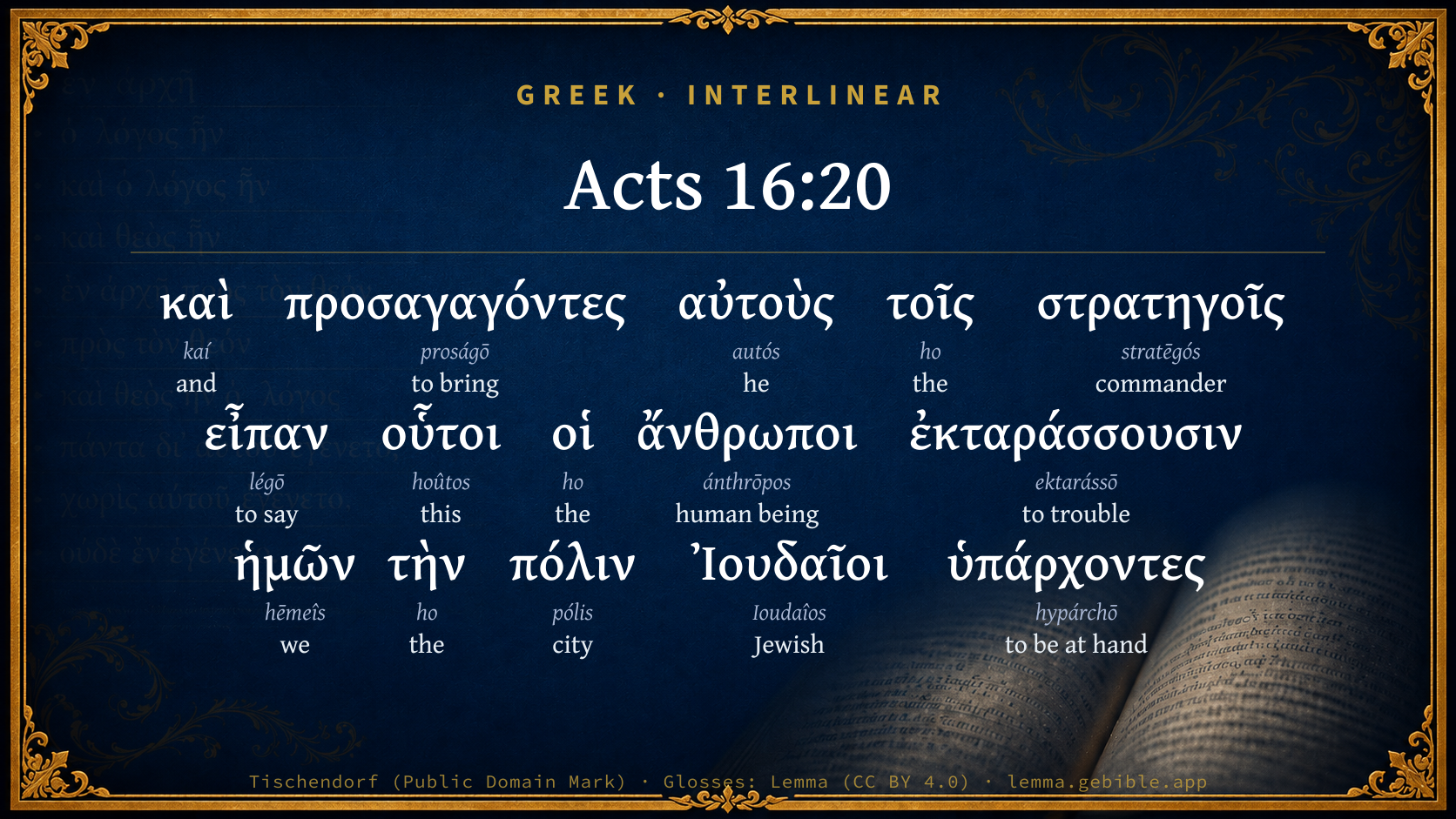
Greek (Tischendorf 8th ed.) Acts 16:20 appears in the Greek New Testament. The text above is from the Tischendorf 8th edition. Each word links to its Strong’s number and a concise gloss. Click any word for its full Thayer’s Greek Lexicon entry.
Download image
Cite this verse

Acts 16:20 (World English Bible). Public Domain. Lemma interlinear Bible study tool, https://lemma.gebible.app/v/acts/16/20.

Show BibTeX & RIS
BibTeX
RIS
English Translation
When they had brought them to the magistrates, they said, "These men, being Jews, are agitating our city,
World English Bible · Public Domain
Highlights
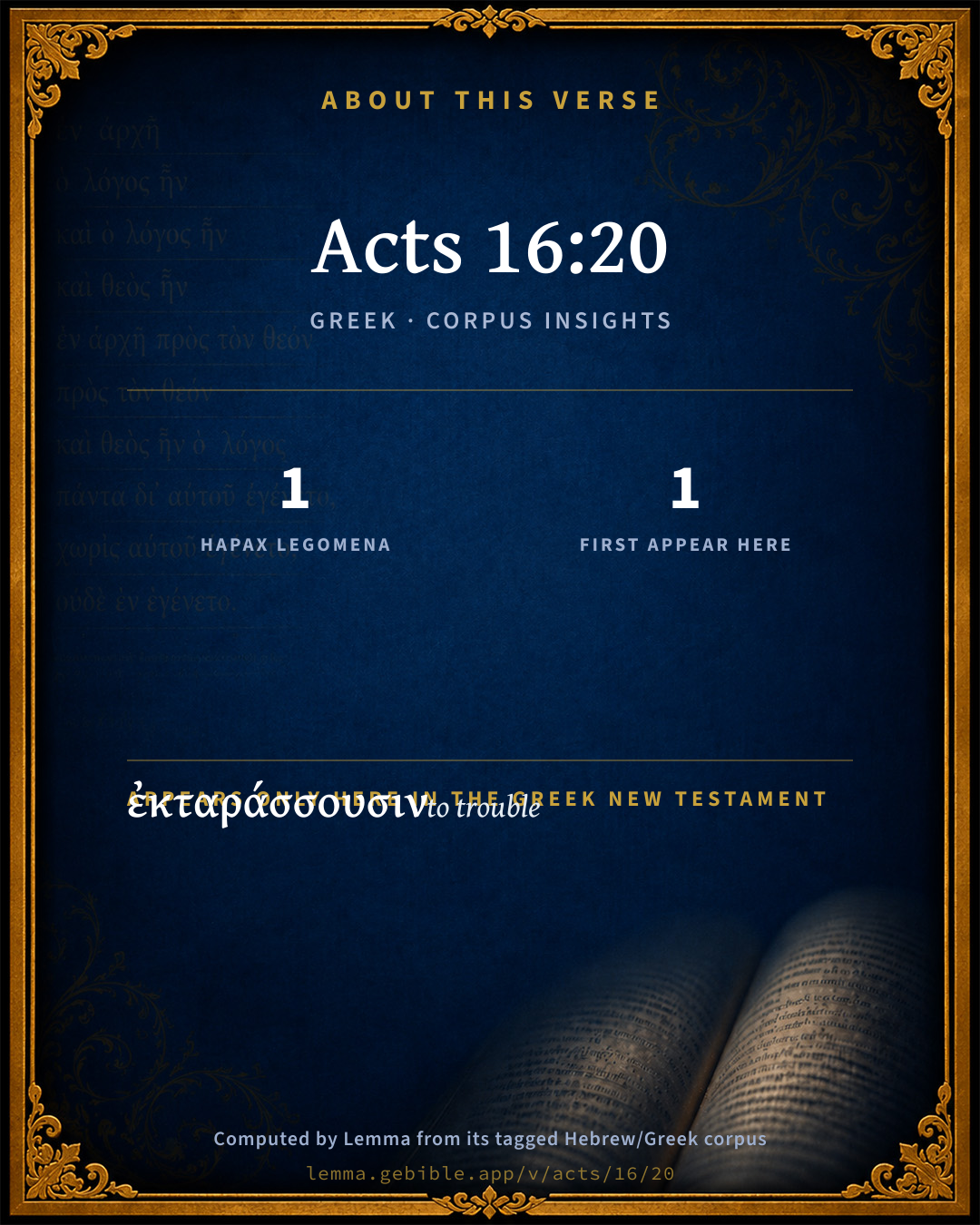
  • 1 hapax legomenon — only here in the Greek New Testament
  • 1 first appearance in the Greek New Testament
Full analysis ↓
Download a study sheet

One document with this verse’s original text, its word-by-word gloss line, the meaning frame, cross-references with their text, attributed commentary, and full source and license credits — printable, and it pastes into notes with its structure intact.

This verse Autodidact and up

Study sheet (.html) Plain text (.txt)

A passage Seminary Student

Up to 50 verses in one chapter. A passage sheet keeps up to 6 commentary sources and 12 cross-references per verse, in the order this page ranks them, and says so on the sheet whenever that leaves anything out. Ask for a single verse and you get the Autodidact verse sheet above.

Everything on this page stays free to read, with no account — the sheet is a download of what is already on screen, not access to it.

Want to remove ads? Support Godless Engineer
Compare translations 3

The same verse in 3 English versions, stacked beneath the original-language interlinear above. Click any original word for its lexicon entry.

Each is an independent rendering of the whole verse — the interlinear is not word-aligned to these translations.

Highlighted words mark where these versions differ — a whole-verse word diff, not a word-by-word alignment.

  • World English Bible Public Domain
    When they had brought them to the magistrates, they said, "These men, being Jews, are agitating our city,
  • King James Version Public Domain
    And brought them to the magistrates, saying, These men, being Jews, do exceedingly trouble our city,
  • unfoldingWord Literal Text CC BY-SA 4.0
    And having brought them to the magistrates, they said, “These men are greatly troubling our city, being Jews,

unfoldingWord Literal Text — © unfoldingWord, licensed CC BY-SA 4.0. Word-aligned USFM3 via Door43 (git.door43.org/unfoldingWord/en_ult).

Versions to compare (up to 4)

3 of 4 selected

Show all 19 translations

Every available English version of this verse, each an independent rendering of the whole verse.

  • World English Bible Public Domain
    When they had brought them to the magistrates, they said, "These men, being Jews, are agitating our city,
  • Berean Standard Bible Public Domain
    They brought them to the magistrates and said, “These men are Jews and are throwing our city into turmoil
  • Majority Standard Bible Public Domain
    They brought them to the magistrates and said, “These men are Jews and are throwing our city into turmoil
  • King James Version Public Domain
    And brought them to the magistrates, saying, These men, being Jews, do exceedingly trouble our city,
  • American Standard Version (1901) Public Domain
    and when they had brought them unto the magistrates, they said, These men, being Jews, do exceedingly trouble our city,
  • Revised Version (1885) Public Domain
    and when they had brought them unto the magistrates, they said, These men, being Jews, do exceedingly trouble our city,
  • Geneva Bible (1599) Public Domain
    And brought them to the gouernours, saying, These men which are Iewes, trouble our citie,
  • Douay-Rheims (1899) Public Domain
    And presenting them to the magistrates, they said: These men disturb our city, being Jews;
  • Young's Literal Translation Public Domain
    and having brought them to the magistrates, they said, `These men do exceedingly trouble our city, being Jews;
  • Literal Standard Version CC BY-SA 4.0
    and having brought them to the magistrates, they said, “These men being Jews exceedingly trouble our city;
  • Unlocked Literal Bible CC BY-SA 4.0
    When they had brought them to the magistrates, they said, “These men are stirring up our city. They are Jews.
  • unfoldingWord Literal Text CC BY-SA 4.0
    And having brought them to the magistrates, they said, “These men are greatly troubling our city, being Jews,
  • Darby Bible Public Domain
    and having brought them up to the praetors, said, These men utterly trouble our city, being Jews,
  • World Messianic Bible Public Domain
    When they had brought them to the magistrates, they said, “These men, being Jews, are agitating our city
  • Webster's Bible Public Domain
    And brought them to the magistrates, saying, These men, being Jews, do exceedingly trouble our city,
  • Free Bible Version CC BY-SA 4.0
    They brought them in front of the magistrates, and accused them: “These Jewish men are causing a great disturbance in our town,” they said.
  • Bible in Basic English Public Domain
    And when they had taken them before the authorities, they said, These men, who are Jews, are greatly troubling our town;
  • Text-Critical English NT CC BY 4.0
    After bringing them to the magistrates, they said, “These men are seriously disturbing our city. They are Jews,
  • Tyndale New Testament (1534) Public Domain
    and brought them to the officers sayinge: These men trouble oure cite which are Iewes

Literal Standard Version (2020), Covenant Press — licensed CC BY-SA 4.0. Text via the HelloAO Bible API (eBible.org). Unlocked Literal Bible (unfoldingWord) — licensed CC BY-SA 4.0. Text via the HelloAO Bible API (eBible.org). unfoldingWord Literal Text — © unfoldingWord, licensed CC BY-SA 4.0. Word-aligned USFM3 via Door43 (git.door43.org/unfoldingWord/en_ult). Free Bible Version, Dr. Jonathan Gallagher — licensed CC BY-SA 4.0. Text via the HelloAO Bible API (eBible.org).

Word by word

More ways to search: Search by grammar → Find every occurrence → Compare this word →

Practice this passage: Drill this verse → Learn its vocabulary →

ἐκταράσσουσιν
ektarássō
G1613
“to trouble”
Verb, Present, Active, Indicative, 3rd person, Plural
Part of Speech
Verb
Tense
Present
Voice
Active
Mood
Indicative
Person
3rd person
Number
Plural
Full Thayer's Definition

Origin: from G1537 and G5015

TDNT: None

1. to agitate, trouble, exceedingly
  1. καὶ kaí G2532 “and” Conjunction
  2. προσαγαγόντες proságō G4317 “to bring” Verb, Aorist, Active, Participle, Nominative, Plural, Masculine
  3. αὐτοὺς autós G846 “he” Personal pronoun, Accusative, Plural, Masculine
  4. τοῖς ho G3588 “the” Article, Dative, Plural, Masculine
  5. στρατηγοῖς stratēgós G4755 “commander” Noun, Dative, Plural, Masculine
  6. εἶπαν légō G3004 “to say” Verb, Aorist, Active, Indicative, 3rd person, Plural
  7. οὗτοι hoûtos G3778 “this” Demonstrative pronoun, Nominative, Plural, Masculine
  8. οἱ ho G3588 “the” Article, Nominative, Plural, Masculine
  9. ἄνθρωποι ánthrōpos G444 “human being” Noun, Nominative, Plural, Masculine
  10. ἡμῶν hēmeîs G2249 “we” Personal pronoun, 1st person, Genitive, Plural
  11. τὴν ho G3588 “the” Article, Accusative, Singular, Feminine
  12. πόλιν pólis G4172 “city” Noun, Accusative, Singular, Feminine
  13. Ἰουδαῖοι Ioudaîos G2453 “Jewish” Adjective, Nominative, Plural, Masculine
  14. ὑπάρχοντες hypárchō G5225 “to be at hand” Verb, Present, Active, Participle, Nominative, Plural, Masculine

About this verse

These counts appear in no published source. They are computed here, from the morphology-tagged text and Lemma’s own curated glosses. What Lemma adds →

15
words
13
distinct lemmas
Acts
section

Notable vocabulary

1 hapax legomenon — a word that appears only here in the entire Greek New Testament:

  • ἐκταράσσουσιν to trouble G1613

First appearance in Scripture

This word makes its first canonical appearance in the Greek New Testament here:

  • ἐκταράσσουσιν to trouble G1613

Shared distinctive vocabulary

προσαγαγόντες to bring G4317 occurs in 4 verses of the Greek New Testament. Also found in:

Repetition

A word recurs within this verse:

  • τοῖς the G3588 ×3

Cross-references

11

Topical passages linked to Acts 16:20 in the Treasury of Scripture Knowledge — connected by theme and wording, ordered by reader-vote popularity; previews shown in the World English Bible.

  • James 4:4 You adulterers and adulteresses, don't you know that friendship with the world is enmity with God? Whoever therefore wants to be a friend of the world makes himself an enemy of God.
  • John 15:18–20 If the world hates you, you know that it has hated me before it hated you.
  • Acts 28:22 But we desire to hear from you what you think. For, as concerning this sect, it is known to us that everywhere it is spoken against."
  • Romans 12:2 Don't be conformed to this world, but be transformed by the renewing of your mind, so that you may prove what is the good, well-pleasing, and perfect will of God.
  • 1 Kings 18:17–18 It happened, when Ahab saw Elijah, that Ahab said to him, Is it you, you troubler of Israel?
  • Ezra 4:12–15 Be it known to the king, that the Jews who came up from you are come to us to Jerusalem; they are building the rebellious and the bad city, and have finished the walls, and repaired the foundations.
  • Esther 3:8–9 Haman said to king Ahasuerus, There is a certain people scattered abroad and dispersed among the peoples in all the provinces of your kingdom; and their laws are diverse from [those of] every people; neither keep they the king's laws: therefore it is not for the king's profit to allow them.
  • Matthew 2:3 When Herod the king heard it, he was troubled, and all Jerusalem with him.
  • Acts 17:6–8 When they didn't find them, they dragged Jason and certain brothers before the rulers of the city, crying, "These who have turned the world upside down have come here also,
  • Acts 18:2 He found a certain Jew named Aquila, a man of Pontus by race, who had recently come from Italy, with his wife Priscilla, because Claudius had commanded all the Jews to depart from Rome. He came to them,
  • Acts 19:34 But when they perceived that he was a Jew, all with one voice for a time of about two hours cried out, "Great is Artemis of the Ephesians!"

Cross-references courtesy of OpenBible.info (CC BY 4.0).

Commentary

Notes on Acts 16:20 from classic Christian and Jewish commentators (each source and its license shown beneath its notes). The classic Christian expositions comment on the surrounding passage and are grouped to its opening verse, so a note may address several verses; the Jewish commentaries on the Tanakh (Rashi and others) are per-verse, so they appear only where the commentator wrote on this verse.

Lemma curates 59 commentaries, every one of them public domain or Creative Commons licensed, each selected and text-cleaned for this edition rather than reprinted as found. About our sources →

Bengel's Gnomon

Johann Albrecht Bengel

Act 16:20. Στρατηγοῖς, to the magistrates) These administered at once the civil and military power: however, they were inferior to the rulers, οἱ ἄρχοντες, Act 16:19, with which comp. Act 16:22, note [wherein it appears that these στρατηγοὶ, magistrates, stripped off the clothes of Paul, an act which the ἄρχοντες would not have been likely to have stooped to].—ἐκταράσσουσιν, exceedingly trouble) They mean to say, These men bring the city from (ἐκ) a state of peace into disturbances.—πόλιν, city) Their private interest was the real motive hidden beneath; the public interest is made the ostensible plea.—Ἰουδαῖοι, Jews) An invidious appellation [they employ it to excite odium against them]. The antithesis is Romans.

Bengel's Gnomon of the New Testament — English translation (T&T Clark, Edinburgh, 1860) — public domain. Text from a community e-Sword module.

Expositor's Greek Testament

ed. W. Robertson Nicoll

Act 16:20 . οὗτοι , contemptuously Ἰουδ . ὄντες : If the decree of Claudius expelling the Jews from Rome had been enacted, it would have easily inflamed the minds of the people and the magistrates at Philippi against the Jews ( cf. Act 18:2 , so Holtzmann). Of the bad odour in which the Jews were held we have also other evidences, cf. Cicero, Pro Flacco , xxviii.; Juvenal, xiv., 96 106. On the attitude of the Romans towards the Jews see Sanday and Headlam, Romans , p. xix. ff. It was of this intense feeling of hatred and contempt felt by Romans and Greeks alike that the masters of the maiden availed themselves: “causa autem alia atque prætextus caussæ,” Blass; the real cause was not a religious but a social and mercenary one, see above on Act 16:19 , and Ramsay, Church in the Roman Empire , p. 131; where the accusation was brought on purely religious grounds, as, e.g. , at Corinth, Act 18:13 , the Roman governor declined to be judge of such matters. ἐκταράσσουσιν : “exceedingly trouble” ( ἐκ ), cf. LXX, Psa 17:4 , 87:16, Wis 17:3-4 , see Hatch and Redpath, xviii., 7; Plut., Cor [295] , 19., more often in classical Greek, συνταράσσω .

[295] Corinth, Corinthian or Corinthians.

The Expositor's Greek Testament, edited by W. Robertson Nicoll (1897–1910) — public domain. Text from a community e-Sword module.

Geneva Bible (1599)

Geneva Bible translators

Covetousness pretendeth a desire of common peace and godliness.

Geneva Bible (1599) marginal notes — public domain. Text via Bolls.life.

Jamieson, Fausset & Brown

Robert Jamieson, A. R. Fausset & David Brown

These men, being Jews--objects of dislike, contempt, and suspicion by the Romans, and at this time of more than usual prejudice.

do exceedingly trouble our city--See similar charges, Act 17:6; Act 24:5; Kg1 18:17. There is some color of truth in all such accusations, in so far as the Gospel, and generally the fear of God, as a reigning principle of human action, is in a godless world a thoroughly revolutionary principle . . . How far external commotion and change will in any case attend the triumph of this principle depends on the breadth and obstinacy of the resistance it meets with.

Jamieson, Fausset & Brown — Commentary Critical and Explanatory on the Whole Bible (1871) — public domain (CC PDM 1.0). Text via the HelloAO Bible API.

Adam Clarke's Commentary

Verse 20. Brought them to the magistrates] στρατηγοις, The commanders of the army, who, very likely, as this city was a Roman colony, possessed the sovereign authority. The civil magistrates, therefore, having heard the case, as we shall soon find, in which it was pretended that the safety of the state was involved, would naturally refer the business to the decision of those who had the supreme command.

Exceedingly trouble our city] They are destroying the public peace, and endangering the public safety.

Adam Clarke's Commentary on the Bible (1810–1826) — public domain. Text from a community e-Sword/MySword module.

John Calvin's Commentaries

20. These men trouble our city. This accusation was craftily composed to burden the servants of Christ. For on the one side they pretend the name of the Romans, than which nothing was more favorable; on the other, they purchase hatred, and bring them in contempt, by naming the Jews, which name was at that time infamous; for, as touching religion, the Romans were more like to any than to the Jewish nation. For it was lawful for a man which was a Roman to do sacrifice either in Asia or in Grecia, or in any other country where were idols and superstitions. I warrant you Satan did agree with himself very well, though he put on divers shapes, but that which was religion only, than which there was no other in the world, was counted among the Romans detestable. They frame a third accusation out of the crime of sedition; for they pretend that the public peace is troubled by Paul and his company. In like sort was Christ brought in contempt, (Luke 23:5) and even at this day the Papists have no more plausible thing wherewith they may bring us to be hated, than when they cry that our doctrine tendeth to no other end but to confusion of all things. But we must valiantly contemn this filthy and false infamy as did Christ and Paul, until the Lord bring to light the malice of our enemies, and refute their impudence.

John Calvin's Commentaries (1540-1563) — public domain. Text from the Calvin Translation Society English edition (1840s-50s) via the Christian Classics Ethereal Library (ccel.org). Calvin's coverage is partial (roughly two-thirds of the Bible); uncommented books and verses are honest gaps, never fabricated. The 19th-century editor's footnotes and remarks are omitted so the notes are faithfully Calvin's own voice.

Ellicott's Commentary for English Readers

(20) The magistrates.—The Greek word used (Stratêgi, literally, generals—the name survived in 1750 in the Italian Stradigo, used of the prefect of Messina) is used with St. Luke’s usual accuracy, for the prætors, or duumviri, who formed the executive of the Roman colonia.

These men, being Jews.—We must remember that the decree of Claudius (see Note on Act_18:2), banishing the Jews from Rome on account of their disturbing that city, would be known, and probably acted on, at Philippi (see Notes on Act_16:12-13), and would give a special force to the accusation. Here, also, there is something specially characteristic of the nature of many of the early persecutions. Christians were exposed, on the one hand, to the relentless enmity of the Jews, and, on the other, they were identified by heathen rulers and mobs with the Jews, and so came in, where the latter were the objects of popular antipathy, for a two-fold measure of suffering.

A Bible Commentary for English Readers, edited by Charles John Ellicott (1878–1897) — public domain. Text from a community e-Sword module.

The Cambridge Bible for Schools and Colleges

gen. ed. J. J. S. Perowne

20. and brought them to the magistrates] These strategoi were the duumviri, the two praetors specially appointed to preside over the administration of justice, in cases where there was no appeal to Rome, in the municipia and colonies of the Romans. The title in the Greek seems to indicate somewhat of a military authority, which could administer summary punishment.

being Jews] On the ways in which Roman aversion was aroused and exhibited towards the Jews, for their religious exclusiveness, see Mayor, Juvenal, xiv. 96–106 notes, with the authorities there given.

do exceedingly trouble] Only found here in the N. T. The kind of trouble is indicated Act_17:6, “These that have turned the world upside down” is their description.

The Cambridge Bible for Schools and Colleges (gen. ed. J. J. S. Perowne; Cambridge University Press, 1878–1918) — public domain. Text from a community e-Sword module.

John Gill's Exposition

And brought them to the magistrates,.... The same as before; wherefore the Syriac version omits them there, and reads them both together here, calling them the magistrates and chief men of the city; though the word here used, properly signifies military captains, captains of the Roman militia: but that they were the same with the Decuriones, or ten men before mentioned, appears from what Harpocratian says (k), that every year were chosen "ten magistrates", the word here used:

saying, these men being Jews, do exceedingly trouble our city; they call Paul and Silas Jews, either because they knew them to be so, or because they attended at the Jewish oratory, or place of worship; and it was common with the Romans to call the Christians Jews; they were generally included in the same name; and this name of the Jews was become very odious with the Romans; a little after this, Claudius commanded them, the Jews, to depart from Rome, Act 18:2 they were commonly looked upon as a troublesome and seditious sort of people, and indeed this was the old charge that was fastened upon them, Ezr 4:15. So that it was enough to say that Paul and Silas were Jews, to prove them to be disturbers of the public peace: and it is to be observed, that their accusers make no mention of the dispossessing of the maid, who was their private property, and which was a private affair; but pretend a concern for the public welfare, and bring a charge of public disturbance and detriment, to which their malice and revenge prompted them, hoping in this way the better to succeed: the Arabic version reads, "these two men trouble our city, and they are both Jews".

(k) Lexicon, p. 274.

John Gill's Exposition of the Whole Bible (1746–1763) — public domain (CC PDM 1.0). Text via the HelloAO Bible API.

Trapp's Complete Commentary

John Trapp

20 And brought them to the magistrates, saying, These men, being Jews, do exceedingly trouble our city,

Ver. 20. Trouble our city] Faithful preachers have ever been by the wicked accounted trouble towns; these covetous caitiffs (wretches) had not so much ingenuity as the devil himself, Act 16:17.

John Trapp, A Commentary or Exposition upon All the Books of the Old and New Testament (1647–1656) — public domain. Text from a community e-Sword module.

Albert Barnes' Notes on the Bible

And brought them to the magistrates - To the military rulers στρατηγοῖς stratēgois or praetors. Philippi was a Roman colony, and it is probable that the officers of the army exercised the double function of civil and military rulers.

Do exceedingly trouble our city - In what way they did it they specify in the next verse. The charge which they wished to substantiate was that of being disturbers of the public peace. All at once they became conscientious. They forgot the subject of their gains, and were greatly distressed about the violation of the laws. There is nothing that will make people more hypocritically conscientious than to denounce, and detect, and destroy their unlawful and dishonest practices. People who are thus exposed become suddenly filled with reverence for the Law or for religion, and they who have heretofore cared nothing for either become greatly alarmed lest the public peace should be disturbed. People slumber quietly in sin, and pursue their wicked gains; they hate or despise all law and all forms of religion; but the moment their course of life is attacked and exposed, they become full of zeal for laws that they Would not themselves hesitate to violate, and for the customs of religion which in their hearts they thoroughly despise. Worldly-minded people often thus complain that their neighborhoods are disturbed by revivals of religion; and the preaching of the truth, and the attacking of their vices, often arouses this hypocritical conscientiousness, and makes them alarmed for the laws, and for religion, and for order, which they at other times are the first to disturb and disregard.

Albert Barnes' Notes on the Bible (1834–1885) — public domain. Text from a community e-Sword/MySword module.

Haydock's Catholic Bible Commentary

Jews. this was the name the first Christians went by among the pagans. Indeed our Saviour’s being born of that nation, and his disciples adoring the same God, and following the same morality and Scriptures as the Jews, were sufficient reasons to make them confounded. When Suetonius relates that Claudius banished the Jews from Rome, he means the Christians. (Calmet)

George Leo Haydock (1774–1849), Haydock's Catholic Family Bible and Commentary, 1859 edition — public domain. Excludes Psalms (Douay-Rheims chapter numbering differs from Protestant) and Deuterocanonical books (Catholic canon only).

Matthew Poole's English Annotations

Magistrates, the same who are called rulers; and the word here shows, that they were under the power of the sword, and ruled by the Romans; though the rulers spoken of in the former verse might be the civil magistrates of the city, and the magistrates here mentioned might be the commanders of the forces therein. They carried them, as they did our Saviour, from one to the other, the more to disgrace them, and to obtain the greater punishment for them. They mention their

being Jews, because it was a most odious name unto all men, by reason of their different opinions in religion, and diversity of manners in conversation from all.

Matthew Poole's English Annotations on the Holy Bible (1683–1685) — public domain. Text from a community e-Sword/MySword module.

Whedon's Commentary on the Bible

Daniel D. Whedon

20. Magistrates—The pretors, for so the duumviri, or twin magistrates, claimed to be called. Saying—It was difficult to frame a charge against them. Had a pig been stolen from them there was law in their behalf, but no compensation for a lost demon. To have restored the unhappy maid from her unhappy condition—fit emblem of the salvation she ascribed to them—was a beneficent deed which Roman justice could adjudge to be no crime.

These men—But a mob, with a magistrate to match, will be at no loss for a charge against their common victim.

Being Jews… being Romans— Here is an antithesis amply sufficient to start a temper, and the deeds will easily be supplied with a pretext. The Jews had lately been expelled from Rome as troublers of that city; and why should not this proud little Macedonian image of Rome enact the same measure?

Daniel D. Whedon (gen. ed.), Commentary on the Old and New Testaments (1874–1909) — public domain. Text from a community e-Sword module.

The Pulpit Commentary

When they had brought for brought, A.V.; unto for to, A.V.; they said for saying, A.V. The magistrates; strathgoi, i.e. the praetors. Philippi, being a colony, was governed by Roman magistrates called duumviri, corresponding to the two consuls at Rome. But we learn from Cicero that in his time the duuraviri in the colonies were beginning to be called praetors, a little previously used only at Rome ("De Leg. Agrar.," 34), and to be preceded by lictors (rJabdoucaoi of ver. 35). Two inscriptions have been found in which the duumviri of Philippi are mentioned (Lewin, p. 26).

The Pulpit Commentary (1880–1919), ed. H.D.M. Spence-Jones & Joseph S. Exell — public domain. Text from a community e-Sword module.

John Wesley's Explanatory Notes

Being Jews - A nation peculiarly despised by the Romans.

John Wesley, Explanatory Notes Upon the Whole Bible (1754–1765) — public domain. Text via the GEBible commentary corpus.

Scofield Reference Notes

C. I. Scofield

magistrates

(Greek - Α ," Roman magistrates).

The Scofield Reference Bible (1917 edition), notes by C. I. Scofield — public domain. Text from a community e-Sword module.

McGarvey & Pendleton's Commentaries

J. W. McGarvey

See notes on verse 19

J. W. McGarvey (with Philip Y. Pendleton), Commentaries on the New Testament (The Fourfold Gospel, 1914; Acts; and the epistles) — public domain. Text from a community e-Sword/MySword module.

Cambridge Greek Testament for Schools and Colleges

20. προσαγαγόντες αὐτοὺς τοῖς στρατηγοῖς, having brought them to the magistrates. These στρατηγοί were the duumviri, the two prætors specially appointed to preside over the administration of justice, in cases where there was no appeal to Rome, in the municipia and coloniæ of the Romans. The title στρατηγοί seems to indicate somewhat of a military authority, which could administer summary punishment.

ἐκταράσσουσιν, do exceedingly trouble. Only used here in N.T. In the LXX. it is twice found of terror arising from visions (Wis 17:3; Wis 18:17 φαντασίαι μὲν ὀνείρων δεινῶς ἐξετάραξαν αὐτούς). Also in Psa 17:5; Psa 87:7, of the trouble caused by floods of ungodliness, and by the terrors of the Lord. The kind of trouble spoken of in the text is seen from Act 17:6. ‘These that have turned the world upside down’ is the description of the preachers.

Ἰουδαῖοι ὑπάρχοντες, being Jews. On the ways in which Roman aversion was aroused and exhibited towards the Jews, for their religious exclusiveness, see Mayor Juvenal XIV. 96–106 notes, with the authorities there given. Jew-baiting is no modern invention.

Cambridge Greek Testament for Schools and Colleges (Cambridge University Press, 1896; 21 vols, various authors incl. Carr, Maclear, Plummer, Farrar, Lumby, Moule, M. R. James, Simcox) — public domain. Text from a community e-Sword module.

Alford’s Greek Testament

Henry Alford

20. στρατηγοῖς] The Duumviri of the colony, of whom at Capua Cicero says, ‘cum in cæteris coloniis Duumviri appellentur, hi se Prætores (στρατηγούς) appellari volebant.’ De Leg. Agr. c. 34. ‘Messinenses,’ says Wetstein, ‘etiam nunc (cir. 1750) Prætorem sive Præfectum urbis Stradigo appellant.’ The name, as a rendering of Prætor, had come from the Greek title of similar magistrates: so Aristotle, Politic. vii. 3, ἐν ταῖς μικραῖς πόλεσι μία περὶ πάντων (ἀρχή)· καλοῦσι δὲ στρατηγοὺς καὶ πολεμάρχους.

Ἰουδ. ὑπάρχοντες.… Ῥωμ. οὖσιν] The distinction between ὑπάρχων and ὤν seems to be, that the former is used of something which the speaker or narrator wishes to put forward into notice, either as unknown to his reader or hearer, or in some way to be marked by him for praise or blame: whereas the latter refers to facts known and recognized, and taken for granted by both. Thus, we may notice that, when the fact of Paul and Silas being Romans is announced to the jailor, it is not ἀνθ. Ῥωμαίους ὄντας, but ὑπάρχοντας; whereas here, both parties, the speakers and the addressed, being indisputably Romans, we have Ῥωμαίοις οὖσιν. The account of this may be, that ὑπάρχω is predicated of something of which the speaker informs the hearer, some prior knowledge which he possessed and now imparts,—εἰμί being predicated of the bare matter of fact. See ch. 17:27, 29; 21:20 (for both); 22:3; Gal 2:14 al., for ὑπάρχων: and for ὤν, Joh 3:4; Joh 4:9 bis; Rom 5:10 al.

‘Versute composita fait hæc criminatio ad gravandos Christi servos: nam ab una parte obtendunt Romanum nomen, quo nihil erat magis favorabile; rursum ex nomine Judaico, quod tunc infame erat (especially if the decree of Claudius, expelling them from Rome, ch. 18:2, had at this time been enacted) conflant illis invidiam: nam, quantum ad religionem, plus habebant Romani affinitatis cum aliis quibuslibet, quam cum gente Judaica.’ Calvin.

20.

20.

Another irregularity had been committed by the duumviri, in scourging them uncondemned: ‘causa cognita multi possunt absolvi: incognita quidem condemnari nemo potest.’ Cic. in Verr. i. 9. ‘Inauditi et indefensi tanquam innocenter perierant.’ Tac. Hist. ii. 10.

ἑκβάλλ.] are they thrusting us out? It does not follow, because ἐκβάλλω has no such sense in ch. 9:40, &c., that therefore it has not here. The circumstances must determine; which here seem to require this sense: the ἐκβάλλειν λάθρα having a tinge of degradation in it, as if said of casting out that of which one is ashamed.

οὐ γάρ] An elliptical answer to a question or position, the negative of which is self-evident: see Hartung, Partikellehre, ii. p. 48: Kühner, Gramm. § 741. 6: Hermann on Viger, p. 462. When it occurs with ἀλλά, it is best written without a stop between: cf. Aristoph. Ran. 58: μὴ σκῶπτέ μʼ, ὦ ʼδέλφʼ· οὐ γὰρ ἀλλʼ ἔχω κακῶς:—ib. 193: μὰ τὸν Δίʼ οὐ γὰρ (scil. νεναυμάχηκα) ἀλλʼ ἔτυχον ὀφθαλμιῶν, and 499, φέρε δὴ ταχέως αὔτʼ· οὐ γὰρ ἀλλὰ πειστέον.

Mr. Humphry remarks, ‘St. Paul submitted to be scourged by his own countrymen (five times, 2Co 11:24): for, though he might have pleaded his privilege as a Roman, to the Jews he “became as a Jew,” observing their ceremonies, and submitting to their law.’

Henry Alford, The Greek Testament (1849–1861) — public domain. Text from a community e-Sword module.

Vincent's Word Studies in the New Testament

Marvin R. Vincent

Magistrates [στρατηγοις] . Their usual name was duumviri answering to the consuls of Rome; but they took pride in calling themselves strathgoi, or praetors, as being a more honorable title. This is the only place in the Acts where Luke applies the term to the rulers of a city. See Introduction to Luke.

Jews. Who at this time were in special disgrace, having been lately banished from Rome by Claudius (see Act 18:2). The Philippians do not appear to have recognized the distinction between Christians and Jews.

Marvin R. Vincent, Word Studies in the New Testament (1887–1900) — public domain. Text from a community e-Sword/MySword module.

Lesson kit

Teaching starters — assembled from the data on this page, not authored interpretation. Every prompt links to the verse data it draws on. Edit before teaching.

Acts, in the Acts, opens this verse with 15 words (13 distinct Greek lemmas). Its most distinctive word is ektarássō (“to trouble”). A historical commentator’s framing appears above. Read the whole chapter for the surrounding context.

Discussion questions

  1. The word ektarássō carries the sense “to trouble.” How does it shape the verse?
  2. This verse holds 1 word here found nowhere else in the Greek New Testament. What might the rare word draw attention to?
  3. The word “to trouble” first appears here in Scripture. What is being introduced at this debut?
  4. Luke 9:41 shares the word «to bring» with this verse. How do the two illuminate each other?
  5. “the” occurs 3× in this one verse. What is the effect of the repetition?
  6. The translations on this page render this verse differently — a whole-verse word diff, not a word-by-word alignment. What might account for the different wordings?
  7. Reading how Bengel's Gnomon and Expositor's Greek Testament read this verse, where do the two commentators agree and where do they part?

Things to notice

  • 1 word in this verse appears nowhere else in the Greek New Testament.
  • 1 word makes its first canonical appearance in Scripture here.
  • These translations choose different wording for 11 words in this verse.
  • “the” occurs 3× in this single verse.
  • 13 distinct Greek lemmas span 15 words in this verse.

Reading settings

Reading text

Shown beneath each verse's original-language words.

Old Testament
Old Testament edition

Read the OT as the Masoretic Hebrew (MT) or the Greek Septuagint (LXX).

English shown for the Greek Septuagint (in the Hebrew ↔ Greek comparison).

Comparing translations? Open the Compare panel on any verse page to stack up to four side by side.