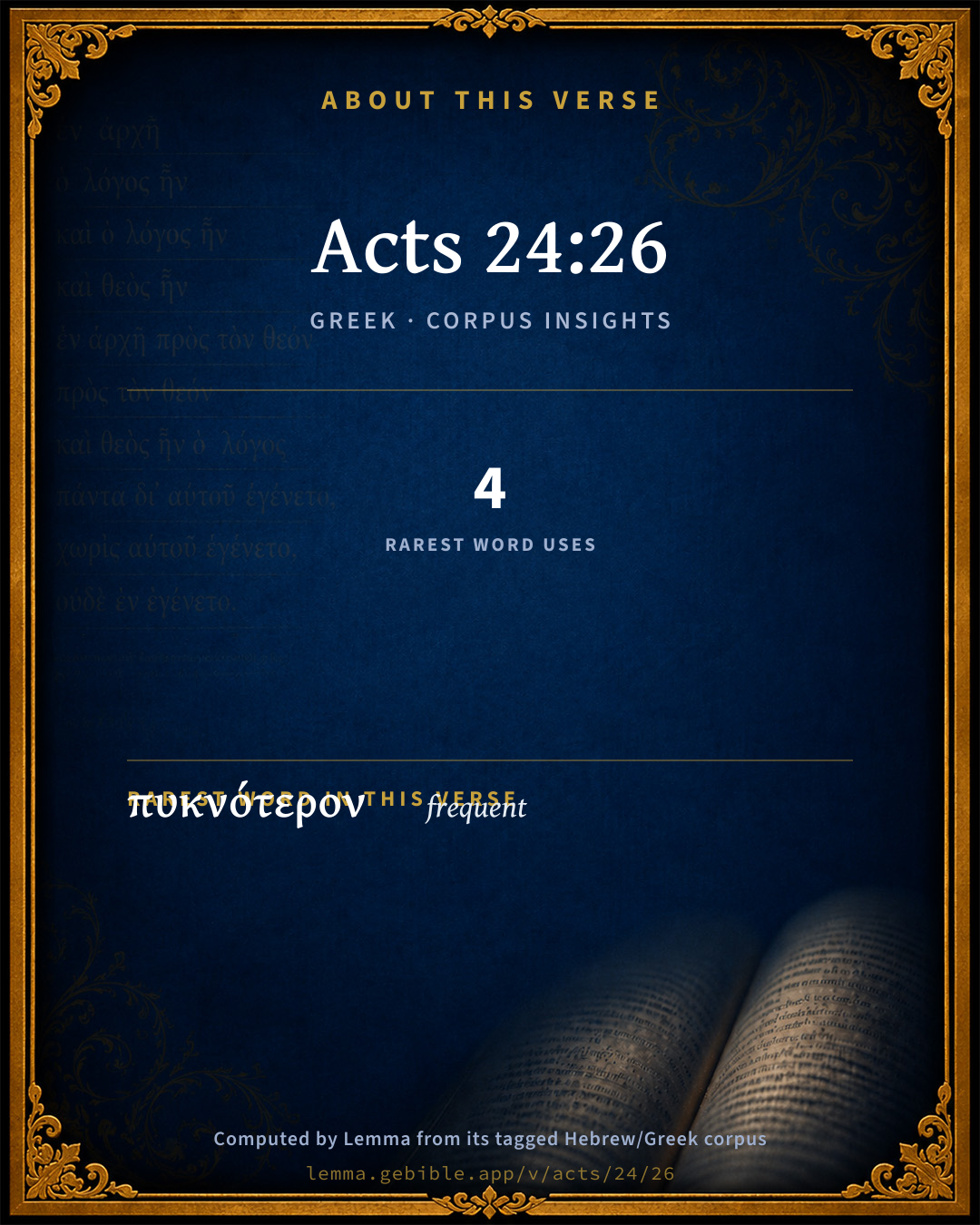
Acts 24:26

Greek (Tischendorf 8th ed.) Acts 24:26 appears in the Greek New Testament. The text above is from the Tischendorf 8th edition. Each word links to its Strong’s number and a concise gloss. Click any word for its full Thayer’s Greek Lexicon entry.

Download image
Cite this verse

Acts 24:26 (World English Bible). Public Domain. Lemma interlinear Bible study tool, https://lemma.gebible.app/v/acts/24/26.

Show BibTeX & RIS
BibTeX
RIS
English Translation
Meanwhile, he also hoped that money would be given to him by Paul, that he might release him. Therefore also he sent for him more often, and talked with him.
World English Bible · Public Domain
Download a study sheet

One document with this verse’s original text, its word-by-word gloss line, the meaning frame, cross-references with their text, attributed commentary, and full source and license credits — printable, and it pastes into notes with its structure intact.

This verse Autodidact and up

Study sheet (.html) Plain text (.txt)

A passage Seminary Student

Up to 50 verses in one chapter. A passage sheet keeps up to 6 commentary sources and 12 cross-references per verse, in the order this page ranks them, and says so on the sheet whenever that leaves anything out. Ask for a single verse and you get the Autodidact verse sheet above.

Everything on this page stays free to read, with no account — the sheet is a download of what is already on screen, not access to it.

Want to remove ads? Support Godless Engineer
Compare translations 3

The same verse in 3 English versions, stacked beneath the original-language interlinear above. Click any original word for its lexicon entry.

Each is an independent rendering of the whole verse — the interlinear is not word-aligned to these translations.

Highlighted words mark where these versions differ — a whole-verse word diff, not a word-by-word alignment.

  • World English Bible Public Domain
    Meanwhile, he also hoped that money would be given to him by Paul, that he might release him. Therefore also he sent for him more often, and talked with him.
  • King James Version Public Domain
    He hoped also that money should have been given him of Paul, that he might loose him: wherefore he sent for him the oftener, and communed with him.
  • unfoldingWord Literal Text CC BY-SA 4.0
    also hoping at the same time that money would be given to him by Paul, and therefore summoning him often, he was speaking with him.

unfoldingWord Literal Text — © unfoldingWord, licensed CC BY-SA 4.0. Word-aligned USFM3 via Door43 (git.door43.org/unfoldingWord/en_ult).

Versions to compare (up to 4)

3 of 4 selected

Show all 19 translations

Every available English version of this verse, each an independent rendering of the whole verse.

  • World English Bible Public Domain
    Meanwhile, he also hoped that money would be given to him by Paul, that he might release him. Therefore also he sent for him more often, and talked with him.
  • Berean Standard Bible Public Domain
    At the same time, he was hoping that Paul would offer him a bribe. So he sent for Paul frequently and talked with him.
  • Majority Standard Bible Public Domain
    At the same time, he was hoping that Paul would offer him a bribe to release him. So he sent for Paul frequently and talked with him.
  • King James Version Public Domain
    He hoped also that money should have been given him of Paul, that he might loose him: wherefore he sent for him the oftener, and communed with him.
  • American Standard Version (1901) Public Domain
    He hoped withal that money would be given him of Paul: wherefore also he sent for him the oftener, and communed with him.
  • Revised Version (1885) Public Domain
    He hoped withal that money would be given him of Paul: wherefore also he sent for him the oftener, and communed with him.
  • Geneva Bible (1599) Public Domain
    Hee hoped also that money shoulde haue bene giuen him of Paul, that he might loose him: wherefore hee sent for him the oftner, and communed with him.
  • Douay-Rheims (1899) Public Domain
    Hoping also withal, that money should be given him by Paul; for which cause also oftentimes sending for him, he spoke with him.
  • Young's Literal Translation Public Domain
    and at the same time also hoping that money shall be given to him by Paul, that he may release him, therefore, also sending for him the oftener, he was conversing with him;
  • Literal Standard Version CC BY-SA 4.0
    and at the same time also hoping that money will be given to him by Paul, that he may release him, therefore, also sending for him often, he was conversing with him;
  • Unlocked Literal Bible CC BY-SA 4.0
    At the same time he wanted Paul to give money to him, so he often sent for him and spoke with him.
  • unfoldingWord Literal Text CC BY-SA 4.0
    also hoping at the same time that money would be given to him by Paul, and therefore summoning him often, he was speaking with him.
  • Darby Bible Public Domain
    hoping at the same time that money would be given him by Paul: wherefore also he sent for him the oftener and communed with him.
  • World Messianic Bible Public Domain
    Meanwhile, he also hoped that money would be given to him by Paul, that he might release him. Therefore also he sent for him more often and talked with him.
  • Webster's Bible Public Domain
    He hoped also that money would have been given him by Paul, that he might loose him: wherefore he sent for him the oftener, and communed with him.
  • Free Bible Version CC BY-SA 4.0
    Hoping that Paul would give him a bribe, Felix often sent for Paul and talked with him.
  • Bible in Basic English Public Domain
    For he was hoping that Paul would give him money: so he sent for him more frequently and had talk with him.
  • Text-Critical English NT CC BY 4.0
    At the same time he was hoping that Paul would give him money, so that he might release him. So he would send for Paul quite often and converse with him.
  • Tyndale New Testament (1534) Public Domain
    He hoped also that money shuld have bene geven him of Paul that he myght lowse him: wherfore he called him the oftener and comened with him.

Literal Standard Version (2020), Covenant Press — licensed CC BY-SA 4.0. Text via the HelloAO Bible API (eBible.org). Unlocked Literal Bible (unfoldingWord) — licensed CC BY-SA 4.0. Text via the HelloAO Bible API (eBible.org). unfoldingWord Literal Text — © unfoldingWord, licensed CC BY-SA 4.0. Word-aligned USFM3 via Door43 (git.door43.org/unfoldingWord/en_ult). Free Bible Version, Dr. Jonathan Gallagher — licensed CC BY-SA 4.0. Text via the HelloAO Bible API (eBible.org).

Word by word

More ways to search: Search by grammar → Find every occurrence → Compare this word →

Practice this passage: Drill this verse → Learn its vocabulary →

πυκνότερον
pyknós
G4437
“frequent”
Adjective, Accusative, Singular, Neuter, Comparative
Part of Speech
Adjective
Case
Accusative
Number
Singular
Gender
Neuter
Degree
Comparative
Full Thayer's Definition

Origin: from the same as G4635

TDNT: None

1. thick, dense, compact a. in reference to time 1. frequently, often, recurring b. vigorously, diligently c. often, more frequently, the oftener
  1. ἅμα háma G260 “together” Adverb
  2. καὶ kaí G2532 “and” Conjunction
  3. ἐλπίζων elpízō G1679 “to hope” Verb, Present, Active, Participle, Nominative, Singular, Masculine
  4. ὅτι hóti G3754 “that” Conjunction
  5. χρήματα chrēma G5536 “thing” Noun, Accusative, Plural, Neuter
  6. δοθήσεται dídōmi G1325 “to give” Verb, Future, Passive, Indicative, 3rd person, Singular
  7. αὐτῷ autós G846 “he” Personal pronoun, Dative, Singular, Masculine
  8. ὑπὸ hypó G5259 “under” Preposition
  9. τοῦ ho G3588 “the” Article, Genitive, Singular, Masculine
  10. Παύλου Paûlos G3972 “Paul” Noun, Genitive, Singular, Masculine
  11. διὸ dió G1352 “wherefore” Conjunction
  12. καὶ kaí G2532 “and” Conjunction
  13. αὐτὸν autós G846 “he” Personal pronoun, Accusative, Singular, Masculine
  14. μεταπεμπόμενος metapémpō G3343 “to send for” Verb, Present, Middle or Passive deponent, Participle, Nominative, Singular, Masculine
  15. ὡμίλει homiléō G3656 “to associate with” Verb, Imperfect, Active, Indicative, 3rd person, Singular
  16. αὐτῷ autós G846 “he” Personal pronoun, Dative, Singular, Masculine

About this verse

These counts appear in no published source. They are computed here, from the morphology-tagged text and Lemma’s own curated glosses. What Lemma adds →

17
words
14
distinct lemmas
Acts
section

Notable vocabulary

The rarest word here is πυκνότερον frequent G4437 — appearing just 4 times in the whole Greek New Testament.

Shared distinctive vocabulary

πυκνότερον frequent G4437 occurs in 4 verses of the Greek New Testament. Also found in:

Repetition

Words recur within this verse:

  • αὐτῷ he G846 ×3
  • καὶ and G2532 ×2

Cross-references

28

Topical passages linked to Acts 24:26 in the Treasury of Scripture Knowledge — connected by theme and wording, ordered by reader-vote popularity; previews shown in the World English Bible.

  • Proverbs 17:23 A wicked man receives a bribe in secret, To pervert the ways of justice.
  • 1 Timothy 6:9–10 But those who are determined to be rich fall into a temptation and a snare and many foolish and harmful lusts, such as drown men in ruin and destruction.
  • Exodus 23:8 You shall take no bribe, for a bribe blinds those who have sight and perverts the words of the righteous.
  • Deuteronomy 16:19 You shall not wrest justice: you shall not respect persons; neither shall you take a bribe; for a bribe does blind the eyes of the wise, and pervert the words of the righteous.
  • 1 Samuel 8:3 His sons didn't walk in his ways, but turned aside after lucre, and took bribes, and perverted justice.
  • 1 Samuel 12:3 Here I am: witness against me before Yahweh, and before his anointed: whose ox have I taken? or whose donkey have I taken? or whom have I defrauded? whom have I oppressed? or of whose hand have I taken a ransom to blind my eyes therewith? and I will restore it you.
  • 2 Chronicles 19:7 Now therefore let the fear of Yahweh be on you; take heed and do it: for there is no iniquity with Yahweh our God, nor respect of persons, nor taking of bribes.
  • Job 15:34 For the company of the godless shall be barren, And fire shall consume the tents of bribery.
  • Psalms 26:9–10 Don't gather my soul with sinners, Nor my life with bloodthirsty men;
  • Proverbs 17:8 A bribe is a precious stone in the eyes of him who gives it; Wherever he turns, he prospers.
  • Proverbs 19:6 Many will entreat the favor of a ruler, And everyone is a friend to a man who gives gifts.
  • Proverbs 29:4 The king by justice makes the land stable, But he who takes bribes tears it down.
  • Isaiah 1:23 Your princes are rebellious, and companions of thieves. Everyone loves bribes, and follows after rewards. They don't judge the fatherless, Neither does the cause of the widow come to them.
  • Isaiah 33:15 He who walks righteously, and speaks blamelessly; he who despises the gain of oppressions, who shakes his hands from taking a bribe, who stops his ears from hearing of blood, and shuts his eyes from looking on evil:
  • Isaiah 56:11 Yes, the dogs are greedy, they can never have enough; and these are shepherds who can't understand: they have all turned to their own way, each one to his gain, from every quarter.
  • Ezekiel 22:27 Her princes in the midst of it are like wolves ravening the prey, to shed blood, [and] to destroy souls, that they may get dishonest gain.
  • Ezekiel 33:31 They come to you as the people comes, and they sit before you as my people, and they hear your words, but don't do them; for with their mouth they show much love, but their heart goes after their gain.
  • Hosea 4:18 Their drink has become sour. They play the prostitute continually. Her rulers dearly love their shameful way.
  • Hosea 12:7–8 A merchant has dishonest scales in his hand. He loves to defraud.
  • Amos 2:6–7 Thus says Yahweh: "For three transgressions of Israel, yes, for four, I will not turn away its punishment; Because they have sold the righteous for silver, And the needy for a pair of shoes;
  • Micah 3:11 Her leaders judge for bribes, And her priests teach for a price, And her prophets of it tell forturnes for money: Yet they lean on Yahweh, and say, Isn't Yahweh in the midst of us? No disaster will come on us.
  • Micah 7:3 Their hands are on that which is evil to do it diligently. The ruler and judge ask for a bribe; And the powerful man dictates the evil desire of his soul. Thus they conspire together.
  • Acts 24:2–3 When he was called, Tertullus began to accuse him, saying, "Seeing that by you we enjoy much peace, and that excellent measures are coming to this nation,
  • Acts 24:17 Now after some years, I came to bring gifts for the needy to my nation, and offerings;
  • 1 Corinthians 6:9 Or don't you know that the unrighteous will not inherit the Kingdom of God? Don't be deceived. Neither the sexually immoral, nor idolaters, nor adulterers, nor male prostitutes, nor homosexuals,
  • Ephesians 5:5–6 Know this for sure, that no sexually immoral person, nor unclean person, nor covetous man, who is an idolater, has any inheritance in the Kingdom of Christ and God.
  • 2 Peter 2:3 In covetousness they will exploit you with deceptive words: whose sentence now from of old doesn't linger, and their destruction will not slumber.
  • 2 Peter 2:14–15 having eyes full of adultery, and who can't cease from sin; enticing unsettled souls; having a heart trained in greed; children of cursing;

Cross-references courtesy of OpenBible.info (CC BY 4.0).

Where the printed editions differ

1 variant

Places in this verse where the major printed Greek editions disagree on the wording in a way that affects the translation — a comparison of editions, not a manuscript-by-manuscript collation. The editions are the modern critical texts (Nestlé-Aland 28/27, SBL, Westcott-Hort, Tregelles, Tyndale House) and the traditional texts behind the KJV (the Textus Receptus and the Byzantine/Majority text). It is not a claim about which reading is original.

  1. Extra text
    ὅπως λύσῃ αὐτόν,

    “so that may release him”

    In TRByz Not in NA28NA27TynSBLWHTreg

    ὅπως λύσῃ αὐτόν, (hopōs lusē auton) 'so that may release him' is only in traditional manuscripts (TR+Byz)

Textual data: Translators Amalgamated Greek New Testament (STEPBible TAGNT) · CC BY 4.0.

Commentary

Notes on Acts 24:26 from classic Christian and Jewish commentators (each source and its license shown beneath its notes). The classic Christian expositions comment on the surrounding passage and are grouped to its opening verse, so a note may address several verses; the Jewish commentaries on the Tanakh (Rashi and others) are per-verse, so they appear only where the commentator wrote on this verse.

Lemma curates 59 commentaries, every one of them public domain or Creative Commons licensed, each selected and text-cleaned for this edition rather than reprinted as found. About our sources →

The Biblical Illustrator

Joseph S. Exell

Act_24:26-27

He hoped also that money should have been given him.

Felix Redivivus

It is a wonderful characteristic of the Bible that all its characters are still with us. The men of the Bible were types.

I. Felix was sated with flattery; no man dare say one critical word to Felix. Are there not men whose minds are narrowed and perverted by always living in the sickly atmosphere of adultation? I am distinguishing in my own mind between just appreciation and foolish idolatry--between the praise which is due to character and the hypocrisy which is offered to mere position.

II. Felix was interested in religious discussions. That Felix is still alive--the bad man who likes to go to church once a day, who likes to spice his life with religious metaphysics and controversies. Who can explain it that a man, whose life is wholly given to the earth, should, now and again, desire to hear a prayer, listen to a discourse, and have his views? What a contradiction is man!

III. Felix lived in sin: he did not dabble in it, he was no retail criminal, yet he sent for an apostle to speak concerning the faith in Christ. It is not only possible, it is the daily use of men. Herein we are to some extent all in the same condemnation. Only yesterday we shattered every commandment of Heaven, and today we are--outwardly at least--standing at heavens gate! There is hope in this contradiction. Do not let us take wholly the black view of it. We can look at the sin until we see Felix turning into a devil; or we can look at him, sending for Paul, until we see spots of whiteness even on the black disc of his character.

IV. Felix was morally impressible. He trembled. Then there is hope of him. Are there not such men amongst us who never hear a sermon without weeping, men who like it the more when it wrings their conscience and turns them white with fear? There is a possibility of becoming too familiar with that kind of emotion, of measuring services by its presence. Marvellous that we like to be vivisected We call the preacher faithful, and, having paid him the compliment, we go to repeat the sin he has rebuked.

V. Felix was open to bribery amidst all this conflict of emotion. He, perhaps, did not know that it was criminal, as we understand that term. Men become accustomed to crime until they repeat it as a kind of virtue. It is the custom of the trade; it is always expected that it should be so. We do not always take the bribe in the form of money, and if the act were isolated, we could detest it. Paul was often sent for, but Paul never suspected the design. Evil be to him who evil thinks. Paul might receive the invitations as expressive of a real desire to know more about these religious mysteries.

VI. Felix was kind to preachers (Act_24:23). Some of the most generous friends I have ever had have been men who made no profession of religion and who yet liked to come to church, and who loved the preacher with even a fond affectionateness. Herein the preacher has an infinite advantage over other men.

VII. Felix was procrastinating (Act_24:25). It was not a rude dismissal; there was a longing for the very whip that scourged him. The procrastinating man is in every Church. He dose not mean to give it up; he says, I will return in the evening. Conclusion: In Felix I see that double action which is so characteristic of every man, which excites the observer, and indeed, excites the subject himself. Sometimes the good is uppermost, and then the bad, and then again the good; and we say, looking on, Which will win? Let us this day, in Gods strength, so act as to give joy in the presence of the angels of God over many a sinner that repenteth. Left to ourselves, the struggle can only go one way; aided by Christ, it is still a struggle, but a struggle that must end in victory. (J. Parker, D. D.)

Power avaricious

You would not think a man who had held high office in the State for long years would descend to mean and paltry tricks to obtain still more power. But he will. You would not believe that a vast capitalist would go out of his way to grab at the farthing which the rough hand of toil is endeavouring to hold. But he does. Power is avaricious alike in birds and men. The more the man has the more he wants. These men who thus display the avarice of power are the white-headed eagles of society. During spring and summer the white-headed eagle follows a course to procure sustenance which you would judge very little suited to a bird as well able to supply itself without interfering with other plunderers. No sooner does the fish hawk make its appearance along the Atlantic shore, or ascend the numerous and large rivers, than the eagle follows it, and robs it of the hard-earned fruits of its labour. Perched on some tall summit in view of the ocean, or of some water course, he watches every movement of the osprey while on the wing. When the latter rises from the water with a fish in its grasp forth rushes the eagle in pursuit. He mounts above the fish hawk and threatens it by actions well understood, when the latter, fearing, perhaps, that its life is in danger, drops its prey. In an instant the eagle, accurately estimating the rapid descent of the fish, closes its wings, follows it with the swiftness of thought, and the next moment grasps it. The white-headed eagles of society pursue their course with equal disgrace to themselves; and their method is not more exalted. They take advantage of their strength, and the great elevation to which fortune has raised them, for the greedy purpose of discovering the movements of those who are below them, the better to rob the more humble of even the little they possess. (Scientific Illustrations.)

Selfish kindness

Though selfish kindness is a paradox, its existence is a reality. There are people who are really kind towards us and others, but are so from no creditable motive. Father Ripa, in the account of his sojourn near the mouth of the Ganges, tells us of a set of religionists who are very kind to all sorts of animals and insects, which they neither kill nor eat, but, on the contrary, tend them with great care. Indeed to such a pitch do they carry their kindness, that they have hospitals for lice and fleas, and pay liberally by the hour those who will allow the insects to feed on their blood. They are also most kind to sheep and cows. And why all this? Not because they possess disinterested kindness, but because they believe in the transmigration of souls, and that after death they will pass into the body of some animal more or less offensive according to the good or evil actions of their past life. And further, because they believe after death that a great river must be passed which can only be done by holding on fast to the tail of the sheep or cow. So that in this, as in a number of other instances to be met with in civilised society, there is really a complete absence of real unselfishness in the act, which, however, may be kind enough in its way. Here we have the expectation of some future advantage as the actual basis of the act. Numbers of deeds which pass for genuine kindness are the result of a complex mixture of motives, amongst which pure charity is not found. Where is the kindness which lends, which does, and which gives, expecting nothing as reward in return either in this world or the other? (Scientific Illustrations.)

Judicial bribery

A poor man in Smyrna claimed a house which a rich man usurped. The former held his deeds to prove his rights; the latter provided witnesses to invalidate his title, whose testimony he sought to support effectually by a present of five hundred ducats. When the day arrived for hearing the case, the poor man told his story, and produced his writings, but could not bring witnesses; the other rested the whole case on his witnesses, and on his adversarys defect who could produce none. He urged the Cadi, therefore, to give sentence in his favour. Whereupon the judge calmly drew from under his sofa the bag of ducats, saying very gravely, You have been much mistaken in the suit, for if the poor man can produce no witnesses in confirmation of his right, I can produce five hundred. He then threw away the bag with indignation, and decreed the house to the poor plaintiff. Such was the noble decision of the Turkish judge, whose disinterestedness was the reverse of the unjust time-serving Felix. (Biblical Museum.)

But after two years Porcius Festus came into Felixs room.--

Pauls two years imprisonment in Caesarea

Or the painful yet blessed resting and waiting times of the servants of God. Compare Joseph in prison, Moses in the wilderness, David in the mountains, Elijah at the brook Cherith, John the Baptist in prison, John the Evangelist in Patmos, Luther at Wartburg, faithful preachers in sick beds.

I. Painful--

1. To the servant of God whose hands are bound.

2. For the congregations of the Lord who are deprived of their pastors.

II. Blessed--

1. For the servant of God.

(1) For quiet consideration.

(2) Deeper purification.

2. For the Church.

(1) For the increase of its strength.

(2) Its grateful estimation of the grace bestowed by God by means of faithful teachers.

(3) Its earnest continuance is prayer for pastors and flocks. (K. Gerok.)

.

The Biblical Illustrator, edited by Joseph S. Exell (c. 1880s–1900s) — public domain. Text from a community e-Sword module.

Joseph Benson's Commentary

Act 24:26-27. He hoped also — A vain and evil hope! So, when he heard, his eye was not single; no marvel then that he profited nothing by all Paul’s discourses; that money would be given him by Paul — Or by the Christians, for the liberty of so able a minister: and, waiting for this, unhappy Felix fell short of the treasure of the gospel. But after two years — After Paul had been two years a prisoner at Cesarea; Porcius Festus came into Felix’s room — Succeeded him in the government of that province; and Felix — Knowing that he had, by his oppressive administration, furnished the Jews with abundant matter of accusation against him; to show them a pleasure — That is, to ingratiate himself with them, and prevent them from pursuing him with their complaints; left Paul bound — Though he was, in his own conscience, not only persuaded of his innocence, but of the worth of his character. Thus the men of the world, to gratify one another, stretch forth their hands to the things of God! Yet the wisdom of Felix did not profit him, did not satisfy the Jews at all. Their accusations followed him to Rome, and would have utterly ruined him, had not the interest of his brother Pallas prevailed to have obtained his pardon from Nero. “How much more effectually would he have consulted the peace of his own mind, and, on the whole, his temporal interest, if he had reformed his life on Paul’s admonition, and cultivated those serious impressions which were once so strongly made upon his conscience. It was during the two years of Paul’s imprisonment here, that those contentions arose between the Jews and Gentiles, as to their respective rites in Cesarea, which, after many tumults and slaughters of the Jews, were inflamed rather than appeased by the hearing at Rome, and did a great deal toward exasperating the Jewish nation to that war which ended in its utter ruin.” — Doddridge.

Joseph Benson's Commentary on the Old and New Testaments (1811–1818) — public domain. Text from a community e-Sword module.

Tyndale Open Study Notes

Tyndale Open Resources

24:26-27 Felix kept Paul in custody hoping for a bribe. When this failed and his own term ended, he left Paul in prison to gain favor with the Jewish people.

Tyndale Open Study Notes — © Tyndale Open Resources, licensed CC BY-SA 4.0. Text via the HelloAO Bible API.

Bengel's Gnomon

Johann Albrecht Bengel

Act 24:26. Ἐλπίζων, hoping) A bad hope: an evil eye.—χρήματα, money) which so many Christians would have contributed through love of Paul. Comp. Act 24:17; Act 24:23. Thus the wretched Felix neglected to secure the treasure of the Gospel.

Bengel's Gnomon of the New Testament — English translation (T&T Clark, Edinburgh, 1860) — public domain. Text from a community e-Sword module.

Expositor's Greek Testament

ed. W. Robertson Nicoll

Act 24:26 . ἅμα δὲ καὶ ἐλπ .: connected by some with ἀπεκ . ( cf. Act 23:25 ), so Weiss, Wendt, Hackett; others punctuate as W.H [386] , R.V., and render it as a finite verb. ὅτι : on the construction with ἐλπίζειν see Simcox, Language of the N.T. , p. 121, and Blass, in loco : Luk 24:31 , 2Co 1:13 ; 2Co 13:6 , Phm 1:22 (not in Attic Greek). On ἅμα cf. Blass, Gram. , p. 247, Col 4:3 , Phm 1:22 , 1Ti 5:13 . ἅμα καί : only in Luke and Paul; on its use by them see further Viteau, Le Grec du N.T. , p. 187 (1893). χρήματα : the mention of “alms,” Act 24:17 , had perhaps suggested the thought that Paul was in a position to purchase his freedom with money, and it was also evident to Felix that the prisoner was not without personal friends, Act 24:23 . Spitta, Apostelgeschichte , p. 280, points to Act 24:17 , and to the fact that Felix could not be unaware that Paul was a man of wide influence and supported by many friends, as a sufficient answer to the supposed improbability urged by Pfleiderer that Felix could hope for money from a poor tent maker and missionary. Spitta thinks that Philippians may have been written from Cæsarea, and that therefore (Phi 4:10 ) Felix had double cause to suppose that the poor missionary had command of money; but without endorsing this view as to the place of writing of Philippians , it may be suggested that St. Paul’s friends at Philippi might have helped to provide financial help for the expenses of his trial: Lydia, e.g. , was not only ready with large-hearted hospitality, but her trade in itself required a considerable capital: see on the other hand the view of Ramsay. St. Paul , p. 312. It is urged, moreover, that a poor man would never have received such attention or aroused such interest. But St. Luke himself has told us how Herod desired to see the Son of Man, Who had not where to lay His head, and the same feeling which prompted Herod, the feeling of curiosity, the hope perhaps of seeing some new thing, may have prompted the desire of an Agrippa or a Drusilla to see and to hear Paul. ἐλπιζ .… δοθ .: “sic thesaurum evangelii omisit infelix Felix,” Bengel. When Overbeck expresses surprise that Felix did not deliver Paul to the Jews for money, he forgets that Paul’s Roman citizenship would make such an action much more dangerous than his detention. διὸ καὶ : characteristic of Luke and Paul, and common to Luke’s Gospel and Acts, cf. Luk 1:35 , Act 10:29 , Rom 4:22 ; Rom 15:22 , 2Co 1:20 ; 2Co 4:13 ; 2Co 5:9 , Phi 2:9 , only twice elsewhere in N.T., Heb 11:12 ; Heb 13:12 ; “ut illiceret eum ad se pecunia temptandum,” Blass, Knabenbauer. πυκνότερον , cf. Luk 5:33 , 1Ti 5:23 ; and LXX, Est 8:13 , 2Ma 8:8 , 3Ma 4:12 . The comparative here is “verus comparativus”: quo sæpius , Blass. Nothing could more plainly show the corruption of the Roman government than the conduct of Felix in face of the law: “Lex Julia de repetundis præcepit, ne quis ob hominem in vincula publice conjiciendum, vinciendum, vincirive jubendum, exve vinculis dimittendum; neve quis ob hominem condemnandum, absolvenduum … aliquid acceperit,” Digest. , xl., 11, 3 (Wetstein); see further on Act 24:3 . ὡμίλει : only in Luke, see above Act 20:11 ; imperfect denoting frequent occurrence.

[386] Westcott and Hort’s The New Testament in Greek: Critical Text and Notes.

The Expositor's Greek Testament, edited by W. Robertson Nicoll (1897–1910) — public domain. Text from a community e-Sword module.

Jamieson, Fausset & Brown

Robert Jamieson, A. R. Fausset & David Brown

He hoped . . . that money should have been given him . . . wherefore he sent for him the oftener, and communed with him--Bribery in a judge was punishable by the Roman law, but the spirit of a slave (to use the words of TACITUS) was in all his acts, and his communing with Paul"--as if he cared for either him or his message--simply added hypocrisy to meanness. The position in life of Paul's Christian visitors might beget the hope of extracting something from them for the release of their champion; but the apostle would rather lie in prison than stoop to this!

Jamieson, Fausset & Brown — Commentary Critical and Explanatory on the Whole Bible (1871) — public domain (CC PDM 1.0). Text via the HelloAO Bible API.

Adam Clarke's Commentary

Verse 26. He hoped also that money should have been given him] Bp. Pearce asks, "How could St. Luke know this?" To which I answer: From the report of St. Paul, with whom Felix had frequent conferences, and to whom he undoubtedly expressed this wish. We may see, here, the most unprincipled avarice, in Felix, united to injustice. Paul had proved before him his innocence of the charges brought against him by the Jews. They had retired in confusion when he had finished his defence. Had Felix been influenced by the common principles of justice, Paul had been immediately discharged; but he detained him on the hope of a ransom. He saw that Paul was a respectable character; that he had opulent friends; that he was at the head of a very numerous sect, to whom he was deservedly dear; and he took it, therefore, for granted that a considerable sum of money would be given for his enlargement. Felix was a freed man of the Emperor Claudius; consequently, had once been a slave. The stream rises not above its source: the meanness of the slave is still apparent, and it is now insufferable, being added to the authority and influence of the governor. Low-bred men should never be intrusted with the administration of public affairs.

Adam Clarke's Commentary on the Bible (1810–1826) — public domain. Text from a community e-Sword/MySword module.

John Calvin's Commentaries

26. Hoping that money. Though Felix had thoroughly tried Paul’s integrity, so that he was ashamed to take money of the Jews for condemning him; yet forasmuch as he was a covetous man, and a man given to corruptions, he would not acquit him for nothing; for this cause he doth often call Paul, that he may with fair words put him in some hope of deliverance. For judges which gape after money do insinuate themselves thus, when as they will make way for corruptions. Whence we gather, that it was but a vain and transitory fear wherewith Felix was taken when he heard Paul dispute, seeing hope of gain doth compel him to call for him whom he was enforced with fear to send away. How did Felix hope for some reward at the hands of a poor man, and one that was destitute? for that ghoul would not have been content with a small prey. I do not doubt but that (as those who have the law and right to sell are witty and can perceive things ) when he saw the Jews did make such earnest suit to have Paul put to death, he smelled somewhat afar off touching him; to wit, that he was none of the common sort; but such a man as was in great favor with many. Wherefore, he did not doubt but that many of his friends would willingly bestow cost to redeem him.

John Calvin's Commentaries (1540-1563) — public domain. Text from the Calvin Translation Society English edition (1840s-50s) via the Christian Classics Ethereal Library (ccel.org). Calvin's coverage is partial (roughly two-thirds of the Bible); uncommented books and verses are honest gaps, never fabricated. The 19th-century editor's footnotes and remarks are omitted so the notes are faithfully Calvin's own voice.

Ellicott's Commentary for English Readers

(26) He hoped also that money should have been given him of Paul.—The Greek gives “hoping also,” as continuing the previous verse, and so places the fact in more immediate connection with the procurator’s conduct. This greed of gain in the very act of administering justice was the root-evil of the weak and wicked character. He had caught at the word “alms” in Act_24:17. St. Paul, then, was not without resources. He had money himself, or he had wealthy friends; could not something be got out of one or both for the freedom which the prisoner would naturally desire?

He sent for him the oftener, and communed with him.—It is not difficult to represent to ourselves the character of these interviews, the suggestive hints—half-promises and half-threats—of the procurator, the steadfast refusal of the prisoner to purchase the freedom which he claimed as a right, his fruitless attempts to bring about a change for the better in his judge’s character.

A Bible Commentary for English Readers, edited by Charles John Ellicott (1878–1897) — public domain. Text from a community e-Sword module.

The Cambridge Bible for Schools and Colleges

gen. ed. J. J. S. Perowne

26. He hoped also (Rev. Ver. withal) that money should have been (R. V. would be) given him of Paul] He had heard the Apostle speak of the contributions which he had gathered for the Jews in Jerusalem. His thought would naturally be that if he could raise money for the needs of others, he could do so for his own release.

that he might loose him] These words are unrepresented in the oldest MSS., and read exactly like a marginal explanation which in time made its way into the text.

wherefore (R. V. wherefore also) he sent … communed with him] The original gives two reasons why Felix sent for Paul. First he desired to hear about the faith in Christ, and secondly to give the Apostle a chance of offering him a bribe. The verb “communed” implies that he brought about somewhat of a friendly intercourse with his prisoner. In this way the proposal for any terms of release would have been made easy.

The Cambridge Bible for Schools and Colleges (gen. ed. J. J. S. Perowne; Cambridge University Press, 1878–1918) — public domain. Text from a community e-Sword module.

John Gill's Exposition

But after two years,.... Not of Felix's government, for he had been judge many years in that nation, but of the apostle's confinement at Caesarea:

Porcius Festus came in Felix's room; was made governor of Judea by Nero in his stead; who having had many and loud complaints against him for malpractice, moved him: and so Josephus (f) says, that Festus succeeded Felix in the government of Judea, and calls him as here, Porcius Festus; in the Arabic version he is called Porcinius Festus, and in the Vulgate Latin version Portius Festus, but his name was not Portius, from "porta", a gate, but "Porcius", a porcis, from hogs; it was common with the Romans to take names from the brute creatures; so Suillius from swine, Caprarius and Caprilius from goats, Bubulcus from oxen, and Ovinius from sheep. The famous Cato was of the family of the Porcii; his name was M. Porcius Cato, and came from Tusculum, a place about twelve miles from Rome, where there is a mountain which still retains the name of Porcius; we read also of Porcius Licinius, a Latin poet, whose fragments are still extant; whether this man was of the same family is not certain, it is very likely he might: his surname Festus signifies joyful and cheerful, as one keeping a feast; this was a name common with the Romans, as Rufus Festus, Pompeius Festus, and others:

and Felix, willing to show the Jews a pleasure, left Paul bound; he had done many injuries to their persons and properties, he had greatly abused them, and incensed them against him; and now he was sent for to Rome, to answer for his maladministration; wherefore, to gratify the Jews, and to oblige them, in hopes that they would not follow him with charges and accusations, at least would mitigate them, and not bear hard upon him, he leaves Paul bound at Caesarea, when it was in his power to have loosed him, and who he knew was an innocent person: but this piece of policy did him no service, for the persons he had wronged, the chief of the Jews at Caesarea, went to Rome, and accused him to Caesar; and he was sent by his successor thither, to appear before Nero, and answer to the charges exhibited against him; and had it not been for his brother Pallas, who was in great authority at court, he had been severely punished (g).

(f) De Bello Jud. l. 2. c. 14. sect. 1. & Antiqu. l. 20. c. 7. sect. 9. (g) Joseph. Antiqu. l. 20. c. 7. sect. 9.

Next: Acts Chapter 25

John Gill's Exposition of the Whole Bible (1746–1763) — public domain (CC PDM 1.0). Text via the HelloAO Bible API.

Trapp's Complete Commentary

John Trapp

26 He hoped also that money should have been given him of Paul, that he might loose him: wherefore he sent for him the oftener, and communed with him.

Ver. 26. He hoped also, &c.] Fuit Felix inexplebilis gurges, as Tacitus testifieth. He trembled, and yet gaped after money. A man may as soon find a harvest in a hedge as the least goodness in a covetous heart. Privatorum fares in nervo et compedibus oetatem agunt; publica in auro et purpura visuntur. (Cato apud Gell. lib. xi. 18.) Public thieves are gallant fellows. And covetousness is a dry drunkenness. Justice is often made a hackney by them to be backed for money; and a golden spur brings her to the desired journey’s end of injury and wrong. Whereas a judge, as he should have nothing to lose, so he should have nothing to get, he should be above all price or sale; and justice justice, as Moses speaketh, that is, pure justice without mud should run down amain, Deu 16:20.

John Trapp, A Commentary or Exposition upon All the Books of the Old and New Testament (1647–1656) — public domain. Text from a community e-Sword module.

Albert Barnes' Notes on the Bible

He hoped also - He thought that by giving him access to his friends, and by often meeting him himself, and showing kindness, Paul might be induced to attempt to purchase his freedom with a bribe.

That money should have been given him of Paul - That Paul would give him money to procure a release. This shows the character of Felix. He was desirous of procuring a bribe. Paul had proved his innocence, and should have been at once discharged. But Felix was influenced by avarice, and he therefore detained Paul in custody with the hope that, wearied with confinement, he would seek his release by a bribe. But Paul offered no bribe. He knew what was justice, and he would not be guilty, therefore, of attempting to purchase what was his due, or of gratifying a man who prostituted his high office for the purposes of gain. The Roman governors in the provinces were commonly rapacious and avaricious, like Felix. They usually took the office for its pecuniary advantage, and they consequently usually disregarded justice, and made the procuring of money their leading object.

He sent for him the oftener - It may seem remarkable that he did not fear that he would again become alarmed. But the hope of money overcame all this. Having once resisted the reasoning of Paul, and the strivings of the Spirit of God, he seems to have had no further alarm or anxiety. He could again hear the same man, and the same truth, unaffected. When sinners have once grieved God’s Spirit, they often sit with unconcern under the same truth which once alarmed them, and become entirely hardened and unconcerned.

And communed with him - And conversed with him.

Albert Barnes' Notes on the Bible (1834–1885) — public domain. Text from a community e-Sword/MySword module.

Matthew Poole's English Annotations

This speaks the charge to be true that the historians give of Felix concerning his covetousness; for taking hold of that part of Paul’s accusation, Act 24:5, that he was the ringleader of the sect of the Nazarenes, he supposed that, there being so many thousands of them, they would give large sums for the life and liberty of this their supposed captain. This did speak Felix (according to his birth) to be of a servile and base spirit, that for money could transgress the laws of God, and the Roman laws too.

Matthew Poole's English Annotations on the Holy Bible (1683–1685) — public domain. Text from a community e-Sword/MySword module.

Whedon's Commentary on the Bible

Daniel D. Whedon

26. Money—How little the preaching of righteousness had affected the man is plain from his expecting a bribe from the preacher! To release a prisoner for pay was forbidden by an express Roman law. Knowing, as Felix did, that Paul was “ringleader” of the sect of Nazarenes, and that he had brought moneys to Jerusalem, he easily inferred that the Nazarenes would readily ransom their chief.

Oftener—An exquisite meanness for this Roman ruler to send every now and then for his prisoner in the keep of his palace, fawning upon him for an offer of a bribe for liberation!

Daniel D. Whedon (gen. ed.), Commentary on the Old and New Testaments (1874–1909) — public domain. Text from a community e-Sword module.

The Pulpit Commentary

Withal for also, A.V.; would be for should have been, A.V.; that he might loose him is omitted in the R.T. and R.V.; wherefore also for wherefore, A.V. Sent for him the oftener . The mixture of conviction with covetousness in the mind of Felix as the motive for seeing Paul is observable. As in other cases of double-mindedness, the convictions were doubtless stifled by the corrupt avarice, and so came to nothing.

Covetousness excusing injustice.

Felix proved utterly ignoble. His reasons for leaving a man prisoner whom he knew to be altogether innocent, are base. "Willing to do the Jews a pleasure." "Hoped also that money should have been given him of Paul." Felix is stamped as

(1) a time-server, and

(2) as a corrupt judge.

well knowing how the Christians aided one another in distress, and possibly having some information of the funds with which St. Paul had been recently entrusted, and ignorant of those principles which make it impossible for a true Christian to tamper by bribes with the course of the law, might naturally suppose that he had here a good prospect of enriching himself." Nothing so quickly and so utterly debases a man as the cherished spirit of covetousness. This, however, is a somewhat unusual form and expression of the many-sided evil. Olshausen says, "The sword of God"s Word pierced deep into the heart of Felix, but for this very reason he suddenly broke off the conference. But his moral baseness betrayed itself strikingly in this, that he could still hold fast his prisoner for the mere purpose of obtaining money for his release, yea, that at his departure from the province, he left him in prison, out of complaisance to the Jews." Illustrate

(1) that Felix knew the right;

(2) but that, nevertheless, he did the wrong; and

(3) that the love of money in part explains his choosing the wrong.

The following incident may be helpful in the illustration of this third point:"A case was tried before a young cadi at Smyrna, the merits of which were these. A poor man claimed a house which a rich man usurped. The former held his deeds and documents to prove his right; but the latter had provided a number of witnesses to invalidate his title. In order to support their evidence effectually, he presented the cadi with a bag containing five hundred ducats. When the day arrived for hearing the cause, the poor man told his story, and produced his writings, but could not support his case by witnesses; the other rested the whole case on his witnesses, and on his adversary"s defect in law, who could produce none; he urged the cadi, therefore, to give sentence in his favor. After the most pressing solicitations, the judge calmly drew out from under his sofa the bag of ducats which the rich man had given him as a bribe, saying to him very gravely, "You have been much mistaken in the suit, for if the poor man could produce no witnesses in confirmation of his right, I myself can produce at least five hundred." He then threw away the bag with reproach and indignation, and decreed the house to the poor plaintiff. R.T.

The Pulpit Commentary (1880–1919), ed. H.D.M. Spence-Jones & Joseph S. Exell — public domain. Text from a community e-Sword module.

John Wesley's Explanatory Notes

He hoped also - An evil hope: so when he heard his eye was not single. No marvel then that he profited nothing by all St. Paul's discourses: that money would be given - By the Christians for the liberty of so able a minister. And waiting for this, unhappy Felix fell short of the treasure of the Gospel.

John Wesley, Explanatory Notes Upon the Whole Bible (1754–1765) — public domain. Text via the GEBible commentary corpus.

Burkitt's Expository Notes on the New Testament

William Burkitt

Observe here, What small success the apostle’s preaching had, it found and left Felix a bad man; covetousness and bribery were his sins before, and they are so still; He hoped that money should be given him of Paul.

That is, he expected a bribe for setting the apostle at liberty, contrary to the law both of God and man.

To this covetousness he added cruelty; for though he had nothing to charge Paul with, yet to gratify the Jews he left Paul bound; minding the pleasing of men more than the displeasing of God.

An hypocrite can become all things to all men, that he may gain by all: but behold the hand of God upon Felix! he that had so unjustly kept Paul for two years, and cruelly left him bound at last, to please and gratify the Jews, is sent a prisoner in bonds himself to Rome, to answer before Nero for his misdemeanors in the managing of his government.

A just reward for him who regards the pleasing of men more than the displeasure of God.

William Burkitt's Expository Notes on the New Testament (1700–1703) — public domain. Text from a community e-Sword module.

McGarvey & Pendleton's Commentaries

J. W. McGarvey

26, 27. True to the character which Tacitus attributes to Felix, Luke adds that (26) " Hoping also that money would be given to him by Paul, so that he would release him, he therefore sent for him the oftener, and conversed with him. (27) But after two years Felix received Portius Festus as a successor; and wishing to do the Jews a favor, Felix left Paul bound. " Having learned, from Paul's own lips, that he had been up to Jerusalem to bear alms from distant Churches to the poor, and knowing something, perhaps of the general liberality of the disciples toward one another, he could have no doubt, judging them according to the usage of the age, that they would be willing to purchase Paul's freedom at a high price. That it was not done, shows that the disciples had too elevated a standard of morality to buy from a corrupt judge release from even unjust and protracted imprisonment.

These two years, if we judge from the silence of history, were the most inactive of Paul's career. There are no epistles which bear this date; and though his friends and brethren had free access to him, we have no recorded effects of their interviews with him. The only moments in which he emerges into our view, from the obscurity of his prison, are those in which he appeared before his judges. We shall, on this account, contemplate his conduct on these occasions with the deeper interest.

J. W. McGarvey (with Philip Y. Pendleton), Commentaries on the New Testament (The Fourfold Gospel, 1914; Acts; and the epistles) — public domain. Text from a community e-Sword/MySword module.

unfoldingWord translationNotes

Door43 World Missions Community

Paul to give money to him

Felix was hoping Paul would offer him a bribe to set him free.

so he often sent for him and spoke with him

"so Felix often sent for Paul and spoke with Paul"

Porcius Festus

This was the new roman Governor who replaced Felix. (See: How to Translate Names)

wanted to gain favor with the Jews

Here "the Jews" refers to the Jewish leaders. AT: "wanted the Jewish leaders to like him" (See: Synecdoche)

he left Paul to continue under guard

"he left Paul in prison"

translationWords

Paul

govern

favor

unfoldingWord translationNotes — © Distant Shores Media and the Door43 World Missions Community, licensed CC BY-SA 4.0. Source: git.door43.org/Door43/en_tn.

Cambridge Greek Testament for Schools and Colleges

26. ὅπως λύσῃ αὐτόν omitted with אABCE. Not represented in Vulg.

26. ἅμα καὶ ἐλπίζων κ.τ.λ., at the same time also hoping that money would be given him by Paul. He had heard the Apostle speak of the contributions which he had gathered for the Jews in Jerusalem. His thought would naturally be that if he could raise money for the needs of others, he could do so for his own release.

διὸ καί, wherefore also, i.e. this was a second reason why Paul was frequently sent for, that he might, if he were disposed, offer Felix a bribe. The first reason was to hear what the Apostle had to say about the faith in Christ.

ὡμίλει αὐτῷ, he communed with him. ὁμιλέω implies that he established a degree of friendly intercourse with his prisoner. Thus the way was made smooth for any proposal about the terms of release, had Paul been inclined to make one.

Cambridge Greek Testament for Schools and Colleges (Cambridge University Press, 1896; 21 vols, various authors incl. Carr, Maclear, Plummer, Farrar, Lumby, Moule, M. R. James, Simcox) — public domain. Text from a community e-Sword module.

Alford’s Greek Testament

Henry Alford

26.] ‘Lex Julia de repetundis præcipit, ne quis ob hominem in vincula publica conjiciendum, vinciendum, vincirive jubendum, exve vinculis dimittendum; neve quis ob hominem condemnandum absolvendumve … aliquid acceperit.’ Digest. xl. 11. 3. Cited by Mr. Humphry, who observes: Albinus, who succeeded Festus, so much encouraged this kind of bribery, that no malefactors remained in prison, except those who did not offer money for their liberation (Jos. B. J. ii. 14. 1). St. Paul did not resort to this mode of shortening his tedious and unjust imprisonment, and Tertullian (‘de Fuga in Persecutione,’ 12, p. 116) quotes his conduct in this respect against those who were disposed to purchase escape from persecution: a practice which prevailed and became a great evil in the time of Cyprian. See his Epistles, iii. and lxviii., denouncing the Libellatici.

Henry Alford, The Greek Testament (1849–1861) — public domain. Text from a community e-Sword module.

Vincent's Word Studies in the New Testament

Marvin R. Vincent

He hoped also [αμα δε και ελπιζων] . A comma should be placed after thee (ver. 25), and the participle ejlpizwn, hoping, joined with answered : "Felix answered, 'Go thy way, etc., ' hoping withal that money would be given him."

Communed [ωμιλει] . See on talked, ch. 20 11.

Marvin R. Vincent, Word Studies in the New Testament (1887–1900) — public domain. Text from a community e-Sword/MySword module.

Lesson kit

Teaching starters — assembled from the data on this page, not authored interpretation. Every prompt links to the verse data it draws on. Edit before teaching.

Acts, in the Acts, opens this verse with 17 words (14 distinct Greek lemmas). Its most distinctive word is pyknós (“frequent”). A historical commentator’s framing appears above. Read the whole chapter for the surrounding context.

Discussion questions

  1. What does “frequent” (pyknós) contribute to the verse as a whole?
  2. How does Mark 7:3, which shares the word «frequent», read alongside this verse?
  3. What does the repetition of “he” (3× in this one verse) do in this verse?
  4. These translations render this verse differently. What is at stake in choosing one wording over another?
  5. Compare how The Biblical Illustrator and Joseph Benson's Commentary read this verse. Where do they agree or differ?

Things to notice

Reading settings

Reading text

Shown beneath each verse's original-language words.

Old Testament
Old Testament edition

Read the OT as the Masoretic Hebrew (MT) or the Greek Septuagint (LXX).

English shown for the Greek Septuagint (in the Hebrew ↔ Greek comparison).

Comparing translations? Open the Compare panel on any verse page to stack up to four side by side.