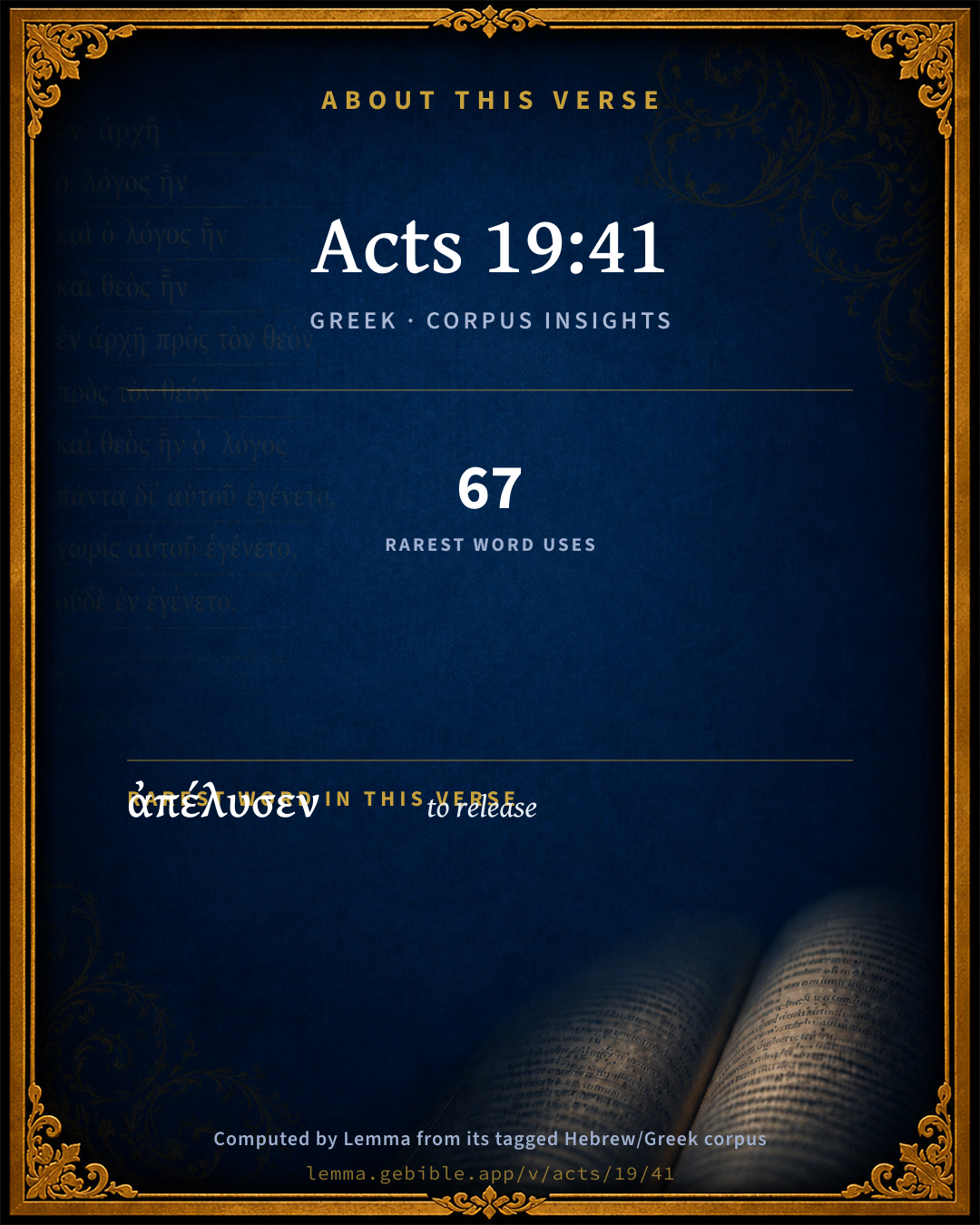
Acts 19:41

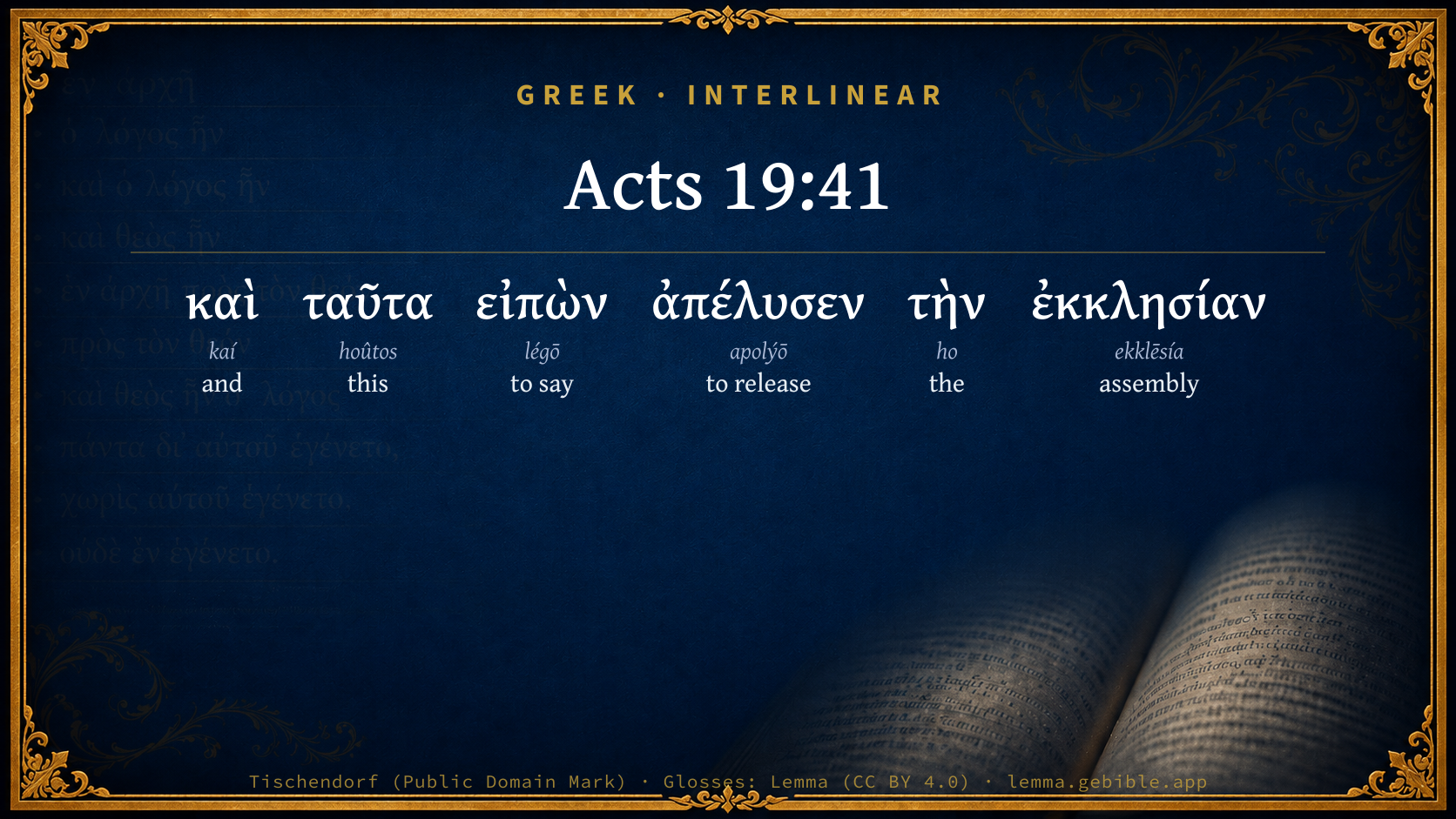
Greek (Tischendorf 8th ed.) Acts 19:41 appears in the Greek New Testament. The text above is from the Tischendorf 8th edition. Each word links to its Strong’s number and a concise gloss. Click any word for its full Thayer’s Greek Lexicon entry.
Download image
Cite this verse

Acts 19:41 (World English Bible). Public Domain. Lemma interlinear Bible study tool, https://lemma.gebible.app/v/acts/19/41.

Show BibTeX & RIS
BibTeX
RIS
English Translation
When he had thus spoken, he dismissed the assembly.
World English Bible · Public Domain
Download a study sheet

One document with this verse’s original text, its word-by-word gloss line, the meaning frame, cross-references with their text, attributed commentary, and full source and license credits — printable, and it pastes into notes with its structure intact.

This verse Autodidact and up

Study sheet (.html) Plain text (.txt)

A passage Seminary Student

Up to 50 verses in one chapter. A passage sheet keeps up to 6 commentary sources and 12 cross-references per verse, in the order this page ranks them, and says so on the sheet whenever that leaves anything out. Ask for a single verse and you get the Autodidact verse sheet above.

Everything on this page stays free to read, with no account — the sheet is a download of what is already on screen, not access to it.

Want to remove ads? Support Godless Engineer
Compare translations 3

The same verse in 3 English versions, stacked beneath the original-language interlinear above. Click any original word for its lexicon entry.

Each is an independent rendering of the whole verse — the interlinear is not word-aligned to these translations.

Highlighted words mark where these versions differ — a whole-verse word diff, not a word-by-word alignment.

  • World English Bible Public Domain
    When he had thus spoken, he dismissed the assembly.
  • King James Version Public Domain
    And when he had thus spoken, he dismissed the assembly.
  • unfoldingWord Literal Text CC BY-SA 4.0
    And having said these things, he dismissed the assembly.

unfoldingWord Literal Text — © unfoldingWord, licensed CC BY-SA 4.0. Word-aligned USFM3 via Door43 (git.door43.org/unfoldingWord/en_ult).

Versions to compare (up to 4)

3 of 4 selected

Show all 17 translations

Every available English version of this verse, each an independent rendering of the whole verse.

  • World English Bible Public Domain
    When he had thus spoken, he dismissed the assembly.
  • Berean Standard Bible Public Domain
    After he had said this, he dismissed the assembly.
  • Majority Standard Bible Public Domain
    After he had said this, he dismissed the assembly.
  • King James Version Public Domain
    And when he had thus spoken, he dismissed the assembly.
  • American Standard Version (1901) Public Domain
    And when he had thus spoken, he dismissed the assembly.
  • Revised Version (1885) Public Domain
    And when he had thus spoken, he dismissed the assembly.
  • Geneva Bible (1599) Public Domain
    And when he had thus spoken, hee let the assembly depart.
  • Young's Literal Translation Public Domain
    and these things having said, he dismissed the assembly.
  • Literal Standard Version CC BY-SA 4.0
    and having said these things, he dismissed the assembly.
  • Unlocked Literal Bible CC BY-SA 4.0
    When he had said this, he dismissed the assembly.
  • unfoldingWord Literal Text CC BY-SA 4.0
    And having said these things, he dismissed the assembly.
  • Darby Bible Public Domain
    And having said these things, he dismissed the assembly.
  • World Messianic Bible Public Domain
    When he had thus spoken, he dismissed the assembly.
  • Free Bible Version CC BY-SA 4.0
    When he had finished speaking, he dismissed the crowd.
  • Bible in Basic English Public Domain
    []
  • Text-Critical English NT CC BY 4.0
    And after saying this, he dismissed the assembly.
  • Tyndale New Testament (1534) Public Domain
    And when he had thus spoken he let the congregacion departe.

Literal Standard Version (2020), Covenant Press — licensed CC BY-SA 4.0. Text via the HelloAO Bible API (eBible.org). Unlocked Literal Bible (unfoldingWord) — licensed CC BY-SA 4.0. Text via the HelloAO Bible API (eBible.org). unfoldingWord Literal Text — © unfoldingWord, licensed CC BY-SA 4.0. Word-aligned USFM3 via Door43 (git.door43.org/unfoldingWord/en_ult). Free Bible Version, Dr. Jonathan Gallagher — licensed CC BY-SA 4.0. Text via the HelloAO Bible API (eBible.org).

Word by word

More ways to search: Search by grammar → Find every occurrence → Compare this word →

Practice this passage: Drill this verse → Learn its vocabulary →

ἀπέλυσεν
apolýō
G630
“to release”
Verb, Aorist, Active, Indicative, 3rd person, Singular
Part of Speech
Verb
Tense
Aorist
Voice
Active
Mood
Indicative
Person
3rd person
Number
Singular
Full Thayer's Definition

Origin: from G575 and G3089

TDNT: None

1. to set free 2. to let go, dismiss, (to detain no longer) a. a petitioner to whom liberty to depart is given by a decisive answer b. to bid depart, send away 3. to let go free, release a. a captive i.e. to loose his bonds and bid him depart, to give him liberty to depart b. to acquit one accused of a crime and set him at liberty c. indulgently to grant a prisoner leave to depart d. to release a debtor, i.e. not to press one's claim against him, to remit his debt 4. used of divorce, to dismiss from the house, to repudiate. The wife of a Greek or Roman may divorce her husband. 5. to send one's self away, to depart
  1. καὶ kaí G2532 “and” Conjunction
  2. ταῦτα hoûtos G3778 “this” Demonstrative pronoun, Accusative, Plural, Neuter
  3. εἰπὼν légō G3004 “to say” Verb, Aorist, Active, Participle, Nominative, Singular, Masculine
  4. τὴν ho G3588 “the” Article, Accusative, Singular, Feminine
  5. ἐκκλησίαν ekklēsía G1577 “assembly” Noun, Accusative, Singular, Feminine

About this verse

These counts appear in no published source. They are computed here, from the morphology-tagged text and Lemma’s own curated glosses. What Lemma adds →

6
words
6
distinct lemmas
Acts
section

Cross-references

4

Topical passages linked to Acts 19:41 in the Treasury of Scripture Knowledge — connected by theme and wording, ordered by reader-vote popularity; previews shown in the World English Bible.

  • Psalms 65:7 Who stills the roaring of the seas, The roaring of their waves, And the turmoil of the nations.
  • Proverbs 15:1–2 A gentle answer turns away wrath, But a harsh word stirs up anger.
  • Ecclesiastes 9:17 The words of the wise heard in quiet are better than the cry of him who rules among fools.
  • 2 Corinthians 1:8–10 For we don't desire to have you uninformed, brothers, concerning our affliction which happened to us in Asia, that we were weighed down exceedingly, beyond our power, so much that we despaired even of life.

Cross-references courtesy of OpenBible.info (CC BY 4.0).

Commentary

Notes on Acts 19:41 from classic Christian and Jewish commentators (each source and its license shown beneath its notes). The classic Christian expositions comment on the surrounding passage and are grouped to its opening verse, so a note may address several verses; the Jewish commentaries on the Tanakh (Rashi and others) are per-verse, so they appear only where the commentator wrote on this verse.

Lemma curates 59 commentaries, every one of them public domain or Creative Commons licensed, each selected and text-cleaned for this edition rather than reprinted as found. About our sources →

Expositor's Greek Testament

ed. W. Robertson Nicoll

Act 19:41 . τὴν ἐκκλησίαν : the word may imply, as Ramsay thinks, that the secretary thus recognised the meeting as an ἐκκλησία to shield it, as far as he could, from Roman censure. The attitude of the secretary is that of a man altogether superior to, and almost contemptuous of, the vulgar mob ( cf. οὗτος in , Act 19:38 ), and there is no apparent desire on his part to deny Paul’s right to preach, provided that the Apostle respected the laws and institutions of the city.

On the historical character of the incidents narrated at Ephesus, the graphic description and the intimate knowledge of the life of the city, see Ramsay, Church in the Roman Empire , p. 143, and the same writer “Ephesus,” Hastings’ B. D. Every detail tends to confirm the faithfulness of the picture drawn of Ephesian society A.D. 57 ( cf. Knabenbauer, p. 340). Wendt also is so impressed with the vividness of the scene as it is narrated, that he considers that we are justified in referring the narrative to a source which we owe to an actual companion of St. Paul, and in regarding it as an historical episode, and he refers in justification to Lightfoot, Cont. Rev. , p. 292 ff., 1878; see Wendt’s edition, 1888, pp. 429, 430, and also edition 1899, p. 316, note. Whilst Baur and Overbeck give an unfavourable verdict as to the historical truthfulness of the Ephesian tumult, a verdict which Wendt condemns, Zeller is constrained to acknowledge the very minute details which tell in favour of the narrative, and for the invention of which there is no apparent reason. Amongst more recent critics, Weizsäcker can only see in the story the historian’s defence of Paul and the same tendency to make events issue in the success of his missionary propaganda: 1Co 15:32 he takes literally, and the tumult recorded in Acts gives us only a faint and shadowy outline of actual reminiscences: nothing is left of the wild beasts except a tumult in the theatre, and the Apostle against whom the violence is mainly directed is himself absent. But as Wendt rightly maintains, 1Co 15:32 is much rather to be taken as referring figuratively to a struggle with men raging against the Apostle’s life; nor are we shut up of necessity to the conclusion that 1Co 15:32 and Act 19:23 ff. refer to one and the same event (so Hilgenfeld, Zöckler), see note on p. 414. McGiffert, whilst taking 1Co 15:32 literally (although he inclines to identify Act 19 with 2Co 1:8 , so too Hilgenfeld), admits as against Weizsäcker the general trustworthiness of St. Luke’s account, since it is too true to life, and is related too vividly to admit any doubt as to its historic reality (p. 282). Hilgenfeld too, Zw. Th. , p. 363, 1896, agrees that the whole narrative is related in a way true to life, and refers it with the possible exception of ὡς ἐπὶ ὥρας δύο in Act 19:34 to his good source : it could not possibly have been invented by the “author to Theophilus”. Even here Clemen and Jüngst can only see an interpolation, referred by the former to Redactor, i.e. , Act 19:15-41 with the possible exception of Act 19:33 to Redactor Antijudaicus; and by the latter also to his Redactor, i.e. , Act 19:23-41 .

The Expositor's Greek Testament, edited by W. Robertson Nicoll (1897–1910) — public domain. Text from a community e-Sword module.

Adam Clarke's Commentary

Verse 41. He dismissed the assembly.] την εκκλησιαν. Another proof that the word εκκλησια, which we generally translate church, signifies an assembly of any kind, good or bad, legal or illegal.

1. How forcible are right words! From the conduct of this prudent, sensible man, we may learn how much influence persons of this character may have, even over the unbridled multitude. But, where the civil power associates itself with the lawless might of the many, THERE must be confusion and every evil work. What a blessing to the community is the civil law! Were it not for this, the unthinking multitude would destroy others, and at last destroy themselves. Law and justice are from God; and the civil power, by which they are supported and administered, should be respected by all who regard the safety of their persons or property.

2. Though the ministry of St. Paul was greatly blessed at Ephesus, and his preaching appears to have been very popular, yet this sunshine was soon darkened: peace with the world cannot last long; the way of the Lord will always be opposed by those who love their own ways.

3. How few would make an outward profession of religion, were there no gain connected with it! And yet, as one justly observes, religion is rendered gainful only by some external part of it. For this very reason, the external part of religion is always on the increase, and none can find fault with it without raising storms and tempests; while the internal part wastes and decays, no man laying it to heart. Demetrius and his fellows would have made no stir for their worship, had not the apostle's preaching tended to discredit that by which they got their wealth. Most of the outcries that have been made against all revivals of religion-revivals by which the Church has been called back to its primitive principles and purity, have arisen out of self-interest. The cry of, the Church is in danger, has been echoed only by those who found their secular interest at stake; and knew that reformation must unmask them and show that the slothful and wicked servants could no longer be permitted to live on the revenues of that Church which they disgraced by their lives, and corrupted by their false doctrines. He that eats the Church's bread should do the Church's world: and he that will not work should not be permitted to eat.

Adam Clarke's Commentary on the Bible (1810–1826) — public domain. Text from a community e-Sword/MySword module.

The Cambridge Bible for Schools and Colleges

gen. ed. J. J. S. Perowne

41. And … assembly] This he could do in his official capacity. Probably the last argument which he used would have most weight with his audience. If such riotous conduct were reported at Rome it might lead to a curtailment of the privileges of their city.

The Cambridge Bible for Schools and Colleges (gen. ed. J. J. S. Perowne; Cambridge University Press, 1878–1918) — public domain. Text from a community e-Sword module.

Trapp's Complete Commentary

John Trapp

41 And when he had thus spoken, he dismissed the assembly.

Ver. 41. Dismissed the assembly] And so Demetrius was deceived. See here the power of civil prudence and flexanimous eloquence. (See Cic. de Oratore, i.)

John Trapp, A Commentary or Exposition upon All the Books of the Old and New Testament (1647–1656) — public domain. Text from a community e-Sword module.

Albert Barnes' Notes on the Bible

Dismissed the assembly - τὴν ἐκκλησίαν tēn ekklēsian. The word usually translated “church.” Here it is applied to the irregular and tumultuous “assemblage” which had convened in a riotous manner.

Albert Barnes' Notes on the Bible (1834–1885) — public domain. Text from a community e-Sword/MySword module.

Matthew Poole's English Annotations

The people were persuaded quietly to depart to their homes. Thus God one way or other, sometimes by friends, and sometimes by foes, kept his church and people from being ruined; and his hand is not shortened.

Matthew Poole's English Annotations on the Holy Bible (1683–1685) — public domain. Text from a community e-Sword/MySword module.

Whedon's Commentary on the Bible

Daniel D. Whedon

41. Dismissed the assembly—The movement of Demetrius had suddenly miscarried; his victim had escaped, and the Church stood intact under Roman law. Yet, on the other hand, the supremacy of Artemis had been reasserted, and the lost ground was so far recovered as that Ephesus felt herself as unanimously as ever pagan and Artemisian. But the words before which the religion, the idol, and the temple should wane away into ruin had been spoken. The spot where the edifice once stood cannot now be identified, and its very materials have been embodied into some of the churches of Christendom.

Daniel D. Whedon (gen. ed.), Commentary on the Old and New Testaments (1874–1909) — public domain. Text from a community e-Sword module.

Godbey's Commentary on the New Testament

William B. Godbey

41. “And saying these things he dismissed the church.” Where E. V. reads “assembly,” the Greek has ecclesia, the word throughout the Bible translated “church.” Why do we have the word “church” used relative to this Ephesian mob? Because it is all right and used correctly, not the Church of God, but Diana’s church, i. e., the church of Satan. Good Lord, help us to wake up to the fact that the world is full of the devil’s churches, this day as in by-gone ages! Ecclesia is from ek, “out,” and kaleoo, “call,” “the called out.” All the people in the world who hear the call of the Holy Ghost come out from this wicked world and all of its sins, leaving the devil forever and identifying themselves with God, are members of the Church of the First-Born. Satan, the great counterfeiter, has done his biggest work on the church line, filling up all lands with his churches, deceiving millions and sweeping them into hell by wholesale. The members of Satan’s churches, deluded by him, worship him under a vast diversity of names, thinking that they are worshipping God. In the Paganistic and Mohammedan churches, the devil calls himself by the names of their various idolatrous divinities and false prophets; while in the fallen churches of Christendom, he actually gets them to worship himself under the name of God, passing himself on them for God (2 Thessalonians 2). The devil is so much more intelligent than any human being, that the wisest and the most learned are in constant liability of mistaking Satan, “the god of this world,” for Jehovah, the God of heaven. While all sinners are led by demons in Satan’s midnight, so long as Christians have depravity in them, these evil Spirits can bivouac amid the dark jungles, play off on them for the Holy Ghost and deceive them. When you are emptied of sin, filled with the Spirit, your eye on Jesus, you have cloudless light within and without, qualifying you readily to detect the most stealthy approach of an evil spirit. Good Lord, save us all from delusion and entanglement in the devil’s church.

William B. Godbey, Commentary on the New Testament (1896–1900) — public domain. Text from a community e-Sword module.

McGarvey & Pendleton's Commentaries

J. W. McGarvey

See notes on verse 35

J. W. McGarvey (with Philip Y. Pendleton), Commentaries on the New Testament (The Fourfold Gospel, 1914; Acts; and the epistles) — public domain. Text from a community e-Sword/MySword module.

Cambridge Greek Testament for Schools and Colleges

41. ἀπέλυσεν τὴν ἐκκλησίαν, he dismissed the assembly. This he could do in his official capacity. Probably the last argument which he used would have most weight with his audience. If such riotous conduct were reported at Rome it might lead to a curtailment of the privileges of their city.

Chrysostom remarks: οὕτως ἔσβεσε τὸν θυμόν. ὥσπερ γὰρ ῥᾳδίως ἐξάπτεται, οὕτω καὶ ῥᾳδίως σβέννυται.

Cambridge Greek Testament for Schools and Colleges (Cambridge University Press, 1896; 21 vols, various authors incl. Carr, Maclear, Plummer, Farrar, Lumby, Moule, M. R. James, Simcox) — public domain. Text from a community e-Sword module.

Lesson kit

Teaching starters — assembled from the data on this page, not authored interpretation. Every prompt links to the verse data it draws on. Edit before teaching.

Acts, in the Acts, opens this verse with 6 words (6 distinct Greek lemmas). Its most distinctive word is apolýō (“to release”). A historical commentator’s framing appears above. Read the whole chapter for the surrounding context.

Discussion questions

  1. The word apolýō carries the sense “to release.” How does it shape the verse?
  2. Psalms 65:7 shares this passage’s theme. How do the two illuminate each other?
  3. These translations render this verse differently; the difference is in the English rendering, not the original. What questions does that raise?
  4. Reading how Expositor's Greek Testament and Adam Clarke's Commentary read this verse, where do the two commentators agree and where do they part?

Things to notice

Reading settings

Reading text

Shown beneath each verse's original-language words.

Old Testament
Old Testament edition

Read the OT as the Masoretic Hebrew (MT) or the Greek Septuagint (LXX).

English shown for the Greek Septuagint (in the Hebrew ↔ Greek comparison).

Comparing translations? Open the Compare panel on any verse page to stack up to four side by side.