

Acts 17:3
Greek (Tischendorf 8th ed.) Acts 17:3 appears in the Greek New Testament. The text above is from the Tischendorf 8th edition. Each word links to its Strong’s number and a concise gloss. Click any word for its full Thayer’s Greek Lexicon entry.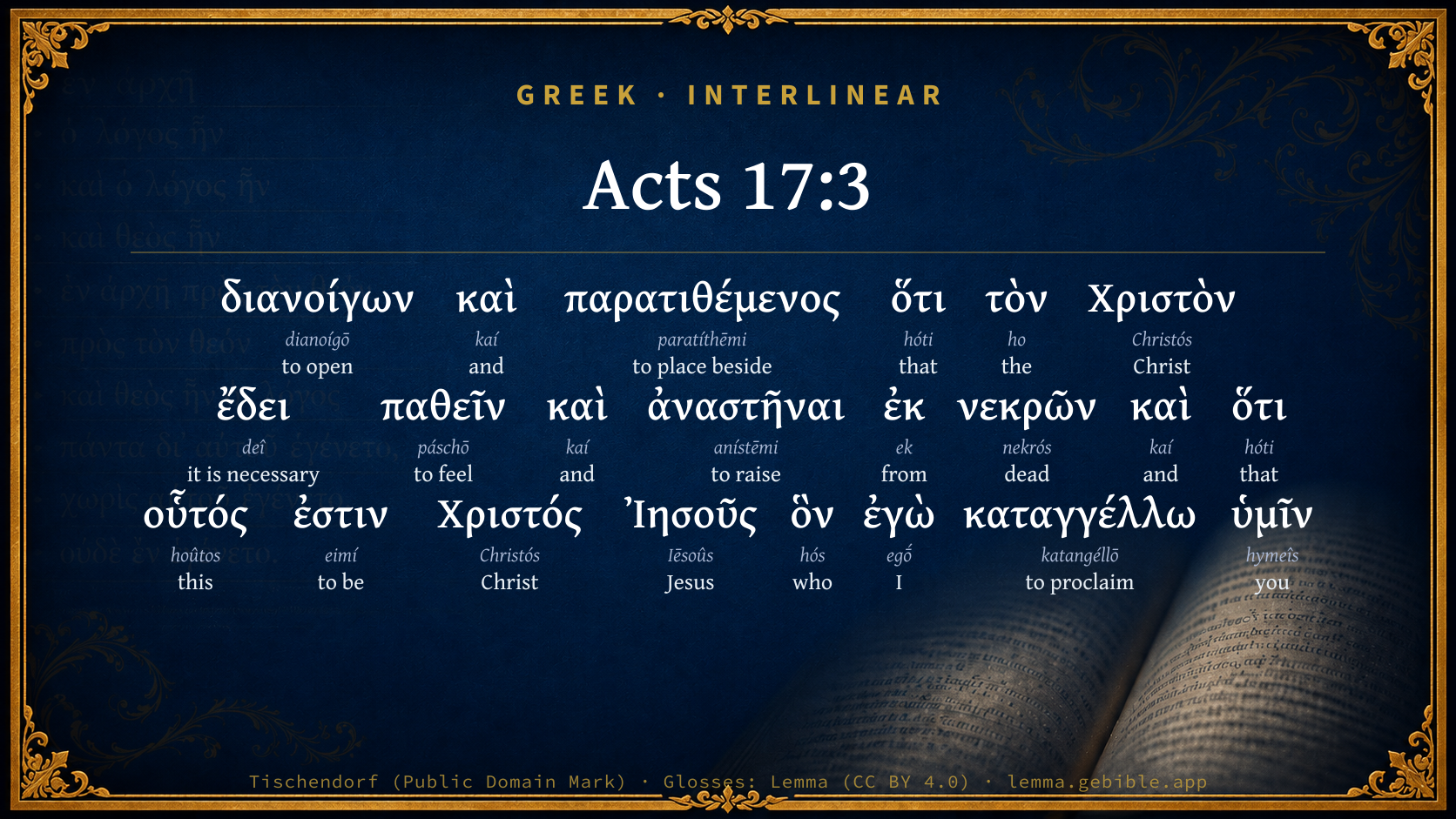
explaining and demonstrating that the Christ had to suffer and rise again from the dead, and saying, "This Jesus, whom I proclaim to you, is the Christ."
Download a study sheet
One document with this verse’s original text, its word-by-word gloss line, the meaning frame, cross-references with their text, attributed commentary, and full source and license credits — printable, and it pastes into notes with its structure intact.
This verse Autodidact and up
A passage Seminary Student
Up to 50 verses in one chapter. A passage sheet keeps up to 6 commentary sources and 12 cross-references per verse, in the order this page ranks them, and says so on the sheet whenever that leaves anything out. Ask for a single verse and you get the Autodidact verse sheet above.
Everything on this page stays free to read, with no account — the sheet is a download of what is already on screen, not access to it.
Compare translations 3
The same verse in 3 English versions, stacked beneath the original-language interlinear above. Click any original word for its lexicon entry.
Each is an independent rendering of the whole verse — the interlinear is not word-aligned to these translations.
Highlighted words mark where these versions differ — a whole-verse word diff, not a word-by-word alignment.
-
World English Bible Public Domain
explaining and demonstrating that the Christ had to suffer and rise again from the dead, and saying, "This Jesus, whom I proclaim to you, is the Christ."
-
King James Version Public Domain
Opening and alleging, that Christ must needs have suffered, and risen again from the dead; and that this Jesus, whom I preach unto you, is Christ.
-
unfoldingWord Literal Text CC BY-SA 4.0
fully opening them and demonstrating that it was necessary for the Christ to suffer and to rise from the dead, and, “This Jesus, whom I proclaim to you, is the Christ.”
unfoldingWord Literal Text — © unfoldingWord, licensed CC BY-SA 4.0. Word-aligned USFM3 via Door43 (git.door43.org/unfoldingWord/en_ult).
Show all 19 translations
Every available English version of this verse, each an independent rendering of the whole verse.
-
World English Bible Public Domain
explaining and demonstrating that the Christ had to suffer and rise again from the dead, and saying, "This Jesus, whom I proclaim to you, is the Christ."
-
Berean Standard Bible Public Domain
explaining and proving that the Christ had to suffer and rise from the dead. “This Jesus I am proclaiming to you is the Christ,” he declared.
-
Majority Standard Bible Public Domain
explaining and proving that the Christ had to suffer and rise from the dead. “This Jesus I am proclaiming to you is the Christ,” he declared.
-
King James Version Public Domain
Opening and alleging, that Christ must needs have suffered, and risen again from the dead; and that this Jesus, whom I preach unto you, is Christ.
-
American Standard Version (1901) Public Domain
opening and alleging that it behooved the Christ to suffer, and to rise again from the dead; and that this Jesus, whom, `said he,' I proclaim unto you, is the Christ.
-
Revised Version (1885) Public Domain
opening and alleging, that it behoved the Christ to suffer, and to rise again from the dead; and that this Jesus, whom, said he, I proclaim unto you, is the Christ.
-
Geneva Bible (1599) Public Domain
Opening, and alleadging that Christ must haue suffered, and risen againe from the dead: and this is Iesus Christ, whom, said he, I preach to you.
-
Douay-Rheims (1899) Public Domain
Declaring and insinuating that the Christ was to suffer, and to rise again from the dead; and that this is Jesus Christ, whom I preach to you.
-
Young's Literal Translation Public Domain
opening and alleging, `That the Christ it behoved to suffer, and to rise again out of the dead, and that this is the Christ -- Jesus whom I proclaim to you.'
-
Literal Standard Version CC BY-SA 4.0
opening and alleging that it was necessary [for] the Christ to suffer, and to rise again out of the dead, and that “this is the Christ—Jesus whom I proclaim to you.”
-
Unlocked Literal Bible CC BY-SA 4.0
He was opening the scriptures and explaining that it was necessary for the Christ to suffer and to rise again from the dead. He said, “This Jesus whom I proclaim to you is the Christ.”
-
unfoldingWord Literal Text CC BY-SA 4.0
fully opening them and demonstrating that it was necessary for the Christ to suffer and to rise from the dead, and, “This Jesus, whom I proclaim to you, is the Christ.”
-
Darby Bible Public Domain
opening and laying down that the Christ must have suffered and risen up from among the dead, and that this is the Christ, Jesus whom *I* announce to you.
-
World Messianic Bible Public Domain
explaining and demonstrating that the Messiah had to suffer and rise again from the dead, and saying, “This Yeshua, whom I proclaim to you, is the Messiah.”
-
Webster's Bible Public Domain
Opening and alledging, that it was needful that Christ should suffer, and rise again from the dead; and that this Jesus, whom I preach to you, is Christ.
-
Free Bible Version CC BY-SA 4.0
He explained what the Scriptures meant, proving that the Messiah had to die and rise from the dead. “This Jesus I'm telling you about—he is the Messiah,” he told them.
-
Bible in Basic English Public Domain
Saying to them clearly and openly that Christ had to be put to death and come back to life again; and that this Jesus, whom, he said, I am preaching to you, is the Christ.
-
Text-Critical English NT CC BY 4.0
explaining and presenting evidence that it was necessary for the Christ to suffer and to rise from the dead, saying, “This Jesus whom I am proclaiming to you is the Christ.”
-
Tyndale New Testament (1534) Public Domain
openynge and allegynge that Christ must nedes have suffred and rysen agayne from deeth and that this Iesus was Christ whom (sayde he) I preache to you.
Literal Standard Version (2020), Covenant Press — licensed CC BY-SA 4.0. Text via the HelloAO Bible API (eBible.org). Unlocked Literal Bible (unfoldingWord) — licensed CC BY-SA 4.0. Text via the HelloAO Bible API (eBible.org). unfoldingWord Literal Text — © unfoldingWord, licensed CC BY-SA 4.0. Word-aligned USFM3 via Door43 (git.door43.org/unfoldingWord/en_ult). Free Bible Version, Dr. Jonathan Gallagher — licensed CC BY-SA 4.0. Text via the HelloAO Bible API (eBible.org).
Word by word
More ways to search: Search by grammar → Find every occurrence → Compare this word →
Practice this passage: Drill this verse → Learn its vocabulary →
- Appears 8× in the Greek New Testament
- First appears at Mark 7:34
- Part of Speech
- Verb
- Tense
- Present
- Voice
- Active
- Mood
- Participle
- Case
- Nominative
- Number
- Singular
- Gender
- Masculine
Full Thayer's Definition
- διανοίγων dianoígō G1272 “to open” Verb, Present, Active, Participle, Nominative, Singular, Masculine
- καὶ kaí G2532 “and” Conjunction
- παρατιθέμενος paratíthēmi G3908 “to place beside” Verb, Present, Middle, Participle, Nominative, Singular, Masculine
- ὅτι hóti G3754 “that” Conjunction
- τὸν ho G3588 “the” Article, Accusative, Singular, Masculine
- Χριστὸν Christós G5547 “Christ” Noun, Accusative, Singular, Masculine
- ἔδει deî G1163 “it is necessary” Verb, Imperfect, Active, Indicative, 3rd person, Singular
- παθεῖν páschō G3958 “to feel” Verb, Aorist, Active, Infinitive
- καὶ kaí G2532 “and” Conjunction
- ἀναστῆναι anístēmi G450 “to raise” Verb, Aorist, Active, Infinitive
- ἐκ ek G1537 “from” Preposition
- νεκρῶν nekrós G3498 “dead” Adjective, Genitive, Plural, Masculine
- καὶ kaí G2532 “and” Conjunction
- ὅτι hóti G3754 “that” Conjunction
- οὗτός hoûtos G3778 “this” Demonstrative pronoun, Nominative, Singular, Masculine
- ἐστιν eimí G1510 “to be” Verb, Present, Active, Indicative, 3rd person, Singular
- Χριστός Christós G5547 “Christ” Noun, Nominative, Singular, Masculine
- Ἰησοῦς Iēsoûs G2424 “Jesus” Noun, Nominative, Singular, Masculine
- ὃν hós G3739 “who” Relative pronoun, Accusative, Singular, Masculine
- ἐγὼ egṓ G1473 “I” Personal pronoun, 1st person, Nominative, Singular
- καταγγέλλω katangéllō G2605 “to proclaim” Verb, Present, Active, Indicative, 1st person, Singular
- ὑμῖν hymeîs G5210 “you” Personal pronoun, 2nd person, Dative, Plural
About this verse
These counts appear in no published source. They are computed here, from the morphology-tagged text and Lemma’s own curated glosses. What Lemma adds →
- 22
- words
- 18
- distinct lemmas
- Acts
- section
Cross-references
15Topical passages linked to Acts 17:3 in the Treasury of Scripture Knowledge — connected by theme and wording, ordered by reader-vote popularity; previews shown in the World English Bible.
- Acts 18:28 for he powerfully refuted the Jews, publicly showing by the Scriptures that Jesus was the Christ.
- Acts 9:22 But Saul increased more in strength, and confounded the Jews who lived at Damascus, proving that this is the Christ.
- Luke 24:32 They said one to another, "Weren't our hearts burning within us, while he spoke to us along the way, and while he opened the Scriptures to us?"
- Luke 24:46 He said to them, "Thus it is written, and thus it was necessary for the Christ to suffer and to rise from the dead the third day,
- Acts 3:18 But the things which God announced by the mouth of all his prophets, that Christ should suffer, he thus fulfilled.
- 1 Corinthians 15:3–4 For I delivered to you first of all that which I also received: that Christ died for our sins according to the Scriptures,
- Galatians 3:1 Foolish Galatians, who has bewitched you not to obey the truth, before whose eyes Jesus Christ was openly set forth among you as crucified?
- 1 Thessalonians 1:5–6 and that our Gospel came to you not in word only, but also in power, and in the Holy Spirit, and with much assurance. You know what kind of men we showed ourselves to be among you for your sake.
- Luke 24:26–27 Didn't the Christ have to suffer these things and to enter into his glory?"
- Luke 24:44 He said to them, "This is what I told you, while I was still with you, that all things which are written in the law of Moses, the prophets, and the psalms, concerning me must be fulfilled."
- John 20:9 For as yet they didn't know the Scripture, that he must rise from the dead.
- Acts 1:4 Being assembled together with them, he charged them, "Don't depart from Jerusalem, but wait for the promise of the Father, which you heard from me.
- Acts 2:16–36 But this is what has been spoken through the prophet Joel:
- Acts 3:22–26 For Moses indeed said to the fathers, 'The Lord God will raise up a prophet for you from among your brothers, like me. You shall listen to him in all things whatever he says to you.
- Acts 13:26–39 Brothers, children of the stock of Abraham, and those among you who fear God, the word of this salvation is sent out to you.
Cross-references courtesy of OpenBible.info (CC BY 4.0).
Lesson kit
Teaching starters — assembled from the data on this page, not authored interpretation. Every prompt links to the verse data it draws on. Edit before teaching.
Acts, in the Acts, opens this verse with 22 words (18 distinct Greek lemmas). Its most distinctive word is dianoígō (“to open”). A historical commentator’s framing appears above. Read the whole chapter for the surrounding context.
Discussion questions
- What does “to open” (dianoígō) contribute to the verse as a whole?
- Mark 7:34 shares the word «to open» with this verse. How do the two illuminate each other?
- “Christ” occurs 2× in this one verse. What is the effect of the repetition?
- The translations on this page render this verse differently — a whole-verse word diff, not a word-by-word alignment. What might account for the different wordings?
- Reading how Bengel's Gnomon and Expositor's Greek Testament read this verse, where do the two commentators agree and where do they part?
Things to notice
- These translations choose different wording for 18 words in this verse.
- “Christ” occurs 2× in this single verse.
- 18 distinct Greek lemmas span 22 words in this verse.
Commentary
Notes on Acts 17:3 from classic Christian and Jewish commentators (each source and its license shown beneath its notes). The classic Christian expositions comment on the surrounding passage and are grouped to its opening verse, so a note may address several verses; the Jewish commentaries on the Tanakh (Rashi and others) are per-verse, so they appear only where the commentator wrote on this verse.
Lemma curates 59 commentaries, every one of them public domain or Creative Commons licensed, each selected and text-cleaned for this edition rather than reprinted as found. About our sources →
Bengel's Gnomon
Johann Albrecht Bengel
Bengel's Gnomon of the New Testament — English translation (T&T Clark, Edinburgh, 1860) — public domain. Text from a community e-Sword module.
Expositor's Greek Testament
ed. W. Robertson Nicoll
The Expositor's Greek Testament, edited by W. Robertson Nicoll (1897–1910) — public domain. Text from a community e-Sword module.
Geneva Bible (1599)
Geneva Bible translators
Geneva Bible (1599) marginal notes — public domain. Text via Bolls.life.
Jamieson, Fausset & Brown
Robert Jamieson, A. R. Fausset & David Brown
Jamieson, Fausset & Brown — Commentary Critical and Explanatory on the Whole Bible (1871) — public domain (CC PDM 1.0). Text via the HelloAO Bible API.
Adam Clarke's Commentary
Adam Clarke's Commentary on the Bible (1810–1826) — public domain. Text from a community e-Sword/MySword module.
John Calvin's Commentaries
John Calvin's Commentaries (1540-1563) — public domain. Text from the Calvin Translation Society English edition (1840s-50s) via the Christian Classics Ethereal Library (ccel.org). Calvin's coverage is partial (roughly two-thirds of the Bible); uncommented books and verses are honest gaps, never fabricated. The 19th-century editor's footnotes and remarks are omitted so the notes are faithfully Calvin's own voice.
Ellicott's Commentary for English Readers
A Bible Commentary for English Readers, edited by Charles John Ellicott (1878–1897) — public domain. Text from a community e-Sword module.
The Cambridge Bible for Schools and Colleges
gen. ed. J. J. S. Perowne
The Cambridge Bible for Schools and Colleges (gen. ed. J. J. S. Perowne; Cambridge University Press, 1878–1918) — public domain. Text from a community e-Sword module.
John Gill's Exposition
John Gill's Exposition of the Whole Bible (1746–1763) — public domain (CC PDM 1.0). Text via the HelloAO Bible API.
Trapp's Complete Commentary
John Trapp
John Trapp, A Commentary or Exposition upon All the Books of the Old and New Testament (1647–1656) — public domain. Text from a community e-Sword module.
Albert Barnes' Notes on the Bible
Albert Barnes' Notes on the Bible (1834–1885) — public domain. Text from a community e-Sword/MySword module.
Haydock's Catholic Bible Commentary
George Leo Haydock (1774–1849), Haydock's Catholic Family Bible and Commentary, 1859 edition — public domain. Excludes Psalms (Douay-Rheims chapter numbering differs from Protestant) and Deuterocanonical books (Catholic canon only).
Matthew Poole's English Annotations
Matthew Poole's English Annotations on the Holy Bible (1683–1685) — public domain. Text from a community e-Sword/MySword module.
Whedon's Commentary on the Bible
Daniel D. Whedon
Daniel D. Whedon (gen. ed.), Commentary on the Old and New Testaments (1874–1909) — public domain. Text from a community e-Sword module.
The Pulpit Commentary
The Pulpit Commentary (1880–1919), ed. H.D.M. Spence-Jones & Joseph S. Exell — public domain. Text from a community e-Sword module.
Scofield Reference Notes
C. I. Scofield
The Scofield Reference Bible (1917 edition), notes by C. I. Scofield — public domain. Text from a community e-Sword module.
McGarvey & Pendleton's Commentaries
J. W. McGarvey
J. W. McGarvey (with Philip Y. Pendleton), Commentaries on the New Testament (The Fourfold Gospel, 1914; Acts; and the epistles) — public domain. Text from a community e-Sword/MySword module.
unfoldingWord translationNotes
Door43 World Missions Community
unfoldingWord translationNotes — © Distant Shores Media and the Door43 World Missions Community, licensed CC BY-SA 4.0. Source: git.door43.org/Door43/en_tn.
Cambridge Greek Testament for Schools and Colleges
Cambridge Greek Testament for Schools and Colleges (Cambridge University Press, 1896; 21 vols, various authors incl. Carr, Maclear, Plummer, Farrar, Lumby, Moule, M. R. James, Simcox) — public domain. Text from a community e-Sword module.
Alford’s Greek Testament
Henry Alford
Henry Alford, The Greek Testament (1849–1861) — public domain. Text from a community e-Sword module.
Vincent's Word Studies in the New Testament
Marvin R. Vincent
Marvin R. Vincent, Word Studies in the New Testament (1887–1900) — public domain. Text from a community e-Sword/MySword module.