
Acts 18:16

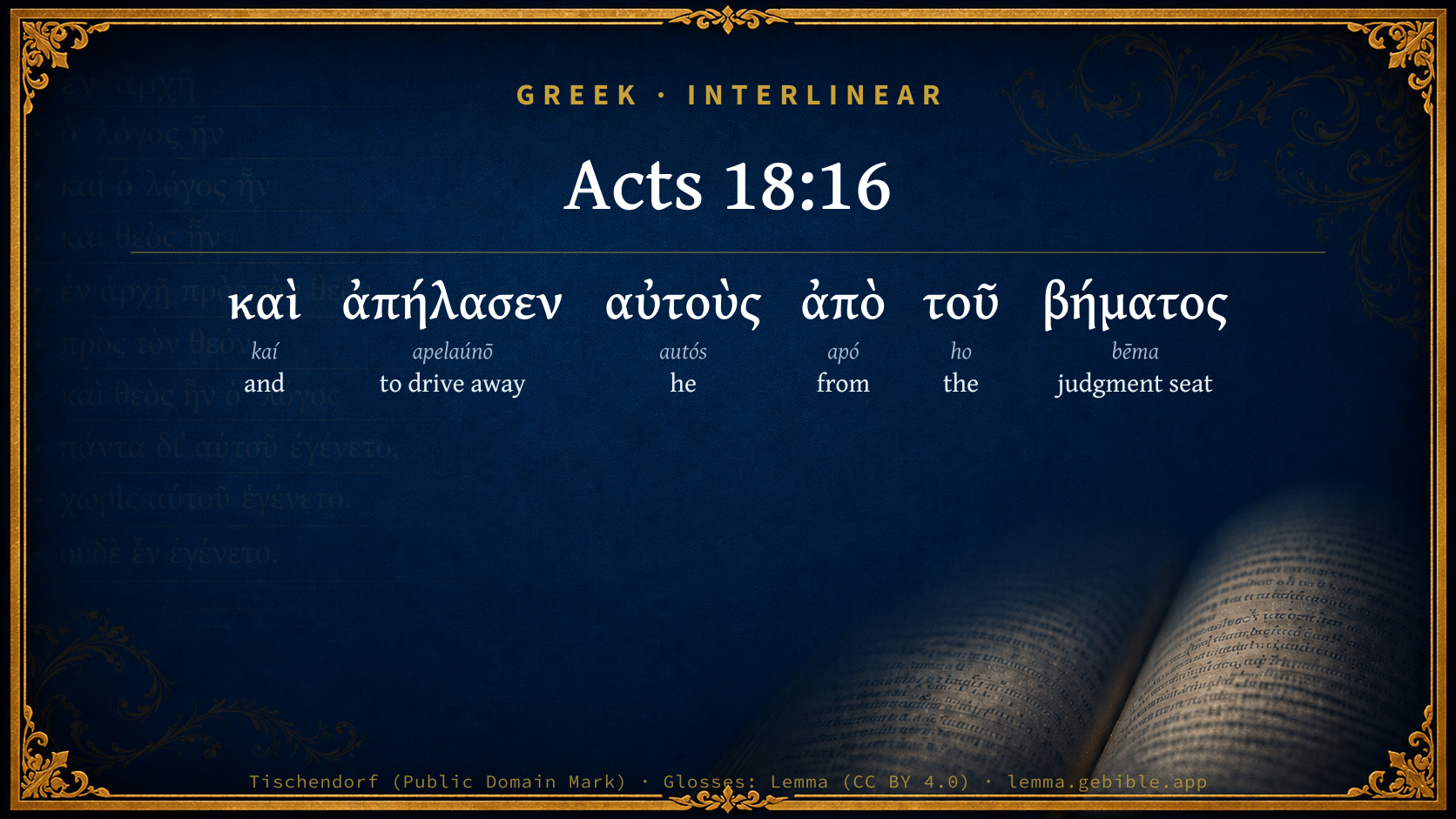
Greek (Tischendorf 8th ed.) Acts 18:16 appears in the Greek New Testament. The text above is from the Tischendorf 8th edition. Each word links to its Strong’s number and a concise gloss. Click any word for its full Thayer’s Greek Lexicon entry.
Download image
Cite this verse

Acts 18:16 (World English Bible). Public Domain. Lemma interlinear Bible study tool, https://lemma.gebible.app/v/acts/18/16.

Show BibTeX & RIS
BibTeX
RIS
English Translation
He drove them from the judgment seat.
World English Bible · Public Domain
Highlights
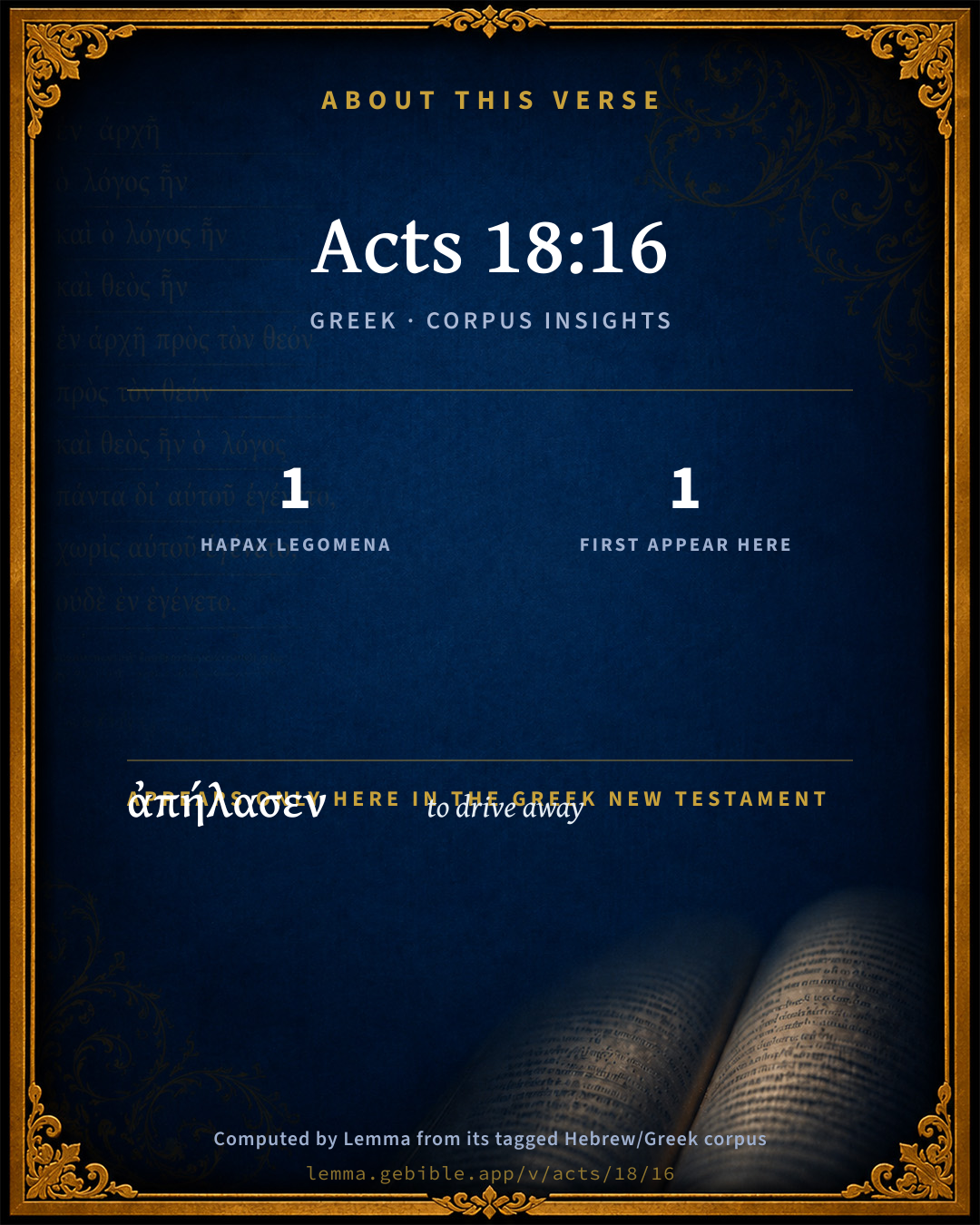
  • 1 hapax legomenon — only here in the Greek New Testament
  • 1 first appearance in the Greek New Testament
Full analysis ↓
Download a study sheet

One document with this verse’s original text, its word-by-word gloss line, the meaning frame, cross-references with their text, attributed commentary, and full source and license credits — printable, and it pastes into notes with its structure intact.

This verse Autodidact and up

Study sheet (.html) Plain text (.txt)

A passage Seminary Student

Up to 50 verses in one chapter. A passage sheet keeps up to 6 commentary sources and 12 cross-references per verse, in the order this page ranks them, and says so on the sheet whenever that leaves anything out. Ask for a single verse and you get the Autodidact verse sheet above.

Everything on this page stays free to read, with no account — the sheet is a download of what is already on screen, not access to it.

Want to remove ads? Support Godless Engineer
Compare translations 3

The same verse in 3 English versions, stacked beneath the original-language interlinear above. Click any original word for its lexicon entry.

Each is an independent rendering of the whole verse — the interlinear is not word-aligned to these translations.

Highlighted words mark where these versions differ — a whole-verse word diff, not a word-by-word alignment.

  • World English Bible Public Domain
    He drove them from the judgment seat.
  • King James Version Public Domain
    And he drave them from the judgment seat.
  • unfoldingWord Literal Text CC BY-SA 4.0
    And he sent them away from the judgment seat.

unfoldingWord Literal Text — © unfoldingWord, licensed CC BY-SA 4.0. Word-aligned USFM3 via Door43 (git.door43.org/unfoldingWord/en_ult).

Versions to compare (up to 4)

3 of 4 selected

Show all 19 translations

Every available English version of this verse, each an independent rendering of the whole verse.

  • World English Bible Public Domain
    He drove them from the judgment seat.
  • Berean Standard Bible Public Domain
    And he drove them away from the judgment seat.
  • Majority Standard Bible Public Domain
    And he drove them away from the judgment seat.
  • King James Version Public Domain
    And he drave them from the judgment seat.
  • American Standard Version (1901) Public Domain
    And he drove them from the judgment-seat.
  • Revised Version (1885) Public Domain
    And he drave them from the judgment-seat.
  • Geneva Bible (1599) Public Domain
    And hee draue them from the iudgement seate.
  • Douay-Rheims (1899) Public Domain
    And he drove them from the judgment seat.
  • Young's Literal Translation Public Domain
    and he drave them from the tribunal;
  • Literal Standard Version CC BY-SA 4.0
    and he drives them from the judgment seat;
  • Unlocked Literal Bible CC BY-SA 4.0
    Gallio made them leave the judgment seat.
  • unfoldingWord Literal Text CC BY-SA 4.0
    And he sent them away from the judgment seat.
  • Darby Bible Public Domain
    And he drove them from the judgment-seat.
  • World Messianic Bible Public Domain
    So he drove them from the judgment seat.
  • Webster's Bible Public Domain
    And he drove them from the judgment-seat.
  • Free Bible Version CC BY-SA 4.0
    Then Gallio had them ejected from the court.
  • Bible in Basic English Public Domain
    And he sent them away from the judge's seat.
  • Text-Critical English NT CC BY 4.0
    So he drove them away from the judgment seat.
  • Tyndale New Testament (1534) Public Domain
    and he drave them from the seate.

Literal Standard Version (2020), Covenant Press — licensed CC BY-SA 4.0. Text via the HelloAO Bible API (eBible.org). Unlocked Literal Bible (unfoldingWord) — licensed CC BY-SA 4.0. Text via the HelloAO Bible API (eBible.org). unfoldingWord Literal Text — © unfoldingWord, licensed CC BY-SA 4.0. Word-aligned USFM3 via Door43 (git.door43.org/unfoldingWord/en_ult). Free Bible Version, Dr. Jonathan Gallagher — licensed CC BY-SA 4.0. Text via the HelloAO Bible API (eBible.org).

Word by word

More ways to search: Search by grammar → Find every occurrence → Compare this word →

Practice this passage: Drill this verse → Learn its vocabulary →

About this verse

These counts appear in no published source. They are computed here, from the morphology-tagged text and Lemma’s own curated glosses. What Lemma adds →

6
words
6
distinct lemmas
Acts
section

Notable vocabulary

1 hapax legomenon — a word that appears only here in the entire Greek New Testament:

  • ἀπήλασεν to drive away G556

First appearance in Scripture

This word makes its first canonical appearance in the Greek New Testament here:

  • ἀπήλασεν to drive away G556

Shared distinctive vocabulary

βήματος judgment seat G968 occurs in 12 verses of the Greek New Testament. Also found in:
Cross-references

3

Topical passages linked to Acts 18:16 in the Treasury of Scripture Knowledge — connected by theme and wording, ordered by reader-vote popularity; previews shown in the World English Bible.

  • Psalms 76:10 Surely the wrath of man praises you. The survivors of your wrath are restrained.
  • Romans 13:3–4 For rulers are not a terror to the good work, but to the evil. Do you desire to have no fear of the authority? Do that which is good, and you will have praise from the same,
  • Revelation 12:16 The earth helped the woman, and the earth opened its mouth and swallowed up the river which the dragon spewed out of his mouth.

Cross-references courtesy of OpenBible.info (CC BY 4.0).

Commentary

Notes on Acts 18:16 from classic Christian and Jewish commentators (each source and its license shown beneath its notes). The classic Christian expositions comment on the surrounding passage and are grouped to its opening verse, so a note may address several verses; the Jewish commentaries on the Tanakh (Rashi and others) are per-verse, so they appear only where the commentator wrote on this verse.

Lemma curates 59 commentaries, every one of them public domain or Creative Commons licensed, each selected and text-cleaned for this edition rather than reprinted as found. About our sources →

Meyer's Critical & Exegetical Commentary

Heinrich August Wilhelm Meyer

Act_18:16-17. Ἀπήλασεν] he dismissed them as plaintiffs, whose information it was not competent to him to entertain. Comp. Dem. 272. 11. 1373. 12.

Under the legal pretext of the necessity of supporting this ἀπήλασεν of the proconsul, all the bystanders (πάντες, partly perhaps Roman subordinate officials, but certainly all Gentiles, therefore οἱ Ἕλληνες is a correct gloss) used the opportunity of wreaking their anger on the leader and certainly also the spokesman of the hated Jews; they seized Sosthenes, the ruler of the synagogue, even before the tribunal, and beat him.

Σωσθένης is by Theodoret, Erasmus, Calvin, and others, also Hofmann, heil. Schr. d. N.T. II. ii. p. 4 f., very arbitrarily (especially as this name was so common) considered as identical with the person mentioned in 1Co_1:1; hence also the erroneous gloss οἱ Ἰουδαῖοι added to πάντες has arisen from the supposition that he either was at this time actually a Christian, or at least inclined to Christianity, and therefore not sufficiently energetic in his accusation. Against this may be urged the very part which Sosthenes, as ruler of the synagogue, evidently plays against Paul;[80] and not less the circumstance, that the person mentioned in 1Co_1:1 was a fellow-labourer of Paul out of Corinth; according to which, for the identification of the two, a more extended hypothesis would be necessary, such as Ewald has. Chrysostom considers him even identical with Crispus.

τὸν ἀρχισυν.] Whether he was a colleague (see on Act_13:15) of the above-named ΚΡΊΣΠΟς, Act_18:8, or successor to him on his resignation in consequence of embracing Christianity (Olshausen, de Wette, Baumgarten, Ewald, and others), or whether he presided over another synagogue in Corinth (Grotius), remains undetermined.

ΚΑῚ ΟὐΔῈΝ ΤΟΎΤΩΝ Κ.Τ.Λ.] and Gallio troubled himself about none of these things, which here took place; he quite disregarded the spectacle. The purpose of this statement is to exhibit the utter failure of the attempt. So little was the charge successful, that even the leader of the accusers himself was beaten by the rabble without any interference of the judge, who by this indifference tacitly connived with the accused.

[80] According to Hofmann, be was so linked with his people, that, although inwardly convinced by the preaching of the apostle, he yet appeared at the head of the furious multitude before the proconsul against Paul, because he could not forsake the synagogue. What a character would thus be the result! And what reader could from the simple words put together for himself traits so odious! How entirely different were Joseph and Nicodemus!

Meyer — Critical and Exegetical Commentary on the New Testament — English translation by Peter Christie, edited by Frederick Crombie (T&T Clark, 1880) — public domain. Text from a community e-Sword module.

Expositor's Greek Testament

ed. W. Robertson Nicoll

Act 18:16 . ἀπήλασεν : probably by his lictors who would be commanded to clear the court. This interpretation of the word is in accordance with the next verse, which describes the crowd of Greeks as prepared to follow up the decision of Gallio by similar treatment of a leading Jew on their own account. See critical note.

The Expositor's Greek Testament, edited by W. Robertson Nicoll (1897–1910) — public domain. Text from a community e-Sword module.

Jamieson, Fausset & Brown

Robert Jamieson, A. R. Fausset & David Brown

drave them, &c.--annoyed at such a case.

Jamieson, Fausset & Brown — Commentary Critical and Explanatory on the Whole Bible (1871) — public domain (CC PDM 1.0). Text via the HelloAO Bible API.

Adam Clarke's Commentary

Verse 16. And he drave them from the judgment seat.] He saw that their accusation was both frivolous and vexatious, and he ordered them to depart, and the assembly to disperse. The word απηλασεν, which we translate he drave, does not signify here any act of violence on the part of Gallio or the Roman officers, but simply an authoritative dismission.

Adam Clarke's Commentary on the Bible (1810–1826) — public domain. Text from a community e-Sword/MySword module.

Ellicott's Commentary for English Readers

(16) He drove them from the judgment seat.—The words imply a magisterial act. The order was given to the lictors to clear the court, and the Jews, who did not immediately retreat were exposed to the ignominy of blows from their rods.

A Bible Commentary for English Readers, edited by Charles John Ellicott (1878–1897) — public domain. Text from a community e-Sword module.

The Cambridge Bible for Schools and Colleges

gen. ed. J. J. S. Perowne

16. And he drave them from the judgment seat] The description given by St Luke makes it probable that the seat of Gallio was in some open public place, where all might come and bring their plaints. The proconsul would be attended by his lictors and other officials, and those he now commands to clear the place of these troublesome cavillers about words and names. The new magistrate found perhaps enough to do in matters which came within his jurisdiction in the busy mercantile life of Corinth.

The Cambridge Bible for Schools and Colleges (gen. ed. J. J. S. Perowne; Cambridge University Press, 1878–1918) — public domain. Text from a community e-Sword module.

John Gill's Exposition

And Paul after this tarried there yet a good while,.... A year and a half, as in Act 18:11 for this insurrection might follow immediately upon the vision the apostle had; and who by that was encouraged to continue in this city, notwithstanding the treatment he met with; he not doubting of the promise of God, and of his power and faithfulness to fulfil it, though this was a trial of his faith and constancy:

and then took his leave of the brethren; whom he had been instrumental in the conversion of, and had established and confirmed in the faith; and having now done his work in this place, at least for the time present, he takes his leave of them and departs:

and sailed thence into Syria; or towards Syria, for he took Ephesus by the way, which was in Asia, and stopped there a little while:

and with him Priscilla and Aquila; whom he had met with at Corinth, and with whom he had lodged and wrought at his trade, Act 18:2

Having shorn his head in Cenchrea; which some understand not of Paul, but of Aquila, who is the last person spoken of; and the Ethiopic version reads in the plural number, referring this to both Priscilla and Aquila, "and they had shaved their heads, for they had a vow"; and so it was read in a manuscript of Baronius, and Bede observes, that it was read in like manner in some copies in his time; but the more authentic reading is in the singular number, and is more generally understood of the Apostle Paul; who being about to go into Judea, to the Jew became a Jew, that he might gain some: Cenchrea, where this was done, was a sea port belonging to the Corinthians, on the east of the Isthmus, as Lechea was on the west; according to Pliny (x), there were two gulfs, or bays, to the Isthmus, the one he calls the Corinthian bay, and others the Crissean and Alcyonian bay, and Golfo de Petras; the other the Saronic bay, now called Golfo de Engia; Lechea was in the Corinthian bay, and Cenchrea in the Saronic bay; and both belonged to Corinth, and were the bounds of the Straights; the space between them was the Isthmus, which consisted of about five miles; and so Pausanias says (y), the Isthmus of the Corinthians is washed on both sides by the sea; on one side at Cenchrea, and on the other at Lechea, and this makes the island a continent; and likewise Philo (z) giving an account of a voyage of Flaccus says, that passing over the Ionian gulf, he came to the sea (or shore) of Corinth ------- and going over the Isthmus from Lechea, to the opposite sea, he came down to Cenchrea, a seaport of the Corinthians; of which Apuleius (a) gives this account:

"this town is a most noble colony of the Corinthians, it is washed by the Aegean and Saronic sea, where there is a port, a most safe receptacle for ships, and very populous.''

Hither the apostle came from Corinth to take shipping, and from hence he sailed to Syria, as before observed: it has its name either from millet, for "Cenchros" signifies "millet"; and "Cenchrias" is "bread made of millet"; or from the bird "Cenchris", which is a kind of hawk; See Gill on Rom 16:1.

For he had a vow; this, some think, could not be the vow of the Nazarites, for then he should have stayed till he came to Jerusalem, and have shaved his head at the door of the tabernacle of the congregation, and cast the hair into the fire, under the pot in which the peace offerings were boiled (b); though he that vowed in the country, was not obliged to this: others think it was such an one as the Jews in travelling used, that they would not shave till they came to such a place; and so the apostle had made a vow that he would shave at Cenchrea; and accordingly did; but this is not likely, that the apostle should make a vow upon so light an occasion: others that it refers to his going to Jerusalem, to keep the feast there, Act 18:21 and so these think the words are a reason, not of his shaving of his head, but of his sailing to Syria; the first is most probable, that it was a Nazarite's vow; see Act 21:24.

(x) Nat. Hist. l. 4. c. 4. (y) Corinthiaca sive, l. 2. p. 86. (z) In Flaccum, p. 987. (a) Metamorphos. l. 10. in fine. (b) Misn. Nazir, c. 6. sect. 8. Maimon. & Bartenora in ib. Bemidbar Rabba, sect. 10. fol. 201. 3.

John Gill's Exposition of the Whole Bible (1746–1763) — public domain (CC PDM 1.0). Text via the HelloAO Bible API.

Trapp's Complete Commentary

John Trapp

16 And he drave them from the judgment seat.

Ver. 16. And he drave them from the tribunal] As so many Vitilitigatores, qui de lana saepe caprina rixantur, that contended for trifles, and such as deserved the whipping post, which is the punishment that the Turks put such among them to as are litigious. {a}

{a} Temere litigantes publice flagellis caeduntur.

John Trapp, A Commentary or Exposition upon All the Books of the Old and New Testament (1647–1656) — public domain. Text from a community e-Sword module.

Albert Barnes' Notes on the Bible

And he drave them ... - He refused to hear and decide the controversy. The word used here does not denote that there was any violence used by Gallio, but merely that he dismissed them in an authoritative manner.

Albert Barnes' Notes on the Bible (1834–1885) — public domain. Text from a community e-Sword/MySword module.

Matthew Poole's English Annotations

He commanded them to be gone, having dismissed their case; and, if need were, added threatening and force.

Matthew Poole's English Annotations on the Holy Bible (1683–1685) — public domain. Text from a community e-Sword/MySword module.

Whedon's Commentary on the Bible

Daniel D. Whedon

16. Drave them—Bid them clear the room so peremptorily as indicated ready compulsion by officers.

It is by no means so clear, as commentators represent, that Gallio does not here display more impatience than becomes his office. The tedium of a regal discussion is no good ground of a nonsuit. Perhaps he is already nervous from the climate, which ultimately sent him home an invalid. It certainly was a prima facie question whether Paul had not deserted from his national creed, requiring a discussion.

Daniel D. Whedon (gen. ed.), Commentary on the Old and New Testaments (1874–1909) — public domain. Text from a community e-Sword module.

The Pulpit Commentary

And he drave them; ajphlasen, found only here in the New Testament or LXX But it is used by Demosthenes and Plutarch in exactly the same connection: ajpoou ajpomatov (Demosthenes, 1373, 12; Plutarch, "Marcell.," p. 410, in Schleusner). It implies the ignominious dismissal of the case, without its being even tried. The judgment seat (bhma); the proconsular place of judgment. The bhma (here and ver. 12) was properly the "raised space," or "tribune," on which, in the case of a consul, proconsul, or praetor, the sella curulis was placed on which he sat and gave judgment. It was usually a kind of apse to the basilica. in Mat_27:19; Joh_19:13, and, indeed, here and elsewhere, it seems to be used, generally, for the judgment-seat itself. (see Act_25:10)

The Pulpit Commentary (1880–1919), ed. H.D.M. Spence-Jones & Joseph S. Exell — public domain. Text from a community e-Sword module.

McGarvey & Pendleton's Commentaries

J. W. McGarvey

See notes on verse 14

J. W. McGarvey (with Philip Y. Pendleton), Commentaries on the New Testament (The Fourfold Gospel, 1914; Acts; and the epistles) — public domain. Text from a community e-Sword/MySword module.

unfoldingWord translationNotes

Door43 World Missions Community

General Information:

Here the word "they" probably refers to the Gentiles at the court. They reacted against the Jews who had brought Paul before the judgment seat. (See: Acts 18:12)

Gallio made them leave the judgment seat

"Gallio dismissed them from the judgment seat." Here "judgment seat" refers to the place where Gallio sits to make legal decisions in court. AT: "Gallio made them leave his presence in the court" or "Gallio made them leave the court" (See: Metonymy)

they all seized

This may be an exaggeration to emphasize the strong feelings the people had. AT: "many people seized" or "many of them grabbed" (See: Hyperbole and Generalization)

So they all seized Sosthenes, the ruler of the synagogue, and beat him in front of the judgment seat

Possible meanings are 1) the Gentiles beat Sosthenes in the court in front of the judgment seat because he was the Jewish leader or 2) it is possible that Sosthenes was a believer in Christ, so the Jews beat him in front of the court.

Sosthenes, the ruler of the synagogue

"Sosthenes" was the Jewish ruler of the synagogue at Corinth. (See: How to Translate Names)

beat him

"repeatedly hit him" or "repeatedly punched him."

translationWords

judge

rule

synagogue

unfoldingWord translationNotes — © Distant Shores Media and the Door43 World Missions Community, licensed CC BY-SA 4.0. Source: git.door43.org/Door43/en_tn.

Cambridge Greek Testament for Schools and Colleges

16. καὶ ἀπήλασεν αὐτοὺς ἀπὸ τοῦ βήματος, and he drave them from the judgement seat. The description given by St Luke makes it probable that Gallio’s βῆμα was in some open public place, whither all might come and bring their plaints. The proconsul would be attended by his lictors and other officials, and those he now commands to clear the place of these troublesome cavillers about words and names. The new magistrate found perhaps enough to do in matters which came within his jurisdiction in the busy mercantile life of Corinth.

Cambridge Greek Testament for Schools and Colleges (Cambridge University Press, 1896; 21 vols, various authors incl. Carr, Maclear, Plummer, Farrar, Lumby, Moule, M. R. James, Simcox) — public domain. Text from a community e-Sword module.

Lesson kit

Teaching starters — assembled from the data on this page, not authored interpretation. Every prompt links to the verse data it draws on. Edit before teaching.

Acts, in the Acts, opens this verse with 6 words (6 distinct Greek lemmas). Its most distinctive word is apelaúnō (“to drive away”). A historical commentator’s framing appears above. Read the whole chapter for the surrounding context.

Discussion questions

  1. The word apelaúnō carries the sense “to drive away.” How does it shape the verse?
  2. 1 word here appears nowhere else in the Greek New Testament. Why might the author reach for such rare wording?
  3. This is the first place “to drive away” appears in Scripture (first appears here). What does its debut here establish?
  4. How does Matthew 27:19, which shares the word «judgment seat», read alongside this verse?
  5. These translations render this verse differently. What is at stake in choosing one wording over another?
  6. Compare how Meyer's Critical & Exegetical Commentary and Expositor's Greek Testament read this verse. Where do they agree or differ?

Things to notice

  • 1 word in this verse appears nowhere else in the Greek New Testament.
  • 1 word makes its first canonical appearance in Scripture here.
  • These translations choose different wording for 4 words in this verse.
  • 6 distinct Greek lemmas span 6 words in this verse.

Reading settings

Reading text

Shown beneath each verse's original-language words.

Old Testament
Old Testament edition

Read the OT as the Masoretic Hebrew (MT) or the Greek Septuagint (LXX).

English shown for the Greek Septuagint (in the Hebrew ↔ Greek comparison).

Comparing translations? Open the Compare panel on any verse page to stack up to four side by side.