
Acts 18:3

Greek (Tischendorf 8th ed.) Acts 18:3 appears in the Greek New Testament. The text above is from the Tischendorf 8th edition. Each word links to its Strong’s number and a concise gloss. Click any word for its full Thayer’s Greek Lexicon entry.

Download image
Cite this verse

Acts 18:3 (World English Bible). Public Domain. Lemma interlinear Bible study tool, https://lemma.gebible.app/v/acts/18/3.

Show BibTeX & RIS
BibTeX
RIS
English Translation
and because he practiced the same trade, he lived with them and worked, for by trade they were tent makers.
World English Bible · Public Domain
Highlights
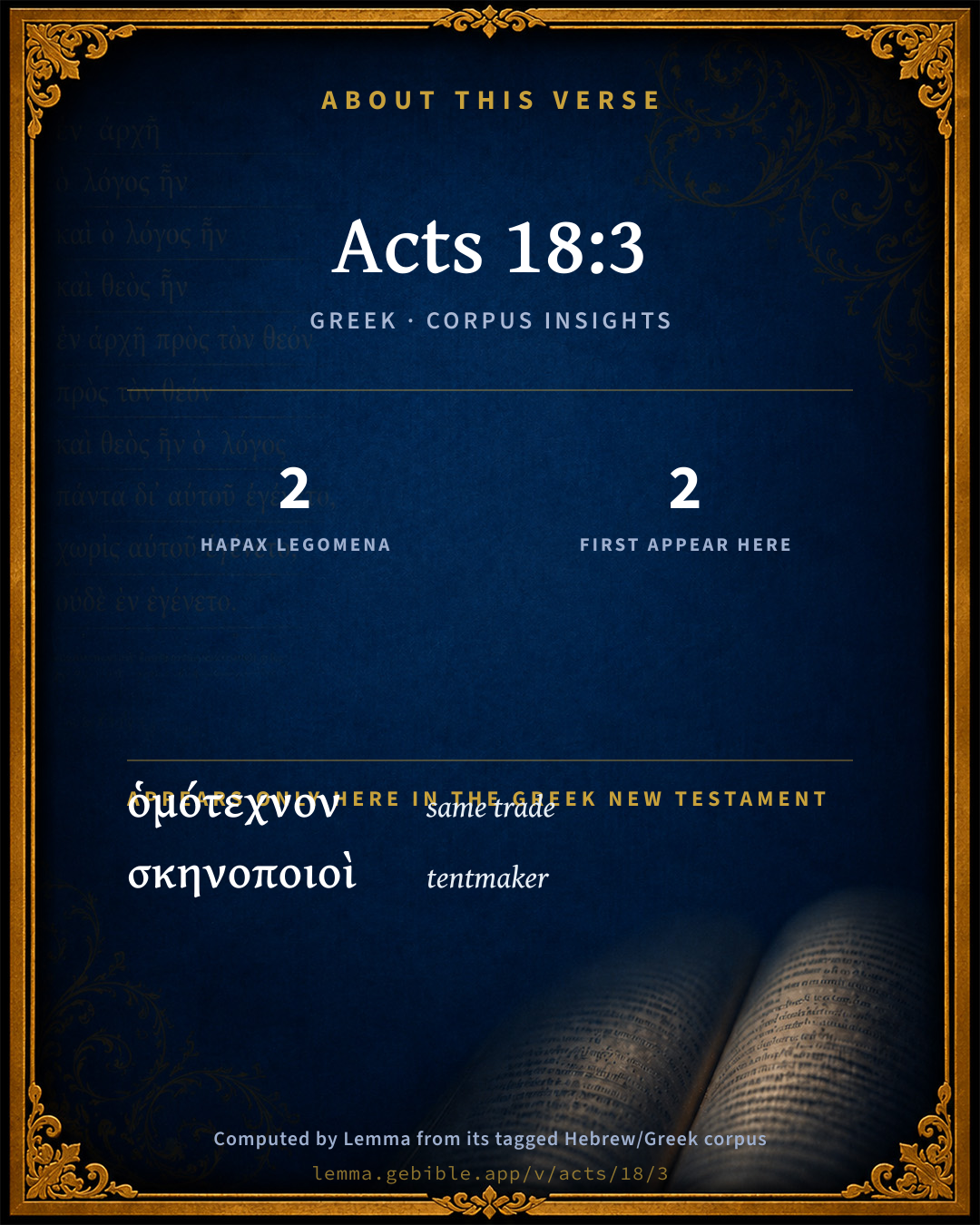
  • 2 hapax legomena — only here in the Greek New Testament
  • 2 first appearances in the Greek New Testament
Full analysis ↓
Download a study sheet

One document with this verse’s original text, its word-by-word gloss line, the meaning frame, cross-references with their text, attributed commentary, and full source and license credits — printable, and it pastes into notes with its structure intact.

This verse Autodidact and up

Study sheet (.html) Plain text (.txt)

A passage Seminary Student

Up to 50 verses in one chapter. A passage sheet keeps up to 6 commentary sources and 12 cross-references per verse, in the order this page ranks them, and says so on the sheet whenever that leaves anything out. Ask for a single verse and you get the Autodidact verse sheet above.

Everything on this page stays free to read, with no account — the sheet is a download of what is already on screen, not access to it.

Want to remove ads? Support Godless Engineer
Compare translations 3

The same verse in 3 English versions, stacked beneath the original-language interlinear above. Click any original word for its lexicon entry.

Each is an independent rendering of the whole verse — the interlinear is not word-aligned to these translations.

Highlighted words mark where these versions differ — a whole-verse word diff, not a word-by-word alignment.

  • World English Bible Public Domain
    and because he practiced the same trade, he lived with them and worked, for by trade they were tent makers.
  • King James Version Public Domain
    And because he was of the same craft, he abode with them, and wrought: for by their occupation they were tentmakers.
  • unfoldingWord Literal Text CC BY-SA 4.0
    and because he was of the same trade, he stayed with them and was working, for they were tentmakers by trade.

unfoldingWord Literal Text — © unfoldingWord, licensed CC BY-SA 4.0. Word-aligned USFM3 via Door43 (git.door43.org/unfoldingWord/en_ult).

Versions to compare (up to 4)

3 of 4 selected

Show all 19 translations

Every available English version of this verse, each an independent rendering of the whole verse.

  • World English Bible Public Domain
    and because he practiced the same trade, he lived with them and worked, for by trade they were tent makers.
  • Berean Standard Bible Public Domain
    and he stayed and worked with them because they were tentmakers by trade, just as he was.
  • Majority Standard Bible Public Domain
    and he stayed and worked with them because they were tentmakers by trade, just as he was.
  • King James Version Public Domain
    And because he was of the same craft, he abode with them, and wrought: for by their occupation they were tentmakers.
  • American Standard Version (1901) Public Domain
    and because he was of the same trade, he abode with them, and they wrought, for by their trade they were tentmakers.
  • Revised Version (1885) Public Domain
    and because he was of the same trade, he abode with them, and they wrought; for by their trade they were tentmakers.
  • Geneva Bible (1599) Public Domain
    And because hee was of the same crafte, he abode with them and wrought (for their crafte was to make tentes.)
  • Douay-Rheims (1899) Public Domain
    And because he was of the same trade, he remained with them, and wrought; (now they were tentmakers by trade.)
  • Young's Literal Translation Public Domain
    and because of being of the same craft, he did remain with them, and was working, for they were tent-makers as to craft;
  • Literal Standard Version CC BY-SA 4.0
    and because of being of the same craft, he remained with them, and was working, for they were tentmakers as to craft;
  • Unlocked Literal Bible CC BY-SA 4.0
    and because he worked at the same trade, he stayed with them and worked, for they were tentmakers by trade.
  • unfoldingWord Literal Text CC BY-SA 4.0
    and because he was of the same trade, he stayed with them and was working, for they were tentmakers by trade.
  • Darby Bible Public Domain
    and because they were of the same trade abode with them, and wrought. For they were tent-makers by trade.
  • World Messianic Bible Public Domain
    and because he practiced the same trade, he lived with them and worked, for by trade they were tent makers.
  • Webster's Bible Public Domain
    And because he was of the same occupation, he abode with them, and wrought (for by their occupation they were tent-makers)
  • Free Bible Version CC BY-SA 4.0
    and because they were in the same business of tent-making, he stayed with them.
  • Bible in Basic English Public Domain
    And because he was of the same trade, he was living with them, and they did their work together; for by trade they were tent-makers.
  • Text-Critical English NT CC BY 4.0
    and because he was of the same trade, he stayed with them and worked, for they were tentmakers by trade.
  • Tyndale New Testament (1534) Public Domain
    And because he was of the same crafte he abode with them and wrought: their crafte was to make tentes.

Literal Standard Version (2020), Covenant Press — licensed CC BY-SA 4.0. Text via the HelloAO Bible API (eBible.org). Unlocked Literal Bible (unfoldingWord) — licensed CC BY-SA 4.0. Text via the HelloAO Bible API (eBible.org). unfoldingWord Literal Text — © unfoldingWord, licensed CC BY-SA 4.0. Word-aligned USFM3 via Door43 (git.door43.org/unfoldingWord/en_ult). Free Bible Version, Dr. Jonathan Gallagher — licensed CC BY-SA 4.0. Text via the HelloAO Bible API (eBible.org).

Word by word

More ways to search: Search by grammar → Find every occurrence → Compare this word →

Practice this passage: Drill this verse → Learn its vocabulary →

ὁμότεχνον
homótechnos
G3673
“same trade”
Adjective, Accusative, Singular, Masculine
Part of Speech
Adjective
Case
Accusative
Number
Singular
Gender
Masculine
Full Thayer's Definition

Origin: from the base of G3674 and G5078

TDNT: None

1. practising the same trade or craft, of the same trade
  1. καὶ kaí G2532 “and” Conjunction
  2. διὰ diá G1223 “through” Preposition
  3. τὸ ho G3588 “the” Article, Accusative, Singular, Neuter
  4. εἶναι eimí G1510 “to be” Verb, Present, Active, Infinitive
  5. ἔμενεν ménō G3306 “to remain” Verb, Imperfect, Active, Indicative, 3rd person, Singular
  6. παρ’ pará G3844 “from” Preposition
  7. αὐτοῖς autós G846 “he” Personal pronoun, Dative, Plural, Masculine
  8. καὶ kaí G2532 “and” Conjunction
  9. ἠργάζοντο ergázomai G2038 “to work” Verb, Imperfect, Middle or Passive deponent, Indicative, 3rd person, Plural
  10. ἦσαν eimí G1510 “to be” Verb, Imperfect, Active, Indicative, 3rd person, Plural
  11. γὰρ gár G1063 “for” Conjunction
  12. σκηνοποιοὶ skēnopoiós G4635 “tentmaker” Noun, Nominative, Plural, Masculine
  13. τῇ ho G3588 “the” Article, Dative, Singular, Feminine
  14. τέχνῃ téchnē G5078 “craft” Noun, Dative, Singular, Feminine

About this verse

These counts appear in no published source. They are computed here, from the morphology-tagged text and Lemma’s own curated glosses. What Lemma adds →

15
words
12
distinct lemmas
Acts
section

Notable vocabulary

2 hapax legomena — words that appear only here in the entire Greek New Testament:

  • ὁμότεχνον same trade G3673
  • σκηνοποιοὶ tentmaker G4635

First appearance in Scripture

These words make their first canonical appearance in the Greek New Testament here:

  • ὁμότεχνον same trade G3673
  • σκηνοποιοὶ tentmaker G4635

Shared distinctive vocabulary

τέχνῃ craft G5078 occurs in 3 verses of the Greek New Testament. Also found in:
Repetition

Words recur within this verse:

Cross-references

8

Topical passages linked to Acts 18:3 in the Treasury of Scripture Knowledge — connected by theme and wording, ordered by reader-vote popularity; previews shown in the World English Bible.

  • 1 Corinthians 4:12 We toil, working with our own hands. When people curse us, we bless. Being persecuted, we endure.
  • 1 Thessalonians 2:9 For you remember, brothers, our labor and travail; for working night and day, that we might not burden any of you, we preached to you the Gospel of God.
  • 2 Corinthians 11:7 Or did I commit a sin in humbling myself that you might be exalted, because I preached to you God's Gospel free of charge?
  • 2 Corinthians 11:9 When I was present with you and was in need, I wasn't a burden on anyone, for the brothers, when they came from Macedonia, supplied the measure of my need. In everything I kept myself from being burdensome to you, and I will continue to do so.
  • 2 Thessalonians 3:8–9 neither did we eat bread from anyone's hand without paying for it, but in labor and travail worked night and day, that we might not burden any of you;
  • 2 Corinthians 12:13 For what is there in which you were made inferior to the rest of the assemblies, unless it is that I myself was not a burden to you? Forgive me this wrong.
  • Acts 20:34–35 You yourselves know that these hands ministered to my necessities, and to those who were with me.
  • 1 Corinthians 9:6–12 Or have only Barnabas and I no right to not work?

Cross-references courtesy of OpenBible.info (CC BY 4.0).

Where the printed editions differ

1 variant

Places in this verse where the major printed Greek editions disagree on the wording in a way that affects the translation — a comparison of editions, not a manuscript-by-manuscript collation. The editions are the modern critical texts (Nestlé-Aland 28/27, SBL, Westcott-Hort, Tregelles, Tyndale House) and the traditional texts behind the KJV (the Textus Receptus and the Byzantine/Majority text). It is not a claim about which reading is original.

  1. Different wording
    ἠργάζετο·

    “he was working;”

    In NA28NA27TynSBLTregTRByz Not in WH

    ἠργάζοντο (ērgazonto) 'they were working' occurs in a few manuscripts (WH) instead of ἠργάζετο· (ērgazeto) 'he was working;' in older manuscripts (NA28+NA27+Tyn+SBL+Treg+TR+Byz)

Textual data: Translators Amalgamated Greek New Testament (STEPBible TAGNT) · CC BY 4.0.

Commentary

Notes on Acts 18:3 from classic Christian and Jewish commentators (each source and its license shown beneath its notes). The classic Christian expositions comment on the surrounding passage and are grouped to its opening verse, so a note may address several verses; the Jewish commentaries on the Tanakh (Rashi and others) are per-verse, so they appear only where the commentator wrote on this verse.

Lemma curates 59 commentaries, every one of them public domain or Creative Commons licensed, each selected and text-cleaned for this edition rather than reprinted as found. About our sources →

Bengel's Gnomon

Johann Albrecht Bengel

Act 18:3. Εἰργάζετο, he worked) in a city so splendid.—σκηνοποιοὶ, tentmakers. The Jews were wont to join to doctrinal (learned) studies manual labours.

Bengel's Gnomon of the New Testament — English translation (T&T Clark, Edinburgh, 1860) — public domain. Text from a community e-Sword module.

Meyer's Critical & Exegetical Commentary

Heinrich August Wilhelm Meyer

Act_18:3-4. It was a custom among the Jews, and admits of sufficient explanation from the national esteem for trade generally, and from the design of rendering the Rabbins independent of others as regards their subsistence (Juch. xliii. 1, 2), that the Rabbins practised a trade. Olshausen strangely holds that the practice was based on the idea of warding off temptations by bodily activity. Comp. on Mar_6:3, according to which Christ Himself was a τέκτων.

διὰ τὸ ὁμότεχνον εἶναι] sc. αὐτόν, because he (Paul) was of the same handicraft. Luke might also have written διὰ τὸ ὁμότεχνος εἶναι (Kühner, II. p. 352); but comp. on the accusative Luk_11:8, and see on the omission of the pronoun, where it is of itself evident from the preceding noun, Kühner, § 852 b, and ad Xen. Mem. i. 2. 49.

ἦσαν] the two married persons.

σκηνοποιοί] is not with Michaelis to be interpreted makers of art-instruments, which is merely based on a misunderstanding of Pollux, vii. 189, nor yet (with Hug and others) makers of tent-cloth. It is true that the trade of preparing cloth from the hair of goats, which was also used for tents (κιλίκια), had its seat in Cilicia (Plin. N. H. vi. 28; Veget. de re mil. iv. 6; Serv. and Philarg. ad Virg. Georg. iii. 313, vol. II. pp. 278 and 338, ed. Lion); but even apart from the fact that the weaving of cloth was more difficult to be combined with the unsettled mode of life of the apostle, the word imports nothing else than tent-maker (Pollux, l.c.; Stob. ecl. phys. i. 52, p. 1084), tent-tailor, which meaning is simply to be retained. Such a person is also called σκηνοῤῥάφος, Ael. V. H. ii. 1; and so Chrysostom[76] designates the apostle, whilst Origen makes him a worker in leather (Hom. 17 in Num.), thinking on leathern tents (comp. de Dieu).

ἔπειθε is the result of ΔΙΕΛΈΓΕΤΟ (Act_17:2; Act_17:17). He convinced, persuaded and won, Jews and Greeks (hereas it is those present in the synagogue that are spoken ofproselytes of the gate).

[76] See also Theodoret on 2Co_2:6 : τοσοῦτον ἴσχυε καὶ γράφων ὁ σκηνοῤῥάφος.

Meyer — Critical and Exegetical Commentary on the New Testament — English translation by Peter Christie, edited by Frederick Crombie (T&T Clark, 1880) — public domain. Text from a community e-Sword module.

Expositor's Greek Testament

ed. W. Robertson Nicoll

Act 18:3 . διὰ τὸ ὁμότεχνον : the word is peculiar to St. Luke, and although it is found in classical Greek and in Josephus, it is not used in the LXX, and it may be regarded as a technical word used by physicians of one another; the medical profession was called ἡ ἰατρικὴ τέχνη , physicians were ὁμότεχνοι ; thus Dioscorides in dedicating his work to Areus speaks of his friendly disposition towards fellow-physicians ( ὁμοτέχνους ), Hobart, p. 239, Weiss in Meyer’s Kommentar , Luk 1:6 , and also Vogel, Zur Charakteristik des Lukas , p. 17 (1897). On the dignity of labour as fully recognised by Judaism at the time of the Advent, see Edersheim, Jewish Social Life , chapter xi.; Sayings of the Jewish Fathers , pp. 18, 19, 141 (Taylor, 2nd edit.). ἔμενε παρʼ αὐτοῖς : “In Alexandria the different trades sat in the synagogue arranged into guilds; and St. Paul could have no difficulty in meeting in the bazaar of his trade with the like-minded Aquila and Priscilla (Act 18:2-3 ), with whom to find a lodging,” Edersheim, u. s. , p. 89, and see passage from T. B. Sukkah , 51 b, quoted by Lumby, in loco , and on Act 6:9 . ἠργάζετο : “at Corinth St. Paul’s first search seems to have been for work,” cf. Act 20:34-35 , 1Th 2:9 , 2Th 3:8 , 1Co 4:11-12 , 2Co 11:9 , Phi 4:12 . In close connection with this passage cf. “St. Paul a Working Man and in Want,” An Expositor’s Note-Book , pp. 419 438 (the late Dr. Samuel Cox), see also Ramsay, St. Paul , pp. 34 36. σκηνοποιοὶ : only here in N.T. ( σκηνοποιεῖν , Symm., Isa 13:20 ; Isa 22:15 ); much has been said about the word, but there seems no reason to depart from the translation “tent-makers,” i.e. , σκηνοῤῥάφος , Aelian, V.H. , ii., 1, and so St. Paul is called by Chrysostom and Theodoret, although Chrysostom also calls him σκυτοτόμος , 2Ti 2 , Hom. , iv., 5, 3. It is no doubt true that tents were often made of a rough material woven from the hair of the goats in which Cilicia abounded, and that the name κιλίκιον (Lat. cilicium , Fr. cilice , hair-cloth) was given to this material; but the word in the text does not mean “makers of materials for tents”. There is no ground for rendering the word with Renan tapissier , or with Michaelis “Kunst-Instrumentenmacher”. On the curious notion that St. Paul was a landscape painter, which appears to have arisen from a confusion between σκηνοῤῥάφος and σκηνογράφος , and the fact that he is described as ἡνιοποιός , probably a confusion with σκηνοποιός , see Expository Times , and notes by Ramsay, Nestle, Dec., 1896, Jan. and March, 1897. As it was often enjoined upon a son not to forsake the trade of his father, perhaps from respect, perhaps because a similar trade might be more easily learnt at home, it is likely that Saul followed his father’s trade, which both father and son might easily have learnt at Tarsus. Schürer, Jewish People , div. ii., vol. i., p. 44, E.T. In a commercial city like Corinth the material would be easily obtainable, see critical note.

The Expositor's Greek Testament, edited by W. Robertson Nicoll (1897–1910) — public domain. Text from a community e-Sword module.

Jamieson, Fausset & Brown

Robert Jamieson, A. R. Fausset & David Brown

tentmakers--manufacturers, probably, of those hair-cloth tents supplied by the goats of the apostle's native province, and hence, as sold in the markets of the Levant, called cilicium. Every Jewish youth, whatever the pecuniary circumstances of his parents, was taught some trade (see on Luk 2:42), and Paul made it a point of conscience to work at that which he had probably been bred to, partly that he might not be burdensome to the churches, and partly that his motives as a minister of Christ might not be liable to misconstruction. To both these he makes frequent reference in his Epistles.

Jamieson, Fausset & Brown — Commentary Critical and Explanatory on the Whole Bible (1871) — public domain (CC PDM 1.0). Text via the HelloAO Bible API.

Adam Clarke's Commentary

Verse 3. He abode with them, and wrought] Bp. Pearce observes that it was a custom among the Jews, even of such as had a better education than ordinary, which was Paul's case, Ac 22:3, to learn a trade, that, wherever they were, they might provide for themselves in case of necessity. And though Paul, in some cases, lived on the bounty of his converts, yet he chose not to do so at Ephesus, Ac 20:34; nor at Corinth or other places, 1Co 4:12; 2Co 9:8-9; 1Th 3:8; and this Paul did for a reason which he gives in 2Co 11:9-12. While he was at Corinth he was supplied, when his own labour did not procure him enough, "by the brethren which came to him there from Macedonia." It appears that the apostle had his lodging with Aquila and Priscilla; and probably a portion of the profits of the business, after his board was deducted. It was evidently no reproach for a man, at that time, to unite public teaching with an honest useful trade. And why should it be so now? May not a man who has acquired a thorough knowledge of the Gospel way of salvation, explain that way to his less informed neighbours, though he be a tent-maker, (what perhaps we would call a house-carpenter,) or a shoemaker, or any thing else? Even many of those who consider it a cardinal sin for a mechanic to preach the Gospel, are providing for themselves and their families in the same way. How many of the clergy, and other ministers, are farmers, graziers, schoolmasters, and sleeping partners in different trades and commercial concerns! A tent-maker, in his place, is as useful as any of these. Do not ridicule the mechanic because he preaches the Gospel to the salvation of his neighbours, lest some one should say, in a language which you glory to have learned, and which the mechanic has not, Mutato nomine, de TE fabula narrator.

There are different opinions concerning that is meant here by the σκηνοποιος, which we translate tent-maker. Some think it means a maker of those small portable tents, formed of skins, which soldiers and travellers usually carried with them on their journeys; others suppose that these tents mere made of linen cloth. Some think that the trade of St. Paul was making hangings or curtains, such as were used at the theatres; others think the σκηνοποιος was a sort of umbrella-maker; others, a weaver, &c., &c. In short, we know not what the trade was. I have generally preferred the notion of a carpenter, or faber lignarius. Whatever it was, it was an honest, useful calling, and Paul got his bread by it.

Adam Clarke's Commentary on the Bible (1810–1826) — public domain. Text from a community e-Sword/MySword module.

John Calvin's Commentaries

3. They were of the same trade. This place teacheth that Paul, before he came to Corinth, was wont to work with his hands; and that not upon pleasure, but that he might get his living with his handiwork. It is not known where he first learned his occupation; notwithstanding it appeareth by his own testimony that he wrought principally at Corinth. And he showeth a reason, because the false apostles taught freely without taking any thing, that they might craftily creep in, therefore the holy man would not give place to them in that point, lest he should cause the gospel of Christ to be evil spoken of, (1 Corinthians 9:12,15.) But we may easily gather out of this place, that whithersoever he came, (until he was occupied in the continual labor of teachings) he wrought of his occupation, that he might get his living. When Chrysostom saith that Paul was a cordiner he doth no whit dissent from Luke, because they were wont at that time to make tents of skins.

John Calvin's Commentaries (1540-1563) — public domain. Text from the Calvin Translation Society English edition (1840s-50s) via the Christian Classics Ethereal Library (ccel.org). Calvin's coverage is partial (roughly two-thirds of the Bible); uncommented books and verses are honest gaps, never fabricated. The 19th-century editor's footnotes and remarks are omitted so the notes are faithfully Calvin's own voice.

Ellicott's Commentary for English Readers

(3) Because he was of the same craft.—The calling was one which St. Paul had probably learnt and practised in his native city, which was noted then, as now, for the rough goat’s-hair fabrics known to the Romans, from the name of the province, as Cilicium ( = sack-cloth). The material was one used for the sails of ships and for tents, and on the whole, though some have supposed that leather was used for the latter, it seems more probable that this was the material which St. Paul worked at. It may be added that Pontus, from which Aquila came, was also famous for the same manufacture, the material in each case being furnished by the goats which fed upon the slopes of the Taurus, and the mountain ranges of that province. The fact that St. Paul had learnt this trade is not inconsistent with the comparative opulence suggested by his education both in boyhood at Tarsus and at the feet of Gamaliel in Jerusalem. The Rabbinic proverb, that “He who does not teach his son a trade, teaches him to be a thief,” made such instruction almost universal. So the great Hillel was a carpenter. Here, it is clear, he took the course of working for his livelihood, as he had done at Thessalonica, that he might keep himself from the suspicion of self-interest in his work as a teacher (1Co_9:15-19; 2Co_11:7-13). Such was the beginning of his labours at Corinth. A new artisan was working for wages, or as a partner, probably the latter, as afterwards with Philemon (Phm_1:17), in the workshop of the Jew, not as yet known to the outer world as more than a Jew, who had recently arrived in Corinth from Rome.

(3) We may add to this motive the principle on which St. Paul acted of being “all things to all men,” and, therefore, as a Jew to Jews (1Co_9:20). A Nazarite vow would testify to all his brethren by blood that he did not despise the Law himself nor teach other Jews to despise it. (See Notes on Act_21:21-24.) Such a vow, involving, as it did, for a time a greater asceticism than that of common life, furnishes a link in the succession of thoughts in 1Co_9:22-25, between the Apostle’s being made “all things to all men” and his “keeping under his body, and bringing it into subjection.”

A Bible Commentary for English Readers, edited by Charles John Ellicott (1878–1897) — public domain. Text from a community e-Sword module.

The Cambridge Bible for Schools and Colleges

gen. ed. J. J. S. Perowne

3. And because he was of the same craft] Among the Jews every Rabbi deemed it proper to practise some handicraft, and they have a proverb about R. Isaac, who was a smith, “Better is the sentence of the smith (R. Isaac) than that of the smith’s son (R. Jochanan),” thus marking their opinion that the pursuit of a craft was no injury to the teacher’s wisdom (T. B. Sanhedrin, 96a). Thus our Lord is spoken of (Mar_6:3) as “the carpenter.”

he abode with them, and wrought] Some ancient authorities read and they wrought. This change in the number seems awkward. The mention already made of the craft of Aquila and his wife conveys the information that they wrought: what the sentence seems to need is the addition which the singular gives that “he wrought.” In a passage from T. B. Sukkah, 51 b, part of which has already been quoted on Act_6:9, we read in a description of the Jewish synagogue at Alexandria, “The people did not sit mixed together, but goldsmiths by themselves, and silversmiths by themselves, and ironworkers by themselves, and miners by themselves, and weavers by themselves, and when a poor man came there he recognised the members of his craft, and went there, and from thence was his support, and that of the members of his house.” This may explain how readily Paul found at Corinth some persons who were of his own craft.

by their occupation they were tentmakers] What they made was most probably tent-cloth. This was of goats’ hair, and the plaiting of it into strips and joining these together was a common employment in Cilicia, to such an extent that the district gave name to the material and the articles made of it, a soldier’s and sailor’s rough hair rug being named Cilicium. As the trade was intended in such cases as St Paul’s merely to be used as a resource under circumstances of need which were not likely to come about, we can understand that while complying with Jewish feeling in the matter, a trade would be chosen for the boy which would not consume a large part of his time in learning. Mishnah Qiddushin iv. 14 says “let a person teach his son a trade both clean and easy.” The most common handicraft of Tarsus offered just such a trade in the making of this rough goats’ hair cloth.

The Cambridge Bible for Schools and Colleges (gen. ed. J. J. S. Perowne; Cambridge University Press, 1878–1918) — public domain. Text from a community e-Sword module.

John Gill's Exposition

And because he was of the same craft, Art, occupation, or trade:

he abode with them; in the same house in which they were:

and wrought; with his own hands, to support himself, for he was a stranger in this place; and as yet here was no church to minister to him; and when there was, he would take nothing of them, that the false teachers, who rose up among them, might not make any handle of it against him, and to the prejudice of the Gospel; though otherwise he thought it his just due to receive a maintenance from the churches; and insisted upon it as an ordination of Christ. He learned a trade whilst among the Jews, with whom it was common for their greatest doctors to be brought up to some trade or another; See Gill on Mar 6:3.

for by their occupation they were tent makers; either for the soldiers, and which were made of sack cloth of hair, or of leather, and of the skins of various animals (f), sewed together; hence the phrase, "sub pellibus", "under the skins", is used for to lie in tents (g): or those tents they made, were canopies made of linen, and other things, which were erected in the summer season to shade and screen from the heat of the sun; though others take them for a sort of tapestry, or hangings, which they made for theatres, palaces, and stately rooms; and according to the Syriac version, they were horses' trappings which they made: perhaps they were of the same occupation with Menedemus the philosopher, who was "a sewer of tents" (h).

(f) Alex. ab Alex. Genial. Dier. l. 1. c. 12. (g) Caesar. Comment. l. 5. de Bello Africano. p. 471. Liv. Hist. l. 5. in principio. (h) Laert. Vit. Philosoph. l. 2. p. 172.

John Gill's Exposition of the Whole Bible (1746–1763) — public domain (CC PDM 1.0). Text via the HelloAO Bible API.

Trapp's Complete Commentary

John Trapp

3 And because he was of the same craft, he abode with them, and wrought: for by their occupation they were tentmakers.

Ver. 3. He abode with them and wrought] Being no less busy in his shop among his tents than in his study among his books and parchments, 2Ti 4:13. So Musculus, persecuted and driven out of his place, was forced for a poor living to dig and weave. (Melch. Adam.) And another late martyr, though he were one of the greatest scholars in Christendom, yet in banishment or flight for conscience served the mason.

John Trapp, A Commentary or Exposition upon All the Books of the Old and New Testament (1647–1656) — public domain. Text from a community e-Sword module.

Albert Barnes' Notes on the Bible

The same craft - Of the same trade or occupation.

And wrought - And worked at that occupation. Why he did it the historian does not affirm; but it seems pretty evident that it was because he had no other means of maintenance. He also labored for his own support in Ephesus Act 20:34 and at Thessalonica, 2Th 3:9-10. The apostle was not ashamed of honest industry for a livelihood; nor did he deem it any disparagement that a minister of the gospel should labor with his own hands.

For by their occupation - By their trade; that is, they had been brought up to this business. Paul had been designed originally for a lawyer, and had been brought up at the feet of Gamaliel. But it was a regular custom among the Jews to train up their sons to some useful employment, that they I might have the means of an honest livelihood. Even though they were instructed in the liberal sciences, yet they deemed a handicraft trade, or some honorable occupation, an indispensable part of education. Thus, Maimonides (in the Tract Talin. Torah, chapter i., section 9) says, “the wise generally practice some of the arts, lest they should be dependent on the charity of others.” See Grotius. The wisdom of this is obvious; and it is equally plain that a custom of this kind now might preserve the health and lives of many professional people, and save from ignoble dependence or vice, in future years, many who are trained up in the lap of indulgence and wealth.

They were tentmakers - σκηνοποιοὶ skēnopoioi. There have been various opinions about the meaning of this word. Many have supposed that it denotes “a weaver of tapestry.” Luther so translated it. But it is probable that it denotes, as in our translation, “a manufacturer of tents, made of skin or cloth.” In Eastern countries, where there was much travel, where there were no inns, and where many were shepherds, such a business might be useful, and a profitable source of living. It was an honorable occupation, and Paul was not ashamed to be employed in it.

Albert Barnes' Notes on the Bible (1834–1885) — public domain. Text from a community e-Sword/MySword module.

Haydock's Catholic Bible Commentary

Critics are divided in their opinion about the nature of St. Paul’s employment: but it is generally supposed to be making tents of skins, such as were formerly used by travellers and soldiers. (Tirinus) --- Hence the expression, esse sub pellibus. The apostle submitted to this labour, that he might be no burden to those whom he preached the gospel. (St. Augustine, tract. in Joan.) --- The Jews, with their characteristic good sense, in matters of this kind, made it the first duty of parents, to teach their children some trade, by which they might gain their livelihood. To neglect this was supposed to be equivalent to teaching them to steal. Hence their learned men were likewise practitioners in some laborious trade. They were ignorant of the distinction between low, and honourable professions, which refinement and vanity have introduced among us. Every employment was honourable, which was conducive to the good of their neighbour, and compatible with virtue and modesty; and the more so, in proportion as the wants of mankind made it more necessary. See Fleury’s Manners of the Israelites. (Passim.)

George Leo Haydock (1774–1849), Haydock's Catholic Family Bible and Commentary, 1859 edition — public domain. Excludes Psalms (Douay-Rheims chapter numbering differs from Protestant) and Deuterocanonical books (Catholic canon only).

Matthew Poole's English Annotations

Of the same craft; the most learned amongst the Jews did always learn some handicraft, and it was one of those things which they held a father was bound to do for his child, viz. to teach him some trade. And one of their rabbi’s sayings is, That whosoever does not teach his child a trade, does as bad as if he did teach him to play the thief.

And wrought; St. Paul wrought with his hands, not so much because as yet there was no church there that could maintain him, but:

1. Because he would not be burdensome unto them, they being probably most mean persons that believed there, as appears, 1Co 1:26. Or:

2. That he might show how that he did not covet theirs, but them, and to gain nothing but souls amongst them. Yet he asserted his right, and the right of ministers, by Divine appointment, to live of the gospel, 1Co 9:6,11,12.

Tent-makers; tents were used by soldiers, and in those hot countries by others also, being usually made of skins sewn together to keep off the violence of the weather.

Matthew Poole's English Annotations on the Holy Bible (1683–1685) — public domain. Text from a community e-Sword/MySword module.

Whedon's Commentary on the Bible

Daniel D. Whedon

3. Same craft—has been debated whether Aquila and Priscilla were converted when Paul first found them at Corinth. Meyer argues that they are first mentioned as merely Jews, not as believers; that Paul was attracted not by sympathy of faith, but by similarity of trade, and that the couple were banished simply as Jews. But it is clear that Luke, without alluding to any conversion, speaks of them as a matter of course as Christians, (Act_18:26,) nay, as mature Christians. Their being of the same craft is given, not as a reason why he became acquainted, but why he made his home with them, namely, to work in their manufactory; and their banishment must have taken place as Jews, whether they were Christians or not. Renan, in his sprightly way, assumes not only that they were Christians, but the true founders of Roman Christianity; and he rebukes the Christian Church for not canonizing them and building cathedrals to their honour.

Tentmakers—In Paul’s native province, Cilicia, was a very shaggy species of goat, from whose hair was manufactured a coarse, strong fabric, called, from the province, cilicium, the material for tents. These tents were in large demand in all sections of the country for the use, in various sizes, of ordinary travellers, and for soldiers, sailors, and the tribes of the deserts. They were the only houses of myriads of Arab nomads, who were hence called scenitae, tent-dwellers. It was in accordance with the Jewish rule, (see note on Mat_13:55,) that even the young rabbi should learn a trade. “Most scholars,” says Maimonides, “practise some art, that they may not depend upon the charity of others.” Paul was able thereby not only thus to preserve his personal independence, but to maintain the policy of defying all charges of personal self-interest, by preaching a gratuitous Gospel. This he did especially at Corinth.

Daniel D. Whedon (gen. ed.), Commentary on the Old and New Testaments (1874–1909) — public domain. Text from a community e-Sword module.

The Pulpit Commentary

Trade for craft, A.V.; they wrought for (he) wrought, A.V. and T.R.; trade for occupation, A.V. (tecnh). Of the same trade; oJmotecnon. This word occurs here only in the New Testament, but is of frequent use in Hippocrates, Dioscorides, and Galen (Hobart, as before). Tent-makers; skhnopoioi, which is paraphrased by skhorjrJafoi, tent-stitchers or tailors, by Chrysostom and Theodoret. Hug and others erroneously interpret it "makers of tent-cloth," from the fact that a certain kind of cloth made of goats" hair, called kilikion, was manufactured in Paul"s native country of Cilicia. But the fact of such manufacture would equally lead persons who were living in Cilicia to exercise the trade of making tents of the cloth so manufactured. St. Paul alludes to his manual labor in Act_20:33-35; 1Co_4:12; 1Th_2:9; 2Th_3:8, 2Th_3:9.

HOMILIES BY P.C. BARKER Vers. 3, 4. Tent-making a sermon.

Paul has left the mockers, the procrastinators, and the believers, each to reap the fruits he has sown, and, departing from Athens, has reached Corinth. And here we find him the center of so natural a touch of history, that it speaks its own fidelity. No "cunningly devised" history would have interpolated such an incident as this before us. Nothing but the truth of history could find its niche here. So distinctly as it is recorded, it must be charged with some useful suggestions.

I PAUL PUTS HONOR ON MERE LABOR WITH THE HANDS. It were of those matters of exceedingly curious interest, not vouchsafed to us, and not necessary to "our learning," if we had been told, what Paul earned as wage; or otherwise how he sold what he made. Of one thing we will be sure, he did neither ask nor take more than was the right price.

II PAUL PUTS ITS REAL HONOR ON THE APOSTOLIC AND MINISTERIAL OFFICE. He does this partly, in one of the most effective of ways, viz. by withdrawing from that office its merely superficial honor. He strips it of mere dignity, of case, and of professionalism.

III PAUL PUTS HONOR ON INDEPENDENCE, EVEN IN THE APOSTOLIC OFFICE. True, in Christianity as in Judaism, that those who minister at the altar have right to live by the altar, and that the exchange of things temporal and "carnal" (1Co_9:11-14) for things spiritual is sure to be to the preponderating gain of those who part with the former. Yet there may be times when the day shall be won by one clear proof, and that the proof of disinterestedness. (1Co_9:15-18)

IV PAUL PUTS HONOR ON THE FREEDOM OF CHRISTIANITY FROM ANY SET AND ARTIFICIAL CLASS DISTINCTIONS. The man who speaks and who does the right and the good is the disciple of Christ.

And discipleship is not determined, or regulated, or modified, in any way whatsoever by the kind of work to which it puts its hand. A man who prays in all the secrecy of the closet may do more than the man who preaches in all the publicity of the Church. A man who gives may haply, on occasion, do more than either. And a man who works at the humblest craft may not only be not second to an apostle, hut may be truest apostle himself. How often have heart and mind died away, and nothing been reaped for want of hand and foot! The union of the practical with the devotional is often just as truly the sine qua non, as the union of the devotional with the teaching and preaching of the highest seraph-tongue.

V PAUL STRIKES AT THE DEEP-LYING PRINCIPLE, SO WELCOME AND HONORED WHEN RIGHTLY EMBRACED, OF THE SELF-SUPPORTING CHARACTER OF CHRISTIANITY. This is its honest pride. It asks air and light. And it asks love and faith, trust and trial. And it thereupon asks nothing more, till of it, it comes to be asked, and passionately, what devout, grateful, adoring return in its surpassing condescension it is willing to receive. Beneath not infrequent disguises, Christianity has been a long history of giving and not taking, giving and not even receiving, till hand and heart have become one. And men, suppliant in loving and overflowing devotion, have begged their Master, Lord, and Savior to accept of themselves and their all. B.

The Pulpit Commentary (1880–1919), ed. H.D.M. Spence-Jones & Joseph S. Exell — public domain. Text from a community e-Sword module.

John Wesley's Explanatory Notes

They were tent makers by trade - For it was a rule among the Jews (and why is it not among the Christians?) to bring up all their children to some trade, were they ever so rich or noble.

John Wesley, Explanatory Notes Upon the Whole Bible (1754–1765) — public domain. Text via the GEBible commentary corpus.

McGarvey & Pendleton's Commentaries

J. W. McGarvey

See notes on verse 2

J. W. McGarvey (with Philip Y. Pendleton), Commentaries on the New Testament (The Fourfold Gospel, 1914; Acts; and the epistles) — public domain. Text from a community e-Sword/MySword module.

The People's New Testament

B. W. Johnson

3. He abode with them. He did this because they were of the same craft. This is the first mention of the handicraft by which so often during his toilsome life Paul earned his daily bread. Every Jewish boy was taught a trade, and Paul no doubt learned his in Tarsus. Compare 20:34; 1 Thess. 2:9; 2 Thess. 3:8; 1 Cor. 4:12.

B. W. Johnson's The People's New Testament with Notes (1889–1891) — public domain. Electronic text from the Christian Classics Ethereal Library (CCEL) ThML edition.

Cambridge Greek Testament for Schools and Colleges

3. καὶ διὰ τὸ ὁμότεχνον εἶναι, and because he was of the same craft. Among the Jews every Rabbi deemed it proper to practise some handicraft, and they have a proverb about R. Isaac, who was a smith, ‘Better is the sentence of the smith (R. Isaac) than that of the smith’s son (R. Jochanan),’ thus marking their opinion that the pursuit of a craft was no injury to the teacher’s wisdom (T. B. Sanhedrin, 96a). Thus our Lord is spoken of (Mar 6:3) as ‘the carpenter.’

There is an interesting passage bearing on this matter in the ‘Teaching of the Twelve Apostles,’ chap. 12. It is concerning one who comes to a Christian congregation ‘in the name of the Lord.’ εἰ δὲ θέλει πρὸς ὑμᾶς καθῆσαι, τεχνίτης ὤν, ἐργαζέσθω καὶ φαγέτω. εἰ δ’ οὐκ ἔχει τέχνην, κατὰ τὴν σύνεσιν ὑμῶν προνοήσατε, πῶς μή ἀργὸς μεθ’ ὑμῶν ζἡσεται Χριστιανός. εἰ δ’ οὐ θέλει οὕτω ποιεῖν, χριστέμπορός ἐστι.

ἔμενεν παρ’ αὐτοῖς καὶ ἠργάζετο, he abode with them and wrought. In a passage from T. B. Sukkah, 51 b, part of which has already been quoted on Act 4:9, we read in a description of the Jewish synagogue at Alexandria, ‘The people did not sit mixed together, but goldsmiths by themselves, and silversmiths by themselves, and ironworkers by themselves, and miners by themselves, and weavers by themselves, and when a poor man came there he recognised the members of his craft, and went there, and from thence was his support, and that of the members of his house.’ This may explain how readily Paul found at Corinth some persons who were of his own craft.

ἦσαν γὰρ σκηνοποιοὶ τῇ τέχνῃ, for by their occupation they were tentmakers. What they made was most probably tent-cloth. This was of goats’ hair, and the plaiting of it into strips and joining these together was a common employment in Cilicia, to such an extent that the district gave name to the material and the articles made of it, a soldier’s and sailor’s rough hair-rug being named Cilicium. As the trade was intended in such cases as St Paul’s merely to be used as a resource under circumstances of need which were not likely to come about, we can understand that while complying with Jewish feeling in the matter, a trade would be chosen for the boy which would not consume a large part of his time in learning. Mishnah Qiddushin IV. 14 says ‘let a person teach his son a trade both clean and easy.’ The most common handicraft of Tarsus offered just such a trade in the making of this rough goats’ haircloth.

Cambridge Greek Testament for Schools and Colleges (Cambridge University Press, 1896; 21 vols, various authors incl. Carr, Maclear, Plummer, Farrar, Lumby, Moule, M. R. James, Simcox) — public domain. Text from a community e-Sword module.

Alford’s Greek Testament

Henry Alford

3. ἠργάζετο] “The Jewish Rabbis having no state pay, it was their practice to teach their children a trade. ‘What is commanded of a father towards his son?’ asks a Talmudic writer. ‘To circumcise him, to teach him the law, to teach him a trade.’ Rabbi Judah saith, ‘He that teacheth not his son a trade, doth the same as if he taught him to be a thief:’ and Rabban Gamaliel saith, ‘He that hath a trade in his hand, to what is he like? He is like a vineyard that is fenced.’ ” C. and H. i. p. 58.

The places where Paul refers to his supporting himself by his own manual labour are,—ch. 20:34 (Ephesus):—1Co 9:12 ff.; 2Co 7:2 (Corinth):—1Th 2:9; 2Th 3:8 (Thessalonica).

In 2Co 11:9, we learn that supplies were also brought to him at Corinth from Macedonia, i.e. Philippi, see Php 4:15.

σκηνοποιοί] The general opinion now is, that Paul was a maker of tents from the ‘cilicium,’ or hair-cloth of Cilician goats. Thus Kuinoel, citing from Hug and Eichhorn, says of the former, “Ad hanc sententiam comprobandam monuit, Ciliciam, Pauli patriam, refertam fuisse hircis et capris villosis, eorumque villis Cilices usos esse ad conficiendum pannum, Cilicium inde dictum. Suidas: Κίλικος τράγος· ὁ δασύς τοιοῦτοι γὰρ ἐν Κιλικίᾳ γίνονται τράγοι, ὅθεν καὶ τὰ ἐκ τῶν τριχῶν συντιθέμενα Κιλίκια καλοῦνται.

Hoc panno usos esse milites, nautas, Nomadas, ad tentoria conficienda, v. Vegetius, de Re Mil. 4:6. Plin. N. H. vi. 28, ‘Nomades, infestatoresque Chaldæorum scenitæ … et ipsi vagi, sed a tabernaculis cognominati, quæ ciliciis metantur, ubi libuit.’ Solin. 33, ‘Scenitæ caussam nominis inde ducunt, quod tentoriis succedunt, nec alias domos habent, ipsa autem tentoria cilicina sunt; ita nuncupantur velamenta caprarum pilis texta.’ ” If it be objected, that Paul would hardly find the raw material for this work in cities far from Cilicia, it may be answered, that this would not be required in the fabrication of tents from the haircloth, which doubtless itself would be an article of commerce in the markets of Greece.

Chrysost. calls Paul sometimes σκηνοῤῥάφος, sometimes σκυτοτόμος, a leather-cutter, imagining that the tents were made of leather; ἐπὶ σκηνοῤῥαφείου ἑστὼς δέρματα ἔῤῥαπτε (in Catena).

Henry Alford, The Greek Testament (1849–1861) — public domain. Text from a community e-Sword module.

Vincent's Word Studies in the New Testament

Marvin R. Vincent

Of the same craft [ομοτεχνον] It was a Rabbinical principle that whoever does not teach his son a trade is as if he brought him up to be a robber. All the Rabbinical authorities in Christ 's time, and later; were working at some trade. Hillel, Paul 's teacher, was a wood - cutter, and his rival, Shammai, a carpenter. It is recorded of one of the celebrated Rabbis that he was in the habit of discoursing to his students from the top of a cask of his own making, which he carried every day to the academy.

Tent - makers [σκηνοποιοι] . Not weavers of the goat 's - hair cloth of which tents were made, which could easily be procured at every large town in the Levant, but makers of tents used by shepherds and travelers. It was a trade lightly esteemed and poorly paid.

Marvin R. Vincent, Word Studies in the New Testament (1887–1900) — public domain. Text from a community e-Sword/MySword module.

Lesson kit

Teaching starters — assembled from the data on this page, not authored interpretation. Every prompt links to the verse data it draws on. Edit before teaching.

Acts, in the Acts, opens this verse with 15 words (12 distinct Greek lemmas). Its most distinctive word is homótechnos (“same trade”). A historical commentator’s framing appears above. Read the whole chapter for the surrounding context.

Discussion questions

  1. The word homótechnos carries the sense “same trade.” How does it shape the verse?
  2. 2 words here appear nowhere else in the Greek New Testament. Why might the author reach for such rare wording?
  3. 2 words make their first appearance in Scripture here. What does this debut establish?
  4. How does Acts 17:29, which shares the word «craft», read alongside this verse?
  5. What does the repetition of “to be” (2× in this one verse) do in this verse?
  6. The translations on this page render this verse differently — a whole-verse word diff, not a word-by-word alignment. What might account for the different wordings?
  7. Compare how Bengel's Gnomon and Meyer's Critical & Exegetical Commentary read this verse. Where do they agree or differ?

Things to notice

  • 2 words in this verse appear nowhere else in the Greek New Testament.
  • 2 words make their first canonical appearance in Scripture here.
  • These translations choose different wording for 13 words in this verse.
  • “to be” occurs 2× in this single verse.
  • 12 distinct Greek lemmas span 15 words in this verse.

Reading settings

Reading text

Shown beneath each verse's original-language words.

Old Testament
Old Testament edition

Read the OT as the Masoretic Hebrew (MT) or the Greek Septuagint (LXX).

English shown for the Greek Septuagint (in the Hebrew ↔ Greek comparison).

Comparing translations? Open the Compare panel on any verse page to stack up to four side by side.