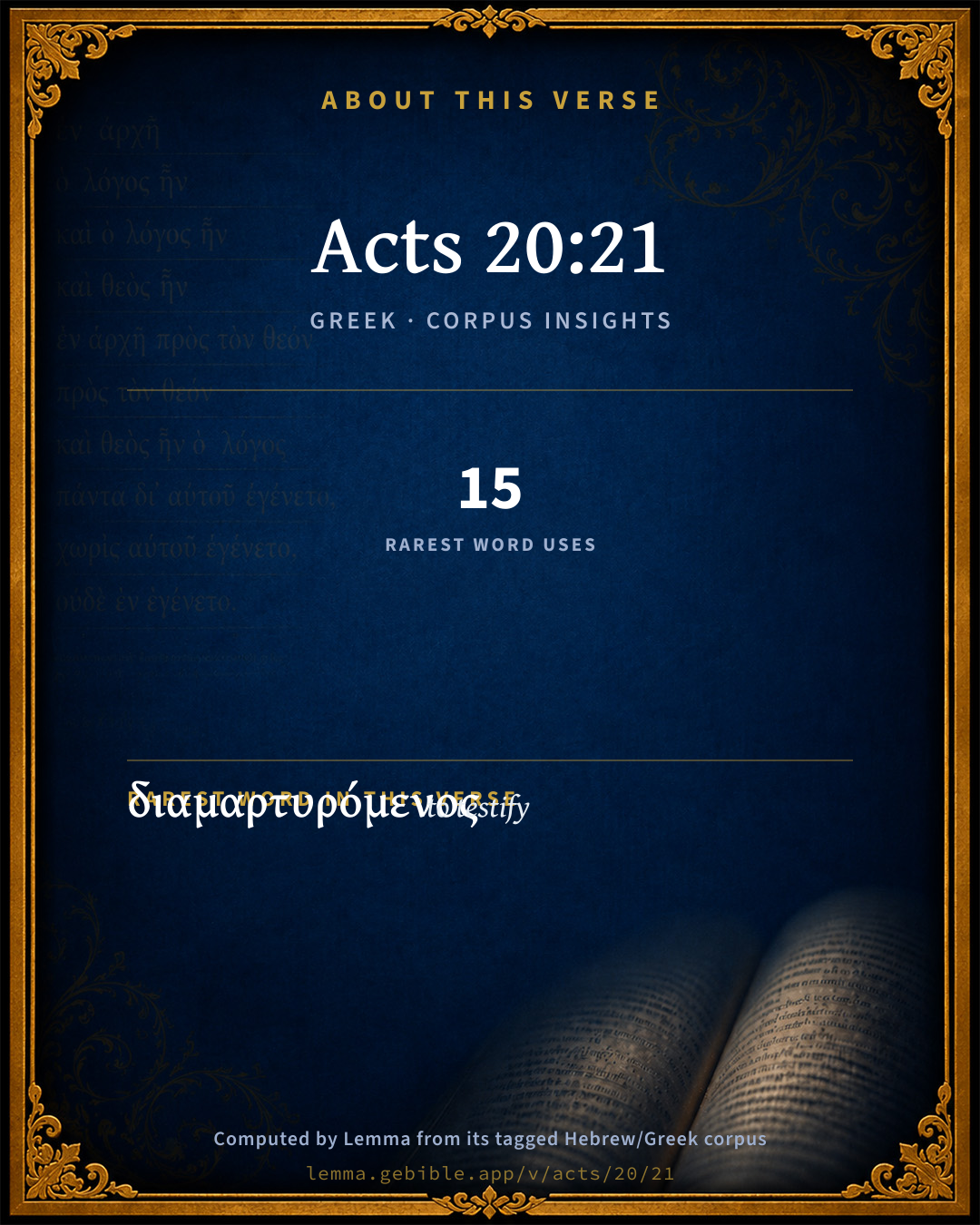
Acts 20:21

Greek (Tischendorf 8th ed.) Acts 20:21 appears in the Greek New Testament. The text above is from the Tischendorf 8th edition. Each word links to its Strong’s number and a concise gloss. Click any word for its full Thayer’s Greek Lexicon entry.

Download image
Cite this verse

Acts 20:21 (World English Bible). Public Domain. Lemma interlinear Bible study tool, https://lemma.gebible.app/v/acts/20/21.

Show BibTeX & RIS
BibTeX
RIS
English Translation
testifying both to Jews and to Greeks repentance toward God, and faith toward our Lord Jesus.
World English Bible · Public Domain
Download a study sheet

One document with this verse’s original text, its word-by-word gloss line, the meaning frame, cross-references with their text, attributed commentary, and full source and license credits — printable, and it pastes into notes with its structure intact.

This verse Autodidact and up

Study sheet (.html) Plain text (.txt)

A passage Seminary Student

Up to 50 verses in one chapter. A passage sheet keeps up to 6 commentary sources and 12 cross-references per verse, in the order this page ranks them, and says so on the sheet whenever that leaves anything out. Ask for a single verse and you get the Autodidact verse sheet above.

Everything on this page stays free to read, with no account — the sheet is a download of what is already on screen, not access to it.

Want to remove ads? Support Godless Engineer
Compare translations 3

The same verse in 3 English versions, stacked beneath the original-language interlinear above. Click any original word for its lexicon entry.

Each is an independent rendering of the whole verse — the interlinear is not word-aligned to these translations.

Highlighted words mark where these versions differ — a whole-verse word diff, not a word-by-word alignment.

  • World English Bible Public Domain
    testifying both to Jews and to Greeks repentance toward God, and faith toward our Lord Jesus.
  • King James Version Public Domain
    Testifying both to the Jews, and also to the Greeks, repentance toward God, and faith toward our Lord Jesus Christ.
  • unfoldingWord Literal Text CC BY-SA 4.0
    testifying to both Jews and Greeks repentance toward God and faith in our Lord Jesus.

unfoldingWord Literal Text — © unfoldingWord, licensed CC BY-SA 4.0. Word-aligned USFM3 via Door43 (git.door43.org/unfoldingWord/en_ult).

Versions to compare (up to 4)

3 of 4 selected

Show all 19 translations

Every available English version of this verse, each an independent rendering of the whole verse.

  • World English Bible Public Domain
    testifying both to Jews and to Greeks repentance toward God, and faith toward our Lord Jesus.
  • Berean Standard Bible Public Domain
    testifying to Jews and Greeks alike about repentance to God and faith in our Lord Jesus Christ.
  • Majority Standard Bible Public Domain
    testifying to Jews and Greeks alike about repentance to God and faith in our Lord Jesus.
  • King James Version Public Domain
    Testifying both to the Jews, and also to the Greeks, repentance toward God, and faith toward our Lord Jesus Christ.
  • American Standard Version (1901) Public Domain
    testifying both to Jews and to Greeks repentance toward God, and faith toward our Lord Jesus Christ.
  • Revised Version (1885) Public Domain
    testifying both to Jews and to Greeks repentance toward God, and faith toward our Lord Jesus Christ.
  • Geneva Bible (1599) Public Domain
    Witnessing both to the Iewes, and to the Grecians the repentance towarde God, and faith toward our Lord Iesus Christ.
  • Douay-Rheims (1899) Public Domain
    Testifying both to Jews and Gentiles penance towards God, and faith in our Lord Jesus Christ.
  • Young's Literal Translation Public Domain
    testifying fully both to Jews and Greeks, toward God reformation, and faith toward our Lord Jesus Christ.
  • Literal Standard Version CC BY-SA 4.0
    testifying fully both to Jews and Greeks, conversion toward God, and faith toward our Lord Jesus Christ.
  • Unlocked Literal Bible CC BY-SA 4.0
    testifying both Jews and Greeks about repentance toward God and of faith in our Lord Jesus.
  • unfoldingWord Literal Text CC BY-SA 4.0
    testifying to both Jews and Greeks repentance toward God and faith in our Lord Jesus.
  • Darby Bible Public Domain
    testifying to both Jews and Greeks repentance towards God, and faith towards our Lord Jesus Christ.
  • World Messianic Bible Public Domain
    testifying both to Jews and to Greeks repentance toward God and faith toward our Lord Yeshua.
  • Webster's Bible Public Domain
    Testifying both to the Jews, and also to the Greeks, repentance towards God, and faith towards our Lord Jesus Christ.
  • Free Bible Version CC BY-SA 4.0
    I witnessed both to Jews and Greeks that it was essential to repent and turn to God, and to trust in our Lord Jesus Christ.
  • Bible in Basic English Public Domain
    Preaching to Jews and to Greeks the need for a turning of the heart to God, and faith in the Lord Jesus Christ.
  • Text-Critical English NT CC BY 4.0
    testifying to both Jews and Greeks about repentance toward God and faith in our Lord Jesus.
  • Tyndale New Testament (1534) Public Domain
    witnessinge bothe to the Iewes and also to the Grekes the repentaunce toward God and faith towarde oure Lorde Iesu.

Literal Standard Version (2020), Covenant Press — licensed CC BY-SA 4.0. Text via the HelloAO Bible API (eBible.org). Unlocked Literal Bible (unfoldingWord) — licensed CC BY-SA 4.0. Text via the HelloAO Bible API (eBible.org). unfoldingWord Literal Text — © unfoldingWord, licensed CC BY-SA 4.0. Word-aligned USFM3 via Door43 (git.door43.org/unfoldingWord/en_ult). Free Bible Version, Dr. Jonathan Gallagher — licensed CC BY-SA 4.0. Text via the HelloAO Bible API (eBible.org).

Word by word

More ways to search: Search by grammar → Find every occurrence → Compare this word →

Practice this passage: Drill this verse → Learn its vocabulary →

διαμαρτυρόμενος
diamartýromai
G1263
“to testify”
Verb, Present, Middle or Passive deponent, Participle, Nominative, Singular, Masculine
Part of Speech
Verb
Tense
Present
Voice
Middle or Passive deponent
Mood
Participle
Case
Nominative
Number
Singular
Gender
Masculine
Full Thayer's Definition

Origin: from G1223 and G3140

TDNT: 12:30,6

1. to testify a. earnestly, religiously to charge 2. to attest, testify to, solemnly affirm a. to give solemn testimony to one b. to confirm a thing by testimony, to testify, cause it to be believed
  1. Ἰουδαίοις Ioudaîos G2453 “Jewish” Adjective, Dative, Plural, Masculine
  2. τε té G5037 “and” Particle
  3. καὶ kaí G2532 “and” Conjunction
  4. Ἕλλησιν Héllēn G1672 “Greek” Noun, Dative, Plural, Masculine
  5. τὴν ho G3588 “the” Article, Accusative, Singular, Feminine
  6. εἰς eis G1519 “into” Preposition
  7. θεὸν theós G2316 “God” Noun, Accusative, Singular, Masculine
  8. μετάνοιαν metánoia G3341 “repentance” Noun, Accusative, Singular, Feminine
  9. καὶ kaí G2532 “and” Conjunction
  10. πίστιν pístis G4102 “faith” Noun, Accusative, Singular, Feminine
  11. εἰς eis G1519 “into” Preposition
  12. τὸν ho G3588 “the” Article, Accusative, Singular, Masculine
  13. κύριον kýrios G2962 “Lord” Noun, Accusative, Singular, Masculine
  14. ἡμῶν hēmeîs G2249 “we” Personal pronoun, 1st person, Genitive, Plural
  15. Ἰησοῦν Iēsoûs G2424 “Jesus” Noun, Accusative, Singular, Masculine
  16. Χριστόν Christós G5547 “Christ” Noun, Accusative, Singular, Masculine

About this verse

These counts appear in no published source. They are computed here, from the morphology-tagged text and Lemma’s own curated glosses. What Lemma adds →

17
words
14
distinct lemmas
Acts
section

Notable vocabulary

The rarest word here is διαμαρτυρόμενος to testify G1263 — appearing just 15 times in the whole Greek New Testament.

Shared distinctive vocabulary

διαμαρτυρόμενος to testify G1263 occurs in 15 verses of the Greek New Testament. Also found in:

Repetition

Words recur within this verse:

Cross-references

49

Topical passages linked to Acts 20:21 in the Treasury of Scripture Knowledge — connected by theme and wording, ordered by reader-vote popularity; previews shown in the World English Bible.

  • Acts 2:38 Peter said to them, "Repent, and be baptized, everyone of you, in the name of Jesus Christ for the forgiveness of sins, and you will receive the gift of the Holy Spirit.
  • Acts 11:18 When they heard these things, they held their peace, and glorified God, saying, "Then God has also granted to the Gentiles repentance to life!"
  • 1 John 5:11–13 The testimony is this, that God gave to us eternal life, and this life is in his Son.
  • Luke 13:3 I tell you, no, but, unless you repent, you will all perish in the same way.
  • Luke 24:47 and that repentance and remission of sins should be preached in his name to all the nations, beginning at Jerusalem.
  • Acts 20:24 But these things don't count; nor do I hold my life dear to myself, so that I may finish my race with joy, and the ministry which I received from the Lord Jesus, to fully testify to the Gospel of the grace of God.
  • 2 Corinthians 7:10 For godly sorrow works repentance to salvation, which brings no regret. But the sorrow of the world works death.
  • 2 Timothy 2:25–26 in gentleness correcting those who oppose him: perhaps God may give them repentance leading to a full knowledge of the truth,
  • Acts 26:18 to open their eyes, that they may turn from darkness to light and from the power of Satan to God, that they may receive remission of sins and an inheritance among those who are sanctified by faith in me.'
  • Romans 10:9 that if you will confess with your mouth the Lord Jesus, and believe in your heart that God raised him from the dead, you will be saved.
  • Mark 6:12 They went out and preached that people should repent.
  • Acts 26:20 but declared first to them of Damascus, at Jerusalem, and throughout all the country of Judea, and also to the Gentiles, that they should repent and turn to God, doing works worthy of repentance.
  • 1 John 5:5 Who is he who overcomes the world, but he who believes that Jesus is the Son of God?
  • Matthew 4:17 From that time, Jesus began to preach, and to say, "Repent! For the Kingdom of Heaven is at hand."
  • Mark 1:15 and saying, "The time is fulfilled, and the Kingdom of God is at hand! Repent, and believe in the Gospel."
  • Acts 17:30 The times of ignorance therefore God overlooked. But now he commands that all people everywhere should repent,
  • Romans 1:16 For I am not ashamed of the Gospel of Christ, for it is the power of God for salvation for everyone who believes; for the Jew first, and also for the Greek.
  • Romans 4:24 but for our sake also, to whom it will be accounted, who believe in him who raised Jesus, our Lord, from the dead,
  • Romans 5:1 Being therefore justified by faith, we have peace with God through our Lord Jesus Christ;
  • Galatians 2:20 I have been crucified with Christ, and it is no longer I that live, but Christ living in me. That life which I now live in the flesh, I live by faith in the Son of God, who loved me, and gave himself up for me.
  • Ephesians 1:15 For this cause I also, having heard of the faith in the Lord Jesus which is among you, and the love which you have toward all the saints,
  • Philemon 1:5 hearing of your love, and of the faith which you have toward the Lord Jesus, and toward all the saints;
  • 1 John 5:1 Whoever believes that Jesus is the Christ is born of God. Whoever loves the father also loves the child who is born of him.
  • Ezekiel 18:30–32 Therefore I will judge you, house of Israel, everyone according to his ways, says the Lord Yahweh. Return you, and turn yourselves from all your transgressions; so iniquity shall not be your ruin.
  • Matthew 3:2 "Repent, for the Kingdom of Heaven is at hand!"
  • Matthew 21:31–32 Which of the two did the will of his father?" They said to him, "The first." Jesus said to them, "Most assuredly I tell you that the tax collectors and the prostitutes are entering into the Kingdom of God before you.
  • Luke 13:5 I tell you, no, but, unless you repent, you will all perish in the same way."
  • Luke 15:7 I tell you that even so there will be more joy in heaven over one sinner who repents, than over ninety-nine righteous people who need no repentance.
  • Luke 15:10 Even so, I tell you, there is joy in the presence of the angels of God over one sinner repenting."
  • John 3:15–18 that whoever believes in him should not perish, but have eternal life.
  • John 3:36 One who believes in the Son has eternal life, but one who disobeys the Son won't see life, but the wrath of God remains on him."
  • John 20:31 but these are written, that you may believe that Jesus is the Christ, the Son of God, and that believing you may have life in his name.
  • Acts 2:40 With many other words he testified, and exhorted them, saying, "Save yourselves from this crooked generation!"
  • Acts 3:19 "Repent therefore, and turn again, that your sins may be blotted out, so that there may come times of refreshing from the presence of the Lord,
  • Acts 8:25 They therefore, when they had testified and spoken the word of the Lord, returned to Jerusalem, and preached the Gospel to many villages of the Samaritans.
  • Acts 10:43 All the prophets testify about him, that through his name everyone who believes in him will receive remission of sins."
  • Acts 13:38–39 Be it known to you therefore, brothers, that through this man is proclaimed to you remission of sins,
  • Acts 16:31 They said, "Believe in the Lord Jesus Christ, and you will be saved, you and your household."
  • Acts 28:23 When they had appointed him a day, many people came to him at his lodging. He explained to them, testifying about the Kingdom of God, and persuading them concerning Jesus, both from the law of Moses and from the prophets, from morning until evening.
  • Romans 1:14 I am debtor both to Greeks and to foreigners, both to the wise and to the foolish.
  • Romans 2:4 Or do you despise the riches of his goodness, forbearance, and patience, not knowing that the goodness of God leads you to repentance?
  • Romans 3:22–26 even the righteousness of God through faith in Jesus Christ to all and on all those who believe. For there is no distinction,
  • 1 Corinthians 1:22 For Jews ask for signs, Greeks seek after wisdom,
  • Galatians 2:16 yet knowing that a man is not justified by the works of the law but through the faith of Jesus Christ, even we believed in Christ Jesus, that we might be justified by faith in Christ, and not by the works of the law, because no flesh will be justified by the works of the law.
  • Galatians 3:22 But the Scriptures shut up all things under sin, that the promise by faith in Jesus Christ might be given to those who believe.
  • Acts 18:4–5 He reasoned in the synagogue every Sabbath, and persuaded Jews and Greeks.
  • Acts 19:17 This became known to all, both Jews and Greeks, who lived at Ephesus. Fear fell on them all, and the name of the Lord Jesus was magnified.
  • Acts 24:24 But after some days, Felix came with Drusilla, his wife, who was a Jewess, and sent for Paul, and heard him concerning the faith in Christ Jesus.
  • Colossians 2:5 For though I am absent in the flesh, yet am I with you in the spirit, rejoicing and seeing your order, and the steadfastness of your faith in Christ.

Cross-references courtesy of OpenBible.info (CC BY 4.0).

Where the printed editions differ

1 variant

Places in this verse where the major printed Greek editions disagree on the wording in a way that affects the translation — a comparison of editions, not a manuscript-by-manuscript collation. The editions are the modern critical texts (Nestlé-Aland 28/27, SBL, Westcott-Hort, Tregelles, Tyndale House) and the traditional texts behind the KJV (the Textus Receptus and the Byzantine/Majority text). It is not a claim about which reading is original.

  1. Extra text
    Χριστόν.

    “Christ.”

    In NA28TregTR Not in NA27TynSBLWHByz

    Χριστόν.¶ (Christon) 'Christ.' is only in traditional manuscripts (NA28+Treg+TR)

Textual data: Translators Amalgamated Greek New Testament (STEPBible TAGNT) · CC BY 4.0.

Commentary

Notes on Acts 20:21 from classic Christian and Jewish commentators (each source and its license shown beneath its notes). The classic Christian expositions comment on the surrounding passage and are grouped to its opening verse, so a note may address several verses; the Jewish commentaries on the Tanakh (Rashi and others) are per-verse, so they appear only where the commentator wrote on this verse.

Lemma curates 59 commentaries, every one of them public domain or Creative Commons licensed, each selected and text-cleaned for this edition rather than reprinted as found. About our sources →

Bengel's Gnomon

Johann Albrecht Bengel

Act 20:21. Τὴν) The sum of those things which are profitable is the sum of Christian doctrine, the sum of the Divine counsel, Repentance and Faith.—εἰς, towards) repentance, whereby men betake themselves to God. Refer this to the Greeks, who were mentioned just before; and refer the word faith to the Jews who betake themselves to Christ, mentioned a little before. It is a Chiasmus, as in Philem. Act 20:5, where see the note. [The Jews ([115]); the Greeks ([116]); Repentance ([117]); Faith ([118]): [119] refers to [120]; [121] to [122]: inverted Chiasmus. See Append. on the distinction of Immediate Relation, Direct Chiasmus, and Inverted.]

[115] the Alexandrine MS.: in Brit. Museum: fifth century: publ. by Woide, 1786–1819: O. and N. Test. defective.

[116] the Vatican MS., 1209: in Vat. Iibr., Rome: fourth cent.: O. and N. Test. def.

[117] Ephræmi Rescriptus: Royal libr., Paris: fifth or sixth cent.: publ. by Tisch. 1843: O. and N. T. def.

[118] Bezæ, or Cantabrig.: Univ. libr., Cambridge: fifth cent.: publ. by Kipling, 1793: Gospels, Acts, and some Epp. def.

[119] the Alexandrine MS.: in Brit. Museum: fifth century: publ. by Woide, 1786–1819: O. and N. Test. defective.

[120] Bezæ, or Cantabrig.: Univ. libr., Cambridge: fifth cent.: publ. by Kipling, 1793: Gospels, Acts, and some Epp. def.

[121] the Vatican MS., 1209: in Vat. Iibr., Rome: fourth cent.: O. and N. Test. def.

[122] Ephræmi Rescriptus: Royal libr., Paris: fifth or sixth cent.: publ. by Tisch. 1843: O. and N. T. def.

Bengel's Gnomon of the New Testament — English translation (T&T Clark, Edinburgh, 1860) — public domain. Text from a community e-Sword module.

Expositor's Greek Testament

ed. W. Robertson Nicoll

Act 20:21 . διαμαρτ ., see above on p. 92; Lucan Pauline. μετάν . καὶ πίστιν , cf. the earliest notes in the preaching of Jesus, Mar 1:15 , and these were equally the notes of the preaching of St. Peter and St. Paul alike. Whether Paul was preaching to Jews or Gentiles, to philosophers at Athens or to peasants at Lystra, the substance of his teaching was the same under all varieties of forms, cf. Act 14:15 , Act 17:30 , Act 26:20 . It is quite arbitrary to refer μετάνοια to the Gentile and πίστις to the Jew. Ἰουδ . τε καὶ Ἕλλησι , Pauline, cf. Rom 1:16 ; Rom 2:9-10 ; Rom 3:9 ; Rom 3:12 , 1Co 1:24 .

The Expositor's Greek Testament, edited by W. Robertson Nicoll (1897–1910) — public domain. Text from a community e-Sword module.

Jamieson, Fausset & Brown

Robert Jamieson, A. R. Fausset & David Brown

Testifying both to Jews and . . . Greeks--laboring under a common malady, and recoverable only by a common treatment.

repentance toward God, and faith toward our Lord Jesus Christ--(See on Act 5:31). REPENTANCE, as distinguished from faith, is that state of the "honest and good heart" which arises from a discovery of one's contrariety to the righteous demands of the divine law. This is said to be "toward God," because seeing Him to be the party dishonored by sin, it feels all its acknowledgments and compunctions to be properly due to Him, as the great Lawgiver, and directs them to Him accordingly; condemning, humbling itself, and grieving before Him, looking also to Him as its only Hope of deliverance. FAITH is said to be "toward our Lord Jesus Christ," because in that frame of mind just described it eagerly credits the testimony of relief divinely provided in Christ, gladly embraces the overtures of reconciliation in Him, and directs all its expectations of salvation, from its first stage to its last, to Him as the one appointed Medium of all grace from God to a sinful world. Thus we have here a brief summary of all Gospel preaching. And it is easy to see why repentance is here put before faith; for the former must of necessity precede the latter. There is a repentance subsequent to faith, the fruit of felt pardon and restoration. It was this which drew the tears with which the Saviour's feet were once so copiously moistened. (Luk 7:37-38, Luk 7:47; and compare Eze 16:63). But that is not the light in which it is here presented.

Jamieson, Fausset & Brown — Commentary Critical and Explanatory on the Whole Bible (1871) — public domain (CC PDM 1.0). Text via the HelloAO Bible API.

Adam Clarke's Commentary

Verse 21. Testify both to - Jews and - Greeks] He always began with the Jews; and, in this case, he had preached to them alone for three months, Ac 19:8-10, and only left their synagogues when he found, through their obstinacy, he could do them no good.

Repentance toward God, c.] As all had sinned against God, so all should humble themselves before him against whom they have sinned but humiliation is no atonement for sin; therefore repentance is insufficient, unless faith in our Lord Jesus Christ accompany it. Repentance disposes and prepares the soul for pardoning mercy; but can never be considered as making compensation for past acts of transgression. This repentance and faith were necessary to the salvation both of Jews and Gentiles; for all had sinned, and come short of God's glory. The Jews must repent, who had sinned so much, and so long, against light and knowledge. The Gentiles must repent, whose scandalous lives were a reproach to man. Faith in Jesus Christ was also indispensably necessary; for a Jew might repent, be sorry for his sin, and suppose that, by a proper discharge of his religious duty, and bringing proper sacrifices, he could conciliate the favour of God: No, this will not do; nothing but faith in Jesus Christ, as the end of the law, and the great and only vicarious sacrifice, will do; hence he testified to them the necessity of faith in this Messiah. The Gentiles might repent of their profligate lives, turn to the true God, and renounce all idolatry: this is well, but it is not sufficient: they also have sinned, and their present amendment and faith can make no atonement for what is past; therefore, they also must believe on the Lord Jesus, who died for their sins, and rose again for their justification.

Adam Clarke's Commentary on the Bible (1810–1826) — public domain. Text from a community e-Sword/MySword module.

John Calvin's Commentaries

21. Testifying both to Jews. Descending now unto the third point, he setteth down the sum of this doctrine in a few words, to wit, that he exhorted all men unto faith and repentance, as it was said before, that the gospel consisteth upon [of] these two points only. Whence we do also gather wherein the true edifying of the Church doth properly consist, the care and burden whereof doth lie upon the pastor’s shoulders, and whereunto we must apply all our study, if we be desirous to profit profitably in God’s school. We have already said that the word of God is profaned, when the readers of the same do occupy themselves in frivolous questions. But to the end we may not read the same wanderingly, we must note and aim at this double mark which the apostle setteth before us. For whosoever he be that turneth unto any other thing, in taking great pains, he shall do nothing else but walk in a circuit. By the word testify he expresseth great vehemency, as if he should have said that by testifying he did commend, that the excuse of ignorance might not remain. For he alludeth unto the custom used in courts, where testifying is used to take away all doubt. As men are not only to be taught, but also to be constrained to embrace salvation in Christ, and to addict themselves to God, to lead a new life. And though he affirm that he was wanting to none, yet doth he place the Jews in the first place; because, as the Lord hath preferred them in the degree of honor before the Gentiles, so it was meet that Christ and his grace should be offered them until they should quite fall away.

Repentance toward God. We must first note the distinction of faith and repentance, which some do falsely and unskillfully confound, saying, that repentance is a part of faith. I grant, indeed, that they cannot be separate; because God doth illuminate no man with the Spirit of faith whom he doth not also regenerate unto newness of life. Yet they must needs be distinguished, as Paul doth in this place. For repentance is a turning unto God, when we frame ourselves and all our life to obey him; but faith is a receiving of the grace offered us in Christ. For all religion tendeth to this end, that, embracing holiness and righteousness, we serve the Lord purely, also that we seek no part of our salvation anywhere else save only at his hands, and that we seek salvation in Christ alone. Therefore, the doctrine of repentance containeth a rule of good life; it requireth the denial of ourselves, the mortifying of our flesh, and meditating upon the heavenly life. But because we be all naturally corrupt, strangers from righteousness, and turned away from God himself. Again, because we fly from God, because we know that he is displeased with us, the means, as well to obtain free reconciliation as newness of life, must be set before us.

Therefore, unless faith be added, it is in vain to speak of repentance; yea, those teachers of repentance who, neglecting faith, stand only upon the framing of life, and precepts of good works, differ nothing, or very little from profane philosophers. They teach how men must live; but, forasmuch as they leave men in their nature, there can no bettering be hoped for thence, until they invite those who are lost unto hope of salvation; until they quicken the dead, promising forgiveness of sins; until they show that God doth, by his free adoption, take those for his children who were before bond-slaves of Satan; until they teach that the Spirit of regeneration must be begged at the hands of the heavenly Father, that we must draw godliness, righteousness, and goodness, from him who is the fountain of all good things. And hereupon followeth calling upon God, which is the chiefest thing in the worship of God.

We see now how that repentance and faith are so linked together that they cannot be separate. For it is faith which reconcileth God to us, not only that he may be favorable unto us, by acquitting us of the guiltiness of death, by not imputing to us our sins, but also that by purging the filthiness of our flesh by his Spirit, he may fashion us again after his own image. He doth not, therefore, name repentance in the former place, as if it did wholly go before faith, forasmuch as a part thereof proceedeth from faith, and is an effect thereof; but because the beginning of repentance is a preparation unto faith. I call the displeasing of ourselves the beginning, which doth enforce us, after we be thoroughly touched with the fear of the wrath of God, to seek some remedy.

Faith toward Christ. It is not without cause that the Scripture doth everywhere make Christ the mark whereat our faith must aim, and as they say commonly, set him before us as the object. For the majesty of God is of itself higher than that men can climb thereunto. Therefore, unless Christ come between, all our senses do vanish away in seeking God. Again, inasmuch as he is the Judge of the world, it must needs be that the beholding of him without Christ shall make us afraid. But God doth not only represent himself unto us in Christ’s image, but also refresh us with his Fatherly favor, and by all means restore us to life. For there is no part of our salvation which may not be found in Christ. By the sacrifice of his death he hath purged our sins; he hath suffered the punishment that he might acquit us; he hath made us clean by his blood; by his obedience he hath appeased his Father’s wrath; by his resurrection he hath purchased righteousness for us. No marvel, therefore, if we said, that faith must be fixed in the beholding of Christ.

John Calvin's Commentaries (1540-1563) — public domain. Text from the Calvin Translation Society English edition (1840s-50s) via the Christian Classics Ethereal Library (ccel.org). Calvin's coverage is partial (roughly two-thirds of the Bible); uncommented books and verses are honest gaps, never fabricated. The 19th-century editor's footnotes and remarks are omitted so the notes are faithfully Calvin's own voice.

Ellicott's Commentary for English Readers

(21) Repentance toward God, and faith toward our Lord Jesus Christ.—These, under all varieties of form, whether speaking to Jews or Gentiles, to philosophers at Athens (Act_17:30) or peasants of Lystra (Act_14:15), formed the substance of his teaching. It is obvious, however, that out of these might be developed a whole system of theology—why repentance was needed, and what it was, and how it should show itself, what was involved in the statement that Jesus was the Christ, and why men should believe in Him, and what works were the proper fruit of faith. All these were questions which had to be answered, before even the most elementary truths could be rightly apprehended.

A Bible Commentary for English Readers, edited by Charles John Ellicott (1878–1897) — public domain. Text from a community e-Sword module.

The Cambridge Bible for Schools and Colleges

gen. ed. J. J. S. Perowne

21. testifying, &c.… to the Greeks] The Rev. Ver. omits “the” before both nouns, the Greek having no article. “Both to Jews and to Greeks.” By “testifying” is meant “proclaiming the need of.” And this message the Apostle would support by his own witness.

repentance … Christ] By some MSS. the last word is omitted. Some have seen in these two clauses a reference to the character of the preaching, “repentance” indicating what was most needful for the Gentiles, and “faith toward our Lord” the demand made upon the Jews. This however seems fanciful, especially when we remember the Pentecostal sermon of St Peter (Act_2:38) which was certainly addressed to Jews rather than Gentiles, “Repent, and be baptized every one of you.”

The Cambridge Bible for Schools and Colleges (gen. ed. J. J. S. Perowne; Cambridge University Press, 1878–1918) — public domain. Text from a community e-Sword module.

John Gill's Exposition

And now behold, I go bound in the spirit unto Jerusalem,.... Not in his own spirit, though the Ethiopic version reads, "in my spirit"; as if he was pressed and straitened, and troubled within himself, at what afflictions and bonds he was to endure at Jerusalem; for this is not consistent with what he says in Act 20:24 nor is the sense, that he was bound in conscience and duty to go to Jerusalem, to carry the collections of the churches made for the poor saints there, which the Gentile churches importuned him to take upon him, and which he undertook, and promised to perform, and so was under obligation to do it; but rather that he was resolved and determined in his own mind, within himself, or he purposed in his spirit, as in Act 19:21 to go to Jerusalem: but it is best to understand it of the Spirit of God; as that either the apostle, by the revelation of the Spirit of God, knew that when he came to Jerusalem he should be laid in bonds, and under a deep impression of that upon his mind, he went thither, as though he was bound already; or rather that he was under such a strong impulse of the Spirit of God, by which he was moved to such a vehement desire to go thither, that the bonds and afflictions he saw waited for him there, could not deter him, and all the entreaties of his friends could not dissuade him from it:

not knowing the things that shall befall me there; that is, the particular things he should suffer there, nor how they would issue with respect to life or death; and if the latter, whether he should suffer death, there or elsewhere; these things were not as yet revealed to him; he only in general knew, that bonds and afflictions would be his lot and portion, and which therefore he excepts in the next verse: after this it was revealed to him by Agabus a prophet, in the name, and under the influence of the Holy Ghost, that he should be apprehended at Jerusalem, and should be bound and delivered to the Gentiles; which was signified by the prophet's taking his girdle and binding his hands and feet with it, but still he knew not whether he should die there or not, though he was ready for it, Act 21:10 afterwards when he was come to Jerusalem, and had been bound, and was in prison, the Lord himself appeared to him, and told him that he must bear witness at Rome, as he had testified of him at Jerusalem, Act 23:11 so that he was not to suffer death there, only bonds and imprisonment.

John Gill's Exposition of the Whole Bible (1746–1763) — public domain (CC PDM 1.0). Text via the HelloAO Bible API.

Trapp's Complete Commentary

John Trapp

21 Testifying both to the Jews, and also to the Greeks, repentance toward God, and faith toward our Lord Jesus Christ.

Ver. 21. Testifying] Not barely preaching, but vehemently pressing (as matters of greatest importance).

Repentance towards God] Not a desperate repentance (as was that of Judas), that drives men from God, but such as draws them towards him, and brings them before him, submitting to his justice, and imploring his mercy, as at the meet at Mizpeh, 1Sa 7:5.

Faith towards Jesus Christ] Repentance is put first, because initial repentance is a preparation to effectual faith. See Mar 1:15. {See Trapp on "Mar 1:15"}

John Trapp, A Commentary or Exposition upon All the Books of the Old and New Testament (1647–1656) — public domain. Text from a community e-Sword module.

Albert Barnes' Notes on the Bible

Testifying - Bearing witness to the necessity of repentance toward God. Or teaching them the nature of repentance, and exhorting them to repent and believe. Perhaps the word “testifying” includes both ideas of giving evidence, and of urging with great earnestness and affection that repentance and faith were necessary. See 1Ti 5:21; 2Ti 2:14; where the word used here, and here translated “testify,” is there translated correctly, “charge,” in the sense of “strongly urging, or entreating with great earnestness.”

And also to the Greeks - To all who were not Jews. “The Greeks” properly denoted “those who lived in Greece, and who spoke the Greek language.” But the phrase, “Jews and Greeks,” among the Hebrews, denoted “the whole human race.” He urged the necessity of repentance and faith in all. Religion makes no distinction, but regards all as sinners, and as needing salvation by the blood of the Redeemer.

Repentance toward God - See the notes on Mat 3:2. Repentance is to be exercised “toward God,” because:

Sin has been committed against him, and it is proper that we express our sorrow to the Being whom we have offended; and, Because only God can pardon. Sincere repentance exists only where there is a willingness to make acknowledgment to the very Being whom we have offended or injured.

And faith - See the notes on Mar 16:16.

Toward - εἰς eis. In regard to; in; confidence in the work and merits of the Lord Jesus. This is required, because there is no other one who can save from sin. See the notes on Act 4:12.

Albert Barnes' Notes on the Bible (1834–1885) — public domain. Text from a community e-Sword/MySword module.

Matthew Poole's English Annotations

Testifying to all sorts and conditions of men, for there is no difference with God, that repentance would be accepted from them by God, and that he was ready to give repentance unto them, as Act 11:18; and that faith in the Lord Jesus Christ was the true saving faith, there being no other name given whereby we may be saved. Upon these two depends the whole gospel, and our salvation by it.

Matthew Poole's English Annotations on the Holy Bible (1683–1685) — public domain. Text from a community e-Sword/MySword module.

Whedon's Commentary on the Bible

Daniel D. Whedon

21. Repentance… faith—This is the order of all true conversion. First, the renunciation of all sin, and the turning from Satan to God. But what avails repentance and there stopping? Faith must finish the work repentance commences.

Daniel D. Whedon (gen. ed.), Commentary on the Old and New Testaments (1874–1909) — public domain. Text from a community e-Sword module.

The Pulpit Commentary

To Jews and to Greeks for both to the Jews, and also to the Greeks, A.V. (see Act_19:10, Act_19:17) Repentance, etc. The two cardinal points of gospel teaching, as they are the two necessary qualities for every Christian man. "Repentance whereby we forsake sin, and faith whereby we steadfastly believe the promises of God." There is no ground for the remarks of Kuinoel and others, that repentance is to be referred chiefly to the Gentiles, and faith to the Jews. (see Act_2:38 Act_3:19 Act_5:31, etc.; Mar_1:15, etc.)

Paul at Miletus; the substance of Christian doctrine.

Surely we have here an excellent summary of distinctive Christian doctrine. These two things are the essentials of Christian truth. Without repentance there can be no living faith; without faith there can be no real spiritual life; with both of these, a man is a recognized citizen of the kingdom of God, an inheritor of eternal life. There must be

I THE TURNING OF THE HEART AND LIFE UNTO GOD. This is what constitutes repentance. Repentance may include, but is not constituted by:

1. Strong feelings of sorrow and shame in view of past sin. It is possible and even common to produce very pungent and powerful feelings by means of energetic oratory; but these, if they are not real, profound convictions, will be temporary, if not even momentary; they are not the essential thing. Repentance will, at some time, include strong feeling of abhorrence of sin, but it may net commence with vivid and convulsive emotions, and is not to be identified with these.

2. Change of outward behavior. It is indeed true that, when really penitent, the idolater will abandon his idolatry, the thief his dishonesty, the drunkard his intemperance, the liar his falsehoods, the truculent man his violence, etc.; but it must be remembered that men sometimes change their habits for other reasons than those of religious conviction. Amendment in outward behavior, valuable and desirable as it is, does not constitute repentance unto God;" it has also to be considered that there may be, and often is, the truest repentance where there is no alteration of conduct observable by man. The essence of repentance is the turning of the heart to God, and therefore of the life; it is that "change of mind" which consists in the soul turning from forgetfulness of God to thoughtfulness about him, from indifference to his claims to earnest consideration of them, from unwillingness to own his sway to a perfect readiness to yield everything to him, from the guilty retention of our powers for ourselves to a cheerful surrender of ourselves and our days to the living God, our Father and our Redeemer. Thence will follow all the compunction for sin and all the change of conduct which the past career of the soul will demand. Of this "Greek and Jew" alike have need: the Greek (the Gentile) has need to change his thought of God, and the Jew his also; whether from superstition, or from indifference, or from formality, all have to come into a different relation to God that of humble subjection to his will and surrender to his service.

II THE ACCEPTANCE OF JESUS CHRIST AS LORD AND SAVIOR. "And faith toward our Lord Jesus Christ." The faith of which Paul testified to Greek and Jew was, we are sure, a living power. It was not a mere passive assent to a form of sound words. It was more than an intellectual acceptance of certain propositions. It was the cordial, hearty acceptance by the soul of a Divine Savior and Lord; it was the soul in all its need welcoming a Redeemer in all his strength to save and bless. It meant that acceptance of Jesus Christ in which the soul, conscious of sin and condemnation, flees to him as to the Rock in which it can hide; in which the heart, recognizing its rightful Lord, goes to him in glad self-surrender, and yields itself to him that he may

(1) guide it in his own paths,

(2) use it for his own glory, and

(3) conduct it to his own kingdom. C.

The ambassador"s message.

"Testifying both to the Jews," etc.

I THE UNIVERSAL REQUIREMENT,

1. The temptations of Jews and Greeks, by which they were hindered from repenting and believing formalism; self-righteousness; ritualism; ignorance. Both in the synagogue and in the heathen temple need of such a proclamation.

2. The blessedness of the change which such a message would effect, The Jewish and Gentile characters, though very different, both requiring an entire renovation. Helplessness apart from the gospel. The message worked wonders in families. Contrast of the new life of the Christian Church with the old life of Judaism and paganism. The same message the substance of all Christian teaching, both in our own populations and in heathen lands.

II THE FIRM FOUNDATION OF MINISTERIAL SUCCESS. The testimony was clear and undoubted; public and private. Repentance and faith.

1. Apostolic preaching aimed at personal conversion. It was not merely intellectual, or sentimental, or doubtful in doctrine, or perfunctory and cold.

2. The foundation on which the truth was placed was the firm one of the gospel facts. Repentance looked towards God who had spoken in the Old Testament, and faith looked towards Christ whose life, death, resurrection, and ascension Paul testified. Mere change of life is not all, but spiritual renovation through Christ.

3. A clear announcement from the pulpit must be accompanied by a faithful testimony from house to house. The private ministry is as important as the public.

4. Such a testimony of repentance and faith involves all who listen to it in immeasurable responsibility. Let each ere add to his seal by personal repentance and personal faith. R.

Vers. 21, 24. Paul"s testimony.

repentance toward God, and faith toward our Lord Jesus Christ." "To testify the gospel of the grace of God." The main lines of the apostle"s work are nowhere given more simply or more clearly than in these sentences. Dean Plumptre suggestively says, "These," viz. repentance and faith, "under all varieties of form, formed the substance of the apostle"s teaching. It is obvious, however, that out of these might be developed a whole system of theology; why repentance was needed, and what it was, and how it should show itself; what was involved in the statement that Jesus was the Christ, and why men should believe in him, and what works were the proper fruit of faith. All these were questions which had to be answered before even the most elementary truths could be rightly apprehended." St. Paul"s ministry consisted in this, bearing witness, "especially as a living example of its power, (1Ti_1:12-16) of the good tidings that God was not a harsh Judge, but a gracious Father, willing all men to be saved, (1Ti_2:4) that was the truth to the proclamation of which his life was to be devoted." As the subjects are familiar, only an outline of treatment is necessary. We take the latter expression first, as being the more general one.

I GOD"S GRACE UNTO FORGIVENESS. The gospel is precisely a message concerning God. It is:

1. A corrective message. God is not as men have thought.

2. A revealing message, bringing to light the fact that, by a sublime act of self-sacrifice, he has declared himself to be love, and has shown his grace.

3. A practical message, bearing directly on our sins, and giving assurance of forgiveness.

II GOD"S CONDITIONS FOR THE MANIFESTATION OF HIS GRACE UNTO FORGIVENESS. Without conditions we should set no value on the grace, the gift, or the forgiveness. The conditions are reasonable and necessary. They are:

1. Repentance. If we are not troubled about out" sin, we shall not care about forgiveness.

2. Faith. If we do not open our hearts to God, he cannot work his good work in us. These are gospel foundations; but how much we have to build thereon! R.T.

The Pulpit Commentary (1880–1919), ed. H.D.M. Spence-Jones & Joseph S. Exell — public domain. Text from a community e-Sword module.

John Wesley's Explanatory Notes

Repentance toward God - The very first motion of the soul toward God is a kind of repentance.

John Wesley, Explanatory Notes Upon the Whole Bible (1754–1765) — public domain. Text via the GEBible commentary corpus.

McGarvey & Pendleton's Commentaries

J. W. McGarvey

See notes on verse 18

J. W. McGarvey (with Philip Y. Pendleton), Commentaries on the New Testament (The Fourfold Gospel, 1914; Acts; and the epistles) — public domain. Text from a community e-Sword/MySword module.

Cambridge Greek Testament for Schools and Colleges

21. διαμαρτυρόμενος, testifying, i.e. proclaiming to them their need of.

Here Chrysostom says: οὐχὶ πρὸς ὑμᾶς, φησί, μόνον, ἀλλὰ καὶ πρὸς Ἕλληνας. ἐνταῦθα ἡ παῤῥησία. καὶ ὅτι κἃν μηδὲν ὠφελῶμεν λέγειν δεῖ. τὸ γὰρ διαμαρτύρασθαι τοῦτό ἐστιν, ὅταν πρὸς τοὺς μὴ προσέχοντας λέγωμεν.

Cambridge Greek Testament for Schools and Colleges (Cambridge University Press, 1896; 21 vols, various authors incl. Carr, Maclear, Plummer, Farrar, Lumby, Moule, M. R. James, Simcox) — public domain. Text from a community e-Sword module.

Alford’s Greek Testament

Henry Alford

21. εἰς θ … εἰς τ. κύρ Ἰ.] This use of εἰς is mostly Pauline: and in ch. 24:24 it seems to be taken from his own expression.

Henry Alford, The Greek Testament (1849–1861) — public domain. Text from a community e-Sword module.

Vincent's Word Studies in the New Testament

Marvin R. Vincent

Repentance toward God. Repentance has the article : the repentance which is due to God. So, also, faith : the faith which is due toward Christ, as the advocate and mediator.

Act 20:29Bound in the spirit. In his own spirit. Constrained by an invincible sense of duty. Not by the Holy Spirit, which is mentioned in the next verse and distinguished by the epithet the Holy.

Act 20:23Testifieth [διαμαρτυρεται] . The compound verb signifies full, clear testimony. Not by internal intimations of the Spirit, but by prophetic declarations "in every city." Two of these are mentioned subsequently, at Tyre and Caesarea (ch Act 21:4, 11).

Marvin R. Vincent, Word Studies in the New Testament (1887–1900) — public domain. Text from a community e-Sword/MySword module.

Lesson kit

Teaching starters — assembled from the data on this page, not authored interpretation. Every prompt links to the verse data it draws on. Edit before teaching.

Acts, in the Acts, opens this verse with 17 words (14 distinct Greek lemmas). Its most distinctive word is diamartýromai (“to testify”). A historical commentator’s framing appears above. Read the whole chapter for the surrounding context.

Discussion questions

  1. What does “to testify” (diamartýromai) contribute to the verse as a whole?
  2. Luke 16:28 shares the word «to testify» with this verse. How do the two illuminate each other?
  3. “into” occurs 2× in this one verse. What is the effect of the repetition?
  4. These translations render this verse differently; the difference is in the English rendering, not the original. What questions does that raise?
  5. Reading how Bengel's Gnomon and Expositor's Greek Testament read this verse, where do the two commentators agree and where do they part?

Things to notice

  • These translations choose different wording for 2 words in this verse.
  • “into” occurs 2× in this single verse.
  • 14 distinct Greek lemmas span 17 words in this verse.

Reading settings

Reading text

Shown beneath each verse's original-language words.

Old Testament
Old Testament edition

Read the OT as the Masoretic Hebrew (MT) or the Greek Septuagint (LXX).

English shown for the Greek Septuagint (in the Hebrew ↔ Greek comparison).

Comparing translations? Open the Compare panel on any verse page to stack up to four side by side.