
Acts 20:19

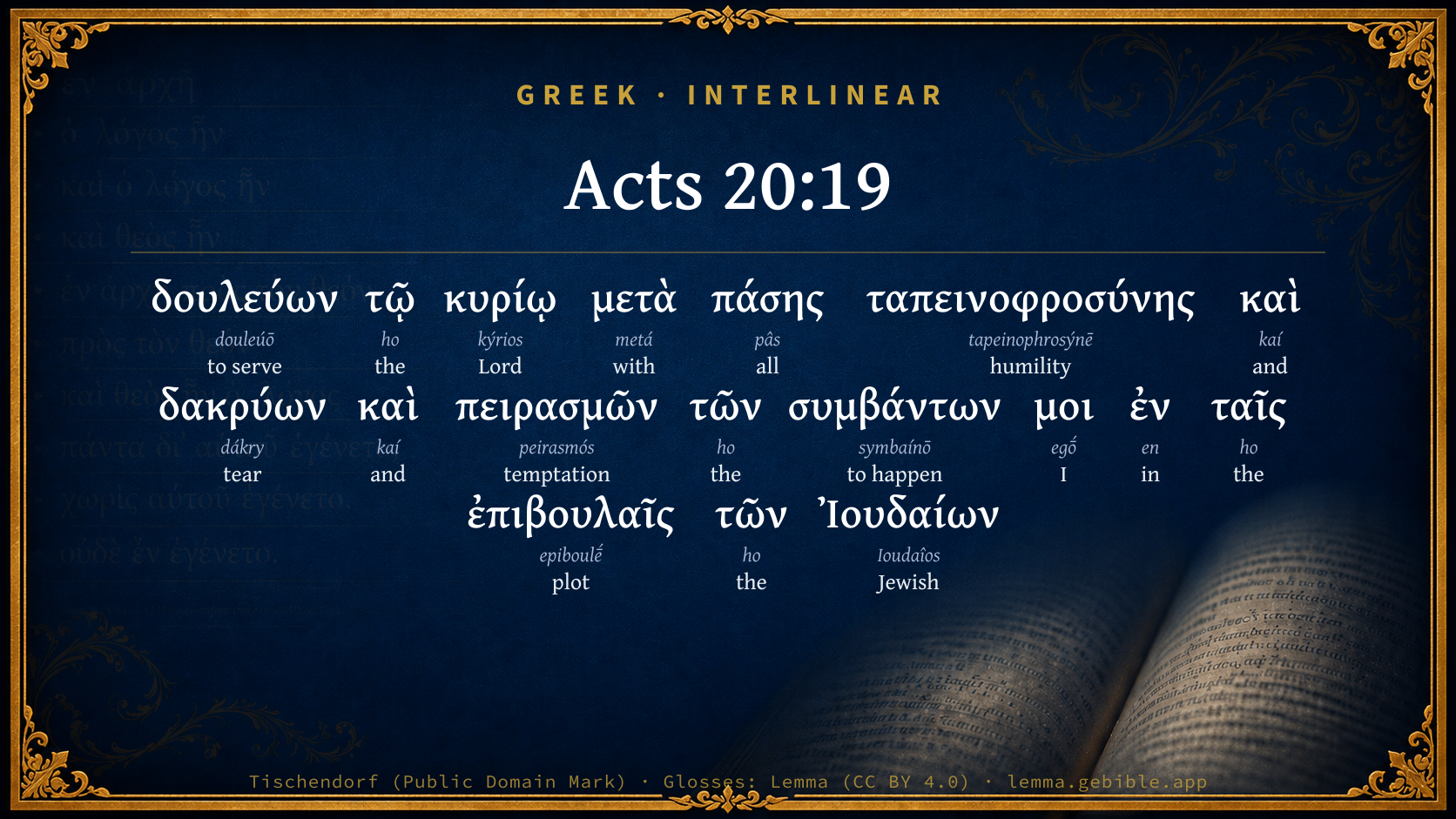
Greek (Tischendorf 8th ed.) Acts 20:19 appears in the Greek New Testament. The text above is from the Tischendorf 8th edition. Each word links to its Strong’s number and a concise gloss. Click any word for its full Thayer’s Greek Lexicon entry.
Download image
Cite this verse

Acts 20:19 (World English Bible). Public Domain. Lemma interlinear Bible study tool, https://lemma.gebible.app/v/acts/20/19.

Show BibTeX & RIS
BibTeX
RIS
English Translation
serving the Lord with all humility, with many tears, and with trials which happened to me by the plots of the Jews;
World English Bible · Public Domain
Highlights
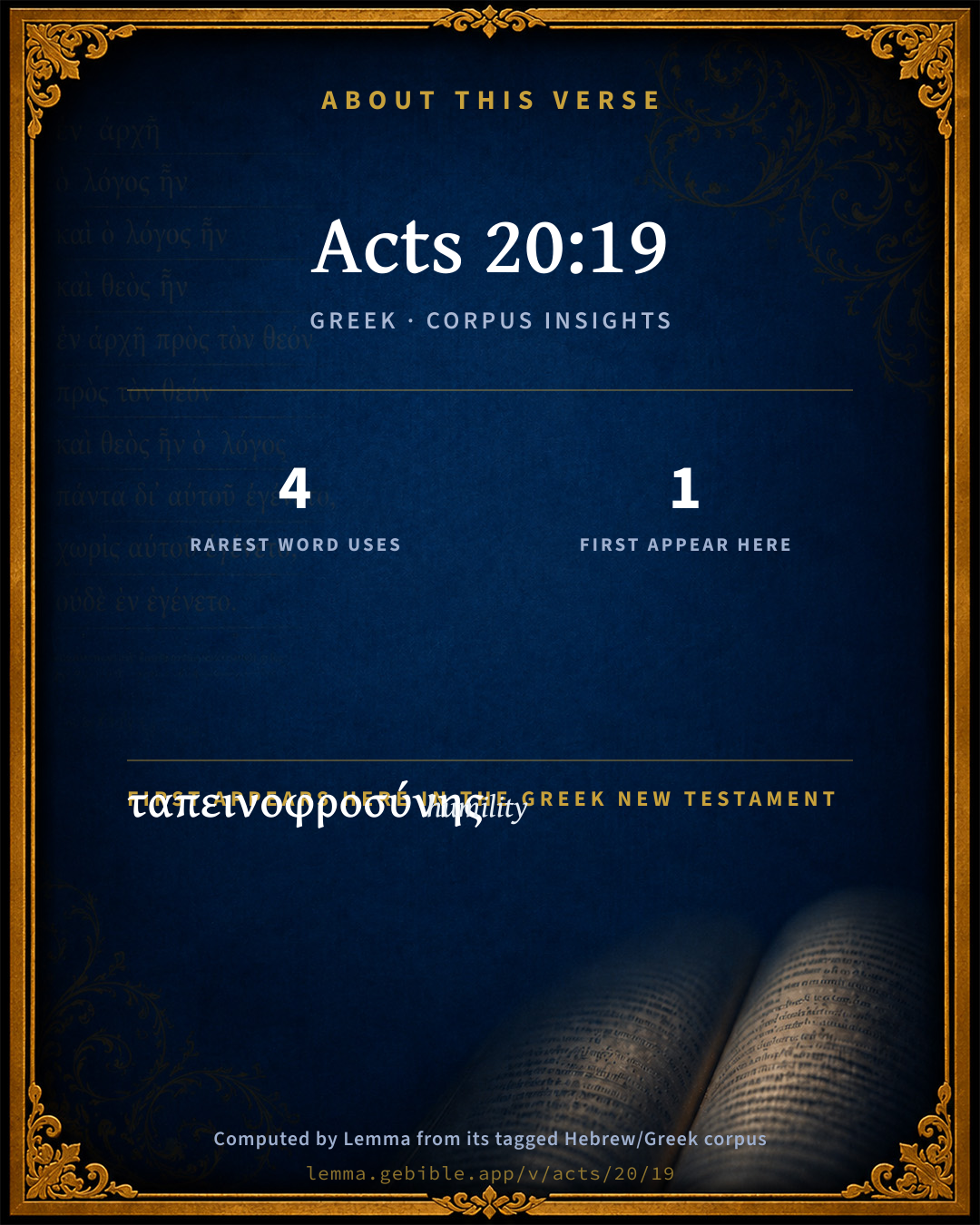
  • 1 first appearance in the Greek New Testament
Full analysis ↓
Download a study sheet

One document with this verse’s original text, its word-by-word gloss line, the meaning frame, cross-references with their text, attributed commentary, and full source and license credits — printable, and it pastes into notes with its structure intact.

This verse Autodidact and up

Study sheet (.html) Plain text (.txt)

A passage Seminary Student

Up to 50 verses in one chapter. A passage sheet keeps up to 6 commentary sources and 12 cross-references per verse, in the order this page ranks them, and says so on the sheet whenever that leaves anything out. Ask for a single verse and you get the Autodidact verse sheet above.

Everything on this page stays free to read, with no account — the sheet is a download of what is already on screen, not access to it.

Want to remove ads? Support Godless Engineer
Compare translations 3

The same verse in 3 English versions, stacked beneath the original-language interlinear above. Click any original word for its lexicon entry.

Each is an independent rendering of the whole verse — the interlinear is not word-aligned to these translations.

Highlighted words mark where these versions differ — a whole-verse word diff, not a word-by-word alignment.

  • World English Bible Public Domain
    serving the Lord with all humility, with many tears, and with trials which happened to me by the plots of the Jews;
  • King James Version Public Domain
    Serving the LORD with all humility of mind, and with many tears, and temptations, which befell me by the lying in wait of the Jews:
  • unfoldingWord Literal Text CC BY-SA 4.0
    serving the Lord with all humility and tears and trials happening to me in the plots of the Jews,

unfoldingWord Literal Text — © unfoldingWord, licensed CC BY-SA 4.0. Word-aligned USFM3 via Door43 (git.door43.org/unfoldingWord/en_ult).

Versions to compare (up to 4)

3 of 4 selected

Show all 19 translations

Every available English version of this verse, each an independent rendering of the whole verse.

  • World English Bible Public Domain
    serving the Lord with all humility, with many tears, and with trials which happened to me by the plots of the Jews;
  • Berean Standard Bible Public Domain
    I served the Lord with great humility and with tears, especially in the trials that came upon me through the plots of the Jews.
  • Majority Standard Bible Public Domain
    I served the Lord with great humility and with many tears, especially in the trials that came upon me through the plots of the Jews.
  • King James Version Public Domain
    Serving the LORD with all humility of mind, and with many tears, and temptations, which befell me by the lying in wait of the Jews:
  • American Standard Version (1901) Public Domain
    serving the Lord with all lowliness of mind, and with tears, and with trials which befell me by the plots of the Jews;
  • Revised Version (1885) Public Domain
    serving the Lord with all lowliness of mind, and with tears, and with trials which befell me by the plots of the Jews:
  • Geneva Bible (1599) Public Domain
    Seruing the Lord with all modestie, and with many teares, and tentations, which came vnto me by the layings awaite of the Iewes,
  • Douay-Rheims (1899) Public Domain
    Serving the Lord with all humility, and with tears, and temptations which befell me by the conspiracies of the Jews;
  • Young's Literal Translation Public Domain
    serving the Lord with all humility, and many tears, and temptations, that befell me in the counsels of the Jews against `me';
  • Literal Standard Version CC BY-SA 4.0
    serving the LORD with all humility, and many tears, and temptations, that befell me in the counsels of the Jews against [me];
  • Unlocked Literal Bible CC BY-SA 4.0
    I kept serving the Lord with all lowliness of mind and with tears, and in sufferings that happened to me because of the plots of the Jews.
  • unfoldingWord Literal Text CC BY-SA 4.0
    serving the Lord with all humility and tears and trials happening to me in the plots of the Jews,
  • Darby Bible Public Domain
    serving the Lord with all lowliness, and tears, and temptations, which happened to me through the plots of the Jews;
  • World Messianic Bible Public Domain
    serving the Lord with all humility, with many tears, and with trials which happened to me by the plots of the Jews;
  • Webster's Bible Public Domain
    Serving the Lord with all humility of mind, and with many tears and temptations, which befell me by the lying in wait of the Jews:
  • Free Bible Version CC BY-SA 4.0
    I served the Lord in humility and in tears. I put up with the troubles and stress caused by the plots of the Jews.
  • Bible in Basic English Public Domain
    Doing the Lord's work without pride, through all the sorrow and troubles which came on me because of the evil designs of the Jews:
  • Text-Critical English NT CC BY 4.0
    serving the Lord with all humility and with many tears and trials, which came upon me because of the plots of the Jews.
  • Tyndale New Testament (1534) Public Domain
    servynge the lorde with all humblenes of mynde and with many teares and temptacions which happened vnto me by the layinges awayte of the Ieues

Literal Standard Version (2020), Covenant Press — licensed CC BY-SA 4.0. Text via the HelloAO Bible API (eBible.org). Unlocked Literal Bible (unfoldingWord) — licensed CC BY-SA 4.0. Text via the HelloAO Bible API (eBible.org). unfoldingWord Literal Text — © unfoldingWord, licensed CC BY-SA 4.0. Word-aligned USFM3 via Door43 (git.door43.org/unfoldingWord/en_ult). Free Bible Version, Dr. Jonathan Gallagher — licensed CC BY-SA 4.0. Text via the HelloAO Bible API (eBible.org).

Word by word

More ways to search: Search by grammar → Find every occurrence → Compare this word →

Practice this passage: Drill this verse → Learn its vocabulary →

ἐπιβουλαῖς
epiboulḗ
G1917
“plot”
Noun, Dative, Plural, Feminine
Part of Speech
Noun
Case
Dative
Number
Plural
Gender
Feminine
Full Thayer's Definition

Origin: from a presumed compound of G1909 and G1014

TDNT: None

1. a plan formed against one, a plot
  1. δουλεύων douleúō G1398 “to serve” Verb, Present, Active, Participle, Nominative, Singular, Masculine
  2. τῷ ho G3588 “the” Article, Dative, Singular, Masculine
  3. κυρίῳ kýrios G2962 “Lord” Noun, Dative, Singular, Masculine
  4. μετὰ metá G3326 “with” Preposition
  5. πάσης pâs G3956 “all” Adjective, Genitive, Singular, Feminine
  6. ταπεινοφροσύνης tapeinophrosýnē G5012 “humility” Noun, Genitive, Singular, Feminine
  7. καὶ kaí G2532 “and” Conjunction
  8. δακρύων dákry G1144 “tear” Noun, Genitive, Plural, Neuter
  9. καὶ kaí G2532 “and” Conjunction
  10. πειρασμῶν peirasmós G3986 “temptation” Noun, Genitive, Plural, Masculine
  11. τῶν ho G3588 “the” Article, Genitive, Plural, Masculine
  12. συμβάντων symbaínō G4819 “to happen” Verb, Aorist, Active, Participle, Genitive, Plural, Masculine
  13. μοι egṓ G1473 “I” Personal pronoun, 1st person, Dative, Singular
  14. ἐν en G1722 “in” Preposition
  15. ταῖς ho G3588 “the” Article, Dative, Plural, Feminine
  16. τῶν ho G3588 “the” Article, Genitive, Plural, Masculine
  17. Ἰουδαίων Ioudaîos G2453 “Jewish” Adjective, Genitive, Plural, Masculine

About this verse

These counts appear in no published source. They are computed here, from the morphology-tagged text and Lemma’s own curated glosses. What Lemma adds →

18
words
14
distinct lemmas
Acts
section

Notable vocabulary

The rarest word here is ἐπιβουλαῖς plot G1917 — appearing just 4 times in the whole Greek New Testament.

First appearance in Scripture

This word makes its first canonical appearance in the Greek New Testament here:

  • ταπεινοφροσύνης humility G5012

Shared distinctive vocabulary

ἐπιβουλαῖς plot G1917 occurs in 4 verses of the Greek New Testament. Also found in:
Repetition

Words recur within this verse:

Cross-references

36

Topical passages linked to Acts 20:19 in the Treasury of Scripture Knowledge — connected by theme and wording, ordered by reader-vote popularity; previews shown in the World English Bible.

  • Colossians 3:24 knowing that from the Lord you will receive the reward of the inheritance; for you serve the Lord Christ.
  • 2 Corinthians 2:4 For out of much affliction and anguish of heart I wrote to you with many tears, not that you should be made sorry, but that you might know the love that I have so abundantly for you.
  • Acts 20:3 When he had spent three months there, and a plot was made against him by Jews as he was about to set sail for Syria, he determined to return through Macedonia.
  • Romans 12:11 not lagging in diligence; fervent in spirit; serving the Lord;
  • 2 Corinthians 4:7–11 But we have this treasure in clay vessels, that the exceeding greatness of the power may be of God, and not from ourselves.
  • Jeremiah 13:17 But if you will not hear it, my soul shall weep in secret for [your] pride; and my eye shall weep sore, and run down with tears, because Yahweh's flock is taken captive.
  • Acts 14:19–20 But some Jews from Antioch and Iconium came there, and having persuaded the multitudes, they stoned Paul, and dragged him out of the city, supposing that he was dead.
  • 2 Corinthians 3:5 not that we are sufficient of ourselves, to account anything as from ourselves; but our sufficiency is from God;
  • 2 Corinthians 7:5 For even when we had come into Macedonia, our flesh had no relief, but we were afflicted on every side. Fightings were outside. Fear was inside.
  • 2 Corinthians 12:7–10 By reason of the exceeding greatness of the revelations, that I should not be exalted excessively, there was given to me a thorn in the flesh, a messenger of Satan to buffet me, that I should not be exalted excessively.
  • Acts 20:31 Therefore watch, remembering that for a period of three years I didn't cease to admonish everyone night and day with tears.
  • 2 Corinthians 11:23–30 Are they servants of Christ? (I speak as one beside himself) I am more so; in labors more abundantly, in prisons more abundantly, in stripes above measure, in deaths often.
  • Galatians 1:10 For am I now seeking the favor of men, or of God? Or am I striving to please men? For if I were still pleasing men, I wouldn't be a servant of Christ.
  • Ephesians 6:7 with good will doing service, as to the Lord, and not to men;
  • Philippians 3:18 For many walk, of whom I told you often, and now tell you even weeping, as the enemies of the cross of Christ,
  • James 1:2 Count it all joy, my brothers, when you fall into various temptations,
  • Psalms 119:136 Streams of tears run down my eyes, Because they don't observe your law.
  • Jeremiah 9:1 Oh that my head were waters, and my eyes a spring of tears, that I might weep day and night for the slain of the daughter of my people!
  • Luke 19:41 When he drew near, he saw the city and wept over it,
  • John 12:26 If anyone serves me, let him follow me. Where I am, there will my servant also be. If anyone serves me, the Father will honor him.
  • Acts 9:23–25 When many days were fulfilled, the Jews conspired together to kill him,
  • Acts 13:50–51 But the Jews stirred up the devout and prominent women and the chief men of the city, and stirred up a persecution against Paul and Barnabas, and threw them out of their borders.
  • Acts 14:5–6 When some of both the Gentiles and the Jews, with their rulers, made a violent attempt to mistreat and stone them,
  • Acts 17:13 But when the Jews of Thessalonica had knowledge that the word of God was proclaimed by Paul at Beroea also, they came there likewise, agitating the multitudes.
  • Acts 27:23 For there stood by me this night an angel, belonging to the God whose I am and whom I serve,
  • Romans 1:1 Paul, a servant of Jesus Christ, called to be an apostle, set apart for the Gospel of God,
  • Romans 1:9 For God is my witness, whom I serve in my spirit in the Gospel of his Son, how unceasingly I make mention of you always in my prayers,
  • 1 Corinthians 4:9–13 For, I think that God has displayed us, the apostles, last of all, like men sentenced to death. For we are made a spectacle to the world, both to angels and men.
  • Galatians 4:13–14 but you know that because of weakness of the flesh I preached the Gospel to you the first time.
  • 1 Thessalonians 1:9 For they themselves report concerning us what kind of a reception we had from you; and how you turned to God from idols, to serve a living and true God,
  • 1 Peter 1:6 Wherein you greatly rejoice, though now for a little while, if need be, you have been put to grief in various trials,
  • 2 Peter 1:1 Simon Peter, a servant and apostle of Jesus Christ, to those who have obtained a like precious faith with us in the righteousness of our God and Savior, Jesus Christ:
  • 2 Timothy 1:4 longing to see you, remembering your tears, that I may be filled with joy;
  • Revelation 7:15 Therefore they are before the throne of God, they serve him day and night in his temple. He who sits on the throne will spread his tent over them.
  • Acts 17:5 But the unpersuaded Jews took along some wicked men from the marketplace, and gathering a crowd, set the city in an uproar. Assaulting the house of Jason, they sought to bring them out to the people.
  • 1 Corinthians 15:9–10 For I am the least of the apostles, who is not worthy to be called an apostle, because I persecuted the assembly of God.

Cross-references courtesy of OpenBible.info (CC BY 4.0).

Where the printed editions differ

1 variant

Places in this verse where the major printed Greek editions disagree on the wording in a way that affects the translation — a comparison of editions, not a manuscript-by-manuscript collation. The editions are the modern critical texts (Nestlé-Aland 28/27, SBL, Westcott-Hort, Tregelles, Tyndale House) and the traditional texts behind the KJV (the Textus Receptus and the Byzantine/Majority text). It is not a claim about which reading is original.

  1. Extra text
    πολλῶν

    “many”

    In TRByz Not in NA28NA27TynSBLWHTreg

    πολλῶν (pollōn) 'many' is only in traditional manuscripts (TR+Byz)

Textual data: Translators Amalgamated Greek New Testament (STEPBible TAGNT) · CC BY 4.0.

Commentary

Notes on Acts 20:19 from classic Christian and Jewish commentators (each source and its license shown beneath its notes). The classic Christian expositions comment on the surrounding passage and are grouped to its opening verse, so a note may address several verses; the Jewish commentaries on the Tanakh (Rashi and others) are per-verse, so they appear only where the commentator wrote on this verse.

Lemma curates 59 commentaries, every one of them public domain or Creative Commons licensed, each selected and text-cleaned for this edition rather than reprinted as found. About our sources →

Bengel's Gnomon

Johann Albrecht Bengel

Act 20:19. Δουλεύων, serving) A noble idea of the servant of the Lord.—τῶ Κυρίῳ) the Lord, whose is the Church.—μετὰ, with) Humility of mind, tears, and temptations, are the concomitants (of service): the act of serving itself is described in the foll. verse.—ταπεινοφροσύνης, humility of mind) This he recommends to the Ephesians also in Eph 4:2, “with all lowliness,” ταπεινοφροσύνης.—δακρύων, tears) Act 20:31; 2Co 2:4; Php 3:18. A characteristic trait of Paul. Holy tears shed by men and heroes, who seldom if ever weep for things in the ordinary course of nature, furnish a specimen of the efficacy, and an argument for the truth, of Christianity. Yet joy is compatible with these tears: Act 20:24. Add the note, Act 20:37.—πειρασμῶν, temptations) The plots of the Jews in various ways truly tried and exercised the mind of Paul.—τῶν Ἰουδαίων, of the Jews) The apostle of the Gentiles speaks of them now as if they were alien (foreigners) to him.

Bengel's Gnomon of the New Testament — English translation (T&T Clark, Edinburgh, 1860) — public domain. Text from a community e-Sword module.

Expositor's Greek Testament

ed. W. Robertson Nicoll

Act 20:19 . δουλεύων : the word occurs six times in St. Paul’s Epistles of serving God, the Lord, Christ, 1Th 1:9 , Rom 12:11 (R., margin, τῷ καιρῷ ), Act 14:18 , Act 16:18 , Eph 6:7 , Col 3:24 (once in Matthew and Luke, of serving God, Mat 6:24 , Luk 16:13 ), and cf. St. Paul’s expression δοῦλος of himself, Rom 1:1 , Gal 1:10 , Phi 1:1 , Tit 1:1 . μετὰ πάσης ταπεινοφ .: this use of πᾶς may be called eminently Pauline, cf. Eph 1:3 ; Eph 1:8 , Eph 4:2 , Eph 6:18 , 2Co 8:7 ; 2Co 12:12 , 1Ti 3:4 ; 2Ti 4:2 , Tit 2:15 ; Tit 3:2 (see Hackett’s note). ταπειν ., a word which may justly be called Pauline, as out of seven places in the N.T. it is used five times by St. Paul in his Epistles, and once in his address in the passage before us; Eph 4:2 , Phi 2:3 , Col 2:18 ; Col 2:23 ; Col 3:12 (elsewhere, only in 1Pe 5:5 ). It will be noted that it finds a place in three Epistles of the First Captivity, although used once disparagingly, Col 3:18 . In pagan ethics ταπεινός was for the most part a depreciatory characteristic, although some few notable exceptions may be quoted, Trench, Synonyms , i., 171 ff. In the LXX and Apocrypha it has a high moral significance and is opposed to ὕβρις in all its forms. The noun is not found either in LXX or Apocrypha, and the adjective ταπεινόφρων (1Pe 3:8 ) and the verb ταπεινοφρονεῖν (not in N.T.), although each found in LXX once, the former in Pro 29:23 and the latter in Psa 130:2 ( cf. instances in Aquila and Symmachus, Hatch and Redpath), cannot be traced in classical Greek before the Christian era, and then not in a laudatory sense. The noun occurs in Jos., B. J. , iv., 9, 2, but in the sense of pusillanimity, and also in Epictet., Diss. , iii., 24, 56, but in a bad sense (Grimm-Thayer). But for St. Paul as for St. Peter the life of Christ had conferred a divine honour upon all forms of lowliness and service, and every Christian was bidden to an imitation of One Who had said: πραΰς εἰμι καὶ ταπεινὸς τῇ καρδίᾳ , Lightfoot on Phi 2:3 ; “Ethics” (T. B. Strong), Hastings’ B.D., i., 786; Cremer, Wörterbuch, sub v. ταπεινος . δακρύων , cf. Act 20:31 , 2Co 2:4 , Phi 3:18 . “Lachrymæ sanctæ … cum his tamen consistit gaudium ”: Bengel. St. Paul was no Stoic, for whom ἀπάθεια was a virtue, the accompaniment of wisdom and the passport to perfection; see Rom 12:15 : “in every age the Christian temper has shivered at the touch of Stoic apathy”. Here the word refers not to the Apostle’s outward trials which were rather a source of joy, but to his sorrow of heart for his brethren and for the world, ἔπασχε γὰρ ὑπὲρ τῶν ἀπολλυμένων , Chrysostom. πειρασμῶν , cf. St. Paul’s own words, 1Th 3:3 , Phi 1:27 , 2Co 1:6 ; 2Co 6:4-10 , 2Co 11:26 , κινδύνοις ἐκ γενους (Gal 4:14 ). In our Lord’s own life and ministry there had been “temptations,” Luk 4:13 ; Luk 22:28 ; and a beatitude rested upon the man who endured temptation, Jas 1:12 ; Jas 1:2 . The noun is found no less than six times in St. Luke’s Gospel, but only here in Acts. It occurs four times in St. Paul’s Epistles, and may be fairly classed as Lucan-Pauline (Bethge). On its use in N.T. and LXX see Hatch, Essays in Biblical Greek , p. 71 ff., and compare Mayor, Epistle of St. James , Jas 1:2 . ἐπιβ . τῶν Ἰ .: evidently classed amongst the πειρασμῶν , Hatch, u. s. , although we must not suppose that St. Luke tells us of all the Apostle’s dangers, trials and temptations here any more than elsewhere. Nothing of the kind is mentioned in connection definitely with the Ephesian Jews, “sed res minime dubia, Act 21:27 ,” Blass. The noun has not been found in any classical author, but it occurs in Dioscorides, Præf. , i., see Grimm, sub v. , and several times in LXX, six times in Ecclus. and in 1Ma 2:52 .

The Expositor's Greek Testament, edited by W. Robertson Nicoll (1897–1910) — public domain. Text from a community e-Sword module.

Jamieson, Fausset & Brown

Robert Jamieson, A. R. Fausset & David Brown

Serving the Lord--Jesus.

with all humility . . . and many tears and temptations--Self-exaltation was unknown to him, and ease of mind: He "sowed in tears," from anxieties both on account of the converts from whom he "travailed in birth," and of the Jews, whose bitter hostility was perpetually plotting against him, interrupting his work and endangering his life.

Jamieson, Fausset & Brown — Commentary Critical and Explanatory on the Whole Bible (1871) — public domain (CC PDM 1.0). Text via the HelloAO Bible API.

Adam Clarke's Commentary

Verse 19. Serving the Lord with all humility, c.] This relates not only to his zealous and faithful performance of his apostolic functions, but also to his private walk as a Christian and shows with what carefulness this apostle himself was obliged to walk, in order to have his calling and election, as a Christian, ratified and made firm.

Adam Clarke's Commentary on the Bible (1810–1826) — public domain. Text from a community e-Sword/MySword module.

John Calvin's Commentaries

19. Serving the Lord. He reckoneth up first not only in what straits he was, but most of all his humility, coupled with contempt of the world, and rebukes, and other afflictions; as if he should say, that he was not honorably received or with commendation; but he was conversant among them under the contemptible form of the cross. And this is no small trial, when we faint not, though we see ourselves trodden under foot by the intolerable pride of the world.

Notwithstanding, we must note everything more distinctly. To serve the Lord is taken in this place, not for to worship God in holiness and righteousness, which is common to all the godly; but it doth signify to execute a public function. Therefore, Paul doth not speak of [as] some one private man, but as one made a minister of the Church. And so he doth testify, that he fulfilled the apostleship to him committed with humility and modesty; both because, knowing his own infirmity, he did mistrust himself; and also, because, considering the excellency of his calling, he counted himself very unmeet; and, lastly, because he did willingly submit himself to bear the reproach of the cross. For this humility is set both against vain confidence, and also haughtiness. Secondly, he toucheth his tears, which strifes, diverse assaults of Satan, the rage of wicked men, the inward diseases of the Church, and offenses, had made him shed; at length, he addeth, that he led a fearful life, amidst the layings in wait of the Jews; and he confesseth that he was tempted therewith, as he was not hardened, though he did not faint. For he is not ashamed to confess his infirmity.

His drift is, that those to whom he speaketh may not faint, through like tribulations; and that, being void of all ambition, they may do their duty carefully and reverently; and that they may not only with a patient mind suffer themselves to be despised of men, but that they may be cast down in themselves. Because, that man can never be rightly framed to obey Christ whose looks are lofty, and whose heart is proud. And (as men cannot long bear a show of virtue) to the end it may appear manifestly, that he behaved himself sincerely and from his heart, he maketh mention of his constancy which lasted three years, wherein he had still kept one course. Ye know (saith he) how I have behaved myself since the first day until this time. To conclude, this is the true trial of the servants of Christ, not to be changed as the times change; but to continue like to themselves, and always to keep a straight course.

John Calvin's Commentaries (1540-1563) — public domain. Text from the Calvin Translation Society English edition (1840s-50s) via the Christian Classics Ethereal Library (ccel.org). Calvin's coverage is partial (roughly two-thirds of the Bible); uncommented books and verses are honest gaps, never fabricated. The 19th-century editor's footnotes and remarks are omitted so the notes are faithfully Calvin's own voice.

Ellicott's Commentary for English Readers

(19) Serving the Lord with all humility of mind . . .—The participle exactly answers to the epithet of the “servant” or “slave” of Christ which St. Paul so often uses of himself (Rom_1:1; Gal_1:10; Php_1:1; Tit_1:1). The “tears,” too, are characteristic of the Apostle, whose intense sensitiveness and sympathy had not been hardened into a Stoic apathy, and therefore found vent in a form which the Stoic would have scorned as unmanly. (Comp. Act_20:31; 2Co_2:4.) Epictetus (Enchirid. c. 2) barely allowed a follower of wisdom to mourn outwardly with those who mourned, and added the warning: “Take heed that thou mourn not inwardly.”

Temptations.—Better, trials—the word retaining its dominant meaning of troubles coming from without, rather than allurements to evil from within. The reference to the “lying in wait of the Jews” refers, of course, to something altogether distinct from the Demetrian tumult, and implies unrecorded sufferings. The Apostle’s life was never safe, and the air was thick with plots against it.

A Bible Commentary for English Readers, edited by Charles John Ellicott (1878–1897) — public domain. Text from a community e-Sword module.

The Cambridge Bible for Schools and Colleges

gen. ed. J. J. S. Perowne

19. serving … humility of mind] The Rev. Ver. here has “lowliness of mind,” as the word is rendered Php_2:3, but the version is not consistent, for the same rendering is not kept (Col_3:12) where it might just as well have been. Probably the translators of 1611 did not like the collocation all lowliness. St Paul is careful to point out that the service in which he spent himself was done unto the Lord as His Apostle.

and with many tears] The oldest authorities omit “many.” The adjective is a comment from the statement in Act_20:31. In 2Co_2:4 St Paul says “I wrote unto you with many tears.”

and temptations, which befell me by the lying in wait of the Jews] The old sense of “temptation” is lost. Read (with Rev. Ver.) “and with trials … by the plots of the Jews. We could only see in the account of the tumult at Ephesus that there were some indications that the Jewish population were anxious to make it plain that they had no sympathy with the Apostle who was so obnoxious to the Gentiles. Here we have an express declaration made before those who knew all the circumstances that plots had been laid against Paul’s life by the Jews. It did not fall in with St Luke’s purpose to tell us of them, but he manifestly knew about them, for he feels no difficulty in recording the Apostle’s own mention of them here, nor has he a thought that his narrative will be held for other than true, though men may point out here an allusion to events of which he had made no mention before. We cannot too often bear in mind that the book is not meant for a history of either one or other Apostle, but a record of how the course of the Gospel was guided according to Christ’s injunction, “beginning at Jerusalem” and ending when an Apostle had proclaimed Christ in the Imperial capital.

The Cambridge Bible for Schools and Colleges (gen. ed. J. J. S. Perowne; Cambridge University Press, 1878–1918) — public domain. Text from a community e-Sword module.

John Gill's Exposition

And how I kept back nothing that was profitable unto you,.... The Syriac version supplies, "to your souls"; to lead them into a true knowledge of the doctrines of the Gospel, and to confirm them in the same, and to preserve them from errors in principle, and immoralities in practice, and to encourage the exercise of every grace, and to instruct them in every branch of duty; nothing of this kind, or which had this tendency, did the apostle dissemble, conceal, or drop, either through sloth and indolence, or through fear of men, or for the sake of reputation, wealth, and friends. The things the apostle may have chiefly in view are the truths of the Gospel, which are very profitable to the souls of men; such as relate to the knowledge of God, his being, perfections, and persons; as that there are three persons in the Godhead, Father, Son, and Spirit, which is profitable to be known, in order to understand the economy of salvation, in which each person has his distinct concern; and that both the Son and Spirit are equally God with the Father, which accounts for the virtue and efficacy of the blood, righteousness, and sacrifice of Christ, and how safely he may be depended upon for salvation, and how equal the Holy Spirit is to his work and office; likewise such doctrines as relate to the sin of Adam and his posterity in him, to the imputation of the guilt of that sin unto them, and the derivation of a corrupt nature from him, and which respect the impurity and impotence of human nature; all which is profitable, since it accounts for the origin of moral evil, and many of the dispensations of providence in involving those that do not know the right hand from their left in public calamities; and since it shows the necessity of regenerating grace, tends to the humiliation of men, and makes for the magnifying the riches of God's grace: also such doctrines as express the grace of God in man's salvation as the doctrines of God's everlasting love, of election, redemption, justification, pardon, reconciliation, union to Christ, and final perseverance; all which are exceeding profitable, for the peace, comfort, and refreshment of the souls of God's people. Moreover, the ordinances of the Gospel, baptism, and the Lord's supper, which are the privileges of believers, and the means of their spiritual profit, may be included, together with all the duties of religion; which though not profitable by way of merit, yet contribute to the peace and pleasure of the mind; and none of these things did the apostle withhold from the elders and church at Ephesus, as his epistle to that church does abundantly show, in which, doctrines, ordinances, and duties are taken notice of: now to keep back these, is either to keep them back wholly, to say nothing of any of them, but in the room of them to deliver out morality and legal righteousness; or in part, to mix the truths of the Gospel with the doctrines of men, and not give out the sincere milk of the word; or to draw and fetch back what has been delivered through the fear of men, and in order to gain reputation and applause: but so did not the apostle, nor should any minister of the Gospel; and that for the reason in the words, because they are profitable; as also because they are the counsel of God; and because it is the will of Christ that nothing should be hid, but everything should be published, which he has signified to his servants; and this is enforced by his own example, who whatever he heard of his Father, he made known to his disciples; and for the ministers of Christ to do otherwise, would argue unfaithfulness in them both to Christ and to the souls of men:

but have showed you; all the doctrines of the Gospel, and pointed to every path of duty, and declared, as he says hereafter, the whole counsel of God:

and have taught you publicly; first in the Jewish synagogue, then in the school of Tyrannus, Act 19:8 and in whatsoever place the church, when formed, might meet together for public worship; there the apostle taught them the truths of the Gospel openly, and without any reserve, before all the people, as Christ ordered his apostles to do, and as he himself did, Mat 10:27

and from house to house: as he visited the saints at their own houses, to know their personal cases, and the state of their souls, he instructed them privately and personally one by one; he taught the same publicly as privately, and privately as publicly: and took every opportunity of instilling Gospel truths into them, and of enriching them with a larger knowledge of them; which shows his affection and zeal, his laboriousness, industry, and indefatigableness in the ministry.

John Gill's Exposition of the Whole Bible (1746–1763) — public domain (CC PDM 1.0). Text via the HelloAO Bible API.

Trapp's Complete Commentary

John Trapp

19 Serving the Lord with all humility of mind, and with many tears, and temptations, which befell me by the lying in wait of the Jews:

Ver. 19. Serving the Lord, &c.] Here is a mirror for ministers.

John Trapp, A Commentary or Exposition upon All the Books of the Old and New Testament (1647–1656) — public domain. Text from a community e-Sword module.

Albert Barnes' Notes on the Bible

Serving the Lord - In the discharge of the appropriate duties of his apostolic office, and in private life. To discharge aright our duties in any vocation is serving the Lord. Religion is often represented in the Bible as a service rendered to the Lord.

With all humility - Without arrogance, pride, or a spirit of dictation; without a desire to “lord it over God’s heritage”; without being elated with the authority of the apostolic office, the variety of the miracles which he was enabled to perform, or the success which attended his labors. What an admirable model for all who are in the ministry; for all who are endowed with talents and learning; for all who meet with remarkable success in their work! The proper effect of such success, and of such talent, will be to produce true humility. The greatest endowments are usually connected with the most simple and childlike humility.

And with many tears - Paul not infrequently gives evidence of the tenderness of his heart, of his regard for the souls of people, and of his deep solicitude for the salvation of sinners, Act 20:31; Phi 3:18; 2Co 2:4. The particular thing, however, here specified as producing weeping was the opposition of the Jews. But it cannot be supposed that those tears were shed from an apprehension of personal danger. It was rather because the opposition of the Jews impeded his work, and retarded his progress in winning souls to Christ. A minister of the gospel will:

(1) Feel, and deeply feel for the salvation of his people. He will weep over their condition when he sees theta going astray, and in danger of perishing. He will,

(2) Be specially affected with opposition, because it will retard his work, and prevent the progress and the triumph of the gospel. It is not because it is a personal concern, but because it is the cause of his Master.

And temptations - Trials arising from their opposition. We use the word “temptation” in a more limited sense, to denote inducements offered to one to lead him into sin. The word in the Scriptures most commonly denotes “trials” of any kind.

Which befell me - Which happened to me; which I encountered.

By the lying in wait ... - By their snares and plots against my life. Compare Act 20:3. Those snares and plans were designed to blast his reputation and to destroy his usefulness.

Albert Barnes' Notes on the Bible (1834–1885) — public domain. Text from a community e-Sword/MySword module.

Haydock's Catholic Bible Commentary

With all humility; that is, of heart, or mind, as the Greek word signifies. He knew, says St. John Chrysostom, how necessary this virtue of humility was for the ministers of the gospel. --- With tears of charity and compassion, under temptations, trials, and persecutions. (Witham)

George Leo Haydock (1774–1849), Haydock's Catholic Family Bible and Commentary, 1859 edition — public domain. Excludes Psalms (Douay-Rheims chapter numbering differs from Protestant) and Deuterocanonical books (Catholic canon only).

Matthew Poole's English Annotations

Serving the Lord; in his apostleship or public ministry; of which, if any ever could, he might have gloried; yet in this office he clothes himself

with humility, as the most becoming garment for a minister of Jesus Christ: though so high, yet so low. We need not cry, (as one did, though ironically), Fie, St. Paul! but fie upon all such as pretend to succeed in his dignity, and do not at all imitate him in his humility.

With many tears; he shed tears of compassion over the ignorant and blind, hard and perverse. It grieved him to see how large a dominion the god of this world had, and what a little part was left for his dear Lord and Master, Christ Jesus.

Temptations; afflictions and troubles, which befell him for Christ and the gospel’s sake; which are so called, Jam 1:2; 1Pe 1:6.

Matthew Poole's English Annotations on the Holy Bible (1683–1685) — public domain. Text from a community e-Sword/MySword module.

Whedon's Commentary on the Bible

Daniel D. Whedon

19. Humility… tears… temptations.—”Who is so broken a man, both individually—who so prostrated as Paul? His righteousness had become in his mind a sin, and the law, the highest glory of his nation, had become to him a sentence of condemnation.”—Baumgarten. (See Rom_9:1-5.)

Daniel D. Whedon (gen. ed.), Commentary on the Old and New Testaments (1874–1909) — public domain. Text from a community e-Sword module.

The Pulpit Commentary

Lowliness for humility, A.V.; tears for many tears, A.V. and T.R.; with trials for temptations, A.V.; plots for lying in wait, A.V. Plots (ejpiboulaiv); comp. ver. 3, and note. There is no special account of Jewish plots in St. Luke"s narrative of St. Paul"s sojourn at Ephesus. But Act_19:9, Act_19:13, and probably 33, we may gather how hostile the unbelieving Jews were to him.

The Pulpit Commentary (1880–1919), ed. H.D.M. Spence-Jones & Joseph S. Exell — public domain. Text from a community e-Sword module.

John Wesley's Explanatory Notes

Serving - See the picture of a faithful servant! The Lord - Whose the church is, with all humility, and with tears, and trials - These are the concomicants of it. The service itself is described more particularly in the following verse. This humility he recommends to the Ephesians themselves, Eph. iv, 2. His tears are mentioned again, verse 31, as also 2 Cor. ii, 4; Phil. iii, 18. These passages laid together supply us with the genuine character of St. Paul. Holy tears, from those who seldom weep on account of natural occurrences, are no mean specimen of the efficacy and proof of the truth of Christianity. Yet joy is well consistent therewith, ver. 24. The same person may be sorrowful, yet always rejoicing.

John Wesley, Explanatory Notes Upon the Whole Bible (1754–1765) — public domain. Text via the GEBible commentary corpus.

McGarvey & Pendleton's Commentaries

J. W. McGarvey

See notes on verse 18

J. W. McGarvey (with Philip Y. Pendleton), Commentaries on the New Testament (The Fourfold Gospel, 1914; Acts; and the epistles) — public domain. Text from a community e-Sword/MySword module.

Cambridge Greek Testament for Schools and Colleges

19. πολλῶν before δακρύων omitted with אABDE. Not represented in Vulg.

19. δουλεύων τῷ κυρίῳ μετὰ πάσης ταπεινοφροσύνης, serving the Lord with all humility of mind. The verb is interesting when we remember how often St Paul calls himself in his Epistles δοῦλος Ἰησοῦ Χριστοῦ. Cf. Rom 1:1; Php 1:1; Tit 1:1.

καὶ δακρύων, and tears. The πολλῶν of the Text. recept. is a comment derived from the statement in Act 20:31 below. In 2Co 2:4 St Paul uses διὰ πολλῶν δακρύων.

καὶ πειρασμῶν τῶν συμβάντων μοι ἐν ταῖς ἐπιβουλαῖς τῶν Ἰουδαίων, and with trials that befell me by the plots of the Jews. We could only see in the account of the tumult at Ephesus some indications how anxious the Jewish population were to make it plain that they had no sympathy with the Apostle who was so obnoxious to the Gentiles. Here we have an express declaration made before those who knew all the circumstances that plots had been laid against Paul’s life by the Jews. It did not fall in with St Luke’s purpose to tell us of them, but he manifestly knew about them, for he feels no difficulty in recording the Apostle’s own mention of them here, nor has he a thought that his narrative will be held for other than true, though men may point out here an allusion to events of which he had made no mention before. We cannot too often bear in mind that the book is not meant for a history of either one or other Apostle, but as a record of how the course of the Gospel was guided according to Christ’s injunction, (beginning at Jerusalem’ and ending when an Apostle had proclaimed Christ in the Imperial capital.

Cambridge Greek Testament for Schools and Colleges (Cambridge University Press, 1896; 21 vols, various authors incl. Carr, Maclear, Plummer, Farrar, Lumby, Moule, M. R. James, Simcox) — public domain. Text from a community e-Sword module.

Alford’s Greek Testament

Henry Alford

19. δουλεύων τῷ κυρ] With the sole exception of the assertion of our Lord, ‘Ye cannot serve God and mammon,’ reff. Matt., Luke, the verb δουλεύω for ‘serving God’ is used by Paul only, and by him seven times, viz. besides reff., Rom 12:11; Rom 14:18; Rom 16:18; [Php 2:22(?)] Col 3:24; 1Th 1:9.

μετ. π. ταπ.] Also a Pauline expression, 2Co 8:7; 2Co 12:12.

πειρασμῶν] See especially Gal 4:14.

Henry Alford, The Greek Testament (1849–1861) — public domain. Text from a community e-Sword module.

Lesson kit

Teaching starters — assembled from the data on this page, not authored interpretation. Every prompt links to the verse data it draws on. Edit before teaching.

Acts, in the Acts, opens this verse with 18 words (14 distinct Greek lemmas). Its most distinctive word is epiboulḗ (“plot”). A historical commentator’s framing appears above. Read the whole chapter for the surrounding context.

Discussion questions

  1. How does “plot” (epiboulḗ) shape what this verse is saying?
  2. This is the first place “humility” appears in Scripture (first appears here). What does its debut here establish?
  3. How does Acts 9:24, which shares the word «plot», read alongside this verse?
  4. What does the repetition of “the” (4× in this one verse) do in this verse?
  5. The translations on this page render this verse differently — a whole-verse word diff, not a word-by-word alignment. What might account for the different wordings?
  6. Compare how Bengel's Gnomon and Expositor's Greek Testament read this verse. Where do they agree or differ?

Things to notice

  • 1 word makes its first canonical appearance in Scripture here.
  • These translations choose different wording for 11 words in this verse.
  • “the” occurs 4× in this single verse.
  • 14 distinct Greek lemmas span 18 words in this verse.

Reading settings

Reading text

Shown beneath each verse's original-language words.

Old Testament
Old Testament edition

Read the OT as the Masoretic Hebrew (MT) or the Greek Septuagint (LXX).

English shown for the Greek Septuagint (in the Hebrew ↔ Greek comparison).

Comparing translations? Open the Compare panel on any verse page to stack up to four side by side.