
Acts 16:26

Greek (Tischendorf 8th ed.) Acts 16:26 appears in the Greek New Testament. The text above is from the Tischendorf 8th edition. Each word links to its Strong’s number and a concise gloss. Click any word for its full Thayer’s Greek Lexicon entry.
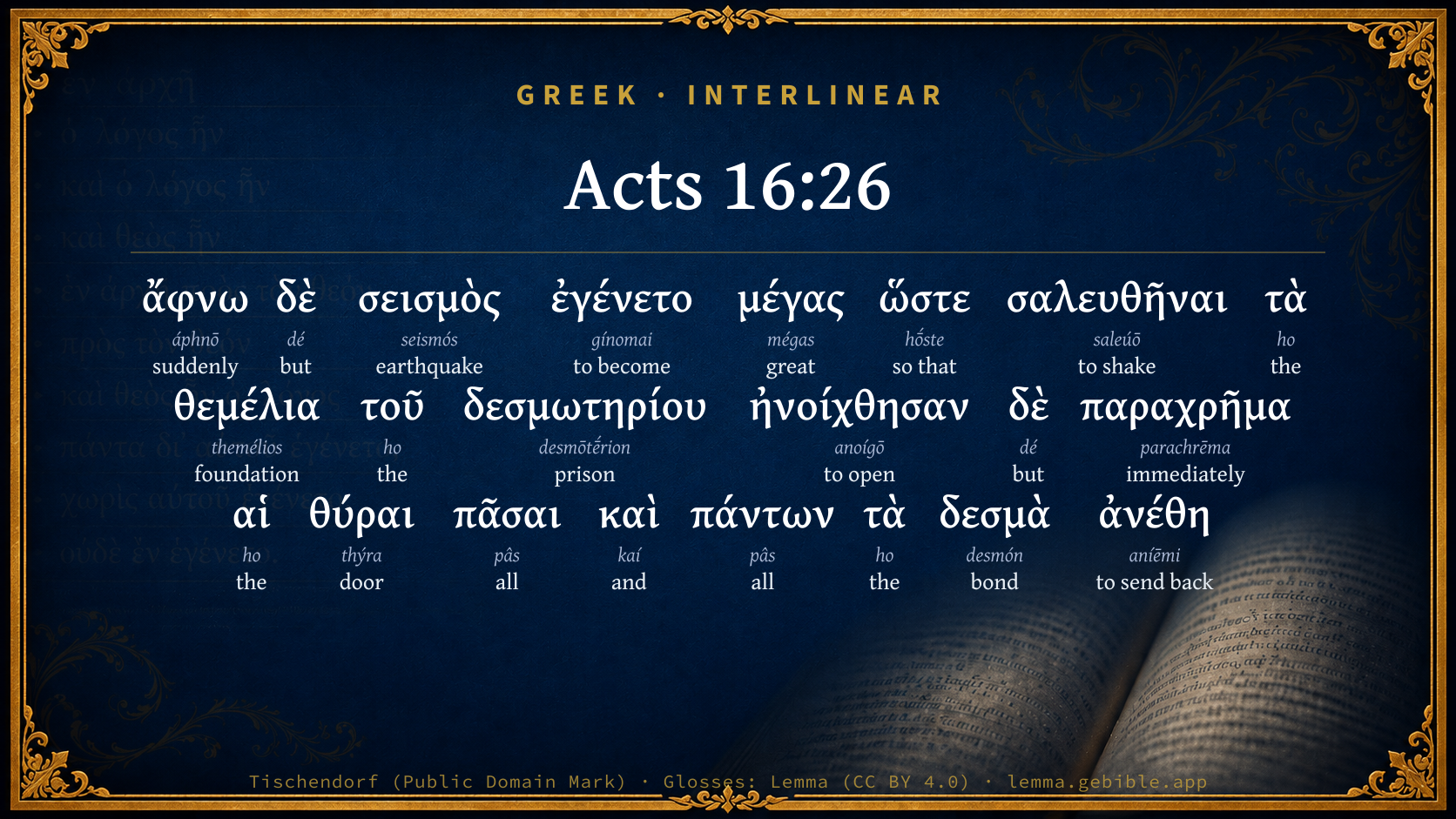
Download image
Cite this verse

Acts 16:26 (World English Bible). Public Domain. Lemma interlinear Bible study tool, https://lemma.gebible.app/v/acts/16/26.

Show BibTeX & RIS
BibTeX
RIS
English Translation
Suddenly there was a great earthquake, so that the foundations of the prison were shaken; and immediately all the doors were opened, and everyone's bonds were loosened.
World English Bible · Public Domain
Highlights
  • 1 first appearance in the Greek New Testament
Full analysis ↓
Download a study sheet

One document with this verse’s original text, its word-by-word gloss line, the meaning frame, cross-references with their text, attributed commentary, and full source and license credits — printable, and it pastes into notes with its structure intact.

This verse Autodidact and up

Study sheet (.html) Plain text (.txt)

A passage Seminary Student

Up to 50 verses in one chapter. A passage sheet keeps up to 6 commentary sources and 12 cross-references per verse, in the order this page ranks them, and says so on the sheet whenever that leaves anything out. Ask for a single verse and you get the Autodidact verse sheet above.

Everything on this page stays free to read, with no account — the sheet is a download of what is already on screen, not access to it.

Want to remove ads? Support Godless Engineer
Compare translations 3

The same verse in 3 English versions, stacked beneath the original-language interlinear above. Click any original word for its lexicon entry.

Each is an independent rendering of the whole verse — the interlinear is not word-aligned to these translations.

Highlighted words mark where these versions differ — a whole-verse word diff, not a word-by-word alignment.

  • World English Bible Public Domain
    Suddenly there was a great earthquake, so that the foundations of the prison were shaken; and immediately all the doors were opened, and everyone's bonds were loosened.
  • King James Version Public Domain
    And suddenly there was a great earthquake, so that the foundations of the prison were shaken: and immediately all the doors were opened, and every one's bands were loosed.
  • unfoldingWord Literal Text CC BY-SA 4.0
    And suddenly a great earthquake happened, so that the foundations of the prison were shaken, and immediately all the doors were opened, and the chains of all were unfastened.

unfoldingWord Literal Text — © unfoldingWord, licensed CC BY-SA 4.0. Word-aligned USFM3 via Door43 (git.door43.org/unfoldingWord/en_ult).

Versions to compare (up to 4)

3 of 4 selected

Show all 19 translations

Every available English version of this verse, each an independent rendering of the whole verse.

  • World English Bible Public Domain
    Suddenly there was a great earthquake, so that the foundations of the prison were shaken; and immediately all the doors were opened, and everyone's bonds were loosened.
  • Berean Standard Bible Public Domain
    Suddenly a strong earthquake shook the foundations of the prison. At once all the doors flew open and everyone’s chains came loose.
  • Majority Standard Bible Public Domain
    Suddenly a strong earthquake shook the foundations of the prison. At once all the doors flew open and everyone’s chains came loose.
  • King James Version Public Domain
    And suddenly there was a great earthquake, so that the foundations of the prison were shaken: and immediately all the doors were opened, and every one's bands were loosed.
  • American Standard Version (1901) Public Domain
    and suddenly there was a great earthquake, so that the foundations of the prison-house were shaken: and immediately all the doors were opened, and every one's bands were loosed.
  • Revised Version (1885) Public Domain
    and suddenly there was a great earthquake, so that the foundations of the prison-house were shaken: and immediately all the doors were opened; and every one’s bands were loosed.
  • Geneva Bible (1599) Public Domain
    And suddenly there was a great earthquake, so that the foundation of the prison was shaken: and by and by all the doores opened, and euery mans bands were loosed.
  • Douay-Rheims (1899) Public Domain
    And suddenly there was a great earthquake, so that the foundations of the prison were shaken. And immediately all the doors were opened, and the bands of all were loosed.
  • Young's Literal Translation Public Domain
    and suddenly a great earthquake came, so that the foundations of the prison were shaken, opened also presently were all the doors, and of all -- the bands were loosed;
  • Literal Standard Version CC BY-SA 4.0
    and suddenly a great earthquake came, so that the foundations of the prison were shaken, also all the doors were immediately opened, and of all—the bands were loosed;
  • Unlocked Literal Bible CC BY-SA 4.0
    Suddenly there was a great earthquake, so that the foundations of the prison were shaken; and immediately all the doors were opened, and everyone's chains were unfastened.
  • unfoldingWord Literal Text CC BY-SA 4.0
    And suddenly a great earthquake happened, so that the foundations of the prison were shaken, and immediately all the doors were opened, and the chains of all were unfastened.
  • Darby Bible Public Domain
    And suddenly there was a great earthquake, so that the foundations of the prison shook, and all the doors were immediately opened, and the bonds of all loosed.
  • World Messianic Bible Public Domain
    Suddenly there was a great earthquake, so that the foundations of the prison were shaken; and immediately all the doors were opened, and everyone’s bonds were loosened.
  • Webster's Bible Public Domain
    And suddenly there was a great earthquake, so that the foundations of the prison were shaken: and immediately all the doors were opened, and every one's bands were loosed.
  • Free Bible Version CC BY-SA 4.0
    Suddenly a tremendous earthquake shook the foundations of the prison. Immediately all the doors flew open and everyone's chains fell off.
  • Bible in Basic English Public Domain
    And suddenly there was an earth-shock, so that the base of the prison was moved: and all the doors came open, and everyone's chains came off.
  • Text-Critical English NT CC BY 4.0
    Suddenly there was a great earthquake, so that the foundations of the prison were shaken. Immediately all the doors opened, and all the chains came loose.
  • Tyndale New Testament (1534) Public Domain
    And sodenly ther was a greate erth quake so that the fonndacion of the preson was shaken and by and by all the dores opened and every mannes bondes were lowsed.

Literal Standard Version (2020), Covenant Press — licensed CC BY-SA 4.0. Text via the HelloAO Bible API (eBible.org). Unlocked Literal Bible (unfoldingWord) — licensed CC BY-SA 4.0. Text via the HelloAO Bible API (eBible.org). unfoldingWord Literal Text — © unfoldingWord, licensed CC BY-SA 4.0. Word-aligned USFM3 via Door43 (git.door43.org/unfoldingWord/en_ult). Free Bible Version, Dr. Jonathan Gallagher — licensed CC BY-SA 4.0. Text via the HelloAO Bible API (eBible.org).

Word by word

More ways to search: Search by grammar → Find every occurrence → Compare this word →

Practice this passage: Drill this verse → Learn its vocabulary →

ἄφνω
áphnō
G869
“suddenly”
Adverb
Part of Speech
Adverb
Full Thayer's Definition

Origin: from G852 (contraction)

TDNT: None

1. suddenly
  1. δὲ dé G1161 “but” Conjunction
  2. σεισμὸς seismós G4578 “earthquake” Noun, Nominative, Singular, Masculine
  3. ἐγένετο gínomai G1096 “to become” Verb, Aorist, Middle deponent, Indicative, 3rd person, Singular
  4. μέγας mégas G3173 “great” Adjective, Nominative, Singular, Masculine
  5. ὥστε hṓste G5620 “so that” Conjunction
  6. σαλευθῆναι saleúō G4531 “to shake” Verb, Aorist, Passive, Infinitive
  7. τὰ ho G3588 “the” Article, Accusative, Plural, Neuter
  8. θεμέλια themélios G2310 “foundation” Noun, Accusative, Plural, Neuter
  9. τοῦ ho G3588 “the” Article, Genitive, Singular, Neuter
  10. δεσμωτηρίου desmōtḗrion G1201 “prison” Noun, Genitive, Singular, Neuter
  11. ἠνοίχθησαν anoígō G455 “to open” Verb, Aorist, Passive, Indicative, 3rd person, Plural
  12. δὲ dé G1161 “but” Conjunction
  13. παραχρῆμα parachrēma G3916 “immediately” Adverb
  14. αἱ ho G3588 “the” Article, Nominative, Plural, Feminine
  15. θύραι thýra G2374 “door” Noun, Nominative, Plural, Feminine
  16. πᾶσαι pâs G3956 “all” Adjective, Nominative, Plural, Feminine
  17. καὶ kaí G2532 “and” Conjunction
  18. πάντων pâs G3956 “all” Adjective, Genitive, Plural, Masculine
  19. τὰ ho G3588 “the” Article, Nominative, Plural, Neuter
  20. δεσμὰ desmón G1199 “bond” Noun, Nominative, Plural, Neuter
  21. ἀνέθη aníēmi G447 “to send back” Verb, Aorist, Passive, Indicative, 3rd person, Singular

About this verse

These counts appear in no published source. They are computed here, from the morphology-tagged text and Lemma’s own curated glosses. What Lemma adds →

22
words
17
distinct lemmas
Acts
section

Notable vocabulary

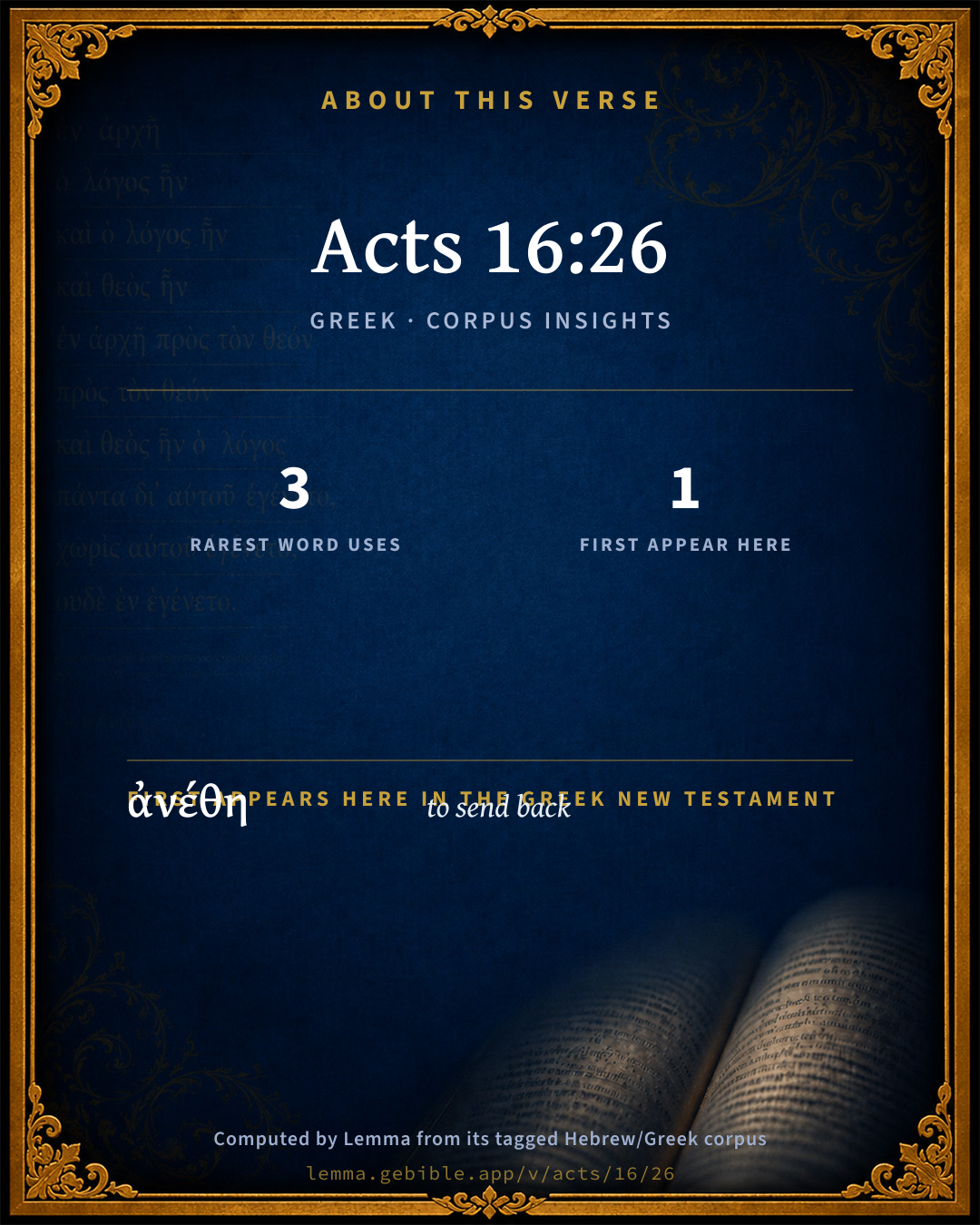
The rarest word here is ἄφνω suddenly G869 — appearing just 3 times in the whole Greek New Testament.

First appearance in Scripture

This word makes its first canonical appearance in the Greek New Testament here:

  • ἀνέθη to send back G447

Shared distinctive vocabulary

ἄφνω suddenly G869 occurs in 3 verses of the Greek New Testament. Also found in:
Repetition

Words recur within this verse:

Cross-references

13

Topical passages linked to Acts 16:26 in the Treasury of Scripture Knowledge — connected by theme and wording, ordered by reader-vote popularity; previews shown in the World English Bible.

  • Acts 4:31 When they had prayed, the place was shaken where they were gathered together. They were all filled with the Holy Spirit, and they spoke the word of God with boldness.
  • Acts 5:19 But an angel of the Lord opened the prison doors by night, and brought them out, and said,
  • Acts 12:7 And behold, an angel of the Lord stood by him, and a light shone in the cell. He struck Peter on the side, and woke him up, saying, "Stand up quickly!" His chains fell off from his hands.
  • Acts 12:10 When they were past the first and the second guard, they came to the iron gate that leads into the city, which opened to them by itself. They went out, and went down one street, and immediately the angel departed from him.
  • Psalms 146:7 Who executes justice for the oppressed; Who gives food to the hungry. Yahweh frees the prisoners.
  • Matthew 28:2 Behold, there was a great earthquake, for an angel of the Lord descended from the sky, and came and rolled away the stone from the door, and sat on it.
  • Psalms 102:20 To hear the groans of the prisoner; To free those who are condemned to death;
  • Isaiah 42:7 to open the blind eyes, to bring out the prisoners from the dungeon, and those who sit in darkness out of the prison-house.
  • Psalms 79:11 Let the sighing of the prisoner come before you. According to the greatness of your power, preserve those who are sentenced to death;
  • Isaiah 61:1 The Spirit of the Lord Yahweh is on me; because Yahweh has anointed me to preach good news to the humble; he has sent me to bind up the broken-hearted, to proclaim liberty to the captives, and the opening [of the prison] to those who are bound;
  • Revelation 11:13 In that day there was a great earthquake, and a tenth of the city fell. Seven thousand people were killed in the earthquake, and the rest were terrified, and gave glory to the God of heaven.
  • Zechariah 9:11–12 As for you also, Because of the blood of your covenant, I have set free your prisoners from the pit in which is no water.
  • Revelation 6:12 I saw when he opened the sixth seal, and there was a great earthquake. The sun became black as sackcloth made of hair, and the whole moon became as blood.

Cross-references courtesy of OpenBible.info (CC BY 4.0).

Commentary

Notes on Acts 16:26 from classic Christian and Jewish commentators (each source and its license shown beneath its notes). The classic Christian expositions comment on the surrounding passage and are grouped to its opening verse, so a note may address several verses; the Jewish commentaries on the Tanakh (Rashi and others) are per-verse, so they appear only where the commentator wrote on this verse.

Lemma curates 59 commentaries, every one of them public domain or Creative Commons licensed, each selected and text-cleaned for this edition rather than reprinted as found. About our sources →

The Biblical Illustrator

Joseph S. Exell

Act_16:26

And suddenly there was a great earthquake.

The earthquake at Philippi

A miraculous act of the breaker of all bonds.

I. He breaks the bonds of tribulation, when His elect call to Him day and night (Paul and Silas).

II. He tears asunder the fetters of sin, when bound souls sigh after Him (the jailer).

III. He makes a path for His word and kingdom even when the world puts fetters on them. The Word of God is not bound.

IV. He bursts open the prison of the grave, when the hour of eternal redemption strikes. That hour is said to be midnight. (K. Gerok.)

Earthquakes

We have all read of the earthquake in Lisbon, in Lima, in Aleppo, and in Caraceas; but we live in a latitude where in all our memory there has not been one severe volcanic disturbance. And yet we have seen fifty earthquakes. Here is a man who has been building up a large fortune. His bid on the money market was felt in all the cities. He thinks he has got beyond all annoying rivalries in trade, and he says to himself, Now I am free and safe from all possible perturbation. But in 1837, or in 1857, or in 1873, a national panic strikes the foundations of the commercial world, and crash f goes all that magnificent business establishment. Here is a man who has built up a very beautiful home. His daughters have just come home from the seminary with diplomas of graduation. His sons have started in life, honest, temperate, and pure. When the evening lights are struck, there is a happy and unbroken family circle. But there has been an accident down at Long Branch. The young man ventured too far out in the surf. The telegraph hurled the terror up to the city. An earthquake struck under the foundations of that beautiful home. The piano closed; the curtains dropped; the laughter hushed. Crash! go all those domestic hopes, and prospects, and expectations. So, my friends, we have all felt the shaking down of some great trouble, and there was a time when we were as much excited as this man of the text, and we cried out as he did: What shall I do?

The midnight hour in the prison of Philippi, an image of the great hour of the Lord

1. The world sleeps, but believers wait for it with watchfulness and prayer.

2. The earth quakes, but the Lord is near.

3. The servants of sin tremble before judgment.

4. The children of the kingdom lift up their heads with joy, because their redemption draweth nigh. (K. Gerok.)

God a powerful Ally

When John G. Paton, upon his little island of Anyeitum, was almost giving up hope of life, though still trying to pacify the bloodthirsty natives, it happened that upon the far horizon line a ships sails were seen and a line of smoke going up into the sky. The fire steamer comes, cried the natives in wild terror, and ran to hide themselves in the bush. The chief, who had been so cruel, came to beg Paton for his life. It seemed like the last judgment to these poor ignorant subjects. But what was it to the missionary? To him the connecting link with his own country, the help and strength of new life. When the ship came it proved to be one of Her Majestys men-of-war, and the sight of the power of Patons Queen so struck the native imagination that they decided to leave the man who had such powerful friends to do his work unharmed. So behind the Christian there is the Christians God, all-powerful, all-willing.

The Biblical Illustrator, edited by Joseph S. Exell (c. 1880s–1900s) — public domain. Text from a community e-Sword module.

Tyndale Open Study Notes

Tyndale Open Resources

16:26 The massive earthquake is reminiscent of the great earthquake at Jesus’ resurrection (Matt 28:2-3).

Tyndale Open Study Notes — © Tyndale Open Resources, licensed CC BY-SA 4.0. Text via the HelloAO Bible API.

Bengel's Gnomon

Johann Albrecht Bengel

Act 16:26. Πάντων, of all) even of the prisoners, in whose minds a great change (conversion) ensued.

Bengel's Gnomon of the New Testament — English translation (T&T Clark, Edinburgh, 1860) — public domain. Text from a community e-Sword module.

Expositor's Greek Testament

ed. W. Robertson Nicoll

Act 16:26 . ἄφνω , see on Act 2:2 . σεισμὸς , cf. Act 4:31 , where the divine nearness and presence were manifested in a similar manner; the neighbourhood and the period were conspicuous for such convulsions of nature, cf. Plumptre on Mat 24:7 , and Ramsay, St. Paul , p. 221. παραχρῆμα , see critical notes. ἀνεῴχθησάν τε … αἱ θύραι πᾶσαι : any one who has seen a Turkish prison, says Prof. Ramsay, will not wonder at this; “each door was merely closed by a bar, and the earthquake, as it passed along the ground, forced the door-posts apart from each other, so that the bar slipped from its hold, and the door swung open,” and see further description on same page. ἀνέθη , cf. Act 27:40 , nowhere else in N.T. in same sense; in LXX we have the same collocation of words in Mal 4:2 . See also for the phrase, Plut., Alex. , 73; see Winer-Schmiedel, p. 101. If we ask, Why did not the prisoners escape? the answer is that a semi-Oriental mob would be panic-stricken by the earthquake, and there is nothing strange in the fact that they made no dash for safety; moreover, the opportunity must have been very quickly lost, for the jailor was not only roused himself, but evidently called at once to the guard for lights; see Ramsay’s description, u. s. , and the comments of Blass, in loco , and Felten, note, p. 318, to the same effect as Ramsay, that the prisoners were panic-stricken, and had no time to collect their thoughts for flight.

The Expositor's Greek Testament, edited by W. Robertson Nicoll (1897–1910) — public domain. Text from a community e-Sword module.

Jamieson, Fausset & Brown

Robert Jamieson, A. R. Fausset & David Brown

And suddenly there was a great earthquake--in answer, doubtless, to the prayers and expectations of the sufferers that, for the truth's sake and the honor of their Lord, some interposition would take place.

every one's bands--that is, the bands of all the prisoners.

were loosed--not by the earthquake, of course, but by a miraculous energy accompanying it. By this and the joyous strains which they had heard from the sufferers, not to speak of the change wrought on the jailer, these prisoners could hardly fail to have their hearts in some measure opened to the truth; and this part of the narrative seems the result of information afterwards communicated by one or more of these men.

Jamieson, Fausset & Brown — Commentary Critical and Explanatory on the Whole Bible (1871) — public domain (CC PDM 1.0). Text via the HelloAO Bible API.

Adam Clarke's Commentary

Verse 26. There was a great earthquake] Thus God bore a miraculous testimony of approbation to his servants; and, by the earthquake, and loosing the bonds of the prisoners, showed, in a symbolical way, the nature of that religion which they preached: while it shakes and terrifies the guilty, it proclaims deliverance to the captives, and the opening of the prison-doors to them that are bound; and sets at liberty them that are bruised.

Every one's bands were loosed.] And yet so eminently did God's providence conduct every thing, that not one of the prisoners made his escape, though the doors were open, and his bolts off!

Adam Clarke's Commentary on the Bible (1810–1826) — public domain. Text from a community e-Sword/MySword module.

John Calvin's Commentaries

26. There was an earthquake. The Lord, in showing this visible sign, meant chiefly to provide for his servants, that they might more manifestly know that the prayers were heard; yet he had respect also of the rest. He could have loosed the fetters of Paul and Silas without an earthquake, and also have opened the gates. But that addition served not a little to confirm them, seeing that the Lord, for their sakes, did shake both the air and also the earth. Again, it was requisite that the keeper of the prison and the rest should feel the presence of God, lest they should think that the miracle came by chance. Neither is it to be doubted, but that the Lord did then show a token of his power, which should be profitable for all ages; so that the faithful may fully assure themselves that he will be nigh unto them so often as they are to enter combats and dangers for the defense of the gospel. Nevertheless, he doth neither always keep the same course, to testify his presence by manifest signs; neither is it lawful for us to prescribe him a law. For he did help his by manifest miracles then for this cause, that we may be content with his hidden grace at this day; concerning which matter we have spoken more upon the second chapter.

John Calvin's Commentaries (1540-1563) — public domain. Text from the Calvin Translation Society English edition (1840s-50s) via the Christian Classics Ethereal Library (ccel.org). Calvin's coverage is partial (roughly two-thirds of the Bible); uncommented books and verses are honest gaps, never fabricated. The 19th-century editor's footnotes and remarks are omitted so the notes are faithfully Calvin's own voice.

Ellicott's Commentary for English Readers

(26) And suddenly there was a great earth quake.—Both the region and the time were, it will be remembered, conspicuous for convulsions of this kind. Cities in Asia, such as Sardis, Apamea and Laodicea, and in Campania, suffered severely under Tiberius. (See Note on Mat_24:7.) St. Luke apparently reads the fact not as in itself miraculous, but as leading to a display of supernatural calmness and courage on the part of the Apostles, and so to the conversion of the gaoler.

Every one’s bands were loosed.—This seems, at first, beyond the range of the usual effects of an earthquake, but the chains of the prisoners were fastened, we must remember, to rings or staples in the wall, and the effect of a great shock would be to loosen the stones and so make it easy to escape. The fact that the “foundations of the prison were shaken” agrees with what has been said above (Note on Act_16:24), as to the dungeon into which the prisoners had been thrust.

A Bible Commentary for English Readers, edited by Charles John Ellicott (1878–1897) — public domain. Text from a community e-Sword module.

The Cambridge Bible for Schools and Colleges

gen. ed. J. J. S. Perowne

26. And suddenly there was a great earthquake] Just as the place wherein the Apostles prayed (Act_4:31) was shaken, so here God testifies that He is near at hand.

and every one’s bands were loosed] The sense in which these words are to be taken may be gathered from the rest of the description. The chains (δεσμὰ) were made fast to the wall, and the shock which burst asunder the bolts of the doors also released the fastenings which held the chains in the masonry.

The Cambridge Bible for Schools and Colleges (gen. ed. J. J. S. Perowne; Cambridge University Press, 1878–1918) — public domain. Text from a community e-Sword module.

John Gill's Exposition

And suddenly there was a great earthquake,.... An extraordinary and unusual one; which did not arise from natural causes, from wind being pent up in the earth, but from the prayers and praises of the saints, going up to heaven; when God was pleased to testify his presence and power this way; and the effects which followed upon this earthquake, show it to be a supernatural one:

so that the foundations of the prison were shaken; not the roof and walls only, as is common in earthquakes, but the very foundation also; and yet the edifice was not thrown down, as is usual when the foundation is shaken:

and immediately all the doors were opened; both of the outer and inner prisons, which is another unusual effect of earthquakes:

and everyone's bands were loosed; not only the bands of Paul and Silas, but of the rest of the prisoners; though the Arabic version reads, "all the fetters and bands of both were loosed", referring it only to Paul and Silas; this circumstance shows also, that the earthquake was miraculous, for when was it ever known that such an effect ever followed one?

John Gill's Exposition of the Whole Bible (1746–1763) — public domain (CC PDM 1.0). Text via the HelloAO Bible API.

Trapp's Complete Commentary

John Trapp

26 And suddenly there was a great earthquake, so that the foundations of the prison were shaken: and immediately all the doors were opened, and every one’s bands were loosed.

Ver. 26. There was a great earthquake] See the great power of prayer. It shaketh heaven and earth, Luther saith; there is a kind of omnipotence in it.

John Trapp, A Commentary or Exposition upon All the Books of the Old and New Testament (1647–1656) — public domain. Text from a community e-Sword module.

Albert Barnes' Notes on the Bible

And suddenly - While they were praying and singing.

A great earthquake - Mat 28:2. An earthquake, in such circumstances, was regarded as a symbol of the presence of God, and as an answer to prayer. See the notes on Act 4:31. The design of this was, doubtless, to furnish them proof of the presence and protection of God, and to provide a way for them to escape. It was one among the series of wonders by which the gospel was established, and the early Christians protected amidst their dangers.

And immediately all the doors were opened - An effect that would naturally follow from the violent concussion of the earthquake. Compare Act 5:19.

Everyone’s bands were loosed - This was evidently a miracle. Some have supposed that their chains were dissolved by electric fluid; but the narrative gives no account of any such fluid, even supposing such an effect to be possible. It was evidently a direct interposition of divine power. But for what purpose it was done is not recorded. Grotius supposes that it was that they might know that the apostles might be useful to them and to others, and that by them their spiritual bonds might be loosed. Probably the design was to impress all the prisoners with the conviction of the presence and power of God, and thus to prepare them to receive the message of life from the lips of his servants Paul and Silas. They had just before heard them singing and praying; they were aware, doubtless, of the cause for which they were imprisoned; they saw evident tokens that they were the servants of the Most High, and under his protection; and their own minds were impressed and awed by the terrors of the earthquake, and by the fact of their own liberation. It renders this scene the more remarkable, that though the doors were opened, and the prisoners loosed, yet no one made any attempt to escape.

Albert Barnes' Notes on the Bible (1834–1885) — public domain. Text from a community e-Sword/MySword module.

Haydock's Catholic Bible Commentary

All the doors were opened. This made the jailer conclude the prisoners had made their escape. And he being answerable for them, and expecting to be put to death, was for stabbing himself. (Witham)

George Leo Haydock (1774–1849), Haydock's Catholic Family Bible and Commentary, 1859 edition — public domain. Excludes Psalms (Douay-Rheims chapter numbering differs from Protestant) and Deuterocanonical books (Catholic canon only).

Matthew Poole's English Annotations

Suddenly; how soon is prayer answered, when the fulness of time is come! So nigh is God unto all that call upon him, Psa 34:17; 145:18.

There was a great earthquake; an earthquake did usually precede some wonderful matter, as Mat 28:2. And although God could have delivered these his servants without an earthquake, yet, to show the more that their deliverance was his work, and it was no artifice or force of their own, he manifested his power after this manner.

Every one’s bands were loosed; either by the earthquake, or some secret power of an angel, or by God himself immediately, that the apostles and others might know that the souls of men should be loosed and set free by them, whose bodies for that purpose were now freed by God.

Matthew Poole's English Annotations on the Holy Bible (1683–1685) — public domain. Text from a community e-Sword/MySword module.

Whedon's Commentary on the Bible

Daniel D. Whedon

26. And suddenly—What sense, says the Rationalist, in a miracle here where it accomplishes nothing which might not have been attained without one? We reply, with Baumgarten, that the miracle was a true, illustrious, and necessary “Divine Sign,” confirming the apostles in the reality of the divine invitation, from the man of Macedonia, of Christianity into Europe. And Baumgarten also plausibly shows that this whole scene was a symbol and a shadow of the future history of Christianity in Europe. Philippi, as a colonia, is an image, ambitiously so, of the Roman pagan power. She opens the first Gentile persecution against the Church, emblem of the pagan persecution for four centuries. For three centuries the martyred Church sings her songs of triumph in the midnight, the bloodshed, and the stocks. Yet the very foundations of that inner structure are shaken, and by the very majesty of the secular power is the Church at last enfranchised.

A great earthquake—The voice of God answers to the voice of man; the earthquake responds to the hymn. The σεισμος was so much an earthquake as a prison-quake. It was not from below, but from above, as truly as the pentecostal house-shaking. It was not, therefore, a mere indiscriminate jar and crash, but a distinct and specific act of the divine volition by which the foundations of the prison were shaken, the prison doors were flung open, and the fetters all sprung, while the power-bound limbs of the prisoners were unable to escape. Doubtless the city and the magistrates heard and were awed by the concussion; for even the ancient pagan recognised in the earthquake the movement of God. The solemn echoes of the apostles’ preaching had for many days been resounding through the city, convictions and misgivings had disturbed the public heart, and it may be saintly supposed that this immediately following sign should dismay the consciences of the guilty inhabitants and magistrates.

Daniel D. Whedon (gen. ed.), Commentary on the Old and New Testaments (1874–1909) — public domain. Text from a community e-Sword module.

The Pulpit Commentary

Prison-house for prison, A.V., as Act_5:21, Act_5:23. All the doors were opened. This would be the natural effect of the earthquake. Bands (desma) St. Luke always follows the Attic usage of desmon, in the neuter. (comp. Act_20:23; Luk_8:29) St. Paul follows the Hellenistic usage of desmov, in the masculine (Php_1:13; see Jer_2:20 Jer_5:5; Hab_3:13) In many instances (genitive and dative) it is, of course, impossible to determine whether the word is masculine or neuter.

Vers. 26-34. God in the earthquake.

God does not always manifest himself in the still small voice"; (1Ki 19) there are times when he makes himself known in other forms. We learn from our text

I THAT GOD IS SOMETIMES, IF NOT OFTEN, IN THE TERRIBLE. (Ver. 26.) "By terrible things in righteousness," as well as by gracious things in mercy and in love, does he answer us. He is in the earthquake and in the fire and in the great and strong wind, sometimes. He was, here. The earthquake was the moving of his hand, the utterance of his voice, the expression of his mind. It was his condemnation of human injustice and cruelty; it was his declaration on behalf of human innocence and worth. As in nature we have the solemn as well as the pleasant, the fearful as well as the delightful, the storm as well as the sunshine, so in God"s providential dealings with us, and also in his revelation of himself in Jesus Christ, we have the awful and the stern as well as the benignant and the merciful, the rebuke as well as the invitation, punishment as well as reward, death as well as life.

II THAT GOD"S AIM, IN THE TERRIBLE, IS TO AWAKEN THE SLUMBERING SOUL. "The keeper of the prison awaking out of his sleep" (ver. 27). It was the sleep of sin from which this earthquake called him, rather than from bodily slumber. God aroused his spirit thus; and from a guilty, deadly unconsciousness of all that is most precious in the human heart, he awoke to newness of life." "God doeth it that men should fear before him". (Ecc_3:14) God sends the earthquake; he shakes the very ground under men"s feet; he makes their life-prospects to rock and quiver; he threatens with loss, or he permits terrible bereavements, to compel men to think of those things which otherwise they would continue to disregard, to make men see the solemn realities which are about them, to place judgment and eternity in full view before their eyes.

III THAT SPIRITUAL AGITATION STILL ASKS THE OLD QUESTION AND RECEIVES THE OLD REPLY. Let men say what they will about "refined selfishness," it will always remain true that a man"s first duty to God is the duty he owes to himself; that the first thing a man awakened by God has to do is to consider how he can come into a right and happy relation to the God with whom he has to do; in other words, to ask him how he can be saved," how his sin can be forever and himself be taken back into the favor and the service of the living God. And the answer of Paul will always be the reply of the Christian teacher. The earnest seeker after salvation must be directed to a Divine Savior, in whom he can "believe." For us to believe in the Lord Jesus Christ is to accept him.for all that he offers to be to us to accept him

(1) as the Savior in whom we trust for Divine mercy;

(2) as the Friend to whom we give our heart;

(3) as the Lord to whom we dedicate our life.

IV THAT THE ACCEPTANCE OF JESUS CHRIST IS TO BE FOLLOWED BY DISCIPLESHIP AND PROFESSION. The converted jailor, so far from being satisfied with his first change, gave his mind to the further and fuller understanding of the truth (ver. 32); moreover, he showed the sincerity of his conversion by being baptized into the Christian faith (ver. 33), by carrying with him all the members of his household, and by offering hospitality to those whom he had treated as criminals and now welcomed as friends. We, too, if our faith be genuine, shall

(1) be eager to learn more of Christ and of his holy will;

(2) make profession of our change of heart and life;

(3) do all we can to befriend and further those who are the ambassadors of Christ.

V THAT FAITH IN CHRIST TURNS PASSING PLEASURE INTO ABIDING JOY. "He rejoiced" (ver. 34). He had often laughed and been merry before; now joy takes up its home in his heart. ".Blessed are all they that put their trust in him. C.

The Pulpit Commentary (1880–1919), ed. H.D.M. Spence-Jones & Joseph S. Exell — public domain. Text from a community e-Sword module.

McGarvey & Pendleton's Commentaries

J. W. McGarvey

26. The song of the apostles was a strange sound to the other prisoners, but one most welcome to heaven; and God, who appeared almost to have forsaken his servants, came to their relief in a manner peculiar to himself, yet most surprising to all within the prison. (26) " And suddenly there was a great earthquake, so that the foundations of the prison were shaken, and immediately all the doors were opened, and every one's bonds were loosed. " The prisoners were all awake when this occurred, having been awakened by the singing, and must instinctively have connected the phenomenon with those midnight singers.

J. W. McGarvey (with Philip Y. Pendleton), Commentaries on the New Testament (The Fourfold Gospel, 1914; Acts; and the epistles) — public domain. Text from a community e-Sword/MySword module.

Cambridge Greek Testament for Schools and Colleges

26. σεισμὸς ἐγένετο μέγας, there was a great earthquake. Just as the place wherein the Apostles prayed (Act 4:31) was shaken, so here God testifies that He is near at hand.

πάντων τὰ δεσμὰ ἀνέθη, every one’s bands were loosed. The sense in which these words are to be taken may be gathered from the rest of the description. The chains (δεσμὰ) were made fast to the wall, and the shock which burst asunder the bolts of the doors also released the fastenings which held the chains in the masonry.

Cambridge Greek Testament for Schools and Colleges (Cambridge University Press, 1896; 21 vols, various authors incl. Carr, Maclear, Plummer, Farrar, Lumby, Moule, M. R. James, Simcox) — public domain. Text from a community e-Sword module.

Alford’s Greek Testament

Henry Alford

26. πάντων τὰ δεσμὰ ἀνέθη] i.e. of all the prisoners in the prison: see below (ver. 28), ἅπαντες γάρ ἐσμεν ἐνθάδε. Doubtless there were gracious purposes in this for those prisoners, who before were listening to the praises of Paul and Silas; and the very form of the narrative, mentioning this listening, shews subsequent communication between some one of these and the narrator.

Their chains were loosed, not by the earthquake, but by miraculous interference over and above it. It is some satisfaction to find, that neither Meyer, De Wette, nor Kuinoel have attempted to rationalize this wonderful example of the triumph of prayer. See some excellent remarks on Baur’s attempt to do so, in Neander, Pfl. u. L. p. 302, note 3.

Henry Alford, The Greek Testament (1849–1861) — public domain. Text from a community e-Sword module.

Lesson kit

Teaching starters — assembled from the data on this page, not authored interpretation. Every prompt links to the verse data it draws on. Edit before teaching.

Acts, in the Acts, opens this verse with 22 words (17 distinct Greek lemmas). Its most distinctive word is áphnō (“suddenly”). A historical commentator’s framing appears above. Read the whole chapter for the surrounding context.

Discussion questions

  1. The word áphnō carries the sense “suddenly.” How does it shape the verse?
  2. The word “to send back” first appears here in Scripture. What is being introduced at this debut?
  3. Acts 2:2 shares the word «suddenly» with this verse. How do the two illuminate each other?
  4. “all” occurs 2× in this one verse. What is the effect of the repetition?
  5. These translations render this verse differently; the difference is in the English rendering, not the original. What questions does that raise?
  6. Reading how The Biblical Illustrator and Tyndale Open Study Notes read this verse, where do the two commentators agree and where do they part?

Things to notice

  • 1 word makes its first canonical appearance in Scripture here.
  • These translations choose different wording for 11 words in this verse.
  • “all” occurs 2× in this single verse.
  • 17 distinct Greek lemmas span 22 words in this verse.

Reading settings

Reading text

Shown beneath each verse's original-language words.

Old Testament
Old Testament edition

Read the OT as the Masoretic Hebrew (MT) or the Greek Septuagint (LXX).

English shown for the Greek Septuagint (in the Hebrew ↔ Greek comparison).

Comparing translations? Open the Compare panel on any verse page to stack up to four side by side.