

Acts 23:21
Greek (Tischendorf 8th ed.) Acts 23:21 appears in the Greek New Testament. The text above is from the Tischendorf 8th edition. Each word links to its Strong’s number and a concise gloss. Click any word for its full Thayer’s Greek Lexicon entry.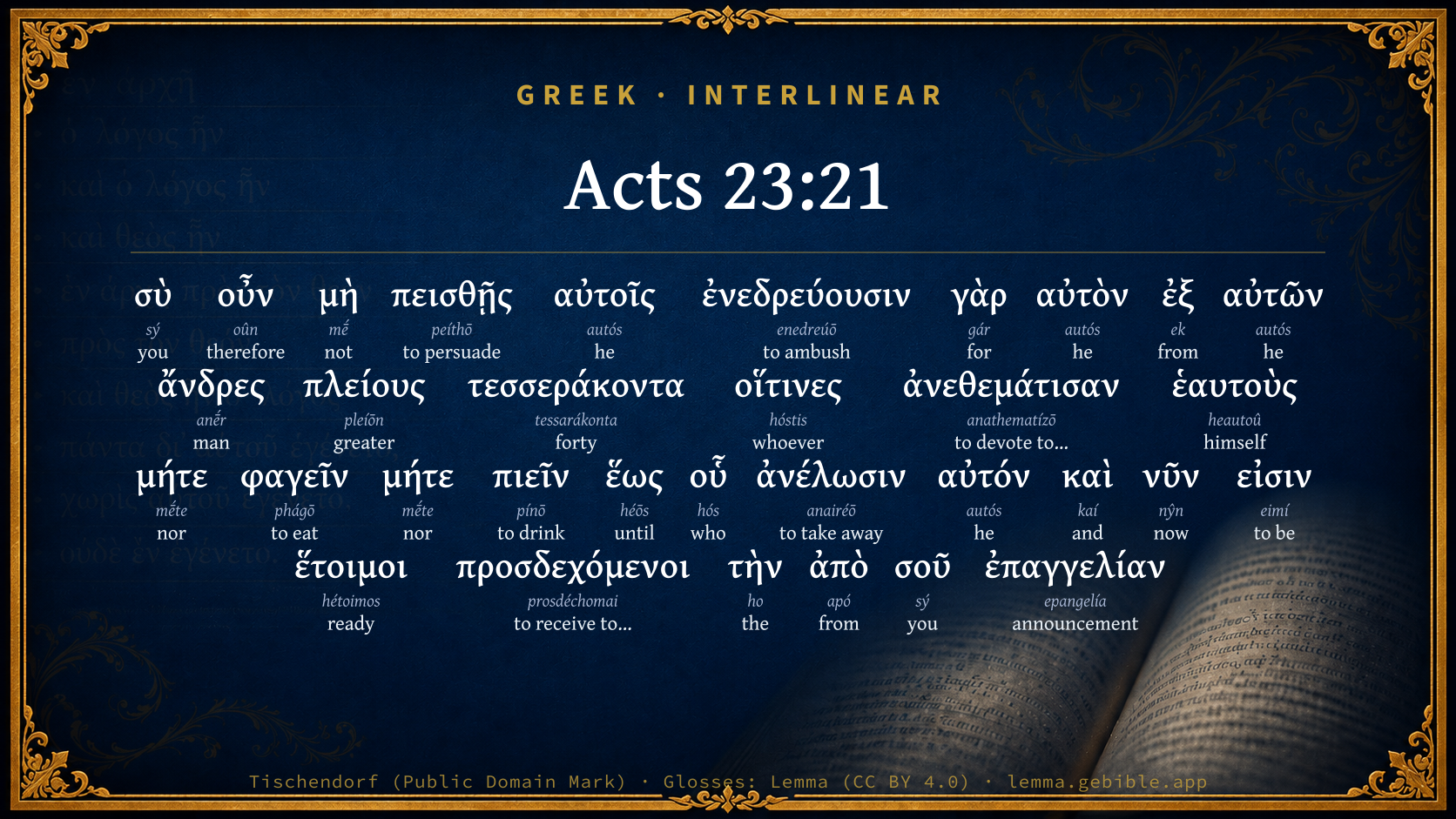
Therefore don't yield to them, for more than forty men lie in wait for him, who have bound themselves under a curse neither to eat nor to drink until they have killed him. Now they are ready, looking for the promise from you."
Download a study sheet
One document with this verse’s original text, its word-by-word gloss line, the meaning frame, cross-references with their text, attributed commentary, and full source and license credits — printable, and it pastes into notes with its structure intact.
This verse Autodidact and up
A passage Seminary Student
Up to 50 verses in one chapter. A passage sheet keeps up to 6 commentary sources and 12 cross-references per verse, in the order this page ranks them, and says so on the sheet whenever that leaves anything out. Ask for a single verse and you get the Autodidact verse sheet above.
Everything on this page stays free to read, with no account — the sheet is a download of what is already on screen, not access to it.
Compare translations 3
The same verse in 3 English versions, stacked beneath the original-language interlinear above. Click any original word for its lexicon entry.
Each is an independent rendering of the whole verse — the interlinear is not word-aligned to these translations.
Highlighted words mark where these versions differ — a whole-verse word diff, not a word-by-word alignment.
-
World English Bible Public Domain
Therefore don't yield to them, for more than forty men lie in wait for him, who have bound themselves under a curse neither to eat nor to drink until they have killed him. Now they are ready, looking for the promise from you."
-
King James Version Public Domain
But do not thou yield unto them: for there lie in wait for him of them more than forty men, which have bound themselves with an oath, that they will neither eat nor drink till they have killed him: and now are they ready, looking for a promise from thee.
-
unfoldingWord Literal Text CC BY-SA 4.0
Therefore may you not be persuaded by them, because from them more than 40 men wait in ambush for him, who have cursed themselves neither to eat nor to drink until they have killed him. Even now they are ready, waiting for the promise from you.”
unfoldingWord Literal Text — © unfoldingWord, licensed CC BY-SA 4.0. Word-aligned USFM3 via Door43 (git.door43.org/unfoldingWord/en_ult).
Show all 19 translations
Every available English version of this verse, each an independent rendering of the whole verse.
-
World English Bible Public Domain
Therefore don't yield to them, for more than forty men lie in wait for him, who have bound themselves under a curse neither to eat nor to drink until they have killed him. Now they are ready, looking for the promise from you."
-
Berean Standard Bible Public Domain
Do not let them persuade you, because more than forty men are waiting to ambush him. They have bound themselves with an oath not to eat or drink until they have killed him; they are ready now, awaiting your consent.”
-
Majority Standard Bible Public Domain
Do not let them persuade you, because more than forty men are waiting to ambush him. They have bound themselves with an oath not to eat or drink until they have killed him; they are ready now, awaiting your consent.”
-
King James Version Public Domain
But do not thou yield unto them: for there lie in wait for him of them more than forty men, which have bound themselves with an oath, that they will neither eat nor drink till they have killed him: and now are they ready, looking for a promise from thee.
-
American Standard Version (1901) Public Domain
Do not thou therefore yield unto them: for there lie in wait for him of them more than forty men, who have bound themselves under a curse, neither to eat nor to drink till they have slain him: and now are they ready, looking for the promise from thee.
-
Revised Version (1885) Public Domain
Do not thou therefore yield unto them: for there lie in wait for him of them more than forty men, which have bound themselves under a curse, neither to eat nor to drink till they have slain him: and now are they ready, looking for the promise from thee.
-
Geneva Bible (1599) Public Domain
But let them not perswade thee: for there lie in waite for him of them, more then fourtie men, which haue bound themselues with a curse, that they will neither eate nor drinke, till they haue killed him: and nowe are they readie, and waite for thy promise.
-
Douay-Rheims (1899) Public Domain
But do not thou give credit to them; for there lie in wait for him more than forty men of them, who have bound themselves by oath neither to eat, nor to drink, till they have killed him: and they are now ready, looking for a promise from thee.
-
Young's Literal Translation Public Domain
thou, therefore, mayest thou not yield to them, for there lie in wait for him of them more than forty men, who did anathematize themselves -- not to eat nor to drink till they kill him, and now they are ready, waiting for the promise from thee.'
-
Literal Standard Version CC BY-SA 4.0
you, therefore, may you not yield to them, for there more than forty men of them lie in wait for him, who cursed themselves—not to eat nor to drink until they kill him, and now they are ready, waiting for the promise from you.”
-
Unlocked Literal Bible CC BY-SA 4.0
But do not give in to them, because there are more than forty men who are lying in wait for him. They have called a curse down on themselves, neither to eat nor to drink until they have killed him. Even now they are ready, waiting for consent from you.”
-
unfoldingWord Literal Text CC BY-SA 4.0
Therefore may you not be persuaded by them, because from them more than 40 men wait in ambush for him, who have cursed themselves neither to eat nor to drink until they have killed him. Even now they are ready, waiting for the promise from you.”
-
Darby Bible Public Domain
Do not thou then be persuaded by them, for there lie in wait for him of them more than forty men, who have put themselves under a curse neither to eat nor drink till they kill him; and now they are ready waiting the promise from thee.
-
World Messianic Bible Public Domain
Therefore don’t yield to them, for more than forty men lie in wait for him, who have bound themselves under a curse to neither eat nor drink until they have killed him. Now they are ready, looking for the promise from you.”
-
Webster's Bible Public Domain
But do not thou yield to them: for there are of them who lie in wait for him more than forty men, who have bound themselves with an oath, that they will neither eat nor drink till they have killed him: and now they are ready, looking for a promise from thee.
-
Free Bible Version CC BY-SA 4.0
“Please don't listen to them, because they have planned to ambush him with more than forty men who have taken an oath not to eat or drink until they have killed him. They're ready right now, waiting for you to agree to the request.”
-
Bible in Basic English Public Domain
But do not give way to them, for more than forty of them are waiting for him, having taken an oath not to take food or drink till they have put him to death: and now they are ready, waiting for your order.
-
Text-Critical English NT CC BY 4.0
Do not be persuaded by them, for more than forty men are lying in ambush for him. They have bound themselves under a curse not to eat or drink until they have killed him. They are now ready, waiting for yoʋr consent.”
-
Tyndale New Testament (1534) Public Domain
But folowe not their mindes: for ther lyein wayte for him of the moo then.xl. men which have boude the selves with a vowe that they will nether eate ner drinke till they have killed him. And now are they redy and loke for thy promes.
Literal Standard Version (2020), Covenant Press — licensed CC BY-SA 4.0. Text via the HelloAO Bible API (eBible.org). Unlocked Literal Bible (unfoldingWord) — licensed CC BY-SA 4.0. Text via the HelloAO Bible API (eBible.org). unfoldingWord Literal Text — © unfoldingWord, licensed CC BY-SA 4.0. Word-aligned USFM3 via Door43 (git.door43.org/unfoldingWord/en_ult). Free Bible Version, Dr. Jonathan Gallagher — licensed CC BY-SA 4.0. Text via the HelloAO Bible API (eBible.org).
Word by word
More ways to search: Search by grammar → Find every occurrence → Compare this word →
Practice this passage: Drill this verse → Learn its vocabulary →
- Appears 2× in the Greek New Testament
- First appears at Luke 11:54
- Part of Speech
- Verb
- Tense
- Present
- Voice
- Active
- Mood
- Indicative
- Person
- 3rd person
- Number
- Plural
Full Thayer's Definition
- σὺ sý G4771 “you” Personal pronoun, 2nd person, Nominative, Singular
- οὖν oûn G3767 “therefore” Conjunction
- μὴ mḗ G3361 “not” Particle, Negative
- πεισθῇς peíthō G3982 “to persuade” Verb, Aorist, Passive, Subjunctive, 2nd person, Singular
- αὐτοῖς autós G846 “he” Personal pronoun, Dative, Plural, Masculine
- ἐνεδρεύουσιν enedreúō G1748 “to ambush” Verb, Present, Active, Indicative, 3rd person, Plural
- γὰρ gár G1063 “for” Conjunction
- αὐτὸν autós G846 “he” Personal pronoun, Accusative, Singular, Masculine
- ἐξ ek G1537 “from” Preposition
- αὐτῶν autós G846 “he” Personal pronoun, Genitive, Plural, Masculine
- ἄνδρες anḗr G435 “man” Noun, Nominative, Plural, Masculine
- πλείους pleíōn G4119 “greater” Adjective, Nominative, Plural, Masculine, Comparative
- τεσσεράκοντα tessarákonta G5062 “forty” Adjective, Numeral (indeclinable)
- οἵτινες hóstis G3748 “whoever” Relative pronoun, Nominative, Plural, Masculine
- ἀνεθεμάτισαν anathematízō G332 “to devote to destruction” Verb, Aorist, Active, Indicative, 3rd person, Plural
- ἑαυτοὺς heautoû G1438 “himself” Reflexive pronoun, 3rd person, Accusative, Plural, Masculine
- μήτε mḗte G3383 “nor” Conjunction, Negative
- φαγεῖν phágō G5315 “to eat” Verb, Aorist, Active, Infinitive
- μήτε mḗte G3383 “nor” Conjunction, Negative
- πιεῖν pínō G4095 “to drink” Verb, Aorist, Active, Infinitive
- ἕως héōs G2193 “until” Adverb
- οὗ hós G3739 “who” Relative pronoun, Genitive, Singular, Masculine
- ἀνέλωσιν anairéō G337 “to take away” Verb, Aorist, Active, Subjunctive, 3rd person, Plural
- αὐτόν autós G846 “he” Personal pronoun, Accusative, Singular, Masculine
- καὶ kaí G2532 “and” Conjunction
- νῦν nŷn G3568 “now” Adverb
- εἰσιν eimí G1510 “to be” Verb, Present, Active, Indicative, 3rd person, Plural
- ἕτοιμοι hétoimos G2092 “ready” Adjective, Nominative, Plural, Masculine
- προσδεχόμενοι prosdéchomai G4327 “to receive to oneself” Verb, Present, Middle or Passive deponent, Participle, Nominative, Plural, Masculine
- τὴν ho G3588 “the” Article, Accusative, Singular, Feminine
- ἀπὸ apó G575 “from” Preposition
- σοῦ sý G4771 “you” Personal pronoun, 2nd person, Genitive, Singular
- ἐπαγγελίαν epangelía G1860 “announcement” Noun, Accusative, Singular, Feminine
About this verse
These counts appear in no published source. They are computed here, from the morphology-tagged text and Lemma’s own curated glosses. What Lemma adds →
- 33
- words
- 28
- distinct lemmas
- Acts
- section
Cross-references
9Topical passages linked to Acts 23:21 in the Treasury of Scripture Knowledge — connected by theme and wording, ordered by reader-vote popularity; previews shown in the World English Bible.
- Acts 23:12–14 When it was day, some of the Jews banded together, and bound themselves under a curse, saying that they would neither eat nor drink until they had killed Paul.
- Exodus 23:2 You shall not follow a crowd to do evil; neither shall you testify in court to side with a multitude to pervert justice;
- Acts 9:23–24 When many days were fulfilled, the Jews conspired together to kill him,
- Acts 14:5–6 When some of both the Gentiles and the Jews, with their rulers, made a violent attempt to mistreat and stone them,
- Acts 20:19 serving the Lord with all humility, with many tears, and with trials which happened to me by the plots of the Jews;
- Acts 25:3 asking a favor against him, that he would summon him to Jerusalem; plotting to kill him on the way.
- Romans 9:3 For I could wish that I myself were accursed from Christ for my brothers' sake, my relatives according to the flesh,
- 2 Corinthians 11:26 I have been in travels often, perils of rivers, perils of robbers, perils from my countrymen, perils from the Gentiles, perils in the city, perils in the wilderness, perils in the sea, perils among false brothers;
- 2 Corinthians 11:32–33 In Damascus the governor under Aretas the king guarded the city of the Damascenes desiring to arrest me.
Cross-references courtesy of OpenBible.info (CC BY 4.0).
Lesson kit
Teaching starters — assembled from the data on this page, not authored interpretation. Every prompt links to the verse data it draws on. Edit before teaching.
Acts, in the Acts, opens this verse with 33 words (28 distinct Greek lemmas). Its most distinctive word is enedreúō (“to ambush”). A historical commentator’s framing appears above. Read the whole chapter for the surrounding context.
Discussion questions
- How does “to ambush” (enedreúō) shape what this verse is saying?
- How does Luke 11:54, which shares the word «to ambush», read alongside this verse?
- What does the repetition of “he” (4× in this one verse) do in this verse?
- These translations render this verse differently. What is at stake in choosing one wording over another?
- Compare how Bengel's Gnomon and Meyer's Critical & Exegetical Commentary read this verse. Where do they agree or differ?
Things to notice
- These translations choose different wording for 26 words in this verse.
- “he” occurs 4× in this single verse.
- 28 distinct Greek lemmas span 33 words in this verse.
Commentary
Notes on Acts 23:21 from classic Christian and Jewish commentators (each source and its license shown beneath its notes). The classic Christian expositions comment on the surrounding passage and are grouped to its opening verse, so a note may address several verses; the Jewish commentaries on the Tanakh (Rashi and others) are per-verse, so they appear only where the commentator wrote on this verse.
Lemma curates 59 commentaries, every one of them public domain or Creative Commons licensed, each selected and text-cleaned for this edition rather than reprinted as found. About our sources →
Bengel's Gnomon
Johann Albrecht Bengel
Bengel's Gnomon of the New Testament — English translation (T&T Clark, Edinburgh, 1860) — public domain. Text from a community e-Sword module.
Meyer's Critical & Exegetical Commentary
Heinrich August Wilhelm Meyer
Meyer — Critical and Exegetical Commentary on the New Testament — English translation by Peter Christie, edited by Frederick Crombie (T&T Clark, 1880) — public domain. Text from a community e-Sword module.
Expositor's Greek Testament
ed. W. Robertson Nicoll
The Expositor's Greek Testament, edited by W. Robertson Nicoll (1897–1910) — public domain. Text from a community e-Sword module.
Jamieson, Fausset & Brown
Robert Jamieson, A. R. Fausset & David Brown
Jamieson, Fausset & Brown — Commentary Critical and Explanatory on the Whole Bible (1871) — public domain (CC PDM 1.0). Text via the HelloAO Bible API.
The Cambridge Bible for Schools and Colleges
gen. ed. J. J. S. Perowne
The Cambridge Bible for Schools and Colleges (gen. ed. J. J. S. Perowne; Cambridge University Press, 1878–1918) — public domain. Text from a community e-Sword module.
John Gill's Exposition
John Gill's Exposition of the Whole Bible (1746–1763) — public domain (CC PDM 1.0). Text via the HelloAO Bible API.
Trapp's Complete Commentary
John Trapp
John Trapp, A Commentary or Exposition upon All the Books of the Old and New Testament (1647–1656) — public domain. Text from a community e-Sword module.
Albert Barnes' Notes on the Bible
Albert Barnes' Notes on the Bible (1834–1885) — public domain. Text from a community e-Sword/MySword module.
Matthew Poole's English Annotations
Matthew Poole's English Annotations on the Holy Bible (1683–1685) — public domain. Text from a community e-Sword/MySword module.
The Pulpit Commentary
The Pulpit Commentary (1880–1919), ed. H.D.M. Spence-Jones & Joseph S. Exell — public domain. Text from a community e-Sword module.
McGarvey & Pendleton's Commentaries
J. W. McGarvey
J. W. McGarvey (with Philip Y. Pendleton), Commentaries on the New Testament (The Fourfold Gospel, 1914; Acts; and the epistles) — public domain. Text from a community e-Sword/MySword module.
Cambridge Greek Testament for Schools and Colleges
Cambridge Greek Testament for Schools and Colleges (Cambridge University Press, 1896; 21 vols, various authors incl. Carr, Maclear, Plummer, Farrar, Lumby, Moule, M. R. James, Simcox) — public domain. Text from a community e-Sword module.
Alford’s Greek Testament
Henry Alford
Henry Alford, The Greek Testament (1849–1861) — public domain. Text from a community e-Sword module.
Vincent's Word Studies in the New Testament
Marvin R. Vincent
Marvin R. Vincent, Word Studies in the New Testament (1887–1900) — public domain. Text from a community e-Sword/MySword module.