
Acts 20:31

Greek (Tischendorf 8th ed.) Acts 20:31 appears in the Greek New Testament. The text above is from the Tischendorf 8th edition. Each word links to its Strong’s number and a concise gloss. Click any word for its full Thayer’s Greek Lexicon entry.

Download image
Cite this verse

Acts 20:31 (World English Bible). Public Domain. Lemma interlinear Bible study tool, https://lemma.gebible.app/v/acts/20/31.

Show BibTeX & RIS
BibTeX
RIS
English Translation
Therefore watch, remembering that for a period of three years I didn't cease to admonish everyone night and day with tears.
World English Bible · Public Domain
Highlights
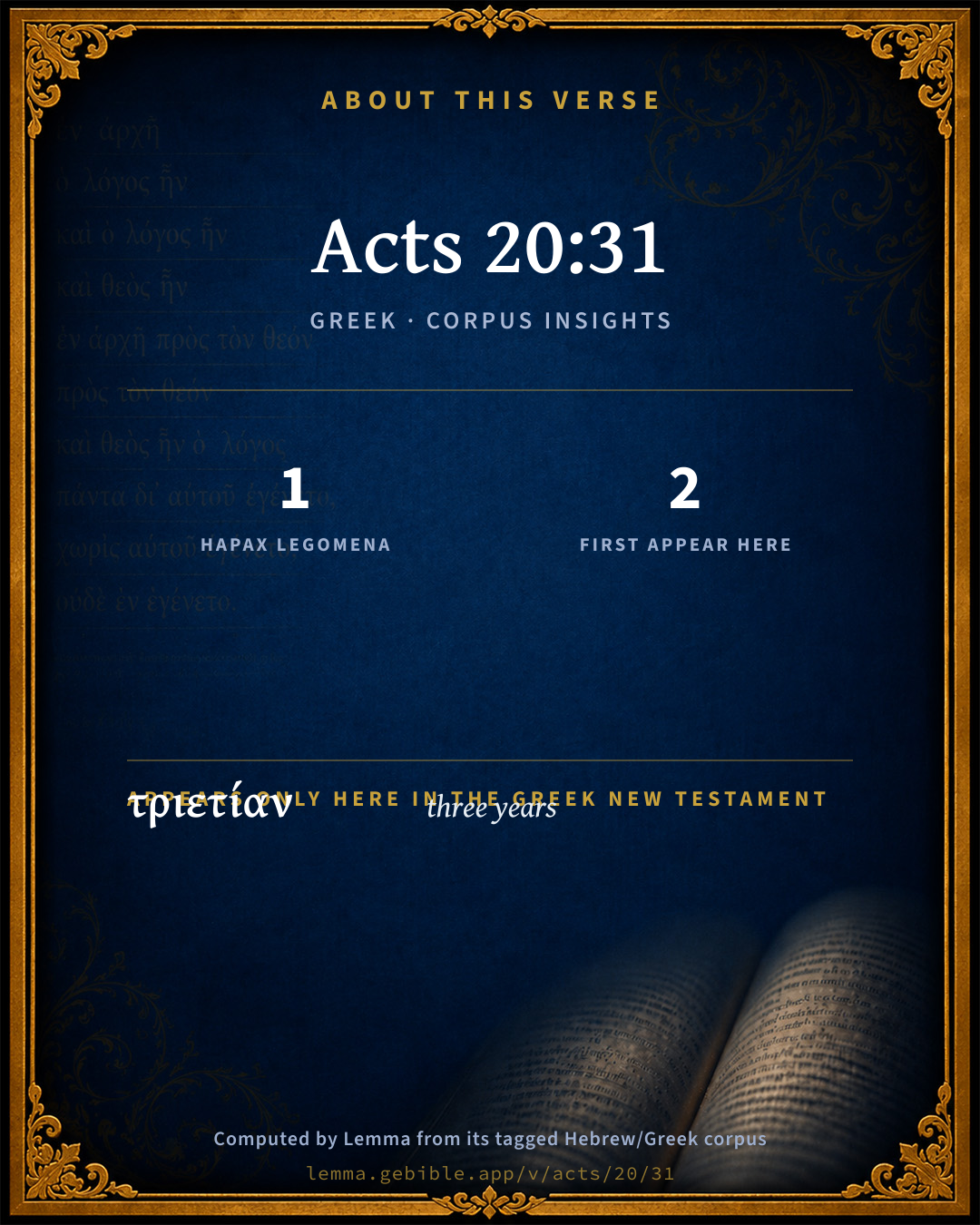
  • 1 hapax legomenon — only here in the Greek New Testament
  • 2 first appearances in the Greek New Testament
Full analysis ↓
Download a study sheet

One document with this verse’s original text, its word-by-word gloss line, the meaning frame, cross-references with their text, attributed commentary, and full source and license credits — printable, and it pastes into notes with its structure intact.

This verse Autodidact and up

Study sheet (.html) Plain text (.txt)

A passage Seminary Student

Up to 50 verses in one chapter. A passage sheet keeps up to 6 commentary sources and 12 cross-references per verse, in the order this page ranks them, and says so on the sheet whenever that leaves anything out. Ask for a single verse and you get the Autodidact verse sheet above.

Everything on this page stays free to read, with no account — the sheet is a download of what is already on screen, not access to it.

Want to remove ads? Support Godless Engineer
Compare translations 3

The same verse in 3 English versions, stacked beneath the original-language interlinear above. Click any original word for its lexicon entry.

Each is an independent rendering of the whole verse — the interlinear is not word-aligned to these translations.

Highlighted words mark where these versions differ — a whole-verse word diff, not a word-by-word alignment.

  • World English Bible Public Domain
    Therefore watch, remembering that for a period of three years I didn't cease to admonish everyone night and day with tears.
  • King James Version Public Domain
    Therefore watch, and remember, that by the space of three years I ceased not to warn every one night and day with tears.
  • unfoldingWord Literal Text CC BY-SA 4.0
    So be alert, remembering that for three years I did not stop admonishing each one with tears night and day.

unfoldingWord Literal Text — © unfoldingWord, licensed CC BY-SA 4.0. Word-aligned USFM3 via Door43 (git.door43.org/unfoldingWord/en_ult).

Versions to compare (up to 4)

3 of 4 selected

Show all 19 translations

Every available English version of this verse, each an independent rendering of the whole verse.

  • World English Bible Public Domain
    Therefore watch, remembering that for a period of three years I didn't cease to admonish everyone night and day with tears.
  • Berean Standard Bible Public Domain
    Therefore be alert and remember that for three years I never stopped warning each of you night and day with tears.
  • Majority Standard Bible Public Domain
    Therefore be alert and remember that for three years I never stopped warning each of you night and day with tears.
  • King James Version Public Domain
    Therefore watch, and remember, that by the space of three years I ceased not to warn every one night and day with tears.
  • American Standard Version (1901) Public Domain
    Wherefore watch ye, remembering that by the space of three years I ceased not to admonish every one night and day with tears.
  • Revised Version (1885) Public Domain
    Wherefore watch ye, remembering that by the space of three years I ceased not to admonish every one night and day with tears.
  • Geneva Bible (1599) Public Domain
    Therefore watche, and remember, that by the space of three yeres I ceased not to warne euery one, both night and day with teares.
  • Douay-Rheims (1899) Public Domain
    Therefore watch, keeping in memory, that for three years I ceased not, with tears to admonish every one of you night and day.
  • Young's Literal Translation Public Domain
    `Therefore, watch, remembering that three years, night and day, I did not cease with tears warning each one;
  • Literal Standard Version CC BY-SA 4.0
    Therefore, watch, remembering that three years, night and day, I did not cease with tears warning each one;
  • Unlocked Literal Bible CC BY-SA 4.0
    So be on guard. Remember that for three years I did not stop instructing every one of you with tears night and day.
  • unfoldingWord Literal Text CC BY-SA 4.0
    So be alert, remembering that for three years I did not stop admonishing each one with tears night and day.
  • Darby Bible Public Domain
    Wherefore watch, remembering that for three years, night and day, I ceased not admonishing each one [of you] with tears.
  • World Messianic Bible Public Domain
    Therefore watch, remembering that for a period of three years I didn’t cease to admonish everyone night and day with tears.
  • Webster's Bible Public Domain
    Therefore watch, and remember, that by the space of three years I ceased not to warn every one night and day with tears.
  • Free Bible Version CC BY-SA 4.0
    So watch out! Don't forget that for three years I went on instructing all of you night and day, often crying over you.
  • Bible in Basic English Public Domain
    So keep watch, having in mind that for three years without resting I was teaching every one of you, day and night, with weeping.
  • Text-Critical English NT CC BY 4.0
    Therefore be watchful, remembering that, night and day, for three years I did not stop admonishing each one of you, with tears.
  • Tyndale New Testament (1534) Public Domain
    Therfore awake and remember that by the space of.iii. yeares I ceased not to warne every one of you both nyght and daye with teares.

Literal Standard Version (2020), Covenant Press — licensed CC BY-SA 4.0. Text via the HelloAO Bible API (eBible.org). Unlocked Literal Bible (unfoldingWord) — licensed CC BY-SA 4.0. Text via the HelloAO Bible API (eBible.org). unfoldingWord Literal Text — © unfoldingWord, licensed CC BY-SA 4.0. Word-aligned USFM3 via Door43 (git.door43.org/unfoldingWord/en_ult). Free Bible Version, Dr. Jonathan Gallagher — licensed CC BY-SA 4.0. Text via the HelloAO Bible API (eBible.org).

Word by word

More ways to search: Search by grammar → Find every occurrence → Compare this word →

Practice this passage: Drill this verse → Learn its vocabulary →

τριετίαν
trietía
G5148
“three years”
Noun, Accusative, Singular, Feminine
Part of Speech
Noun
Case
Accusative
Number
Singular
Gender
Feminine
Full Thayer's Definition

Origin: from a compound of G5140 and G2094

TDNT: None

1. a space of three years
  1. διὸ dió G1352 “wherefore” Conjunction
  2. γρηγορεῖτε grēgoreúō G1127 “to watch” Verb, Present, Active, Imperative, 2nd person, Plural
  3. μνημονεύοντες mnēmoneúō G3421 “to remember” Verb, Present, Active, Participle, Nominative, Plural, Masculine
  4. ὅτι hóti G3754 “that” Conjunction
  5. νύκτα nýx G3571 “night” Noun, Accusative, Singular, Feminine
  6. καὶ kaí G2532 “and” Conjunction
  7. ἡμέραν hēméra G2250 “day” Noun, Accusative, Singular, Feminine
  8. οὐκ ou G3756 “not” Particle, Negative
  9. ἐπαυσάμην paúō G3973 “to cease” Verb, Aorist, Middle, Indicative, 1st person, Singular
  10. μετὰ metá G3326 “with” Preposition
  11. δακρύων dákry G1144 “tear” Noun, Genitive, Plural, Neuter
  12. νουθετῶν nouthetéō G3560 “to admonish” Verb, Present, Active, Participle, Nominative, Singular, Masculine
  13. ἕνα heîs G1520 “one” Adjective, Accusative, Singular, Masculine
  14. ἕκαστον hékastos G1538 “each” Adjective, Accusative, Singular, Masculine

About this verse

These counts appear in no published source. They are computed here, from the morphology-tagged text and Lemma’s own curated glosses. What Lemma adds →

15
words
15
distinct lemmas
Acts
section

Notable vocabulary

1 hapax legomenon — a word that appears only here in the entire Greek New Testament:

  • τριετίαν three years G5148

First appearance in Scripture

These words make their first canonical appearance in the Greek New Testament here:

  • τριετίαν three years G5148
  • νουθετῶν to admonish G3560

Shared distinctive vocabulary

νουθετῶν to admonish G3560 occurs in 8 verses of the Greek New Testament. Also found in:
Cross-references

19

Topical passages linked to Acts 20:31 in the Treasury of Scripture Knowledge — connected by theme and wording, ordered by reader-vote popularity; previews shown in the World English Bible.

  • Acts 19:8 He entered into the synagogue, and spoke boldly for a period of three months, reasoning and persuading about the things concerning the Kingdom of God.
  • Acts 19:10 This continued for two years, so that all those who lived in Asia heard the word of the Lord Jesus, both Jews and Greeks.
  • Acts 20:19 serving the Lord with all humility, with many tears, and with trials which happened to me by the plots of the Jews;
  • Ezekiel 3:17–20 Son of man, I have made you a watchman to the house of Israel: therefore hear the word at my mouth, and give them warning from me.
  • Colossians 1:28 whom we proclaim, admonishing every man and teaching every man in all wisdom, that we may present every man perfect in Christ Jesus;
  • Hebrews 13:17 Obey your leaders and submit to them, for they watch on behalf of your souls, as those who will give account, that they may do this with joy, and not with groaning, for that would be unprofitable for you.
  • Matthew 13:25 but while people slept, his enemy came and sowed darnel also among the wheat, and went away.
  • Luke 21:36 Therefore be watchful all the time, asking that you may be counted worthy to escape all these things that will happen, and to stand before the Son of Man."
  • 2 Timothy 4:5 But you be sober in all things, suffer hardship, do the work of an evangelist, and fulfill your ministry.
  • Matthew 3:7 But when he saw many of the Pharisees and Sadducees coming for his baptism, he said to them, "You offspring of vipers, who warned you to flee from the wrath to come?
  • Mark 13:34–37 "It is like a man, traveling to another country, having left his house, and given authority to his servants, and to each one his work, and also commanded the doorkeeper to keep watch.
  • Acts 20:7 On the first day of the week, when the disciples were gathered together to break bread, Paul talked with them, intending to depart on the next day, and continued his speech until midnight.
  • Acts 20:11 When he had gone up, and had broken bread, and eaten, and had talked with them a long while, even until break of day, he departed.
  • Acts 24:17 Now after some years, I came to bring gifts for the needy to my nation, and offerings;
  • 1 Corinthians 4:14 I don't write these things to shame you, but to admonish you as my beloved children.
  • 1 Thessalonians 2:9–10 For you remember, brothers, our labor and travail; for working night and day, that we might not burden any of you, we preached to you the Gospel of God.
  • 1 Thessalonians 5:14 We exhort you, brothers, admonish the disorderly, encourage the fainthearted, support the weak, be patient toward all.
  • 2 Thessalonians 3:8 neither did we eat bread from anyone's hand without paying for it, but in labor and travail worked night and day, that we might not burden any of you;
  • Revelation 16:15 "Behold, I come like a thief. Blessed is he who watches, and keeps his clothes, so that he doesn't walk naked, and they see his shame."

Cross-references courtesy of OpenBible.info (CC BY 4.0).

Commentary

Notes on Acts 20:31 from classic Christian and Jewish commentators (each source and its license shown beneath its notes). The classic Christian expositions comment on the surrounding passage and are grouped to its opening verse, so a note may address several verses; the Jewish commentaries on the Tanakh (Rashi and others) are per-verse, so they appear only where the commentator wrote on this verse.

Lemma curates 59 commentaries, every one of them public domain or Creative Commons licensed, each selected and text-cleaned for this edition rather than reprinted as found. About our sources →

Joseph Benson's Commentary

Act 20:31. Therefore watch — With all diligence and care; take heed yourselves, and warn others to take heed; and remember, that by the space of three years, (for so long had he been preaching at Ephesus and the parts adjacent,) I ceased not to warn every one — To whom I had access; night and day with tears — This was watching indeed! Who copies after this example? Let it then, as if he had said, be your care, that a church planted by me with so much labour and solicitude, may not be ravaged and overthrown by the enemy, but that it may long continue to flourish. Observe here, reader, 1st, Paul, like a faithful watchman, had warned them publicly, by preaching, and by the warnings he thus gave them was instrumental in prevailing with them to receive the truth and turn to God. 2d, He warned every one. Besides the public warnings he gave to all in general that attended his ministry, he applied himself to particular persons, according as he saw their case called for it. 3d, He was constant in giving warning; he warned them night and day, his time was filled up with this work. 4th, He was indefatigable in it, he ceased not to warn; though some might be obstinate and persist in sin, disregarding his warnings, yet he persevered, hoping, that at length, by the grace of God, they would be reformed. And though others might appear to comply with his warnings, yet still he did not desist, fearing lest, although they were now righteous, they should, through the power of temptation, be overcome in some unguarded hour, and turn from their righteousness, Eze 3:18 to Eze 21:5 th, He addressed them, whether in public or private, with a great deal of affection and concern; he warned them with tears, namely, with tears of compassion; thereby showing how much he was himself affected with the danger an misery of those who were in a sinful state and false way; or with tears of love and gratitude to God in behalf of those who were savingly converted to him and adorned his gospel.

Joseph Benson's Commentary on the Old and New Testaments (1811–1818) — public domain. Text from a community e-Sword module.

Bengel's Gnomon

Johann Albrecht Bengel

Act 20:31. Γρηγορεῖτε, watch) A pastoral expression.—νύκτα—ἓκαστον, by night—every one) This was great watchfulness. [And if this was becoming in an apostle, how much more is it so in a pastor!—V. g.]

Bengel's Gnomon of the New Testament — English translation (T&T Clark, Edinburgh, 1860) — public domain. Text from a community e-Sword module.

Meyer's Critical & Exegetical Commentary

Heinrich August Wilhelm Meyer

Act_20:31. Γρηγορεῖτε] verbum pastorale, Bengel,comp. προσέχετε ἑαυτοῖς καὶ παντὶ τῷ ποιμνίῳ Act_20:28,and that, encouraged by the recollection of my own example, μνημονεύοντες, ὅτι κ.τ.λ.

τριετίαν] See on Act_19:10.

μετὰ δακρύων] extorted both by afflictions (Act_20:19) and by the sympathetic fervour with which Paul prosecuted his quite special (ἕνα ἕκαστον) pastoral care, 2Co_11:29; 2Co_2:4.

νύκτα κ. ἡμέρ.] See on Luk_2:37. νύκτα is here placed first, because it most closely corresponds to the figurative γρηγορεῖτε.

As to the idea of νουθεσία, admonition, see on Eph_6:4.

Meyer — Critical and Exegetical Commentary on the New Testament — English translation by Peter Christie, edited by Frederick Crombie (T&T Clark, 1880) — public domain. Text from a community e-Sword module.

Expositor's Greek Testament

ed. W. Robertson Nicoll

Act 20:31 . γρηγ .: the pastoral metaphor continued; verb used four times by St. Paul, and it may well have passed into familiar use in the early Church by the solemn injunction of our Lord on the Mount of Olives to watch, cf. also Luk 12:37 , 1Pe 5:8 , Rev 3:2-3 ; Rev 16:15 , and the names Gregory, Vigilantius , amongst the early converts. τριετίαν : the three years may be used summarily i.e. , as speaking in round numbers, or literally. It would have seemed out of place in such an appeal to say “two years and three months,” or whatever the exact time may have been. The intention was to give a practical turn to this watchfulness: triennium celeste , Bengel. The word is regarded by Vogel as a decided employment of a medical term by Luke from Dioscorides, see also to the same effect Meyer Weiss, Evangelium des Lukas , note on Act 1:1 . The word is found only here in N.T., not at all in LXX, but used by Theophr., Plut., Artem. νύκτα : perhaps placed first because it corresponded more closely to the idea of watching against attacks, or perhaps because it emphasised the ceaselessness of the Apostle’s labours, cf. Act 26:7 , 1Th 2:9 ; 1Th 3:10 , 1Ti 5:5 , 2Ti 1:3 . μετὰ δακρύων , cf. 2Co 2:4 , Chrys., Hom. , xliv. “Quod cor tamen saxatum, ut hisce lacrimis non emolliatur? qui non fleat flente Paulo?” Corn. à Lapide; see also Farrar, St. Paul , ii., 283. νουθετῶν : only here in Acts, but seven times in St. Paul’s Epistles, but nowhere else in N.T., “admonish,” R.V. In classical Greek it is joined both with παρακαλεῖν and κολάζειν ; St. Paul too used it in gentleness, or “with a rod”. In LXX, Job 4:3 ; Wis 11:10 ; Wis 12:2 . ἕνα ἕκαστον , 2Co 11:29 and Joh 10:3 ; αἶς ἕκαστος twice in St. Luke’s Gospel, Luk 4:40 , Luk 16:5 , six times in Acts, five times in St. Paul’s Epistles (only once elsewhere in N.T., Mat 26:22 , but not in T.R.).

The Expositor's Greek Testament, edited by W. Robertson Nicoll (1897–1910) — public domain. Text from a community e-Sword module.

Jamieson, Fausset & Brown

Robert Jamieson, A. R. Fausset & David Brown

by the space of three years--speaking in round numbers; for it was nearer three than two years.

I ceased not to warn every one night and day with tears--What an appeal to be able to make! "And if this was an apostle's part, how much more a pastor's!" [BENGEL].

Jamieson, Fausset & Brown — Commentary Critical and Explanatory on the Whole Bible (1871) — public domain (CC PDM 1.0). Text via the HelloAO Bible API.

Adam Clarke's Commentary

Verse 31. Therefore watch, and remember] The only way to abide in the truth is to watch against evil, and for good; and to keep in mind the heavenly doctrines originally received. Unwatchfulness and forgetfulness are two grand inlets to apostasy.

By the space of three years] τριετιαν. The Greek word here does not necessarily mean three whole years: it may be months more or less. In Ac 19:8; Ac 19:10, we have an account of his spending two years and three months among them; probably this is all that is intended. One MS., perceiving that the time of three years was not completed, inserts διετιαν, the space of two years.

Adam Clarke's Commentary on the Bible (1810–1826) — public domain. Text from a community e-Sword/MySword module.

John Calvin's Commentaries

31. For which cause, watch. Paul doth again exhort them unto diligence by his own example, though he doth join therewithal fear of danger, as if he should say that they have need of great attention to beware; and that it is an unseemly thing that they should be wearied who had seen his singular patience by the space of three years. Also, he speaketh of his tears, which did add no small efficacy to his exhortations. Whereas he saith that he admonished every one, it may be referred as well unto the common people as unto the elders. For because he was determined to speak such things as should be common to the whole Church, he speaketh as if the whole body were present. Nevertheless, if any had rather restrain it unto the order of the pastors, the meaning shall be this, that their studies must be kindled, not only with this speech which he now maketh, but that it is meet that they remember those often exhortations which he did continually beat in by the space of three years, and that with many tears. Yet it seemeth to me to be more likely that he speaketh of all in general.

John Calvin's Commentaries (1540-1563) — public domain. Text from the Calvin Translation Society English edition (1840s-50s) via the Christian Classics Ethereal Library (ccel.org). Calvin's coverage is partial (roughly two-thirds of the Bible); uncommented books and verses are honest gaps, never fabricated. The 19th-century editor's footnotes and remarks are omitted so the notes are faithfully Calvin's own voice.

Ellicott's Commentary for English Readers

(31) Therefore watch . . .—The word was, as it were, an echo from our Lord’s teaching (Mat_24:42; Mat_25:13, et al.), which could hardly have been unknown to St. Paul. Here, however, it receives a fresh significance from its connection with the term episcopi. They who were the bishops, the overseers, the watchers of the flock, ought, above all others, to set an example of vigilance.

By the space of three years.—Strictly speaking, the narrative of the Acts accounts for three months’ preaching in the synagogue (Act_19:8), two years in the school of Tyrannus (Act_19:10), and an undefined period embracing the time immediately before and after the tumult of Demetrius. This would be enough to warrant him describing the time of his ministry, speaking roughly, as extending over three years.

To warn every one night and day with tears.—Comp. Note on Act_20:19.

A Bible Commentary for English Readers, edited by Charles John Ellicott (1878–1897) — public domain. Text from a community e-Sword module.

The Cambridge Bible for Schools and Colleges

gen. ed. J. J. S. Perowne

31. Therefore watch] The sort of watching implied is that unsleeping alertness which can never be taken by surprise.

and remember, that by the space of three years] As the verb here is a participial form the Rev. Ver. translates “Wherefore watch ye, remembering, &c.,” in which there is this gain, that the watchfulness which the Apostle enjoins is thus enforced by his own example. Be ye watchful, because ye know that I was so night and day while I was among you. The “three years” may be a speaking in round numbers, yet it cannot have been far from the length of time which Paul spent at Ephesus. See notes on Act_19:8; Act_19:10.

I ceased not to warn [admonish, Rev. Ver.] every one night and day with tears] We know from his appeal to the Corinthians (2Co_11:29) and other places, how sympathetic St Paul was in all that concerned his flock. “Who is weak, and I am not weak? who is offended, and I burn not?” And if for weakness and offences, how much more in a city like Ephesus where idolatry was rampant everywhere. We need not confine the “every one” to the presbyters, St Paul’s labour was spent on the whole Ephesian Church.

The Cambridge Bible for Schools and Colleges (gen. ed. J. J. S. Perowne; Cambridge University Press, 1878–1918) — public domain. Text from a community e-Sword module.

John Gill's Exposition

I have showed you all things,.... Both as to doctrine and practice, and had set them an example how to behave in every point, and particularly in this:

how that so labouring ye ought to support the weak; the sense of which is, that they should labour with their hands as he did, and so support the weak; either such who were weak in body, and unable to work and help themselves, and therefore should be helped, assisted, relieved, and supported by the labours of others, that were able; or the weak in faith, and take nothing of them, lest they should think the preachers of the word sought only their own worldly advantage, and so they should be stumbled and fall from the truth:

and to remember the words of the Lord Jesus; which the apostle had either collected as the sense of some passages of his, such as Luk 6:30, &c. or which though not recorded in any of the Gospels, the apostle might have received from one or other of the twelve disciples, as what were frequently used by Christ in the days of his flesh; and which the apostle had inculcated among the Ephesians, and now puts them in mind of them, they being worthy of remembrance: how he said,

it is more blessed to give than to receive: it is more comfortable, honourable, pleasant, and profitable: the giver is in a more comfortable situation, having an abundance, at least a sufficiency, and something to spare; whereas the receiver is often in want and distress, and so uncomfortable: it is an honour to give; an honour is reflected upon the giver, both by the receiver, and others; when to receive is an instance of meanness, and carries in it, among men, some degree of dishonour: it is a pleasure to a liberal man to distribute to the necessities of others; and it cannot be grateful to a man to be in such circumstances, as make it necessary for him to receive from others, and be dependent on them; and great are the advantages and profit which a cheerful giver reaps, both in this world, and that to come: wherefore the conclusion which the apostle would have drawn from hence is, that it is much more eligible for a man to work with his own hands, and support himself, and assist others, than to receive at the hands of others.

John Gill's Exposition of the Whole Bible (1746–1763) — public domain (CC PDM 1.0). Text via the HelloAO Bible API.

Trapp's Complete Commentary

John Trapp

31 Therefore watch, and remember, that by the space of three years I ceased not to warn every one night and day with tears.

Ver. 31. Night and day with tears] Good men weep easily, saith the Greek poet; {a} and the better any is, the more inclined to weeping; as David than Jonathan, 1Sa 20:41. Some (as they say of witches) cannot weep for sin. But they that weep not here, where there are wiping handkerchiefs in the hands of Christ, shall have their eyes whiped out in hell.

{a} αγαθοι δ αριδακρυες αυδρες.

John Trapp, A Commentary or Exposition upon All the Books of the Old and New Testament (1647–1656) — public domain. Text from a community e-Sword module.

Albert Barnes' Notes on the Bible

Therefore watch - Mat 24:42. In view of the dangers which beset yourselves Act 20:28, the danger from people not connected with the church Act 20:29, and the danger which will arise from the love of power among yourselves Act 20:30, be on your guard. Observe the approach of danger, and set yourselves against it.

Remember - Recall my counsels and admonitions in reference to these dangers.

By the space of three years - In Act 19:10, we are told that Paul spent two years in the school of Tyrannus. In Act 19:8, it is said that he was teaching in the synagogue at Ephesus three months. In addition to this, it is not improbable that he spent some months more in Ephesus in instructing the church in other places. Perhaps, however, by the phrase three years, he meant to use merely a round number, denoting about three years; or, in accordance with the Jewish custom, part of each of the three years one whole year, and a considerable portion of the two others. Compare the notes on Mat 12:40.

I ceased not - I continued to do it.

To warn - To admonish; to place before the mind νουθετῶν nouthetōn; setting the danger and duty of each individual before him.

Everyone - He had thus set them an example of what he had enjoined, Act 20:28. He had admonished each individual, whatever was his rank or standing. It is well when a minister can refer to his own example as an illustration of what he meant by his precepts.

Night and day - Continually; by every opportunity.

With tears - Expressive of his deep feeling, and his deep interest in their welfare. See the notes on Act 20:19.

Albert Barnes' Notes on the Bible (1834–1885) — public domain. Text from a community e-Sword/MySword module.

Matthew Poole's English Annotations

Watch; take heed yourselves, and warn others to take heed.

By the space of three years; from St. Paul’s first coming to Ephesus it was three years current, and now almost complete, Act 19:8,10; 20:3.

With tears; a great, and no feigned παθος; as Christ wept over Jerusalem, Luk 19:41, so St. Paul over the unbelieving Jews; it went to his heart to think that they could not be saved. See how St. Paul loved souls, and pitied souls.

Matthew Poole's English Annotations on the Holy Bible (1683–1685) — public domain. Text from a community e-Sword/MySword module.

Whedon's Commentary on the Bible

Daniel D. Whedon

31. Three years—In round numbers. Three months in the synagogue, (Act_19:8,) two years in the school of Tyrannus, (Acts 10,) preceded by a brief visit, (Act_18:21,) and followed, perhaps, by a short delay, (Act_20:1.)

Daniel D. Whedon (gen. ed.), Commentary on the Old and New Testaments (1874–1909) — public domain. Text from a community e-Sword module.

The Pulpit Commentary

Wherefore watch ye for therefore watch, A.V.; remembering for and remember, A.V.; admonish for warn, A.V. By the space of three years (trietian). The word is only found here in the New Testament; but it is used in the LXX of Isa_15:5 and 2Ch_31:16, and in classical Greek. We have here one of the few chronological data in the Acts. Three years includes the whole of his sojourn at Ephesus as his headquarters. There were first the three months during which he preached in the synagogue; then the two years which he spent in preaching in the school of Tyrannus, and which terminated with the incident of burning the books of magic. (Act_19:8, Act_19:10, Act_19:19) Then there was an indefinite time described in Act_19:22 as "for a while" (aujtosce cro) during which he was busy making plans, probably writing letters, sending off Timothy and Erastus to Macedonia, and perhaps making missionary expeditions in the neighborhood. This may have occupied three or four months longer, and made up a term of two years and six, seven, or eight months, which would quite justify the term trietia. Every one. Each one separately, not merely the whole flock together. A weighty lesson for every one who has the cure of souls. (comp. Joh_10:3) Night and day. The night is mentioned first, in accordance with Hebrew usage (meron). (Gen_1:5, Gen_1:8, Gen_1:13, etc.; comp. the word nucqh in 2Co_11:25) St. Paul enforces the word "Watch," so appropriate to shepherds who watch over their flocks by night, (Luk_2:8) by his own example of admonishing by night as well as day.

The Pulpit Commentary (1880–1919), ed. H.D.M. Spence-Jones & Joseph S. Exell — public domain. Text from a community e-Sword module.

John Wesley's Explanatory Notes

I ceased not to warn every one night and day - This was watching indeed! Who copies after this example?

John Wesley, Explanatory Notes Upon the Whole Bible (1754–1765) — public domain. Text via the GEBible commentary corpus.

Godbey's Commentary on the New Testament

William B. Godbey

31. “Watch, therefore, remembering that three years, night and day, I ceased not warning each one of you with tears.” Paul was a weeping prophet, his tears giving a force to the truth as nothing else could. I preached fifteen years with dry eyes. Then sanctification, breaking up the fountains of my tears, made me a weeping prophet, so I have preached thirty years, my eyes flowing like rivers. Rest assured the Holy Ghost can find the pent-up fountains of tears in the most arid soul. God help us to be personal like Paul, looking our beloved in the face and telling them the whole truth, as here you see he looks these Ephesian elders squarely in the physiognomy and tells them that some of them will turn Satan’s wolves and lead off disciples after them. How signally true has this sad Pauline prophecy been verified in the merciless laceration of the Apostolic church into six thousand sectarian denominations, filling the world with confusion, i. e., Babylon. Entire sanctification, the only grace adequate to fortify us against human leadership and put us where we will follow Jesus only, has for this very reason been rejected and antagonized by the party leaders of all ages, from the simple fact that it renders the people unmanageable by human manipulators and puts them where God alone can lead them by His precious Word, instructing their minds, His sweet Holy Spirit illuminating their spirits, and His gracious providence determining their environments. Glory to God, for His wonderful triple leadership, actually infallible when duly appreciated. Sad will be the day for the present holiness movement when captured and manipulated by human leaders. As God’s revivals in by- gone ages, the Church of God is ruled by the Holy Ghost alone, having no laws, no creed and no authority but God’s Word. It is the very audacity of Satan to invade God’s Church through the instrumentality of his preachers, i. e., the “grievous wolves” predicted by Paul. Oh, how they have scattered, torn and devoured God’s flock in all ages! The word “heresy” means separation. Hence all separation from God and His Word is heresy. Such is the predominant influence of Satan in this awfully wicked world during these dark ages of Satanic triumph, that he actually perverts everything pertaining to truth and righteousness, calling evil good, and good evil. Hence the Lord’s people, in all ages, have been anathematized and slaughtered under charge of heresy. It was true, they had separated from the devil and his people, and were heretics from their standpoint. So it is, this day, very difficult to walk with God in the beauty of holiness and the clear light of His Word, the fullness and freedom of His Spirit, without constant collision, ostracism and persecution by the great human ecclesiasticisms, antagonistical to God’s Word and Spirit, and claiming a right to domineer human conscience, which is the prerogative of God alone. Hence we live amid the awful fulfillment of the Pauline prediction of these “grievous wolves,” i. e., carnal men, “speaking perverse things, in order to draw off disciples after them.”

William B. Godbey, Commentary on the New Testament (1896–1900) — public domain. Text from a community e-Sword module.

McGarvey & Pendleton's Commentaries

J. W. McGarvey

See notes on verse 28

J. W. McGarvey (with Philip Y. Pendleton), Commentaries on the New Testament (The Fourfold Gospel, 1914; Acts; and the epistles) — public domain. Text from a community e-Sword/MySword module.

unfoldingWord translationNotes

Door43 World Missions Community

be on guard. Remember

"be on guard and remember" or "be on guard as you remember"

be on guard

"be awake and alert" or "watch out." Christian leaders being alert about anyone that may harm the community of believers is spoken of as if they were guards in an army watching out for the enemy army. (See: Metaphor)

Remember that

"Continue to remember that" or "Do not forget that"

for three years I did not stop instructing ... night and day

Paul did not teach them continuously for three years, but over the space of three years. (See: Hyperbole and Generalization)

I did not stop instructing

"I did not stop warning"

with tears

Here "tears" refers to Paul's crying because of the strong emotion of concern he felt while he was warning the people. (See: Metonymy)

I entrust you to God and to the word of his grace

Here "word" stands for a message. AT: "I ask God to take care of you and that he will help you to keep believing the message I spoke to you about his grace" (See: Metonymy)

entrust

to give someone else the responsibility of taking care of someone or something

which is able to build you up

A person's faith becoming stronger is spoken of as if the person were a wall and someone were building him higher and stronger. AT: "which is able to make become stronger and stronger in your faith" (See: Metaphor)

to give you the inheritance

This speaks about the "word of his grace" as if it were God himself that would give the inheritance to believers. AT: "God will give you the inheritance" (See: Personification)

the inheritance

The blessings that God gives believers is spoken of as if they were money or property that a child inherits from his father. (See: Metaphor)

translationWords

year

God

grace

inherit

set apart

unfoldingWord translationNotes — © Distant Shores Media and the Door43 World Missions Community, licensed CC BY-SA 4.0. Source: git.door43.org/Door43/en_tn.

Cambridge Greek Testament for Schools and Colleges

31. διὸ γρηγορεῖτε, therefore watch. And the sort of watching indicated is that unsleeping alertness which can never be taken by surprise.

μνημονεύοντες κ.τ.λ., remembering that by the space of three years. St Paul enforces watchfulness by appealing to his own example. Be ye watchful, bearing in mind that I was so night and day while I laboured among you. The three years may be a speaking in round numbers, but it cannot have been a much less time that St Paul spent in Ephesus. See notes on Act 19:8; Act 19:10.

οὐκ ἐπαυσάμην μετὰ δακρύων νουθετῶν κ.τ.λ., I ceased not to admonish every one with tears. We know from his appeal to the Corinthians (2Co 11:29) and from other places, how sympathetic St Paul was in all that concerned his flock. ‘Who is weak, and I am not weak? who is offended, and I burn not?’ And if for weakness and offences, how much more in a city like Ephesus where idolatry was rampant everywhere! We need not confine the ‘every one’ to the presbyters; St Paul’s labour was spent on the whole Ephesian Church.

Cambridge Greek Testament for Schools and Colleges (Cambridge University Press, 1896; 21 vols, various authors incl. Carr, Maclear, Plummer, Farrar, Lumby, Moule, M. R. James, Simcox) — public domain. Text from a community e-Sword module.

Alford’s Greek Testament

Henry Alford

31.] μνημ. ὅτι is only (retf.) used by Paul.

νύκτα κ. ἡμέραν] This expression is remarkable: we have it (see reff.) in Mark, but Luke always uses the genitive, except in the speeches of Paul: and so Paul himself, except as in reff.

νουθετῶν (reff.) is used only by Paul.

On the three years spoken of in this verse, see note, ch. 19:10. We may just remark here (1) that this passage being precise and definite, must be the master key to those others (as in ch. 19) which give wide and indefinite notes of time: and (2) that it seems at first sight to preclude the idea of a journey (as some think) to Crete and Corinth having taken place during this period. But this apparent inference may require modifying by other circumstances: cf. Prolegg. to 1 Cor. § v. 4.

Henry Alford, The Greek Testament (1849–1861) — public domain. Text from a community e-Sword module.

Vincent's Word Studies in the New Testament

Marvin R. Vincent

Watch [γρηγορειτε] . See on Mr 8:35.

To warn [νουθετων] . From nouv, the mind, and tiqhmi, to put. Lit., to put in mind; admonish (so Rev., better than warn). "It's fundamental idea is the well - intentioned seriousness with which one would influence the mind and disposition of another by advice, admonition, warning, putting right, according to circumstances" [χρεμερ] .

Marvin R. Vincent, Word Studies in the New Testament (1887–1900) — public domain. Text from a community e-Sword/MySword module.

Lesson kit

Teaching starters — assembled from the data on this page, not authored interpretation. Every prompt links to the verse data it draws on. Edit before teaching.

Acts, in the Acts, opens this verse with 15 words (15 distinct Greek lemmas). Its most distinctive word is trietía (“three years”). A historical commentator’s framing appears above. Read the whole chapter for the surrounding context.

Discussion questions

  1. What does “three years” (trietía) contribute to the verse as a whole?
  2. 1 word here appears nowhere else in the Greek New Testament. Why might the author reach for such rare wording?
  3. 2 words make their first appearance in Scripture here. What does this debut establish?
  4. How does Romans 15:14, which shares the word «to admonish», read alongside this verse?
  5. The translations on this page render this verse differently — a whole-verse word diff, not a word-by-word alignment. What might account for the different wordings?
  6. Compare how Joseph Benson's Commentary and Bengel's Gnomon read this verse. Where do they agree or differ?

Things to notice

  • 1 word in this verse appears nowhere else in the Greek New Testament.
  • 2 words make their first canonical appearance in Scripture here.
  • These translations choose different wording for 19 words in this verse.
  • 15 distinct Greek lemmas span 15 words in this verse.

Reading settings

Reading text

Shown beneath each verse's original-language words.

Old Testament
Old Testament edition

Read the OT as the Masoretic Hebrew (MT) or the Greek Septuagint (LXX).

English shown for the Greek Septuagint (in the Hebrew ↔ Greek comparison).

Comparing translations? Open the Compare panel on any verse page to stack up to four side by side.