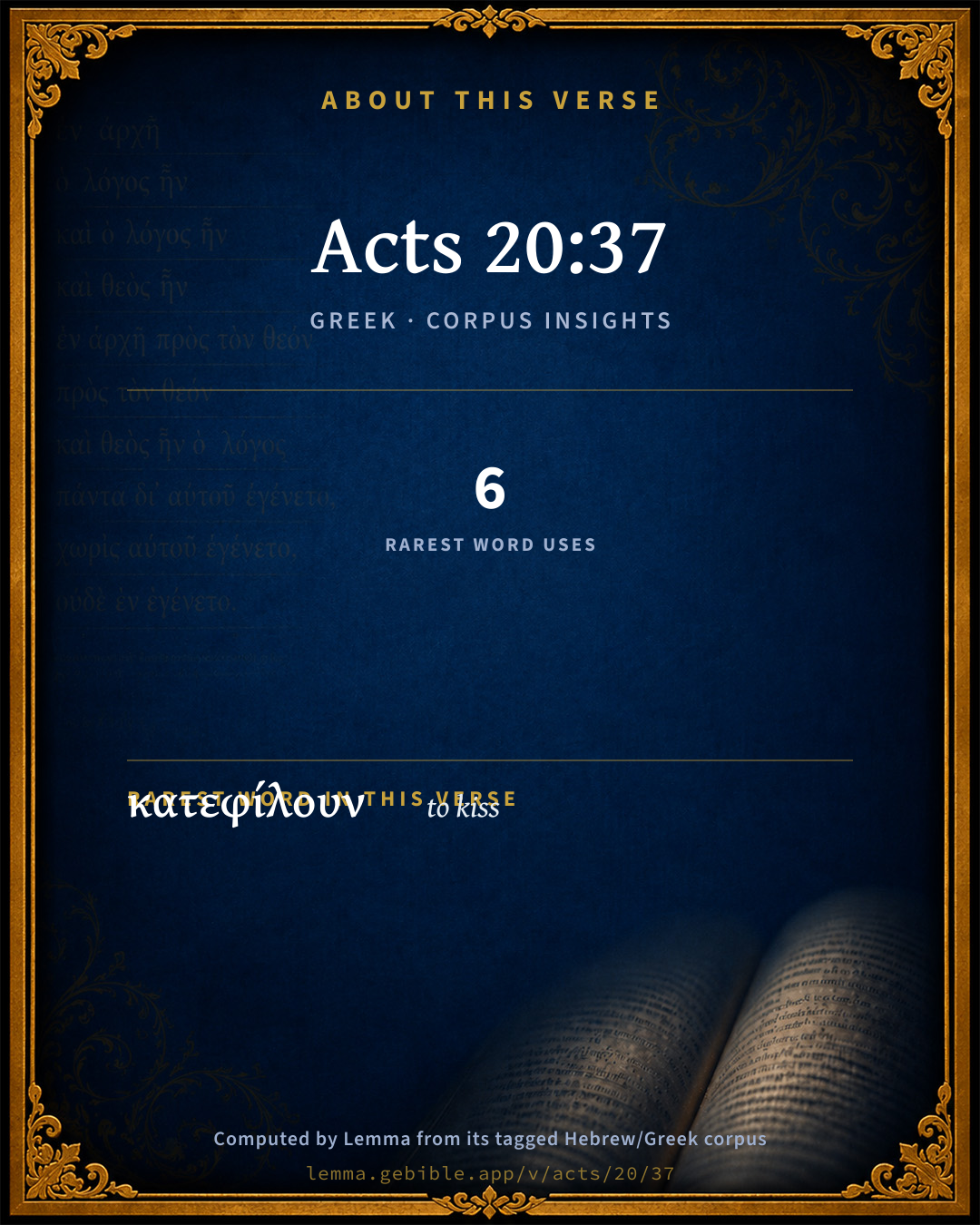
Acts 20:37

Greek (Tischendorf 8th ed.) Acts 20:37 appears in the Greek New Testament. The text above is from the Tischendorf 8th edition. Each word links to its Strong’s number and a concise gloss. Click any word for its full Thayer’s Greek Lexicon entry.

Download image
Cite this verse

Acts 20:37 (World English Bible). Public Domain. Lemma interlinear Bible study tool, https://lemma.gebible.app/v/acts/20/37.

Show BibTeX & RIS
BibTeX
RIS
English Translation
They all wept a lot, and fell on Paul's neck and kissed him,
World English Bible · Public Domain
Download a study sheet

One document with this verse’s original text, its word-by-word gloss line, the meaning frame, cross-references with their text, attributed commentary, and full source and license credits — printable, and it pastes into notes with its structure intact.

This verse Autodidact and up

Study sheet (.html) Plain text (.txt)

A passage Seminary Student

Up to 50 verses in one chapter. A passage sheet keeps up to 6 commentary sources and 12 cross-references per verse, in the order this page ranks them, and says so on the sheet whenever that leaves anything out. Ask for a single verse and you get the Autodidact verse sheet above.

Everything on this page stays free to read, with no account — the sheet is a download of what is already on screen, not access to it.

Want to remove ads? Support Godless Engineer
Compare translations 3

The same verse in 3 English versions, stacked beneath the original-language interlinear above. Click any original word for its lexicon entry.

Each is an independent rendering of the whole verse — the interlinear is not word-aligned to these translations.

Highlighted words mark where these versions differ — a whole-verse word diff, not a word-by-word alignment.

  • World English Bible Public Domain
    They all wept a lot, and fell on Paul's neck and kissed him,
  • King James Version Public Domain
    And they all wept sore, and fell on Paul's neck, and kissed him,
  • unfoldingWord Literal Text CC BY-SA 4.0
    But much weeping happened among them all, and falling upon the neck of Paul, they were kissing him,

unfoldingWord Literal Text — © unfoldingWord, licensed CC BY-SA 4.0. Word-aligned USFM3 via Door43 (git.door43.org/unfoldingWord/en_ult).

Versions to compare (up to 4)

3 of 4 selected

Show all 19 translations

Every available English version of this verse, each an independent rendering of the whole verse.

  • World English Bible Public Domain
    They all wept a lot, and fell on Paul's neck and kissed him,
  • Berean Standard Bible Public Domain
    They all wept openly as they embraced Paul and kissed him.
  • Majority Standard Bible Public Domain
    They all wept openly as they embraced Paul and kissed him.
  • King James Version Public Domain
    And they all wept sore, and fell on Paul's neck, and kissed him,
  • American Standard Version (1901) Public Domain
    And they all wept sore, and fell on Paul's neck and kissed him,
  • Revised Version (1885) Public Domain
    And they all wept sore, and fell on Paul’s neck, and kissed him,
  • Geneva Bible (1599) Public Domain
    Then they wept all abundantly, and fell on Pauls necke, and kissed him,
  • Douay-Rheims (1899) Public Domain
    And there was much weeping among them all; and falling on the neck of Paul, they kissed him,
  • Young's Literal Translation Public Domain
    and there came a great weeping to all, and having fallen upon the neck of Paul, they were kissing him,
  • Literal Standard Version CC BY-SA 4.0
    and there came a great weeping to all, and having fallen on the neck of Paul, they were kissing him,
  • Unlocked Literal Bible CC BY-SA 4.0
    There was a lot of crying and they embraced Paul and kissed him.
  • unfoldingWord Literal Text CC BY-SA 4.0
    But much weeping happened among them all, and falling upon the neck of Paul, they were kissing him,
  • Darby Bible Public Domain
    And they all wept sore; and falling upon the neck of Paul they ardently kissed him,
  • World Messianic Bible Public Domain
    They all wept freely, and fell on Paul’s neck and kissed him,
  • Webster's Bible Public Domain
    And they all wept bitterly, and fell on Paul's neck, and kissed him,
  • Free Bible Version CC BY-SA 4.0
    They all wept as they hugged and kissed him.
  • Bible in Basic English Public Domain
    And they were all weeping, falling on Paul's neck and kissing him,
  • Text-Critical English NT CC BY 4.0
    There was much weeping among them all, and they threw their arms around Paul's neck and kissed him,
  • Tyndale New Testament (1534) Public Domain
    And they wept all aboundantly and fell on Pauls necke and kissed him

Literal Standard Version (2020), Covenant Press — licensed CC BY-SA 4.0. Text via the HelloAO Bible API (eBible.org). Unlocked Literal Bible (unfoldingWord) — licensed CC BY-SA 4.0. Text via the HelloAO Bible API (eBible.org). unfoldingWord Literal Text — © unfoldingWord, licensed CC BY-SA 4.0. Word-aligned USFM3 via Door43 (git.door43.org/unfoldingWord/en_ult). Free Bible Version, Dr. Jonathan Gallagher — licensed CC BY-SA 4.0. Text via the HelloAO Bible API (eBible.org).

Word by word

More ways to search: Search by grammar → Find every occurrence → Compare this word →

Practice this passage: Drill this verse → Learn its vocabulary →

κατεφίλουν
kataphiléō
G2705
“to kiss”
Verb, Imperfect, Active, Indicative, 3rd person, Plural
Part of Speech
Verb
Tense
Imperfect
Voice
Active
Mood
Indicative
Person
3rd person
Number
Plural
Full Thayer's Definition

Origin: of Latin origin

TDNT: 10:54,1

1. to kiss much, kiss again and again, kiss tenderly
  1. ἱκανὸς hikanós G2425 “sufficient” Adjective, Nominative, Singular, Masculine
  2. δὲ dé G1161 “but” Conjunction
  3. κλαυθμὸς klauthmós G2805 “weeping” Noun, Nominative, Singular, Masculine
  4. ἐγένετο gínomai G1096 “to become” Verb, Aorist, Middle deponent, Indicative, 3rd person, Singular
  5. πάντων pâs G3956 “all” Adjective, Genitive, Plural, Masculine
  6. καὶ kaí G2532 “and” Conjunction
  7. ἐπιπεσόντες epipíptō G1968 “to fall upon” Verb, Aorist, Active, Participle, Nominative, Plural, Masculine
  8. ἐπὶ epí G1909 “upon” Preposition
  9. τὸν ho G3588 “the” Article, Accusative, Singular, Masculine
  10. τράχηλον tráchēlos G5137 “to be ready” Noun, Accusative, Singular, Masculine
  11. τοῦ ho G3588 “the” Article, Genitive, Singular, Masculine
  12. Παύλου Paûlos G3972 “Paul” Noun, Genitive, Singular, Masculine
  13. αὐτόν autós G846 “he” Personal pronoun, Accusative, Singular, Masculine

About this verse

These counts appear in no published source. They are computed here, from the morphology-tagged text and Lemma’s own curated glosses. What Lemma adds →

14
words
13
distinct lemmas
Acts
section

Notable vocabulary

The rarest word here is κατεφίλουν to kiss G2705 — appearing just 6 times in the whole Greek New Testament.

Shared distinctive vocabulary

κατεφίλουν to kiss G2705 occurs in 6 verses of the Greek New Testament. Also found in:

Repetition

A word recurs within this verse:

Cross-references

16

Topical passages linked to Acts 20:37 in the Treasury of Scripture Knowledge — connected by theme and wording, ordered by reader-vote popularity; previews shown in the World English Bible.

  • 2 Timothy 1:4 longing to see you, remembering your tears, that I may be filled with joy;
  • Luke 15:20 "He arose, and came to his father. But while he was still far off, his father saw him, and was moved with compassion, and ran, and fell on his neck, and kissed him.
  • Romans 16:16 Greet one another with a holy kiss. The assemblies of Christ greet you.
  • 1 Corinthians 16:20 All the brothers greet you. Greet one another with a holy kiss.
  • 2 Corinthians 13:12 Greet one another with a holy kiss.
  • 1 Thessalonians 5:26 Greet all the brothers with a holy kiss.
  • Revelation 21:4 He will wipe away from them every tear from their eyes. Death will be no more; neither will there be mourning, nor crying, nor pain, any more. The first things have passed away."
  • Genesis 45:14 He fell on his brother Benjamin's neck, and wept, and Benjamin wept on his neck.
  • Genesis 46:29 Joseph made ready his chariot, and went up to meet Israel, his father, in Goshen. He presented himself to him, and fell on his neck, and wept on his neck a good while.
  • 1 Samuel 20:41 As soon as the boy was gone, David arose out of [a place] toward the South, and fell on his face to the ground, and bowed himself three times: and they kissed one another, and wept one with another, until David exceeded.
  • 2 Samuel 15:30 David went up by the ascent of the [Mount of] Olives, and wept as he went up; and he had his head covered, and went barefoot: and all the people who were with him covered every man his head, and they went up, weeping as they went up.
  • 2 Kings 20:3 Remember now, Yahweh, I beg you, how I have walked before you in truth and with a perfect heart, and have done that which is good in your sight. Hezekiah wept sore.
  • Ezra 10:1 Now while Ezra prayed and made confession, weeping and casting himself down before the house of God, there was gathered together to him out of Israel a very great assembly of men and women and children; for the people wept very sore.
  • Job 2:12 When they lifted up their eyes from a distance, and didn't recognize him, they raised their voices, and wept; and they each tore his robe, and sprinkled dust on their heads toward the sky.
  • Psalms 126:5 Those who sow in tears will reap in joy.
  • Revelation 7:17 for the Lamb who is in the midst of the throne shepherds them, and leads them to springs of waters of life. And God will wipe away every tear from their eyes."

Cross-references courtesy of OpenBible.info (CC BY 4.0).

Commentary

Notes on Acts 20:37 from classic Christian and Jewish commentators (each source and its license shown beneath its notes). The classic Christian expositions comment on the surrounding passage and are grouped to its opening verse, so a note may address several verses; the Jewish commentaries on the Tanakh (Rashi and others) are per-verse, so they appear only where the commentator wrote on this verse.

Lemma curates 59 commentaries, every one of them public domain or Creative Commons licensed, each selected and text-cleaned for this edition rather than reprinted as found. About our sources →

The Biblical Illustrator

Joseph S. Exell

Act_20:37-38

And they all wept sore … sorrowing most of all … that they should see his face no more.

Pauls farewell

I. The tears of the noble servants of God.

1. A painful tax of human weakness, which even the best have to pay in--

(1) External trials.

(2) Internal temptations.

2. A precious ornament of holy souls from which shines forth the faithfulness which follows the Lord in suffering, and the love which weeps over the misery of the world.

3. A fruitful seed for the beautiful harvest of joy, which shall ripen to those who weep--

(1) Not only in heaven, when those who have sown in tears will reap in joy; but also--

(2) Here, on the field of the heart, since their labour is not in vain in the Lord.

II. The saying of separating love (cf. Joh_16:16)

.

1. With its bitterness--sorrow of orphanage--reproaches of conscience, if we have neglected the hour of our merciful visitation.

2. With its sweet comfort.

(1) Continued uniting in the Lord.

(2) Reunion with the Lord. (K. Gerok.)

The sorrow of parting

Surely there is nothing so sad in life as the sadness of partings. I listened the other day to two little children talk--two little simple children--without any experience of the sorrows of life. They were about to part for a short time, and I overheard their words. I am so sorry to leave you, dear, said one, almost an infant. And so am I, so sorry to part with you. What was the meaning of such words from young lips? Dear innocent hearts! They knew little or nothing of the sorrows of life. For them all that was to come; if black the future, the present was in sunlight. It was the expression of one of those deep truths which lie buried in the very essence of our mortal nature. It was the expression of the pang of parting. Partings are the saddest things in life. Partings create sorrows whilst we are living; partings robe the beds of death in the deepest gloom; partings fill the eyes of the dying with looks of anguish; partings make our hearts ache as we gaze at those who lie before us loved and dead. (Knox-Little.)

Robert Moffats farewell

Robert Moffat laboured for more than fifty years in South Africa and chiefly at Kuruman. On Sunday, March 20, 1870, he preached for the last time in Kuruman church. In all that great congregation there were few of his own contemporaries. With a pathetic grace he pleaded with those who still remained unbelieving. It was an impressive close to an impressive career. On the Friday following the aged missionary and his wife took their departure. As they came out of their house and walked to their waggon they were beset with crowds of the Bechuanas, each longing for a handshake and another word of farewell, and as the waggon drove away it was followed by all who could walk, and a long and pitiful wail arose, enough to melt the hardest heart.

A sad parting

A Zulu missionary, the Rev. Daniel Lindley, D.D., died at Morristown, U.S. He sailed from Boston to South Africa in 1834. During eleven years he and his wife were not privileged to see a single soul brought to Christ. But when they left Zululand, in 1873, after labouring there for thirty-eight years, they left, as the fruit of the blessing of God on their work, a flourishing Christian Church at Inanda, with a native pastor. At their departure a farewell sermon was preached, at the close of which the native minister, Thomas Hawes, said that the Zulu Christians were left orphans; they had gathered to bury their father and mother. The missionary, he said, knew all, from the governor to the poorest man, and he is called by all Unicwawes, Father. His authority might have been greater than the chiefs, but he governed not. He was as meek as a little child. He added: His wife has taught our wives and daughters, and has by precept upon precept, and an unwavering example of goodness and faithfulness, done her work for Christ.

Parting, with the hope of reunion

It is the measure of hope which gives joy or sorrow to a parting. To part with a loved one in the morning, in the confident expectation of meeting again at the days close, hardly causes a twinge of sorrow to the most sensitive heart. A parting which looks forward to a reunion at the close of a summers vacation, or of a European tour, or on the return of an anniversary gathering, has more of brightness than of shadow in its firmament. But when the parting is with a soldier son or brother, who is starting out for active service at the front; or with a missionary worker who leaves his country with no thought of a return to it; or, when for any reason the hope of another meeting in this life is faint or is lacking--then its sadness is intensified. So it is when the parting is at the graves border. Even the brightest-hearted Christian has a right to have sorrow in parting with a loved friend, with no hope of seeing him again on earth. It is not that the friend is a loser by passing out from earths prison house; but it is that he who remains here shall see that friends face no more. But even in such a parting, believers in Christ can have hope of a meeting beyond the grave; and this hope it is which should encourage the believer to sorrow not as those who have no hope. (H. C. Trumbull, D. D.)

The sorrow that arises at the departure of a Christian minister

Let us consider--

I. Its source.

1. The loss of a true friend. Next to the assurance that we have the best friend in heaven is the conviction that we have a true friend on earth. A Christian minister should be this, and felt to be this, by his people. The apostle evidently stood in this relation to these Ephesians.

2. The close of lengthened religious privileges.

3. The recollection of numerous changes which this death suggests.

II. Its comfort.

1. To him it is immeasurable gain. Our departed Christian friends have but entered on a farther voyage than that to which these Ephesians accompanied the apostle; but surely a more favouring one; for death is that ship into which the disciples received their Master, in the gloom of night, that He might scatter their fears, and still the waves for them, and bring them immediately to the land whither they went. They have not died; they have emigrated to the better country.

2. Results may still remain. No man can live and labour for Christ without bequeathing to the world such a legacy, which our eye may not be able to separate from the great whole, but which is still there, increasing the amount and hastening on the grand and glorious close. A man may scatter precious seed, and be called away; but if he has done his work faithfully and well, the green blade shall spring, and the yellow harvest shall wave, though the head of the sower be in the dust beneath.

3. Changes are preparing the way for a world that is immutable. We look for a city which hath foundations, whose builder and maker is God. Every good and perfect gift comes from above; but more, it departs thither also.

III. Its improvement. Christian sorrow for the departed should lead us--

1. To seek reunion with the object of our affection. This is the instinct of grief, wherever it is genuine--to be where the lost one is. The gospel does not destroy human grief with its natural longings; it comes to consecrate it to the noblest ends, and make a ladder of it that shall reach to heaven.

2. To cultivate what they had most at heart while with us. (J. Ker, D. D.)

.

The Biblical Illustrator, edited by Joseph S. Exell (c. 1880s–1900s) — public domain. Text from a community e-Sword module.

Bengel's Gnomon

Johann Albrecht Bengel

Act 20:37. Ἱκανὸς, great) The tenderest and sweetest affections reign here. No book in the world equals Scripture, even as regards τὰ ἤθη καὶ πάθη, the manners and affections.—πάντων, of all) Even tears are a proof of how much the successive ages of men degenerate. Formerly both men and good men, and heroes themselves (even among the Gentiles), were readily moved to tears, even in a body collectively. Jdg 2:4-5; 1Sa 30:4. Now when all things are more effeminate than they were then, yet the giving way to tears is permitted only in women and boys. John Hornbeck, l. 6, Theol. pract. c. 8, beautifully discusses the subject of pious tears.

Ὀδυνώμενοι, grieving) How great hereafter will be the grief (of the lost), to be deprived of the sight of GOD, of the angels, and of the elect![124]

[124] Bengel, J. A. (1860). Vol. 2: Gnomon of the New Testament (M. E. Bengel & J. C. F. Steudel, Ed.) (A. R. Fausset, Trans.) (621–692). Edinburgh: T&T Clark.

Bengel's Gnomon of the New Testament — English translation (T&T Clark, Edinburgh, 1860) — public domain. Text from a community e-Sword module.

Expositor's Greek Testament

ed. W. Robertson Nicoll

Act 20:37 . ἱκανὸς , cf. Act 8:13 . ἐπιπεσόντες : an exact parallel only in Luk 15:22 ( cf. also κατεφίλησεν in same verse), cf. above on ἐπιπίπτειν and in LXX, Gen 33:4 ; Gen 45:14 ; Gen 46:29 , Tob 11:8 , 3Ma 5:49 . κατεφίλουν , imperfect, i.e. , repeatedly and tenderly. The verb occurs three times in St. Luke’s Gospel, Act 7:38 ; Act 7:45 , Act 15:20 , and once in Matthew and Mark of the kiss of Judas, cf. Xen., Mem. , ii., 6, 33.

The Expositor's Greek Testament, edited by W. Robertson Nicoll (1897–1910) — public domain. Text from a community e-Sword module.

Geneva Bible (1599)

Geneva Bible translators

The Gospel doth not take away natural affections, but ruleth and bridleth them in good order.

Geneva Bible (1599) marginal notes — public domain. Text via Bolls.life.

Adam Clarke's Commentary

Verse 37. Fell on Paul's neck] Leaned their heads against his shoulders, and kissed his neck. This was not an unusual custom in the east.

Adam Clarke's Commentary on the Bible (1810–1826) — public domain. Text from a community e-Sword/MySword module.

John Calvin's Commentaries

37. Great weeping. No marvel if all the godly did entirely love this holy man. for it had been a point of too gross unthankfulness to despise him whom the Lord had so beautified with so many excellent gifts. And the chief cause of their weeping was, as Luke noteth, because they should see him no more. For they did bewail their own condition, and the condition of all the whole church of Asia, not in vain, which they saw to be deprived of an inestimable treasure. And when the Spirit commendeth their tears by the mouth of Luke, as witnesses of sincere godliness, he condemneth the rashness of those who require at the hands of the faithful hard and cruel constancy. For that is false whereof they dream that those affections proceed only of corruption, which we have naturally from God. Wherefore, the perfection of the faithful consisteth not in this, that they put off all affections; but that they be moved therewith only for just causes, and that they may moderate the same.

John Calvin's Commentaries (1540-1563) — public domain. Text from the Calvin Translation Society English edition (1840s-50s) via the Christian Classics Ethereal Library (ccel.org). Calvin's coverage is partial (roughly two-thirds of the Bible); uncommented books and verses are honest gaps, never fabricated. The 19th-century editor's footnotes and remarks are omitted so the notes are faithfully Calvin's own voice.

Ellicott's Commentary for English Readers

(37) Fell on Paul’s neck, and kissed him.—We note, as before in Act_20:19, the absence of any suppression of emotion. As David and Jonathan parted of old (1Sa_20:41), so did St. Paul and his fellow-workers part now. In 2Ti_1:4 we have a passing reference to another parting scene of perhaps even tenderer emotion. To think that they should see his face no more, that this was their last farewell, made the elders of Ephesus and the other disciples eager, up to the very hour of embarkation, for the last embrace.

A Bible Commentary for English Readers, edited by Charles John Ellicott (1878–1897) — public domain. Text from a community e-Sword module.

The Cambridge Bible for Schools and Colleges

gen. ed. J. J. S. Perowne

37. kissed him] The word is not the simple verb but expresses earnest, sorrowing salutations.

The Cambridge Bible for Schools and Colleges (gen. ed. J. J. S. Perowne; Cambridge University Press, 1878–1918) — public domain. Text from a community e-Sword module.

Trapp's Complete Commentary

John Trapp

37 And they all wept sore, and fell on Paul’s neck, and kissed him,

Ver. 37. And they all wept sore] Expletur lachrymis egeriturque dolor. It was noted and noticed by the very heathens that there were no people under heaven so loving one to another as the primitive Christians: animo animaque inter se miscebantur, saith Tertullian of them: it should seem so indeed by this mutual melting heartedness. Well might the heathen beholders say, Vide ut invicem se ament Christiani, See how these Christians love one another; like as the Jews when they saw Jesus weep over Lazarus, said, "Behold how he loved him," Joh 11:35-36.

John Trapp, A Commentary or Exposition upon All the Books of the Old and New Testament (1647–1656) — public domain. Text from a community e-Sword module.

Albert Barnes' Notes on the Bible

Wept sore - Wept much. Greek: “There was a great weeping of all.”

And fell on Paul’s neck - Embraced him, as a token of tender affection. The same thing Joseph did when he met his aged father Jacob, Gen 46:29.

And kissed him - This was the common token of affection. See the Mat 26:48 note; Luk 15:20 note; Rom 16:16 note; 1Co 16:20 note.

Albert Barnes' Notes on the Bible (1834–1885) — public domain. Text from a community e-Sword/MySword module.

Haydock's Catholic Bible Commentary

They kissed him. These marks of tenderness are dictated by nature, and have always been used between friends, who were separating from each other, or who meet after a long absence. The Scripture furnishes us with numberless examples of it. (Calmet) --- He likewise prayed, as he usually did, when he bade his last farewell. See his last adieus with the Tyrians, (chap. xxi. 5. 6.) were they all kneeled down to pray on the shore. This is also reasonable, and becoming a Christian. It is a sign of communion and mutual charity, and implores a prosperous voyage for those who were departing, whilst those who remained, cherish in their mind the remembrance of the virtues of their absent friend. (Menochius) --- The mind of man cannot conceive a finer subject for the painter than this melting separation. After the discourse, we see St. Paul falling on his knees, and praying with them all for the last time; an general burst of tears takes place, when they are told that they are to see their father’s face no more; they fall upon his neck and kiss him; and with hearts full of grief and gratitude, they accompany him on his way to the very ship which is to transport their father, friend, and benefactor, to other souls, who wanted the charitable assistance of the man of God.

George Leo Haydock (1774–1849), Haydock's Catholic Family Bible and Commentary, 1859 edition — public domain. Excludes Psalms (Douay-Rheims chapter numbering differs from Protestant) and Deuterocanonical books (Catholic canon only).

Matthew Poole's English Annotations

As they used to do their friends when they took their leave of them: see Gen 45:14,15.

Matthew Poole's English Annotations on the Holy Bible (1683–1685) — public domain. Text from a community e-Sword/MySword module.

Whedon's Commentary on the Bible

Daniel D. Whedon

37. Fell on Paul’s neck—Affectionately embracing his chest, and laying the head upon his neck and shoulder, after the Oriental fashion.

Daniel D. Whedon (gen. ed.), Commentary on the Old and New Testaments (1874–1909) — public domain. Text from a community e-Sword module.

The Pulpit Commentary

Vers. 37, 38. Sure springs of affection.

The great regard of the Ephesian elders to Paul was genuinely spoken in their great regret as now manifested. Farewells have a pathos all their own, and share it with nothing else. They legitimately exhibit what has been long years, perhaps, as legitimately concealed. They are often acts of pardon, and ought always to be such. They bring out better qualities than have been seen before or even suspected of existing. And sometimes they are the inauguration of a far higher love than all that had been, when love of the personal presence is superseded by the love of souls. The farewells of an average human life, could their added effect be calculated, would in many instances be found to have constituted some of its most potent and its highest influences. Notice some of the leading causes of the deep affection recorded in this place.

I THE ACQUAINTANCE OF THE EPHESIANS WITH PAUL HAD BEEN ONE IN WHICH THEY HAD RECEIVED THE NEW AND PRICELESS BLESSING OF HOLY TEACHING.

II THE ACQUAINTANCE HAD BEEN ONE IN THE SURE BACKGROUND OF WHICH HAD BEEN ALWAYS A HOLY LIVING EXAMPLE.

III THE ACQUAINTANCE HAD BEEN ONE FAR REMOVED FROM ALL NARROWNESS OR LIMITEDNESS OF AIM: IT HAD BEEN STAMPED WITH USEFULNESS. The behavior of the sabbath and even of the Lord"s day is far more easily taught than the behavior of all life"s common days," and to teach this it is abundantly plain Paul did not disdain.

IV THE ACQUAINTANCE WAS ONE ALL THE MEMORIES OF WHICH WERE MEMORIES OF UNAFFECTED KINDLINESS AND CONDESCENSION. B. (1Th_2:7, 1Th_2:8)

The Pulpit Commentary (1880–1919), ed. H.D.M. Spence-Jones & Joseph S. Exell — public domain. Text from a community e-Sword module.

John Wesley's Explanatory Notes

They all wept - Of old, men, yea, the best and bravest of men, were easily melted into tears; a thousand instances of which might be produced from profane as well as sacred writers. But now, notwithstanding the effeminacy which almost universally prevails, we leave those tears to women and children.

John Wesley, Explanatory Notes Upon the Whole Bible (1754–1765) — public domain. Text via the GEBible commentary corpus.

Godbey's Commentary on the New Testament

William B. Godbey

37. “Great was the lamentation of all, and falling on the neck of Paul they continued to kiss him,

William B. Godbey, Commentary on the New Testament (1896–1900) — public domain. Text from a community e-Sword module.

McGarvey & Pendleton's Commentaries

J. W. McGarvey

See notes on verse 36

J. W. McGarvey (with Philip Y. Pendleton), Commentaries on the New Testament (The Fourfold Gospel, 1914; Acts; and the epistles) — public domain. Text from a community e-Sword/MySword module.

Cambridge Greek Testament for Schools and Colleges

37. κατεφίλουν αὐτόν, they kissed him. The verb expresses earnest and sorrowful salutations.

Cambridge Greek Testament for Schools and Colleges (Cambridge University Press, 1896; 21 vols, various authors incl. Carr, Maclear, Plummer, Farrar, Lumby, Moule, M. R. James, Simcox) — public domain. Text from a community e-Sword module.

Vincent's Word Studies in the New Testament

Marvin R. Vincent

Kissed [κατεφιλουν] . See on Mt 26:49.

Marvin R. Vincent, Word Studies in the New Testament (1887–1900) — public domain. Text from a community e-Sword/MySword module.

Lesson kit

Teaching starters — assembled from the data on this page, not authored interpretation. Every prompt links to the verse data it draws on. Edit before teaching.

Acts, in the Acts, opens this verse with 14 words (13 distinct Greek lemmas). Its most distinctive word is kataphiléō (“to kiss”). A historical commentator’s framing appears above. Read the whole chapter for the surrounding context.

Discussion questions

  1. The word kataphiléō carries the sense “to kiss.” How does it shape the verse?
  2. How does Matthew 26:49, which shares the word «to kiss», read alongside this verse?
  3. What does the repetition of “the” (2× in this one verse) do in this verse?
  4. These translations render this verse differently. What is at stake in choosing one wording over another?
  5. Compare how The Biblical Illustrator and Bengel's Gnomon read this verse. Where do they agree or differ?

Things to notice

Reading settings

Reading text

Shown beneath each verse's original-language words.

Old Testament
Old Testament edition

Read the OT as the Masoretic Hebrew (MT) or the Greek Septuagint (LXX).

English shown for the Greek Septuagint (in the Hebrew ↔ Greek comparison).

Comparing translations? Open the Compare panel on any verse page to stack up to four side by side.