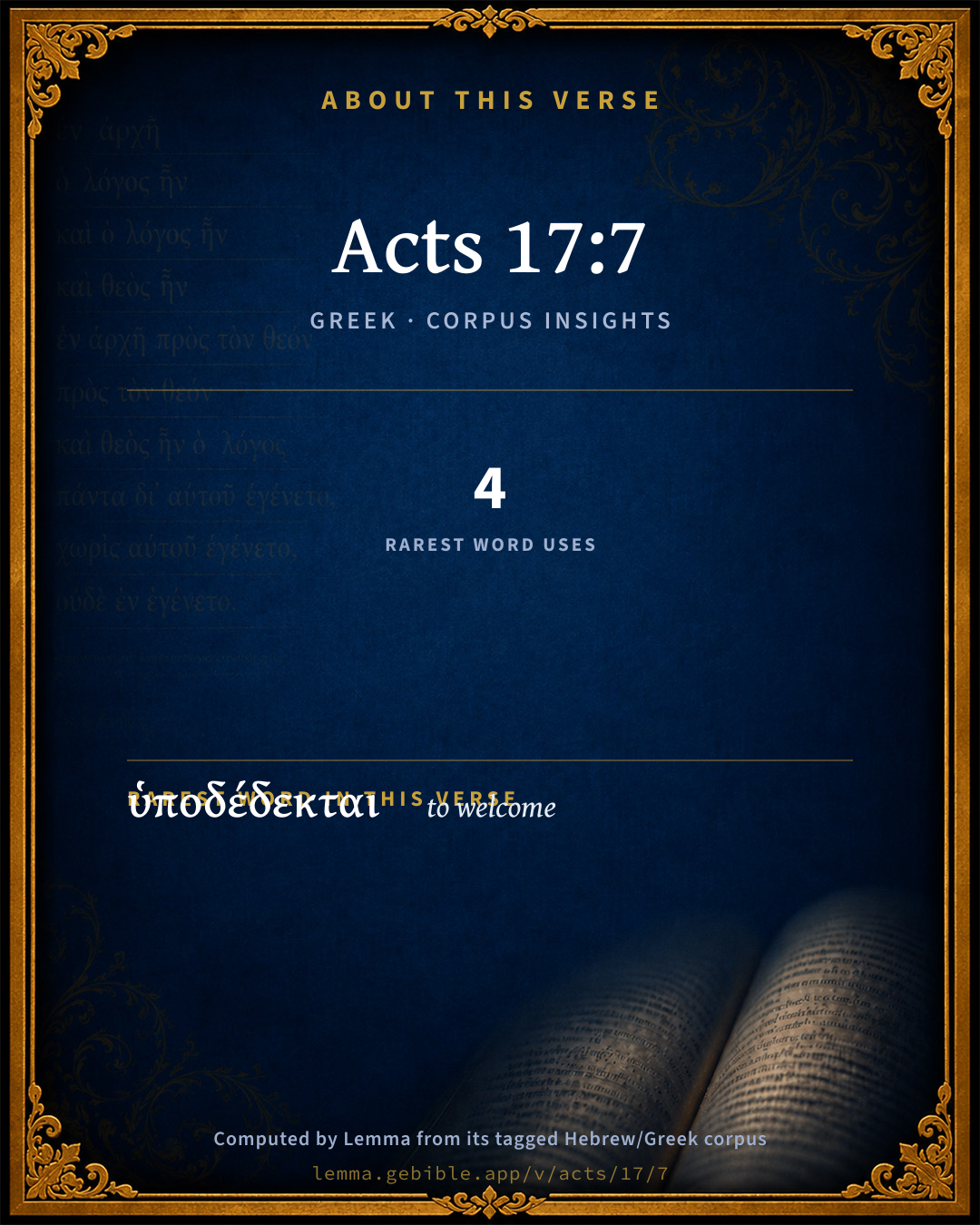
Acts 17:7

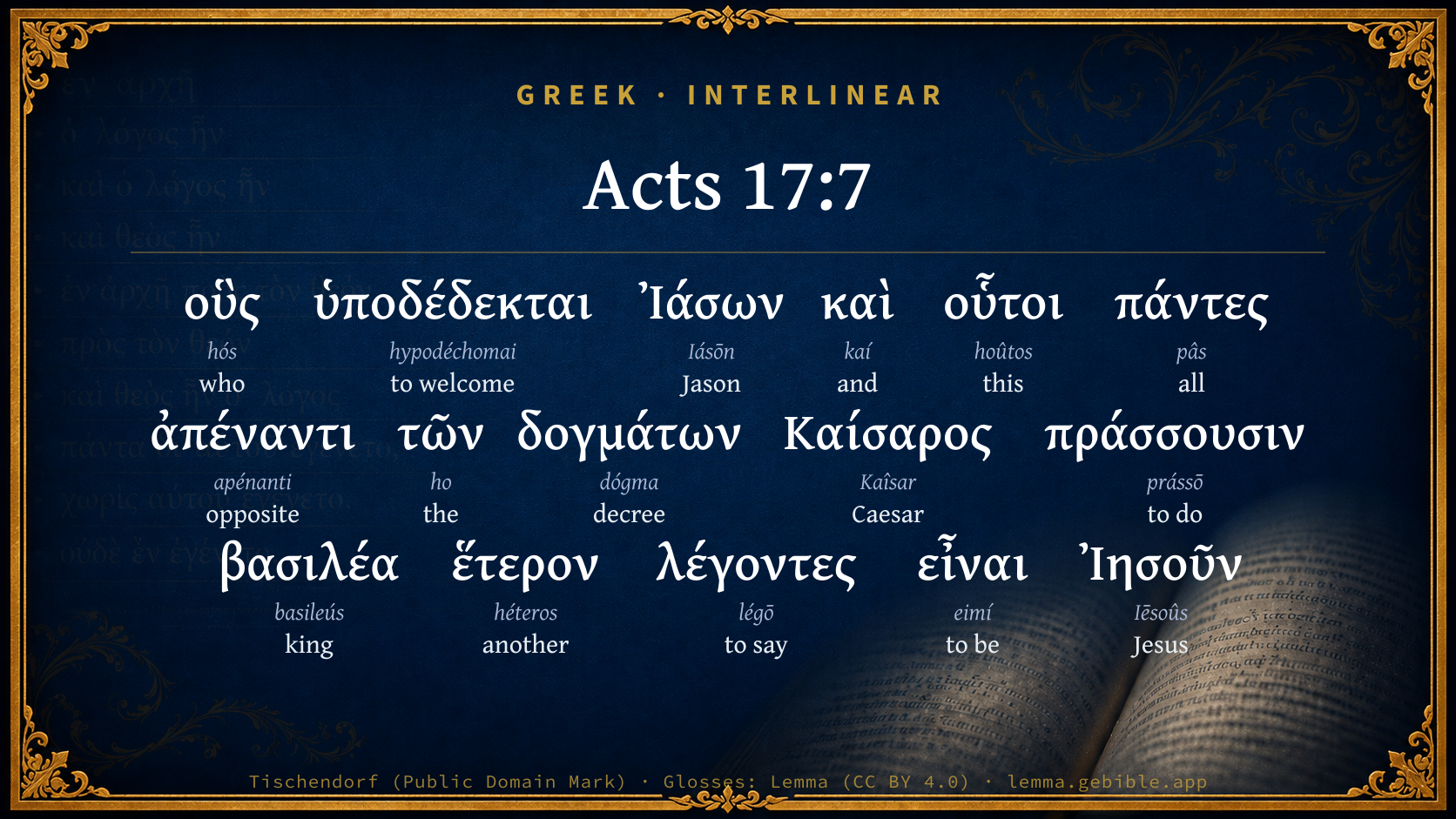
Greek (Tischendorf 8th ed.) Acts 17:7 appears in the Greek New Testament. The text above is from the Tischendorf 8th edition. Each word links to its Strong’s number and a concise gloss. Click any word for its full Thayer’s Greek Lexicon entry.
Download image
Cite this verse

Acts 17:7 (World English Bible). Public Domain. Lemma interlinear Bible study tool, https://lemma.gebible.app/v/acts/17/7.

Show BibTeX & RIS
BibTeX
RIS
English Translation
whom Jason has received. These all act contrary to the decrees of Caesar, saying that there is another king, Jesus!"
World English Bible · Public Domain
Download a study sheet

One document with this verse’s original text, its word-by-word gloss line, the meaning frame, cross-references with their text, attributed commentary, and full source and license credits — printable, and it pastes into notes with its structure intact.

This verse Autodidact and up

Study sheet (.html) Plain text (.txt)

A passage Seminary Student

Up to 50 verses in one chapter. A passage sheet keeps up to 6 commentary sources and 12 cross-references per verse, in the order this page ranks them, and says so on the sheet whenever that leaves anything out. Ask for a single verse and you get the Autodidact verse sheet above.

Everything on this page stays free to read, with no account — the sheet is a download of what is already on screen, not access to it.

Want to remove ads? Support Godless Engineer
Compare translations 3

The same verse in 3 English versions, stacked beneath the original-language interlinear above. Click any original word for its lexicon entry.

Each is an independent rendering of the whole verse — the interlinear is not word-aligned to these translations.

Highlighted words mark where these versions differ — a whole-verse word diff, not a word-by-word alignment.

  • World English Bible Public Domain
    whom Jason has received. These all act contrary to the decrees of Caesar, saying that there is another king, Jesus!"
  • King James Version Public Domain
    Whom Jason hath received: and these all do contrary to the decrees of Caesar, saying that there is another king, one Jesus.
  • unfoldingWord Literal Text CC BY-SA 4.0
    whom Jason and all these men have welcomed. They are acting against the decrees of Caesar, saying there is another king, Jesus.”

unfoldingWord Literal Text — © unfoldingWord, licensed CC BY-SA 4.0. Word-aligned USFM3 via Door43 (git.door43.org/unfoldingWord/en_ult).

Versions to compare (up to 4)

3 of 4 selected

Show all 19 translations

Every available English version of this verse, each an independent rendering of the whole verse.

  • World English Bible Public Domain
    whom Jason has received. These all act contrary to the decrees of Caesar, saying that there is another king, Jesus!"
  • Berean Standard Bible Public Domain
    and Jason has welcomed them into his home. They are all defying Caesar’s decrees, saying that there is another king, named Jesus!”
  • Majority Standard Bible Public Domain
    and Jason has welcomed them into his home. They are all defying Caesar’s decrees, saying that there is another king, named Jesus!”
  • King James Version Public Domain
    Whom Jason hath received: and these all do contrary to the decrees of Caesar, saying that there is another king, one Jesus.
  • American Standard Version (1901) Public Domain
    whom Jason hath received: and these all act contrary to the decrees of Caesar, saying that there is another king, `one' Jesus.
  • Revised Version (1885) Public Domain
    whom Jason hath received: and these all act contrary to the decrees of Caesar, saying that there is another king, one Jesus.
  • Geneva Bible (1599) Public Domain
    Whom Iason hath receiued, and these all doe against the decrees of Cesar, saying that there is another King, one Iesus.
  • Douay-Rheims (1899) Public Domain
    Whom Jason hath received; and these all do contrary to the decrees of Caesar, saying that there is another king, Jesus.
  • Young's Literal Translation Public Domain
    whom Jason hath received; and these all do contrary to the decrees of Caesar, saying another to be king -- Jesus.'
  • Literal Standard Version CC BY-SA 4.0
    whom Jason has received; and all these do contrary to the decrees of Caesar, saying another to be king—Jesus.”
  • Unlocked Literal Bible CC BY-SA 4.0
    These men whom Jason has welcomed act against the decrees of Caesar; they say that there is another king—Jesus.”
  • unfoldingWord Literal Text CC BY-SA 4.0
    whom Jason and all these men have welcomed. They are acting against the decrees of Caesar, saying there is another king, Jesus.”
  • Darby Bible Public Domain
    whom Jason has received; and these all do contrary to the decrees of Caesar, saying, that there is another king, Jesus.
  • World Messianic Bible Public Domain
    whom Jason has received. These all act contrary to the decrees of Caesar, saying that there is another king, Yeshua!”
  • Webster's Bible Public Domain
    Whom Jason hath received: and these all do contrary to the decrees of Cesar, saying, That there is another king, one Jesus.
  • Free Bible Version CC BY-SA 4.0
    and Jason has made them welcome in his house. They all defy Caesar's decrees, committing treason by saying there is another king called Jesus.”
  • Bible in Basic English Public Domain
    Whom Jason has taken into his house: and they are acting against the orders of Caesar, saying that there is another king, Jesus.
  • Text-Critical English NT CC BY 4.0
    and Jason has welcomed them. They all act contrary to the decrees of Caesar, saying that there is another king, Jesus.”
  • Tyndale New Testament (1534) Public Domain
    which Iason hath receaved prevely. And these all do contrary to the elders of Cesar affirmynge another kynge one Iesus.

Literal Standard Version (2020), Covenant Press — licensed CC BY-SA 4.0. Text via the HelloAO Bible API (eBible.org). Unlocked Literal Bible (unfoldingWord) — licensed CC BY-SA 4.0. Text via the HelloAO Bible API (eBible.org). unfoldingWord Literal Text — © unfoldingWord, licensed CC BY-SA 4.0. Word-aligned USFM3 via Door43 (git.door43.org/unfoldingWord/en_ult). Free Bible Version, Dr. Jonathan Gallagher — licensed CC BY-SA 4.0. Text via the HelloAO Bible API (eBible.org).

Word by word

More ways to search: Search by grammar → Find every occurrence → Compare this word →

Practice this passage: Drill this verse → Learn its vocabulary →

ὑποδέδεκται
hypodéchomai
G5264
“to welcome”
Verb, Perfect, Middle or Passive deponent, Indicative, 3rd person, Singular
Part of Speech
Verb
Tense
Perfect
Voice
Middle or Passive deponent
Mood
Indicative
Person
3rd person
Number
Singular
Full Thayer's Definition

Origin: from G5259 and G1209

TDNT: None

1. to receive as a guest
  1. οὓς hós G3739 “who” Relative pronoun, Accusative, Plural, Masculine
  2. Ἰάσων Iásōn G2394 “Jason” Noun, Nominative, Singular, Masculine
  3. καὶ kaí G2532 “and” Conjunction
  4. οὗτοι hoûtos G3778 “this” Demonstrative pronoun, Nominative, Plural, Masculine
  5. πάντες pâs G3956 “all” Adjective, Nominative, Plural, Masculine
  6. ἀπέναντι apénanti G561 “opposite” Adverb
  7. τῶν ho G3588 “the” Article, Genitive, Plural, Neuter
  8. δογμάτων dógma G1378 “decree” Noun, Genitive, Plural, Neuter
  9. Καίσαρος Kaîsar G2541 “Caesar” Noun, Genitive, Singular, Masculine
  10. πράσσουσιν prássō G4238 “to do” Verb, Present, Active, Indicative, 3rd person, Plural
  11. βασιλέα basileús G935 “king” Noun, Accusative, Singular, Masculine
  12. ἕτερον héteros G2087 “another” Adjective, Accusative, Singular, Masculine
  13. λέγοντες légō G3004 “to say” Verb, Present, Active, Participle, Nominative, Plural, Masculine
  14. εἶναι eimí G1510 “to be” Verb, Present, Active, Infinitive
  15. Ἰησοῦν Iēsoûs G2424 “Jesus” Noun, Accusative, Singular, Masculine

About this verse

These counts appear in no published source. They are computed here, from the morphology-tagged text and Lemma’s own curated glosses. What Lemma adds →

16
words
16
distinct lemmas
Acts
section

Notable vocabulary

The rarest word here is ὑποδέδεκται to welcome G5264 — appearing just 4 times in the whole Greek New Testament.

Shared distinctive vocabulary

ὑποδέδεκται to welcome G5264 occurs in 4 verses of the Greek New Testament. Also found in:

Cross-references

8

Topical passages linked to Acts 17:7 in the Treasury of Scripture Knowledge — connected by theme and wording, ordered by reader-vote popularity; previews shown in the World English Bible.

  • Luke 23:2 They began to accuse him, saying, "We found this man perverting the nation, forbidding paying taxes to Caesar, and saying that he himself is Christ, a king."
  • John 19:12 At this, Pilate was seeking to release him, but the Jews cried out, saying, "If you release this man, you aren't Caesar's friend! Everyone who makes himself a king speaks against Caesar!"
  • Acts 16:21 and set forth customs which it is not lawful for us to accept or to observe, being Romans."
  • Ezra 4:12–15 Be it known to the king, that the Jews who came up from you are come to us to Jerusalem; they are building the rebellious and the bad city, and have finished the walls, and repaired the foundations.
  • Daniel 3:12 There are certain Jews whom you have appointed over the affairs of the province of Babylon: Shadrach, Meshach, and Abednego; these men, O king, have not regarded you: they don't serve your gods, nor worship the golden image which you have set up.
  • Daniel 6:13 Then answered they and said before the king, That Daniel, who is of the children of the captivity of Judah, doesn't regard you, O king, nor the interdict that you have signed, but makes his petition three times a day.
  • Acts 25:8–11 while he said in his defense, "Neither against the law of the Jews, nor against the temple, nor against Caesar, have I sinned at all."
  • 1 Peter 2:15 For this is the will of God, that by well-doing you should put to silence the ignorance of foolish men:

Cross-references courtesy of OpenBible.info (CC BY 4.0).

Commentary

Notes on Acts 17:7 from classic Christian and Jewish commentators (each source and its license shown beneath its notes). The classic Christian expositions comment on the surrounding passage and are grouped to its opening verse, so a note may address several verses; the Jewish commentaries on the Tanakh (Rashi and others) are per-verse, so they appear only where the commentator wrote on this verse.

Lemma curates 59 commentaries, every one of them public domain or Creative Commons licensed, each selected and text-cleaned for this edition rather than reprinted as found. About our sources →

The Biblical Illustrator

Joseph S. Exell

Act_17:7

These do all contrary to the decrees of Caesar, saying that there is another King, one Jesus.

Christ versus Caesar

Thessalonica, though a free city, was yet under imperial government, and the Jews therefore appeal to the emperors decree, probably to the edict of Claudius (Act_18:2), as at least showing the drift of the emperors policy, even though it was not strictly binding except in Rome and the coloniae. This, however, might prove an insufficient weapon of attack, and therefore they add another charge, to which no magistrate throughout the empire could be indifferent (Luk_23:2; Joh_19:12). The preachers were not only bringing in a relligio illicita, but were guilty of treason against the majesty of the empire; they said there was another King. It is clear from the Epistle to the Thessalonians that the kingdom of Christ, and specially His second coming as King, had been very prominent in the apostles teaching (1Th_4:14; 1Th_5:2; 1Th_5:23; 2Th_1:7-8; 2Th_2:1-12, and this may have furnished materials for the accusation. (Dean Plumptre.)

The King of kings

I. His Personal attractions. There is another King, one Jesus, who is fairer than the children of men. Oh, how great is His beauty!

II. His regal grandeur. He is Lord of both the dead and the living.

III. The blessedness of his subjects.

IV. His duration. His name shall be continued as long as the sun. (R. C. Dillon, D. D.)

The King of kings, contrasted with the kings of the earth

I. The dignity of His person.

II. The extent of His empire. All created things are His.

III. The blessedness and security of His subjects. Who are so--

1. Safe.

2. Free.

3. Rich.

IV. The duration of His reign. He shall reign forever and ever. (W. Jay.)

Jesus a king

(childrens sermon):--

1. What a blank would be produced if all we know about kings and queens were destroyed! We are not to suppose that all have been like our own good Queen Victoria. What we know of kings and queens ought to make us very grateful that we live under such a reign.

2. Do not suppose that there are not any kings or queens but such as wear crowns. If a boy does what is right, serves and loves God, he is a king. If a girl is gentle, wise, pure, dutiful, she has graces which make her queenly. Kingly qualities have often been developed by the ordinary trades of life. The walks of literature also have produced many. So that in the history of the world we have had more monarchs without crowns than with. The Lord Jesus is King--

I. On the ground of right. He had the right of the Fathers appointment. We do not question the right of Moses to the leadership, or of David to kingship, or of St. Paul to the apostleship, because they received their offices from God. And it is quite as certain that Jesus received kingship from the same power. Yet have I set My King upon My holy hill of Zion.

II. Because of His perfect qualifications for the regal position. This is a great deal more than can be said about all kings. If experience and knowledge, if tenderness and power, if majesty and condescension, if dignity and humility, if wisdom and wealth, and if royal lineage and great personal virtues, can show qualification for government, then Jesus has such qualification without limit. It pleased the Father that in Him should all fulness dwell.

III. Because he has the hearty approval of his subjects. No king ever yet had the free, intelligent goodwill of his people so fully accorded him. Convene a meeting of all His subjects, not any of the crowned heads of Europe would secure one vote from the subjects of Jesus, in opposition to His monarchy. Every voter would say, Jesus only, our King.

IV. Because He issues law to His people and maintains respect for and obedience to the law He issues. What mighty contrasts exist between the laws of earthly sovereigns and those of Jesus! Human laws affect nations; Divine laws are for and affect everybody. Human laws have to be altered to suit altered circumstances, but one jot or one tittle of His word shall not fail. Laws here have been founded in error; Christs are founded in eternal truth. Laws are frequently hard to interpret correctly, and men of plain, simple minds, as well as astute lawyers, have made mistakes. Christs laws are all easy, simple, and plain.

V. Because He has power to enforce His will. No king, however large his army, or however great his power, ever had the might that Jesus has.

VI. Because He has a large retinue of illustrious persons. The retinue King Jesus has, and will have, will far surpass anything of the sort ever seen upon our earth--Abel, Noah, Abraham, David, etc. Yes, patriarchs looked forward to His day; prophets gladly announced His coming; kings and poets wrote of Him, and angels ministered unto Him. And now, as His chariot appears, they all say, There is another King, one Jesus. Look at the chariot. It is called the gospel. Its wheels are capable of travelling over any sort of roads, rough or smooth, hard or soft; through woods, across seas, or over deserts. The chariot itself is so strong that not all the powers of men and devils can break it. No time can cause it to decay, nor can any element impair its beauty. It is lined within and without with promises. It is so full of provisions that not the supply of all the wants of all men can possibly produce deficiency. And then this chariot is so large that there is room for all: and all who ride do so free of charge. Then, what steeds are drawing this chariot! The one is called Love abounding, and the other Zeal undying; and they never tire. But neither chariot nor horses are half so wonderful as King Jesus, the occupant of this chariot (Rev_1:13). On the procession moves; and the illustrious ones following are as grand and even more numerous than such as preceded. Here come the apostles, martyrs, reformers, etc., etc. There is no wisdom so wise, no goodness so great, nor any act so becoming, as to join whilst we are yoking the retinue of King Jesus. This is done by giving our hearts to Him. Joseph joined when but a boy. Samuel also, and David, and Timothy.

VII. Because He takes a deep personal interest in the elevation and good of all His subjects. All kings have not done so. Some have asked only how they could increase their possessions or dignity. Note the marks of the interest monarchs take in their subjects.

1. The sacrifices they make in their behalf. Look then at the sacrifices made by Jesus for all His people.

2. Their gladness when the people are contented and prosperous; and their tenderness and sympathy when calamity comes upon them. A king should he the reflex, or counterpart, of his people. This, I am sure, is what Jesus is; when His subjects are in suffering, He says, Fear not, I will uphold thee; and when He has turned their sorrow into joy, He says, Let the children of Zion be joyful in their King.

VIII. Because he gives access to His people. The power of an earthly king to do this is limited; and those who approach earthly thrones can only do so at great cost. But Jesus allows all His subjects to approach Him at all times, and without expense.

IX. Because He has a large revenue. As rich as a king is quite a proverb. Boys and girls may well wonder where the king gets all his money from. It is from taxes! Jesus is by far the richest king that ever occupied a throne. The earth is the Lords, and the fulness thereof. But He is not dependent upon gold for the progress of His kingdom. In His treasury there are contributions of greater value. Prayer, praise, holy living, zeal.

X. Because He protects the rights and liberties of His subjects. Does He not say to all, Touch not Mine anointed, and do My prophets no harm? I know that sometimes it looks as though He gave them up to the power of their enemies. It looked as though He had forgotten Joseph, Daniel, etc.; but the issue showed how well they were cared for.

XI. Because He has royal favours to bestow. In all countries kings have been noted for this. Warriors, legislators, poets, philanthropists, the great, the wealthy, and the learned, are they who carry off royal honours; and should royal favours come down to the poor and indigent in any great measure, what a stir and to-do would be made about it! Jesus carries off the palm in this department. He restricts not His favours to any privileged class; like the sunlight, they fall with equal beauty and energy upon the brow of the poor and of the wealthy; like the dew, they descend with equal power upon the cottage and the palace home. What are the favours of King Jesus?

1. Pardon for all sin. He is exalted a Prince and a Saviour, etc.

2. Purity of heart and life.

3. Grace, according to the wants of His people.

4. A valid title to heaven, and its possession at death.

For these gifts the worlds gold, valour, industry, wisdom, are all in vain; and so for each one we must say, Now, thanks be unto God for His unspeakable gift. (J. Goodacre.)

Jesus, another King

As compared with earthly sovereigns, Jesus is another King; for He is one--

I. Contemplating exclusively spiritual dominion. Earthly monarchs aspire after territorial dominion, and are accounted monarchs because they possess it. Christs kingdom has its seat in the soul.

II. Claiming rightfully unqualified obedience. Of what earthly sovereign can it be said that he rightfully claims unqualified obedience? He justly demands unqualified obedience--

1. In right of His position. He is King of kings: obedience cannot he withheld from Him on the plea that there is a higher power we must first consult.

2. In right of the equity of His government. His service is always reasonable, His honour and our interests never really clash.

3. In right of His grace. He is the Saviour. Obedience cannot be withheld from Him on the plea that we owe Him but little.

III. Securing infallibly heartfelt homage. If admission be granted to the presence of an earthly sovereign, how often is the homage rendered to him nothing more than compliance with a state ceremony! Jesus is another King. He rules by love, He wins the heart.

IV. Expecting confidently universal empire. (J. T. Poulter, B. A.)

The risen Christ as King

1. There is another King. Alas! for the world, alas! for us all, if there be not. The hope of the world is a Christendom in which Christ shall reign. A Christendom in which He does not reign we see, and have seen enough of. Men are getting weary of the preaching of Jesus and His gospel, while Christian races are wasted by vice, poverty, and war. Along with all our Christianity we still need men to preach another King, one Jesus; to whom all the selfishness of our politics, the craft of our diplomacy, the fierce contention of our industry, are hateful; a King who has left A new commandment, That ye love one another, and in one aspiration, That they all may be one, the key to His hope and effort for mankind. The world has yet to try what Jesus can do for it.

2. Christ foretold that His method would try the patience and weary the hope of man. There is nothing in England or in Europe which is sadder than the picture which He Himself draws of the development of His kingdom in Mat_24:1-51. But He saw beyond that which moved Him to pour out His soul unto death. And I, if I be lifted up from the earth, will draw all men unto Me. And this is the rebuke of all our faithless doubts and dreads. Mark the patience with which through unnumbered ages the Lord of the world has been elaborating the chirping apparatus of a cricket, the feather of the pinion of a bird, or the spots on the gay plumage of a butterflys wing--and yet we faint and lose heart because in a few centuries this great world is not converted to Jesus, and the harvest, for the sake of which the whole creation has been groaning and travailing through well-nigh infinite ages, is not yet reaped and garnered on high.

3. The fundamental question is, Why should man want another king? Why should we not leave the secular spirit to take charge of the interests and to guide the progress of human society? and I answer--

(1) That something like the form of Christs kingdom is implied in and prophesied by the very structure of human society. When we say that man is a social being, we mean something differing entirely in kind, and not only in degree, from what we mean when we speak of the social instincts and habits of the ants or the bees. The key to mans life is to be sought in heaven and not in the dust. In entering the sphere of human society we come under a higher law and enter a higher world. Consider the fact that all mans most exquisite pleasures and griefs arise out of his relations with others, out of his social habits and affections, of which the richest elements connect themselves with his duties and ministries to the poor, the weak, the helpless; can we believe with all this before us, that mans life as a social being is still to be but the struggle for existence in another form, of which self-seeking and not self-devotion must be the law? I can see no possible beauty, joy, or hope in human society, except bear ye one anothers burdens be the law. And I can see no basis for that law, and no assurance of its supremacy, but in the contemplation of His life and His living energy who came from heaven not to be ministered unto, but to minister, and to give His life a ransom for many. Just as a skilled naturalist, looking at the structure of an animal, can forecast its habit and habitation, even so, as we look at the structure of man as a social being, we can affirm with certainty that the habit of his life was meant to be obedience to the law of Christ, and the home of his life and theatre of its development is the kingdom of heaven.

(2) And what seems implied in mans constitution is exemplified in his history. Among all peoples there are visions of which this is the substance. Mans ideal of society everywhere takes this form; he seems to feel instinctively that only in such a world as the kingdom of heaven can he truly and nobly live. All the worlds great thinkers lead on its thoughts to a time when that reign of truth, righteousness, and love, which the Bible associates with Messiahs kingdom, shall be realised, and all the woe and waste and wrong of the world shall be stayed.

4. But then, it may be said, if men are dreaming about this and are aiming at this, why not leave them alone to work out their idea? The answer to this is that God did leave man in the Gentile world alone, that he might discover whither the course of things would drift him, and might be prepared through disappointment and suffering to accept at length the helping Hand which would be held out to him from on high. Caesar was the result of mans development as a social being. The worlds work for itself ends in ruin. The march of the ages resulted in a condition of the Roman Empire which, but for the restoring power brought to bear upon it by Christianity, nothing but a second deluge could have cured. Let the state of India before the English came to it, let the state of China and Africa at this moment, exhibit the result which comes inevitably to peoples when they try--or do not try, for this is what it ends in--to work out their own salvation for themselves. We need only look round us at this moment in Europe to form some just estimate of Caesar and his work. We have had modern Caesars in our day, enthroned in the centres of civilisation; and the end of their sway has everywhere been wreck. Blessed be God that there is another King, one Jesus; for mans experiments in government are failures, and must be failures. But is it not a stain on Gods righteous government, does it not reveal a flaw in His will or in His power, that things in human society, thus left to themselves, tend to dissolution? Surely not: it was never intended in the scheme of Providence that man should work out his own salvation or the salvation of society.

5. What is the relation of this other King to the kingdoms of this world? The officers of Caesar were naturally alarmed. This is what perplexed and alarmed Pilate. There was little that was kinglike in Jesus, in Pilates sense of kingship. And yet he was anxious and afraid, though why he could not tell. Men are slow to believe in a kingship which makes no sign before the world. The true kingdom is a kingdom which penetrates and purifies all other kingdoms, just as the electric force pervades creation, everywhere felt, never touched and seen. We do nothing contrary to the decrees of Caesar in preaching that there is another King, one Jesus. He works entirely from within; what of blessing can come to the world by making men wiser, purer, more unselfish, more brotherly, that He bestows. But this breaks up nothing which the progress of humanity, however realised, would not break up; it consolidates everything on earth which stands square with truth, righteousness, and God.

6. Christ has one way of working out the regeneration of human society; Caesar, under all the various shapes and forms of government, has another. The one works purely from the inward outward, and heals and cleanses at the spring. The other cleanses for awhile the outside, but finding itself powerless to cleanse the inward, finally gives up its work in despair. How many times through the ages has society been broken up, reconstructed, reformed, redressed, only to fall back again more hopelessly into the darkness. Guilt is oppressing, sin is corrupting, and selfishness is wasting humanity everywhere. The King whom we preach cares nothing for His Royalty, save in so far as it can lift that burden, heal that corruption, stay that waste. (J. Baldwin Brown, B. A.)

Christ our deathless King

Christ is our King, King of Zion, King of glory, King of earth, King of heaven. He is a King that always lives. Where is Louis XIV? Dead. Where is Richard III? Dead. Where is Henry VIII? Dead. Where is Peter the Great? Dead. There is a whole sheaf of sceptres at the door of the tomb. Death is an old monarch, and his palace is a sepulchre, and the kings of the earth are his cup bearers; and the old blind monarch, walking around in the palace of sepulchres, ever and anon stumbles over a newly-fallen coronet. Charlemagne after death sat on a throne, and a crown was put upon his pulseless temples and a sceptre was put in his lifeless hand; but these things did not bring back his kingdom. But our King always lives. He lived before the world was made. He will live after the world is burned. King immortal! (T. De Witt Talmage.)

Jesus a sympathetic King

The Sultan of Turkey arranged that whenever he rode out on horseback his subjects might come up to him and tell their sorrows and tell their wrongs; and when the Sultan rode the crowd came up, and after a while his progress was impossible. But more merciful is our King, for at any hour of the day or night we may come up to Him and tell all our wants and all our sorrows and get relief. To come to other courts, we must have a court dress rightly cut and rightly adorned; but to come into the presence, into the court of our King, we need no such preparation, and the beggar may come with his rags, and the prodigal from the filth of the swine trough, and be without introduction immediately ushered. Merciful King! Pardoning King! Sympathetic King! Oh, Jesus, live for ever! (T. De Witt Talmage.)

Jesus a helpful King

On the first elevation of the ancient amphitheatre, on the day of a celebration, sat Tiberius, or Augustus, or the reigning king. So in the great arena of spectators that watch our struggles, and in the first Divine gallery, as I shall call it, sits our King, one Jesus. The Roman emperor sat, with folded arms, indifferent as to whether the swordsman or the lion beat; but our Kings sympathies are all with us. Nay, unheard of condescension! I see Him come down from the gallery into the arena to help us in the fight, shouting, until all up and down His voice is heard: Fear not! I will help thee! (Ibid.)

The Biblical Illustrator, edited by Joseph S. Exell (c. 1880s–1900s) — public domain. Text from a community e-Sword module.

Bengel's Gnomon

Johann Albrecht Bengel

Act 17:7. Ὑποδέδεκται, hath received [underhand, ὑπὸ]) stealthily. This is the notion of the verb in Jas 2:25, but not so in Luk 19:6.—οὗτοι πάντες, these all) They mean to mark those who had fled, and those who were present.

Bengel's Gnomon of the New Testament — English translation (T&T Clark, Edinburgh, 1860) — public domain. Text from a community e-Sword module.

Meyer's Critical & Exegetical Commentary

Heinrich August Wilhelm Meyer

Act_17:7. Ὑποδέδεκται] not secretly, which Erasmus finds in ὑπό, but as in Luk_10:38; Luk_19:6.

As formerly in the case of Jesus the Messianic name was made to serve as a basis for the charge of high treason, so here with the confessors of Jesus (οὗτοι πάντες) as the Messiah. Comp. Act_19:12. Perhaps (see 1 and 2 Thess.) the doctrine of the Parousia of the risen (Act_17:3) Jesus had furnished a special handle for this accusation.

οὗτοι πάντες] Eos qui fugerant, et quiaderant notant, Bengel.

ἀπέναντι τῶν δογμάτ. Καίσ.] in direct opposition to the edicts of the emperor, which interdicted high treason and guarded the majesty of the Caesar. On ἀπέναντι, comp. Sir_36:13; Sir_37:4.

βασιλ. λέγ. ἕτερον εἶναι] βασιλ. in the wider sense, which includes also the imperial dignity, Joh_19:15; 1Pe_2:12; Herodian, i. 6. 14.

Meyer — Critical and Exegetical Commentary on the New Testament — English translation by Peter Christie, edited by Frederick Crombie (T&T Clark, 1880) — public domain. Text from a community e-Sword module.

Expositor's Greek Testament

ed. W. Robertson Nicoll

Act 17:7 . ὑποδέδεκται : no notion of secrecy as Erasmus and Bengel, but as in Luk 10:38 ; Luk 19:6 ; only found in these three passages in Luke, and in Jas 2:25 , cf. LXX, Tob 7:8 , Jdg 13:13 (see Hatch and Redpath for both instances), 1Ma 16:15 , and 4Ma 13:17 , often in classical Greek without any notion of secrecy. οὗτοι πάντες : the words may be taken as referring not only to Jason and the accused, but with Alford, “all these people,” i.e. , Christians wherever found. ἀπέναντι : only here in N.T. in this sense (common in LXX and Apocrypha, so also Polyb., i., 86, 3), cf. Sirach 36 (33):14. δογματων , see on Act 16:4 . The word may here refer to the successive decrees of the emperors against treason, and there is no need to refer it in this passage to the decree of Claudius, see on Act 18:2 , but rather to the Julian Leges Majestatis . β . λέγοντες ἕτερον εἶναι : this was the charge, the political charge of high treason, brought against our Lord Himself by the Jews, Luk 23:2 , Joh 19:12 ; Joh 19:15 . The nature of this charge may fairly point to a Jewish source, for the Jews thought of the Messiah as a king, and in their hostility to Paul they could easily accuse him of proclaiming Jesus or another king, another emperor (Ramsay), instead of Caesar; so McGiffert on this passage, “whose trustworthiness can hardly be doubted” ( Apostolic Age , p. 246). The Epistles to the Thessalonians contain passages which might be as easily perverted in the same direction, 1Th 2:12 ; 1Th 4:14 ; 1Th 5:2 ; 1Th 5:23 ; 2Th 1:5-8 , or the fact that Jesus was so often spoken of as Κύριος , “that deathless King Who lived and died for men,” might have given colour to the charge, cf. on the coincidence and accuracy of the Acts and 1Th 2:14-16 , Paley, Horæ Paulinæ , ix., 5, and McGiffert, u. s.

The Expositor's Greek Testament, edited by W. Robertson Nicoll (1897–1910) — public domain. Text from a community e-Sword module.

Jamieson, Fausset & Brown

Robert Jamieson, A. R. Fausset & David Brown

all do contrary to the decrees of Cæsar, &c.--meaning, probably, nothing but what is specified in the next words.

saying . . . there is another king, one Jesus--(See on Joh 19:12).

Jamieson, Fausset & Brown — Commentary Critical and Explanatory on the Whole Bible (1871) — public domain (CC PDM 1.0). Text via the HelloAO Bible API.

Adam Clarke's Commentary

Verse 7. These all do contrary to the decrees of Caesar] Persecutors always strive to affect the lives of the objects of their hatred, by accusing them of sedition, or plots against the state.

That there is another king, one Jesus.] How malevolent was this saying! The apostles proclaimed Jesus as king-that is true; but never once insinuated that his kingdom was of this world. The reverse they always maintained.

Adam Clarke's Commentary on the Bible (1810–1826) — public domain. Text from a community e-Sword/MySword module.

John Calvin's Commentaries

7. All these men, etc. The second point of the accusation of this, that they violate the majesty of the empire of Rome. A great and grievous crime, yet too impudently forged. Paul and Silas sought to erect the kingdom of Christ, which is spiritual. The Jews knew that this might be done without doing any injury to the Roman empire. They knew that they meant nothing less than to overthrow the public estate, or to take from Caesar his authority. Therefore, the Jews catch at the pretense of treason, that they may oppress the innocent with the envy of the crime alone.

Neither doth Satan cease at this day to blear men’s eyes with such smokes and mists. The Papists know full well, and they be sufficiently convict before God, that that is more than false which they lay to our charge, That we overthrow all civil government; that laws and judgments are quite taken away; that the authority of kings if subverted by us; and yet they be not ashamed to the end they may make all the whole world offended with us, falsely to report that the Jews do not only allege that Caesar’s commandments were broken, because Paul and Silas durst presume to alter and innovate somewhat in religion, but because they said there was another king. This crime was altogether forged; but if at any time religion enforces us to resist tyrannical edicts and commandments which forbid us to give due honor to Christ, and due worship to God; we may then justly say for ourselves, that we are not rebellious against kings, for they be not so exalted, that they may go about like giants to pull God out of his seat and throne. That excuse of Daniel was true, that he had not offended the king, whereas notwithstanding he had not obeyed his wicked commandment, neither had he injured mortal man, because he had preferred God before him. So let us faithfully pay to princes the tributes which are due to them, let us be ready to give them all civil obedience; but if, being not content with their degree, they go about to pluck out of our hands the fear and worship of God, there is no cause why any should say that we despise them, because we make more account of the power and majesty of God.

John Calvin's Commentaries (1540-1563) — public domain. Text from the Calvin Translation Society English edition (1840s-50s) via the Christian Classics Ethereal Library (ccel.org). Calvin's coverage is partial (roughly two-thirds of the Bible); uncommented books and verses are honest gaps, never fabricated. The 19th-century editor's footnotes and remarks are omitted so the notes are faithfully Calvin's own voice.

Ellicott's Commentary for English Readers

(7) These all do contrary to the decrees of Cæsar.—Thessalonica, though a free city, was yet under the imperial government, and the Jews therefore appeal to the emperor’s decree, probably to the edict of Claudius (Act_18:2), as at least showing the drift of the emperor’s policy, even though it was not strictly binding except in Rome and the coloniæ. This, however, might prove an insufficient weapon of attack, and therefore they add another charge, to which no magistrate throughout the empire could be indifferent. (See Notes on Luk_23:2; Joh_19:12.) The preachers were not only bringing in a relligio illicita, but were guilty of treason against the majesty of the empire; they said there was “another King.” It is clear from the Epistle to the Thessalonians that the Kingdom of Christ, and specially His second coming as King, had been very prominent in the Apostle’s teaching (1Th_4:14; 1Th_5:2; 1Th_5:23; 2Th_1:7-8; 2Th_2:1-12), and this may have furnished materials for the accusation.

A Bible Commentary for English Readers, edited by Charles John Ellicott (1878–1897) — public domain. Text from a community e-Sword module.

The Cambridge Bible for Schools and Colleges

gen. ed. J. J. S. Perowne

7. hath received] As guests into his house, and therefore he may be counted a sympathizer with their teaching.

these all] Implying that Paul and Silas, whom they had not found, would also be included in their accusation, if they could be caught.

another king, one Jesus] So far as this chapter gives an account of St Paul’s preaching, he had drawn the attention of the Jews to the sufferings of the Messiah, but we cannot doubt that he had also spoken of His kingdom. Such language the mob would be urged to seize on, and make it the justification for their uproar. For Thessalonica though a free city was subject to the Emperor.

The Cambridge Bible for Schools and Colleges (gen. ed. J. J. S. Perowne; Cambridge University Press, 1878–1918) — public domain. Text from a community e-Sword module.

John Gill's Exposition

Whom Jason hath received,.... Into his house in a private manner, and has entertained, contrary to law, which forbids men to receive and entertain persons of seditious principles, and practices, for this is mentioned as a charge against Jason:

and these all do contrary to the decrees of Caesar; both the apostle and those with him, and Jason, and the brethren, whom they now had set before the magistrates, who were all of the same sentiments and practices; and which were opposite to the decrees of the Roman emperor, and the Roman senate, who suffered none to be called a king but whom they pleased; whereas these men taught, saying,

that there is another king, one Jesus; but then though they said he was a king, yet not a temporal one, but one whose kingdom was spiritual, and not of this world; and therefore asserted nothing contrary to the decrees of Caesar, or what was in the least prejudicial to his worldly interest and glory.

John Gill's Exposition of the Whole Bible (1746–1763) — public domain (CC PDM 1.0). Text via the HelloAO Bible API.

Trapp's Complete Commentary

John Trapp

7 Whom Jason hath received: and these all do contrary to the decrees of Caesar, saying that there is another king, one Jesus.

Ver. 7. Whom Jason hath received] υποδεδεκται. Clanculum excepit, so Erasmus well rendereth it, hath closely and covertly entertained them, as Obadiah did the Lord’s prophets.

Contrary to the decrees of Caesar] Unicum crimen eorum, qui crimine vacabant. Tacit. The only crime of them who were without offense.

John Trapp, A Commentary or Exposition upon All the Books of the Old and New Testament (1647–1656) — public domain. Text from a community e-Sword module.

Albert Barnes' Notes on the Bible

Whom Jason hath received - Has received into his house, and entertained kindly.

These all do contrary to the decrees of Caesar - The charge against them was that of sedition and rebellion against the Roman emperor. Grotius on this verse remarks that the Roman people, and after them the emperors, would not permit the name of king to be mentioned in any of the vanquished provinces except by their permission.

Saying that there is another king - This was probably a charge of mere malignity. They probably understood that when the apostles spoke of Jesus as a king, they did not do it as of a temporal prince. But it was easy to pervert their words, and to give plausibility to the accusation. The same thing had occurred in regard to the Lord Jesus himself, Luk 23:2.

Albert Barnes' Notes on the Bible (1834–1885) — public domain. Text from a community e-Sword/MySword module.

Haydock's Catholic Bible Commentary

Another king. These Jews suppress, with great artifice, their true cause of vexation against the apostles, and change a mere question of religion into one of temporal policy. The accusation of raising up a new power in opposition to Cæsar’s, had been sufficiently refuted and disavowed before Pilate by the author of our religion, and was therefore too gross to be repeated now. My kingdom, says our blessed Saviour, is not of this world. There is no necessary connection between spiritual and temporal power. It is thus that the abettors of persecution are never at a loss for pretexts, when necessary. Mad zeal is not scrupulously nice in the choice of arguments. (Haydock)

George Leo Haydock (1774–1849), Haydock's Catholic Family Bible and Commentary, 1859 edition — public domain. Excludes Psalms (Douay-Rheims chapter numbering differs from Protestant) and Deuterocanonical books (Catholic canon only).

Matthew Poole's English Annotations

Hath received; privily, and with design.

Contrary to the decrees of Caesar: the Romans, before they were brought under their emperors, (and after that), did not suffer any to be called king without their allowance and approbation; which was also much valued by such unto whom that honour was bestowed by them.

Another king, besides Caesar, who was called the lord of the world. This is like to the charge laid against our Saviour; but most maliciously both then and now, and wholly against their own consciences; for they themselves expected the Messiah to be a king, and refused and rejected him because his kingdom was a spiritual kingdom, and not of this world, Joh 18:36,37.

Matthew Poole's English Annotations on the Holy Bible (1683–1685) — public domain. Text from a community e-Sword/MySword module.

Whedon's Commentary on the Bible

Daniel D. Whedon

7. Decrees of Cesar—Paul’s unfolding the Messiah in his royal character as son of David and eternal king of Israel enabled the Jews to set Jesus against Cesar. It is the same deception as the Jews used in regard to Jesus before Pilate, and with much the same effect. (See notes on Mat_27:11; Mat_27:30; Joh_18:34-37; Joh_19:12-13.)

Daniel D. Whedon (gen. ed.), Commentary on the Old and New Testaments (1874–1909) — public domain. Text from a community e-Sword module.

The Pulpit Commentary

Act for do, A.V. Received; i.e. as the word uJpodecomai always means "received as a guest" (Luk_10:38 Luk_19:6; Jam_2:25, etc.) Hence the substantive uJpodoch, an entertainment or reception. The insinuation is that, by harboring these seditious men, Jason had made himself a partner in their sedition. That there is another king, etc.. (comp. Joh_19:12, Joh_19:15)

The Pulpit Commentary (1880–1919), ed. H.D.M. Spence-Jones & Joseph S. Exell — public domain. Text from a community e-Sword module.

McGarvey & Pendleton's Commentaries

J. W. McGarvey

See notes on verse 5

J. W. McGarvey (with Philip Y. Pendleton), Commentaries on the New Testament (The Fourfold Gospel, 1914; Acts; and the epistles) — public domain. Text from a community e-Sword/MySword module.

Cambridge Greek Testament for Schools and Colleges

7. βασιλέα ἕτερον λέγοντες with אAB. Vulg. ‘regem alium dicentes.’

7. οὓς ὑποδέδεκται Ἰάσων, whom Jason hath received, as guests into his house. Thus he would be counted for a sympathizer with their teaching, as most probably he was. For the verb cf. Tob 7:9; 1Ma 16:15.

οὖτοι πάντες, these all. Implying that Paul and Silas, whom they had not found, would be included in the accusation, if they could be caught.

βασιλέα ἕτερον λέγοντες εἶναι Ἰησοῦν, saying that there is another king, one Jesus. So far as this chapter gives an account of St Paul’s preaching, he had only drawn the attention of the Jews to the sufferings of the Messiah, but we cannot doubt that he had also spoken of His kingdom. Such language the mob would be urged to seize on, and make it the justification for their uproar, for Thessalonica though a free city was subject to the Emperor.

Cambridge Greek Testament for Schools and Colleges (Cambridge University Press, 1896; 21 vols, various authors incl. Carr, Maclear, Plummer, Farrar, Lumby, Moule, M. R. James, Simcox) — public domain. Text from a community e-Sword module.

Alford’s Greek Testament

Henry Alford

7. οὗτοι πάντες] All these people, i.e. Christians, wherever found. A wider acquaintance is shewn, or at least assumed, with the belief of Christians, than extended merely to Jason and his friends.

ἀπέναντι … πράσς.] Not ‘do this in the face of the decrees,’ which would require τοῦτο with πράσς., but as E. V. The δόγματα in this case would be the Julian ‘leges majestatis.’

βασιλέα κ.τ.λ.] This false charge seems to have been founded on Paul’s preaching much at Thessalonica concerning the triumphant παρουσία of Christ. This appears again and again in his two Epistles: see 1Th 1:10; 1Th 2:19; 1Th 3:13; 1Th 4:13-18; 1Th 5:1, 1Th 5:2; 2Th 1:5, 2Th 1:7-10; 2Th 2:1-12: and particularly 2Th 2:5, where he refers to his having often told them of these things, viz. the course, and destruction of Antichrist, by whom these Jews might perhaps misrepresent Paul as designating Cæsar.

Henry Alford, The Greek Testament (1849–1861) — public domain. Text from a community e-Sword module.

Vincent's Word Studies in the New Testament

Marvin R. Vincent

Contrary to the decrees of Caesar. The charge at Philippi was that of introducing new customs; but as Thessalonica was not a colony, that charge could have no force there. The accusation substituted is that of treason against the emperor; that of which Jesus was accused before Pilate. "The law of treason, by which the ancient legislators of the republic had sought to protect popular liberty from the encroachments of tyranny,... was gradually concentrated upon the emperor alone, the sole impersonation of the sovereign people. The definition of the crime itself was loose and elastic, such as equally became the jealousy of a licentious republic or of a despotic usurper" (Merivale, " History of the Romans under the Empire ").

Marvin R. Vincent, Word Studies in the New Testament (1887–1900) — public domain. Text from a community e-Sword/MySword module.

Lesson kit

Teaching starters — assembled from the data on this page, not authored interpretation. Every prompt links to the verse data it draws on. Edit before teaching.

Acts, in the Acts, opens this verse with 16 words (16 distinct Greek lemmas). Its most distinctive word is hypodéchomai (“to welcome”). A historical commentator’s framing appears above. Read the whole chapter for the surrounding context.

Discussion questions

  1. What does “to welcome” (hypodéchomai) contribute to the verse as a whole?
  2. Luke 10:38 shares the word «to welcome» with this verse. How do the two illuminate each other?
  3. The translations on this page render this verse differently — a whole-verse word diff, not a word-by-word alignment. What might account for the different wordings?
  4. Reading how The Biblical Illustrator and Bengel's Gnomon read this verse, where do the two commentators agree and where do they part?

Things to notice

Reading settings

Reading text

Shown beneath each verse's original-language words.

Old Testament
Old Testament edition

Read the OT as the Masoretic Hebrew (MT) or the Greek Septuagint (LXX).

English shown for the Greek Septuagint (in the Hebrew ↔ Greek comparison).

Comparing translations? Open the Compare panel on any verse page to stack up to four side by side.