

Acts 24:16
Greek (Tischendorf 8th ed.) Acts 24:16 appears in the Greek New Testament. The text above is from the Tischendorf 8th edition. Each word links to its Strong’s number and a concise gloss. Click any word for its full Thayer’s Greek Lexicon entry.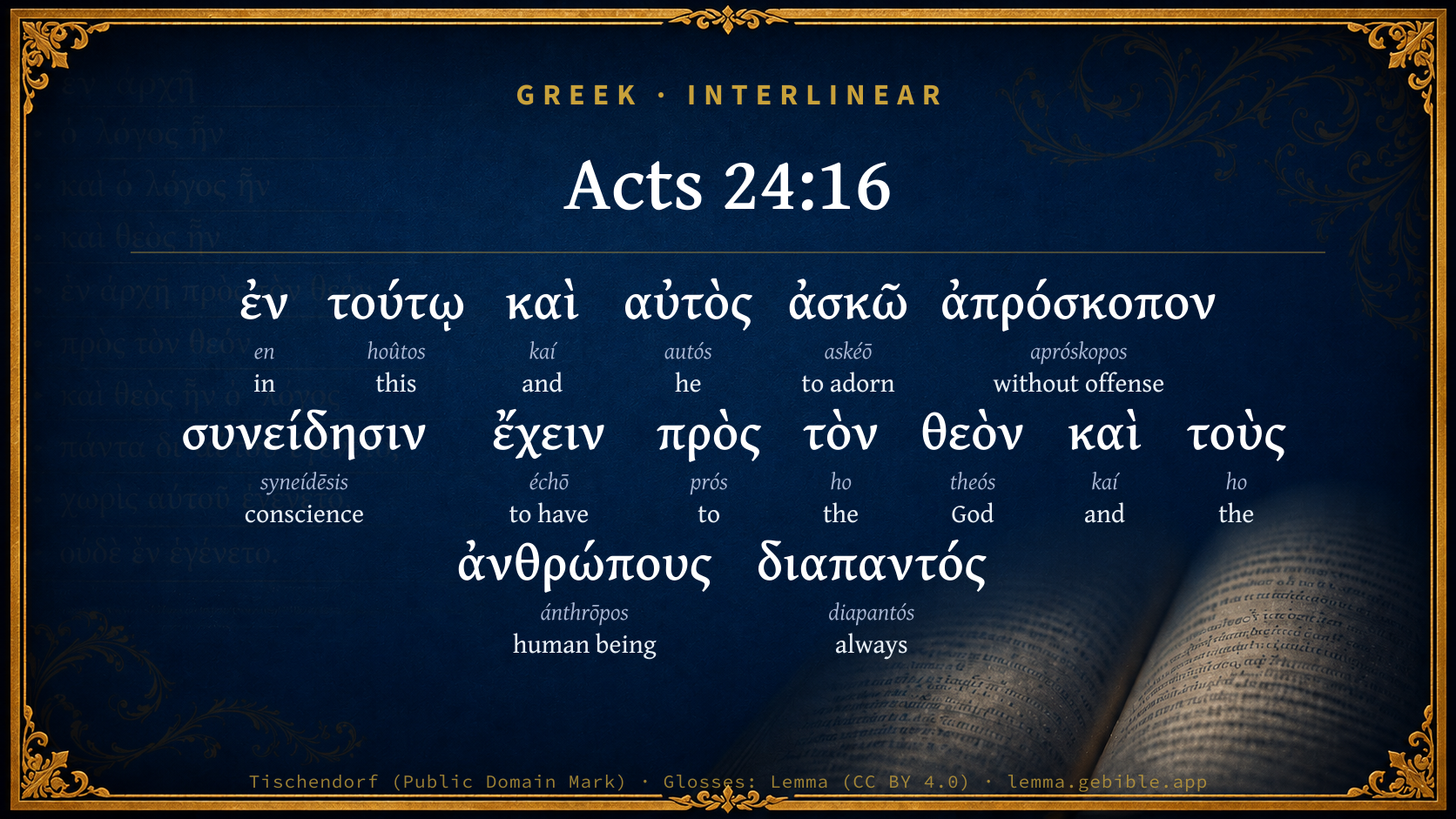
Herein I also practice always having a conscience void of offense toward God and men.
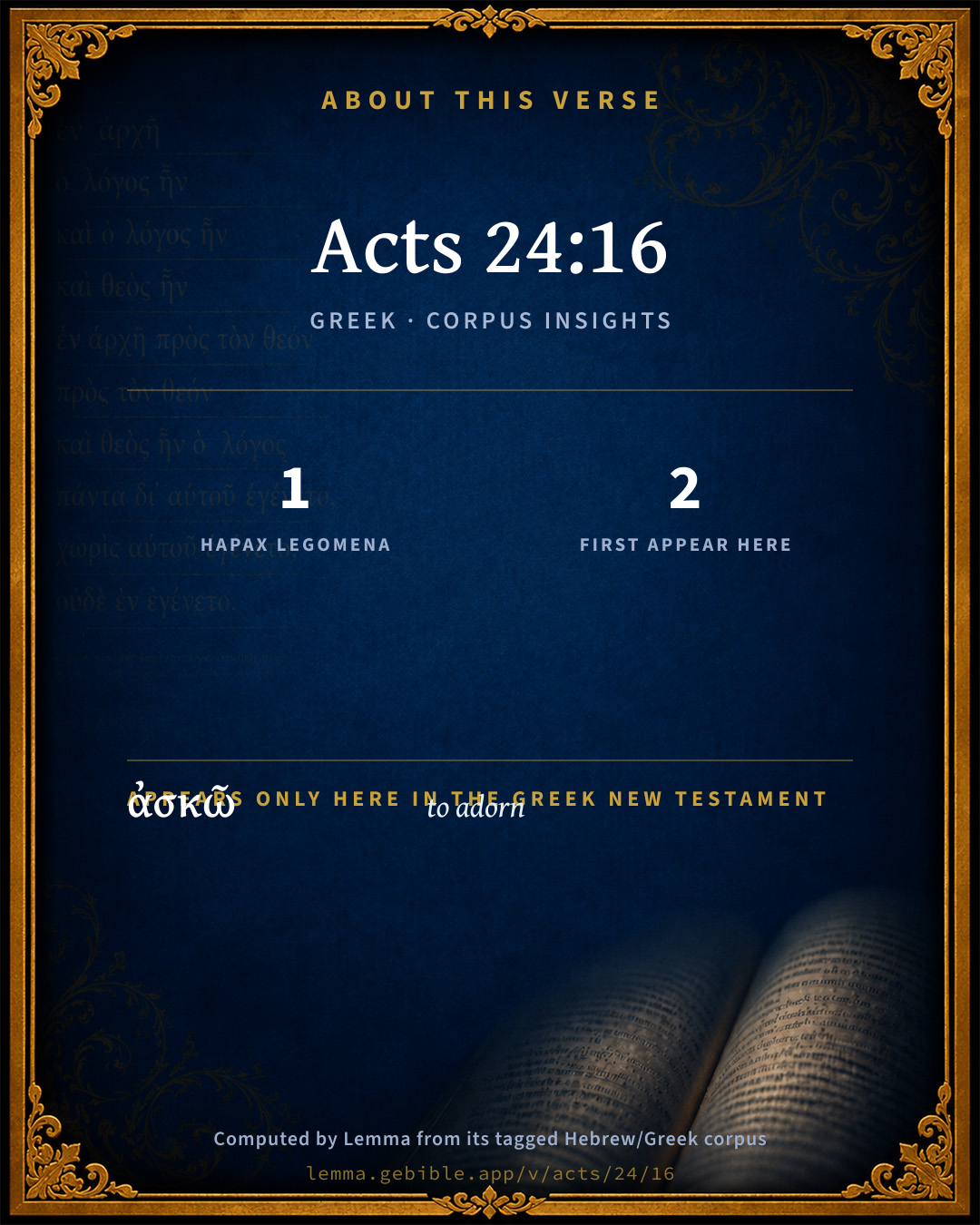
- 1 hapax legomenon — only here in the Greek New Testament
- 2 first appearances in the Greek New Testament
Download a study sheet
One document with this verse’s original text, its word-by-word gloss line, the meaning frame, cross-references with their text, attributed commentary, and full source and license credits — printable, and it pastes into notes with its structure intact.
This verse Autodidact and up
A passage Seminary Student
Up to 50 verses in one chapter. A passage sheet keeps up to 6 commentary sources and 12 cross-references per verse, in the order this page ranks them, and says so on the sheet whenever that leaves anything out. Ask for a single verse and you get the Autodidact verse sheet above.
Everything on this page stays free to read, with no account — the sheet is a download of what is already on screen, not access to it.
Compare translations 3
The same verse in 3 English versions, stacked beneath the original-language interlinear above. Click any original word for its lexicon entry.
Each is an independent rendering of the whole verse — the interlinear is not word-aligned to these translations.
Highlighted words mark where these versions differ — a whole-verse word diff, not a word-by-word alignment.
-
World English Bible Public Domain
Herein I also practice always having a conscience void of offense toward God and men.
-
King James Version Public Domain
And herein do I exercise myself, to have always a conscience void to offence toward God, and toward men.
-
unfoldingWord Literal Text CC BY-SA 4.0
In this I myself also strive to have a blameless conscience before God and men continually.
unfoldingWord Literal Text — © unfoldingWord, licensed CC BY-SA 4.0. Word-aligned USFM3 via Door43 (git.door43.org/unfoldingWord/en_ult).
Show all 19 translations
Every available English version of this verse, each an independent rendering of the whole verse.
-
World English Bible Public Domain
Herein I also practice always having a conscience void of offense toward God and men.
-
Berean Standard Bible Public Domain
In this hope, I strive always to maintain a clear conscience before God and man.
-
Majority Standard Bible Public Domain
In this hope, I strive always to maintain a clear conscience before God and man.
-
King James Version Public Domain
And herein do I exercise myself, to have always a conscience void to offence toward God, and toward men.
-
American Standard Version (1901) Public Domain
Herein I also exercise myself to have a conscience void of offence toward God and men always.
-
Revised Version (1885) Public Domain
Herein do I also exercise myself to have a conscience void of offence toward God and men alway.
-
Geneva Bible (1599) Public Domain
And herein I endeuour my selfe to haue alway a cleare conscience towarde God, and toward men.
-
Douay-Rheims (1899) Public Domain
And herein do I endeavour to have always a conscience without offence toward God, and towards men.
-
Young's Literal Translation Public Domain
and in this I do exercise myself, to have a conscience void of offence toward God and men always.
-
Literal Standard Version CC BY-SA 4.0
and in this I exercise myself, to always have a conscience void of offense toward God and men.
-
Unlocked Literal Bible CC BY-SA 4.0
So I always strive to have a clear conscience before God and human beings.
-
unfoldingWord Literal Text CC BY-SA 4.0
In this I myself also strive to have a blameless conscience before God and men continually.
-
Darby Bible Public Domain
For this cause I also exercise [myself] to have in everything a conscience without offence towards God and men.
-
World Messianic Bible Public Domain
In this I also practice always having a conscience void of offense toward God and men.
-
Webster's Bible Public Domain
And in this I exercise myself, to have always a conscience void of offense towards God, and towards men.
-
Free Bible Version CC BY-SA 4.0
Consequently I try to make sure I always have a clear conscience before God and everyone.
-
Bible in Basic English Public Domain
And in this, I do my best at all times to have no reason for shame before God or men.
-
Text-Critical English NT CC BY 4.0
Because of this I strive the way I do, always having a clear conscience before God and men.
-
Tyndale New Testament (1534) Public Domain
And therfore stody I to have a cleare consciece towarde God and toward man also.
Literal Standard Version (2020), Covenant Press — licensed CC BY-SA 4.0. Text via the HelloAO Bible API (eBible.org). Unlocked Literal Bible (unfoldingWord) — licensed CC BY-SA 4.0. Text via the HelloAO Bible API (eBible.org). unfoldingWord Literal Text — © unfoldingWord, licensed CC BY-SA 4.0. Word-aligned USFM3 via Door43 (git.door43.org/unfoldingWord/en_ult). Free Bible Version, Dr. Jonathan Gallagher — licensed CC BY-SA 4.0. Text via the HelloAO Bible API (eBible.org).
Word by word
More ways to search: Search by grammar → Find every occurrence → Compare this word →
Practice this passage: Drill this verse → Learn its vocabulary →
- Appears 1× in the Greek New Testament
- First appears here
- Part of Speech
- Verb
- Tense
- Present
- Voice
- Active
- Mood
- Indicative
- Person
- 1st person
- Number
- Singular
Full Thayer's Definition
- ἐν en G1722 “in” Preposition
- τούτῳ hoûtos G3778 “this” Demonstrative pronoun, Dative, Singular, Neuter
- καὶ kaí G2532 “and” Conjunction
- αὐτὸς autós G846 “he” Personal pronoun, Nominative, Singular, Masculine
- ἀσκῶ askéō G778 “to adorn” Verb, Present, Active, Indicative, 1st person, Singular
- ἀπρόσκοπον apróskopos G677 “without offense” Adjective, Accusative, Singular, Feminine
- συνείδησιν syneídēsis G4893 “conscience” Noun, Accusative, Singular, Feminine
- ἔχειν échō G2192 “to have” Verb, Present, Active, Infinitive
- πρὸς prós G4314 “to” Preposition
- τὸν ho G3588 “the” Article, Accusative, Singular, Masculine
- θεὸν theós G2316 “God” Noun, Accusative, Singular, Masculine
- καὶ kaí G2532 “and” Conjunction
- τοὺς ho G3588 “the” Article, Accusative, Plural, Masculine
- ἀνθρώπους ánthrōpos G444 “human being” Noun, Accusative, Plural, Masculine
- διαπαντός diapantós G1275 “always” Adverb
About this verse
These counts appear in no published source. They are computed here, from the morphology-tagged text and Lemma’s own curated glosses. What Lemma adds →
- 15
- words
- 13
- distinct lemmas
- Acts
- section
Notable vocabulary
1 hapax legomenon — a word that appears only here in the entire Greek New Testament:
- ἀσκῶ to adorn G778
First appearance in Scripture
These words make their first canonical appearance in the Greek New Testament here:
Shared distinctive vocabulary
ἀπρόσκοπον without offense G677 occurs in 3 verses of the Greek New Testament. Also found in:
Cross-references
19Topical passages linked to Acts 24:16 in the Treasury of Scripture Knowledge — connected by theme and wording, ordered by reader-vote popularity; previews shown in the World English Bible.
- Acts 23:1 Paul, looking steadfastly at the council, said, "Brothers, I have lived before God in all good conscience until this day."
- 1 Timothy 1:5 but the end of the charge is love, out of a pure heart and a good conscience and unfeigned faith;
- 2 Corinthians 4:2 But we have renounced the hidden things of shame, not walking in craftiness, nor handling the word of God deceitfully; but by the manifestation of the truth commending ourselves to every man's conscience in the sight of God.
- Hebrews 10:22 let's draw near with a true heart in fullness of faith, having our hearts sprinkled from an evil conscience, and having our body washed with pure water,
- Romans 2:15 in that they show the work of the law written in their hearts, their conscience testifying with them, and their thoughts among themselves accusing or else excusing them)
- 2 Corinthians 1:12 For our boasting is this: the testimony of our conscience, that in holiness and sincerity of God, not in fleshly wisdom but in the grace of God we behaved ourselves in the world, and more abundantly toward you.
- 1 Peter 3:21 This is a symbol of baptism, which now saves you-- not the putting away of the filth of the flesh, but the answer of a good conscience toward God, through the resurrection of Jesus Christ,
- 1 Corinthians 4:4 For I know nothing against myself. Yet I am not justified by this, but he who judges me is the Lord.
- 2 Timothy 1:3 I thank God, whom I serve as my forefathers did, with a pure conscience. How unceasing is my memory of you in my petitions, night and day
- Titus 1:15 To the pure, all things are pure; but to those who are defiled and unbelieving, nothing is pure; but both their mind and their conscience are defiled.
- 1 Thessalonians 2:10 You are witnesses with God, how holy, righteously, and blamelessly we behaved ourselves toward you who believe.
- Titus 2:11–13 For the grace of God has appeared, bringing salvation to all men,
- Hebrews 9:14 how much more will the blood of Christ, who through the eternal Spirit offered himself without blemish to God, cleanse your conscience from dead works to serve the living God?
- Hebrews 13:18 Pray for us, for we are persuaded that we have a good conscience, desiring to live honorably in all things.
- 1 Peter 2:19 For it is commendable if someone endures pain, suffering unjustly, because of conscience toward God.
- 1 Peter 3:16 having a good conscience; that, while you are spoken against as evildoers, they may be disappointed who curse your good manner of life in Christ.
- 1 Timothy 1:19 holding faith and a good conscience; which some having thrust away made a shipwreck concerning the faith;
- 1 Timothy 3:9 holding the mystery of the faith in a pure conscience.
- Romans 9:1 I tell the truth in Christ. I am not lying, my conscience testifying with me in the Holy Spirit,
Cross-references courtesy of OpenBible.info (CC BY 4.0).
Where the printed editions differ
1 variantPlaces in this verse where the major printed Greek editions disagree on the wording in a way that affects the translation — a comparison of editions, not a manuscript-by-manuscript collation. The editions are the modern critical texts (Nestlé-Aland 28/27, SBL, Westcott-Hort, Tregelles, Tyndale House) and the traditional texts behind the KJV (the Textus Receptus and the Byzantine/Majority text). It is not a claim about which reading is original.
-
Editions differ
διὰ
“through”
In NA28NA27TynSBLWHTregTR»1Byz Not in TR
Textual data: Translators Amalgamated Greek New Testament (STEPBible TAGNT) · CC BY 4.0.
Lesson kit
Teaching starters — assembled from the data on this page, not authored interpretation. Every prompt links to the verse data it draws on. Edit before teaching.
Acts, in the Acts, opens this verse with 15 words (13 distinct Greek lemmas). Its most distinctive word is askéō (“to adorn”). A historical commentator’s framing appears above. Read the whole chapter for the surrounding context.
Discussion questions
- The word askéō carries the sense “to adorn.” How does it shape the verse?
- This verse holds 1 word here found nowhere else in the Greek New Testament. What might the rare word draw attention to?
- 2 words here appear for the first time in Scripture. What is being introduced at this debut?
- 1 Corinthians 10:32 shares the word «without offense» with this verse. How do the two illuminate each other?
- “and” occurs 2× in this one verse. What is the effect of the repetition?
- These translations render this verse differently. What is at stake in choosing one wording over another?
- Reading how The Biblical Illustrator and Tyndale Open Study Notes read this verse, where do the two commentators agree and where do they part?
Things to notice
- 1 word in this verse appears nowhere else in the Greek New Testament.
- 2 words make their first canonical appearance in Scripture here.
- These translations choose different wording for 17 words in this verse.
- “and” occurs 2× in this single verse.
- 13 distinct Greek lemmas span 15 words in this verse.
Commentary
Notes on Acts 24:16 from classic Christian and Jewish commentators (each source and its license shown beneath its notes). The classic Christian expositions comment on the surrounding passage and are grouped to its opening verse, so a note may address several verses; the Jewish commentaries on the Tanakh (Rashi and others) are per-verse, so they appear only where the commentator wrote on this verse.
Lemma curates 59 commentaries, every one of them public domain or Creative Commons licensed, each selected and text-cleaned for this edition rather than reprinted as found. About our sources →
The Biblical Illustrator
Joseph S. Exell
The Biblical Illustrator, edited by Joseph S. Exell (c. 1880s–1900s) — public domain. Text from a community e-Sword module.
Tyndale Open Study Notes
Tyndale Open Resources
Tyndale Open Study Notes — © Tyndale Open Resources, licensed CC BY-SA 4.0. Text via the HelloAO Bible API.
Bengel's Gnomon
Johann Albrecht Bengel
Bengel's Gnomon of the New Testament — English translation (T&T Clark, Edinburgh, 1860) — public domain. Text from a community e-Sword module.
Meyer's Critical & Exegetical Commentary
Heinrich August Wilhelm Meyer
Meyer — Critical and Exegetical Commentary on the New Testament — English translation by Peter Christie, edited by Frederick Crombie (T&T Clark, 1880) — public domain. Text from a community e-Sword module.
Expositor's Greek Testament
ed. W. Robertson Nicoll
The Expositor's Greek Testament, edited by W. Robertson Nicoll (1897–1910) — public domain. Text from a community e-Sword module.
Jamieson, Fausset & Brown
Robert Jamieson, A. R. Fausset & David Brown
Jamieson, Fausset & Brown — Commentary Critical and Explanatory on the Whole Bible (1871) — public domain (CC PDM 1.0). Text via the HelloAO Bible API.
Adam Clarke's Commentary
Adam Clarke's Commentary on the Bible (1810–1826) — public domain. Text from a community e-Sword/MySword module.
John Calvin's Commentaries
John Calvin's Commentaries (1540-1563) — public domain. Text from the Calvin Translation Society English edition (1840s-50s) via the Christian Classics Ethereal Library (ccel.org). Calvin's coverage is partial (roughly two-thirds of the Bible); uncommented books and verses are honest gaps, never fabricated. The 19th-century editor's footnotes and remarks are omitted so the notes are faithfully Calvin's own voice.
Ellicott's Commentary for English Readers
A Bible Commentary for English Readers, edited by Charles John Ellicott (1878–1897) — public domain. Text from a community e-Sword module.
The Cambridge Bible for Schools and Colleges
gen. ed. J. J. S. Perowne
The Cambridge Bible for Schools and Colleges (gen. ed. J. J. S. Perowne; Cambridge University Press, 1878–1918) — public domain. Text from a community e-Sword module.
John Gill's Exposition
John Gill's Exposition of the Whole Bible (1746–1763) — public domain (CC PDM 1.0). Text via the HelloAO Bible API.
Trapp's Complete Commentary
John Trapp
John Trapp, A Commentary or Exposition upon All the Books of the Old and New Testament (1647–1656) — public domain. Text from a community e-Sword module.
Albert Barnes' Notes on the Bible
Albert Barnes' Notes on the Bible (1834–1885) — public domain. Text from a community e-Sword/MySword module.
Matthew Poole's English Annotations
Matthew Poole's English Annotations on the Holy Bible (1683–1685) — public domain. Text from a community e-Sword/MySword module.
The Pulpit Commentary
The Pulpit Commentary (1880–1919), ed. H.D.M. Spence-Jones & Joseph S. Exell — public domain. Text from a community e-Sword module.
John Wesley's Explanatory Notes
John Wesley, Explanatory Notes Upon the Whole Bible (1754–1765) — public domain. Text via the GEBible commentary corpus.
Godbey's Commentary on the New Testament
William B. Godbey
William B. Godbey, Commentary on the New Testament (1896–1900) — public domain. Text from a community e-Sword module.
McGarvey & Pendleton's Commentaries
J. W. McGarvey
J. W. McGarvey (with Philip Y. Pendleton), Commentaries on the New Testament (The Fourfold Gospel, 1914; Acts; and the epistles) — public domain. Text from a community e-Sword/MySword module.
Cambridge Greek Testament for Schools and Colleges
Cambridge Greek Testament for Schools and Colleges (Cambridge University Press, 1896; 21 vols, various authors incl. Carr, Maclear, Plummer, Farrar, Lumby, Moule, M. R. James, Simcox) — public domain. Text from a community e-Sword module.
Alford’s Greek Testament
Henry Alford
Henry Alford, The Greek Testament (1849–1861) — public domain. Text from a community e-Sword module.
Vincent's Word Studies in the New Testament
Marvin R. Vincent
Marvin R. Vincent, Word Studies in the New Testament (1887–1900) — public domain. Text from a community e-Sword/MySword module.