Acts 20:30

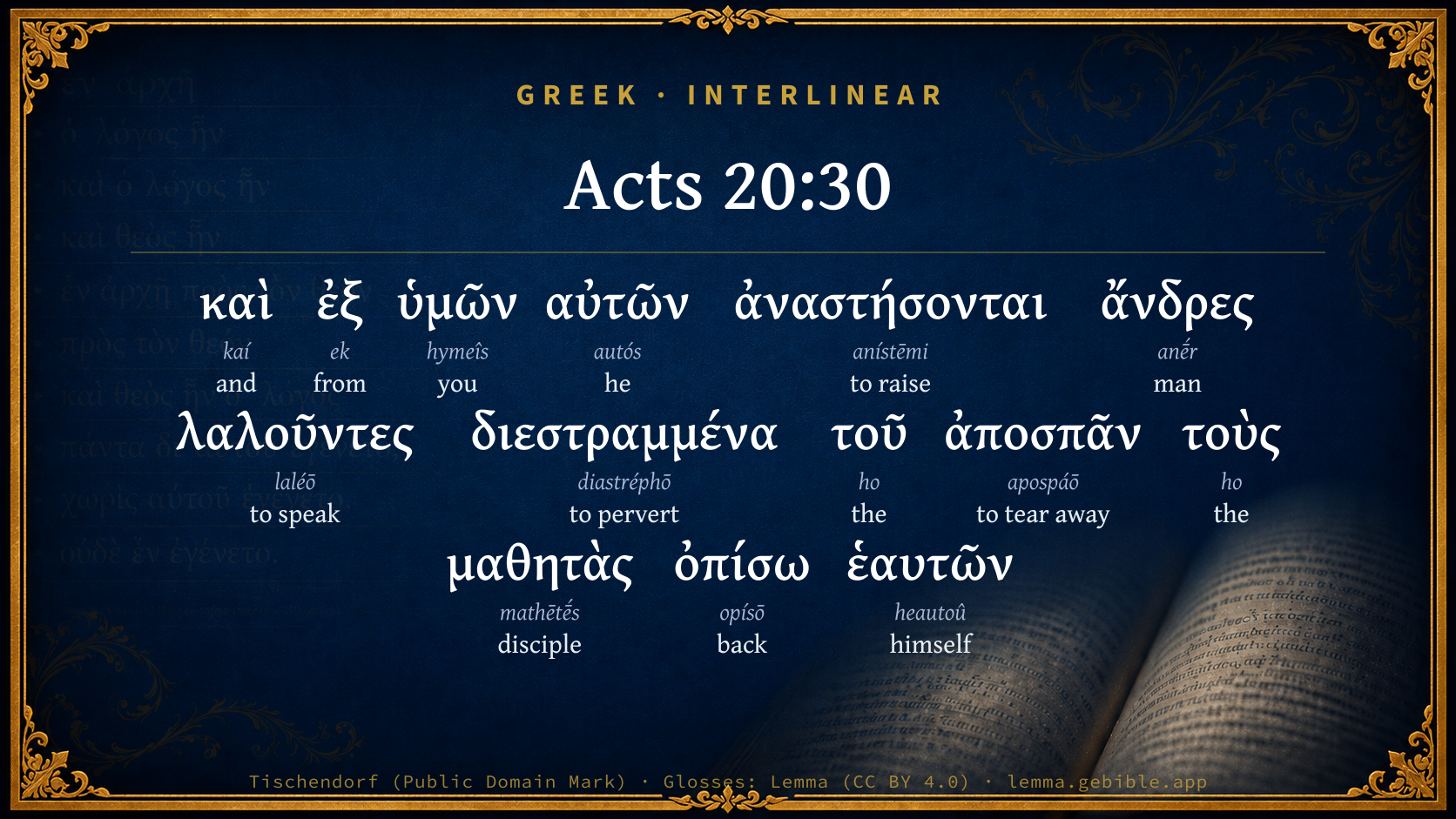
Greek (Tischendorf 8th ed.) Acts 20:30 appears in the Greek New Testament. The text above is from the Tischendorf 8th edition. Each word links to its Strong’s number and a concise gloss. Click any word for its full Thayer’s Greek Lexicon entry.
Download image
Cite this verse

Acts 20:30 (World English Bible). Public Domain. Lemma interlinear Bible study tool, https://lemma.gebible.app/v/acts/20/30.

Show BibTeX & RIS
BibTeX
RIS
English Translation
Men will arise from among your own selves, speaking perverse things, to draw away the disciples after them.
World English Bible · Public Domain
Download a study sheet

One document with this verse’s original text, its word-by-word gloss line, the meaning frame, cross-references with their text, attributed commentary, and full source and license credits — printable, and it pastes into notes with its structure intact.

This verse Autodidact and up

Study sheet (.html) Plain text (.txt)

A passage Seminary Student

Up to 50 verses in one chapter. A passage sheet keeps up to 6 commentary sources and 12 cross-references per verse, in the order this page ranks them, and says so on the sheet whenever that leaves anything out. Ask for a single verse and you get the Autodidact verse sheet above.

Everything on this page stays free to read, with no account — the sheet is a download of what is already on screen, not access to it.

Want to remove ads? Support Godless Engineer
Compare translations 3

The same verse in 3 English versions, stacked beneath the original-language interlinear above. Click any original word for its lexicon entry.

Each is an independent rendering of the whole verse — the interlinear is not word-aligned to these translations.

Highlighted words mark where these versions differ — a whole-verse word diff, not a word-by-word alignment.

  • World English Bible Public Domain
    Men will arise from among your own selves, speaking perverse things, to draw away the disciples after them.
  • King James Version Public Domain
    Also of your own selves shall men arise, speaking perverse things, to draw away disciples after them.
  • unfoldingWord Literal Text CC BY-SA 4.0
    Even from you yourselves, men will arise speaking perverted things in order to draw away the disciples after them.

unfoldingWord Literal Text — © unfoldingWord, licensed CC BY-SA 4.0. Word-aligned USFM3 via Door43 (git.door43.org/unfoldingWord/en_ult).

Versions to compare (up to 4)

3 of 4 selected

Show all 19 translations

Every available English version of this verse, each an independent rendering of the whole verse.

  • World English Bible Public Domain
    Men will arise from among your own selves, speaking perverse things, to draw away the disciples after them.
  • Berean Standard Bible Public Domain
    Even from your own number, men will rise up and distort the truth to draw away disciples after them.
  • Majority Standard Bible Public Domain
    Even from your own number, men will rise up and distort the truth to draw away disciples after them.
  • King James Version Public Domain
    Also of your own selves shall men arise, speaking perverse things, to draw away disciples after them.
  • American Standard Version (1901) Public Domain
    and from among your own selves shall men arise, speaking perverse things, to draw away the disciples after them.
  • Revised Version (1885) Public Domain
    and from among your own selves shall men arise, speaking perverse things, to draw away the disciples after them.
  • Geneva Bible (1599) Public Domain
    Moreouer of your owne selues shall men arise speaking peruerse thinges, to drawe disciples after them.
  • Douay-Rheims (1899) Public Domain
    And of your own selves shall arise men speaking perverse things, to draw away disciples after them.
  • Young's Literal Translation Public Domain
    and of your own selves there shall arise men, speaking perverse things, to draw away the disciples after them.
  • Literal Standard Version CC BY-SA 4.0
    and there will arise men of your own selves, speaking perverse things, to draw away the disciples after them.
  • Unlocked Literal Bible CC BY-SA 4.0
    I know that from even among you some men shall come and distort the truth in order to draw away the disciples after them.
  • unfoldingWord Literal Text CC BY-SA 4.0
    Even from you yourselves, men will arise speaking perverted things in order to draw away the disciples after them.
  • Darby Bible Public Domain
    and from among your own selves shall rise up men speaking perverted things to draw away the disciples after them.
  • World Messianic Bible Public Domain
    Men will arise from among your own selves, speaking perverse things, to draw away the disciples after them.
  • Webster's Bible Public Domain
    Also from your own selves will men arise, speaking perverse things, to draw away disciples after them.
  • Free Bible Version CC BY-SA 4.0
    From among your own group men will rise up perverting what is right and good so they can lead believers to follow them.
  • Bible in Basic English Public Domain
    And from among yourselves will come men who will give wrong teaching, turning away the disciples after them.
  • Text-Critical English NT CC BY 4.0
    Even from your own number men will rise up, speaking perverse things to draw the disciples away after them.
  • Tyndale New Testament (1534) Public Domain
    Moreover of youre awne selves shall men aryse speakinge perverse thinges to drawe disciples after them.

Literal Standard Version (2020), Covenant Press — licensed CC BY-SA 4.0. Text via the HelloAO Bible API (eBible.org). Unlocked Literal Bible (unfoldingWord) — licensed CC BY-SA 4.0. Text via the HelloAO Bible API (eBible.org). unfoldingWord Literal Text — © unfoldingWord, licensed CC BY-SA 4.0. Word-aligned USFM3 via Door43 (git.door43.org/unfoldingWord/en_ult). Free Bible Version, Dr. Jonathan Gallagher — licensed CC BY-SA 4.0. Text via the HelloAO Bible API (eBible.org).

Word by word

More ways to search: Search by grammar → Find every occurrence → Compare this word →

Practice this passage: Drill this verse → Learn its vocabulary →

ἀποσπᾶν
apospáō
G645
“to tear away”
Verb, Present, Active, Infinitive
Part of Speech
Verb
Tense
Present
Voice
Active
Mood
Infinitive
Full Thayer's Definition

Origin: from G575 and G4685

TDNT: None

1. to draw off, tear away
  1. καὶ kaí G2532 “and” Conjunction
  2. ἐξ ek G1537 “from” Preposition
  3. ὑμῶν hymeîs G5210 “you” Personal pronoun, 2nd person, Genitive, Plural
  4. αὐτῶν autós G846 “he” Personal pronoun, Genitive, Plural, Masculine
  5. ἀναστήσονται anístēmi G450 “to raise” Verb, Future, Middle, Indicative, 3rd person, Plural
  6. ἄνδρες anḗr G435 “man” Noun, Nominative, Plural, Masculine
  7. λαλοῦντες laléō G2980 “to speak” Verb, Present, Active, Participle, Nominative, Plural, Masculine
  8. διεστραμμένα diastréphō G1294 “to pervert” Verb, Perfect, Passive, Participle, Accusative, Plural, Neuter
  9. τοῦ ho G3588 “the” Article, Genitive, Singular, Neuter
  10. τοὺς ho G3588 “the” Article, Accusative, Plural, Masculine
  11. μαθητὰς mathētḗs G3101 “disciple” Noun, Accusative, Plural, Masculine
  12. ὀπίσω opísō G3694 “back” Adverb
  13. ἑαυτῶν heautoû G1438 “himself” Reflexive pronoun, 3rd person, Genitive, Plural, Masculine

About this verse

These counts appear in no published source. They are computed here, from the morphology-tagged text and Lemma’s own curated glosses. What Lemma adds →

14
words
13
distinct lemmas
Acts
section

Notable vocabulary

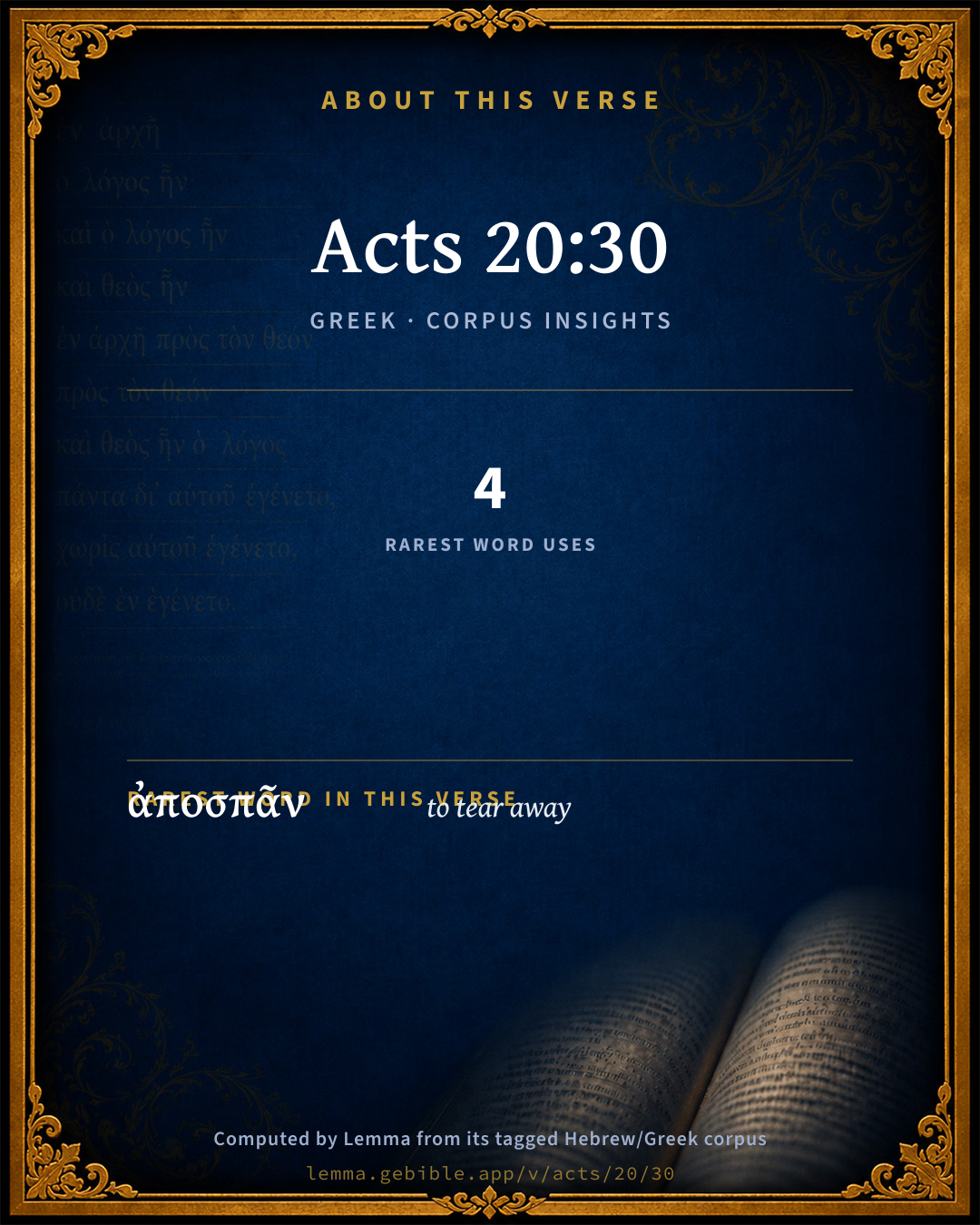
The rarest word here is ἀποσπᾶν to tear away G645 — appearing just 4 times in the whole Greek New Testament.

Shared distinctive vocabulary

ἀποσπᾶν to tear away G645 occurs in 4 verses of the Greek New Testament. Also found in:

Repetition

A word recurs within this verse:

Cross-references

21

Topical passages linked to Acts 20:30 in the Treasury of Scripture Knowledge — connected by theme and wording, ordered by reader-vote popularity; previews shown in the World English Bible.

  • 1 Timothy 1:19–20 holding faith and a good conscience; which some having thrust away made a shipwreck concerning the faith;
  • 2 Timothy 4:3–4 For the time will come when they will not listen to the sound doctrine, but, having itching ears, will heap up for themselves teachers after their own lusts;
  • Proverbs 23:33 Your eyes will see strange things, And your mind will imagine confusing things.
  • 1 John 2:19 They went out from us, but they didn't belong to us; for if they had belonged to us, they would have continued with us. But they left, that they might be revealed that none of them belong to us.
  • Proverbs 19:1 Better is the poor who walks in his integrity Than he who is perverse in his lips and is a fool.
  • Acts 11:26 When he had found him, he brought him to Antioch. It happened, that for a whole year they were gathered together with the assembly, and taught many people. The disciples were first called Christians in Antioch.
  • Isaiah 59:3 For your hands are defiled with blood, and your fingers with iniquity; your lips have spoken lies, your tongue mutters wickedness.
  • Matthew 23:15 Woe to you, scribes and Pharisees, hypocrites! For you travel around by sea and land to make one proselyte; and when he becomes one, you make him twice as much of a son of Gehenna as yourselves.
  • Matthew 26:21–25 As they were eating, he said, "Most assuredly I tell you that one of you will betray me."
  • Acts 5:36–37 For before these days Theudas rose up, making himself out to be somebody; to whom a number of men, about four hundred, joined themselves: who was slain; and all, as many as obeyed him, were dispersed, and came to nothing.
  • Acts 21:38 Aren't you then the Egyptian, who before these days stirred up to sedition and led out into the wilderness the four thousand men of the Assassins?"
  • 1 Corinthians 1:12–15 Now I mean this, that each one of you says, "I follow Paul," "I follow Apollos," "I follow Cephas," and, "I follow Christ."
  • Galatians 6:12–13 As many as desire to look good in the flesh, they compel you to be circumcised; only that they may not be persecuted for the cross of Christ.
  • 1 Timothy 5:13 Besides, they also learn to be idle, going about from house to house. Not only idle, but also gossips and busybodies, saying things which they ought not.
  • 1 Timothy 6:5 constant friction of people of corrupt minds and destitute of the truth, who suppose that godliness is a means of gain. Withdraw yourself from such.
  • 2 Timothy 2:17–18 and their word will consume like gangrene, of whom is Hymenaeus and Philetus;
  • 2 Peter 2:1–3 But there also arose false prophets among the people, as among you also there will be false teachers, who will secretly bring in destructive heresies, denying even the Master who bought them, bringing on themselves swift destruction.
  • 2 Peter 2:18 For, uttering great swelling words of emptiness, they entice in the lusts of the flesh, by licentiousness, those who are indeed escaping from those who live in error;
  • 2 John 1:7 For many deceivers have gone out into the world, those who don't confess that Jesus Christ came in the flesh. This is the deceiver and the Antichrist.
  • Jude 1:4–16 For there are certain men who crept in secretly, even those who were long ago written about for this condemnation: ungodly men, turning the grace of our God into lasciviousness, and denying our only Master, God, and Lord, Jesus Christ.
  • Revelation 2:6 But this you have, that you hate the works of the Nicolaitans, which I also hate.

Cross-references courtesy of OpenBible.info (CC BY 4.0).

Commentary

Notes on Acts 20:30 from classic Christian and Jewish commentators (each source and its license shown beneath its notes). The classic Christian expositions comment on the surrounding passage and are grouped to its opening verse, so a note may address several verses; the Jewish commentaries on the Tanakh (Rashi and others) are per-verse, so they appear only where the commentator wrote on this verse.

Lemma curates 59 commentaries, every one of them public domain or Creative Commons licensed, each selected and text-cleaned for this edition rather than reprinted as found. About our sources →

Bengel's Gnomon

Johann Albrecht Bengel

Act 20:30. Ἀποσπᾷν) to draw away, from their simplicity towards Christ, and from the unity of the body. This is the characteristic of a false teacher, to wish that the disciples should depend (hang) on himself alone.

Bengel's Gnomon of the New Testament — English translation (T&T Clark, Edinburgh, 1860) — public domain. Text from a community e-Sword module.

Expositor's Greek Testament

ed. W. Robertson Nicoll

Act 20:30 . καὶ ἐξ ὑμῶν αὐτῶν αὐτῶς : αὐτῶν adds emphasis, “from your own selves”. The Pastoral Epistles afford abundant evidence of the fulfilment of the words, cf. 1Ti 1:20 , 2Ti 1:15 ; 2Ti 2:17 ; 2Ti 3:8 ; 2Ti 3:13 . To some extent the Apostolic warning was effectual at all events in Ephesus itself, cf. Rev 2:2 ; Ignat., Ephes. , vi., 2. ἀναστήσονται : common word in Acts, see on Act 20:17 , used here perhaps as in Act 5:36 . διεστραμμένα , cf. LXX, Deu 32:5 . The verb is found twice in Luk 9:41 (Mat 17:17 ), Act 23:2 , three times in Act 13:8 ; Act 13:10 , and once again by St. Paul, Phi 2:15 , in a similar sense, cf. Arist., Pol. , iii., 16, 5, viii., 7, 7; Arrian, Epict. , iii., 6, 8. ἀποσπᾷν τοὺς μαθητὰς : “the disciples,” R.V. with art [344] meaning that they would try and draw away those that were already Christians, μαθ . always so used in Acts. ἀποσ . to tear away from that to which one is already attached; used by St.Mat 26:51 , and elsewhere only by St.Luk 22:41 , Act 21:1 ; compare with the genitive of purpose after ἀνίστημι , 2Ch 20:23 . ὀπίσω αὑτῶν , “after themselves,” cf. Act 5:37 , not after Christ, Mat 4:19 .

[344] grammatical article.

The Expositor's Greek Testament, edited by W. Robertson Nicoll (1897–1910) — public domain. Text from a community e-Sword module.

Geneva Bible (1599)

Geneva Bible translators

This is a great misery, to want the presence of such a shepherd, but greater to have wolves enter in.

Geneva Bible (1599) marginal notes — public domain. Text via Bolls.life.

Adam Clarke's Commentary

Verse 30. Also of your own selves, c.] From out of your own assembly shall men arise, speaking perverse things, teaching for truth what is erroneous in itself, and perversive of the genuine doctrine of Christ crucified.

To draw away disciples] To make schisms or rents in the Church, in order to get a party to themselves. See, here, the cause of divisions in the Church:

1. The superintendents lose the life of God, neglect the souls of the people, become greedy of gain, and, by secular extortions, oppress the people.

2. The members of the Church, thus neglected, oppressed, and irritated, get their minds alienated from their rapacious pastors.

3. Men of sinister views take advantage of this state of distraction, foment discord, preach up the necessity of division, and thus the people become separated from the great body, and associate with those who profess to care for their souls, and who disclaim all secular views.

In this state of distraction, it is a high proof of God's love to his heritage, if one be found who, possessing the true apostolic doctrine and spirit, rises up to call men back to the primitive truth, and restore the primitive discipline. How soon the grievous wolves and perverse teachers arose in the Churches of Asia Minor, the first chapters of the Apocalypse inform us. The Nicolaitans had nearly ruined the Church of Ephesus, Re 1:2, Re 1:6. The same sect, with other false teachers, infested the Church of Pergamos, and preached there the doctrine of Balaam, Re 2:14-15. A false prophetess seduced the Church of Thyatira, Re 2:20. All these Churches were in Asia Minor, and probably bishops or ministers from each were present at this convocation.

Adam Clarke's Commentary on the Bible (1810–1826) — public domain. Text from a community e-Sword/MySword module.

John Calvin's Commentaries

30. Of your ownselves shall arise. This amplifieth the grievousness of the evil, because there be some wolves within, and so hiding themselves under the title of pastors, [which] do wait for some opportunity wherein they may do hurt. Also, he declareth what danger these wolves do threaten, to wit, the scattering abroad of the flock, when the Church is drawn away from the unity of faith, and is divided into sects. Neither are all those wolves who do not their duty as they ought, but there be oftentimes hirelings, a kind of men not so hurtful as the other. But the corruption of doctrine is a most deadly plague to the sheep. Now, in the third place, the fountain and beginning of this evil is noted, because they will draw disciples after them. Therefore, ambition is the mother of all heresies. For the sincerity of the word of God doth then flourish when the pastors join hand in hand to bring disciples unto Christ, because this alone is the sound state of the Church, that he be heard alone; wherefore, both the doctrine of salvation must needs be perverted, and also the safety of the flock must needs go to nought, where men be desirous of mastership. And as this place teacheth that almost all corruptions of doctrine flow from the pride of men, so we learn again out of the same that it cannot otherwise be, but that ambitious men will turn away from right purity, and corrupt the word of God. For seeing that the pure and sincere handling of the Scripture tendeth to this end, that Christ alone may have the preeminence, and that men can challenge nothing to themselves, but they shall take so much from the glory of Christ, it followeth that those are corrupters of sound doctrine who are addicted to themselves, and study to advance their own glory, which doth only darken Christ. Which thing the Lord doth confirm in the seventh of John (John 7:18). Furthermore, by the word arise which he useth, he signifieth that those wolves do nourish secret destruction until they may have some opportunity offered to break out.

And this place doth very well prevent an horrible stumbling-block and offense which Satan hath always cast in to trouble weak consciences. If external and professed enemies do resist the gospel, this doth not so much hurt to the Church, as if inward enemies issue out of the bosom of the Church, which at a sudden blow to the field, or which unfaithfully provoke the people to fall away; and yet God hath from the beginning exercised his Church with this temptation, and now doth exercise it. Wherefore, let our faith be fortified with this defense that it fail not, if at any time it so fall out that pastors begin to rage like wolves. He saith they shall be “grievous wolves”, that he may the more terrify them; secondly, they shall be authors of wicked opinions, and that to the end they may draw disciples after them, because it cannot almost otherwise be but that ambition will corrupt the purity of the gospel.

By this it appeareth also how frivolous and vain the brag of the Papists is touching their continual succession. For seeing we can easily show that these horned beasts are nothing less than that which they will be thought to be, being always convicted, they fly unto this fortress, that they succeed the apostles by a continual course. As if these did not also succeed them, of whom Paul willeth to take heed. Therefore, seeing that God, either to prove the constancy of his [people], or in his just judgment doth oftentimes suffer wolves to rage under the person of pastors, the authority doth not consist in the name and place alone, neither is succession anything worth unless faith and integrity be joined therewithal. But and if the Papists object that they cannot be called wolves, one word of Paul shall be as a touchstone to prove whether this be so or no, that they may (saith he) draw disciples after them. And to what end tendeth all Popish religion, save only that men’s lust and pleasure may reign instead of God’s word? But Christ hath no disciples where he is not counted the only master.

John Calvin's Commentaries (1540-1563) — public domain. Text from the Calvin Translation Society English edition (1840s-50s) via the Christian Classics Ethereal Library (ccel.org). Calvin's coverage is partial (roughly two-thirds of the Bible); uncommented books and verses are honest gaps, never fabricated. The 19th-century editor's footnotes and remarks are omitted so the notes are faithfully Calvin's own voice.

Ellicott's Commentary for English Readers

(30) Of your own selves shall men arise, speaking perverse things.—The Pastoral Epistles, 2 Peter and Jude, supply but too abundant evidence of the clearness of the Apostle’s prevision. Hymenæus and Alexander and Philetus, saying that the resurrection was past already (1Ti_1:20; 2Ti_2:17); evil men and seducers becoming worse and worse (2Ti_3:13); resisting the faith, as Jannes and Jambres had resisted Moses (2Ti_3:8); false prophets, bringing in damnable heresies and denying the Lord that bought them (2Pe_2:1); these were part of the rank aftergrowth of the apostolic age, of which St. Paul saw even now the germs. It adds to the pathos of this parting to think that men such as Hymenæus and Philetus may have been actually present, listening to the Apostle’s warnings, and warned by him in vain.

To draw away disciples after them.—Better, to draw away the disciples—those who had previously been disciples of Christ and His Apostles. This was at once the motive and the result of the work of the false teachers. The note of heresy was that it was essentially self-asserting and schismatical.

A Bible Commentary for English Readers, edited by Charles John Ellicott (1878–1897) — public domain. Text from a community e-Sword module.

The Cambridge Bible for Schools and Colleges

gen. ed. J. J. S. Perowne

30. Also of your own selves, &c.] Better (with Rev. Ver.) “And from among your own selves.” This gives an idea of the greater nearness of the apostasy which the Apostle predicts. Not some who may come of those to whom he speaks, but even out of the present existing Christian body. We know from St Paul’s own experience that he had learnt how out of the professedly Christian body some would go back like Demas (2Ti_4:10) through love of this world’s good things, and some would err concerning the truth, like Hymenæus and Philetus, and that their word would eat like a canker, and they would overthrow the faith of some. These are the speakers of perverse things, things which should twist even the Apostle’s own words into a wrong sense.

shall men arise … draw away disciples after them] Better, “the disciples,” i.e. other members of the Christian body. It is not that these men will desire and endeavour to gain disciples, but they will do their best, after their own falling-away, to drag others likewise from the true faith. This is expressed also by the verb which implies the tearing away from that to which they are already attached, and this more literal translation of the verb expresses the labour and exertion which these false teachers will spend to achieve their object.

The Cambridge Bible for Schools and Colleges (gen. ed. J. J. S. Perowne; Cambridge University Press, 1878–1918) — public domain. Text from a community e-Sword module.

John Gill's Exposition

I have coveted no man's silver, or gold, or apparel. This the apostle says, not merely in vindication of himself, and his character, from all charge or suspicion of avarice; but chiefly for the instruction of these elders, and all others of the same office, not to indulge the sin of covetousness, which is very disagreeable, and ought not to be in a minister of the word; and it may be observed, that many things which the apostle says before of himself to those elders, is said not to commend himself, nor so much in his own vindication, as for their imitation; compare with this Num 16:15 and to point out the character of false teachers that would come in, or spring up among them, who would make merchandise of them. Beza's ancient copy, and others, read, "the silver, &c. of none of you"; and so the Ethiopic version.

and to point out the character of false teachers that would come in, or spring up among them, who would make merchandise of them. Beza's ancient copy, and others, read, "the silver, &c. of none of you"; and so the Ethiopic version.

Acts 20:34

act 20:34

act 20:34

act 20:34Yea, you yourselves know,.... So far was the apostle from desiring to have other men's money, or to wear their apparel, or to eat their bread, that he could appeal to these elders for the truth of it, they having been eyewitnesses of it:

that these hands have ministered unto my necessities; meaning, that he had wrought with his hands, which he then held up, or stretched out, at tent making, along with Aquila and Priscilla, at Ephesus, as he had done before at Corinth, Act 18:2 and therewith supplied himself with necessaries for food and clothing; for though he had a power, as a minister of the Gospel, to forbear working, and to insist upon a maintenance from the churches, yet in some cases, and in some places, he chose rather to forego that, lest he should either any ways hinder the progress of the Gospel at the first preaching of it, or be burdensome to the churches, or give the false teachers any handle against him; and he not only supported himself in this way, but assisted others also:

and to them that were with me; as Luke, Timothy, and others; see Act 20:4.

John Gill's Exposition of the Whole Bible (1746–1763) — public domain (CC PDM 1.0). Text via the HelloAO Bible API.

Trapp's Complete Commentary

John Trapp

30 Also of your own selves shall men arise, speaking perverse things, to draw away disciples after them.

Ver. 30. To draw away disciples] αποσπαν, to tear them limb from limb by a violent avulsion and distraction, compelling them by their persuasions to embrace those distorted doctrines, διεστραμμενα, that produce convulsions of conscience, Deu 13:5. Such are said to thrust men out of God’s ways.

John Trapp, A Commentary or Exposition upon All the Books of the Old and New Testament (1647–1656) — public domain. Text from a community e-Sword module.

Albert Barnes' Notes on the Bible

Also of your own selves - From your own church; from those who profess to. be Christians.

Speaking perverse things - Crooked, perverted, distracting doctrines διεστραμμένα diestrammena. Compare the notes on Act 13:10. They would proclaim doctrines tending to distract and divide the church. The most dangerous enemies which the church has had have been nurtured in its own bosom, and have consisted of those who have perverted the true doctrines of the gospel. Among the Ephesians, as among the Corinthians 1Co 1:11-13, there might be parties formed; there might be people influenced by ambition, like Diotrephes 3Jo 1:9, or like Phygellus or Hermogenes 2Ti 1:15, or like Hymeneus and Alexander, 1Ti 1:20. Men under the influence of ambition, or from the love of power or popularity, form parties in the church, produce divisions and distractions, and greatly retard its internal prosperity, and mar its peace. The church of Christ would have little to fear from external enemies if it nurtured no foes in its own bosom; and all the power of persecutors is not so much to be dreaded as the plans, the parties, the strifes, the heart burnings, and the contentions which are produced by those who love and seek power, among the professed friends of Christ.

Albert Barnes' Notes on the Bible (1834–1885) — public domain. Text from a community e-Sword/MySword module.

Matthew Poole's English Annotations

Of your own selves shall men arise; whilst Paul yet lived, and was only departed from that place. Several seducers may be reckoned up, as Nicolas the deacon, (from whom it is thought the sect of the Nicolaitanes came, Rev 2:6), Hymenaeus, Alexander, Phygellus, and Hermogenes, 1Ti 1:20; 2Ti 1:15.

Speaking perverse things; perverting Scripture; establishing their false doctrines by Scripture, which they wrest to their purpose.

To draw away disciples; as members are forcibly plucked from their body; which speak the cruelty and violence of these heretics, and the tenderness of the church towards her members, being loth to part from them.

After them; thus false teachers gain indeed disciples to themselves, but not unto the Lord.

Matthew Poole's English Annotations on the Holy Bible (1683–1685) — public domain. Text from a community e-Sword/MySword module.

Whedon's Commentary on the Bible

Daniel D. Whedon

30. Of your own selves—Internal heresiarchs, not merely from among the present elders, but from the Church they represent. Dr. Gloag says, “Mention is made of no fewer than six heresiarchs belonging to Ephesus: Hymeneus and Alexander, (1Ti_1:20,) Phygellus and Hermogenes, (2Ti_1:15,) Philetus, (2Ti_2:17,) and Diotrephes, (3Jn_1:9.)” Here were the Nicolaitans, (Rev_2:6, and note on Act_6:5,) and here Cerinthus rose against the apostle John. (See our vol. ii, p. 224.)

Daniel D. Whedon (gen. ed.), Commentary on the Old and New Testaments (1874–1909) — public domain. Text from a community e-Sword module.

The Pulpit Commentary

And from among for also of, A.V.; the disciples for disciples, A.V. From among your own selves; as opposed to the strangers from Judaea in the preceding verse. So 2Ti_4:3, "The time will come when they will not endure sound doctrine; but after their own lusts shall they heap to themselves teachers, having itching ears" (see, as instances,. (2Ti_2:17, 18 4:14) Speaking perverse things. So 2Ti_4:4, "They shall turn away their ears from the truth, and shall be turned unto fables." To draw away the disciples, etc.; i.e. to induce Christians to leave the communion and doctrine of the Church, and join their heresy. The A.V., "to draw away disciples," is manifestly wrong; touv maqhtav are Christ"s disciples. For the general statement, see 2Ti_3:6, "They which creep into houses, and lead captive silly women;" and comp. Rom_16:17, Rom_16:18, which, according to Renan, was addressed to the Ephesians. For the rise of false teachers in Asia, see 1Ti_1:3, 20 4:1-7 6:20, 21; 2Ti_1:15 2Ti_3:4; 1Jn_2:26 1Jn_4:1, 1Jn_4:3, 1Jn_4:5; and through the whole Epistle; Rev_2:1-7.

The Pulpit Commentary (1880–1919), ed. H.D.M. Spence-Jones & Joseph S. Exell — public domain. Text from a community e-Sword module.

John Wesley's Explanatory Notes

Yea, from among yourselves men will arise - Such were the Nicolaitans, of whom Christ complains, Rev. ii, 6; to draw away disciples - From the purity of the Gospel and the unity of the body.

John Wesley, Explanatory Notes Upon the Whole Bible (1754–1765) — public domain. Text via the GEBible commentary corpus.

Godbey's Commentary on the New Testament

William B. Godbey

30. “And from you yourselves men will rise up, speaking perverse things, in order to draw away disciples after them.

William B. Godbey, Commentary on the New Testament (1896–1900) — public domain. Text from a community e-Sword module.

McGarvey & Pendleton's Commentaries

J. W. McGarvey

See notes on verse 28

J. W. McGarvey (with Philip Y. Pendleton), Commentaries on the New Testament (The Fourfold Gospel, 1914; Acts; and the epistles) — public domain. Text from a community e-Sword/MySword module.

Cambridge Greek Testament for Schools and Colleges

30. καὶ ἐξ ὑμῶν αὐτῶν, and from among your own selves. This gives an idea of the greater nearness of the apostasy which the Apostle predicts. Not some who may come of those to whom he speaks, but even out of the present existing Christian body. We know from St Paul’s own experience that he learnt (and no doubt had learnt this long before he wrote to Timothy) how out of the professedly Christian body some would go back like Demas (2Ti 4:10) through love of this world’s good things, and some would err concerning the truth, like Hymenæus and Philetus, and that their word would eat like a canker, and they would overthrow the faith of some. These are the speakers of perverse things, such as would twist even the Apostle’s own words into a wrong sense.

τοῦ ἀποσπᾷν τοὺς μαθητὰς ὀπίσω ἑαυτῶν, to draw away the disciples after them, i.e. to pervert the other members of the Christian body. It is not that these men will desire and endeavour to gain disciples, but they will do their best, after their own falling-away, to drag others likewise from the true faith. This is expressed also by the verb which implies the tearing away from that to which they are already attached, and this more literal translation of the verb expresses the labour and exertion which these false teachers will spend to achieve their object.

On the genitival infinitive τοῦ ἀποσπᾷν cf. Act 3:2 note, and for an exact parallel to the instance in this verse, see 2Ch 20:23 ἀνέστησαν εἰς ἀλλήλους τοῦ ἐξολοθρευθῆναι.

Cambridge Greek Testament for Schools and Colleges (Cambridge University Press, 1896; 21 vols, various authors incl. Carr, Maclear, Plummer, Farrar, Lumby, Moule, M. R. James, Simcox) — public domain. Text from a community e-Sword module.

Alford’s Greek Testament

Henry Alford

30.] ὑμῶν αὐτ. does not necessarily signify the presbyters: he speaks to them as being the whole flock.

Henry Alford, The Greek Testament (1849–1861) — public domain. Text from a community e-Sword module.

Lesson kit

Teaching starters — assembled from the data on this page, not authored interpretation. Every prompt links to the verse data it draws on. Edit before teaching.

Acts, in the Acts, opens this verse with 14 words (13 distinct Greek lemmas). Its most distinctive word is apospáō (“to tear away”). A historical commentator’s framing appears above. Read the whole chapter for the surrounding context.

Discussion questions

  1. What does “to tear away” (apospáō) contribute to the verse as a whole?
  2. Matthew 26:51 shares the word «to tear away» with this verse. How do the two illuminate each other?
  3. “the” occurs 2× in this one verse. What is the effect of the repetition?
  4. The translations on this page render this verse differently — a whole-verse word diff, not a word-by-word alignment. What might account for the different wordings?
  5. Reading how Bengel's Gnomon and Expositor's Greek Testament read this verse, where do the two commentators agree and where do they part?

Things to notice

Reading settings

Reading text

Shown beneath each verse's original-language words.

Old Testament
Old Testament edition

Read the OT as the Masoretic Hebrew (MT) or the Greek Septuagint (LXX).

English shown for the Greek Septuagint (in the Hebrew ↔ Greek comparison).

Comparing translations? Open the Compare panel on any verse page to stack up to four side by side.