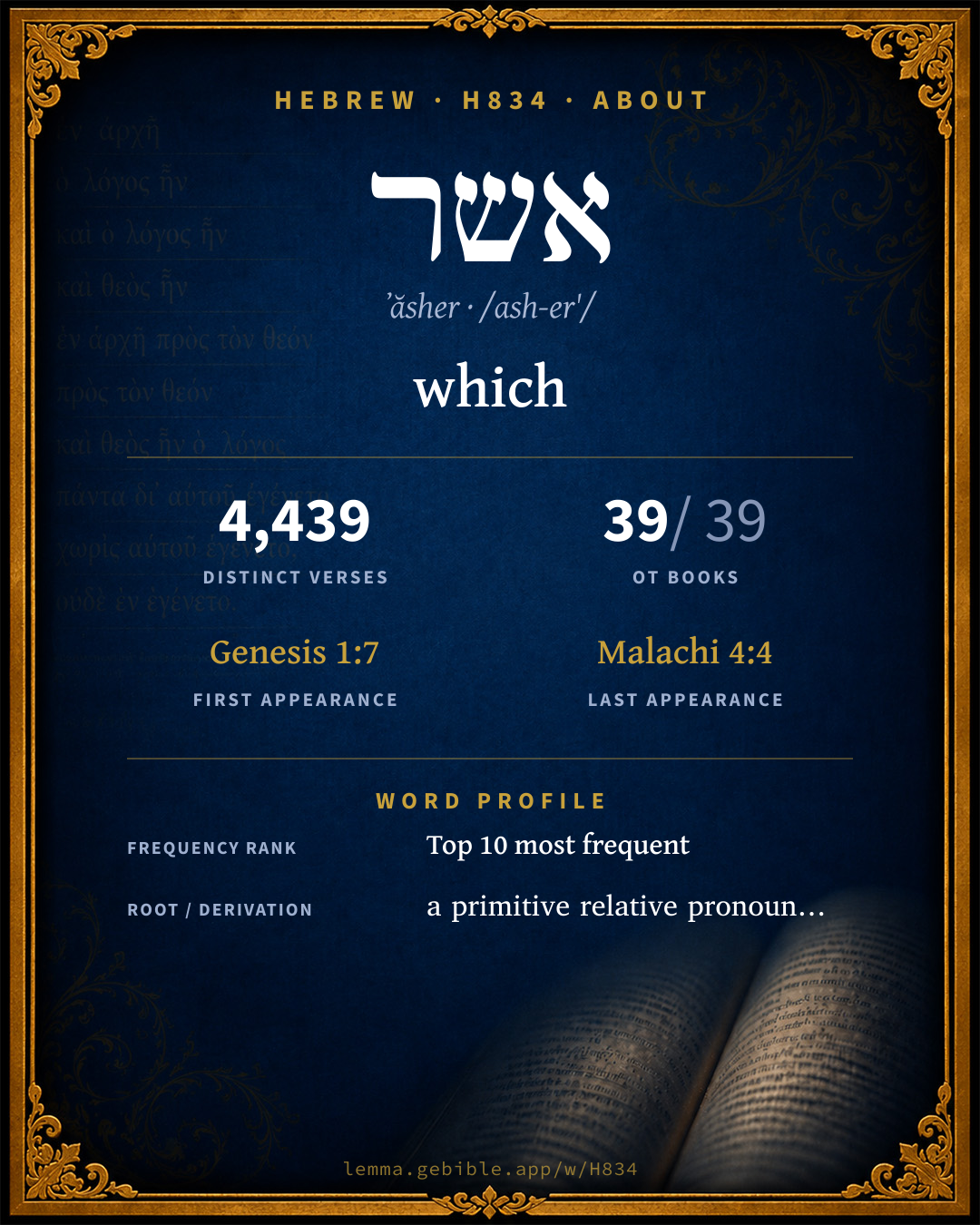
אֲשֶׁר
which
‘which’ is one of 7 main senses fuller range ↓
Full lexicon entry — Brown-Driver-Briggs (BDB)
From Brown-Driver-Briggs (BDB)
Where this word appears
Grammar key — what these labels mean
Part of speech
- Particle
- A short function word — article, negation, interrogative, the sign of the direct object, and the like.
Every verse where H834 appears in the Book of Nehemiah — 82 distinct verses. Click any verse to open its interlinear word-by-word view. Verse text shown in the World English Bible for context — . Each verse’s Hebrew form is shown with its reference; the English is not keyword-highlighted, since the data carries no word-level English alignment. Use “Compare translations” on any verse to read it across multiple English versions. This concordance covers the Hebrew Bible; Septuagint (Greek Old Testament) occurrences are not indexed here.
Nehemiah
- Nehemiah 1:2 אֲשֶֽׁר ptcl rel that Hanani, one of my brothers, came, he and certain men out of Judah; and I asked them concerning the Jews who had escaped, who were left of the captivity, and concerning Jerusalem.
- Nehemiah 1:3 אֲשֶֽׁר ptcl rel They said to me, The remnant who are left of the captivity there in the province are in great affliction and reproach: the wall of Jerusalem also is broken down, and the gates of it are burned with fire.
- Nehemiah 1:6 אֲשֶׁ֣ר אֲשֶׁ֣ר ptcl rel ptcl rel Let your ear now be attentive, and your eyes open, that you may listen to the prayer of your servant, which I pray before you at this time, day and night, for the children of Israel your servants while I confess the sins of the children of Israel, which we have sinned against you. Yes, I and my father's house have sinned:
- Nehemiah 1:7 אֲשֶׁ֥ר ptcl rel we have dealt very corruptly against you, and have not kept the commandments, nor the statutes, nor the ordinances, which you commanded your servant Moses.
- Nehemiah 1:8 אֲשֶׁ֥ר ptcl rel Remember, I beg you, the word that you commanded your servant Moses, saying, If you trespass, I will scatter you abroad among the peoples:
- Nehemiah 1:9 אֲשֶׁ֣ר ptcl rel but if you return to me, and keep my commandments and do them, though your outcasts were in the uttermost part of the heavens, yet will I gather them from there, and will bring them to the place that I have chosen, to cause my name to dwell there.
- Nehemiah 1:10 אֲשֶׁ֤ר ptcl rel Now these are your servants and your people, whom you have redeemed by your great power, and by your strong hand.
- Nehemiah 2:3 אֲשֶׁ֨ר ptcl rel I said to the king, Let the king live forever: why should not my face be sad, when the city, the place of my fathers' tombs, lies waste, and the gates of it are consumed with fire?
- Nehemiah 2:5 אֲשֶׁ֧ר ptcl rel I said to the king, If it please the king, and if your servant have found favor in your sight, that you would send me to Judah, to the city of my fathers' tombs, that I may build it.
- Nehemiah 2:7 אֲשֶׁר֙ אֲשֶׁר ptcl rel ptcl rel Moreover I said to the king, If it please the king, let letters be given me to the governors beyond the River, that they may let me pass through until I come to Judah;
- Nehemiah 2:8 אֲשֶׁ֣ר אֲשֶׁ֣ר אֲשֶׁר אֲשֶׁר ptcl rel ptcl rel ptcl rel ptcl rel and a letter to Asaph the keeper of the king's forest, that he may give me timber to make beams for the gates of the castle which appertains to the house, and for the wall of the city, and for the house that I shall enter into. The king granted me, according to the good hand of my God on me.
- Nehemiah 2:10 אֲשֶׁר ptcl rel When Sanballat the Horonite, and Tobiah the servant, the Ammonite, heard of it, it grieved them exceedingly, because a man had come to seek the welfare of the children of Israel.
- Nehemiah 2:12 אֲשֶׁ֥ר ptcl rel I arose in the night, I and some few men with me; neither told I any man what my God put into my heart to do for Jerusalem; neither was there any animal with me, except the animal that I rode on.
- Nehemiah 2:13 אֲשֶׁר ptcl rel I went out by night by the valley gate, even toward the jackal's well, and to the dung gate, and viewed the walls of Jerusalem, which were broken down, and the gates of it were consumed with fire.
- Nehemiah 2:17 אֲשֶׁ֣ר אֲשֶׁ֤ר ptcl rel ptcl rel Then said I to them, You see the evil case that we are in, how Jerusalem lies waste, and the gates of it are burned with fire: come, and let us build up the wall of Jerusalem, that we be no more a reproach.
- Nehemiah 2:18 אֲשֶׁר אֲשֶׁ֣ר ptcl rel ptcl rel I told them of the hand of my God which was good on me, as also of the king's words that he had spoken to me. They said, Let us rise up and build. So they strengthened their hands for the good [work].
- Nehemiah 2:19 אֲשֶׁ֣ר ptcl rel But when Sanballat the Horonite, and Tobiah the servant, the Ammonite, and Geshem the Arabian, heard it, they ridiculed us, and despised us, and said, What is this thing that you do? will you rebel against the king?
- Nehemiah 3:25 אֲשֶׁ֖ר ptcl rel Palal the son of Uzai [repaired] over against the turning [of the wall], and the tower that stands out from the upper house of the king, which is by the court of the guard. After him Pedaiah the son of Parosh [repaired].
- Nehemiah 4:1 כַּ/אֲשֶׁ֧ר prep + ptcl rel But it happened that when Sanballat heard that we were building the wall, he was angry, and took great indignation, and mocked the Jews.
- Nehemiah 4:3 אֲשֶׁר ptcl rel Now Tobiah the Ammonite was by him, and he said, Even that which they are building, if a fox go up, he shall break down their stone wall.
- Nehemiah 4:7 כַ/אֲשֶׁ֣ר prep + ptcl rel But it happened that when Sanballat, Tobiah, the Arabians, the Ammonites, and the Ashdodites heard that the repairing of the walls of Jerusalem went forward, [and] that the breaches began to be stopped, then they were very angry;
- Nehemiah 4:11 אֲשֶׁר ptcl rel Our adversaries said, They shall not know, neither see, until we come into the midst of them, and kill them, and cause the work to cease.
- Nehemiah 4:12 כַּ/אֲשֶׁר אֲשֶׁר prep + ptcl rel ptcl rel It happened that when the Jews who lived by them came, they said to us ten times from all places, You must return to us.
- Nehemiah 4:15 כַּֽ/אֲשֶׁר prep + ptcl rel It happened, when our enemies heard that it was known to us, and God had brought their counsel to nothing, that we returned all of us to the wall, everyone to his work.
- Nehemiah 4:20 אֲשֶׁ֤ר ptcl rel in whatever place you hear the sound of the trumpet, resort you there to us; our God will fight for us.
- Nehemiah 4:23 אֲשֶׁ֣ר ptcl rel So neither I, nor my brothers, nor my servants, nor the men of the guard who followed me, none of us put off our clothes, everyone [went with] his weapon [to] the water.
- Nehemiah 5:2 אֲשֶׁ֣ר ptcl rel For there were that said, We, our sons and our daughters, are many: let us get grain, that we may eat and live.
- Nehemiah 5:3 אֲשֶׁ֣ר ptcl rel Some also there were that said, We are mortgaging our fields, and our vineyards, and our houses: let us get grain, because of the dearth.
- Nehemiah 5:4 אֲשֶׁ֣ר ptcl rel There were also that said, We have borrowed money for the king's tribute [on] our fields and our vineyards.
- Nehemiah 5:6 כַּ/אֲשֶׁ֤ר prep + ptcl rel I was very angry when I heard their cry and these words.
- Nehemiah 5:9 אֲשֶׁר ptcl rel Also I said, The thing that you do is not good: ought you not to walk in the fear of our God, because of the reproach of the nations our enemies?
- Nehemiah 5:11 אֲשֶׁ֥ר ptcl rel Please restore to them, even this day, their fields, their vineyards, their olive groves, and their houses, also the hundredth part of the money, and of the grain, the new wine, and the oil, that you exact of them.
- Nehemiah 5:12 כַּ/אֲשֶׁ֖ר prep + ptcl rel Then said they, We will restore them, and will require nothing of them; so will we do, even as you say. Then I called the priests, and took an oath of them, that they would do according to this promise.
- Nehemiah 5:13 אֲשֶׁ֨ר ptcl rel Also I shook out my lap, and said, So God shake out every man from his house, and from his labor, that doesn't perform this promise; even thus be he shaken out, and emptied. All the assembly said, Amen, and praised Yahweh. The people did according to this promise.
- Nehemiah 5:14 אֲשֶׁר ptcl rel Moreover from the time that I was appointed to be their governor in the land of Judah, from the twentieth year even to the two and thirtieth year of Artaxerxes the king, [that is], twelve years, I and my brothers have not eaten the bread of the governor.
- Nehemiah 5:15 אֲשֶׁר ptcl rel But the former governors who were before me were chargeable to the people, and took of them bread and wine, besides forty shekels of silver; yes, even their servants bore rule over the people: but I didn't do so, because of the fear of God.
- Nehemiah 5:17 אֲשֶׁר ptcl rel Moreover there were at my table, of the Jews and the rulers, one hundred fifty men, besides those who came to us from among the nations that were round about us.
- Nehemiah 5:18 וַ/אֲשֶׁר֩ conj + ptcl rel Now that which was prepared for one day was one ox and six choice sheep; also fowls were prepared for me, and once in ten days store of all sorts of wine: yet for all this I didn't demand the bread of the governor, because the bondage was heavy on this people.
- Nehemiah 5:19 אֲשֶׁר ptcl rel Remember to me, my God, for good, all that I have done for this people.
- Nehemiah 6:1 כַ/אֲשֶׁ֣ר prep + ptcl rel Now it happened, when it was reported to Sanballat and Tobiah, and to Geshem the Arabian, and to the rest of our enemies, that I had built the wall, and that there was no breach left therein; (though even to that time I had not set up the doors in the gates;)
- Nehemiah 6:3 כַּ/אֲשֶׁ֣ר prep + ptcl rel I sent messengers to them, saying, I am doing a great work, so that I can't come down: why should the work cease, while I leave it, and come down to you?
- Nehemiah 6:8 אֲשֶׁ֖ר ptcl rel Then I sent to him, saying, There are no such things done as you say, but you feign them out of your own heart.
- Nehemiah 6:11 אֲשֶׁר ptcl rel I said, Should such a man as I flee? and who is there that, being such as I, would go into the temple to save his life? I will not go in.
- Nehemiah 6:14 אֲשֶׁ֥ר ptcl rel Remember, my God, Tobiah and Sanballat according to these their works, and also the prophetess Noadiah, and the rest of the prophets, that would have put me in fear.
- Nehemiah 6:16 כַּ/אֲשֶׁ֤ר אֲשֶׁ֣ר prep + ptcl rel ptcl rel It happened, when all our enemies heard [of it], that all the nations that were about us feared, and were much cast down in their own eyes; for they perceived that this work was worked of our God.
- Nehemiah 6:17 וַ/אֲשֶׁ֥ר conj + ptcl rel Moreover in those days the nobles of Judah sent many letters to Tobiah, and [the letters] of Tobiah came to them.
- Nehemiah 7:1 כַּ/אֲשֶׁ֤ר prep + ptcl rel Now it happened, when the wall was built, and I had set up the doors, and the porters and the singers and the Levites were appointed,
- Nehemiah 7:6 אֲשֶׁ֣ר ptcl rel These are the children of the province, who went up out of the captivity of those who had been carried away, whom Nebuchadnezzar the king of Babylon had carried away, and who returned to Jerusalem and to Judah, everyone to his city;
- Nehemiah 7:63 אֲשֶׁ֣ר ptcl rel Of the priests: the children of Hobaiah, the children of Hakkoz, the children of Barzillai, who took a wife of the daughters of Barzillai the Gileadite, and was called after their name.
- Nehemiah 7:65 אֲשֶׁ֥ר ptcl rel The governor said to them, that they should not eat of the most holy things, until there stood up a priest with Urim and Thummim.
- Nehemiah 7:72 וַ/אֲשֶׁ֣ר conj + ptcl rel That which the rest of the people gave was twenty thousand darics of gold, and two thousand minas of silver, and sixty-seven priests' garments.
- Nehemiah 8:1 אֲשֶׁ֖ר אֲשֶׁר ptcl rel ptcl rel All the people gathered themselves together as one man into the broad place that was before the water gate; and they spoke to Ezra the scribe to bring the book of the law of Moses, which Yahweh had commanded to Israel.
- Nehemiah 8:3 אֲשֶׁ֣ר ptcl rel He read therein before the broad place that was before the water gate from early morning until midday, in the presence of the men and the women, and of those who could understand; and the ears of all the people were [attentive] to the book of the law.
- Nehemiah 8:4 אֲשֶׁ֣ר ptcl rel Ezra the scribe stood on a pulpit of wood, which they had made for the purpose; and beside him stood Mattithiah, and Shema, and Anaiah, and Uriah, and Hilkiah, and Maaseiah, on his right hand; and on his left hand, Pedaiah, and Mishael, and Malchijah, and Hashum, and Hashbaddanah, Zechariah, [and] Meshullam.
- Nehemiah 8:12 אֲשֶׁ֥ר ptcl rel All the people went their way to eat, and to drink, and to send portions, and to make great mirth, because they had understood the words that were declared to them.
- Nehemiah 8:14 אֲשֶׁ֨ר אֲשֶׁר֩ ptcl rel ptcl rel They found written in the law, how that Yahweh had commanded by Moses, that the children of Israel should dwell in booths in the feast of the seventh month;
- Nehemiah 8:15 וַ/אֲשֶׁ֣ר conj + ptcl rel and that they should publish and proclaim in all their cities, and in Jerusalem, saying, Go forth to the mountain, and get olive branches, and branches of wild olive, and myrtle branches, and palm branches, and branches of thick trees, to make booths, as it is written.
- Nehemiah 9:6 אֲשֶׁ֤ר אֲשֶׁ֣ר ptcl rel ptcl rel You are Yahweh, even you alone; you have made heaven, the heaven of heavens, with all their host, the earth and all things that are thereon, the seas and all that is in them, and you preserve them all; and the host of heaven worships you.
- Nehemiah 9:7 אֲשֶׁ֤ר ptcl rel You are Yahweh the God, who did choose Abram, and brought him forth out of Ur of the Chaldees, and gave him the name of Abraham,
- Nehemiah 9:12 אֲשֶׁ֥ר ptcl rel Moreover in a pillar of cloud you led them by day; and in a pillar of fire by night, to give them light in the way in which they should go.
- Nehemiah 9:15 אֲשֶׁר ptcl rel and gave them bread from the sky for their hunger, and brought forth water for them out of the rock for their thirst, and commanded those who they should go in to possess the land which you had sworn to give them.
- Nehemiah 9:17 אֲשֶׁ֣ר ptcl rel and refused to obey, neither were mindful of your wonders that you did among them, but hardened their neck, and in their rebellion appointed a captain to return to their bondage. But you are a God ready to pardon, gracious and merciful, slow to anger, and abundant in loving kindness, and didn't forsake them.
- Nehemiah 9:18 אֲשֶׁ֥ר ptcl rel Yes, when they had made them a molten calf, and said, This is your God who brought you up out of Egypt, and had committed awful blasphemies;
- Nehemiah 9:19 אֲשֶׁ֥ר ptcl rel yet you in your manifold mercies didn't forsake them in the wilderness: the pillar of cloud didn't depart from over them by day, to lead them in the way; neither the pillar of fire by night, to show them light, and the way in which they should go.
- Nehemiah 9:23 אֲשֶׁר ptcl rel Their children also multiplied you as the stars of the sky, and brought them into the land concerning which you did say to their fathers, that they should go in to possess it.
- Nehemiah 9:26 אֲשֶׁר ptcl rel Nevertheless they were disobedient, and rebelled against you, and cast your law behind their back, and killed your prophets that testified against them to turn them again to you, and they committed awful blasphemies.
- Nehemiah 9:29 אֲשֶׁר ptcl rel and testified against them, that you might bring them again to your law. Yet they dealt proudly, and didn't listen to your commandments, but sinned against your ordinances, (which if a man do, he shall live in them), and withdrew the shoulder, and hardened their neck, and would not hear.
- Nehemiah 9:32 אֲֽשֶׁר ptcl rel Now therefore, our God, the great, the mighty, and the awesome God, who keep covenant and loving kindness, don't let all the travail seem little before you, that has come on us, on our kings, on our princes, and on our priests, and on our prophets, and on our fathers, and on all your people, since the time of the kings of Assyria to this day.
- Nehemiah 9:34 אֲשֶׁ֥ר ptcl rel neither have our kings, our princes, our priests, nor our fathers, kept your law, nor listened to your commandments and your testimonies with which you did testify against them.
- Nehemiah 9:35 אֲשֶׁר אֲשֶׁר ptcl rel ptcl rel For they have not served you in their kingdom, and in your great goodness that you gave them, and in the large and fat land which you gave before them, neither turned they from their wicked works.
- Nehemiah 9:36 אֲשֶׁר ptcl rel Behold, we are servants this day, and as for the land that you gave to our fathers to eat the fruit of it and the good of it, behold, we are servants in it.
- Nehemiah 9:37 אֲשֶׁר ptcl rel It yields much increase to the kings whom you have set over us because of our sins: also they have power over our bodies, and over our cattle, at their pleasure, and we are in great distress.
- Nehemiah 10:29 אֲשֶׁ֣ר ptcl rel They joined with their brothers, their nobles, and entered into a curse, and into an oath, to walk in God's law, which was given by Moses the servant of God, and to observe and do all the commandments of Yahweh our Lord, and his ordinances and his statutes;
- Nehemiah 10:30 וַ/אֲשֶׁ֛ר conj + ptcl rel and that we would not give our daughters to the peoples of the land, nor take their daughters for our sons;
- Nehemiah 11:3 אֲשֶׁ֥ר ptcl rel Now these are the chiefs of the province who lived in Jerusalem: but in the cities of Judah lived everyone in his possession in their cities, [to wit], Israel, the priests, and the Levites, and the Nethinim, and the children of Solomon's servants.
- Nehemiah 12:1 אֲשֶׁ֥ר ptcl rel Now these are the priests and the Levites who went up with Zerubbabel the son of Shealtiel, and Jeshua: Seraiah, Jeremiah, Ezra,
- Nehemiah 13:1 אֲ֠שֶׁר ptcl rel On that day they read in the book of Moses in the audience of the people; and therein was found written, that an Ammonite and a Moabite should not enter into the assembly of God forever,
- Nehemiah 13:7 אֲשֶׁ֨ר ptcl rel and I came to Jerusalem, and understood the evil that Eliashib had done for Tobiah, in preparing him a chamber in the courts of the house of God.
- Nehemiah 13:14 אֲשֶׁ֥ר ptcl rel Remember me, my God, concerning this, and don't wipe out my good deeds that I have done for the house of my God, and for the observances of it.
- Nehemiah 13:17 אֲשֶׁ֣ר ptcl rel Then I contended with the nobles of Judah, and said to them, What evil thing is this that you do, and profane the Sabbath day?
- Nehemiah 13:19 כַּ/אֲשֶׁ֣ר אֲשֶׁר֙ prep + ptcl rel ptcl rel It came to pass that, when the gates of Jerusalem began to be dark before the Sabbath, I commanded that the doors should be shut, and commanded that they should not be opened until after the Sabbath: and some of my servants set I over the gates, that there should no burden be brought in on the Sabbath day.
- Nehemiah 13:22 אֲשֶׁ֨ר ptcl rel I commanded the Levites that they should purify themselves, and that they should come and keep the gates, to sanctify the Sabbath day. Remember to me, my God, this also, and spare me according to the greatness of your loving kindness.
About this entry
At a glance — auto-summarized from this page’s data, not written by a person. Every figure links to its source below. This summary describes the numbers; it doesn’t interpret them.
At its core, אשר (ʼăsher) means “which.” Carrying more than one sense, it rewards its full sense range. With 4,439 verses in 39 books, it is one of the most common word in the Hebrew Bible. First canonically at Genesis 1:7, it enters the text early. From the same root come של and שם. Dig into 4,439-verse concordance and the renderings breakdown below.
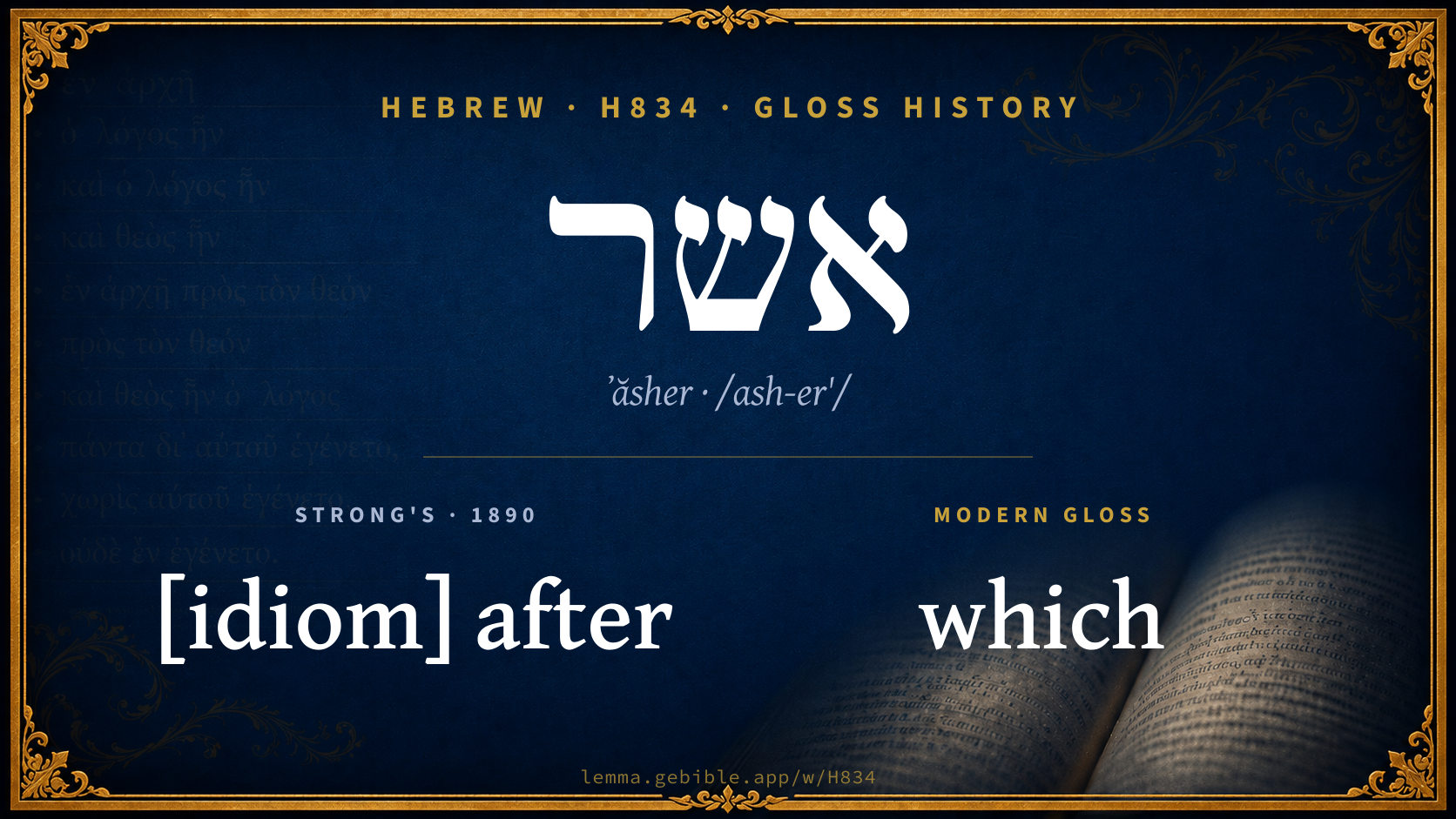
Gloss history
Strong's 1890 vs modern scholarship
About this word
Strong's H834 catalogs a Hebrew word from the Hebrew Old Testament.
These counts are not copied from any lexicon or concordance. They are computed here, from the morphology-tagged Hebrew Old Testament. What Lemma adds →
- 4,439
- distinct verses
- The word appears in 4,439 distinct verses.
- 39 / 39
- OT books
- The word appears in 39 of 39 Old Testament books.
- #5
- by frequency
- Top 10 most frequent Hebrew words (rank 5 of 8,640 Hebrew words by occurrence).
View all 4,439 occurrences in the concordance →
Most concentrated in
- Deuteronomy 430 verses 10%
- Jeremiah 363 verses 8%
- Genesis 349 verses 8%
By section of the Old Testament
By traditional corpus
Conventional, traditional groupings — biblical authorship is debated, so this is a traditional corpus grouping, not an authorship claim. Each share is this word’s portion of its verses in that division of the Hebrew canon. Each figure is a share of the word’s 4,439 distinct verses.
- Prophets (Nevi'im) 2,138 verses · 48%
- Torah (Pentateuch) 1,548 verses · 35%
- Writings (Ketuvim) 753 verses · 17%
How translations render this word
Counts come from each version’s own published word-to-Strong’s tagging or interlinear alignment — an approximate guide to how each version renders this word, not a word-level alignment the data otherwise carries. Because each total is that version’s own tagged count, the per-version totals vary from one another and need not match the appearance or distinct-verse counts above. These counts may also differ from a printed concordance because Lemma counts each distinctly tagged rendering and does not collapse phrase taggings into a single head-word total. This is a fixed set of word-tagged versions (KJV, ASV, BSB, ULT) and does not change with the reading translation you choose elsewhere. Each version’s license is shown beside its name below (and on Sources).
- King James Version: Which 13×, That 11×, Because 10×
- American Standard Version: Which 12×, That 10×, Because 9×
- Berean Standard Bible: That 899×, Who 470×, Which 301×
- unfoldingWord Literal Text: That 2,059×, Who 770×, Which 627×
King James Version Public Domain
Renders H834 across 107 tagged occurrences — most commonly:
Plus other, less common renderings. Plus 35 renderings that appear only once — usually multi-word phrases or single function words the recovered tagging swept in, not distinct renderings. Not rendered by a distinct English word in 4 further occurrences.
American Standard Version Public Domain
Renders H834 across 107 tagged occurrences — most commonly:
Plus other, less common renderings. Plus 29 renderings that appear only once — usually multi-word phrases or single function words the recovered tagging swept in, not distinct renderings.
Berean Standard Bible Public Domain
Renders H834 across 3,224 tagged occurrences — most commonly:
Plus other, less common renderings. Plus 158 renderings that appear only once — usually multi-word phrases or single function words the recovered tagging swept in, not distinct renderings. Not rendered by a distinct English word in 2,258 further occurrences.
unfoldingWord Literal Text CC BY-SA 4.0
Renders H834 across 5,332 tagged occurrences — most commonly:
Plus other, less common renderings. Plus 119 renderings that appear only once — usually multi-word phrases or single function words the recovered tagging swept in, not distinct renderings.
23 senses and sub-senses in the full BDB
What do BDB’s symbols mean?
BDB uses these scholarly abbreviations:
| Symbol | Meaning |
|---|---|
| 𝔊 | the Septuagint (the ancient Greek translation, LXX) |
| 𝔙 | the Vulgate (the Latin translation) |
| 𝔖 | the Syriac version (the Peshitta) |
| 𝔗 | the Targum (the Aramaic translation) |
| ψ | the Psalms |
| √ | root (the underlying root or stem) |
| ‖ | parallel passage (a synonymous or contrasted parallel) |
| † | the dagger: every passage where the word occurs is cited |
The 23 senses and sub-senses the full Brown-Driver-Briggs lexicon distinguishes for this word, in lexicon order (not ranked by frequency), with BDB’s own verbatim wording and sub-sense lettering. Shown in Hebrew script with BDB’s own scholarly abbreviations. The condensed entry is in the Lexicon Entry tab. See also the Forms in the corpus table below.
- 1. it includes its pronominal antecedent, whether in the nom. or obl. cases, as Nu 22:6 וַאֲשֶׁר תָּאֹר יוּאָר and he whom thou cursest is cursed, Ex 4:12 and I will teach thee אֲשֶׁר תְּדַבֵּר that which thou shalt say; and with particles or prepositions, as אֵת אֲשֶׁר (according to the context) him who …, those who …, that which …; לַאֲשֶׁר to him who … Gn 43:16, to those who … 47:24, to that which 27:8; מֵאֲשֶׁר Ju 16:30 2 S 18:8 than those whom; Lv 27:24 לַאֲשֶׁר קָנָהוּ מֵאִתּוֹ to him from whom he bought it, Nu 5:7; Is 24:2 כַּאֲשֶׁר נֹשֶׁא בוֹ like him against whom there is a creditor. e.g. Numbers 22:6
- 2. instances of אֲשֶׁר followed by a pron. affix, or by שָׁם, שָֽׁמָּה, מִשָּׁם, are so common that the exx. cited above will be sufficient. Very rarely there occurs the anomalous constr. עִם אֲשֶׁר Gn 31:32 for אֲשֶׁר עִמּוֹ (see Gn 44:9), בַּאֲשֶׁר Is 47:12 for אֲשֶׁר בָּהֶם, לַאֲשֶׁר for אֲשֶׁר … לָהֶם Ez 23:40: ψ 119:49 see under על אשׁר. It is followed by the pron. in the nomin., in the foll. cases:—(a) immediately, mostly before an adj. or ptcp., Gn 9:3 all moving things אֲשֶׁר הוּא־חַי which are living, Lv 11:26 Nu 9:13; 14:8, 27; 35:31 Dt 20:20 1 S 10:19 (v. Dr) 2 K 25:19 (‖ Je 52:25 היה) Je 27:9 Ez 43:19 Hg 1:9 Ru 4:15 Ne 2:18 Ec 7:26; before a vb. 2 K 22:13 (omitted 2 Ch 34:21). (b) in a negative sentence, at the end: Gn 7:2; 17:12 Nu 17:5 Dt 17:15 אֲשֶׁר לֹא אָחִיךָ הוּא who is not thy brother, 20:15 Ju 19:12 1 K 8:41 ‖ 9:20 ‖. N.B. ψ 16:3 אֲשֶׁר בָּאָרֶץ הֵ֑מָּה is an unparalleled expression for ‘who are in the land’; read אֲשֶׁר בָּאָ֑רֶץ הֵמָּה אַדִּירֵי וג׳ ‘the saints that are in the land, they (המה) are the nobles, in whom,’ etc. e.g. Genesis 31:32
- 3. sometimes (though rarely) the defining adjunct is a pron. of 1 or 2 ps. as well as of 3 ps. In such cases it is strictly to be rendered I who …, thou who, etc.; Ho 14:4 אֲשֶׁר־בְּךָ יְרֻחַם יָתוֹם thou by whom the fatherless is compassionated! Je 31:32 I, whose covenant they brake, 32:19 Is 49:23 Jb 37:17f. thou whose garments are warm …, canst thou? etc., ψ 71:19, 20; 144:12 we whose sons, etc., 139:15 my frame was not hidden from thee, אֲשֶׁר־עֻשֵּׂיתִי בַסֵּתֶר—I who was wrought in secret (= though I was wrought in secret), Ex 14:13 for ye who have seen the Egyptians to-day,—ye shall not see them again or ever! (cf. ψ 41:9). e.g. Hosea 14:4
- 4. the defining pron. adjunct is dispensed with—
- a. when אֲשֶׁר represents the simple subj. of a sentence, or the direct obj. of a vb.: so constantly, as Gn 2:2 the work אֲשֶׁר עָשָׂה which he made, 3:3 the tree אֲשֶׁר בְּתוֹךְ הַגָּן which is in the midst of the garden, etc. e.g. Genesis 2:2
- b. after words denoting time, place, or manner, so that אֲשֶׁר then becomes equivalent to when, where, why: (α) Gn 6:4 אַחֲרֵי־כֵן אֲשֶׁר afterwards, when, etc. (cf. 2 Ch 35:20) 45:6 there are still 5 years אֲשֶׁר אֵין חָרִישׁ when there shall be no plowing, Jos 14:10 1 K 22:25; after יוֹם or הַיּוֹם Dt 4:10 Ju 4:14 1 S 24:5 (v. Dr) 2 S 19:25 Je 20:14 al.; similarly Gn 40:13. (β) Gn 35:13 בַּמָּקוֹם אֲשֶׁר דִּבֶּר אִתּוֹ in the place where he spake with him, v 14; 39:20 Nu 13:27; 22:26 Dt 1:31 in the desert which thou sawest, where (accents Ke Di), 8:15 1 K 8:9 (unless לוּחוֹת הַבְּרִית has here fallen out: v. 𝔊 & Dt 9:9) Is 55:11; 64:10 ψ 84:4. So (γ) in אֶל אֲשֶׁר to (the place) which (or whither) Ex 32:34 Ru 1:16; אֶל־כָּל־אֲשֶׁר to every (place) whither Jos 1:16 Pr 17:8; בַּאֲשֶׁר in (the place) where †Ju 5:27; 17:8, 9 1 S 23:13 2 K 8:1 Ru 1:16, 17 Jb 39:30, once only with שָׁם Gn 21:17; בְּכֹל אֲשֶׁר wheresoever Jos 1:7, 9 Ju 2:15 1 S 14:47; 18:5 2 S 7:7 2 K 18:7; מֵאֲשֶׁר from (the place) where = whencesoever †Ex 5:11 Ru 2:9; עַל־אֲשֶׁר to (the place) whither (or which) 2 S 15:20 1 K 18:12; עַל־כָּל־אֲשֶׁר Je 1:7. (δ) זֶה הַדָּבָר אֲשֶׁר … this is the reason that or why … Jos 5:4 1 K 11:27. e.g. Genesis 6:4
- c. more extreme instances Lv 14:22, 30, 31 Nu 6:21, Dt 7:19 (wherewith), 28:20 1 S 2:32 1 K 2:26 (wherein), Ju 8:15 (about whom), Is 8:12 (where יאמר would be foll. normally by לוֹ), 31:6 turn ye to (him as to) whom they have deeply rebelled, 47:15 Zp 3:11 Ec 3:9, 1 K 14:19 (= how). e.g. Leviticus 14:22
- d. it is dispensed with only in appearance after (אָמַרְתִּי וג׳) אֲשֶׁר אָמַר followed by the words used, its place being really taken by a pron. in the speech which follows, as Gn 3:17 the tree as to which I commanded thee saying, Thou shalt not eat from it, Ex 22:8 Dt 28:68 Ju 7:4 (זֶה) 8:15 (where the noun repeated takes the place of the pron., cf. Dt 9:2) 1 S 9:17 (זֶה)23 1 K 11:2 +; cf. 2 S 11:16 2 K 17:12; 21:4. e.g. Genesis 3:17
- 5. אֲשֶׁר sometimes in poet. = one who, a man who (men who), ὅστις, οἵτινες, ψ 24:4; 55:20; 95:4, 5 Jb 4:19; 5:5; 9:5, (Hi) 15, 17. e.g. Psalms 24:4
- 6. אֲשֶׁר occas. receives its closer definition by a subst. following it, in other words, its logical antecedent is inserted in the rel. clause: (a) in the phrase peculiar to Je., אֲשֶׁר הָיָה דְבַר י׳ אֶל יר׳ that which came (of) the word of י׳ to Je. †14:1; 46:1; 47:1; 49:34 (cf. Ew§ 334); (b) Ex 25:9 Nu 33:4 1 S 25:30 2 K 8:12, 12:6 לְכֹל אֲשֶׁר־יִמָּצֵא שָׁם בָּֽדֶק׃, Ez 12:25; cf. the Ethiopic usage Di§ 201; (c) (antec. repeated) Gn 49:30 = 50:13, 1 S 25:39 (י׳ repeated), Is 54:9 (prob.) as to which I sware that, etc., Am 5:1 which I take up over you (as) a dirge. e.g. Jeremiah 14:1
- 7. אֲשֶׁר ל׳ that (belongs, belong, belonged) to, is used
- a. either alone or preceded by כָּל־ to express (all) that (belongs) to, as Gn 14:23 מִכָּל־אֲשֶׁר־לָ֑ךְ of all that is thine, 31:1 מֵאֲשֶׁר לְאָבִינוּ of that which was our father’s 32:24 & sent over אֶת־אֲשֶׁר־לוֹ that which he had, + often e.g. Genesis 14:23
- b. as a circumlocution of the genitive, as Gn 29:9 עִם־הַצֹּאן אֲשֶׁר לְאָבִיהָ with the sheep that were her father’s, 40:5; 47:4, Lv 9:8; Ju 6:11; 1 S 25:7 הָרֹעִים אֲשֶׁר־לְךָ, 2 S 14:31 אֶת־הַחֶלְקָה אֲשֶׁר־לִי, 23:8; 1 K 1:8, 33 עַל הַפִּרְדָּה אֲשֶׁר־לִי upon mine own mule, v 49; 4:2; 2 K 11:10; 16:13 Ru 2:21; and especially in the case of a compound expression depending on a single genit., as Gn 23:9; 40:5; 41:43 מִרְכֶּבֶת הַמִּשְׁנֶה אֲשֶׁר־לוֹ the chariot of the second rank which he had, Ex 38:30; Ju 3:20; 6:25; 1 S 17:40; 21:8, אֲבִיר הָרֹעִים אֲשֶׁר לְשָׁאוּל the mightiest of Saul’s herdmen, 24:5 אֶת־כְּנַף־הַמְּעִיל אֲשֶׁר־לְשָׁאוּל, 2 S 2:8 Saul’s captain of the host, 1 K 10:28; 15:20; 22:31; Je 52:17; Ru 4:3. e.g. Genesis 29:9
- c. with names of places (especially such as do not readily admit the st. cstr.) Ju 18:28; 19:14 הַגִּבְעָה אֲשֶׁר לְבִנְיָמִן Gibeah (the hill) of Benjamin, 20:4; 1 S 17:1; 1 K 15:27; 16:15; 17:9; 19:3; 2 K 14:11. Comp. שֶׁל (q.v.) which in Rabb., like the Aramaic דִּיל-, ܕܺܝܠ, is in habitual use as a mark of the genitive.—N.B. In Aramaic also דּי, ܕ, without ל, expresses the gen. relation, as מִלְּתָא דִי־מַלְכָּא, lit. the word, that of the king = the word of the king. The few apparent cases of a similar use of אשׁר are, however, too foreign to the general usage of the language to be regarded otherwise than as due to textual error: 1 S 13:8 read אֲשֶׁר אָמַר (or שָׂם Ex 9:5) שְׁמוּאֵל (𝔊 εἶπε); 1 K 11:25 supply עָשָׂה (𝔊 ἣν ἐποίησεν); 2 K 25:10 supply אֵת with (as ‖ Je 52:14); 2 Ch 34:22 read וַאֲשֶׁר אָמַר הַמֶּלֶךְ (cf. 𝔊) and those whom the king appointed (abbreviated from 2 K 22:14); cf. Ew§ 292 a, b with note. e.g. Judges 18:28
- 8. אֲשֶׁר becomes, like Aramaic דּי, ܕ, a conj. approximating in usage to כִּי: thus
- a. = quod, ὅτι, that, subordinating an entire sentence to a verb of knowing, remembering, etc. (α) with אֵת Dt 9:7 forget not אֵת אֲשֶׁר הִקְצַפְתָּ the fact that (= how) thou provokedst, etc., 29:15; Jos 2:10; 1 S 24:11, 19; 2 S 11:20 know ye not אֵת אֲשֶׁר־יֹרוּ how they shoot from off the wall? 2 K 8:12 Is 38:3 + often. As subj. (rare) 1 K 14:19; 2 K 14:15; 20:20. Of time (peculiarly) †2 S 14:15 עַתָּה אֲשֶׁר now (is it) that … Zc 8:20 (prob.) yet (shall it be) that … v 23; cf. כִּמְעַט שֶׁ Ct 3:4. (β) without אֵת (not very common, כִּי being usually employed): after יָדַע Ex 11:7; Nu 32:23; Ez 20:26 (strange in Ez: v. Hi) Jb 9:5 (Ew De Di) Ec 8:12, רָאָה Dt 1:31 (RV) 1 S 18:15, הִתְוַדָּה to confess Lv 5:5; 26:40b, הִשְׁבִּיעַ 1 K 22:16 (caused to swear that …); after a noun Is 38:7 הָאוֹת אֲשֶׁר the sign that … (‖ 2 K 20:9 כִּי) with growing frequency in late Hebrew, 2 Ch 2:7, and especially Ne Est: Ne 2:5, 10; 7:65 (= Ezr 2:63) 8:14, 15; 10:31; 13:1, 19, 22; Est 1:19; 2:10; 3:4; 4:11; 6:2; 8:11; Ec 3:22 (מֵאֲשֶׁר) 5:4; 7:18 (with טוֹב: contrast Ru 2:22) v 22, 29; 8:12, 14; 9:1; Dn 1:8(×2). (γ) prefixed to a direct citation, like כִּי q.v. (= ὅτι recitativum) (rare) 1 S 15:20; 2 S 1:4; 2:4 (v. Dr) ψ 10:6 (prob.), Ne 4:6. e.g. Deuteronomy 9:7
- b. it is resolvable into so that: Gn 11:7 אֲשֶׁר לֹא יִשְׁמְעוּ so that they understand not, etc., 13:16; 22:14 אֲשֶׁר יֵאָמֵר so that it is said, Ex 20:26; Dt 4:10, 40 אֲשֶׁר יִיטַב לְךָ 6:3; 28:27, 51; 1 K 3:12, 13; 2 K 9:37; Mal 3:19. e.g. Genesis 11:7
- c. it has a causal force, forasmuch as, in that, since: Gn 30:18; 31:49 and Mizpah, אֲשֶׁר אָמַר for that he said. 34:13, 27; 42:21 we are guilty, אֲשֶׁר רָאִינוּ we who saw (or, in that we saw), Nu 20:13 Meribah, because they strove there, Dt 3:24; Jos 4:7, 23; 22:31; Ju 9:17; 1 S 2:23; 15:15; 20:42 go in peace, אֲשֶׁר נִשְׁבַּעְנוּ forasmuch as we have sworn, 25:26 thou whom (= or, seeing that) י׳ hath withholden, 2 S 2:5 blessed are ye of י׳, אֲשֶׁר עֲשִׂיתֶם, who (οἵτινες) have done (or in that ye have done), 1 K 3:19; 15:5; 2 K 12:3; 17:4; 23:26; Je 16:13; Ec 8:11, 12 (Hi De Now). Here also belongs its use in אֲשֶׁר לָמָּה since why …? (= lest) Dn 1:10: v. sub לָמָּה. On אֲשֶׁר עַל כֵּן forasmuch as Jb 34:27 v. sub כִּי עַל כֵּן. e.g. Genesis 30:18
- d. it expresses a condition (rare & peculiar): Lv 4:22 אֲשֶׁר נָשִׂיא יֶחֱטָא in (case) that = when (or if) a ruler sinneth (v 3, 13, 27 אִם) 25:33; Nu 5:29 (explained differently by Ew§ 334a), Dt 11:27 and the blessing אֲשֶׁר תִּשְׁמְעוּ if ye hearken (v 28 אִם), 18:22 Ges§ 159 cc Jos 4:21 אֲשֶׁר יִשְׁאָלוּן … when they ask …, then … (v 6 כִּי), Is 31:4. In 1 K 8:33 (‖ 2 Ch 6:24 כִּי, cf. K v 35, 37) אֲשֶׁר may be rendered indifferently because or when. Once, similarly, אֵת אֲשֶׁר 1 K 8:31 v. p. 85. e.g. Leviticus 4:22
- e. perhaps (exceptionally) = כַּאֲשֶׁר, as, Je 33:22; Is 54:9 (sq. כֵּן; but כֵּן q.v. sometimes stands without כאשׁר, & אשׁר may in these passages connect with what precedes); according to some also Je 48:8 ψ 106:34 (in a connexion where כַּאֲשֶׁר would be more usual: אֲשֶׁר may however be the obj. of אָמַר). In 1 S 16:7 אֲשֶׁר יִרְאֶה הָאָדָם read כַּאֲשֶׁר, v. Dr.In Dt 15:14 also read כַּאֲשֶׁר: note ברכך before. e.g. Jeremiah 33:22
- f. combined with preps., אֲשֶׁר converts them into conjunctions: see below, בַּאֲשֶׁר, כַּאֲשֶׁר, מֵאֲשֶׁר. On its use similarly with (אַחֲרֵי) אַחַר, מִבְּלִי, בַּעֲבוּר, עַל דְּבַר, יַעַן, לְמַעַן, כְּפִי, עַד, עַל, עֵקֶב, מִפְּנֵי, תַּחַת, see these words.—הַאֲשֶׁר, with ה interrog., occurs once, 2 K 6:22. e.g. 2 Kings 6:22
- 1. אֲשֶׁר being a connecting link, without any perfectly corresponding equivalent in Engl., its force is not unfreq. capable of being represented in more than one way. See e.g. 2 S 2:5 (above 8 c), Is 28:12 unto whom he said, or for that he said to them. e.g. 2 Samuel 2:5
- 2. The opinion that אֲשֶׁר has an asseverative force (like כִּי, q.v.), or introduces the apodosis, is not prob., being both alien to its general usage & not required by the passages alleged. Render Is 8:20 either ‘Surely according to this word will those speak who have no dawn,’ or ‘… will they speak when (cf. supr. 8 d Dt 11:27; Jos 4:21) they have no dawn.’ e.g. Isaiah 8:20
Senses from the full Brown-Driver-Briggs lexicon (Brown, Driver, Briggs; Oxford 1906 — public domain), digitized via Sefaria, supplemented by the OpenScriptures HebrewLexicon (CC BY 4.0). Full attribution on Sources.
Word origin
part. of relation (Moab. id.; origin dub.: 1. according to TsepreghiDiss. Lugd. p. 171 MühlauBö Lb. ii. 79 n. StaMorg. Forsch. 1875, 188; Lb. § 167 HomZMG 1878, 708 ff. Müll§ 153 SayceHbr. ii. 51 LagM. i. 255 & especially KraetzschmarHbr. vi. 298 ff, orig. a subst. ‘place’ = أَثَرٌ footstep, mark አሠr (do.), אֲתַר, ܐܰܬܰܪ place, Assyrian ašar, used (v. Kraetz.) both as a subst. ‘there, where,’ and as a relative of place ‘where’: in Heb. this development has advanced further, and it has become a relative sign generally. The chief objection to this explanation is that it would isolate Heb. from the other Semitic languages, in which pronouns are formed regularly from demonstrative roots (cf. also NöZMG 1886, 738). 2. according to PhiSt. C. 73 SperlingNota Rel. im Hebr. 1876, 15–22 for אֲשֶׁל, developed from the relative שׁ (q.v.) by (1) the prefixing of either a merely prosthetic א, or, better, a pronominal א (giving rise to אש, the form of the relative in Ph.), and (2) the addition of the demonstr. root ל [found also in אֵל, אֵלֶּה, הַלָּזֶה (q.v.). اَلَّذِى he who, እለ who (pl.)]: the main objection to this explanation is the change of ל to ר, which is hardly rendered probable by the comp. of Syriac ܗܳܪܟܳܐ by side of Targ. הָלְכָּא. 1 seems preferable, the primitive root having acquired different significations in the different Semitic languages, and having been weakened in Heb. to a mere particle of relation). A sign of relation, bringing the clause introduced by it into relation with an antecedent clause. As a rule אֲשֶׁר is a mere connecting link, and requires to be supplemented (see the grammars) by a pron. affix, or other word, such as שָׁם, defining the nature of the relation more precisely: e.g. Gn 1:11 אֲשֶׁר זַרְעוֹ־בוֹ lit. as to which, its seed is in it = in which is its seed, ψ 1:4 like the chaff אֲשֶׁר־תִּדְּפֶנּוּ רוּחַ as to which, the wind drives it = which the wind drives, etc.; & so אֲשֶׁר … שָׁם = where, אֲשֶׁר … מִשָּׁם = whence, Gn 2:11; 3:23; 20:13 etc. Sometimes also (v. infr.) the relation expressed by it is specifically temporal, local, causal, etc. More particularly
— Brown-Driver-Briggs (Oxford 1906, public domain), digitized via Sefaria, supplemented by the OpenScriptures HebrewLexicon (CC BY 4.0). See Sources.
Origin: a primitive relative pronoun (of every gender and number)
Jastrow Dictionary
A second Hebrew/Aramaic lexicon for comparison, covering Aramaic and post-biblical (Talmudic, Targumic, Midrashic) usage that the biblical-Hebrew BDB does not. Matched by lemma rather than by Strong’s number, so a lemma may carry more than one Jastrow headword (shown separately below), and the entries cover usage well beyond the Bible.
אֲשֶׁר
- ; v. Ges. H. Dict. s. v., as to opinions on etymol.) [being,] who, which. Ber. 11ᵇ א׳ בחר וכ׳ who hast chosen us; a. v. fr. (in prayer formulas).—In Talm. mostly prefix-שֶׁ.
אָשַׁר
- , v. אשש) to exist, be strong, happy; v. יָשַׁר.
- (b. h.)
- 1. to exalt, praise, declare happy. Pesik. R. s. 45 התחיל מְאַשְּׁרֵם he commenced by declaring them happy; v. אַשְׁרֵי.
- 2. to substantiate; to verify, attest to. Num. R. s. 14 לאַשֵּׁר את הדין to give strength to the legal decision Y. Gitt. IX, 50ᶜ bot. (אישרניהי) אִישַּׁרְנוּהוּ we have verified it in the presence of &c.—Part. pass. מְאוּשָּׁר 1) firm, strong. Gen. R. s. 15, beg. the bux-tree is called תְּאַשּׁוּר because it is מא׳ וכ׳ the strongest of all (cmp. אֵשֶׁל). Y. Succ. III, 54ᵃ top; Y. Meg. I, 72ᵃ top המא׳ שבכלן וכ׳ the strongest (expression) of all, is Hallelujah.—2) substantial, good, rich. Gen. R. s. 90, end (ref. to את כל אֲשֶׁר Gen. XLI, 56) המְאוּשָּׁרִין שבהם the best stores of all. Gen. R. s. 28.—Snh. 22ᵃ is called Ashurith שמְאוּשֶּׁרֶת בכתב because its characters are substantial (Ar. שמאושר); Y. Meg. I, 71ᵇ bot.; Y. Sot. VII, 21ᶜ top. e.g. Genesis 41:56
- to be set up, be erected. Sifra K’dosh. beg. (play on אֲשֵׁרִים) על שם שהם מִתְאַשְּׁרִים מאחרים because they are put up by others.
אֲשַׁר
- [Ithpe. אִיתְּשַׁר to be strengthened. Targ. Y. Deut. X, 2 יַיתְשַׁר, prob. to be read יִתְיַשַּׁר, v. ישר.]
- 1. to make strong. Keth. 10ᵇ; Gitt. 70ᵃ (dates) מְאַשְּׁרָן give strength.
- 2. to confirm, verify; also to credit, (consider true). Keth. 21ᵃ אַשַּׁרְנוּהִי וכ׳ we verified it &c., v. preced.—Gitt. 30ᵇ (prov.) חברך מית א׳ וכ׳ if you are told, ‘your friend is dead’, believe it; ‘your friend has grown rich’ לא תְאַשַּׁר don’t trust.
אֶשֶׁר
- (b. h.), only in plur. constr. אַשְׁרֵי the happiness of!, happy is he, are they &c. Pes. 117ᵃ; a. fr.—Midr. Till. to Ps. LXXXIV אַשְׁרַאי happy am I.—Yoma VIII, 9 אַשְׁרֵיכֶם happy are ye. Ib. 87ᵃ אַשְׁרֵיהֶם לצדיקים happy are the righteous; a. fr.
שֵׁר
- Tower of Sher (or Shed), Straton’s Tower (v. Hildesh. Beitr. p. 4 sq.). Sifré Deut. 51 מדבר שרשך דור, read: מגדל שר שן דור; Yalk. ib. 874 מגדל שרשן דירו (corr. acc.); Y. Shebi. VI, 36ᶜ top מגדל שיד.
שַׂר
- prince, chief.; שר (של מעלה) guardian angel, genius. Zeb. 116ᵇ שר ונגיד a prince or a nobleman. Yeb. 16ᵇ שר העולם the genius of the universe; Ḥull. 60ᵃ. Ex. R. s. 22 נטל הקב"ה שר שלהם וכ׳ the Lord took first their (the Egyptians’) guardian angel and drowned him. Pes. 118ᵃ שר הברד, v. יוּרְקָמִי. Ib. אני שר של אש I (Gabriel) am the angel of fire. B. Bath. 74ᵇ שר של ים the angel of the sea. Mekh. B’shall., Shir., s. 2 כיון שראו שָׂרָהּ של מלכות נופל (not נופלת) when they saw the genius of the (Egyptian) empire fallen; Yalk. Ex. 243; a. v. fr.—Pl. שָׂרִים. Ib. אין … משָׂרֵיהֶן תחלה the Lord will not punish governments, unless he have punished their guardian angels first. Gen. R. s. 78, beg. מיכאל … שהם ש׳ של מעלה Michael and Gabriel who are the princes on high. Yalk. l. c. קרא … לכל שָׂרֵי האומות the Lord summoned all the tutelary angels of the nations. Cant. R. to VIII, 14 ש׳ של מעלה the princes on high (angels); ש׳ של מטה the earthly (human) governors. Ib. (play on הרי בשמים, ib.) המתינו לי … על הריהם שהם שָׂרֵיהֶם שנתונים אצלי בַּשָּׁמַיִם (not שנתונות) wait until I shall have sat in judgment over their mounts, that is, their chiefs that are placed with me in heaven; a. fr.—Gen. R. s. 98 גני ש׳, v. גִּינֵּיסַר.—Fem. שָׂרָה. Tosef. Ber. I, 12 (ref. to Gen. XVII, 15) בתחלה הרי היא ש׳ על עמה ועכשיו הרי היא ש׳ על אומות העולם ed. Zuck. (Var. שָׂרַי על עמה … על כל באי העולם, v. ed. Zuck. note) at first she was a princess of her own people, and now she is a princess for the nations of the world (for all that enter into the world); Ber. 13ᵃ שרי לאומתה … ש׳ לכל העולם. e.g. Genesis 17:15
A Dictionary of the Targumim, the Talmud Babli and Yerushalmi, and the Midrashic Literature (Marcus Jastrow; London, Luzac, 1903) — Public Domain. Digitized via Sefaria. Digitized via Sefaria. Full attribution on Sources.
Forms in the corpus
The 104 distinct written forms H834 takes in the Hebrew Bible, most frequent first — each parse links to that state’s occurrences in the concordance. Hebrew forms include their vowel points and cantillation, so a single lemma takes many written forms.
| Form | Parsing | Example | Uses |
|---|---|---|---|
| אֲשֶׁר | Particle, Relative | Amos 1:1 | 1,293 |
| אֲשֶׁ֣ר | Particle, Relative | Amos 9:15 | 1,064 |
| אֲשֶׁ֥ר | Particle, Relative | Amos 5:26 | 976 |
| אֲשֶׁ֨ר | Particle, Relative | Amos 2:9 | 499 |
| אֲשֶׁ֤ר | Particle, Relative | Daniel 1:11 | 304 |
| אֲשֶׁ֖ר | Particle, Relative | Daniel 1:8 | 179 |
| אֲשֶׁר֙ | Particle, Relative | Amos 4:1 | 129 |
| כַּ/אֲשֶׁ֥ר | Particle, Relative | Amos 5:14 | 109 |
| אֲשֶׁ֧ר | Particle, Relative | Amos 3:1 | 98 |
| אֲשֶׁר֩ | Particle, Relative | Amos 1:1 | 96 |
| כַּ/אֲשֶׁ֛ר | Particle, Relative | Deuteronomy 2:1 | 78 |
| אֲשֶׁ֛ר | Particle, Relative | Deuteronomy 8:11 | 71 |
| כַּ/אֲשֶׁ֣ר | Particle, Relative | Deuteronomy 3:2 | 69 |
| כַּ/אֲשֶׁ֖ר | Particle, Relative | Deuteronomy 1:11 | 57 |
| כַּ/אֲשֶׁ֨ר | Particle, Relative | Amos 5:19 | 52 |
| אֲשֶֽׁר | Particle, Relative | Amos 4:7 | 44 |
| כַּ/אֲשֶׁ֤ר | Particle, Relative | Amos 2:13 | 41 |
| וַ/אֲשֶׁ֥ר | Particle, Relative | Deuteronomy 5:8 | 34 |
| אֲ֠שֶׁר | Particle, Relative | Exodus 9:24 | 21 |
| וַ/אֲשֶׁ֣ר | Particle, Relative | Deuteronomy 11:2 | 20 |
| אֲֽשֶׁר | Particle, Relative | Deuteronomy 27:3 | 17 |
| כַּ/אֲשֶׁר֩ | Particle, Relative | Amos 3:12 | 17 |
| כַּ/אֲשֶׁר | Particle, Relative | Deuteronomy 4:33 | 15 |
| וַ/אֲשֶׁ֤ר | Particle, Relative | Ecclesiastes 10:14 | 12 |
| וַ/אֲשֶׁ֨ר | Particle, Relative | Deuteronomy 11:6 | 12 |
| מֵ/אֲשֶׁ֥ר | Particle, Relative | Exodus 29:27 | 10 |
| כַּֽ/אֲשֶׁר֙ | Particle, Relative | Ezekiel 2:2 | 10 |
| כַּ/אֲשֶׁ֧ר | Particle, Relative | Deuteronomy 2:12 | 8 |
| וְ/לַ/אֲשֶׁ֥ר | Particle, Relative | Genesis 47:24 | 7 |
| כַּ/אֲשֶׁר֙ | Particle, Relative | Genesis 26:29 | 7 |
| לַ/אֲשֶׁ֥ר | Particle, Relative | Exodus 16:16 | 7 |
| אֲשֶׁ֕ר | Particle, Relative | Esther 1:16 | 6 |
| בַּ/אֲשֶׁ֣ר | Particle, Relative | Genesis 39:9 | 6 |
| כַּֽ/אֲשֶׁר | Particle, Relative | 1 Samuel 12:8 | 6 |
| בַּ/אֲשֶׁ֥ר | Particle, Relative | Ecclesiastes 8:4 | 5 |
| כַּֽ/אֲשֶׁ֛ר | Particle, Relative | Genesis 7:9 | 5 |
| וְ/כַ/אֲשֶׁ֥ר | Particle, Relative | Esther 4:16 | 4 |
| וַ/אֲשֶׁ֖ר | Particle, Relative | 2 Samuel 21:5 | 4 |
| וַ/אֲשֶׁ֧ר | Particle, Relative | 1 Kings 2:24 | 4 |
| וַ/אֲשֶׁר | Particle, Relative | Deuteronomy 33:29 | 4 |
| וַ/אֲשֶׁר֙ | Particle, Relative | Daniel 1:4 | 4 |
| וְ/לַ/אֲשֶׁ֖ר | Particle, Relative | Ecclesiastes 9:2 | 3 |
| וַ/אֲשֶׁ֛ר | Particle, Relative | Ezekiel 33:27 | 3 |
| וַ/אֲשֶׁר֩ | Particle, Relative | Deuteronomy 19:5 | 3 |
| וּ/בַ/אֲשֶׁ֥ר | Particle, Relative | Isaiah 65:12 | 3 |
| כַ/אֲשֶׁ֣ר | Particle, Relative | Isaiah 66:22 | 3 |
| כַ/אֲשֶׁר | Particle, Relative | Deuteronomy 2:16 | 3 |
| כַּֽ/אֲשֶׁר | Particle, Relative | Deuteronomy 32:50 | 3 |
| לַ/אֲשֶׁ֖ר | Particle, Relative | Jeremiah 27:5 | 3 |
| מֵ/אֲשֶׁ֨ר | Particle, Relative | Ecclesiastes 3:22 | 3 |
| אֲ֝שֶׁ֗ר | Particle, Relative | Psalms 119:38 | 2 |
| אֲשֶׁ֗ר | Particle, Relative | Ezekiel 6:11 | 2 |
| וְ/כַ/אֲשֶׁ֛ר | Particle, Relative | Esther 9:31 | 2 |
| וְ/כַ/אֲשֶׁ֣ר | Particle, Relative | Daniel 1:13 | 2 |
| וְ/כַ/אֲשֶׁ֤ר | Particle, Relative | Deuteronomy 29:13 | 2 |
| וְ/כַ/אֲשֶׁ֨ר | Particle, Relative | Genesis 26:29 | 2 |
| וְ/כַֽ/אֲשֶׁר֙ | Particle, Relative | Ezekiel 37:18 | 2 |
| וְ/לַ/אֲשֶׁ֧ר | Particle, Relative | 1 Samuel 30:28 | 2 |
| וַֽ/אֲשֶׁר֙ | Particle, Relative | Ezekiel 33:27 | 2 |
| כַּ֝/אֲשֶׁ֗ר | Particle, Relative | Psalms 33:22 | 2 |
The 60 most common forms are shown; 44 rarer forms follow in the full concordance.
Same root — word family
Other BDB entries built from the same root as H834, grouped by Strong’s listed origin. These share a root / origin per the lexicon — not necessarily a shared meaning. Each links to that word’s own entry.
Derived from this word
Compare all same-root words → They share a root, not necessarily a meaning.
Septuagint verse parallels
Most of the 4,439 Hebrew verses this word occurs in also exist in the Greek Old Testament (Septuagint), so the same passages can be read in Greek by switching the Old Testament edition to the Septuagint.
Read these verses in the Septuagint
- Genesis 1:7
- Exodus 1:8
- Leviticus 1:5
- Numbers 1:5
- Deuteronomy 1:1
- Joshua 1:2
- Judges 1:7
- Ruth 1:7
- 1 Samuel 1:17
- 2 Samuel 1:4
- 1 Kings 1:8
- 2 Kings 1:2
This is a verse-level parallel only — the same verses exist in both the Hebrew and Greek Old Testaments. No word-level Hebrew↔Greek correspondence is claimed: the data carries no such alignment, so no Greek word is shown as this Hebrew word’s translation. Coverage is not total — the Septuagint omits the deuterocanon and renumbers the Psalms, so some Hebrew verses have no direct Greek parallel.