Nehemiah 6:8

Hebrew (Westminster Leningrad Codex) Nehemiah 6:8 appears in the Hebrew Old Testament. The text above is from the Westminster Leningrad Codex. Each word links to its Strong’s number, a concise gloss, and parsing drawn from the Open Scriptures Hebrew Bible morphology. Click any word for its full Brown-Driver-Briggs (BDB) entry.
Download image
Cite this verse

Nehemiah 6:8 (World English Bible). Public Domain. Lemma interlinear Bible study tool, https://lemma.gebible.app/v/nehemiah/6/8.

Show BibTeX & RIS
BibTeX
RIS
English Translation
Then I sent to him, saying, There are no such things done as you say, but you feign them out of your own heart.
World English Bible · Public Domain
Download a study sheet

One document with this verse’s original text, its word-by-word gloss line, the meaning frame, cross-references with their text, attributed commentary, and full source and license credits — printable, and it pastes into notes with its structure intact.

This verse Autodidact and up

Study sheet (.html) Plain text (.txt)

A passage Seminary Student

Up to 50 verses in one chapter. A passage sheet keeps up to 6 commentary sources and 12 cross-references per verse, in the order this page ranks them, and says so on the sheet whenever that leaves anything out. Ask for a single verse and you get the Autodidact verse sheet above.

Everything on this page stays free to read, with no account — the sheet is a download of what is already on screen, not access to it.

Want to remove ads? Support Godless Engineer
Compare translations 3

The same verse in 3 English versions, stacked beneath the original-language interlinear above. Click any original word for its lexicon entry.

Each is an independent rendering of the whole verse — the interlinear is not word-aligned to these translations.

Highlighted words mark where these versions differ — a whole-verse word diff, not a word-by-word alignment.

  • World English Bible Public Domain
    Then I sent to him, saying, There are no such things done as you say, but you feign them out of your own heart.
  • King James Version Public Domain
    Then I sent unto him, saying, There are no such things done as thou sayest, but thou feignest them out of thine own heart.
  • unfoldingWord Literal Text CC BY-SA 4.0
    And I sent to him, saying, “No such thing has been done according to these words that you are saying, but you are inventing them out of your own heart.”

unfoldingWord Literal Text — © unfoldingWord, licensed CC BY-SA 4.0. Word-aligned USFM3 via Door43 (git.door43.org/unfoldingWord/en_ult).

Versions to compare (up to 4)

3 of 4 selected

Show all 18 translations

Every available English version of this verse, each an independent rendering of the whole verse.

  • World English Bible Public Domain
    Then I sent to him, saying, There are no such things done as you say, but you feign them out of your own heart.
  • Berean Standard Bible Public Domain
    Then I sent him this reply: “There is nothing to these rumors you are spreading; you are inventing them in your own mind.”
  • Majority Standard Bible Public Domain
    Then I sent him this reply: “There is nothing to these rumors you are spreading; you are inventing them in your own mind.”
  • King James Version Public Domain
    Then I sent unto him, saying, There are no such things done as thou sayest, but thou feignest them out of thine own heart.
  • American Standard Version (1901) Public Domain
    Then I sent unto him, saying, There are no such things done as thou sayest, but thou feignest them out of thine own heart.
  • Revised Version (1885) Public Domain
    Then I sent unto him, saying, There are no such things done as thou sayest, but thou feignest them out of thine own heart.
  • Geneva Bible (1599) Public Domain
    Then I sent vnto him, saying, It is not done according to these wordes that thou sayest: for thou feynest them of thine owne heart.
  • Douay-Rheims (1899) Public Domain
    And I sent to them, saying: There is no such thing done as thou sayest: but thou feignest these things out of thy own heart.
  • Young's Literal Translation Public Domain
    And I send unto him, saying, `It hath not been according to these words that thou art saying, for from thine own heart thou art devising them;'
  • Literal Standard Version CC BY-SA 4.0
    And I send to him, saying, “It has not been according to these words that you are saying, for from your own heart you are devising them”;
  • Unlocked Literal Bible CC BY-SA 4.0
    Then I sent word to him saying, “No such things have occurred as you say, for within your heart you invented them.”
  • unfoldingWord Literal Text CC BY-SA 4.0
    And I sent to him, saying, “No such thing has been done according to these words that you are saying, but you are inventing them out of your own heart.”
  • Darby Bible Public Domain
    And I sent to him, saying, There are no such things done as thou sayest, but thou feignest them out of thine own heart.
  • World Messianic Bible Public Domain
    Then I sent to him, saying, “There are no such things done as you say, but you imagine them out of your own heart.”
  • Webster's Bible Public Domain
    Then I sent to him, saying, There are no such things done as thou sayest, but thou feignest them out of thy own heart.
  • Free Bible Version CC BY-SA 4.0
    I replied, telling him, “Nothing's happening like you're saying! In fact you're just making it all up!”
  • Bible in Basic English Public Domain
    Then I sent to him, saying, No such things as you say are being done, they are only a fiction you have made up yourself.
  • JPS Tanakh (1917) Public Domain
    Then I sent unto him, saying: 'There are no such things done as thou sayest, but thou feignest them out of thine own heart.'

Literal Standard Version (2020), Covenant Press — licensed CC BY-SA 4.0. Text via the HelloAO Bible API (eBible.org). Unlocked Literal Bible (unfoldingWord) — licensed CC BY-SA 4.0. Text via the HelloAO Bible API (eBible.org). unfoldingWord Literal Text — © unfoldingWord, licensed CC BY-SA 4.0. Word-aligned USFM3 via Door43 (git.door43.org/unfoldingWord/en_ult). Free Bible Version, Dr. Jonathan Gallagher — licensed CC BY-SA 4.0. Text via the HelloAO Bible API (eBible.org).

Word by word

More ways to search: Search by grammar → Find every occurrence → Compare this word →

Practice this passage: Drill this verse → Learn its vocabulary →

בוֹדָֽאם
bâdâʼ
H908
“devising · them”
Verb, Qal, Participle Active, Masculine, Singular, Construct + Suffix, Personal, 3rd Person, Masculine, Plural
Part of Speech
Verb
Stem
Qal
Form
Participle Active
Gender
Masculine
Number
Singular
State
Construct
Full BDB Definition

Origin: a primitive root

TWOT: 200

to devise, contrive, invent (bad sense) - (Qal) - to devise - to contrive
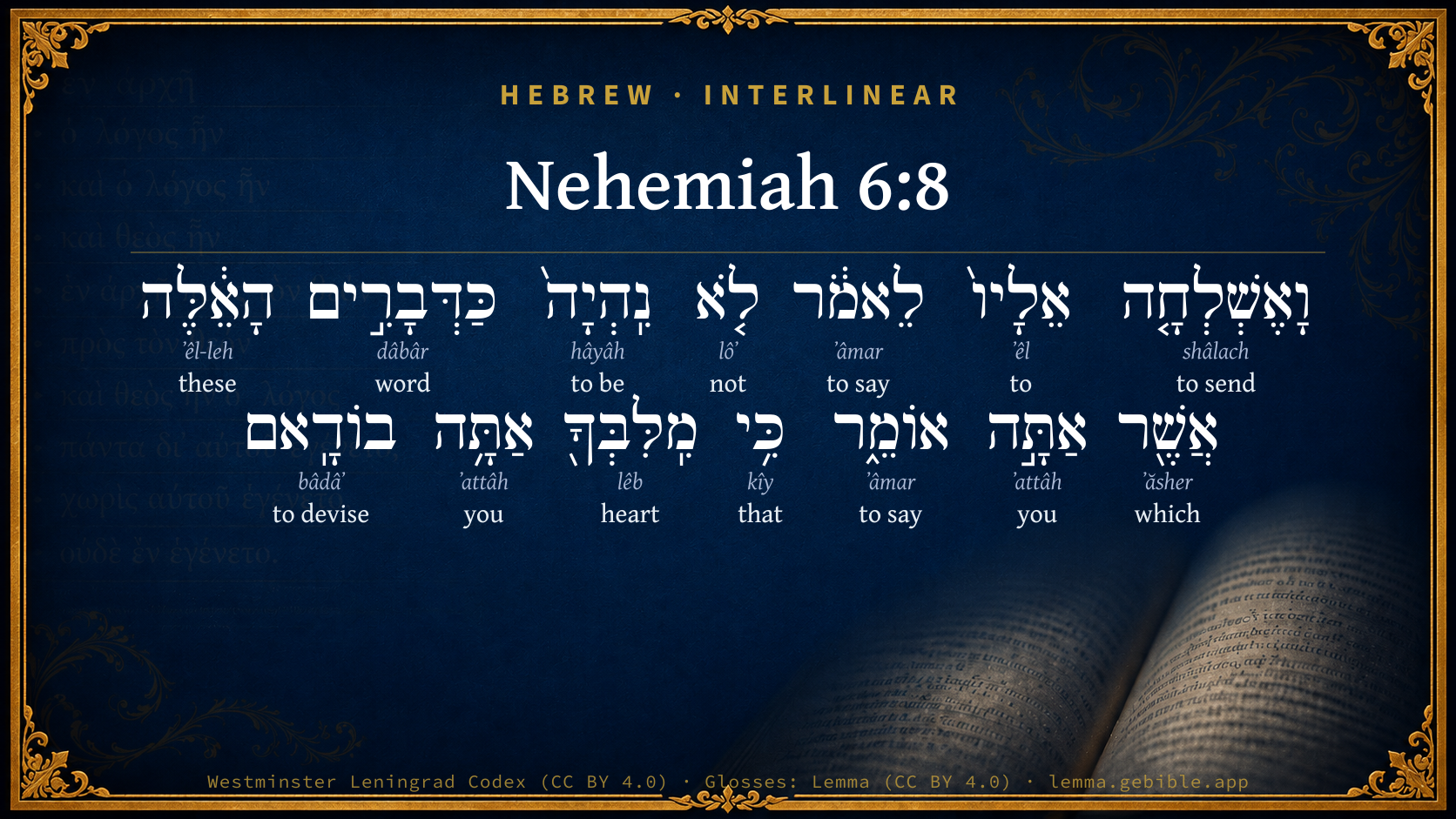
  1. וָאֶשְׁלְחָ֤ה shâlach H7971 “and · to send” Conjunction + Verb, Qal, Sequential Imperfect, 1st Person, Common, Singular + Suffix, h
  2. אֵלָיו֙ ʼêl H413 “to · him” Preposition + Suffix, Personal, 3rd Person, Masculine, Singular
  3. לֵאמֹ֔ר ʼâmar H559 “to say” Preposition + Verb, Qal, Infinitive Construct
  4. לֹ֤א lôʼ H3808 “not” Particle, Negative
  5. נִֽהְיָה֙ hâyâh H1961 “to be” Verb, Niphal, Perfect, 3rd Person, Masculine, Singular
  6. כַּדְּבָרִ֣ים dâbâr H1697 “like/as the · words” Preposition, Determined + Noun, Common, Masculine, Plural, Absolute
  7. הָאֵ֔לֶּה ʼêl-leh H428 “the · these” Particle, Definite Article + Pronoun, Demonstrative, Common, Plural
  8. אֲשֶׁ֖ר ʼăsher H834 “which” Particle, Relative
  9. אַתָּ֣ה ʼattâh H859 “you” Pronoun, Personal, 2nd Person, Masculine, Singular
  10. אוֹמֵ֑ר ʼâmar H559 “saying” Verb, Qal, Participle Active, Masculine, Singular, Absolute
  11. כִּ֥י kîy H3588 “that” Conjunction
  12. מִֽלִּבְּךָ֖ lêb H3820 “from · heart · your” Preposition + Noun, Common, Masculine, Singular, Construct + Suffix, Personal, 2nd Person, Masculine, Singular
  13. אַתָּ֥ה ʼattâh H859 “you” Pronoun, Personal, 2nd Person, Masculine, Singular

About this verse

These counts appear in no published source. They are computed here, from the morphology-tagged text and Lemma’s own curated glosses. What Lemma adds →

14
words
12
distinct lemmas
Historical
section

Notable vocabulary

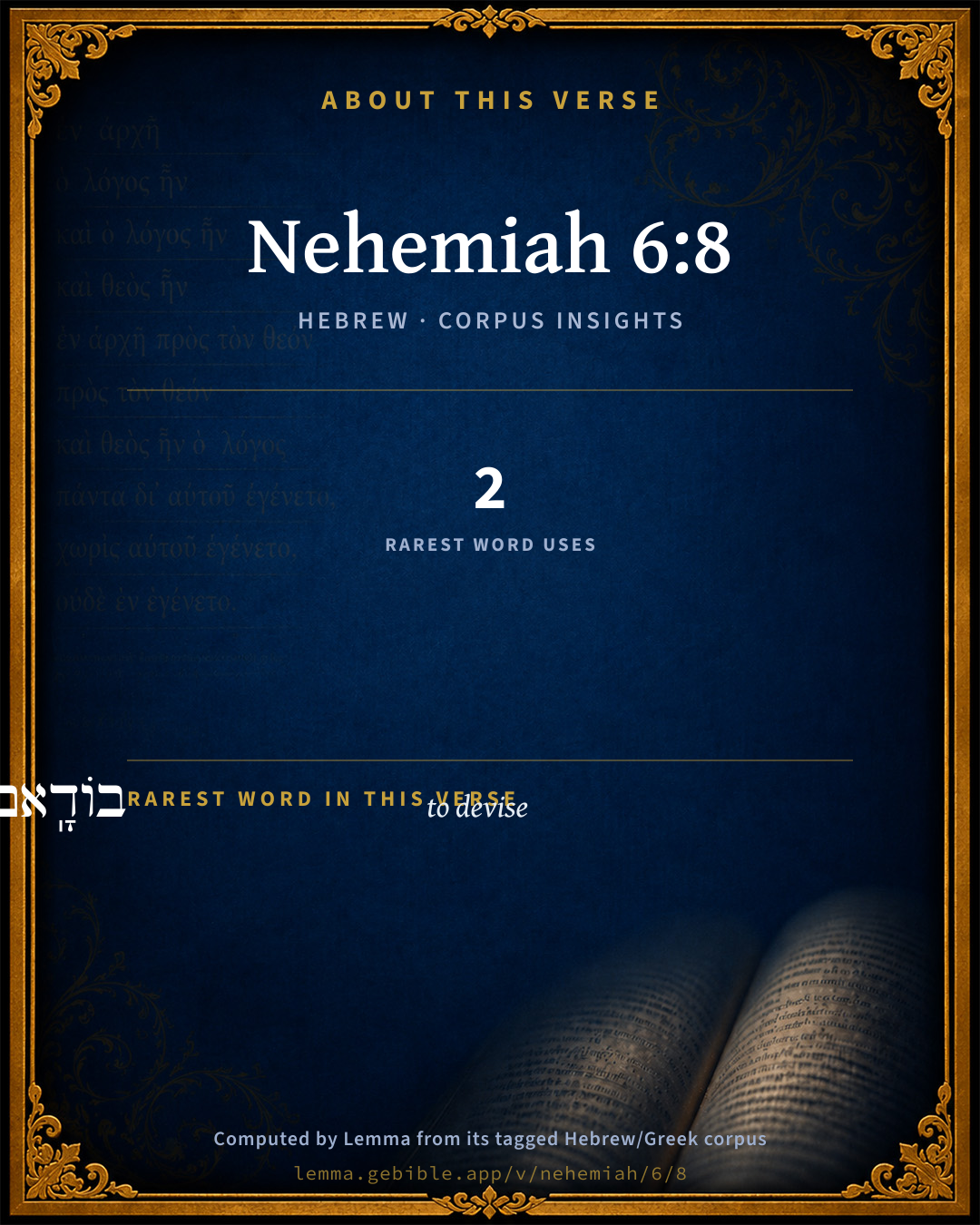
The rarest word here is בוֹדָֽאם to devise H908 — appearing just 2 times in the whole Hebrew Bible.

Shared distinctive vocabulary

בוֹדָֽאם to devise H908 occurs in 2 verses of the Hebrew Bible. Also found in:

Grammatical profile

  • 5 verbs
  • 2 nouns
  • 3 pronouns
  • 1 preposition
  • 1 conjunction
  • 2 particles

Verb forms

  • וָאֶשְׁלְחָ֤ה Qal · Sequential Imperfect
  • לֵאמֹ֔ר Qal · Infinitive Construct
  • נִֽהְיָה֙ Niphal · Perfect
  • אוֹמֵ֑ר Qal · Participle Active
  • בוֹדָֽאם Qal · Participle Active

Repetition

Words recur within this verse — often emphatic in Hebrew:

  • לֵאמֹ֔ר to say H559 ×2
  • אַתָּ֣ה you H859 ×2

Cross-references

11

Topical passages linked to Nehemiah 6:8 in the Treasury of Scripture Knowledge — connected by theme and wording, ordered by reader-vote popularity; previews shown in the World English Bible.

  • Psalms 52:2 Your tongue plots destruction, Like a sharp razor, working deceitfully.
  • Job 13:4 But you are forgers of lies. You are all physicians of no value.
  • Psalms 36:3 The words of his mouth are iniquity and deceit. He has ceased to be wise and to do good.
  • Psalms 38:12 They also who seek after my life lay snares. Those who seek my hurt speak mischievous things, And meditate deceits all day long.
  • Isaiah 59:4 None sues in righteousness, and none pleads in truth: they trust in vanity, and speak lies; they conceive mischief, and bring forth iniquity.
  • Daniel 11:27 As for both these kings, their hearts shall be to do mischief, and they shall speak lies at one table: but it shall not prosper; for yet the end shall be at the time appointed.
  • Matthew 12:34 You offspring of vipers, how can you, being evil, speak good things? For out of the abundance of the heart, the mouth speaks.
  • John 8:44 You are of your Father, the devil, and you want to do the desires of your father. He was a murderer from the beginning, and doesn't stand in the truth, because there is no truth in him. When he speaks a lie, he speaks on his own; for he is a liar, and the father of it.
  • Acts 24:12–13 In the temple they didn't find me disputing with anyone or stirring up a crowd, either in the synagogues, or in the city.
  • Acts 25:7 When he had come, the Jews who had come down from Jerusalem stood around him, bringing against him many and grievous charges which they could not prove,
  • Acts 25:10 But Paul said, "I am standing before Caesar's judgment seat, where I ought to be tried. I have done no wrong to the Jews, as you also know very well.

Cross-references courtesy of OpenBible.info (CC BY 4.0).

Hebrew and Greek witnesses Masoretic Hebrew ↔ Greek Septuagint

The same verse in the two great witnesses to the Old Testament, shown verse-for-verse.

These are two independent witnesses, not word-aligned to each other, and the Septuagint is shown in lemma (dictionary) form.

Hebrew Nehemiah 6:8 Masoretic · Westminster Leningrad Codex

וָאֶשְׁלְחָ֤ה אֵלָיו֙ לֵאמֹ֔ר לֹ֤א נִֽהְיָה֙ כַּדְּבָרִ֣ים הָאֵ֔לֶּה אֲשֶׁ֖ר אַתָּ֣ה אוֹמֵ֑ר כִּ֥י מִֽלִּבְּךָ֖ אַתָּ֥ה בוֹדָֽאם

Then I sent to him, saying, There are no such things done as you say, but you feign them out of your own heart.

World English Bible · Public Domain

Greek LXX Structure differs

The Septuagint has no separate book of Nehemiah. Its Greek text is the second half of Esdras B (2 Esdras), chapters 11–23; Ezra is the first half (1–10).

A verse-for-verse comparison isn’t shown here because the chapters and verses don’t line up. Switch to the LXX edition with the MT / LXX toggle above to read the Greek directly.

Hebrew: Westminster Leningrad Codex (CC BY 4.0). Greek: Septuagint (public domain); English from a public-domain English Septuagint. How the Septuagint differs from the Hebrew →

Commentary

Notes on Nehemiah 6:8 from classic Christian and Jewish commentators (each source and its license shown beneath its notes). The classic Christian expositions comment on the surrounding passage and are grouped to its opening verse, so a note may address several verses; the Jewish commentaries on the Tanakh (Rashi and others) are per-verse, so they appear only where the commentator wrote on this verse.

Lemma curates 59 commentaries, every one of them public domain or Creative Commons licensed, each selected and text-cleaned for this edition rather than reprinted as found. About our sources →

Trapp's Complete Commentary

John Trapp

Neh 6:8 Then I sent unto him, saying, There are no such things done as thou sayest, but thou feignest them out of thine own heart.

Ver. 8. There are no such things done as thou sayest] Nehemiah is not too careful to clear himself. This was so transparent a lie, that a man might see through it, and was, therefore, best answered with a neglective denial. It falls out often that plain dealing puts craft out of countenance. Animus recti conscius obiecta probra ut visus nocturnos et vanas somniorum imagines digno supplicio punit, festivo scilicet contemptu, et oblivione: vel, si tanti est, misericordia elevat (John Wower).

John Trapp, A Commentary or Exposition upon All the Books of the Old and New Testament (1647–1656) — public domain. Text from a community e-Sword module.

Adam Clarke's Commentary

Verse 8. There are no such things done] You well know that what you say is false: I shall not, therefore, trouble myself about a false charge.

Adam Clarke's Commentary on the Bible (1810–1826) — public domain. Text from a community e-Sword/MySword module.

The Cambridge Bible for Schools and Colleges

gen. ed. J. J. S. Perowne

8. There are no such things done] Literally, ‘it has not happened or it has not been done according to these words.’ Nehemiah contents himself with curtly retorting that there is no sort of foundation for Sanballat’s words. The letters of Artaxerxes to ‘the governor beyond the river’ (Neh_2:9) were well known to all; Nehemiah could not be a rebel; he had royal and official support for his work. And the assertion that he was currently rumoured to be engaged in an insurrectionary movement was a mere pretence. The very rumour, he replies, is of Sanballat’s own making; and such as it is, it has nothing to go upon.

Nehemiah saw that the object of the letter was to damage him in the eyes of the people. Compare Sennacherib’s messengers, 2Ch_32:18.

thou feignest them out of thine own heart] i.e. your assertion that a rumour of this kind is being circulated is as much your own invention as the statements which you graft upon it. ‘Feignest.’ The Hebrew word so rendered only occurs elsewhere in the O. T. in 1Ki_12:33, ‘in the month which he had devised of his own heart.’

The Cambridge Bible for Schools and Colleges (gen. ed. J. J. S. Perowne; Cambridge University Press, 1878–1918) — public domain. Text from a community e-Sword module.

John Gill's Exposition

Then I sent unto him,.... Whether a letter, or a messenger, is not said:

saying there are no such things done as thou sayest; that there was any scheme formed to rebel, and make him king, or that prophets were appointed to declare him such:

but thou feignest them out of thine own heart; in short, that they were no other than lies of his own inventing.

John Gill's Exposition of the Whole Bible (1746–1763) — public domain (CC PDM 1.0). Text via the HelloAO Bible API.

Whedon's Commentary on the Bible

Daniel D. Whedon

8. Thou feignest them… heart — The governor no longer hesitates to charge his enemy with devising a wicked slander.

Daniel D. Whedon (gen. ed.), Commentary on the Old and New Testaments (1874–1909) — public domain. Text from a community e-Sword module.

unfoldingWord translationNotes

Door43 World Missions Community

Then I sent word to him

Here "I" refers to Nehemiah and "him" to Sanballat.

No such things have occurred as you say

"None of the things you have written have occurred"

for within your heart you invented them

Here the "heart" refers to the "mind," that is, to one's desires and thoughts. AT: "for within your mind you invented them" or "for you have made this up in your own imagination" (See: Metonymy)

For they all wanted to make us afraid

Here "they" refers to Nehemiah's enemies, Sanballat, Tobiah, Geshem, and their followers. The word "us" refers to the Jews.

They will drop their hands from doing the work

This is a descriptive phrase that means that they are stopping their work on the wall. AT: "The workers on the wall will stop doing the work" (See: Assumed Knowledge and Implicit Information)

strengthen my hands

Here Nehemiah requests for God to strengthen him by asking him to strengthen his "hands." AT: "strengthen me" or "give me courage" (See: Synecdoche)

translationWords

send

heart

fear

works

God

unfoldingWord translationNotes — © Distant Shores Media and the Door43 World Missions Community, licensed CC BY-SA 4.0. Source: git.door43.org/Door43/en_tn.

Rashi

Rabbi Shlomo Yitzchaki (Rashi)

from your heart Heb. כִּי. This כִּי is in place of אֶלָּא, but.

invent them contro(u)ves eles in Old French; you are concocting them, like (I Kings 12:33): “...that he had fabricated (בָּדָה) from his heart.”

Rashi on the Tanakh — English translations: “The Judaica Press complete Tanach with Rashi, translated by A. J. Rosenberg” (CC BY 4.0); “Pentateuch with Rashi's commentary by M. Rosenbaum and A.M. Silbermann, 1929-1934” (public domain); “The Metsudah Tanach series, Lakewood, N.J” (CC BY 4.0); and “The Book of Joshua, Metsudah Publications, 1997” (CC BY 4.0). Text via Sefaria.

Lesson kit

Teaching starters — assembled from the data on this page, not authored interpretation. Every prompt links to the verse data it draws on. Edit before teaching.

Nehemiah, in the Historical, opens this verse with 14 words (12 distinct Hebrew lemmas). Its most distinctive word is bâdâʼ (“to devise”). A historical commentator’s framing appears above. Read the whole chapter for the surrounding context.

Discussion questions

  1. The word bâdâʼ carries the sense “to devise.” How does it shape the verse?
  2. How does 1 Kings 12:33, which shares the word «to devise», read alongside this verse?
  3. What does the repetition of “to say” (2× in this one verse) do in this verse?
  4. These translations render this verse differently. What is at stake in choosing one wording over another?
  5. «וָאֶשְׁלְחָ֤ה» is a Qal Sequential Imperfect verb. How does that grammatical form shape the action described?
  6. Compare how Trapp's Complete Commentary and Adam Clarke's Commentary read this verse. Where do they agree or differ?

Things to notice

Reading settings

Reading text

Shown beneath each verse's original-language words.

Old Testament
Old Testament edition

Read the OT as the Masoretic Hebrew (MT) or the Greek Septuagint (LXX).

English shown for the Greek Septuagint (in the Hebrew ↔ Greek comparison).

Comparing translations? Open the Compare panel on any verse page to stack up to four side by side.