
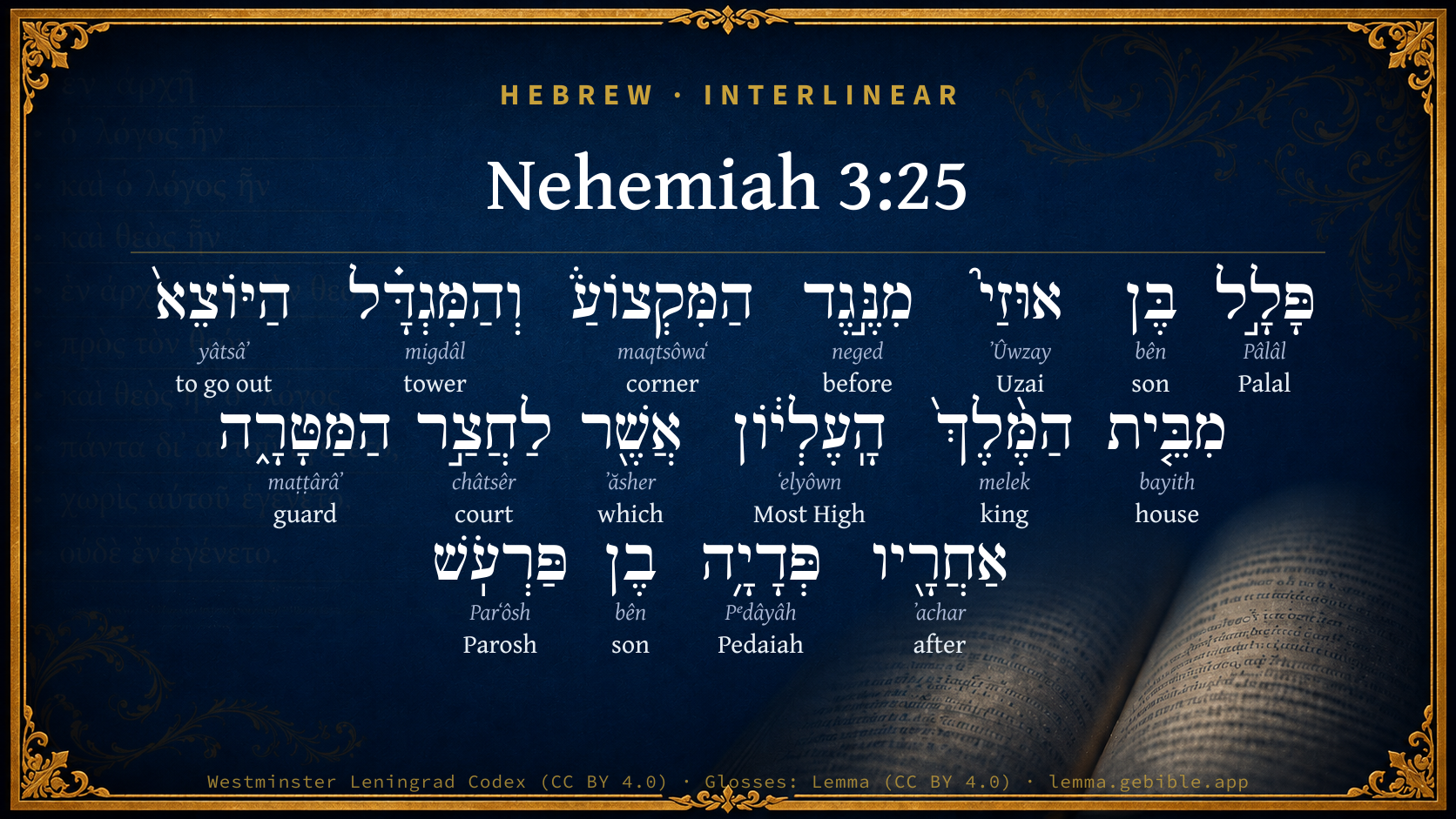
Nehemiah 3:25

Hebrew (Westminster Leningrad Codex) Nehemiah 3:25 appears in the Hebrew Old Testament. The text above is from the Westminster Leningrad Codex. Each word links to its Strong’s number, a concise gloss, and parsing drawn from the Open Scriptures Hebrew Bible morphology. Click any word for its full Brown-Driver-Briggs (BDB) entry.
Download image
Cite this verse

Nehemiah 3:25 (World English Bible). Public Domain. Lemma interlinear Bible study tool, https://lemma.gebible.app/v/nehemiah/3/25.

Show BibTeX & RIS
BibTeX
RIS
English Translation
Palal the son of Uzai [repaired] over against the turning [of the wall], and the tower that stands out from the upper house of the king, which is by the court of the guard. After him Pedaiah the son of Parosh [repaired].
World English Bible · Public Domain
Highlights
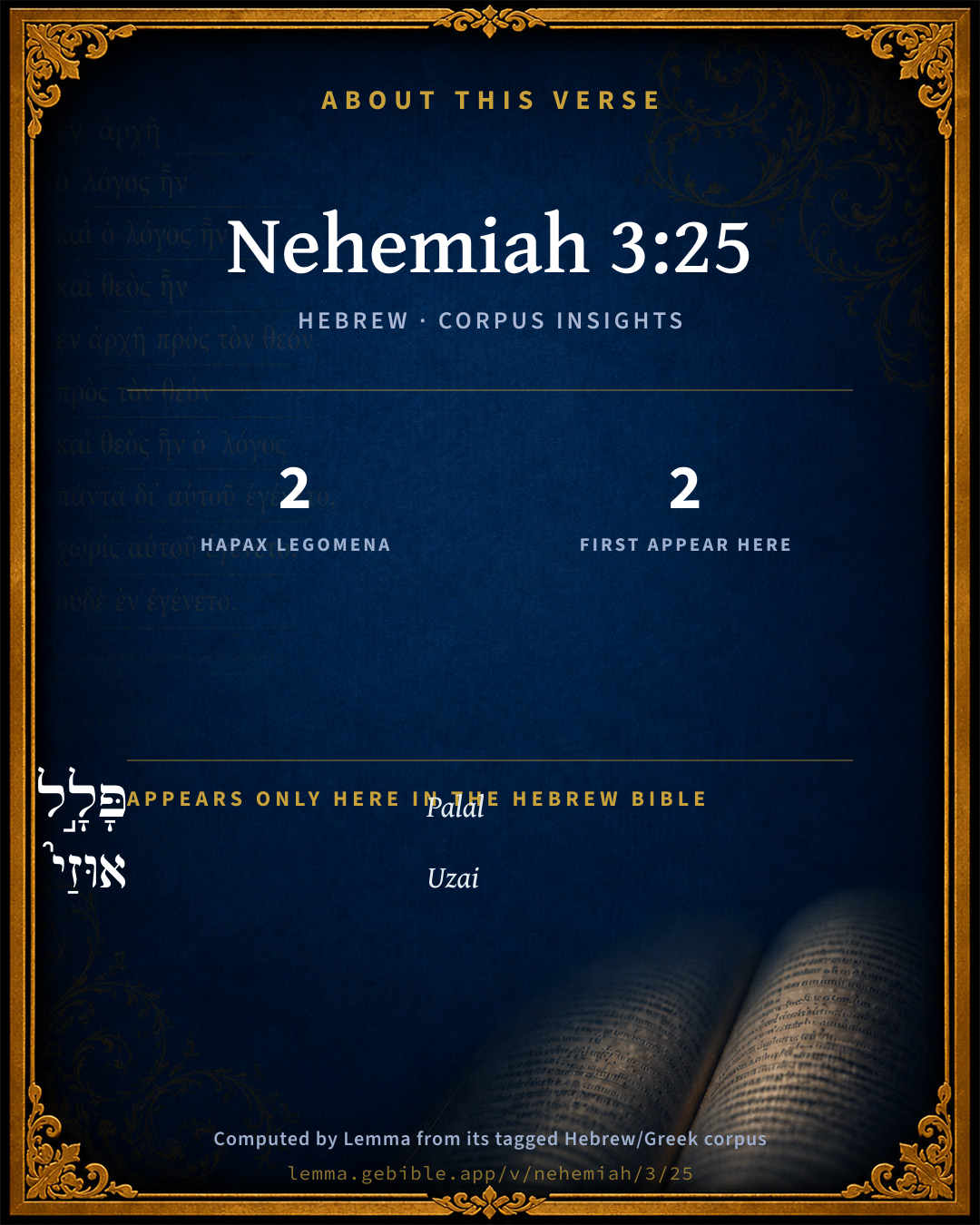
  • 2 hapax legomena — only here in the Hebrew Bible
  • 2 first appearances in the Hebrew Bible
Full analysis ↓
Download a study sheet

One document with this verse’s original text, its word-by-word gloss line, the meaning frame, cross-references with their text, attributed commentary, and full source and license credits — printable, and it pastes into notes with its structure intact.

This verse Autodidact and up

Study sheet (.html) Plain text (.txt)

A passage Seminary Student

Up to 50 verses in one chapter. A passage sheet keeps up to 6 commentary sources and 12 cross-references per verse, in the order this page ranks them, and says so on the sheet whenever that leaves anything out. Ask for a single verse and you get the Autodidact verse sheet above.

Everything on this page stays free to read, with no account — the sheet is a download of what is already on screen, not access to it.

Want to remove ads? Support Godless Engineer
Compare translations 3

The same verse in 3 English versions, stacked beneath the original-language interlinear above. Click any original word for its lexicon entry.

Each is an independent rendering of the whole verse — the interlinear is not word-aligned to these translations.

Highlighted words mark where these versions differ — a whole-verse word diff, not a word-by-word alignment.

  • World English Bible Public Domain
    Palal the son of Uzai [repaired] over against the turning [of the wall], and the tower that stands out from the upper house of the king, which is by the court of the guard. After him Pedaiah the son of Parosh [repaired].
  • King James Version Public Domain
    Palal the son of Uzai, over against the turning of the wall, and the tower which lieth out from the king's high house, that was by the court of the prison. After him Pedaiah the son of Parosh.
  • unfoldingWord Literal Text CC BY-SA 4.0
    Palal the son of Uzai, from opposite the angle and the tower projecting from the upper house of the king which is by the court of the guard; after him, Pedaiah the son of Parosh.

unfoldingWord Literal Text — © unfoldingWord, licensed CC BY-SA 4.0. Word-aligned USFM3 via Door43 (git.door43.org/unfoldingWord/en_ult).

Versions to compare (up to 4)

3 of 4 selected

Show all 18 translations

Every available English version of this verse, each an independent rendering of the whole verse.

  • World English Bible Public Domain
    Palal the son of Uzai [repaired] over against the turning [of the wall], and the tower that stands out from the upper house of the king, which is by the court of the guard. After him Pedaiah the son of Parosh [repaired].
  • Berean Standard Bible Public Domain
    and Palal son of Uzai made repairs opposite the angle and the tower that juts out from the upper palace of the king near the courtyard of the guard. Next to him, Pedaiah son of Parosh
  • Majority Standard Bible Public Domain
    and Palal son of Uzai made repairs opposite the angle and the tower that juts out from the upper palace of the king near the courtyard of the guard. Next to him, Pedaiah son of Parosh
  • King James Version Public Domain
    Palal the son of Uzai, over against the turning of the wall, and the tower which lieth out from the king's high house, that was by the court of the prison. After him Pedaiah the son of Parosh.
  • American Standard Version (1901) Public Domain
    Palal the son of Uzai `repaired' over against the turning `of the wall', and the tower that standeth out from the upper house of the king, which is by the court of the guard. After him Pedaiah the son of Parosh `repaired'.
  • Revised Version (1885) Public Domain
    Palal the son of Uzai repaired over against the turning of the wall, and the tower that standeth out from the upper house of the king, which is by the court of the guard. After him Pedaiah the son of Parosh repaired.
  • Geneva Bible (1599) Public Domain
    Palal, the sonne of Vzai, from ouer against the corner, and the high tower, that lieth out from the Kings house, which is beside the court of the prison. After him, Pedaiah, the sonne of Parosh.
  • Douay-Rheims (1899) Public Domain
    Phalel, the son of Ozi, over against the bending and the tower, which lieth out from the king's high house, that is, in the court of the prison: after him Phadaia the son of Pharos.
  • Young's Literal Translation Public Domain
    Palal son of Uzai, from over-against the angle, and the tower that is going out from the upper house of the king that `is' at the court of the prison; after him Pedaiah son of Parosh.
  • Literal Standard Version CC BY-SA 4.0
    Palal son of Uzai [strengthened] from opposite the angle, and the tower that is going out from the upper house of the king that [is] at the court of the prison; after him Pedaiah son of Parosh [strengthened].
  • Unlocked Literal Bible CC BY-SA 4.0
    Palal son of Uzai repaired over against the corner of the wall and the tower that extends upward from the upper house of the king at the courtyard of the guard. After him Pedaiah son of Parosh repaired.
  • unfoldingWord Literal Text CC BY-SA 4.0
    Palal the son of Uzai, from opposite the angle and the tower projecting from the upper house of the king which is by the court of the guard; after him, Pedaiah the son of Parosh.
  • Darby Bible Public Domain
    Palal the son of Uzai, over against the angle, and the high tower that lies out from the king's house, which was by the court of the prison. After him, Pedaiah the son of Parosh.
  • World Messianic Bible Public Domain
    Palal the son of Uzai made repairs opposite the turning of the wall, and the tower that stands out from the upper house of the king, which is by the court of the guard. After him Pedaiah the son of Parosh made repairs.
  • Webster's Bible Public Domain
    Palal, the son of Uzai, over against the turning of the wall, and the tower which lieth out from the king's high house, that was by the court of the prison. After him Pedaiah, the son of Parosh.
  • Free Bible Version CC BY-SA 4.0
    Palal, son of Uzai, worked opposite where the wall turns and the tower that extends from the upper palace, near the court of the guard. Next were Pedaiah, son of Parosh
  • Bible in Basic English Public Domain
    Palal, the son of Uzai, made good the wall opposite the angle and the tower which comes out from the higher part of the king's house, by the open space of the watch. After him was Pedaiah, the son of Parosh.
  • JPS Tanakh (1917) Public Domain
    Palal the son of Uzai repaired over against the Turning, and the tower that standeth out from the upper house of the king, which is by the court of the guard. After him Pedaiah the son of Parosh repaired. —

Literal Standard Version (2020), Covenant Press — licensed CC BY-SA 4.0. Text via the HelloAO Bible API (eBible.org). Unlocked Literal Bible (unfoldingWord) — licensed CC BY-SA 4.0. Text via the HelloAO Bible API (eBible.org). unfoldingWord Literal Text — © unfoldingWord, licensed CC BY-SA 4.0. Word-aligned USFM3 via Door43 (git.door43.org/unfoldingWord/en_ult). Free Bible Version, Dr. Jonathan Gallagher — licensed CC BY-SA 4.0. Text via the HelloAO Bible API (eBible.org).

Word by word

More ways to search: Search by grammar → Find every occurrence → Compare this word →

Practice this passage: Drill this verse → Learn its vocabulary →

פָּלָ֣ל
Pâlâl
H6420
“Palal”
Noun, Proper
Part of Speech
Noun
Type
Proper
Full BDB Definition

Origin: from H6419

TWOT: None

Palal = "judge" - son of Uzai and one who assisted in restoring the walls of Jerusalem in the time of Nehemiah
  1. בֶּן bên H1121 “son of” Noun, Common, Masculine, Singular, Construct
  2. אוּזַי֮ ʼÛwzay H186 “Uzai” Noun, Proper
  3. מִנֶּ֣גֶד neged H5048 “from · before” Preposition + Preposition
  4. הַמִּקְצוֹעַ֒ maqtsôwaʻ H4740 “the · corner” Particle, Definite Article + Noun, Common, Masculine, Singular, Absolute
  5. וְהַמִּגְדָּ֗ל migdâl H4026 “and · the · tower” Conjunction + Particle, Definite Article + Noun, Common, Both, Singular, Absolute
  6. הַיּוֹצֵא֙ yâtsâʼ H3318 “the · going out” Particle, Definite Article + Verb, Qal, Participle Active, Masculine, Singular, Absolute
  7. מִבֵּ֤ית bayith H1004 “from · house of” Preposition + Noun, Common, Masculine, Singular, Construct
  8. הַמֶּ֨לֶךְ֙ melek H4428 “the · king” Particle, Definite Article + Noun, Common, Masculine, Singular, Absolute
  9. הָֽעֶלְי֔וֹן ʻelyôwn H5945 “the · Most High” Particle, Definite Article + Adjective, Adjective, Masculine, Singular, Absolute
  10. אֲשֶׁ֖ר ʼăsher H834 “which” Particle, Relative
  11. לַחֲצַ֣ר châtsêr H2691 “to/for · court of” Preposition + Noun, Common, Both, Singular, Construct
  12. הַמַּטָּרָ֑ה maṭṭârâʼ H4307 “the · guard” Particle, Definite Article + Noun, Common, Feminine, Singular, Absolute
  13. אַחֲרָ֖יו ʼachar H310 “after · him” Preposition + Suffix, Personal, 3rd Person, Masculine, Singular
  14. פְּדָיָ֥ה Pᵉdâyâh H6305 “Pedaiah” Noun, Proper
  15. בֶן bên H1121 “son of” Noun, Common, Masculine, Singular, Construct
  16. פַּרְעֹֽשׁ Parʻôsh H6551 “Parosh” Noun, Proper

About this verse

These counts appear in no published source. They are computed here, from the morphology-tagged text and Lemma’s own curated glosses. What Lemma adds →

17
words
16
distinct lemmas
Historical
section

Notable vocabulary

2 hapax legomena — words that appear only here in the entire Hebrew Bible:

  • פָּלָ֣ל Palal H6420
  • אוּזַי֮ Uzai H186

First appearance in Scripture

These words make their first canonical appearance in the Hebrew Bible here:

  • פָּלָ֣ל Palal H6420
  • אוּזַי֮ Uzai H186

Shared distinctive vocabulary

פַּרְעֹֽשׁ Parosh H6551 occurs in 6 verses of the Hebrew Bible. Also found in:

Grammatical profile

  • 1 verb
  • 12 nouns
  • 1 adjective
  • 2 prepositions
  • 1 particle

Verb forms

  • הַיּוֹצֵא֙ Qal · Participle Active

Repetition

A word recurs within this verse — often emphatic in Hebrew:

Cross-references

10

Topical passages linked to Nehemiah 3:25 in the Treasury of Scripture Knowledge — connected by theme and wording, ordered by reader-vote popularity; previews shown in the World English Bible.

  • Jeremiah 32:2 Now at that time the king of Babylon's army was besieging Jerusalem; and Jeremiah the prophet was shut up in the court of the guard, which was in the king of Judah's house.
  • Jeremiah 37:21 Then Zedekiah the king commanded, and they committed Jeremiah into the court of the guard; and they gave him daily a loaf of bread out of the bakers' street, until all the bread in the city was spent. Thus Jeremiah remained in the court of the guard.
  • Ezra 2:3 The children of Parosh, two thousand one hundred seventy-two.
  • Nehemiah 12:39 and above the gate of Ephraim, and by the old gate, and by the fish gate, and the tower of Hananel, and the tower of Hammeah, even to the sheep gate: and they stood still in the gate of the guard.
  • Jeremiah 33:1 Moreover the word of Yahweh came to Jeremiah the second time, while he was yet shut up in the court of the guard, saying,
  • Nehemiah 7:8 The children of Parosh, two thousand one hundred seventy-two.
  • Nehemiah 8:4 Ezra the scribe stood on a pulpit of wood, which they had made for the purpose; and beside him stood Mattithiah, and Shema, and Anaiah, and Uriah, and Hilkiah, and Maaseiah, on his right hand; and on his left hand, Pedaiah, and Mishael, and Malchijah, and Hashum, and Hashbaddanah, Zechariah, [and] Meshullam.
  • Jeremiah 22:14 who says, I will build me a wide house and spacious chambers, and cuts him out windows; and it is ceiling with cedar, and painted with vermilion.
  • Jeremiah 39:8 The Chaldeans burned the king's house, and the houses of the people, with fire, and broke down the walls of Jerusalem.
  • Jeremiah 39:14–15 they sent, and took Jeremiah out of the court of the guard, and committed him to Gedaliah the son of Ahikam, the son of Shaphan, that he should carry him home: so he lived among the people.

Cross-references courtesy of OpenBible.info (CC BY 4.0).

Hebrew and Greek witnesses Masoretic Hebrew ↔ Greek Septuagint

The same verse in the two great witnesses to the Old Testament, shown verse-for-verse.

These are two independent witnesses, not word-aligned to each other, and the Septuagint is shown in lemma (dictionary) form.

Hebrew Nehemiah 3:25 Masoretic · Westminster Leningrad Codex

פָּלָ֣ל בֶּן אוּזַי֮ מִנֶּ֣גֶד הַמִּקְצוֹעַ֒ וְהַמִּגְדָּ֗ל הַיּוֹצֵא֙ מִבֵּ֤ית הַמֶּ֨לֶךְ֙ הָֽעֶלְי֔וֹן אֲשֶׁ֖ר לַחֲצַ֣ר הַמַּטָּרָ֑ה אַחֲרָ֖יו פְּדָיָ֥ה בֶן פַּרְעֹֽשׁ

Palal the son of Uzai [repaired] over against the turning [of the wall], and the tower that stands out from the upper house of the king, which is by the court of the guard. After him Pedaiah the son of Parosh [repaired].

World English Bible · Public Domain

Greek LXX Structure differs

The Septuagint has no separate book of Nehemiah. Its Greek text is the second half of Esdras B (2 Esdras), chapters 11–23; Ezra is the first half (1–10).

A verse-for-verse comparison isn’t shown here because the chapters and verses don’t line up. Switch to the LXX edition with the MT / LXX toggle above to read the Greek directly.

On this verse, The Cambridge Bible for Schools and Colleges discusses the Septuagint’s reading. Read the note in Commentary ↓

Hebrew: Westminster Leningrad Codex (CC BY 4.0). Greek: Septuagint (public domain); English from a public-domain English Septuagint. How the Septuagint differs from the Hebrew →

Commentary

Notes on Nehemiah 3:25 from classic Christian and Jewish commentators (each source and its license shown beneath its notes). The classic Christian expositions comment on the surrounding passage and are grouped to its opening verse, so a note may address several verses; the Jewish commentaries on the Tanakh (Rashi and others) are per-verse, so they appear only where the commentator wrote on this verse.

Lemma curates 59 commentaries, every one of them public domain or Creative Commons licensed, each selected and text-cleaned for this edition rather than reprinted as found. About our sources →

Trapp's Complete Commentary

John Trapp

Neh 3:25 Palal the son of Uzai, over against the turning [of the wall], and the tower which lieth out from the king’s high house, that [was] by the court of the prison. After him Pedaiah the son of Parosh.

Ver. 25. Over against the turning] Of these turnings there were many, as appeareth above.

The king’s high house] In Spain, not only doth the king dwell in a stately high palace, but also the highest room in every great house is his, and he must be paid for it.

That was by the court of the prison] Here Jeremiah was prisoner more than once, Jer 32:2; Jer 38:7; Jer 38:13. And therefore other good people that came after him thither might be as well apaid as Dr Taylor, martyr, who blessed God that ever he was fellow-prisoner to that earthly angel (as be called him), John Bradford; or, as that other good woman, who rejoiced that she might have her foot in the hole of the stocks in which Mr Philpot had been before her.

John Trapp, A Commentary or Exposition upon All the Books of the Old and New Testament (1647–1656) — public domain. Text from a community e-Sword module.

Joseph Benson's Commentary

Neh 3:25. Over against the turning of the wall — In a part of the wall which jutted out. And the tower — Or, even the tower. Which lieth out from the king’s high house — Either from the royal palace, or from some other house which the king formerly built there, either for prospect or for defence. By the court of the prison — A place often mentioned: see Jer 32:2; Jer 38:7; Jer 38:13.

Joseph Benson's Commentary on the Old and New Testaments (1811–1818) — public domain. Text from a community e-Sword module.

Tyndale Open Study Notes

Tyndale Open Resources

3:25-26 The tower that projects up from the king’s upper house and the court of the guard might refer to a royal complex on the hill of Ophel, just south of the Temple area.

Tyndale Open Study Notes — © Tyndale Open Resources, licensed CC BY-SA 4.0. Text via the HelloAO Bible API.

Jamieson, Fausset & Brown

Robert Jamieson, A. R. Fausset & David Brown

the tower which lieth out from the king's high house--that is, watchtower by the royal palace [BARCLAY].

Jamieson, Fausset & Brown — Commentary Critical and Explanatory on the Whole Bible (1871) — public domain (CC PDM 1.0). Text via the HelloAO Bible API.

Ellicott's Commentary for English Readers

(25) The tower which lieth out from the king’s high house.—Better, the high tower outlying from the king’s palace.

That was by the court of the prison.—The palace generally had its prison, and near this was the “prison-gate” of Neh_12:39.

A Bible Commentary for English Readers, edited by Charles John Ellicott (1878–1897) — public domain. Text from a community e-Sword module.

The Cambridge Bible for Schools and Colleges

gen. ed. J. J. S. Perowne

25. Palal the son of Uzai] R.V. Palal the son of Uzai repaired.

the tower which lieth out from the king’s high house, that was by the court of the prison] R.V. the tower that standeth out from the upper house of the king, which is by the court of the guard, R.V. marg. ‘Or, the upper tower … from the house of the king’.

It is not easy to determine the meaning of this description. The adjective ‘upper’ may be applied either to the king’s house or to the tower; and the clause ‘which is by the court of the guard’ follows it as a further description either of house or tower. In Jer_32:2 ‘the court of the guard’ is in ‘the king’s house’ (cf. Jer_33:1; Jer_37:21; Jer_38:6; Jer_38:13; Jer_38:28; Jer_39:14-15). In the present passage we have either ‘the king’s upper house,’ so called to distinguish it from the king’s house, in which was the court of the guard; or, as seems more probable, seeing that the passage is a description of the city wall, ‘the upper tower,’ which is identified as the one projecting from the king’s palace and close to the ‘court of the guard.’ In the vicinity of the royal palace and Temple there would probably be several towers. The LXX. ὁ πύργος … ὁ ἀνώτερος accepted the latter explanation.

It is very probable that the base of ‘the tower’ here spoken of was reached by Sir Charles Warren. ‘A great wall still exists, though buried in rubbish, joining the Haram wall at the south-east angle. It was evidently built for purposes of fortification, for it is fourteen feet thick.… There are several towers projecting from the wall, one of which is very remarkable, as it projects more than any of the rest, standing upon scarped rock, and having another wall leading from it going down towards the Kedron.’ (Harper, The Bible and Modern Discoveries, P. 509.)

‘the upper house of the king’. This building, erected upon the site of the old palace of the kings of Judah and perhaps at this time occupied by the chief officials of the city, stood apparently on the ‘Ophel’ summit, immediately S. of the Temple precincts.

Pedaiah the son of Parosh] R.V. Pedaiah the son of Parosh repaired. R.V. marg. ‘Pedaiah the son of Parosh (now … Ophel) repaired unto, &c.’ See note on Neh_3:26. On Parosh see Ezr_2:3. As in the earlier part of the verse the verb ‘repaired’ has to be understood.

The Cambridge Bible for Schools and Colleges (gen. ed. J. J. S. Perowne; Cambridge University Press, 1878–1918) — public domain. Text from a community e-Sword module.

John Gill's Exposition

After them the Tekoites repaired another piece,.... Having finished what they undertook in another part of the wall, Neh 3:5, they engage in this part of it; which shows their great zeal and diligence, when their nobles were so backward to it, and withdrew from it:

over against the great tower that lieth out; the same as in the preceding verse:

even unto the wall of Ophel; from right against the great tower unto the wall the Tekoites repaired.

John Gill's Exposition of the Whole Bible (1746–1763) — public domain (CC PDM 1.0). Text via the HelloAO Bible API.

Matthew Poole's English Annotations

Over against the turning of the wall; in a part of the wall, which jutted out as the tower here following did, and therefore was opposite to or over against that turning.

And the tower, or, even the tower. Out from the king’s high house; either from the royal palace; or from some other smaller house which the king formerly built there, either for prospect or for defence.

By the court of the prison; a place oft mentioned; of which see Jer 32:2; 38:6,13.

Matthew Poole's English Annotations on the Holy Bible (1683–1685) — public domain. Text from a community e-Sword/MySword module.

Whedon's Commentary on the Bible

Daniel D. Whedon

25. The tower… king’s high house… court of the prison — These are also unknown. The king’s high house seems most naturally to designate the great palace of Solomon, which stood at the south of the temple area, commanding the slope of Ophel. See note at the beginning of 1 Kings 7.

But in the time of Nehemiah, more than a century after that ancient palace had been laid in ruins, the name may have been given to some other royal house. Hence all attempts to designate its exact location are at best conjectural.

Daniel D. Whedon (gen. ed.), Commentary on the Old and New Testaments (1874–1909) — public domain. Text from a community e-Sword module.

The Pulpit Commentary

The tower which lieth out from the king"s high house. In the original it is uncertain whether the word translated "high" belongs to "tower" or "house." Most commentators attach it to "tower." The "king"s house" of this place can be nothing but the old palace of David, which was in this quarter, while Solomon"s was on the opposite, or western, hill This palace, like Solomon s, (Jer_32:2) would naturally have its prison, which would stand in its own court. From this prison, the "prison gate" of Neh_12:39 took its name.

The Pulpit Commentary (1880–1919), ed. H.D.M. Spence-Jones & Joseph S. Exell — public domain. Text from a community e-Sword module.

unfoldingWord translationNotes

Door43 World Missions Community

Palal ... repaired ... Parosh repaired ... servants ... repaired ... repaired another section

These phrases refer to repairing the wall. AT: "Palal ... repaired the wall ... Parosh repaired the wall ... servants ... repaired the wall ... repaired another section of the wall"

Palal ... Uzai ... Pedaiah ... Parosh

These are the names of men. (See: How to Translate Names)

the tower that extends upward

"the tower that rises up"

upper house of the king

"higher palace of the leader of Israel"

the courtyard of the guard

This is the place where the guards stayed.

After him

"Next to him"

Ophel

This is the name of a place. (See: How to Translate Names)

opposite the Water Gate

"in front of the Water Gate"

the projecting tower ... the great projecting tower

"the tall tower ... the tall tower." The phrase "the projecting tower" means a tall tower that juts out from the wall. It is likely that both of these phrases refer to the same tower.

the Tekoites

These are people from the town of Tekoa. See how you translated this in Nehemiah 3:5. (See: How to Translate Names)

translationWords

son

house

king

court

temple

servant

life

water

gate

unfoldingWord translationNotes — © Distant Shores Media and the Door43 World Missions Community, licensed CC BY-SA 4.0. Source: git.door43.org/Door43/en_tn.

Rashi

Rabbi Shlomo Yitzchaki (Rashi)

and the tower that juts out There was one tower in the wall that jutted out and protruded from within.

Rashi on the Tanakh — English translations: “The Judaica Press complete Tanach with Rashi, translated by A. J. Rosenberg” (CC BY 4.0); “Pentateuch with Rashi's commentary by M. Rosenbaum and A.M. Silbermann, 1929-1934” (public domain); “The Metsudah Tanach series, Lakewood, N.J” (CC BY 4.0); and “The Book of Joshua, Metsudah Publications, 1997” (CC BY 4.0). Text via Sefaria.

Lesson kit

Teaching starters — assembled from the data on this page, not authored interpretation. Every prompt links to the verse data it draws on. Edit before teaching.

Nehemiah, in the Historical, opens this verse with 17 words (16 distinct Hebrew lemmas). Its most distinctive word is Pâlâl (“Palal”). A historical commentator’s framing appears above. Read the whole chapter for the surrounding context.

Discussion questions

  1. The word Pâlâl carries the sense “Palal.” How does it shape the verse?
  2. 2 words here appear nowhere else in the Hebrew Bible. Why might the author reach for such rare wording?
  3. 2 words make their first appearance in Scripture here. What does this debut establish?
  4. How does Ezra 2:3, which shares the word «Parosh», read alongside this verse?
  5. What does the repetition of “son” (2× in this one verse) do in this verse?
  6. These translations render this verse differently; the difference is in the English rendering, not the original. What questions does that raise?
  7. «הַיּוֹצֵא֙» is a Qal Participle Active verb. How does that grammatical form shape the action described?
  8. Compare how Trapp's Complete Commentary and Joseph Benson's Commentary read this verse. Where do they agree or differ?

Things to notice

  • 2 words in this verse appear nowhere else in the Hebrew Bible.
  • 2 words make their first canonical appearance in Scripture here.
  • These translations choose different wording for 17 words in this verse.
  • “son” occurs 2× in this single verse.
  • 16 distinct Hebrew lemmas span 17 words in this verse.

Reading settings

Reading text

Shown beneath each verse's original-language words.

Old Testament
Old Testament edition

Read the OT as the Masoretic Hebrew (MT) or the Greek Septuagint (LXX).

English shown for the Greek Septuagint (in the Hebrew ↔ Greek comparison).

Comparing translations? Open the Compare panel on any verse page to stack up to four side by side.