Nehemiah 13:17

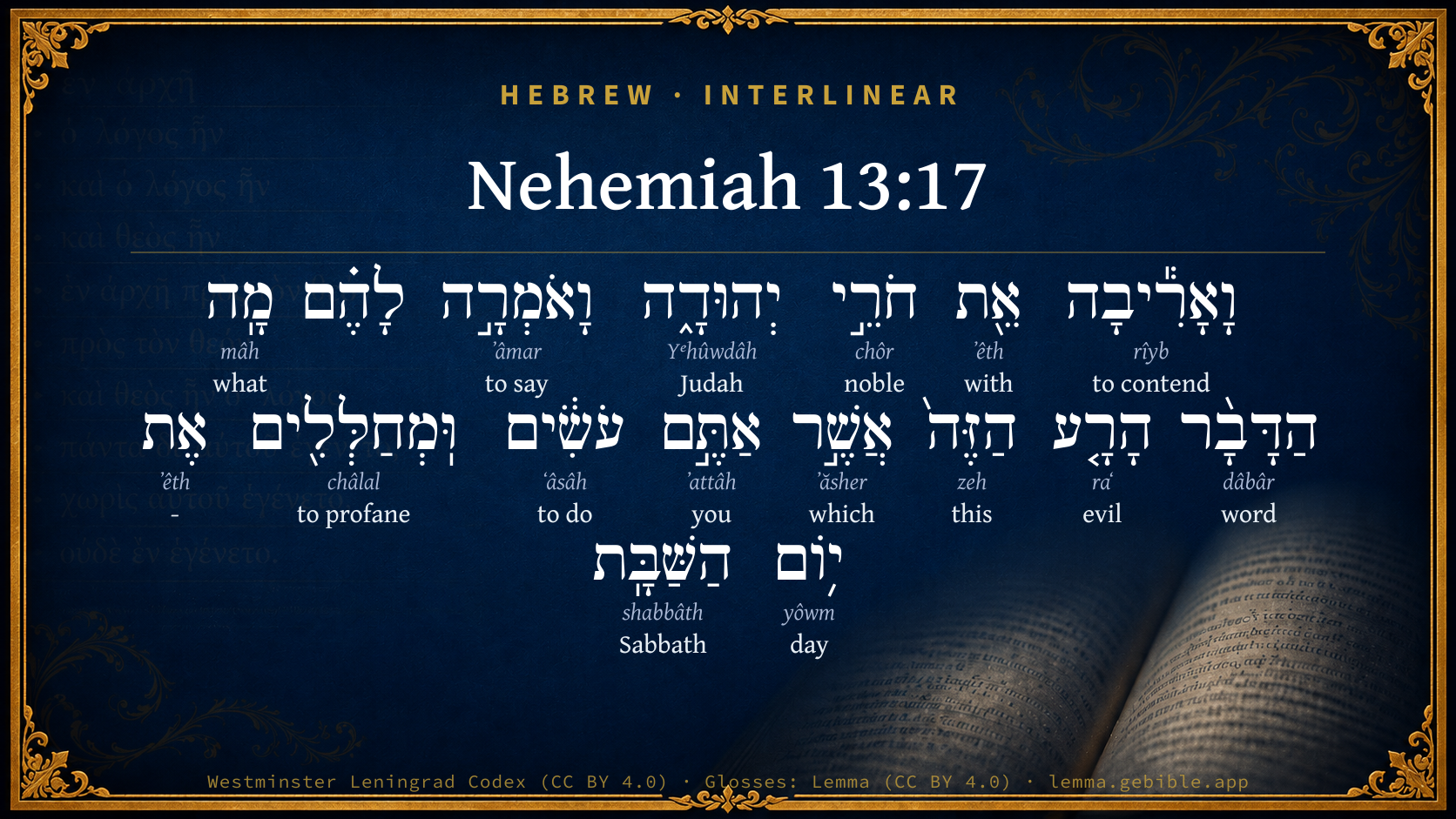
Hebrew (Westminster Leningrad Codex) Nehemiah 13:17 appears in the Hebrew Old Testament. The text above is from the Westminster Leningrad Codex. Each word links to its Strong’s number, a concise gloss, and parsing drawn from the Open Scriptures Hebrew Bible morphology. Click any word for its full Brown-Driver-Briggs (BDB) entry.
Download image
Cite this verse

Nehemiah 13:17 (World English Bible). Public Domain. Lemma interlinear Bible study tool, https://lemma.gebible.app/v/nehemiah/13/17.

Show BibTeX & RIS
BibTeX
RIS
English Translation
Then I contended with the nobles of Judah, and said to them, What evil thing is this that you do, and profane the Sabbath day?
World English Bible · Public Domain
Download a study sheet

One document with this verse’s original text, its word-by-word gloss line, the meaning frame, cross-references with their text, attributed commentary, and full source and license credits — printable, and it pastes into notes with its structure intact.

This verse Autodidact and up

Study sheet (.html) Plain text (.txt)

A passage Seminary Student

Up to 50 verses in one chapter. A passage sheet keeps up to 6 commentary sources and 12 cross-references per verse, in the order this page ranks them, and says so on the sheet whenever that leaves anything out. Ask for a single verse and you get the Autodidact verse sheet above.

Everything on this page stays free to read, with no account — the sheet is a download of what is already on screen, not access to it.

Want to remove ads? Support Godless Engineer
Compare translations 3

The same verse in 3 English versions, stacked beneath the original-language interlinear above. Click any original word for its lexicon entry.

Each is an independent rendering of the whole verse — the interlinear is not word-aligned to these translations.

Highlighted words mark where these versions differ — a whole-verse word diff, not a word-by-word alignment.

  • World English Bible Public Domain
    Then I contended with the nobles of Judah, and said to them, What evil thing is this that you do, and profane the Sabbath day?
  • King James Version Public Domain
    Then I contended with the nobles of Judah, and said unto them, What evil thing is this that ye do, and profane the sabbath day?
  • unfoldingWord Literal Text CC BY-SA 4.0
    And I contended with the nobles of Judah. And I said to them, “What is this evil thing that you are doing, and profaning the day of the sabbath?

unfoldingWord Literal Text — © unfoldingWord, licensed CC BY-SA 4.0. Word-aligned USFM3 via Door43 (git.door43.org/unfoldingWord/en_ult).

Versions to compare (up to 4)

3 of 4 selected

Show all 18 translations

Every available English version of this verse, each an independent rendering of the whole verse.

  • World English Bible Public Domain
    Then I contended with the nobles of Judah, and said to them, What evil thing is this that you do, and profane the Sabbath day?
  • Berean Standard Bible Public Domain
    Then I rebuked the nobles of Judah and asked, “What is this evil you are doing—profaning the Sabbath day?
  • Majority Standard Bible Public Domain
    Then I rebuked the nobles of Judah and asked, “What is this evil you are doing—profaning the Sabbath day?
  • King James Version Public Domain
    Then I contended with the nobles of Judah, and said unto them, What evil thing is this that ye do, and profane the sabbath day?
  • American Standard Version (1901) Public Domain
    Then I contended with the nobles of Judah, and said unto them, What evil thing is this that ye do, and profane the sabbath day?
  • Revised Version (1885) Public Domain
    Then I contended with the nobles of Judah, and said unto them, What evil thing is this that ye do, and profane the sabbath day?
  • Geneva Bible (1599) Public Domain
    Then reprooued I the rulers of Iudah, and sayd vnto them, What euil thing is this that yee doe, and breake the Sabbath day?
  • Douay-Rheims (1899) Public Domain
    And I rebuked the chief men of Juda, and said to them: What is this evil thing that you are doing, profaning the sabbath day?
  • Young's Literal Translation Public Domain
    And I strive with the freemen of Judah, and say to them, `What `is' this evil thing that ye are doing, and polluting the sabbath-day?
  • Literal Standard Version CC BY-SA 4.0
    And I strive with the nobles of Judah, and say to them, “What [is] this evil thing that you are doing, and defiling the Sabbath day?
  • Unlocked Literal Bible CC BY-SA 4.0
    Then I confronted the leaders of Judah, “What is this evil thing you are doing, profaning the Sabbath day?
  • unfoldingWord Literal Text CC BY-SA 4.0
    And I contended with the nobles of Judah. And I said to them, “What is this evil thing that you are doing, and profaning the day of the sabbath?
  • Darby Bible Public Domain
    And I contended with the nobles of Judah, and said to them, What evil thing is this which ye do, profaning the sabbath day?
  • World Messianic Bible Public Domain
    Then I contended with the nobles of Judah, and said to them, “What evil thing is this that you do, and profane the Sabbath day?
  • Webster's Bible Public Domain
    Then I contended with the nobles of Judah, and said to them, What evil thing is this that ye do, and profane the sabbath day?
  • Free Bible Version CC BY-SA 4.0
    Some people from Tyre who lived in Jerusalem were bringing in fish and all kinds of things and they were selling them on the Sabbath to the people of Judah in Jerusalem.
  • Bible in Basic English Public Domain
    Then I made protests to the chiefs of Judah, and said to them, What is this evil which you are doing, not keeping the Sabbath day holy?
  • JPS Tanakh (1917) Public Domain
    Then I contended with the nobles of Judah, and said unto them: 'What evil thing is this that ye do, and profane the sabbath day?

Literal Standard Version (2020), Covenant Press — licensed CC BY-SA 4.0. Text via the HelloAO Bible API (eBible.org). Unlocked Literal Bible (unfoldingWord) — licensed CC BY-SA 4.0. Text via the HelloAO Bible API (eBible.org). unfoldingWord Literal Text — © unfoldingWord, licensed CC BY-SA 4.0. Word-aligned USFM3 via Door43 (git.door43.org/unfoldingWord/en_ult). Free Bible Version, Dr. Jonathan Gallagher — licensed CC BY-SA 4.0. Text via the HelloAO Bible API (eBible.org).

Word by word

More ways to search: Search by grammar → Find every occurrence → Compare this word →

Practice this passage: Drill this verse → Learn its vocabulary →

חֹרֵ֣י
chôr
H2715
“nobles of”
Noun, Common, Masculine, Plural, Construct
Part of Speech
Noun
Type
Common
Gender
Masculine
Number
Plural
State
Construct
Full BDB Definition

Origin: from H2787

TWOT: 757a

a noble, freeborn one
  1. וָאָרִ֕יבָה rîyb H7378 “and · to contend” Conjunction + Verb, Qal, Sequential Imperfect, 1st Person, Common, Singular + Suffix, h
  2. אֵ֖ת ʼêth H854 “with” Preposition
  3. יְהוּדָ֑ה Yᵉhûwdâh H3063 “Judah” Noun, Proper
  4. וָאֹמְרָ֣ה ʼâmar H559 “and · to say” Conjunction + Verb, Qal, Sequential Imperfect, 1st Person, Common, Singular + Suffix, h
  5. מָֽה mâh H4100 “what” Particle, Interrogative
  6. הַדָּבָ֨ר dâbâr H1697 “the · word” Particle, Definite Article + Noun, Common, Masculine, Singular, Absolute
  7. הָרָ֤ע raʻ H7451 “the · evil” Particle, Definite Article + Adjective, Adjective, Masculine, Singular, Absolute
  8. הַזֶּה֙ zeh H2088 “the · this” Particle, Definite Article + Pronoun, Demonstrative, Masculine, Singular
  9. אֲשֶׁ֣ר ʼăsher H834 “which” Particle, Relative
  10. אַתֶּ֣ם ʼattâh H859 “you” Pronoun, Personal, 2nd Person, Masculine, Plural
  11. עֹשִׂ֔ים ʻâsâh H6213 “doing” Verb, Qal, Participle Active, Masculine, Plural, Absolute
  12. וּֽמְחַלְּלִ֖ים châlal H2490 “and · profaning” Conjunction + Verb, Piel, Participle Active, Masculine, Plural, Absolute
  13. אֶת ʼêth H853 “-” Particle, Direct Object
  14. י֥וֹם yôwm H3117 “day of” Noun, Common, Masculine, Singular, Construct
  15. הַשַּׁבָּֽת shabbâth H7676 “the · Sabbath” Particle, Definite Article + Noun, Common, Both, Singular, Absolute

About this verse

These counts appear in no published source. They are computed here, from the morphology-tagged text and Lemma’s own curated glosses. What Lemma adds →

17
words
16
distinct lemmas
Historical
section

Notable vocabulary

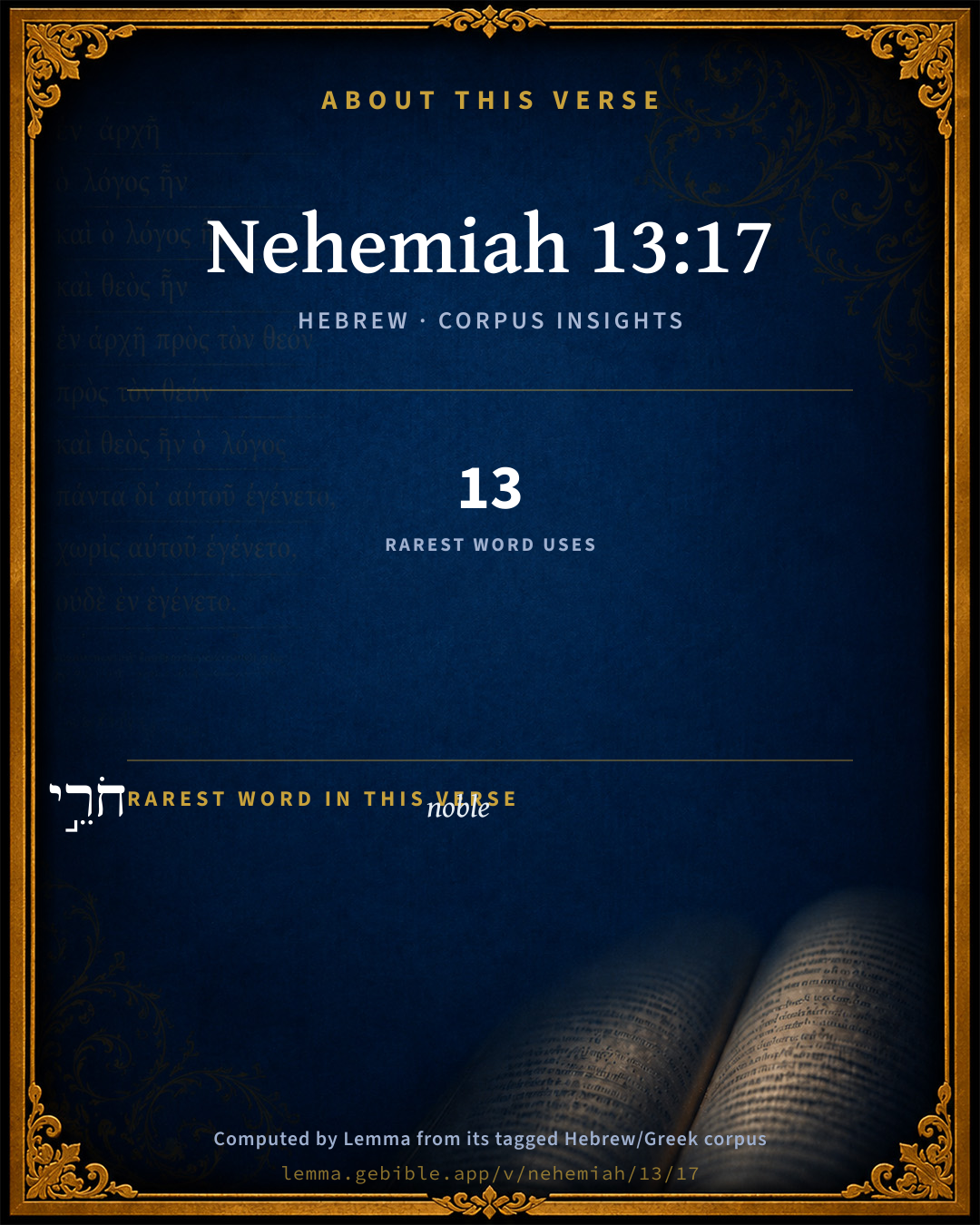
The rarest word here is חֹרֵ֣י noble H2715 — appearing just 13 times in the whole Hebrew Bible.

Shared distinctive vocabulary

חֹרֵ֣י noble H2715 occurs in 13 verses of the Hebrew Bible. Also found in:

Grammatical profile

  • 4 verbs
  • 5 nouns
  • 1 adjective
  • 2 pronouns
  • 2 prepositions
  • 3 particles

Verb forms

  • וָאָרִ֕יבָה Qal · Sequential Imperfect
  • וָאֹמְרָ֣ה Qal · Sequential Imperfect
  • עֹשִׂ֔ים Qal · Participle Active
  • וּֽמְחַלְּלִ֖ים Piel · Participle Active

Cross-references

11

Topical passages linked to Nehemiah 13:17 in the Treasury of Scripture Knowledge — connected by theme and wording, ordered by reader-vote popularity; previews shown in the World English Bible.

  • Nehemiah 13:11 Then contended I with the rulers, and said, Why is the house of God forsaken? I gathered them together, and set them in their place.
  • Nehemiah 13:25 I contended with them, and cursed them, and struck certain of them, and plucked off their hair, and made them swear by God, [saying], You shall not give your daughters to their sons, nor take their daughters for your sons, or for yourselves.
  • Nehemiah 5:7 Then I consulted with myself, and contended with the nobles and the rulers, and said to them, You exact usury, everyone of his brother. I held a great assembly against them.
  • Psalms 82:1–2 God presides in the great assembly. He judges among the gods.
  • Proverbs 28:4 Those who forsake the law praise the wicked; But those who keep the law contend with them.
  • Isaiah 1:10 Hear the word of Yahweh, you rulers of Sodom! Listen to the law of our God, you people of Gomorrah!
  • Jeremiah 5:5 I will get me to the great men, and will speak to them; for they know the way of Yahweh, and the law of their God. But these with one accord have broken the yoke, and burst the bonds.
  • Jeremiah 13:18 Say you to the king and to the queen-mother, Humble yourselves, sit down; for your headdresses are come down, even the crown of your glory.
  • Jeremiah 22:2–23 Say, Hear the word of Yahweh, king of Judah, who sits on the throne of David, you, and your servants, and your people who enter in by these gates.
  • Micah 3:1 I said, "Please listen, you heads of Jacob, And rulers of the house of Israel: Isn't it for you to know justice?
  • Micah 3:9 Please listen to this, you heads of the house of Jacob, And rulers of the house of Israel, Who abhor justice, And pervert all equity.

Cross-references courtesy of OpenBible.info (CC BY 4.0).

Hebrew and Greek witnesses Masoretic Hebrew ↔ Greek Septuagint

The same verse in the two great witnesses to the Old Testament, shown verse-for-verse.

These are two independent witnesses, not word-aligned to each other, and the Septuagint is shown in lemma (dictionary) form.

Hebrew Nehemiah 13:17 Masoretic · Westminster Leningrad Codex

וָאָרִ֕יבָה אֵ֖ת חֹרֵ֣י יְהוּדָ֑ה וָאֹמְרָ֣ה לָהֶ֗ם מָֽה הַדָּבָ֨ר הָרָ֤ע הַזֶּה֙ אֲשֶׁ֣ר אַתֶּ֣ם עֹשִׂ֔ים וּֽמְחַלְּלִ֖ים אֶת י֥וֹם הַשַּׁבָּֽת

Then I contended with the nobles of Judah, and said to them, What evil thing is this that you do, and profane the Sabbath day?

World English Bible · Public Domain

Greek LXX Structure differs

The Septuagint has no separate book of Nehemiah. Its Greek text is the second half of Esdras B (2 Esdras), chapters 11–23; Ezra is the first half (1–10).

A verse-for-verse comparison isn’t shown here because the chapters and verses don’t line up. Switch to the LXX edition with the MT / LXX toggle above to read the Greek directly.

Hebrew: Westminster Leningrad Codex (CC BY 4.0). Greek: Septuagint (public domain); English from a public-domain English Septuagint. How the Septuagint differs from the Hebrew →

Commentary

Notes on Nehemiah 13:17 from classic Christian and Jewish commentators (each source and its license shown beneath its notes). The classic Christian expositions comment on the surrounding passage and are grouped to its opening verse, so a note may address several verses; the Jewish commentaries on the Tanakh (Rashi and others) are per-verse, so they appear only where the commentator wrote on this verse.

Lemma curates 59 commentaries, every one of them public domain or Creative Commons licensed, each selected and text-cleaned for this edition rather than reprinted as found. About our sources →

Trapp's Complete Commentary

John Trapp

Neh 13:17 Then I contended with the nobles of Judah, and said unto them, What evil thing [is] this that ye do, and profane the sabbath day?

Ver. 17. Then contended I with the nobles] Heb. With the white ones; that had white clothes, but black souls. The snow drift covers many a muck hill. See Neh 13:11.

What evil thing is this that ye do] Or suffer others to do, at least, and are, therefore, worthily disgraced; as Moses also was for like cause, Exo 16:28.

And profane the sabbath day?] As if it were a common day, and not God’s enclosure, holy and honourable. Should men thus rob God of his right, unmound his several, make false entry upon his freehold? Hath he not singled out this day for his own, as he did Israel out of all nations, the tree of knowledge out of all the trees of the garden, and out of all the world (which is his) the tenth? This is the day which the Lord hath made, &c., it is a day like that night, Exo 12:42, to be kept holy unto the Lord; that day of the Lord which all his people must keep throughout their generations. To profane it or wound it is here called an evil thing with an accent, a wickedness with a witness.

John Trapp, A Commentary or Exposition upon All the Books of the Old and New Testament (1647–1656) — public domain. Text from a community e-Sword module.

Joseph Benson's Commentary

Neh 13:17. Then I contended with the nobles — Their chief men and rulers; whom he charges with this sin, because, though others committed it, it was done by their countenance or connivance, probably by their example: and if these nobles had exercised their authority, the people durst not have done as they did. If magistrates, nobles, and people in the higher ranks of life, allow themselves in recreations, in idle visits and idle talk on the sabbath day, men of business will profane it by their worldly employments, as the more justifiable practice of the two.

Joseph Benson's Commentary on the Old and New Testaments (1811–1818) — public domain. Text from a community e-Sword module.

Adam Clarke's Commentary

Verse 17. I contended with the nobles] These evils took place through their negligence; and this I proved before them.

Adam Clarke's Commentary on the Bible (1810–1826) — public domain. Text from a community e-Sword/MySword module.

Ellicott's Commentary for English Readers

(17) That ye do.—The nobles, in the absence of Nehemiah, had been responsible, and the sin is charged upon them. The appeal supposes their familiarity with the express prediction of Jeremiah and its literal fulfilment (Jer_17:27).

A Bible Commentary for English Readers, edited by Charles John Ellicott (1878–1897) — public domain. Text from a community e-Sword module.

The Cambridge Bible for Schools and Colleges

gen. ed. J. J. S. Perowne

17. Then I contended] cf. Neh_13:11.

the nobles of Judah] A different word (ḥorim) from that used for the rulers in Neh_13:11.

The Cambridge Bible for Schools and Colleges (gen. ed. J. J. S. Perowne; Cambridge University Press, 1878–1918) — public domain. Text from a community e-Sword module.

John Gill's Exposition

And it came to pass, that when the gates of Jerusalem began to be dark before the sabbath,.... Or "were shaded" (g); that is, as Jarchi interprets it, when the shadows of the eve of the sabbath were stretched out upon the gates; the sabbath did not begin till sun setting, and the stars appeared; but before that, as the sun was declining, the shadows through the houses in Jerusalem, and mountains about it, spread themselves over the gates: and when it was near dusk, and as soon as it was so,

I commanded that the gates should be shut, and charged that they should not be opened till after the sabbath; until sun setting the next day:

and some of my servants set I at the gates, that there should be burden brought in on the sabbath day; the porters being not to be trusted, being liable to be bribed and corrupted, which he knew his servants were not; and therefore, since it might be necessary on a few occasions to open the gates to let some persons in and out, and especially such who dwelt near, and came to worship, he placed his servants there, to take care that none were admitted that had any burdens upon them.

(g) "obumbratae", Pagninus, Montanus; "obumbrarentur", Junius & Tremellius, Piscator, Rambachius; "incidentibus umbris", Tigurine version.

John Gill's Exposition of the Whole Bible (1746–1763) — public domain (CC PDM 1.0). Text via the HelloAO Bible API.

Matthew Poole's English Annotations

The nobles of Judah, i.e. their chief men and rulers; whom he chargeth with this sin, because though others did it, it was by their countenance or connivance, and they should and might have punished and restrained it.

Matthew Poole's English Annotations on the Holy Bible (1683–1685) — public domain. Text from a community e-Sword/MySword module.

The Pulpit Commentary

Then I contended with the nobles. In the desecration of the sabbath, as in the non-payment of tithes, the nobles were the chief offenders, being at once luxurious and latitudinarian. They desired the freshest food for their feasts, and encouraged both foreigners and natives to break the law for the gratification of their carnal appetites.

The Pulpit Commentary (1880–1919), ed. H.D.M. Spence-Jones & Joseph S. Exell — public domain. Text from a community e-Sword module.

John Wesley's Explanatory Notes

Nobles - Their chief men and rulers; whom he charges with this sin, because though others did it, it was by their countenance or connivance: probably too by their example. If the nobles allowed themselves in recreations, in idle visits and idle talk on the sabbath day, the men of business would profane it by their worldly employments, as the more justifiable of the two.

John Wesley, Explanatory Notes Upon the Whole Bible (1754–1765) — public domain. Text via the GEBible commentary corpus.

Lesson kit

Teaching starters — assembled from the data on this page, not authored interpretation. Every prompt links to the verse data it draws on. Edit before teaching.

Nehemiah, in the Historical, opens this verse with 17 words (16 distinct Hebrew lemmas). Its most distinctive word is chôr (“noble”). A historical commentator’s framing appears above. Read the whole chapter for the surrounding context.

Discussion questions

  1. How does “noble” (chôr) shape what this verse is saying?
  2. How does 1 Kings 21:8, which shares the word «noble», read alongside this verse?
  3. The translations on this page render this verse differently — a whole-verse word diff, not a word-by-word alignment. What might account for the different wordings?
  4. «וָאָרִ֕יבָה» is a Qal Sequential Imperfect verb. How does that grammatical form shape the action described?
  5. Compare how Trapp's Complete Commentary and Joseph Benson's Commentary read this verse. Where do they agree or differ?

Things to notice

Reading settings

Reading text

Shown beneath each verse's original-language words.

Old Testament
Old Testament edition

Read the OT as the Masoretic Hebrew (MT) or the Greek Septuagint (LXX).

English shown for the Greek Septuagint (in the Hebrew ↔ Greek comparison).

Comparing translations? Open the Compare panel on any verse page to stack up to four side by side.