
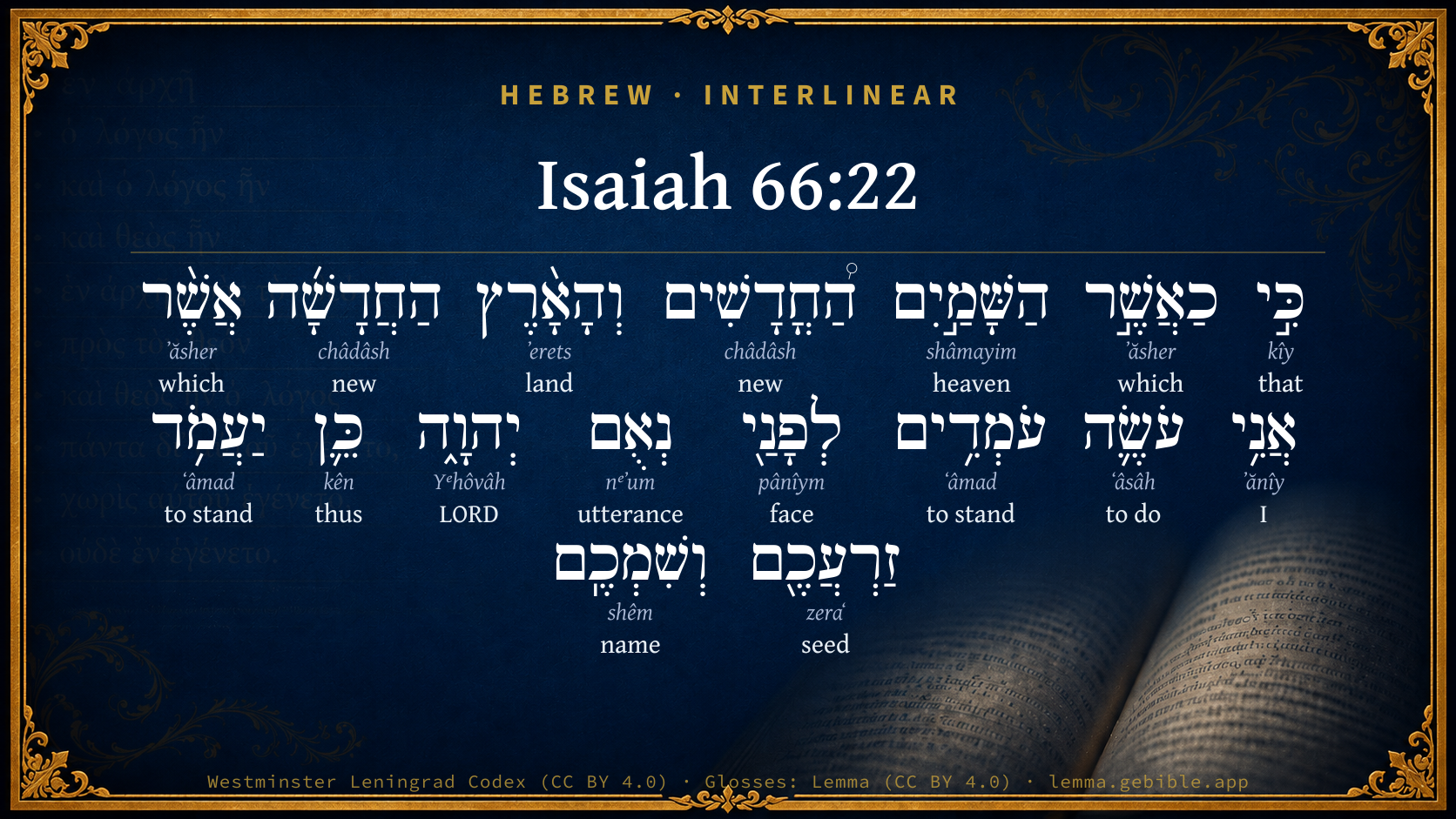
Isaiah 66:22

Hebrew (Westminster Leningrad Codex) Isaiah 66:22 appears in the Hebrew Old Testament. The text above is from the Westminster Leningrad Codex. Each word links to its Strong’s number, a concise gloss, and parsing drawn from the Open Scriptures Hebrew Bible morphology. Click any word for its full Brown-Driver-Briggs (BDB) entry.
Download image
Cite this verse

Isaiah 66:22 (World English Bible). Public Domain. Lemma interlinear Bible study tool, https://lemma.gebible.app/v/isaiah/66/22.

Show BibTeX & RIS
BibTeX
RIS
English Translation
For as the new heavens and the new earth, which I will make, shall remain before me, says Yahweh, so shall your seed and your name remain.
World English Bible · Public Domain
Download a study sheet

One document with this verse’s original text, its word-by-word gloss line, the meaning frame, cross-references with their text, attributed commentary, and full source and license credits — printable, and it pastes into notes with its structure intact.

This verse Autodidact and up

Study sheet (.html) Plain text (.txt)

A passage Seminary Student

Up to 50 verses in one chapter. A passage sheet keeps up to 6 commentary sources and 12 cross-references per verse, in the order this page ranks them, and says so on the sheet whenever that leaves anything out. Ask for a single verse and you get the Autodidact verse sheet above.

Everything on this page stays free to read, with no account — the sheet is a download of what is already on screen, not access to it.

Want to remove ads? Support Godless Engineer
Compare translations 3

The same verse in 3 English versions, stacked beneath the original-language interlinear above. Click any original word for its lexicon entry.

Each is an independent rendering of the whole verse — the interlinear is not word-aligned to these translations.

Highlighted words mark where these versions differ — a whole-verse word diff, not a word-by-word alignment.

  • World English Bible Public Domain
    For as the new heavens and the new earth, which I will make, shall remain before me, says Yahweh, so shall your seed and your name remain.
  • King James Version Public Domain
    For as the new heavens and the new earth, which I will make, shall remain before me, saith the LORD, so shall your seed and your name remain.
  • unfoldingWord Literal Text CC BY-SA 4.0
    “For just as the new heavens and the new earth that I am making are standing to my face”—the declaration of Yahweh— “thus your seed and your name will stand.

unfoldingWord Literal Text — © unfoldingWord, licensed CC BY-SA 4.0. Word-aligned USFM3 via Door43 (git.door43.org/unfoldingWord/en_ult).

Versions to compare (up to 4)

3 of 4 selected

Show all 18 translations

Every available English version of this verse, each an independent rendering of the whole verse.

  • World English Bible Public Domain
    For as the new heavens and the new earth, which I will make, shall remain before me, says Yahweh, so shall your seed and your name remain.
  • Berean Standard Bible Public Domain
    “For just as the new heavens and the new earth, which I will make, will endure before Me,” declares the LORD, “so your descendants and your name will endure.
  • Majority Standard Bible Public Domain
    “For just as the new heavens and the new earth, which I will make, will endure before Me,” declares the LORD, “so your descendants and your name will endure.
  • King James Version Public Domain
    For as the new heavens and the new earth, which I will make, shall remain before me, saith the LORD, so shall your seed and your name remain.
  • American Standard Version (1901) Public Domain
    For as the new heavens and the new earth, which I will make, shall remain before me, saith Jehovah, so shall your seed and your name remain.
  • Revised Version (1885) Public Domain
    For as the new heavens and the new earth, which I will make, shall remain before me, saith the LORD, so shall your seed and your name remain.
  • Geneva Bible (1599) Public Domain
    For as the newe heauens, and the newe earth which I will make, shall remaine before me, saith the Lord, so shall your seede and your name continue.
  • Douay-Rheims (1899) Public Domain
    For as the new heavens, and the new earth, which I will make to stand before me, saith the Lord: so shall your seed stand, and your name.
  • Young's Literal Translation Public Domain
    For, as the new heavens and the new earth that I am making, Are standing before Me, An affirmation of Jehovah! So remain doth your seed and your name.
  • Literal Standard Version CC BY-SA 4.0
    “For as the new heavens and the new earth that I am making, || Are standing before Me,” || A declaration of YHWH, || “So your seed and your name remain.
  • Unlocked Literal Bible CC BY-SA 4.0
    For just as the new heavens and the new earth that I will make will remain before me—this is Yahweh's declaration—so your descendants will remain, and your name will remain.
  • unfoldingWord Literal Text CC BY-SA 4.0
    “For just as the new heavens and the new earth that I am making are standing to my face”—the declaration of Yahweh— “thus your seed and your name will stand.
  • Darby Bible Public Domain
    For as the new heavens and the new earth which I will make shall remain before me, saith Jehovah, so shall your seed and your name remain.
  • World Messianic Bible Public Domain
    “For as the new heavens and the new earth, which I will make, shall remain before me,” says the LORD, “so your offspring and your name shall remain.
  • Webster's Bible Public Domain
    For as the new heavens and the new earth, which I will make, shall remain before me, saith the LORD, so shall your seed and your name remain.
  • Free Bible Version CC BY-SA 4.0
    As the new heavens and the new earth, which I will make, will last forever, so your descendants and your reputation will also last forever, says the Lord.
  • Bible in Basic English Public Domain
    For as the new heaven and the new earth which I will make will be for ever before me, says the Lord, so will your seed and your name be for ever.
  • JPS Tanakh (1917) Public Domain
    For as the new heavens and the new earth, which I will make, shall remain before Me, saith the LORD, so shall your seed and your name remain.

Literal Standard Version (2020), Covenant Press — licensed CC BY-SA 4.0. Text via the HelloAO Bible API (eBible.org). Unlocked Literal Bible (unfoldingWord) — licensed CC BY-SA 4.0. Text via the HelloAO Bible API (eBible.org). unfoldingWord Literal Text — © unfoldingWord, licensed CC BY-SA 4.0. Word-aligned USFM3 via Door43 (git.door43.org/unfoldingWord/en_ult). Free Bible Version, Dr. Jonathan Gallagher — licensed CC BY-SA 4.0. Text via the HelloAO Bible API (eBible.org).

Word by word

More ways to search: Search by grammar → Find every occurrence → Compare this word →

Practice this passage: Drill this verse → Learn its vocabulary →

הַ֠חֳדָשִׁים
châdâsh
H2319
“the · new”
Particle, Definite Article + Adjective, Adjective, Masculine, Plural, Absolute
Part of Speech
Particle + Adjective
Type
Adjective
Gender
Masculine
Number
Plural
State
Absolute
Full BDB Definition

Origin: from H2318

TWOT: 613a

new, new thing, fresh
  1. כִּ֣י kîy H3588 “that” Conjunction
  2. כַאֲשֶׁ֣ר ʼăsher H834 “like/as · which” Preposition + Particle, Relative
  3. הַשָּׁמַ֣יִם shâmayim H8064 “the · heaven(s)” Particle, Definite Article + Noun, Common, Masculine, Plural, Absolute
  4. וְהָאָ֨רֶץ ʼerets H776 “and · the · land” Conjunction + Particle, Definite Article + Noun, Common, Both, Singular, Absolute
  5. הַחֲדָשָׁ֜ה châdâsh H2319 “the · new” Particle, Definite Article + Adjective, Adjective, Feminine, Singular, Absolute
  6. אֲשֶׁ֨ר ʼăsher H834 “which” Particle, Relative
  7. אֲנִ֥י ʼănîy H589 “I” Pronoun, Personal, 1st Person, Common, Singular
  8. עֹשֶׂ֛ה ʻâsâh H6213 “doing” Verb, Qal, Participle Active, Masculine, Singular, Absolute
  9. עֹמְדִ֥ים ʻâmad H5975 “standing” Verb, Qal, Participle Active, Masculine, Plural, Absolute
  10. לְפָנַ֖י pânîym H6440 “to/for · face(s) · my” Preposition + Noun, Common, Both, Plural, Construct + Suffix, Personal, 1st Person, Common, Singular
  11. נְאֻם nᵉʼum H5002 “utterance of” Noun, Common, Masculine, Singular, Construct
  12. יְהוָ֑ה Yᵉhôvâh H3068 “LORD” Noun, Proper
  13. כֵּ֛ן kên H3651 “thus” Particle, Demonstrative
  14. יַעֲמֹ֥ד ʻâmad H5975 “to stand” Verb, Qal, Imperfect, 3rd Person, Masculine, Singular
  15. זַרְעֲכֶ֖ם zeraʻ H2233 “seed · your” Noun, Common, Masculine, Singular, Construct + Suffix, Personal, 2nd Person, Masculine, Plural
  16. וְשִׁמְכֶֽם shêm H8034 “and · name · your” Conjunction + Noun, Common, Masculine, Singular, Construct + Suffix, Personal, 2nd Person, Masculine, Plural

About this verse

These counts appear in no published source. They are computed here, from the morphology-tagged text and Lemma’s own curated glosses. What Lemma adds →

17
words
14
distinct lemmas
Prophets
section

Shared distinctive vocabulary

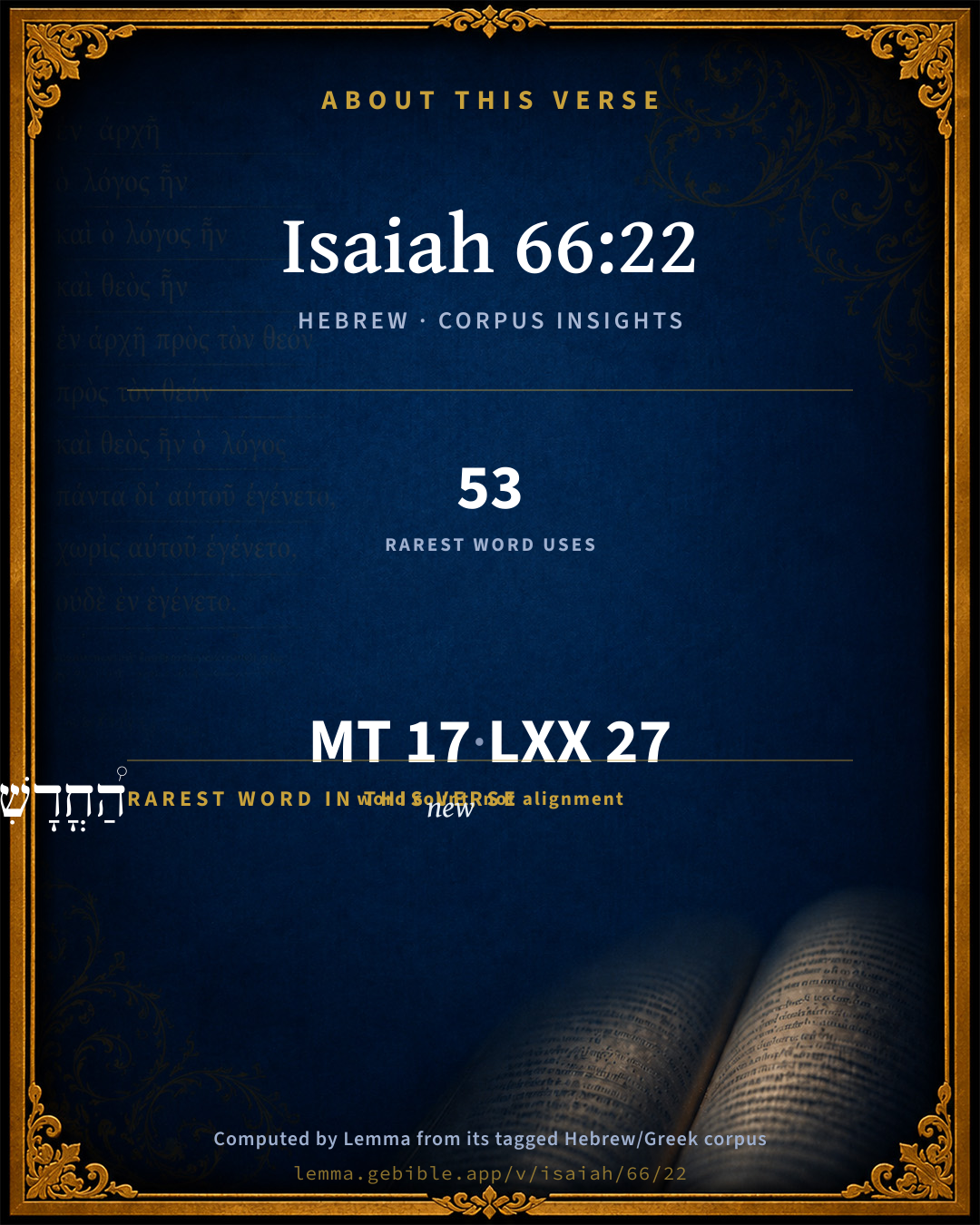
הַ֠חֳדָשִׁים new H2319 occurs in 48 verses of the Hebrew Bible. Also found in:

Grammatical profile

  • 3 verbs
  • 7 nouns
  • 2 adjectives
  • 1 pronoun
  • 1 conjunction
  • 3 particles

Verb forms

  • עֹשֶׂ֛ה Qal · Participle Active
  • עֹמְדִ֥ים Qal · Participle Active
  • יַעֲמֹ֥ד Qal · Imperfect

Repetition

Words recur within this verse — often emphatic in Hebrew:

  • הַ֠חֳדָשִׁים new H2319 ×2
  • עֹמְדִ֥ים to stand H5975 ×2
  • כַאֲשֶׁ֣ר which H834 ×2

Hebrew & Septuagint length

In English translation the verse runs 27 words from the Hebrew and 26 from the Septuagint (LXX English) — closely comparable.

A rough comparison of the two English renderings, which tokenize alike — not a word-level alignment.

Word counts can differ between the Hebrew and the Greek without any difference in meaning — e.g. the Hebrew direct-object marker אֵת has no separate Greek word, and Greek often adds the article ὁ.

In the original languages it is 17 Hebrew tokens and 27 Greek tokens — but the two are counted differently (Hebrew bundles its prefixes and suffixes into one token; the Greek is in lemma form), so that isn’t a like-for-like length.

Cross-references

7

Topical passages linked to Isaiah 66:22 in the Treasury of Scripture Knowledge — connected by theme and wording, ordered by reader-vote popularity; previews shown in the World English Bible.

  • Isaiah 65:17 For, behold, I create new heavens and a new earth; and the former things shall not be remembered, nor come into mind.
  • 2 Peter 3:13 But, according to his promise, we look for new heavens and a new earth, in which dwells righteousness.
  • Revelation 21:1 I saw a new heaven and a new earth: for the first heaven and the first earth have passed away, and the sea is no more.
  • John 10:27–29 My sheep hear my voice, and I know them, and they follow me.
  • 1 Peter 1:4–5 to an incorruptible and undefiled inheritance that doesn't fade away, reserved in heaven for you,
  • Matthew 28:20 teaching them to observe all things that I commanded you. Behold, I am with you always, even to the end of the age." Amen.
  • Hebrews 12:26–28 whose voice shook the earth, then, but now he has promised, saying, "Yet once more I will shake not only the earth, but also the heavens."

Cross-references courtesy of OpenBible.info (CC BY 4.0).

Hebrew and Greek witnesses Masoretic Hebrew ↔ Greek Septuagint

The same verse in the two great witnesses to the Old Testament, shown verse-for-verse.

These are two independent witnesses, not word-aligned to each other, and the Septuagint is shown in lemma (dictionary) form.

Hebrew Isaiah 66:22 Masoretic · Westminster Leningrad Codex

כִּ֣י כַאֲשֶׁ֣ר הַשָּׁמַ֣יִם הַ֠חֳדָשִׁים וְהָאָ֨רֶץ הַחֲדָשָׁ֜ה אֲשֶׁ֨ר אֲנִ֥י עֹשֶׂ֛ה עֹמְדִ֥ים לְפָנַ֖י נְאֻם יְהוָ֑ה כֵּ֛ן יַעֲמֹ֥ד זַרְעֲכֶ֖ם וְשִׁמְכֶֽם

For as the new heavens and the new earth, which I will make, shall remain before me, says Yahweh, so shall your seed and your name remain.

World English Bible · Public Domain

Greek LXX Isaiah 66:22 Septuagint · lemma form

ὅς τρόπος γάρ ὁ οὐρανός καινός καί ὁ γῆ καινός ὅς ἐγώ ποιέω μένω ἐνώπιον ἐγώ λέγω κύριος οὕτως ἵστημι ὁ σπέρμα σύ καί ὁ ὄνομα σύ

For as the new heaven and the new earth, which I make, remain before me, says the Lord, so shall your seed and your name continue.

LXX2012 (modern English Septuagint) · Public Domain

Hebrew: Westminster Leningrad Codex (CC BY 4.0). Greek: Septuagint (public domain); English from LXX2012 (modern English Septuagint) (Public Domain). How the Septuagint differs from the Hebrew →

Targum (Aramaic paraphrase)

1

The Targum is the ancient Jewish Aramaic paraphrase of the Hebrew Scriptures — an interpretive translation, not the Hebrew text itself. Onkelos (literal) and Pseudo-Jonathan (expansive) render the Torah, and Jonathan the Prophets. Coverage is partial: where no permissively-licensed English translation exists for a verse, only the Aramaic is shown. This is verse-level text, not a word-by-word alignment to the Hebrew.

  1. Targum Jonathan Prophets (Joshua–Malachi)
    אֲרֵי כְּמָא דִשְׁמַיָא חַדְתִּין וְאַרְעָא חַדְתָּא דַאֲנָא עָבִיד קַיְמִין קֳדָמַי אֲמַר יְיָ כֵּן יִתְקַיֵם זַרְעֲכוֹן וְשׁוּמְכוֹן:

    For as the new heavens and the new earth, which I will make, shall remain before me, saith the Lord, thus shall your seed and your name be made to remain.

    Targum Jonathan — Aramaic: “Mikraot Gedolot” (public domain). English: “Sefaria Community Translation” (CC0 1.0 (public-domain dedication)); “London "Chaldee Paraphrase," 1871” (public domain). Text via Sefaria.

Commentary

Notes on Isaiah 66:22 from classic Christian and Jewish commentators (each source and its license shown beneath its notes). The classic Christian expositions comment on the surrounding passage and are grouped to its opening verse, so a note may address several verses; the Jewish commentaries on the Tanakh (Rashi and others) are per-verse, so they appear only where the commentator wrote on this verse.

Lemma curates 59 commentaries, every one of them public domain or Creative Commons licensed, each selected and text-cleaned for this edition rather than reprinted as found. About our sources →

Trapp's Complete Commentary

John Trapp

Isa 66:22 For as the new heavens and the new earth, which I will make, shall remain before me, saith the LORD, so shall your seed and your name remain.

Ver. 22. For as the new heavens.] So shall there be a true Church and a ministry for the good of my people to the world’s end. It shall not be taken away, as is the Jewish polity and hierarchy.

John Trapp, A Commentary or Exposition upon All the Books of the Old and New Testament (1647–1656) — public domain. Text from a community e-Sword module.

The Biblical Illustrator

Joseph S. Exell

Isa_66:22

For as the new heavens and the new earth

The perpetuity of the true Israel

The bulk of the heathen world and also of Israel perish, but Israels name and seed, i.. Israel as a nation with the same ancestors and an independent name, remains for ever (cf. Jer_31:35 f.; 33:20-26), as the new heaven and the new earth. And just because Israels calling in regard to the heathen world is now fulfilled and all things are made new, the old fencing off of Israel from the heathen now comes to an end; and what qualifies for priestly and Levitical service in Gods temple is no longer mere natural descent, but inner nobility The prophet thus represents to himself the Church of the future on a new earth and under a new heaven; but he is unable to represent the eternal in the form of eternity; he represents it to himself merely as an unending continuation of temporal history (Isa_66:23). (F. Delitzch, D. D.)

A figure of the spiritual

The thought of Isa_56:7 is here (verse 23) expressed by a figure, which, understood literally, involves a physical impossibility; but the prophet cannot altogether emancipate himself from the forms of the Jewish economy, and clothes a spiritual truth in a garb which in strictness is too narrow for it (cf. Zec_14:16-19). (Prof. S. R. Driver, D. D.)

The stability of the Christian Church

(with Isa_60:20-21):--The Christian Church is not the conqueror of the Jewish polity, but the heir and successor. The new covenant has been developed out of the old. There was no break when Christ came, but a fulfilment and a completion. And so the promises were handed down in the Christian line, among which these from the latter part of Isaiah, relating to the stability of the ancient Church, are not the least remarkable. They declare that God is an everlasting light to His people, that their permanence is like the permanence of the creation of God. (T. D. Woolsey.)

The Christian Church not a human institution

The permanence of the Christian Church in the world, if it be a fact, is unlike all facts of history. Everything human decays and passes away. All institutions, forms of government, civilizations, have their day and decline. No one doubts that the old religions of India and its castes are doomed to perish. We cannot, therefore, be assured from history that Christianity may not perish also. Still when you look at its origin, its power of growth, its vitality, when everything around was dead; its changes of form joined to unchangeableness of principle; its power to correct evils within its pale; its predominance among the influences that act on mankind; its universal character, and its consciousness--so to speak--that the world is its own, you cannot feel it to be otherwise than quite probable that it is to be mans guide to the end of time. (T. D. Woolsey.)

The history of the Church augurs its permanence

Though history is not prophecy, though it cannot with authority predict the universal and final sway of Christs Gospel and of Christian institutions, it reveals, at the least, a working power, a tenacity of life, a hopefulness, a benevolent energy which are not inconsistent with stability and with continuance until the end of time. (T. D. Woolsey.)

The stability of the Christian Church

I. WE SHALL LOOK AT SEVERAL CAUSES TO WHICH IT IS NOT DUE: but to which, on a superficial view, it might be ascribed.

1. It is not owing to strength borrowed from governments, the Church grew without help from the government; it grew also in spite of long efforts of the government to destroy it.

2. For is the stability of the Church due to the stability of its forms of discipline and order. These have passed through a great variety of changes, from the times of the nascent Church, when there was little of established order, down through the ages of hierarchy, to our times, when the Church thrives in a great variety of forms, and with varied theories of government.

3. Nor yet is the stability of the Church owing to the stability of theological systems. It grew, it almost reigned, before any received dogmatic statements of its sacred truth were current. It has outlived theories and expositions innumerable, and indeed nothing connected with Christianity has been more changing than the scientific arrangements of its truths.

4. Nor can the stability of the Church be explained by saying that it got the control of opinion and kept thought in leading strings, so that when science was emancipated, new conditions full of danger to the Church began. It arose in spite of a reigning heathen opinion and philosophy, which it overthrew and put another in the place. It has in its healthiest state favoured all knowledge in the confidence of being itself together with every other true thing from God.

5. Nor can the stability of the Church be attributed to the condescending patronage of large-minded men, who saw in its justice and humanity a help for the world to be found nowhere else, but yet did not believe in it themselves.

II. TO WHAT, THEN, IS THE STABILITY OF THE CHURCH DUE? To this question it is no sufficient answer that the Holy Spirit is ever in and with the Church. For the Spirits office is to act on men according to the laws of character by Divine realities. It is due--

1. To this: that the Gospel, on which the Church is built, works out some of the great problems which lie on the heart of man, in a way to give lasting peace and satisfaction to the soul. I refer to practical rather than to intellectual problems, although even the restless questionings of the mind either meet with an answer from the Divine oracles, or are carried up into a higher realm of truth. The power inherent in Christianity itself, as a way of reconciling God and man, and of raising man above sin by great truths and great hopes, is a real and permanent power. It is suited to all natures and capacities, to all races and times.

2. To those permanent features of the Gospel, which bind men together in a brotherhood pervaded by the spirit of love and fellowship.

3. To its self-reforming capacity. The human and the Divine have ever mingled and will ever mingle in the historical progress of Christianity, as they mingle in the development of a Christian life. There are unavoidable sources of corruption in the revolutions of society, in the growth of wealth, in the love of self-gratification, in the increase of worldly comforts. There are other sources in the ignorance of untrained Christians, in the ambition of the clergy and their love of dominion, in the rewards offered within the Church to the aspiring, in formalism, in a dead orthodoxy. At the lowest ebb of Christian life and knowledge there remain within the reach of the Church the sources of a better spiritual state, so that it can reform itself as it has done more than once.

(1) As long as the Bible is acknowledged as an authority, there is an appeal to it from all other authorities, from popes, and councils, and philosophers, and the current opinion of the time.

(2) There are at the times of greatest declension men who arc somehow led, as we believe, by the Divine Spirit concurring with the Word, into a deeper experience; they rise above their times, they reach convictions which are irrepressible, they must proclaim to the world at any cost what they found out as the resting-places of their souls; they become the starting-points of a reform which sweeps over all Christian nations.

4. The stability of the Church is ensured by the stability of Christ. Jesus Christ, the same yesterday, to-day and for ever. Doubt is of to day, but He is of all time. He is a permanent possession for the soul. He does not wear out in a lifetime. He is the permanent possession of the Church in all its ages and changes He does not wear out while there are men to long for redemption. (T. D. Woolsey.)

The Biblical Illustrator, edited by Joseph S. Exell (c. 1880s–1900s) — public domain. Text from a community e-Sword module.

Joseph Benson's Commentary

Isa 66:22-23. For as the new heavens, &c. — The new state of the church to be raised up under the Messiah; shall remain before me — Unalterable. As the gospel dispensation is to be continued till the end of time, and not to be succeeded by any other; as it shall therefore remain, because it is before me, under my eye, my care, and special protection; so shall your seed and your name remain — A seed of ministers, a seed of Christians. As one generation of both passeth away, another generation shall come, and thus the name of Christ, with that of Christians, shall continue on earth while the earth remains, and his throne as the days of heaven! The gates of hell, though they fight against the church, shall not prevail against it, nor wear out the saints of the Most High: for there shall be a daily succession of true believers for the upholding of it; for, if believers could fail from the earth, the church, made up of them only, as the true members of it, must fail also. And from one new-moon to another, &c. — In the gospel church there shall be as constant and settled a course of worship, (though of another nature,) as ever was in the Jewish Church. This is described in expressions suited to the Old Testament dispensation, to show that, though the ceremonial law should be abolished, and the temple service at an end, yet God should be still as regularly, statedly, and acceptedly worshipped as ever. Heretofore the Jews were only obliged to appear three times in a year at the place of God’s public worship, but, saith the prophet, in the gospel church people shall worship from one new moon to another, and from one sabbath to another — They shall be perpetually employed in serving and glorifying him, although in different ways. Their state shall be one continued festival. And whereas, under the former dispensation, the Jews only were bound to attend God’s worship at the great feasts, and of them only the males; now, under the new dispensation, all flesh, Gentiles as well as Jews, women as well as men, shall come and worship before God — That is, shall worship in his presence, though not in his temple at Jerusalem, but in religious assemblies dispersed all over the world, which shall be to them as the tabernacle of meeting was to the Jews: God will in them record his name; and, though but two or three come together, he will be in the midst of them, will meet and bless them.

Joseph Benson's Commentary on the Old and New Testaments (1811–1818) — public domain. Text from a community e-Sword module.

Tyndale Open Study Notes

Tyndale Open Resources

66:22 always be my people: God’s promise to Abraham was secure (Gen 17:7; see also Gal 3:8, 14). • a name that will never disappear: The identity of this new people will last forever (see Isa 59:21).

Tyndale Open Study Notes — © Tyndale Open Resources, licensed CC BY-SA 4.0. Text via the HelloAO Bible API.

Geneva Bible (1599)

Geneva Bible translators

Hereby he signifieth the kingdom of Christ wherein his Church shall be renewed, and whereas before there were appointed seasons to sacrifice, in this there shall be one continual Sabbath, so that all times and seasons shall be meet.

Geneva Bible (1599) marginal notes — public domain. Text via Bolls.life.

Jamieson, Fausset & Brown

Robert Jamieson, A. R. Fausset & David Brown

(Isa 65:17; Pe2 3:13; Rev 21:1).

Jamieson, Fausset & Brown — Commentary Critical and Explanatory on the Whole Bible (1871) — public domain (CC PDM 1.0). Text via the HelloAO Bible API.

Ellicott's Commentary for English Readers

(22) As the new heavens and the new earth . . .—The transformation of Isa_65:17 is pre-supposed, but that future kingdom of God shall perpetuate the historical continuity of that which has preceded it. Israel (the prophet’s range of vision seems limited to the outward Israel, while St. Paul extends it to the spiritual) shall still exist. The ideal represented by that name will have an indestructible vitality.

A Bible Commentary for English Readers, edited by Charles John Ellicott (1878–1897) — public domain. Text from a community e-Sword module.

The Cambridge Bible for Schools and Colleges

gen. ed. J. J. S. Perowne

22. Comp. Jer_31:35 f., Jer_33:25 f.

the new heavens and the new earth] ch. Isa_65:17.

The Cambridge Bible for Schools and Colleges (gen. ed. J. J. S. Perowne; Cambridge University Press, 1878–1918) — public domain. Text from a community e-Sword module.

John Gill's Exposition

For as the new heavens, and the new earth, which I will make,.... Not "have made"; for this is not to be understood of the heavens and the earth made new in the beginning, and which continue so without any change or alteration; though sometimes the perpetuity of the church, which is here predicted, is set forth by the duration of those, Psa 89:36 but either of the new state of things under the Gospel dispensation, which still continues, promised Isa 65:15, or rather, since that would be an illustration of it by the same thing in different words, it may be interpreted literally of the new heavens and the new earth, which will be made when the present ones shall wax old and perish, and be no more, as in the New Jerusalem state, Pe2 3:10,

shall remain before me, saith the Lord; these shall continue, not only throughout the Millennium, or thousand years' reign, but for ever:

so shall your seed and your name remain; not the natural seed of believers; all have not such seed, and they that have, they are not all converted persons; but the spiritual "seed" of the church, born in her, and brought up by her; which shall continue in successive generations to the end of time, notwithstanding the persecutions of men, and the craft of false teachers, and the reproaches and banters of a vain world, Psa 22:30, and their "name" also; the name of Christ they name and confess, and that is called upon them, and from whence they are called Christians; this shall endure as long as the sun, Psa 72:17 or the new name of sons and daughters of the Almighty; or their fame and glory, the memory of them; they shall be had in everlasting remembrance, Psa 112:6.

John Gill's Exposition of the Whole Bible (1746–1763) — public domain (CC PDM 1.0). Text via the HelloAO Bible API.

Albert Barnes' Notes on the Bible

For as the new heavens and the new earth - (See the notes at Isa 65:17).

Shall remain before me - They shall not pass away and be succeeded by others. The idea is, that the state of things here described would be permanent and abiding.

So shall your seed and your name remain - (See the notes at Isa 65:15).

Albert Barnes' Notes on the Bible (1834–1885) — public domain. Text from a community e-Sword/MySword module.

Haydock's Catholic Bible Commentary

Name. The faith and morals of Christianity shall subsist for ever, like the gospel, which is termed the new heavens, chap. lxv. 17., and Matthew xvi. 18.

George Leo Haydock (1774–1849), Haydock's Catholic Family Bible and Commentary, 1859 edition — public domain. Excludes Psalms (Douay-Rheims chapter numbering differs from Protestant) and Deuterocanonical books (Catholic canon only).

Matthew Poole's English Annotations

This whole verse is only a promise of the perpetuity of the gospel church, and the not failing of the additions to it of such as shall be saved till the world shall have an end.

The new heavens and the new earth; the new state of the church to be raised up under the Messias. As I intend that shall abide, so there shall be a daily succession of true believers for the upholding of it; for if believers could fail from the earth, the church, made up of them only, as the true members of it, must fail also.

Matthew Poole's English Annotations on the Holy Bible (1683–1685) — public domain. Text from a community e-Sword/MySword module.

The Pulpit Commentary

As the new heavens and the new earth, which I will make, shall remain. The "new heavens and the new earth," once created, continue for ever. (comp. Rev_21:1-27 Rev_22:1-5) So shall your seed and your name remain. This statement is usually taken to be a promise of some special pre-eminence to the Jew over the Gentile in the final kingdom of the redeemed. But St. Paul speaks of all such privileges as already abolished in his day; (Col_3:11) and, if the priesthood is to be common to both Gentile and Jew, the principle of equality would seem to be conceded. Perhaps no more is here meant than that, as the "new heaven and new earth" will always remain, so there will always remain a seed of true believers to worship God in them.

Vers. 22-24. Eternal suffering and eternal glory.

Holy Scripture sets before us,. as Moses set before the people of Israel in the wilderness, a tremendous alternative and death;" one the eternal foil and counterpart of the other, with the exhortation a thousand times repeated in a thousand different forms life". (Deu_30:19) Man"s desire is to separate what God has inseparably connected, and to retain "everlasting life," "eternal glory," endless bliss," but to get rid altogether of their counterparts suffering," "everlasting contempt," "endless death." But man cannot alter the system of God"s universe, nor, could he do so, is it to be supposed that he would find himself able to improve it. Deep down in the nature of things lies the eternal antagonism between good and evil an antagonism which would seem to be necessary to the very existence of good in created beings; and the teaching of Scripture clearly is that this antagonism continues for ever. (see Dan_12:2 Mat_25:46 Mar_9:44 Joh_5:29 Rev_20:10, 15 21:8 22:11, 15) Of the nature of the eternal glory and the eternal suffering reserved for souls in the world to come, it is impossible for us in this life to have anything more than a dim and faint conception. But some points may be laid down negatively.

I THE PAINS AND JOYS ARE NOT, NECESSARILY, IN ANY SENSE MATERIAL. For

(1) they exist in the intermediate state, (Luk_16:23-25) where men have no bodies, the resurrection not having as yet taken place; and

(2) they are described by contra dictory material images, which would certainly not have been the case had the descriptions been intended literally.

II THE PAINS AND JOYS ARE OF VARIOUS DEGREES OF INTENSITY. For

(1) we hear of "few stripes" and "many stripes," of rule over "five cities" and over "ten cities"; (Luk_12:47, 48 19:17, 19) and

(2) we are told that the rewards and punishments shall be apportioned exactly according to men"s deserts, and men"s deserts vary infinitely by infinitesimal degrees.

III THE MAIN PUNISHMENT OF MANY MAY NOT CONSIST IN POSITIVE PAIN AT ALL. Mediaeval divines spoke of many souls in the place of punishment as suffering only the paena damni, or "sense of loss" inseparable from being shut out from God"s presence, from the presence of the holy angels, and from that of the spirits of just men made perfect. This is quite possible, and in no way contradictory to the statements of Scripture.

IV THERE MAY NOT IMPROBABLY BE AN AMELIORATION IN THE CONDITION OF SOME OF THE SUFFERERS. It cannot but be the case that the sufferers may bear their punishment with different degrees of patience, of obduracy, or of rebellion. As the determinedly rebellious would deserve, and may receive, an augmentation of punishment, so the more submissive and patient may conceivably have their burdens lightened. The very act of submission lightens the weight of a suffering, and a merciful God might be expected to show his approval of the submission by some positive alleviation of the pain.

These are thoughts which may tend to mitigate the horror wherewith some persons regard the entire doctrine of eternal punishment, and prevent them from viewing it as incompatible with God"s essential attribute of mercy. At the same time, it must be granted that the whole subject is mysterious, and awful in the extreme so mysterious and so awful that the greatest caution is needed lest we dogmatize upon it beyond the teaching of Scripture. Here, if anywhere, the warning of the preacher applies, "Be not rash with thy mouth, and let not thine heart be hasty to utter anything before God: for God is in heaven, and thou on earth: therefore let thy words be few". (Ecc_5:2)

The Pulpit Commentary (1880–1919), ed. H.D.M. Spence-Jones & Joseph S. Exell — public domain. Text from a community e-Sword module.

John Wesley's Explanatory Notes

The new heavens - The new state of the church to be raised up under the Messiah. Remain - As I intend that shall abide, so there shall be a daily succession of true believers for the upholding of it.

John Wesley, Explanatory Notes Upon the Whole Bible (1754–1765) — public domain. Text via the GEBible commentary corpus.

Keil & Delitzsch

C. F. Keil & F. Delitzsch

"For as the new heaven and the new earth, which I am about to make, continue before me, saith Jehovah, so will your family and your name continue." The great mass of the world of nations and of Israel also perish; but the seed and name of Israel, i.e., Israel as a people with the same ancestors and an independent name, continues for ever, like the new heaven and the new earth; and because the calling of Israel towards the world of nations is now fulfilled and everything has become new, the former fencing off of Israel from other nations comes to an end, and the qualification for priesthood and Levitical office in the temple of God is no longer merely natural descent, but inward nobility. The new heaven and the new earth, God's approaching creation (quae facturus sum), continue eternally before Him (lephânai as in Isa 49:16), for the old ones pass away because they do not please God; but these are pleasing to Him, and are eternally like His love, whose work and image they are. The prophet here thinks of the church of the future as being upon a new earth and under a new heaven. But he cannot conceive of the eternal in the form of eternity; all that he can do is to conceive of it as the endless continuance of the history of time.

Keil & Delitzsch — Biblical Commentary on the Old Testament (1861–1891) — public domain (CC PDM 1.0). Text via the HelloAO Bible API. (Old Testament only.)

J. A. Alexander on Isaiah

Joseph Addison Alexander

“For as the new heavens and the new earth, which I am making (or about to make), are standing (or about to stand) before me, saith Jehovah, so shall stand your name and your seed.” To the reference of the preceding verse to the Gentiles it is urged as one objection, that the verse before us does not give a reason for the promise so explained; for how could it be said that God would put them on a level with the Jews because the name and succession of the latter were to be perpetual? But this objection rests upon the false assumption, running through the whole interpretation of this book, that the promise is addressed to Israel as a nation; whereas it is addressed to Israel as a church, from which the natural descendants of Jacob for the most part have been cut off, and the object of this verse is to assure the church that notwithstanding this excision it should still continue to exist, not only as a church, but as the church, the identical body which was clothed in the forms of the old dispensation, and which still survives when they are worn out and rejected. The grand error incident to a change of dispensations was the very one which has perverted and obscured the meaning of these prophecies, the error of confounding the two Israels whom Paul so carefully distinguishes, and of supposing that the promises given to the church when externally identified with one race are continued to that race even after its excision from the church. It was to counteract this very error that the verse before us was recorded, in which God’s people, comprehending a remnant of the natural Israel and a vast accession from the Gentiles, are assured that God regards them as his own chosen people, not a new one, but the same that was of old, and that the very object of the great revolution, here and elsewhere represented as a new creation, was to secure their perpetuity and constant recognition as His people. Since then He creates a new heaven and a new earth for this very purpose, that purpose cannot be defeated while these heavens and that earth endure. The Jews themselves understand this as a promise that their national pre-eminence shall be perpetual.

Joseph Addison Alexander, The Prophecies of Isaiah (1846–1847; New York: Scribner, 1870–1878) — public domain. Text from a community e-Sword module.

unfoldingWord translationNotes

Door43 World Missions Community

the new heavens and the new earth

See how you translated this in Isaiah 65:17.

this is Yahweh's declaration

Yahweh speaks of himself by name to express the certainty of what he is declaring. Translate as in Isaiah 30:1. AT: "this is what Yahweh has declared" or "this is what I, Yahweh, have declared" (See: First, Second, or Third Person)

translationWords

heaven

earth

Yahweh

declare

descend

name

Sabbath

bow

unfoldingWord translationNotes — © Distant Shores Media and the Door43 World Missions Community, licensed CC BY-SA 4.0. Source: git.door43.org/Door43/en_tn.

Ibn Ezra

Rabbi Abraham ibn Ezra

The new heavens. I have already explained this expression (65:17).

עמדים Shall remain, shall not be destroyed, as their predecessors have been. Before me. Before God, who is the first, cause of all existing things.

And your name shall remain, so that it will not be blotted out; or, it has the same meaning as your seed, and is a mere repetition of the same idea. Comp. To Jacob and to Israel (Num. 23:23)

Ibn Ezra on the Tanakh — English translations: “Sefaria Community Translation” (CC0 1.0 (public-domain dedication)); “Yalkut, Sifsei Chachomim Chumash, Metsudah Publications, 2009” (CC BY 4.0); and “Commentary of Ibn Ezra on Isaiah - trans. by M. Friedlander, 1873” (public domain). Text via Sefaria.

Lesson kit

Teaching starters — assembled from the data on this page, not authored interpretation. Every prompt links to the verse data it draws on. Edit before teaching.

Isaiah, in the Prophets, opens this verse with 17 words (14 distinct Hebrew lemmas). Its most distinctive word is châdâsh (“new”). A historical commentator’s framing appears above. Read the whole chapter for the surrounding context.

Discussion questions

  1. What does “new” (châdâsh) contribute to the verse as a whole?
  2. How does Exodus 1:8, which shares the word «new», read alongside this verse?
  3. What does the repetition of “new” (2× in this one verse) do in this verse?
  4. The translations on this page render this verse differently — a whole-verse word diff, not a word-by-word alignment. What might account for the different wordings?
  5. «עֹשֶׂ֛ה» is a Qal Participle Active verb. How does that grammatical form shape the action described?
  6. Compare how Trapp's Complete Commentary and The Biblical Illustrator read this verse. Where do they agree or differ?

Things to notice

Reading settings

Reading text

Shown beneath each verse's original-language words.

Old Testament
Old Testament edition

Read the OT as the Masoretic Hebrew (MT) or the Greek Septuagint (LXX).

English shown for the Greek Septuagint (in the Hebrew ↔ Greek comparison).

Comparing translations? Open the Compare panel on any verse page to stack up to four side by side.