Nehemiah 10:30

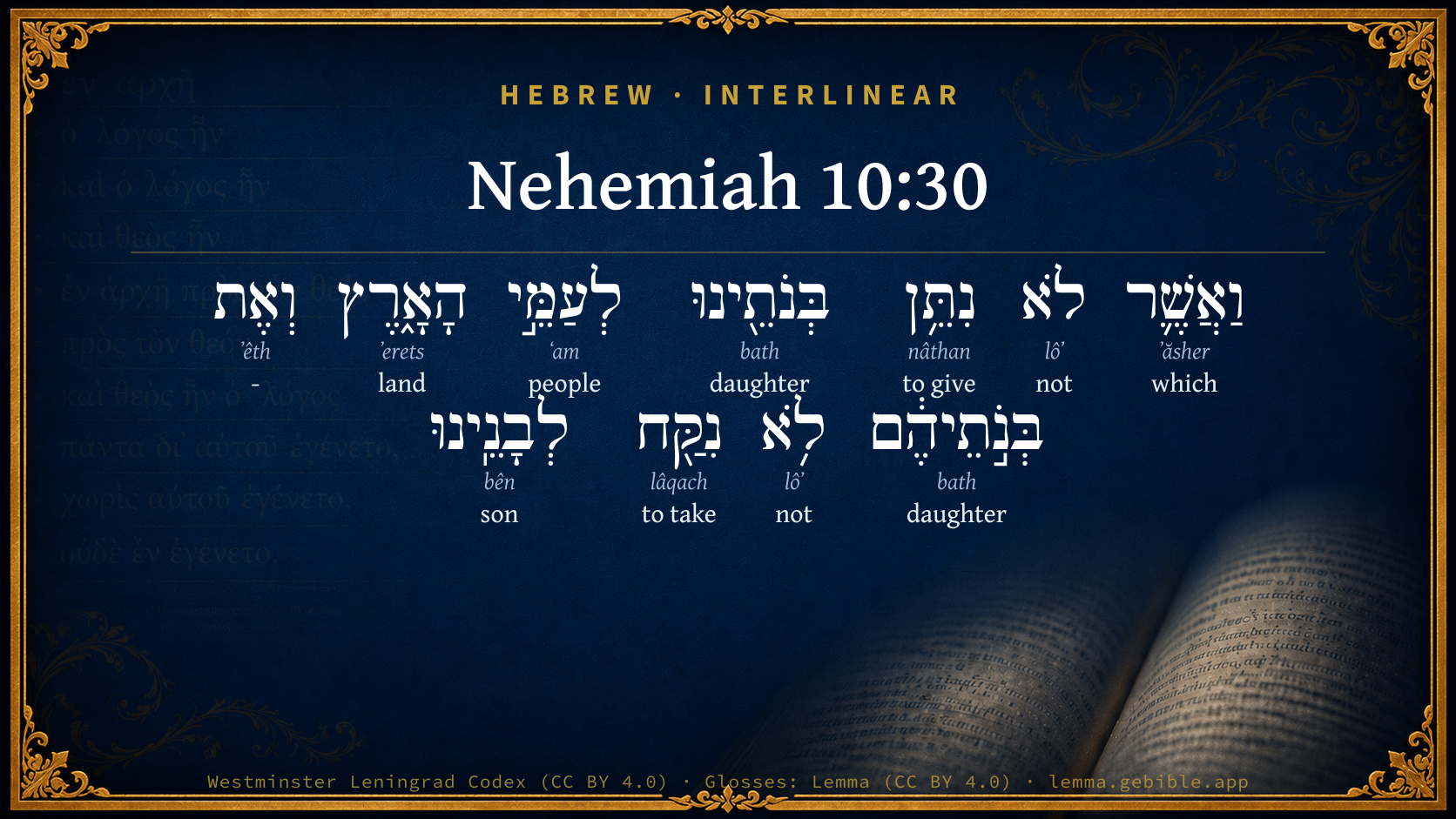
Hebrew (Westminster Leningrad Codex) Nehemiah 10:30 appears in the Hebrew Old Testament. The text above is from the Westminster Leningrad Codex. Each word links to its Strong’s number, a concise gloss, and parsing drawn from the Open Scriptures Hebrew Bible morphology. Click any word for its full Brown-Driver-Briggs (BDB) entry.
Download image
Cite this verse

Nehemiah 10:30 (World English Bible). Public Domain. Lemma interlinear Bible study tool, https://lemma.gebible.app/v/nehemiah/10/30.

Show BibTeX & RIS
BibTeX
RIS
English Translation
and that we would not give our daughters to the peoples of the land, nor take their daughters for our sons;
World English Bible · Public Domain
Download a study sheet

One document with this verse’s original text, its word-by-word gloss line, the meaning frame, cross-references with their text, attributed commentary, and full source and license credits — printable, and it pastes into notes with its structure intact.

This verse Autodidact and up

Study sheet (.html) Plain text (.txt)

A passage Seminary Student

Up to 50 verses in one chapter. A passage sheet keeps up to 6 commentary sources and 12 cross-references per verse, in the order this page ranks them, and says so on the sheet whenever that leaves anything out. Ask for a single verse and you get the Autodidact verse sheet above.

Everything on this page stays free to read, with no account — the sheet is a download of what is already on screen, not access to it.

Want to remove ads? Support Godless Engineer
Compare translations 3

The same verse in 3 English versions, stacked beneath the original-language interlinear above. Click any original word for its lexicon entry.

Each is an independent rendering of the whole verse — the interlinear is not word-aligned to these translations.

Highlighted words mark where these versions differ — a whole-verse word diff, not a word-by-word alignment.

  • World English Bible Public Domain
    and that we would not give our daughters to the peoples of the land, nor take their daughters for our sons;
  • King James Version Public Domain
    And that we would not give our daughters unto the people of the land, not take their daughters for our sons:
  • unfoldingWord Literal Text CC BY-SA 4.0
    and that we would not give our daughters to the peoples of the land, and we would not take their daughters for our sons;

unfoldingWord Literal Text — © unfoldingWord, licensed CC BY-SA 4.0. Word-aligned USFM3 via Door43 (git.door43.org/unfoldingWord/en_ult).

Versions to compare (up to 4)

3 of 4 selected

Show all 18 translations

Every available English version of this verse, each an independent rendering of the whole verse.

  • World English Bible Public Domain
    and that we would not give our daughters to the peoples of the land, nor take their daughters for our sons;
  • Berean Standard Bible Public Domain
    We will not give our daughters in marriage to the people of the land, and we will not take their daughters for our sons.
  • Majority Standard Bible Public Domain
    We will not give our daughters in marriage to the people of the land, and we will not take their daughters for our sons.
  • King James Version Public Domain
    And that we would not give our daughters unto the people of the land, not take their daughters for our sons:
  • American Standard Version (1901) Public Domain
    and that we would not give our daughters unto the peoples of the land, nor take their daughters for our sons;
  • Revised Version (1885) Public Domain
    and that we would not give our daughters unto the peoples of the land, nor take their daughters for our sons:
  • Geneva Bible (1599) Public Domain
    And that we would not giue our daughters to the people of the lande, neither take their daughters for our sonnes.
  • Douay-Rheims (1899) Public Domain
    And that we would not give our daughters to the people of the land, not take their daughters for our sons.
  • Young's Literal Translation Public Domain
    and that we give not our daughters to the peoples of the land, and their daughters we take not to our sons;
  • Literal Standard Version CC BY-SA 4.0
    and that we do not give our daughters to the peoples of the land, and we do not take their daughters to our sons;
  • Unlocked Literal Bible CC BY-SA 4.0
    We promised that we would not give our daughters to the people of the land or take their daughters for our sons.
  • unfoldingWord Literal Text CC BY-SA 4.0
    and that we would not give our daughters to the peoples of the land, and we would not take their daughters for our sons;
  • Darby Bible Public Domain
    and that we would not give our daughters to the peoples of the land, nor take their daughters for our sons:
  • World Messianic Bible Public Domain
    and that we would not give our daughters to the peoples of the land, nor take their daughters for our sons;
  • Webster's Bible Public Domain
    And that we would not give our daughters to the people of the land, nor take their daughters for our sons:
  • Free Bible Version CC BY-SA 4.0
    “We promise not to allow our daughters to marry the people of the land, and not to allow our sons to marry their daughters.
  • Bible in Basic English Public Domain
    And that we would not give our daughters to the peoples of the lands, or take their daughters for our sons;
  • JPS Tanakh (1917) Public Domain
    (10-31) and that we would not give our daughters unto the peoples of the land, nor take their daughters for our sons;

Literal Standard Version (2020), Covenant Press — licensed CC BY-SA 4.0. Text via the HelloAO Bible API (eBible.org). Unlocked Literal Bible (unfoldingWord) — licensed CC BY-SA 4.0. Text via the HelloAO Bible API (eBible.org). unfoldingWord Literal Text — © unfoldingWord, licensed CC BY-SA 4.0. Word-aligned USFM3 via Door43 (git.door43.org/unfoldingWord/en_ult). Free Bible Version, Dr. Jonathan Gallagher — licensed CC BY-SA 4.0. Text via the HelloAO Bible API (eBible.org).

Word by word

More ways to search: Search by grammar → Find every occurrence → Compare this word →

Practice this passage: Drill this verse → Learn its vocabulary →

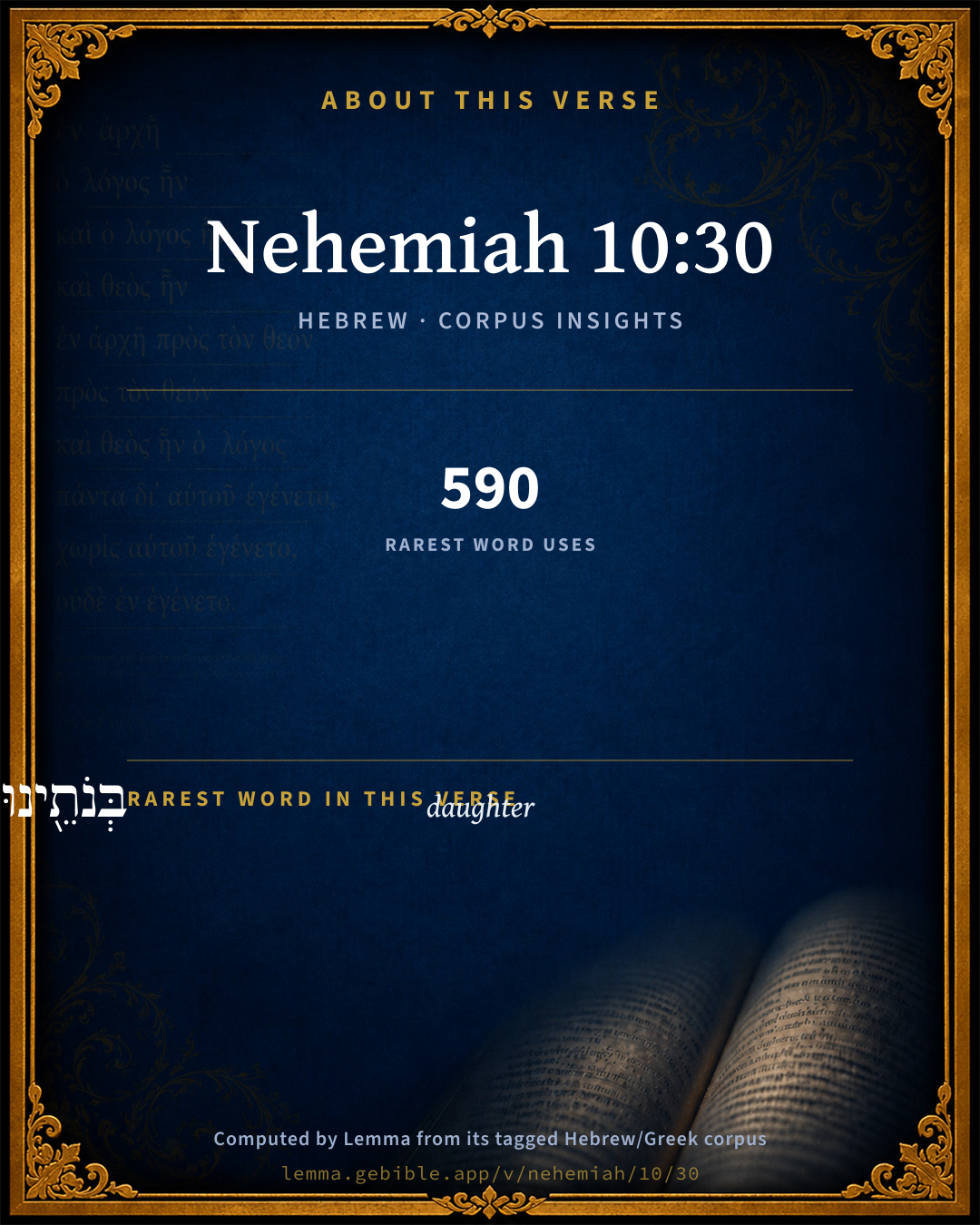
בְּנֹתֵ֖ינוּ
bath
H1323
“daughters · our”
Noun, Common, Feminine, Plural, Construct + Suffix, Personal, 1st Person, Common, Plural
Part of Speech
Noun
Type
Common
Gender
Feminine
Number
Plural
State
Construct
Full BDB Definition

Origin: from H1129 and H1121

TWOT: 254b

daughter (noun feminine) - daughter, girl, adopted daughter, daughter-in-law, sister, granddaughters, female child, cousin - as polite address - as designation of women of a particular place (noun proper feminine) - young women, women (noun feminine) - as personification - daughter-villages - description of character
  1. וַאֲשֶׁ֛ר ʼăsher H834 “and · which” Conjunction + Particle, Relative
  2. לֹא lôʼ H3808 “not” Particle, Negative
  3. נִתֵּ֥ן nâthan H5414 “to give” Verb, Qal, Imperfect, 1st Person, Common, Plural
  4. לְעַמֵּ֣י ʻam H5971 “to/for · peoples of” Preposition + Noun, Common, Masculine, Plural, Construct
  5. הָאָ֑רֶץ ʼerets H776 “the · land” Particle, Definite Article + Noun, Common, Both, Singular, Absolute
  6. וְאֶת ʼêth H853 “and · -” Conjunction + Particle, Direct Object
  7. בְּנֹ֣תֵיהֶ֔ם bath H1323 “daughters · their” Noun, Common, Feminine, Plural, Construct + Suffix, Personal, 3rd Person, Masculine, Plural
  8. לֹ֥א lôʼ H3808 “not” Particle, Negative
  9. נִקַּ֖ח lâqach H3947 “to take” Verb, Qal, Imperfect, 1st Person, Common, Plural
  10. לְבָנֵֽינוּ bên H1121 “to/for · sons · our” Preposition + Noun, Common, Masculine, Plural, Construct + Suffix, Personal, 1st Person, Common, Plural

About this verse

These counts appear in no published source. They are computed here, from the morphology-tagged text and Lemma’s own curated glosses. What Lemma adds →

11
words
9
distinct lemmas
Historical
section

Grammatical profile

  • 2 verbs
  • 5 nouns
  • 4 particles

Verb forms

  • נִתֵּ֥ן Qal · Imperfect
  • נִקַּ֖ח Qal · Imperfect

Repetition

Words recur within this verse — often emphatic in Hebrew:

  • בְּנֹתֵ֖ינוּ daughter H1323 ×2
  • לֹא not H3808 ×2

Cross-references

5

Topical passages linked to Nehemiah 10:30 in the Treasury of Scripture Knowledge — connected by theme and wording, ordered by reader-vote popularity; previews shown in the World English Bible.

  • Deuteronomy 7:3 neither shall you make marriages with them; your daughter you shall not give to his son, nor his daughter shall you take to your son.
  • Exodus 34:16 and you take of their daughters to your sons, and their daughters play the prostitute after their gods, and make your sons play the prostitute after their gods.
  • Ezra 9:1–3 Now when these things were done, the princes drew near to me, saying, The people of Israel, and the priests and the Levites, have not separated themselves from the peoples of the lands, [doing] according to their abominations, even of the Canaanites, the Hittites, the Perizzites, the Jebusites, the Ammonites, the Moabites, the Egyptians, and the Amorites.
  • Ezra 9:12–14 now therefore don't give your daughters to their sons, neither take their daughters to your sons, nor seek their peace or their prosperity forever; that you may be strong, and eat the good of the land, and leave it for an inheritance to your children forever.
  • Ezra 10:10–12 Ezra the priest stood up, and said to them, You have trespassed, and have married foreign women, to increase the guilt of Israel.

Cross-references courtesy of OpenBible.info (CC BY 4.0).

Hebrew and Greek witnesses Masoretic Hebrew ↔ Greek Septuagint

The same verse in the two great witnesses to the Old Testament, shown verse-for-verse.

These are two independent witnesses, not word-aligned to each other, and the Septuagint is shown in lemma (dictionary) form.

Hebrew Nehemiah 10:30 Masoretic · Westminster Leningrad Codex

וַאֲשֶׁ֛ר לֹא נִתֵּ֥ן בְּנֹתֵ֖ינוּ לְעַמֵּ֣י הָאָ֑רֶץ וְאֶת בְּנֹ֣תֵיהֶ֔ם לֹ֥א נִקַּ֖ח לְבָנֵֽינוּ

and that we would not give our daughters to the peoples of the land, nor take their daughters for our sons;

World English Bible · Public Domain

Greek LXX Structure differs

The Septuagint has no separate book of Nehemiah. Its Greek text is the second half of Esdras B (2 Esdras), chapters 11–23; Ezra is the first half (1–10).

A verse-for-verse comparison isn’t shown here because the chapters and verses don’t line up. Switch to the LXX edition with the MT / LXX toggle above to read the Greek directly.

Hebrew: Westminster Leningrad Codex (CC BY 4.0). Greek: Septuagint (public domain); English from a public-domain English Septuagint. How the Septuagint differs from the Hebrew →

Commentary

Notes on Nehemiah 10:30 from classic Christian and Jewish commentators (each source and its license shown beneath its notes). The classic Christian expositions comment on the surrounding passage and are grouped to its opening verse, so a note may address several verses; the Jewish commentaries on the Tanakh (Rashi and others) are per-verse, so they appear only where the commentator wrote on this verse.

Lemma curates 59 commentaries, every one of them public domain or Creative Commons licensed, each selected and text-cleaned for this edition rather than reprinted as found. About our sources →

Trapp's Complete Commentary

John Trapp

Neh 10:30 And that we would not give our daughters unto the people of the land, nor take their daughters for our sons:

Ver. 30. And that we would not give our daughters] This is the first particular branch of the covenant, that they would make no inter-marriages with the heathen; as knowing the snare that herein Satan laid for their souls. In the first sentence against man, this cause is expressed, Because you obeyed the voice of your wife, &c. By the rib, as by a ladder, Satan oft climbs to the heart, and corrupts it, as Gregory hath it. O wives (saith another)! the most sweet poison, the most desired evil in the world, &c. Make a wise choice, therefore. The heathen well saith, that every man, when he marrieth, brings either a good or an evil spirit into his house, and so makes it either a heaven or a hell.

John Trapp, A Commentary or Exposition upon All the Books of the Old and New Testament (1647–1656) — public domain. Text from a community e-Sword module.

Joseph Benson's Commentary

Neh 10:30. And that we would not give our daughters — Namely, in marriage. Having sworn obedience to God’s laws in the general, they now specify some particular instances, wherein they had lately transgressed, or were most prone to transgress. In our covenants with God, we should engage particularly against those sins that we have been most frequently overtaken in and injured by.

Joseph Benson's Commentary on the Old and New Testaments (1811–1818) — public domain. Text from a community e-Sword module.

Tyndale Open Study Notes

Tyndale Open Resources

10:30-39 Although the community had committed itself broadly to all the instructions in the law of Moses, some specific issues were being addressed in this commitment. These issues related to maintaining the purity of the community and worship at the Temple.

10:30 Cp. Ezra 9–10.

Tyndale Open Study Notes — © Tyndale Open Resources, licensed CC BY-SA 4.0. Text via the HelloAO Bible API.

Adam Clarke's Commentary

Verse 30. Not give our daughters] Make no affinity with the people of the land.

Adam Clarke's Commentary on the Bible (1810–1826) — public domain. Text from a community e-Sword/MySword module.

The Cambridge Bible for Schools and Colleges

gen. ed. J. J. S. Perowne

30. Prohibition of Intermarriage with the Heathen

we] Observe the first person plural here introduced and maintained to Neh_10:39 throughout the rest of the Covenant details.

people] R.V. peoples.

This prohibition of intermarriage with the people of the land had been strenuously upheld by Ezr_9:2. (See note.) The difficulty of enforcing it appears from Neh_13:23-28. The words of the prohibition seem to be based on Deu_7:3 ‘Neither shalt thou make marriages with them; thy daughter thou shalt not give unto his son, nor his daughter shalt thou take unto thy son.’ Cf. Exo_34:16; Jos_23:12; Jdg_3:6.

It is to be noticed that the so-called Priestly Code gives no such prohibition unless it is implied in Gen_26:35; nor is it found in the central legislative portion of Deut. (12–26).

The Covenant introduces no new enactment, but affirms the Deuteronomic teaching which itself appears to be an expansion of the oldest law in Exo_23:32-33, ‘Thou shalt make no covenant with them, nor with their gods. They shall not dwell in thy land, lest they make thee sin against me.’

The Cambridge Bible for Schools and Colleges (gen. ed. J. J. S. Perowne; Cambridge University Press, 1878–1918) — public domain. Text from a community e-Sword module.

John Gill's Exposition

And that we would not give our daughters unto the people of the land, nor take their daughters for our sons,.... Intermarry with them as they had done, and were prone to do, and even did after this, Neh 13:23.

.

Nehemiah 10:31

neh 10:31

neh 10:31

neh 10:31And if the people of the land bring ware,.... Any thing to be sold, any sort of goods, that being sold might be taken away, as the word signifies:

or any victuals on the sabbath day to sell; anything to make food of; wheat or barley, as Aben Ezra interprets it; the same word is rendered corn; see Gill on Gen 42:1; to sell which was not lawful on the sabbath day, see Amo 8:5

that we would not buy it of them on the sabbath, or on the holy day; any festival, as the feast of the passover, pentecost, and tabernacles:

and that we would leave the seventh year: the ground untilled in that year, the vines unpruned, and the fruits of the earth, which sprung of themselves, for the poor to gather, Lev 25:4,

and the exaction of every debt; that they would not demand the payment of any debt on the seventh year, as the law required they should not, Deu 15:2.

John Gill's Exposition of the Whole Bible (1746–1763) — public domain (CC PDM 1.0). Text via the HelloAO Bible API.

Haydock's Catholic Bible Commentary

And. In all covenants, the articles which have been chiefly broken, are specified. (Worthington)

George Leo Haydock (1774–1849), Haydock's Catholic Family Bible and Commentary, 1859 edition — public domain. Excludes Psalms (Douay-Rheims chapter numbering differs from Protestant) and Deuterocanonical books (Catholic canon only).

Matthew Poole's English Annotations

We would not give our daughters, to wit, in marriage. Having sworn obedience to God’s laws in the general, they now do so to some particulars, wherein they had lately transgressed, or were most prone to transgress.

Matthew Poole's English Annotations on the Holy Bible (1683–1685) — public domain. Text from a community e-Sword/MySword module.

The Pulpit Commentary

That we would not give our daughters, etc. On the recurrence of the mixed marriages so soon after the reformation of Ezra, see the comment on Neh_13:23.

The Pulpit Commentary (1880–1919), ed. H.D.M. Spence-Jones & Joseph S. Exell — public domain. Text from a community e-Sword module.

unfoldingWord translationNotes

Door43 World Missions Community

General Information:

In these verses, the people describe the content of the oath they were making in Nehemiah 10:29.

would not give our daughters to the people of the land or take their daughters for our sons

This means that they would not allow their sons and daughters to marry them. AT: "would not give our daughters to marry the people of the land or take their daughters to marry our sons" (See: Assumed Knowledge and Implicit Information)

the people of the land

This refers to the people who live in their land who do not worship Yahweh. AT: "the people of this land who do not worship Yahweh" (See: Assumed Knowledge and Implicit Information)

We promised ... we would not give ... we would not buy ... we will let ... we will cancel

The pronoun "we" here includes Nehemiah and the Jewish people, but not the reader of this book. (See: Exclusive and Inclusive "We")

seventh year

"year 7" (See: Ordinal Numbers)

we will let our fields rest

This is an idiom. AT: "we will not plow our fields" or "we will not grow anything in our fields" (See: Idiom)

we will cancel all debts

This means that they will not require that people pay them what they owe. AT: "we will cancel all debts that people owe us" or "we will tell people that they no longer have to pay us back"

translationWords

promise

people group

son

grain

Sabbath

holy

rest

unfoldingWord translationNotes — © Distant Shores Media and the Door43 World Missions Community, licensed CC BY-SA 4.0. Source: git.door43.org/Door43/en_tn.

Rashi

Rabbi Shlomo Yitzchaki (Rashi)

with their brethen Heb. עַל אֲחֵיהֶם with their brothers.

their noblemen the great ones among them.

Rashi on the Tanakh — English translations: “The Judaica Press complete Tanach with Rashi, translated by A. J. Rosenberg” (CC BY 4.0); “Pentateuch with Rashi's commentary by M. Rosenbaum and A.M. Silbermann, 1929-1934” (public domain); “The Metsudah Tanach series, Lakewood, N.J” (CC BY 4.0); and “The Book of Joshua, Metsudah Publications, 1997” (CC BY 4.0). Text via Sefaria.

Lesson kit

Teaching starters — assembled from the data on this page, not authored interpretation. Every prompt links to the verse data it draws on. Edit before teaching.

Nehemiah, in the Historical, opens this verse with 11 words (9 distinct Hebrew lemmas). Its most distinctive word is bath (“daughter”). A historical commentator’s framing appears above. Read the whole chapter for the surrounding context.

Discussion questions

  1. How does “daughter” (bath) shape what this verse is saying?
  2. How does Deuteronomy 7:3, which shares this passage’s theme, read alongside this verse?
  3. What does the repetition of “daughter” (2× in this one verse) do in this verse?
  4. These translations render this verse differently; the difference is in the English rendering, not the original. What questions does that raise?
  5. «נִתֵּ֥ן» is a Qal Imperfect verb. How does that grammatical form shape the action described?
  6. Compare how Trapp's Complete Commentary and Joseph Benson's Commentary read this verse. Where do they agree or differ?

Things to notice

  • These translations choose different wording for 2 words in this verse.
  • “daughter” occurs 2× in this single verse.
  • 9 distinct Hebrew lemmas span 11 words in this verse.

Reading settings

Reading text

Shown beneath each verse's original-language words.

Old Testament
Old Testament edition

Read the OT as the Masoretic Hebrew (MT) or the Greek Septuagint (LXX).

English shown for the Greek Septuagint (in the Hebrew ↔ Greek comparison).

Comparing translations? Open the Compare panel on any verse page to stack up to four side by side.