
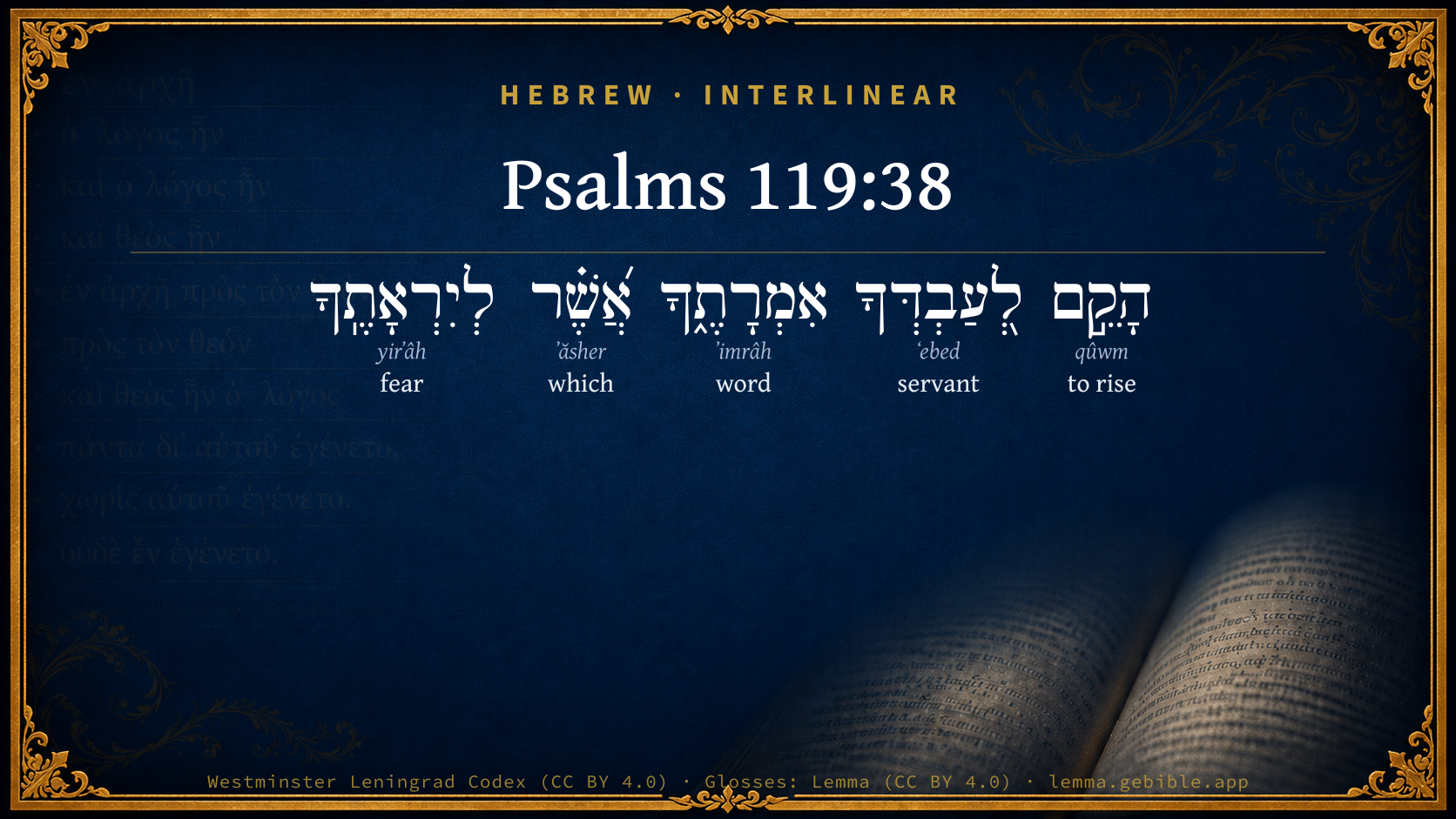
Psalms 119:38

Hebrew (Westminster Leningrad Codex) Psalms 119:38 appears in the Hebrew Old Testament. The text above is from the Westminster Leningrad Codex. Each word links to its Strong’s number, a concise gloss, and parsing drawn from the Open Scriptures Hebrew Bible morphology. Click any word for its full Brown-Driver-Briggs (BDB) entry.
Download image
Cite this verse

Psalms 119:38 (World English Bible). Public Domain. Lemma interlinear Bible study tool, https://lemma.gebible.app/v/psalms/119/38.

Show BibTeX & RIS
BibTeX
RIS
English Translation
Fulfill your promise to your servant, That you may be feared.
World English Bible · Public Domain
Download a study sheet

One document with this verse’s original text, its word-by-word gloss line, the meaning frame, cross-references with their text, attributed commentary, and full source and license credits — printable, and it pastes into notes with its structure intact.

This verse Autodidact and up

Study sheet (.html) Plain text (.txt)

A passage Seminary Student

Up to 50 verses in one chapter. A passage sheet keeps up to 6 commentary sources and 12 cross-references per verse, in the order this page ranks them, and says so on the sheet whenever that leaves anything out. Ask for a single verse and you get the Autodidact verse sheet above.

Everything on this page stays free to read, with no account — the sheet is a download of what is already on screen, not access to it.

Want to remove ads? Support Godless Engineer
Compare translations 3

The same verse in 3 English versions, stacked beneath the original-language interlinear above. Click any original word for its lexicon entry.

Each is an independent rendering of the whole verse — the interlinear is not word-aligned to these translations.

Highlighted words mark where these versions differ — a whole-verse word diff, not a word-by-word alignment.

  • World English Bible Public Domain
    Fulfill your promise to your servant, That you may be feared.
  • King James Version Public Domain
    Stablish thy word unto thy servant, who is devoted to thy fear.
  • unfoldingWord Literal Text CC BY-SA 4.0
    Fulfill for your servant your word, which for the fear of you.

unfoldingWord Literal Text — © unfoldingWord, licensed CC BY-SA 4.0. Word-aligned USFM3 via Door43 (git.door43.org/unfoldingWord/en_ult).

Versions to compare (up to 4)

3 of 4 selected

Show all 17 translations

Every available English version of this verse, each an independent rendering of the whole verse.

  • World English Bible Public Domain
    Fulfill your promise to your servant, That you may be feared.
  • Berean Standard Bible Public Domain
    Establish Your word to Your servant, to produce reverence for You.
  • Majority Standard Bible Public Domain
    Establish Your word to Your servant, to produce reverence for You.
  • King James Version Public Domain
    Stablish thy word unto thy servant, who is devoted to thy fear.
  • American Standard Version (1901) Public Domain
    Confirm unto thy servant thy word, Which `is in order' unto the fear of thee.
  • Revised Version (1885) Public Domain
    Confirm thy word unto thy servant, which belongeth unto the fear of thee.
  • Geneva Bible (1599) Public Domain
    Stablish thy promise to thy seruaunt, because he feareth thee.
  • Young's Literal Translation Public Domain
    Establish to Thy servant Thy saying, That `is' concerning Thy fear.
  • Literal Standard Version CC BY-SA 4.0
    Establish Your saying to Your servant, || That [is] concerning Your fear.
  • Unlocked Literal Bible CC BY-SA 4.0
    Carry out for your servant your promise that you made to those who honor you.
  • unfoldingWord Literal Text CC BY-SA 4.0
    Fulfill for your servant your word, which for the fear of you.
  • Darby Bible Public Domain
    Establish thy ùword unto thy servant, who is [devoted] to thy fear.
  • World Messianic Bible Public Domain
    Fulfill your promise to your servant, that you may be feared.
  • Webster's Bible Public Domain
    Establish thy word to thy servant, who is devoted to thy fear.
  • Free Bible Version CC BY-SA 4.0
    Please keep your promise to me, your servant, that you made to those who worship you.
  • Bible in Basic English Public Domain
    Give effect to your word to your servant, in whose heart is the fear of you.
  • JPS Tanakh (1917) Public Domain
    Confirm Thy word unto Thy servant, which pertaineth unto the fear of Thee.

Literal Standard Version (2020), Covenant Press — licensed CC BY-SA 4.0. Text via the HelloAO Bible API (eBible.org). Unlocked Literal Bible (unfoldingWord) — licensed CC BY-SA 4.0. Text via the HelloAO Bible API (eBible.org). unfoldingWord Literal Text — © unfoldingWord, licensed CC BY-SA 4.0. Word-aligned USFM3 via Door43 (git.door43.org/unfoldingWord/en_ult). Free Bible Version, Dr. Jonathan Gallagher — licensed CC BY-SA 4.0. Text via the HelloAO Bible API (eBible.org).

Word by word

More ways to search: Search by grammar → Find every occurrence → Compare this word →

Practice this passage: Drill this verse → Learn its vocabulary →

About this verse

These counts appear in no published source. They are computed here, from the morphology-tagged text and Lemma’s own curated glosses. What Lemma adds →

5
words
5
distinct lemmas
Wisdom
section

Shared distinctive vocabulary

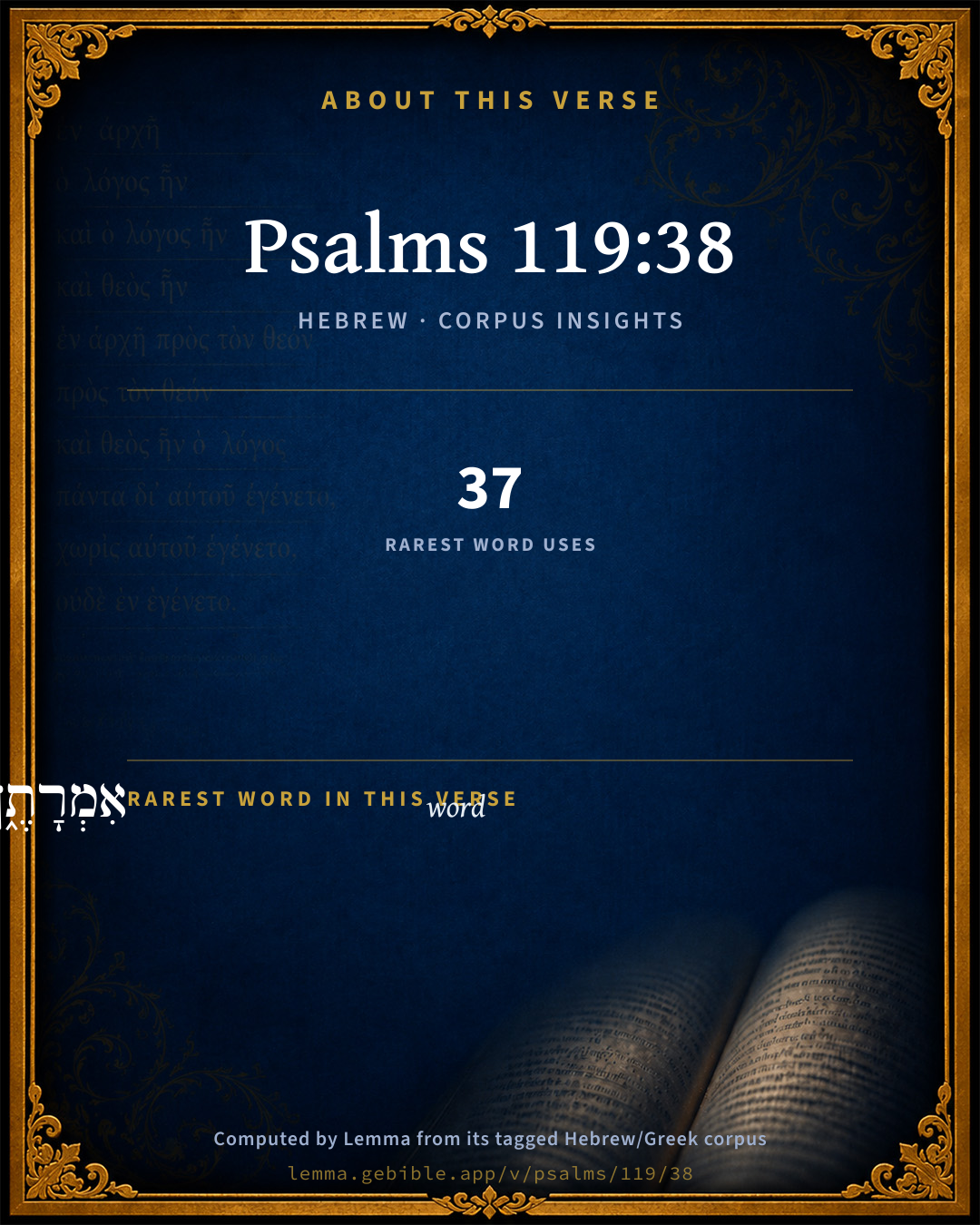
אִמְרָתֶ֑ךָ word H565 occurs in 35 verses of the Hebrew Bible. Also found in:

Grammatical profile

  • 1 verb
  • 3 nouns
  • 1 particle

Verb forms

  • הָקֵ֣ם Hiphil · Imperative

Hebrew & Septuagint length

In English translation the verse runs 11 words from the Hebrew and 11 from the Septuagint (LXX English) — the same length.

A rough comparison of the two English renderings, which tokenize alike — not a word-level alignment.

Word counts can differ between the Hebrew and the Greek without any difference in meaning — e.g. the Hebrew direct-object marker אֵת has no separate Greek word, and Greek often adds the article ὁ.

Cross-references

9

Topical passages linked to Psalms 119:38 in the Treasury of Scripture Knowledge — connected by theme and wording, ordered by reader-vote popularity; previews shown in the World English Bible.

  • Jeremiah 32:39–41 and I will give them one heart and one way, that they may fear me forever, for the good of them, and of their children after them:
  • Psalms 147:11 Yahweh takes pleasure in those who fear him, In those who hope in his loving kindness.
  • Psalms 103:17 But Yahweh's loving kindness is from everlasting to everlasting with those who fear him, His righteousness to children's children;
  • 2 Corinthians 1:20 For however many are the promises of God, in him is the "Yes." Therefore also through him is the "Amen," to the glory of God through us.
  • 2 Samuel 7:25–29 Now, Yahweh God, the word that you have spoken concerning your servant, and concerning his house, confirm you it forever, and do as you have spoken.
  • Psalms 103:11 For as the heavens are high above the earth, So great is his loving kindness toward those who fear him.
  • Psalms 103:13 Like a father has compassion on his children, So Yahweh has compassion on those who fear him.
  • Psalms 119:49 Remember your word to your servant, Because you gave me hope.
  • Psalms 145:19 He will fulfill the desire of those who fear him. He also will hear their cry, and will save them.

Cross-references courtesy of OpenBible.info (CC BY 4.0).

Hebrew and Greek witnesses Masoretic Hebrew ↔ Greek Septuagint

The same verse in the two great witnesses to the Old Testament, shown verse-for-verse.

You’re reading Greek Psalm 118 (Hebrew Psalm 119). The Septuagint counts the superscription, so verse numbers can differ from the Hebrew — chapter-level alignment, not verse-by-verse. Numbering follows Rahlfs.

These are two independent witnesses, not word-aligned to each other, and the Septuagint is shown in lemma (dictionary) form.

Hebrew Psalms 119:38 Masoretic · Westminster Leningrad Codex

הָקֵ֣ם לְ֭עַבְדְּךָ אִמְרָתֶ֑ךָ אֲ֝שֶׁ֗ר לְיִרְאָתֶֽךָ

Fulfill your promise to your servant, That you may be feared.

World English Bible · Public Domain

Greek LXX Greek Psalm 118:38 Septuagint · lemma form

ἵστημι ὁ δοῦλος σύ ὁ λόγιον σύ εἰς ὁ φόβος σύ

Confirm your oracle to your servant, that he may fear you.

LXX2012 (modern English Septuagint) · Public Domain

On this verse, Ellicott's Commentary for English Readers discusses the Septuagint’s reading. Read the note in Commentary ↓

Hebrew: Westminster Leningrad Codex (CC BY 4.0). Greek: Septuagint (public domain); English from LXX2012 (modern English Septuagint) (Public Domain). How the Septuagint differs from the Hebrew →

Commentary

Notes on Psalms 119:38 from classic Christian and Jewish commentators (each source and its license shown beneath its notes). The classic Christian expositions comment on the surrounding passage and are grouped to its opening verse, so a note may address several verses; the Jewish commentaries on the Tanakh (Rashi and others) are per-verse, so they appear only where the commentator wrote on this verse.

Lemma curates 59 commentaries, every one of them public domain or Creative Commons licensed, each selected and text-cleaned for this edition rather than reprinted as found. About our sources →

Trapp's Complete Commentary

John Trapp

Psa 119:38 Stablish thy word unto thy servant, who [is devoted] to thy fear.

Ver. 38. Stablish thy word unto thy servant] i.e. Make good thy promise; we must by our prayers put the promises of God in suit, and God will perform them.

Who is devoted to thy fear] And so am an heir of the promises. Or, which (word) is (given) for the fear of thee, that thou mayest be feared.

John Trapp, A Commentary or Exposition upon All the Books of the Old and New Testament (1647–1656) — public domain. Text from a community e-Sword module.

The Biblical Illustrator

Joseph S. Exell

Psa_119:38

Stablish Thy Word unto Thy servant, who is devoted to Thy fear.

Confirmation

By the Word here, some understand simply the promise of God. But, in truth, the meaning is far larger, and comprehends the whole Word of Gods revelation--truth, precept, command, judgment, promise--he prays for the confirmation or stablishment of the whole.

I. In respect to its truth. Are there any serious intellectual doubts about the Word of God? About its Divine origin? its inspiration? its great doctrines? These doubts must be dealt with in their own nature, and for what they are. As they affect a mans mind he must meet them with his mind--he must examine the evidences which have been adduced for the disputed points, and take time to make the examination complete. If a man, for instance, reads a good deal of the sceptical criticism of the time, and a good deal of light literature, which is not unfrequently spiced by a little scepticism to make it more piquant, and--nothing, or something by the merest chance, in the department of the Christian apology and defence--that is not fair, either to the truth or to the mind. He is not taking the proper way to solve his doubts. He is feeding them. The Book itself should be read. It carries its own light, evidences, defences. To read it is, in many an instance, to find an answer to the objections made against it. Then, again, there are doubts and irresolute conditions of mind which can only be exchanged for faith and fixedness by the instrumentality of work--honest, earnest work for God. Exercise thyself unto godliness. But our text seems especially to remind us that there are some doubts--affecting the Word of God as truth--which will yield only to prayer. Not to thinking, not to reading, not to Christian working--only to prayer. The text is a prayer. It is the looking of the shadowed soul up to the very source of light. Stablish Thy Word unto Thy servant; and unless religion is all a dream, and our hopes in God the greatest vanities of our life, there must be answer.

II. In respect to its preciousness. The Gospel is exceedingly precious. When first consciously received, it is accepted with thankfulness and joy. The first love is fed by fresh discoveries, by wondering thought, by rapid acts of faith, by grateful memories, by new-born hopes,--these all make fuel for that holy flame. Alas! that it should change, and cool, and wane, and darken! Just where and when discovery is made of decline and failure, there and then begin renewal and repair.

III. In respect to its practical power. If there be one point in human experience more dangerous than another, it is exactly the point between faith and practice, between inward love and outward work. That point, or region rather, is one where Satan has great advantage. He persuades us that it is enough to think truly, to feel tenderly, and that we really need not fritter away the fine bloom and strength of the inner man in constant rounds of dusty activity. Are there not many intelligent Christian people who do very little visibly and expressly for Christ? Our emotion should not be a turbulent and intermittent thing, like the pool of Bethesda, which took motion and gave healing only after it had been troubled by the angel; but rather like the waters of Siloah--that flow softly, but also steadily, and equably, all day long, and all through the year. Continuing in Christs Word, we become His disciples indeed. (A. Raleigh, D. D.)

The Biblical Illustrator, edited by Joseph S. Exell (c. 1880s–1900s) — public domain. Text from a community e-Sword module.

J. A. Alexander on Psalms

Joseph Addison Alexander

38. (Psa 119:38) Make good to thy servant thy word which (thou hast spoken) to thy fearers. The first verb means to cause to stand, to set up, to establish, to confirm, and in this connection to fulfil or verify. To thy servant, not merely to me, but to me who am thy servant, in a special and emphatic sense, which is applicable either to the chosen people as a whole, or to its individual members. Thy word, as in Psa 119:25; Psa 119:28. To thy fearers, literally to thy fear, the abstract being put for the concrete term: or it might be rendered for thy fear, that thou mayest be feared. See below, on Psa 130:4.

Joseph Addison Alexander, The Psalms Translated and Explained (1850) — public domain. Text from a community e-Sword module.

Matthew Henry's Commentary

Here is 1. The character of a good man, which is the work of God's grace in him; he is God's servant, subject to his law and employed in his work, that is, devoted to his fear, given up to his direction and disposal, and taken up with high thoughts of him and all those acts of devotion which have a tendency to his glory. Those are truly God's servants who, though they have their infirmities and defects, are sincerely devoted to the fear of God and have all their affections and motions governed by that fear; they are engaged and addicted to religion. 2. The confidence that a good man has towards God, in dependence upon the word of his grace to him. Those that are God's servants may, in faith and with humble boldness, pray that God would establish his word to them, that is, that he would fulfil his promises to them in due time, and in the mean time give them an assurance that they shall be fulfilled. What God has promised we must pray for; we need not be so aspiring as to ask more; we need not be so modest as to ask less.

Matthew Henry's Commentary on the Whole Bible (1708–1710) — public domain (CC PDM 1.0). Text via the HelloAO Bible API.

Adam Clarke's Commentary

Verse 38. Stablish thy word] Fulfil the promises thou hast made to me.

Adam Clarke's Commentary on the Bible (1810–1826) — public domain. Text from a community e-Sword/MySword module.

John Calvin's Commentaries

38. Confirm thy word unto thy servant. Here we have briefly set forth the sole end and legitimate use of prayer, which is, that we may reap the fruits of God’s promises. Whence it comes to pass, that they commit sin who utter vague and incoherent desires. For we perceive the prophet allows not himself to petition or wish any thing but what God hath condescended to promise. And certainly their presumption is great, who rush into the presence of God without any call from his word; as if they would make him subservient to their humor and caprice. The argument by which the Psalmist enforces his plea deserves to be noticed; because I am devoted to thy fear. The relative אשר asher, in this place bears the signification of the causal conjunction, because or for. The prophet intimates that he does not content himself with mere temporal enjoyments, as worldly men do; and that he did not make a preposterous abuse of God’s promises, to secure the delights of the flesh, but that he made his fear and reverence his aim. And truly the best assurance which we can have of obtaining our requests is when these and God’s service harmonize, and our sole desire is that he may reign in and over us.

John Calvin's Commentaries (1540-1563) — public domain. Text from the Calvin Translation Society English edition (1840s-50s) via the Christian Classics Ethereal Library (ccel.org). Calvin's coverage is partial (roughly two-thirds of the Bible); uncommented books and verses are honest gaps, never fabricated. The 19th-century editor's footnotes and remarks are omitted so the notes are faithfully Calvin's own voice.

Ellicott's Commentary for English Readers

(38) Who is devoted to thy fear.—This is an improbable explanation of this elliptical expression. There are two renderings, each in accordance with the general drift of the psalm: (1) Stablish to Thy servant Thy word, which leads to fear of Thee; or, more likely, (2) Stablish to Thy servant Thy promise which is to those who fear Thee, as apparently the LXX.

A Bible Commentary for English Readers, edited by Charles John Ellicott (1878–1897) — public domain. Text from a community e-Sword module.

The Cambridge Bible for Schools and Colleges

gen. ed. J. J. S. Perowne

38. who is devoted to thy fear] This rendering is retained in R.V. marg., but the order of the words is in favour of rendering

Confirm unto thy servant thy promise

Which belongeth to the fear of thee,

or, Which maketh for the fear of thee. Perform for me the promises made to those who fear Thee: or, which aim at promoting and encouraging reverence for Thee. Cp. Psa_130:4.

The Cambridge Bible for Schools and Colleges (gen. ed. J. J. S. Perowne; Cambridge University Press, 1878–1918) — public domain. Text from a community e-Sword module.

John Gill's Exposition

Behold, I have longed after thy precepts,.... After a greater degree of knowledge of them, and an opportunity of hearing them explained and enforced, and of yielding obedience to them; see Psa 119:7;

quicken me in thy righteousness: in the way of righteousness, according to the word of righteousness, the Gospel, and with the righteousness of Christ revealed in it; and which is unto life, and quickens and comforts the heart, and from whence abundance of peace and joy flows.

John Gill's Exposition of the Whole Bible (1746–1763) — public domain (CC PDM 1.0). Text via the HelloAO Bible API.

Albert Barnes' Notes on the Bible

Stablish thy word unto thy servant - Confirm it; make it seem firm and true; let not my mind be vacillating or skeptical in regard to thy truth. This seems to be a prayer against the influence of doubt and scepticism; a prayer that doubts might not be suffered to spring up in his mind, and that the objections and difficulties of scepticism might have no place there. There is a class of people whose minds are naturally skeptical and unbelieving, and for such people such a prayer is especially appropriate. For none can it be improper to pray that the word of God may always seem to them to be true; that their minds may never be left to the influence of doubt and unbelief.

Who is devoted to thy fear - literally, “Who,” or which, “to thy fear.” This may refer either to the author of the psalm, or to the word of God. It may mean that he was among those who feared - that is, worshipped God; or, that the word of God had reference to the “fear,” that is, to the worship of God, or was designed to secure that. The construction seems to demand the latter interpretation; and then the prayer is, that God would confirm his faith in that “word” - in that revealed truth - which was designed to secure the worship of God.

Albert Barnes' Notes on the Bible (1834–1885) — public domain. Text from a community e-Sword/MySword module.

Matthew Poole's English Annotations

Confirm and perform thy promises, as concerning the kingdom, so also for the giving of gracious assistances, directions and comforts to those that fear thee, of which number I am one.

Matthew Poole's English Annotations on the Holy Bible (1683–1685) — public domain. Text from a community e-Sword/MySword module.

The Treasury of David

Charles H. Spurgeon

Ver. 38. Stablish thy word unto thy servant. Make me sure of thy sure word: make it sure to me and make me sure of it. If we possess the spirit of service, and yet are troubled with sceptical thoughts we cannot do better than pray to be established in the truth. Times will arise when every doctrine and promise seems to be shaken, and our mind gets no rest: then we must appeal to God for establishment in the faith, for he would have all his servants to be well instructed and confirmed in his word. But we must mind that we are the Lord's servants, for else we shall not long be sound in his truth. Practical holiness is a great help towards doctrinal certainty: if we are God's servants he will confirm his word in our experience. "If any man will do his will, he shall know of the doctrine"; and so know it as to be fully assured of it. Atheism in the heart is a horrible plague to a God fearing man, it brings more torment with it than can well be described; and nothing but a visitation of grace can settle the soul after it has been violently assailed thereby. Vanity or falsehood is bad for the eyes, but it is even worse when it defiles the understanding and casts a doubt upon the word of the living God.

Who is devoted to thy fear, or simply "to thy fear." That is, make good thy word to godly fear: wherever it exists; strengthen the whole body of reverent men. Stablish thy word, not only to me, but to all the godly ones under the sun. Or, again, it may mean "Stablish thy word to thy fear, "namely, that men may be led to fear thee; since a sure faith in the divine promise is the fountain and foundation of godly fear. Men will never worship a God in whom they do not believe. More faith will lead to more godly fear. We cannot look for the fulfilment of promises in our experience unless we live under the influence of the fear of the Lord: establishment in grace is the result of holy watchfulness and prayerful energy. We shall never be rooted and grounded in our belief unless we daily practise what we profess to believe. Full assurance is the reward of obedience. Answers to prayer are given to those whose hearts answer to the Lord's command. If we are devoted to God's fear we shall be delivered from all other fear. He has no fear as to the truth of the word who is filled with fear of the Author of the word. Scepticism is both the parent and the child of impiety; but strong faith both begets piety and is begotten of it. We commend this whole verse to any devout man whose tendency is to scepticism: it will be an admirable prayer for use in seasons of unusually strong misgivings.

Ver. 38. Stablish thy word unto thy servant. In view of the exposition of the previous verses of the section this would be more correctly rendered, "Hold up thy word before thy servant; "i.e., hold it up to my eyes, to my mind, to my steps, and to my heart. Make all that is vain to pass, so that I see it not; but let thy word be so set up before my whole being that I shall always see it, and thus, by it, see my way to thee.

Ver. 38. Stablish thy word unto thy servant, etc. Well, but here is a strange thing a man who is a true "servant of God, " "devoted to his fear, "praying for what he surely must already have, else how could he be a servant? or be living in Jehovah's fear? He seems to assume, clearly and without any doubt, his own personal consecration, and then he prays for that which must surely be, at least in considerable measure, assumed and comprehended in the very idea of a true personal consecration. Unless God's word is made sure to a man he will never become his servant. If he is his servant, why should he pray, "Stablish thy word"? Why, too, should he say in Ps 119:35, "Make me to go in the path of thy commandments; for therein do I delight"? "Therein do I delight. It is the way of my choice, of my joy!" And yet, "Make me to go in it, "as if I were unwilling. This apparent contradiction or discrepancy is easily solved in a true experience, and can be, in fact, solved in no other way. Is not this the very condition of many and many a one? "Stablished, " yet moved; "devoted, "yet uncertain; "serving" God truly, yet looking and longing for clearer warrant, and higher sanction, and more inward grace, to make the service better; "believing, "yet crying, sometimes, "with tears, Help thou mine unbelief!" Alexander Raleigh.

Ver. 38. Stablish thy word unto thy servant. Why doth David pray thus, "Stablish thy word to me; "since God's word is most certain and so stable in itself that it cannot be more so? (2Pe 1:19). "We have a more sure, "or a more stable, "word of prophecy, "as the word signifies. How can the word be more stable than it is? I answer, it is sure in regard of God from whom it comes, and in itself. In regard of the things propounded it cannot be more or less stable, it cannot be fast and loose: but in regard of us, it may be more or less established. And that two ways,

1. By the inward assurance of the Spirit increasing our faith.

2. By the outward performance of what is promised.

First, By the inward assurance of the Spirit, by which our faith is increased. Great is the weakness of our faith, as appears by our fears, doubts, distrusts, so that we need to be assured more and more. We need say with tears as he doth in the gospel: "Lord, I believe; help thou mine unbelief" (Mr 9:24); and to cry out with the apostles, "Lord, increase our faith" (Lu 17:5). There is none believeth so, but he may yet believe more. And in this sense the word is more established, when we are confirmed in the belief of it, and look upon it as sure ground for faith to rest upon. Secondly, By actual performance, when the promise is made good to us. Every event which falls out according to the word is a notable testimony of the truth of it, and a seal to confirm and strengthen our faith. Three ways may this be made good.

1. The making good of some promises at one time strengthens our faith in expecting the like favour at another. Christ was angry with his disciples for not remembering the miracle of the loaves, when they fell into a like strait again. "Do ye not yet understand, neither remember the five loaves?" (Mt 16:9). We are to seek upon every difficulty; whereas former experience in the same kind should be a means of establishment to us: "He hath delivered, and doth deliver: in whom we trust that he will yet deliver us" (2Co 1:10). In teaching a child to spell we are angry, if, when we have showed him a letter once, twice, and a third time, yet when he meets with it again still he misses: so, God is angry with us when we have had experience of his word in this, that, and the other providence, yet still our doubts return upon us.

2. The accomplishment of one promise confirms another; for God, that keepeth touch at one time, will do so at another: "I was delivered out of the mouth of the lion. And the Lord shall deliver me from every evil work, and will preserve me unto his heavenly kingdom." (2Ti 4:17-18). In such a strait God failed not, and surely he that hath been true hitherto will not fail at last.

3. When the word is performed in part, it assures us of, the performance of the whole. It is an earnest given us of all the rest: For all the promises of God in him are yea, and in him amen (2Co 1:20). A Christian hath a great many promises, and they are being performed daily; God is delivering, comforting, protecting him, speaking peace to his conscience; but the greater part are yet to be performed. Present experiences do assure us of what is to come. Thus, "Stablish thy word, "that is, make it good by the event, that I may learn to trust another time either for the same, or other promises or accomplishments of thy whole word. Thomas Manton.

Ver. 38. Stablish thy word unto thy servant. Confirm it; make it seem firm and true; let not my mind be vacillating or sceptical in regard to thy truth. This seems to be a prayer against the influence of doubt and scepticism; a prayer that doubts might not be suffered to spring up in his mind, and that the objections and difficulties of scepticism might have no place there. There is a class of men whose minds are naturally sceptical and unbelieving, and for such men such a prayer is peculiarly appropriate. For none can it be improper to pray that the word of God may always seem to them to be true; that their minds may never be left to the influence of doubt and unbelief. Albert Barnes.

Ver. 38. Who is devoted to thy fear. The word may be rendered either which or who; as relating either to thy word or to thy servant.

1. Thy word; for in the original Hebrew the posture of the verse is thus, "Stablish to thy servant thy word, which is to the fearing of thee, "or, "which is given that thou mayest be feared; "there being in the word of God the greatest arguments and inducements to fear, to reverence, and to obey him. The word of God was appointed to plant the fear of God in our hearts, and to increase our reverence of God; not that we may play the wantons with promises, and feed our lusts with them. 2. I rather take our own translation, and it hath such a sense as that passage, "But I give myself unto prayer" (Ps 119:4). In the original it is, "But I prayer." So in this place it may be read, Stablish thy word to thy servant, "Who is to thy fear." Our translators add, to make the sense more full, addicted, or "devoted to thy fear, "that is, who makes it his business, care, and desire to stand in the fear of God.

Now this is added as a true note and description of God's servants, as being a main thing in religion, "The fear of the Lord is the beginning of wisdom" (Ps 11:10), it is the first in point of order, and it is the first thing when we begin to be wise, to think of God, to have awful thoughts of God, it is a chief point of wisdom, the great thing that makes us wise to salvation. And it is added as an argument of prayer, "O Lord, let thine ear be attentive to the prayer of thy servants, who desire to fear thy name" (Ne 1:11). The more any are given to the fear of God, the more assurance they have of God's love, and of his readiness to hear them at the throne of grace. Thomas Manton.

Ver. 38. Who is devoted to thy fear. He who hath received from the Lord grace to fear him may be bold to seek any necessary good thing from him; because the fear of God hath annexed the promises of all other blessings with it. William Cowper.

Ver. 38. He that chooses God, devotes himself to God as the vessels of the sanctuary were consecrated and set apart from common to holy uses, so he that has chosen God to be his God, has dedicated himself to God, and will no more be devoted to profane uses. Thomas Watson.

Ver. 38. Confirmation. What? "Thy word established." To whom? "Unto thy servant." Why? "Who is devoted, "etc.

Ver. 38. Fear of God evidences itself,

1. By a dread of his displeasure.

2. Desire of his favour.

3. Regard for his excellencies.

4. Submission to his will.

5. Gratitude for his benefits.

6. Conscientious obedience to his commands. Charles Buck.

Ver. 38. The four kinds of fear.

1. The fear of man, by which we are led rather to do wrong than to suffer evil.

2. Servile fear, through which we are induced to avoid sin only from the dread of hell.

3. Initial fear, in which we avoid sin partly from the fear of hell, but partly also from the love of God, which is the fear of ordinary Christians.

4. Filial fear, when we are afraid to disobey God only and altogether from the love we bear him. Jer 32:40. Ayguan, in J. Edward Vaux's "Preacher's Storehouse, "1878.

Psalms 119:39*

Charles H. Spurgeon's The Treasury of David (1869–1885) — public domain. Psalms only. Text from a community e-Sword/MySword module.

The Pulpit Commentary

Stablish thy Word unto thy servant; or, "make good thy promise unto thy servant thy promise of aid and support in all times of temptation and difficulty. Who is devoted to thy fear; rather, which belongeth unto thy fear. The antecedent to the relative is "word" or "promise," and not "servant;" and the prayer is that God will make good to his servant that promise, which lies at the root of all reverence and godly fear. (comp. Psa_130:4, "There is forgiveness with thee, that thou mayest be feared

The Pulpit Commentary (1880–1919), ed. H.D.M. Spence-Jones & Joseph S. Exell — public domain. Text from a community e-Sword module.

John Wesley's Explanatory Notes

Stablish - Confirm and perform thy promises.

John Wesley, Explanatory Notes Upon the Whole Bible (1754–1765) — public domain. Text via the GEBible commentary corpus.

Scofield Reference Notes

C. I. Scofield

fear

(See Scofield "Psa 19:9").

The Scofield Reference Bible (1917 edition), notes by C. I. Scofield — public domain. Text from a community e-Sword module.

Rashi

Rabbi Shlomo Yitzchaki (Rashi)

Fulfill for Your servant Your word that You promised me.

that is for Your fear That I and my children shall fear Your name, for on that condition You promised me (I Kings 2:4): “if your children take heed in their way, etc.”

Rashi on the Tanakh — English translations: “The Judaica Press complete Tanach with Rashi, translated by A. J. Rosenberg” (CC BY 4.0); “Pentateuch with Rashi's commentary by M. Rosenbaum and A.M. Silbermann, 1929-1934” (public domain); “The Metsudah Tanach series, Lakewood, N.J” (CC BY 4.0); and “The Book of Joshua, Metsudah Publications, 1997” (CC BY 4.0). Text via Sefaria.

Lesson kit

Teaching starters — assembled from the data on this page, not authored interpretation. Every prompt links to the verse data it draws on. Edit before teaching.

Psalms, in the Wisdom, opens this verse with 5 words (5 distinct Hebrew lemmas). Its most distinctive word is ʼimrâh (“word”). A historical commentator’s framing appears above. Read the whole chapter for the surrounding context.

Discussion questions

  1. The word ʼimrâh carries the sense “word.” How does it shape the verse?
  2. Genesis 4:23 shares the word «word» with this verse. How do the two illuminate each other?
  3. These translations render this verse differently. What is at stake in choosing one wording over another?
  4. The verb «הָקֵ֣ם» is Hiphil Imperative. How does its form color the action?
  5. Reading how Trapp's Complete Commentary and The Biblical Illustrator read this verse, where do the two commentators agree and where do they part?

Things to notice

Reading settings

Reading text

Shown beneath each verse's original-language words.

Old Testament
Old Testament edition

Read the OT as the Masoretic Hebrew (MT) or the Greek Septuagint (LXX).

English shown for the Greek Septuagint (in the Hebrew ↔ Greek comparison).

Comparing translations? Open the Compare panel on any verse page to stack up to four side by side.