
Nehemiah 2:7

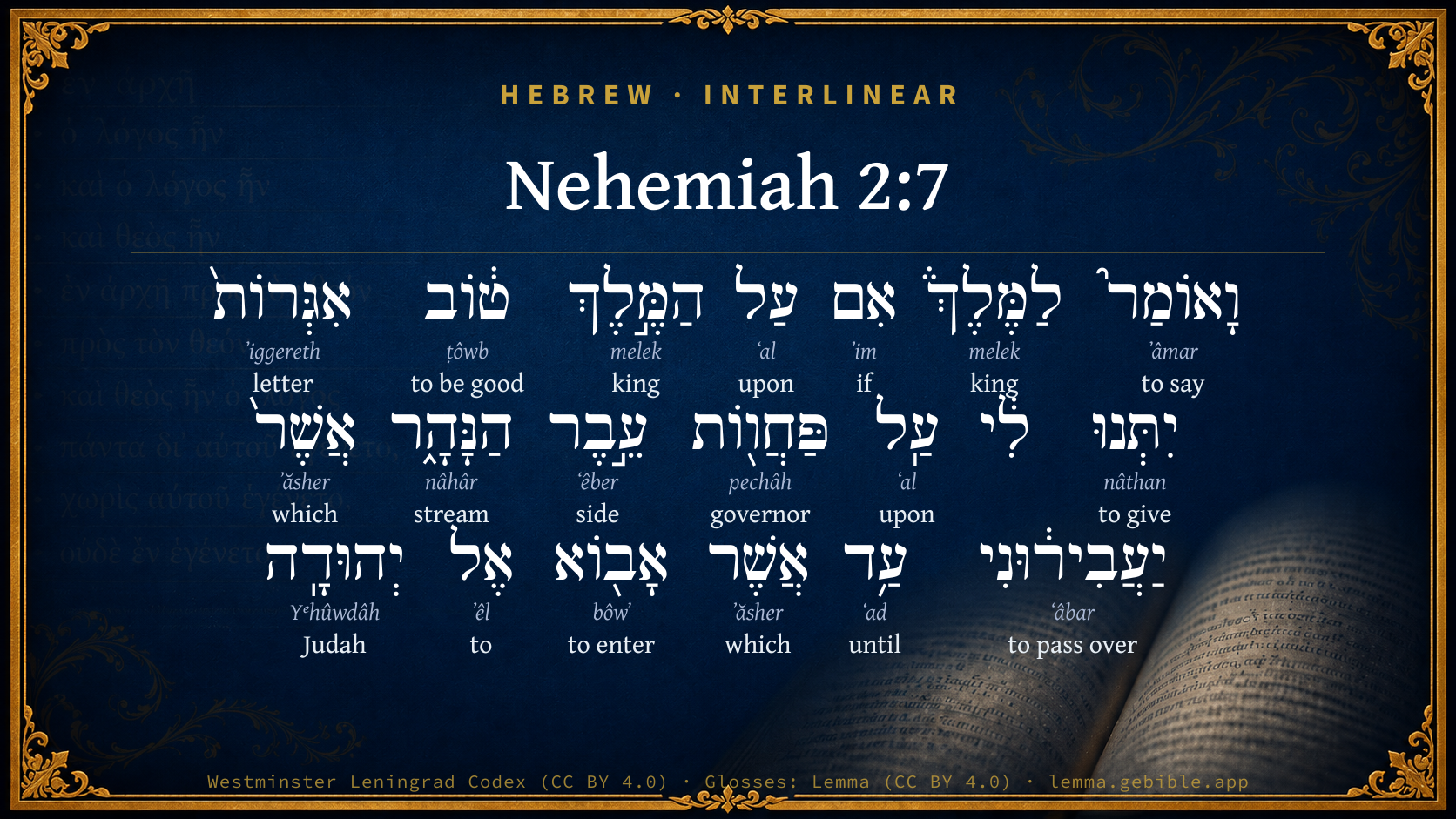
Hebrew (Westminster Leningrad Codex) Nehemiah 2:7 appears in the Hebrew Old Testament. The text above is from the Westminster Leningrad Codex. Each word links to its Strong’s number, a concise gloss, and parsing drawn from the Open Scriptures Hebrew Bible morphology. Click any word for its full Brown-Driver-Briggs (BDB) entry.
Download image
Cite this verse

Nehemiah 2:7 (World English Bible). Public Domain. Lemma interlinear Bible study tool, https://lemma.gebible.app/v/nehemiah/2/7.

Show BibTeX & RIS
BibTeX
RIS
English Translation
Moreover I said to the king, If it please the king, let letters be given me to the governors beyond the River, that they may let me pass through until I come to Judah;
World English Bible · Public Domain
Download a study sheet

One document with this verse’s original text, its word-by-word gloss line, the meaning frame, cross-references with their text, attributed commentary, and full source and license credits — printable, and it pastes into notes with its structure intact.

This verse Autodidact and up

Study sheet (.html) Plain text (.txt)

A passage Seminary Student

Up to 50 verses in one chapter. A passage sheet keeps up to 6 commentary sources and 12 cross-references per verse, in the order this page ranks them, and says so on the sheet whenever that leaves anything out. Ask for a single verse and you get the Autodidact verse sheet above.

Everything on this page stays free to read, with no account — the sheet is a download of what is already on screen, not access to it.

Want to remove ads? Support Godless Engineer
Compare translations 3

The same verse in 3 English versions, stacked beneath the original-language interlinear above. Click any original word for its lexicon entry.

Each is an independent rendering of the whole verse — the interlinear is not word-aligned to these translations.

Highlighted words mark where these versions differ — a whole-verse word diff, not a word-by-word alignment.

  • World English Bible Public Domain
    Moreover I said to the king, If it please the king, let letters be given me to the governors beyond the River, that they may let me pass through until I come to Judah;
  • King James Version Public Domain
    Moreover I said unto the king, If it please the king, let letters be given me to the governors beyond the river, that they may convey me over till I come into Judah;
  • unfoldingWord Literal Text CC BY-SA 4.0
    And I said to the king, “If it is good to the king, let letters be given to me for the governors of Beyond-the-River, that they will bring me across as far as where I enter into Judah;

unfoldingWord Literal Text — © unfoldingWord, licensed CC BY-SA 4.0. Word-aligned USFM3 via Door43 (git.door43.org/unfoldingWord/en_ult).

Versions to compare (up to 4)

3 of 4 selected

Show all 18 translations

Every available English version of this verse, each an independent rendering of the whole verse.

  • World English Bible Public Domain
    Moreover I said to the king, If it please the king, let letters be given me to the governors beyond the River, that they may let me pass through until I come to Judah;
  • Berean Standard Bible Public Domain
    I also said to him, “If it pleases the king, may letters be given to me for the governors west of the Euphrates, so that they will grant me safe passage until I reach Judah.
  • Majority Standard Bible Public Domain
    I also said to him, “If it pleases the king, may letters be given to me for the governors west of the Euphrates, so that they will grant me safe passage until I reach Judah.
  • King James Version Public Domain
    Moreover I said unto the king, If it please the king, let letters be given me to the governors beyond the river, that they may convey me over till I come into Judah;
  • American Standard Version (1901) Public Domain
    Moreover I said unto the king, If it please the king, let letters be given me to the governors beyond the River, that they may let me pass through till I come unto Judah;
  • Revised Version (1885) Public Domain
    Moreover I said unto the king, If it please the king, let letters be given me to the governors beyond the river, that they may let me pass through till I come unto Judah;
  • Geneva Bible (1599) Public Domain
    After I saide vnto the King, If it please the King, let them giue mee letters to the captaines beyond the Riuer, that they may conuay me ouer, till I come into Iudah,
  • Douay-Rheims (1899) Public Domain
    And I said to the king: If it seem good to the king, let him give me letters to the governors of the country beyond the river, that they convey me over, till I come into Judea:
  • Young's Literal Translation Public Domain
    And I say to the king, `If to the king `it be' good, letters let be given to me for the governors beyond the River, that they let me pass over till that I come in unto Judah:
  • Literal Standard Version CC BY-SA 4.0
    And I say to the king, “If [it is] good to the king, let letters be given to me for the governors beyond the River, that they let me pass over until I come to Judah:
  • Unlocked Literal Bible CC BY-SA 4.0
    Then I said to the king, “If it pleases the king, may letters be given to me for the governors in the Province Beyond the River so that they may permit me to pass through their territories on my way to Judah.
  • unfoldingWord Literal Text CC BY-SA 4.0
    And I said to the king, “If it is good to the king, let letters be given to me for the governors of Beyond-the-River, that they will bring me across as far as where I enter into Judah;
  • Darby Bible Public Domain
    And I said to the king, If it please the king, let letters be given me to the governors beyond the river, that they may set me forward till I come into Judah;
  • World Messianic Bible Public Domain
    Moreover I said to the king, “If it pleases the king, let letters be given me to the governors beyond the River, that they may let me pass through until I come to Judah;
  • Webster's Bible Public Domain
    Moreover, I said to the king, If it should please the king, let letters be given me to the governors beyond the river, that they may convey me over till I come into Judah:
  • Free Bible Version CC BY-SA 4.0
    I also asked him, “If it pleases Your Majesty, let letters be provided to give to the governors west of the Euphrates, so that they will allow me to pass safely until I reach Judah.
  • Bible in Basic English Public Domain
    Further, I said to the king, If it is the king's pleasure, let letters be given to me for the rulers across the river, so that they may let me go through till I come to Judah;
  • JPS Tanakh (1917) Public Domain
    Moreover I said unto the king: 'If it please the king, let letters be given me to the governors beyond the River, that they may let me pass through till I come unto Judah;

Literal Standard Version (2020), Covenant Press — licensed CC BY-SA 4.0. Text via the HelloAO Bible API (eBible.org). Unlocked Literal Bible (unfoldingWord) — licensed CC BY-SA 4.0. Text via the HelloAO Bible API (eBible.org). unfoldingWord Literal Text — © unfoldingWord, licensed CC BY-SA 4.0. Word-aligned USFM3 via Door43 (git.door43.org/unfoldingWord/en_ult). Free Bible Version, Dr. Jonathan Gallagher — licensed CC BY-SA 4.0. Text via the HelloAO Bible API (eBible.org).

Word by word

More ways to search: Search by grammar → Find every occurrence → Compare this word →

Practice this passage: Drill this verse → Learn its vocabulary →

אִגְּרוֹת֙
ʼiggereth
H107
“letters”
Noun, Common, Feminine, Plural, Absolute
Part of Speech
Noun
Type
Common
Gender
Feminine
Number
Plural
State
Absolute
Full BDB Definition

Origin: from H104

TWOT: 23b

letter, missive
  1. וָאוֹמַר֮ ʼâmar H559 “and · to say” Conjunction + Verb, Qal, Sequential Imperfect, 1st Person, Common, Singular
  2. לַמֶּלֶךְ֒ melek H4428 “to/for the · king” Preposition, Determined + Noun, Common, Masculine, Singular, Absolute
  3. אִם ʼim H518 “if” Conjunction
  4. עַל ʻal H5921 “upon” Preposition
  5. הַמֶּ֣לֶךְ melek H4428 “the · king” Particle, Definite Article + Noun, Common, Masculine, Singular, Absolute
  6. ט֔וֹב ṭôwb H2895 “good” Adjective, Adjective, Masculine, Singular, Absolute
  7. יִתְּנוּ nâthan H5414 “to give” Verb, Qal, Imperfect, 3rd Person, Masculine, Plural
  8. עַֽל ʻal H5921 “upon” Preposition
  9. פַּחֲו֖וֹת pechâh H6346 “governors of” Noun, Common, Masculine, Plural, Construct
  10. עֵ֣בֶר ʻêber H5676 “side of” Noun, Common, Masculine, Singular, Construct
  11. הַנָּהָ֑ר nâhâr H5104 “the · stream” Particle, Definite Article + Noun, Common, Masculine, Singular, Absolute
  12. אֲשֶׁר֙ ʼăsher H834 “which” Particle, Relative
  13. יַעֲבִיר֔וּנִי ʻâbar H5674 “to pass over · me” Verb, Hiphil, Imperfect, 3rd Person, Masculine, Plural + Suffix, Personal, 1st Person, Common, Singular
  14. עַ֥ד ʻad H5704 “until” Preposition
  15. אֲשֶׁר ʼăsher H834 “which” Particle, Relative
  16. אָב֖וֹא bôwʼ H935 “to enter” Verb, Qal, Imperfect, 1st Person, Common, Singular
  17. אֶל ʼêl H413 “to” Preposition
  18. יְהוּדָֽה Yᵉhûwdâh H3063 “Judah” Noun, Proper

About this verse

These counts appear in no published source. They are computed here, from the morphology-tagged text and Lemma’s own curated glosses. What Lemma adds →

20
words
16
distinct lemmas
Historical
section

Notable vocabulary

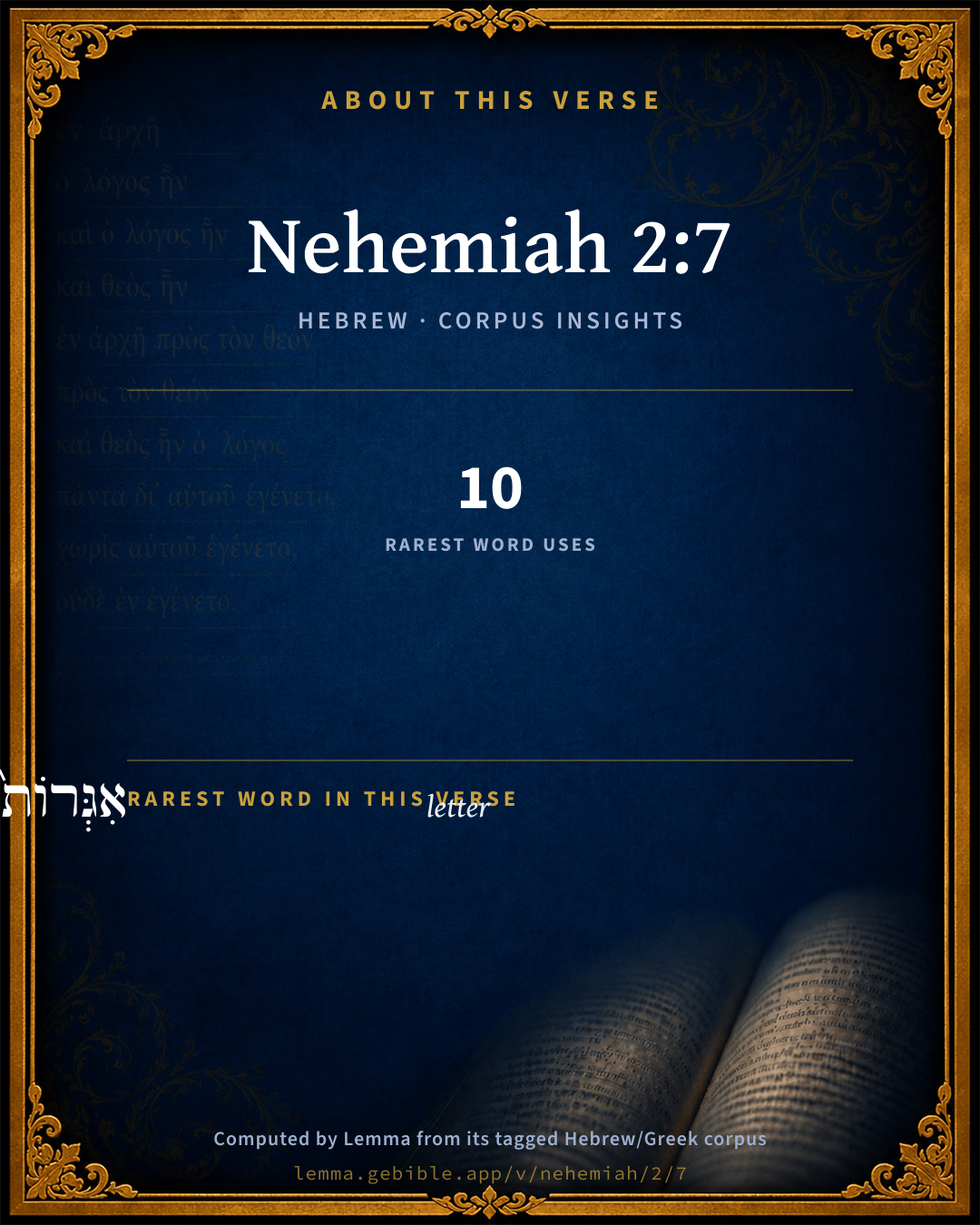
The rarest word here is אִגְּרוֹת֙ letter H107 — appearing just 10 times in the whole Hebrew Bible.

Shared distinctive vocabulary

אִגְּרוֹת֙ letter H107 occurs in 10 verses of the Hebrew Bible. Also found in:

Grammatical profile

  • 4 verbs
  • 7 nouns
  • 1 adjective
  • 5 prepositions
  • 1 conjunction
  • 2 particles

Verb forms

  • וָאוֹמַר֮ Qal · Sequential Imperfect
  • יִתְּנוּ Qal · Imperfect
  • יַעֲבִיר֔וּנִי Hiphil · Imperfect
  • אָב֖וֹא Qal · Imperfect

Repetition

Words recur within this verse — often emphatic in Hebrew:

  • לַמֶּלֶךְ֒ king H4428 ×2
  • עַל upon H5921 ×2
  • אֲשֶׁר֙ which H834 ×2

Cross-references

5

Topical passages linked to Nehemiah 2:7 in the Treasury of Scripture Knowledge — connected by theme and wording, ordered by reader-vote popularity; previews shown in the World English Bible.

  • Ezra 7:21 I, even I Artaxerxes the king, do make a decree to all the treasurers who are beyond the River, that whatever Ezra the priest, the scribe of the law of the God of heaven, shall require of you, it be done with all diligence,
  • Ezra 8:36 They delivered the king's commissions to the king's satraps, and to the governors beyond the River: and they furthered the people and the house of God.
  • Nehemiah 2:9 Then I came to the governors beyond the River, and gave them the king's letters. Now the king had sent with me captains of the army and horsemen.
  • Ezra 6:6 Now therefore, Tattenai, governor beyond the River, Shetharbozenai, and your companions the Apharsachites, who are beyond the River, be you far from there:
  • Ezra 8:22 For I was ashamed to ask of the king a band of soldiers and horsemen to help us against the enemy in the way, because we had spoken to the king, saying, The hand of our God is on all those who seek him, for good; but his power and his wrath is against all those who forsake him.

Cross-references courtesy of OpenBible.info (CC BY 4.0).

Hebrew and Greek witnesses Masoretic Hebrew ↔ Greek Septuagint

The same verse in the two great witnesses to the Old Testament, shown verse-for-verse.

These are two independent witnesses, not word-aligned to each other, and the Septuagint is shown in lemma (dictionary) form.

Hebrew Nehemiah 2:7 Masoretic · Westminster Leningrad Codex

וָאוֹמַר֮ לַמֶּלֶךְ֒ אִם עַל הַמֶּ֣לֶךְ ט֔וֹב אִגְּרוֹת֙ יִתְּנוּ לִ֔י עַֽל פַּחֲו֖וֹת עֵ֣בֶר הַנָּהָ֑ר אֲשֶׁר֙ יַעֲבִיר֔וּנִי עַ֥ד אֲשֶׁר אָב֖וֹא אֶל יְהוּדָֽה

Moreover I said to the king, If it please the king, let letters be given me to the governors beyond the River, that they may let me pass through until I come to Judah;

World English Bible · Public Domain

Greek LXX Structure differs

The Septuagint has no separate book of Nehemiah. Its Greek text is the second half of Esdras B (2 Esdras), chapters 11–23; Ezra is the first half (1–10).

A verse-for-verse comparison isn’t shown here because the chapters and verses don’t line up. Switch to the LXX edition with the MT / LXX toggle above to read the Greek directly.

Hebrew: Westminster Leningrad Codex (CC BY 4.0). Greek: Septuagint (public domain); English from a public-domain English Septuagint. How the Septuagint differs from the Hebrew →

Commentary

Notes on Nehemiah 2:7 from classic Christian and Jewish commentators (each source and its license shown beneath its notes). The classic Christian expositions comment on the surrounding passage and are grouped to its opening verse, so a note may address several verses; the Jewish commentaries on the Tanakh (Rashi and others) are per-verse, so they appear only where the commentator wrote on this verse.

Lemma curates 59 commentaries, every one of them public domain or Creative Commons licensed, each selected and text-cleaned for this edition rather than reprinted as found. About our sources →

Trapp's Complete Commentary

John Trapp

Neh 2:7 Moreover I said unto the king, If it please the king, let letters be given me to the governors beyond the river, that they may convey me over till I come into Judah;

Ver. 7. Moreover I said unto the king] He taketh further boldness upon the former encouragement; so may we with Almighty God, the Sun of our righteousness, the Sea of our salvation. Conclude as she did, A company comes. God never left bating till Abraham left begging.

Let letters be given me to the governors] Those nearest neighbours, but greatest enemies.

That they may convey me over] He committed himself to God, and yet petitions the king for a convoy. In all our enterprises God is so to be trusted as if we had used no means; and yet the means is so to be used as if we had no God to trust in.

John Trapp, A Commentary or Exposition upon All the Books of the Old and New Testament (1647–1656) — public domain. Text from a community e-Sword module.

The Biblical Illustrator

Joseph S. Exell

Neh_2:7

If it please the king, let letters be given me.

Religious prudence

I. That prudent forethought is essential to success in spiritual as in secular enterprises (Psa_112:5; Pro_11:29; Pro_12:23; Pro_14:15; Luk_14:28).

II. That prudent forethought is not opposed, but helpful, to spiritual faith.

1. It furnishes a rational basis for expecting success.

2. It acts upon the supposition that mental powers were given to be employed in the service of God.

3. It takes no step without seeking Divine guidance and approval. (Homiletic Commentary.)

Common sense in religious work

When we go about the Lords work, we must not leave our wits behind us, or forget the principles of business and the rules of daily life. Neither should we ignore difficulties or suppose that they will disappear before some miracle-working power. Although depending solely on the Lord, we need not denude ourselves of judgment and common sense. (W. P. Lockhart.)

Prayer and common sense

So I stood and prayed unto the God of heaven--then I asked the king to give me letters. This is the true model of prayer to pray to the King of kings and then to accept the ordinary appointments of life; to invoke Omnipotence, and then to use your senses. Have you been praying? Did you sit in your chair and pray that you might be able at the end of the week to make both ends meet, and then fall asleep until the time came, and wake up to find that both ends did not meet? That was not prayer at all. I will pray God to help me to pay every debt I owe, to overcome every difficulty in my way. Now, having said my prayer, let me go out and do it. (J. Parker, D. D.)

The Biblical Illustrator, edited by Joseph S. Exell (c. 1880s–1900s) — public domain. Text from a community e-Sword module.

Joseph Benson's Commentary

Neh 2:7-8. That they may convey me over till I come into Judah — May conduct me with safety through their several territories, and furnish me with necessaries on my journey. And a letter unto Asaph, the keeper of the king’s forest — The forest of Lebanon, famous for choice trees. That he may give me timber for the gates — The gates of the temple. For though the temple itself was built, yet the several courts seem not to have been walled about, nor the gates made leading to the temple. Of the palace — The king’s palace, which adjoined to the house of God. And for the house that I shall enter into — He desired leave to build a convenient house for himself, and for those that should be future governors. According to the good hand of my God upon me — By the divine favour, which inclined the king to do what he desired; which he calls God’s good hand, because we extend favour with our hands.

Joseph Benson's Commentary on the Old and New Testaments (1811–1818) — public domain. Text from a community e-Sword module.

Geneva Bible (1599)

Geneva Bible translators

Or, Euphrates.

Geneva Bible (1599) marginal notes — public domain. Text via Bolls.life.

Jamieson, Fausset & Brown

Robert Jamieson, A. R. Fausset & David Brown

letters be given me to the governors beyond the river--The Persian empire at this time was of vast extent, reaching from the Indus to the Mediterranean. The Euphrates was considered as naturally dividing it into two parts, eastern and western (see on Ezr 5:3).

Jamieson, Fausset & Brown — Commentary Critical and Explanatory on the Whole Bible (1871) — public domain (CC PDM 1.0). Text via the HelloAO Bible API.

Ellicott's Commentary for English Readers

(7) To the governors beyond the river.—Between the Euphrates and Susa protection was not needed.

A Bible Commentary for English Readers, edited by Charles John Ellicott (1878–1897) — public domain. Text from a community e-Sword module.

The Cambridge Bible for Schools and Colleges

gen. ed. J. J. S. Perowne

7. letters] see note on Ezr_4:8.

the governors beyond the river] The ‘Pekhahs’ of the province on the west bank of the Euphrates (Ezr_8:36). A reference to Ezr_4:7-10; Ezr_4:17 shows the importance of securing the recognition of these provincial governors.

convey me over … into Judah] R.V. let me pass through … unto Judah. Letters of safe conduct through their territory. The governors would not be asked to assist the journey, but to secure that Nehemiah should not be hindered or molested on the way.

The Cambridge Bible for Schools and Colleges (gen. ed. J. J. S. Perowne; Cambridge University Press, 1878–1918) — public domain. Text from a community e-Sword module.

John Gill's Exposition

Moreover, I said unto the king, let letters be given me to the governors beyond the river,.... The river of Euphrates, on that side of it towards the land of Judea:

that they may convey me over till I come into Judah; furnish him with provisions, and a guard to protect him.

John Gill's Exposition of the Whole Bible (1746–1763) — public domain (CC PDM 1.0). Text via the HelloAO Bible API.

Haydock's Catholic Bible Commentary

Over; give me a guard, (Haydock) or accompany me to Jerusalem. (Menochius)

George Leo Haydock (1774–1849), Haydock's Catholic Family Bible and Commentary, 1859 edition — public domain. Excludes Psalms (Douay-Rheims chapter numbering differs from Protestant) and Deuterocanonical books (Catholic canon only).

Matthew Poole's English Annotations

That they may safely conduct me through their several territories.

Matthew Poole's English Annotations on the Holy Bible (1683–1685) — public domain. Text from a community e-Sword/MySword module.

Whedon's Commentary on the Bible

Daniel D. Whedon

7. Let letters be given me — This was a wise precaution on the part of Nehemiah, for the governors beyond the river were generally hostile to the Jews. Comp. Ezra 4, 5.

Daniel D. Whedon (gen. ed.), Commentary on the Old and New Testaments (1874–1909) — public domain. Text from a community e-Sword module.

The Pulpit Commentary

Let letters be given me to the governors beyond the river. It is not quite clear why no letters were needed to the governors between Susa and the Euphrates. Perhaps, while travelling was safe, at any rate with an escort, in the more central provinces, beyond the river it became unsafe. (see Ezr_8:31)

The Pulpit Commentary (1880–1919), ed. H.D.M. Spence-Jones & Joseph S. Exell — public domain. Text from a community e-Sword module.

Keil & Delitzsch

C. F. Keil & F. Delitzsch

Hereupon Nehemiah also requested from the king letters to the governors beyond (west of) the river (Euphrates), to allow him to travel unmolested through their provinces to Judah (לי יתּנוּ, let them give me = let there be given me; העביר, to pass or travel through a country, comp. Deu 3:20); and a letter to Asaph, the keeper (inspector) of the royal forests, to give him timber to make beams for the gates of the citadel by the temple, and for the walls of the city, and for the governor's own house. These requests were also granted. פּרדּס in Sol 4:13; Ecc 2:5, signifies a park or orchard; it is a word of Aryan origin (in Armenian pardez, the garden round the house, in Greek παράδεισος), and is explained either from the Sanscrit parta-da, a superior district, or (by Haug) from the Zend. pairi-daza, a fenced-in place. In Old-Persian it probably denoted the king's pleasure-grounds, and in our verse a royal wood or forest. Of the situation of this park nothing reliable can be ascertained. As wood for extensive buildings was to be taken from it, the sycamore forest in the low plains, which had been the property of King David (Ch1 27:28), and became, after the overthrow of the Davidic dynasty, first a Babylonian, and then a Persian possession, may be intended.

(Note: Older expositors supposed a regio a Libano ad Antilibanum protensa et arboribus amoenissimus consita to be meant. In this view, indeed, they followed Sol 4:13, but incorrectly. Cler. thought it to be a tractus terrarum in Judaea, qui Paradisus regius dicebatur. Josephus speaks (Ant. viii. 7. 3) of fine gardens and ponds at Etham, seven miles south of Jerusalem, where Solomon often made pleasure excursions. Hence Ewald (Gesch. iv. p. 169, comp. iii. p. 328) thinks that the פּרדּס which belonged to the king must have been Solomon's old royal park at Aetham, which in the time of Nehemiah had become a Persian domain, and that the hill town lying not far to the west of it, and now called by the Arabs Fureidis, i.e., paradisaic, may have received its Hebrew name Beth-Kerem, i.e., house of vineyards, from similar pleasure-grounds. Hereupon Bertheau grounds the further conjecture, that "the whole district from Aetham to the hill of Paradise, situate about a league east-south-east of Aetham, may from its nature have been once covered with forest; and no hesitation would be felt in connecting the name of the mountain Gebel el-Fureidis or el-Feridis (Paradise-hill - hill which rises in a Pardes) with the Pardes in question, if it could be proved that this name was already in existence in prae-Christian times." All these conjectures rest on very uncertain bases. The Dshebel Fureidis is also called the Hill of the Franks. See the description of it in Robinson's Palestine, ii. p. 392f., and Tobler, Topographie von Jerusalem, ii. pp. 565-572.)

לקרות, to timber, to overlay, to cover with beams (comp. Ch2 34:11) the gates of the citadel which belongs to the house, i.e., to the temple. This citadel - בּירה, in Greek Βᾶρις - by the temple is mentioned here for the first time; for in Ch1 29:1, Ch1 29:19, the whole temple is called בּירה. It was certainly situate on the same place where Hyrcanus I, son of Simon Maccabaeus, or the kings of the Asmonean race, built the akro'polis and called it Baris (Jos. Ant. xv. 11. 4, comp. with xviii. 4. 3). This was subsequently rebuilt by Herod when he repaired and enlarged the temple, and named Antonia, in honour of his friend Mark Antony. It was a citadel of considerable size, provided with corner towers, walls, chambers, and spacious courts, built on a north-western side of the external chambers of the temple, for the defence of that edifice, and did not extend the entire length of the north side of the present Haram, as Robinson (see Biblical Researches, p. 300) seeks to show; comp., on the other hand, Tobler, Topographic von Jerusalem, i. p. 688f., and Rosen, Haram von Jerusalem, p. 25f. וּלחומת is coordinate with לקרות: "and for the walls of the city;" the timber not being used for building the wall itself, but for the gates (Neh 3:3, Neh 3:6). "And for the house into which I come (to dwell)." This must be Nehemiah's official residence as Pecha. For though it is not expressly stated in the present chapter that Nehemiah was appointed Pecha (governor) by Artaxerxes, yet Nehemiah himself tells us, Neh 5:14, that he had been Pecha from the twentieth year of Artaxerxes. Former governors had perhaps no official residence becoming their position. By לבּית the temple cannot, as older expositors thought, be intended. This request also was granted by the king, "according to the good hand of my God upon me;" comp. rem. on Ezr 7:6.

Keil & Delitzsch — Biblical Commentary on the Old Testament (1861–1891) — public domain (CC PDM 1.0). Text via the HelloAO Bible API. (Old Testament only.)

unfoldingWord translationNotes

Door43 World Missions Community

may letters be given to me

This may be stated in active form. AT: "may you give letters to me" (See: Active or Passive)

the Province Beyond the River

This is the name of the province that was west of the Euphrates River. It was across the river from the city of Susa.

Asaph

This is the name of a man. (See: How to Translate Names)

the good hand of God was on me

God's "good hand" represents his "favor." AT: "God's favor was upon me" (See: Metonymy)

translationWords

king

epistle

govern

kingdom of Judah

gate

temple

house

life

good

hand

God

unfoldingWord translationNotes — © Distant Shores Media and the Door43 World Missions Community, licensed CC BY-SA 4.0. Source: git.door43.org/Door43/en_tn.

Rashi

Rabbi Shlomo Yitzchaki (Rashi)

may letters be given to me [Let] your scribes [give me letters] by your sanction and your knowledge, sealed with your signet to the governors of the land beyond the river, on the side of the land of Israel.

that they escort me through and escort me in peace.

until I come to Jerusalem, which is in the province of Judea.

Rashi on the Tanakh — English translations: “The Judaica Press complete Tanach with Rashi, translated by A. J. Rosenberg” (CC BY 4.0); “Pentateuch with Rashi's commentary by M. Rosenbaum and A.M. Silbermann, 1929-1934” (public domain); “The Metsudah Tanach series, Lakewood, N.J” (CC BY 4.0); and “The Book of Joshua, Metsudah Publications, 1997” (CC BY 4.0). Text via Sefaria.

Lesson kit

Teaching starters — assembled from the data on this page, not authored interpretation. Every prompt links to the verse data it draws on. Edit before teaching.

Nehemiah, in the Historical, opens this verse with 20 words (16 distinct Hebrew lemmas). Its most distinctive word is ʼiggereth (“letter”). A historical commentator’s framing appears above. Read the whole chapter for the surrounding context.

Discussion questions

  1. What does “letter” (ʼiggereth) contribute to the verse as a whole?
  2. 2 Chronicles 30:1 shares the word «letter» with this verse. How do the two illuminate each other?
  3. “king” occurs 2× in this one verse. What is the effect of the repetition?
  4. These translations render this verse differently; the difference is in the English rendering, not the original. What questions does that raise?
  5. The verb «וָאוֹמַר֮» is Qal Sequential Imperfect. How does its form color the action?
  6. Reading how Trapp's Complete Commentary and The Biblical Illustrator read this verse, where do the two commentators agree and where do they part?

Things to notice

Reading settings

Reading text

Shown beneath each verse's original-language words.

Old Testament
Old Testament edition

Read the OT as the Masoretic Hebrew (MT) or the Greek Septuagint (LXX).

English shown for the Greek Septuagint (in the Hebrew ↔ Greek comparison).

Comparing translations? Open the Compare panel on any verse page to stack up to four side by side.