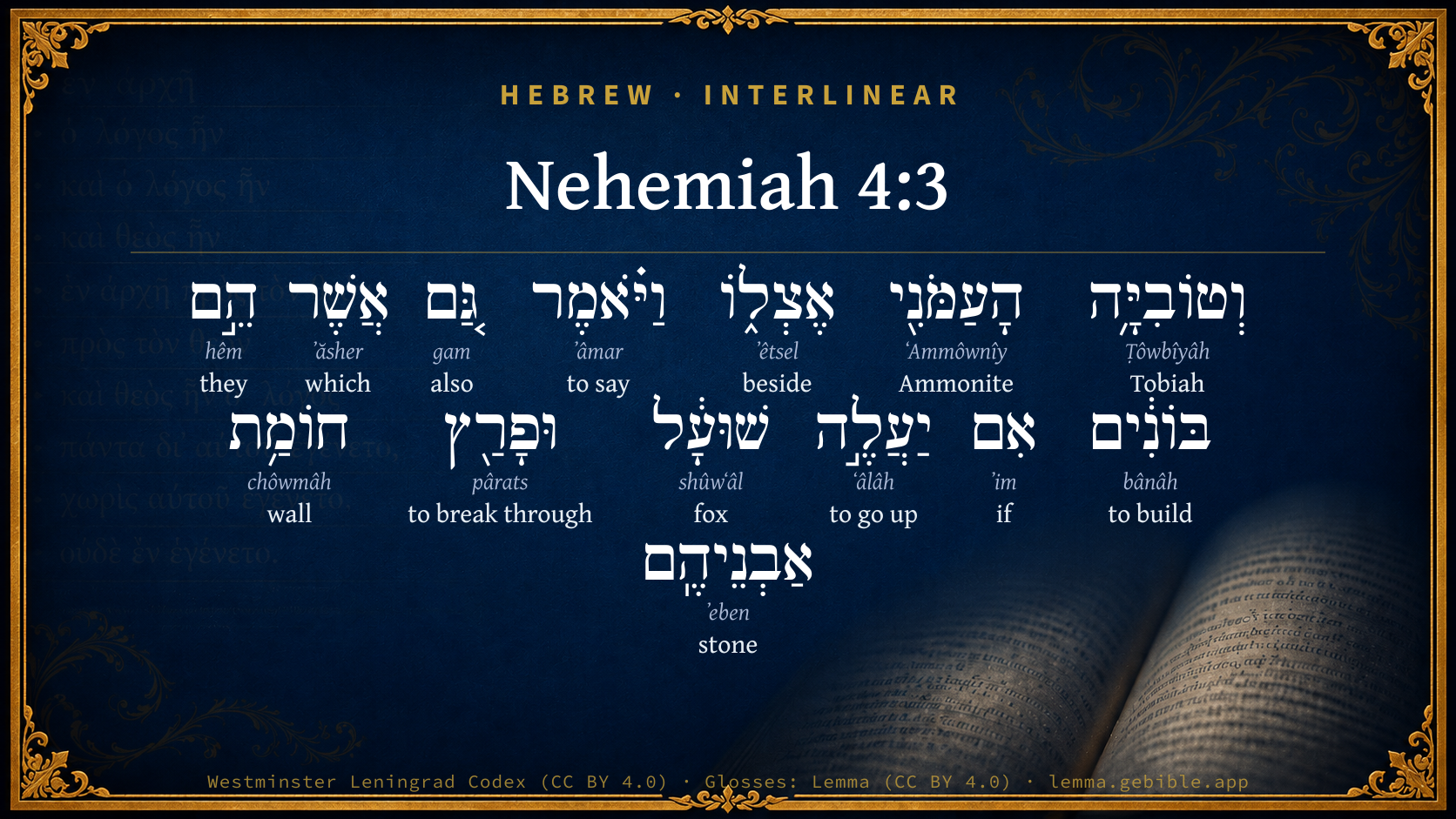
Nehemiah 4:3

Hebrew (Westminster Leningrad Codex) Nehemiah 4:3 appears in the Hebrew Old Testament. The text above is from the Westminster Leningrad Codex. Each word links to its Strong’s number, a concise gloss, and parsing drawn from the Open Scriptures Hebrew Bible morphology. Click any word for its full Brown-Driver-Briggs (BDB) entry.
Download image
Cite this verse

Nehemiah 4:3 (World English Bible). Public Domain. Lemma interlinear Bible study tool, https://lemma.gebible.app/v/nehemiah/4/3.

Show BibTeX & RIS
BibTeX
RIS
English Translation
Now Tobiah the Ammonite was by him, and he said, Even that which they are building, if a fox go up, he shall break down their stone wall.
World English Bible · Public Domain
Download a study sheet

One document with this verse’s original text, its word-by-word gloss line, the meaning frame, cross-references with their text, attributed commentary, and full source and license credits — printable, and it pastes into notes with its structure intact.

This verse Autodidact and up

Study sheet (.html) Plain text (.txt)

A passage Seminary Student

Up to 50 verses in one chapter. A passage sheet keeps up to 6 commentary sources and 12 cross-references per verse, in the order this page ranks them, and says so on the sheet whenever that leaves anything out. Ask for a single verse and you get the Autodidact verse sheet above.

Everything on this page stays free to read, with no account — the sheet is a download of what is already on screen, not access to it.

Want to remove ads? Support Godless Engineer
Compare translations 3

The same verse in 3 English versions, stacked beneath the original-language interlinear above. Click any original word for its lexicon entry.

Each is an independent rendering of the whole verse — the interlinear is not word-aligned to these translations.

Highlighted words mark where these versions differ — a whole-verse word diff, not a word-by-word alignment.

  • World English Bible Public Domain
    Now Tobiah the Ammonite was by him, and he said, Even that which they are building, if a fox go up, he shall break down their stone wall.
  • King James Version Public Domain
    Now Tobiah the Ammonite was by him, and he said, Even that which they build, if a fox go up, he shall even break down their stone wall.
  • unfoldingWord Literal Text CC BY-SA 4.0
    And Tobiah the Ammonite was beside him. And he said, “Yes, if a fox goes up on what they are building, then he would break down their wall of stones!”

unfoldingWord Literal Text — © unfoldingWord, licensed CC BY-SA 4.0. Word-aligned USFM3 via Door43 (git.door43.org/unfoldingWord/en_ult).

Versions to compare (up to 4)

3 of 4 selected

Show all 18 translations

Every available English version of this verse, each an independent rendering of the whole verse.

  • World English Bible Public Domain
    Now Tobiah the Ammonite was by him, and he said, Even that which they are building, if a fox go up, he shall break down their stone wall.
  • Berean Standard Bible Public Domain
    Then Tobiah the Ammonite, who was beside him, said, “If even a fox were to climb up on what they are building, it would break down their wall of stones!”
  • Majority Standard Bible Public Domain
    Then Tobiah the Ammonite, who was beside him, said, “If even a fox were to climb up on what they are building, it would break down their wall of stones!”
  • King James Version Public Domain
    Now Tobiah the Ammonite was by him, and he said, Even that which they build, if a fox go up, he shall even break down their stone wall.
  • American Standard Version (1901) Public Domain
    Now Tobiah the Ammonite was by him, and he said, Even that which they are building, if a fox go up, he shall break down their stone wall.
  • Revised Version (1885) Public Domain
    Now Tobiah the Ammonite was by him, and he said, Even that which they build, if a fox go up, he shall break down their stone wall.
  • Geneva Bible (1599) Public Domain
    And Tobiah the Ammonite was beside him, and said, Although they buylde, yet if a foxe goe vp, he shall euen breake downe their stonie wall.
  • Douay-Rheims (1899) Public Domain
    Tobias also the Ammonite who was by him said: Let them build: if a fox go up, he will leap over their stone wall.
  • Young's Literal Translation Public Domain
    And Tobiah the Ammonite `is' by him and saith, `Also, that which they are building -- if a fox doth go up, then it hath broken down their stone wall.'
  • Literal Standard Version CC BY-SA 4.0
    And Tobiah the Ammonite [is] by him and says, “Also, that which they are building—if a fox goes up, then it has broken down their stone wall.”
  • Unlocked Literal Bible CC BY-SA 4.0
    Tobiah the Ammonite was with him, and he said, “If only a fox went up on what they are building, it would break down their stone wall!”
  • unfoldingWord Literal Text CC BY-SA 4.0
    And Tobiah the Ammonite was beside him. And he said, “Yes, if a fox goes up on what they are building, then he would break down their wall of stones!”
  • Darby Bible Public Domain
    And Tobijah the Ammonite was by him, and he said, Even that which they build, if a fox went up, it would break down their stone wall. --
  • World Messianic Bible Public Domain
    Now Tobiah the Ammonite was by him, and he said, “What they are building, if a fox climbed up it, he would break down their stone wall.”
  • Webster's Bible Public Domain
    Now Tobiah the Ammonite was by him, and he said, Even that which they build, if a fox should go up, he would even break down their stone wall.
  • Free Bible Version CC BY-SA 4.0
    Tobiah the Ammonite, standing beside him, commented, “Even a fox walking on what they're building would knock down their wall of stones!”
  • Bible in Basic English Public Domain
    Now Tobiah the Ammonite was by him, and he said, Such is their building that if a fox goes up it, their stone wall will be broken down.
  • JPS Tanakh (1917) Public Domain
    (3-35) Now Tobiah the Ammonite was by him, and he said: 'Even that which they build, if a fox go up, he shall break down their stone wall.'

Literal Standard Version (2020), Covenant Press — licensed CC BY-SA 4.0. Text via the HelloAO Bible API (eBible.org). Unlocked Literal Bible (unfoldingWord) — licensed CC BY-SA 4.0. Text via the HelloAO Bible API (eBible.org). unfoldingWord Literal Text — © unfoldingWord, licensed CC BY-SA 4.0. Word-aligned USFM3 via Door43 (git.door43.org/unfoldingWord/en_ult). Free Bible Version, Dr. Jonathan Gallagher — licensed CC BY-SA 4.0. Text via the HelloAO Bible API (eBible.org).

Word by word

More ways to search: Search by grammar → Find every occurrence → Compare this word →

Practice this passage: Drill this verse → Learn its vocabulary →

שׁוּעָ֔ל
shûwʻâl
H7776
“fox”
Noun, Common, Masculine, Singular, Absolute
Part of Speech
Noun
Type
Common
Gender
Masculine
Number
Singular
State
Absolute
Full BDB Definition

Origin: from the same as H8168

TWOT: 2433a

fox, a burrower - fox - perhaps also jackal
  1. וְטוֹבִיָּ֥ה Ṭôwbîyâh H2900 “and · Tobiah” Conjunction + Noun, Proper
  2. הָעַמֹּנִ֖י ʻAmmôwnîy H5984 “the · Ammonite” Particle, Definite Article + Noun, Gentilic, Masculine, Singular, Absolute
  3. אֶצְל֑וֹ ʼêtsel H681 “beside · him” Preposition + Suffix, Personal, 3rd Person, Masculine, Singular
  4. וַיֹּ֗אמֶר ʼâmar H559 “and · to say” Conjunction + Verb, Qal, Sequential Imperfect, 3rd Person, Masculine, Singular
  5. גַּ֚ם gam H1571 “also” Particle, Accusative
  6. אֲשֶׁר ʼăsher H834 “which” Particle, Relative
  7. הֵ֣ם hêm H1992 “they” Pronoun, Personal, 3rd Person, Masculine, Plural
  8. בּוֹנִ֔ים bânâh H1129 “building” Verb, Qal, Participle Active, Masculine, Plural, Absolute
  9. אִם ʼim H518 “if” Conjunction
  10. יַעֲלֶ֣ה ʻâlâh H5927 “to go up” Verb, Qal, Imperfect, 3rd Person, Masculine, Singular
  11. וּפָרַ֖ץ pârats H6555 “and · to break through” Conjunction + Verb, Qal, Sequential Perfect, 3rd Person, Masculine, Singular
  12. חוֹמַ֥ת chôwmâh H2346 “wall of” Noun, Common, Feminine, Singular, Construct
  13. אַבְנֵיהֶֽם ʼeben H68 “stones · their” Noun, Common, Feminine, Plural, Construct + Suffix, Personal, 3rd Person, Masculine, Plural

About this verse

These counts appear in no published source. They are computed here, from the morphology-tagged text and Lemma’s own curated glosses. What Lemma adds →

14
words
14
distinct lemmas
Historical
section

Notable vocabulary

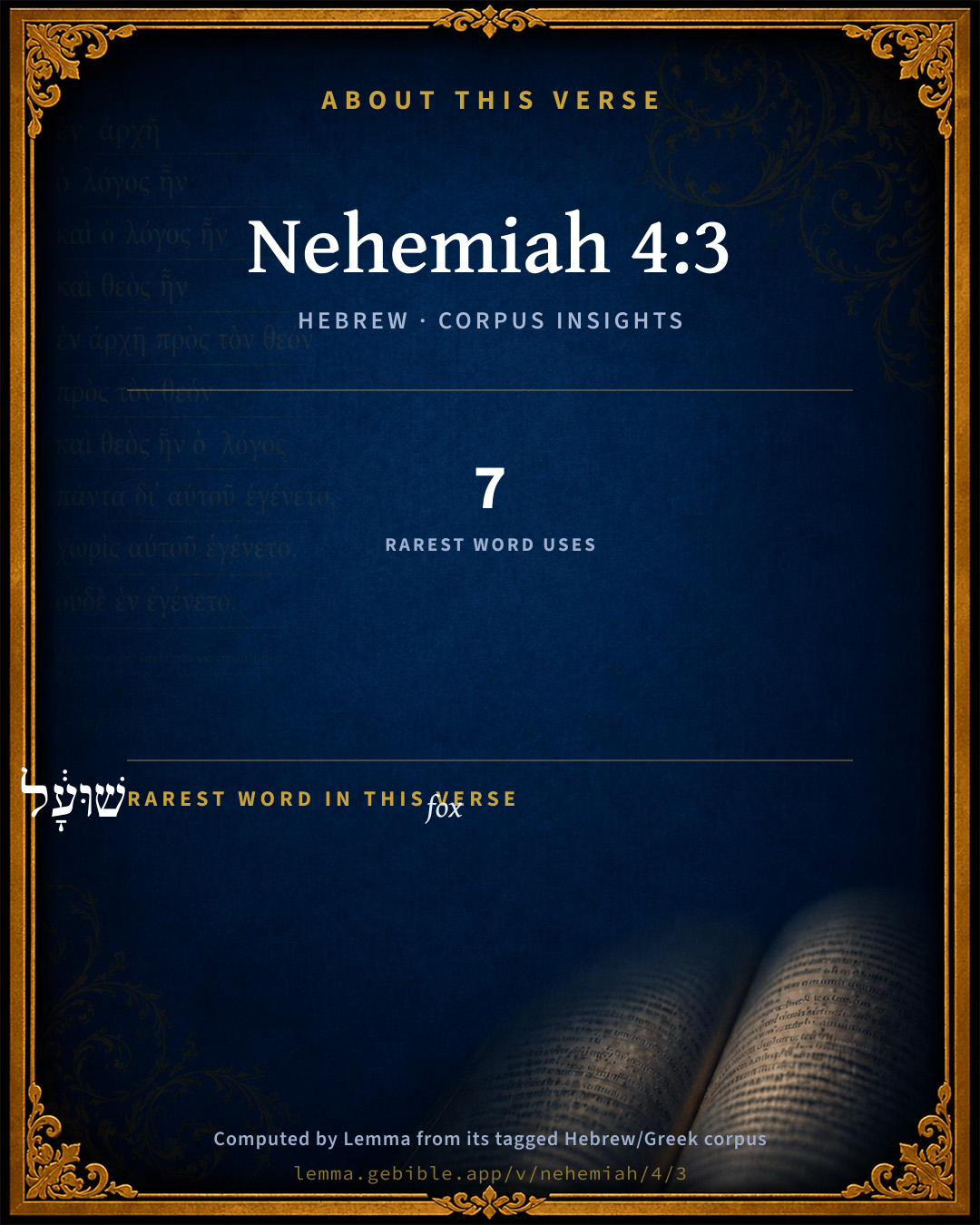
The rarest word here is שׁוּעָ֔ל fox H7776 — appearing just 7 times in the whole Hebrew Bible.

Shared distinctive vocabulary

שׁוּעָ֔ל fox H7776 occurs in 6 verses of the Hebrew Bible. Also found in:

Grammatical profile

  • 4 verbs
  • 5 nouns
  • 1 pronoun
  • 1 preposition
  • 1 conjunction
  • 2 particles

Verb forms

  • וַיֹּ֗אמֶר Qal · Sequential Imperfect
  • בּוֹנִ֔ים Qal · Participle Active
  • יַעֲלֶ֣ה Qal · Imperfect
  • וּפָרַ֖ץ Qal · Sequential Perfect

Cross-references

7

Topical passages linked to Nehemiah 4:3 in the Treasury of Scripture Knowledge — connected by theme and wording, ordered by reader-vote popularity; previews shown in the World English Bible.

  • Nehemiah 2:19 But when Sanballat the Horonite, and Tobiah the servant, the Ammonite, and Geshem the Arabian, heard it, they ridiculed us, and despised us, and said, What is this thing that you do? will you rebel against the king?
  • 1 Kings 20:10 Ben Hadad sent to him, and said, The gods do so to me, and more also, if the dust of Samaria shall suffice for handfuls for all the people who follow me.
  • 1 Kings 20:18 He said, Whether they are come out for peace, take them alive, or whether they are come out for war, taken them alive.
  • 2 Kings 18:23 Now therefore, Please give pledges to my master the king of Assyria, and I will give you two thousand horses, if you are able on your part to set riders on them.
  • Nehemiah 2:10 When Sanballat the Horonite, and Tobiah the servant, the Ammonite, heard of it, it grieved them exceedingly, because a man had come to seek the welfare of the children of Israel.
  • Nehemiah 6:1 Now it happened, when it was reported to Sanballat and Tobiah, and to Geshem the Arabian, and to the rest of our enemies, that I had built the wall, and that there was no breach left therein; (though even to that time I had not set up the doors in the gates;)
  • Lamentations 5:18 For the mountain of Zion, which is desolate: The foxes walk on it.

Cross-references courtesy of OpenBible.info (CC BY 4.0).

Hebrew and Greek witnesses Masoretic Hebrew ↔ Greek Septuagint

The same verse in the two great witnesses to the Old Testament, shown verse-for-verse.

These are two independent witnesses, not word-aligned to each other, and the Septuagint is shown in lemma (dictionary) form.

Hebrew Nehemiah 4:3 Masoretic · Westminster Leningrad Codex

וְטוֹבִיָּ֥ה הָעַמֹּנִ֖י אֶצְל֑וֹ וַיֹּ֗אמֶר גַּ֚ם אֲשֶׁר הֵ֣ם בּוֹנִ֔ים אִם יַעֲלֶ֣ה שׁוּעָ֔ל וּפָרַ֖ץ חוֹמַ֥ת אַבְנֵיהֶֽם

Now Tobiah the Ammonite was by him, and he said, Even that which they are building, if a fox go up, he shall break down their stone wall.

World English Bible · Public Domain

Greek LXX Structure differs

The Septuagint has no separate book of Nehemiah. Its Greek text is the second half of Esdras B (2 Esdras), chapters 11–23; Ezra is the first half (1–10).

A verse-for-verse comparison isn’t shown here because the chapters and verses don’t line up. Switch to the LXX edition with the MT / LXX toggle above to read the Greek directly.

On this verse, Haydock's Catholic Bible Commentary discusses the Septuagint’s reading. Read the note in Commentary ↓

Hebrew: Westminster Leningrad Codex (CC BY 4.0). Greek: Septuagint (public domain); English from a public-domain English Septuagint. How the Septuagint differs from the Hebrew →

Commentary

Notes on Nehemiah 4:3 from classic Christian and Jewish commentators (each source and its license shown beneath its notes). The classic Christian expositions comment on the surrounding passage and are grouped to its opening verse, so a note may address several verses; the Jewish commentaries on the Tanakh (Rashi and others) are per-verse, so they appear only where the commentator wrote on this verse.

Lemma curates 59 commentaries, every one of them public domain or Creative Commons licensed, each selected and text-cleaned for this edition rather than reprinted as found. About our sources →

Trapp's Complete Commentary

John Trapp

Neh 4:3 Now Tobiah the Ammonite [was] by him, and he said, Even that which they build, if a fox go up, he shall even break down their stone wall.

Ver. 3. Now Tobiah the Ammonite] This was one of Sanballat’s good brethren, Neh 4:2. A bird of the same feather, a loaf of the same leaven, his fellow scoffer, and so homine peior, saith Chrysostom, worse than a man; as the scoffed that beareth it well, is Angelis par, saith he, an angel’s peer.

Even that which they build, if a fox go up, &c.] It was some such bitter jeer that Remus uttered in contempt of Romulus’s new wall, and was knocked on the head for it. Hae sannae leniter volant, non leniter violant.

John Trapp, A Commentary or Exposition upon All the Books of the Old and New Testament (1647–1656) — public domain. Text from a community e-Sword module.

Joseph Benson's Commentary

Neh 4:3. If a fox go up — He mentions foxes because they were very numerous in those parts, and because in the late desolation of Jerusalem, the foxes did frequent the mount and city of Zion, (Lam 5:18,) wherewith he seems to upbraid them. He shall even break down their stone wall — It is so low that a fox can easily ascend to the top of it, and so weak, and built so hastily and carelessly, that the least weight or thrust will tumble it down.

Joseph Benson's Commentary on the Old and New Testaments (1811–1818) — public domain. Text from a community e-Sword module.

Jamieson, Fausset & Brown

Robert Jamieson, A. R. Fausset & David Brown

if a fox go up--The foxes were mentioned because they were known to infest in great numbers the ruined and desolate places in the mount and city of Zion (Lam 5:18).

Jamieson, Fausset & Brown — Commentary Critical and Explanatory on the Whole Bible (1871) — public domain (CC PDM 1.0). Text via the HelloAO Bible API.

The Cambridge Bible for Schools and Colleges

gen. ed. J. J. S. Perowne

3. Even that which they build &c.] Whatever they are trying to build.

a fox] R.V. marg. ‘Or, jackal’. The light tread of some creeping animal was enough to bring down their weak wall stone though it was. The ‘shuâl’ or fox is elsewhere mentioned in Jdg_15:4; Psa_63:10; Eze_13:4; Lam_5:18; Son_2:15. In the passages from Ps., Ez., Lam., it is spoken of in connexion with ruined places. The R.V. margin gives the alternative, ‘jackal’ in each case, except in Ezek. and Cant., where the slyness of the animal (cf. Luk_13:32) shows that the fox is clearly intended. The Hebrew language probably does not distinguish between the ‘jackal’ and the ‘fox.’ Perhaps the allusion in Canticles to the depredations committed by foxes in a vineyard throws light upon Tobiah’s sneer. A fox, he seems to say, would have as little difficulty in breaking through the wall of Jerusalem as through a vineyard fence.

break down] Vulg. transiliet.

The Cambridge Bible for Schools and Colleges (gen. ed. J. J. S. Perowne; Cambridge University Press, 1878–1918) — public domain. Text from a community e-Sword module.

John Gill's Exposition

Now Tobiah the Ammonite was by him,.... Who was one of his brethren he spake before, Neh 4:2,

and he said; in the like contemptuous and scoffing manner:

even that which they build, if a fox go up, he shall break down their stone wall; signifying not only that it was so low that a fox could easily get up to it, or leap over it; but that the materials were so bad, and the work so poorly done, that the weight of a fox would break it down; of which creatures many were thereabout, since Jerusalem was desolate, see Lam 5:18.

John Gill's Exposition of the Whole Bible (1746–1763) — public domain (CC PDM 1.0). Text via the HelloAO Bible API.

Haydock's Catholic Bible Commentary

Leap over. Hebrew, Septuagint, &c., "break down." (Calmet) --- Bitter sarcasm, which excites the indignation of Nehemias! (Tirinus)

George Leo Haydock (1774–1849), Haydock's Catholic Family Bible and Commentary, 1859 edition — public domain. Excludes Psalms (Douay-Rheims chapter numbering differs from Protestant) and Deuterocanonical books (Catholic canon only).

Matthew Poole's English Annotations

He mentions the foxes, because they were very numerous in those parts, and because in the late desolations the foxes did walk in the mount and city of Zion, Lam 5:18, wherewith he seems to upbraid them.

He shall even break down their stone wall: it is so low, that a fox can easily get to the top of it; and so weak, and done so hastily and carelessly, that the least thrust will tumble it down.

Matthew Poole's English Annotations on the Holy Bible (1683–1685) — public domain. Text from a community e-Sword/MySword module.

Whedon's Commentary on the Bible

Daniel D. Whedon

3. Tobiah — See on Neh_2:10.

If a fox go up — Thus Tobiah adds derision and contempt to Sanballat’s pitying scorn.

Daniel D. Whedon (gen. ed.), Commentary on the Old and New Testaments (1874–1909) — public domain. Text from a community e-Sword module.

The Pulpit Commentary

Tobiah the Ammonite was by him. The presence of Tobiah on this occasion, before the alliance was made with the Ammonites (ver. 8), is a strong indication that his position was not one of independent authority, but of dependence upon Sanballat. There is nothing to show that he was more than a favourite slave of the Samaritan governor. A fox. Or, "a jackal," which would be more likely than a fox to stray over a ruined wall into a town.

The Pulpit Commentary (1880–1919), ed. H.D.M. Spence-Jones & Joseph S. Exell — public domain. Text from a community e-Sword module.

Keil & Delitzsch

C. F. Keil & F. Delitzsch

Tobiah the Ammonite, standing near Sanballat, and joining in in his raillery, adds: "Even that which they build, if a fox go up he will break their stone wall;" i.e., even if they build up walls, the light footsteps of the stealthy fox will suffice to tread them down, and to make breaches in their work.

Keil & Delitzsch — Biblical Commentary on the Old Testament (1861–1891) — public domain (CC PDM 1.0). Text via the HelloAO Bible API. (Old Testament only.)

Rashi

Rabbi Shlomo Yitzchaki (Rashi)

over them over the builders.

because of them because of the enemies.

Rashi on the Tanakh — English translations: “The Judaica Press complete Tanach with Rashi, translated by A. J. Rosenberg” (CC BY 4.0); “Pentateuch with Rashi's commentary by M. Rosenbaum and A.M. Silbermann, 1929-1934” (public domain); “The Metsudah Tanach series, Lakewood, N.J” (CC BY 4.0); and “The Book of Joshua, Metsudah Publications, 1997” (CC BY 4.0). Text via Sefaria.

Lesson kit

Teaching starters — assembled from the data on this page, not authored interpretation. Every prompt links to the verse data it draws on. Edit before teaching.

Nehemiah, in the Historical, opens this verse with 14 words (14 distinct Hebrew lemmas). Its most distinctive word is shûwʻâl (“fox”). A historical commentator’s framing appears above. Read the whole chapter for the surrounding context.

Discussion questions

  1. The word shûwʻâl carries the sense “fox.” How does it shape the verse?
  2. Judges 15:4 shares the word «fox» with this verse. How do the two illuminate each other?
  3. These translations render this verse differently; the difference is in the English rendering, not the original. What questions does that raise?
  4. The verb «וַיֹּ֗אמֶר» is Qal Sequential Imperfect. How does its form color the action?
  5. Reading how Trapp's Complete Commentary and Joseph Benson's Commentary read this verse, where do the two commentators agree and where do they part?

Things to notice

Reading settings

Reading text

Shown beneath each verse's original-language words.

Old Testament
Old Testament edition

Read the OT as the Masoretic Hebrew (MT) or the Greek Septuagint (LXX).

English shown for the Greek Septuagint (in the Hebrew ↔ Greek comparison).

Comparing translations? Open the Compare panel on any verse page to stack up to four side by side.