Nehemiah 7:65

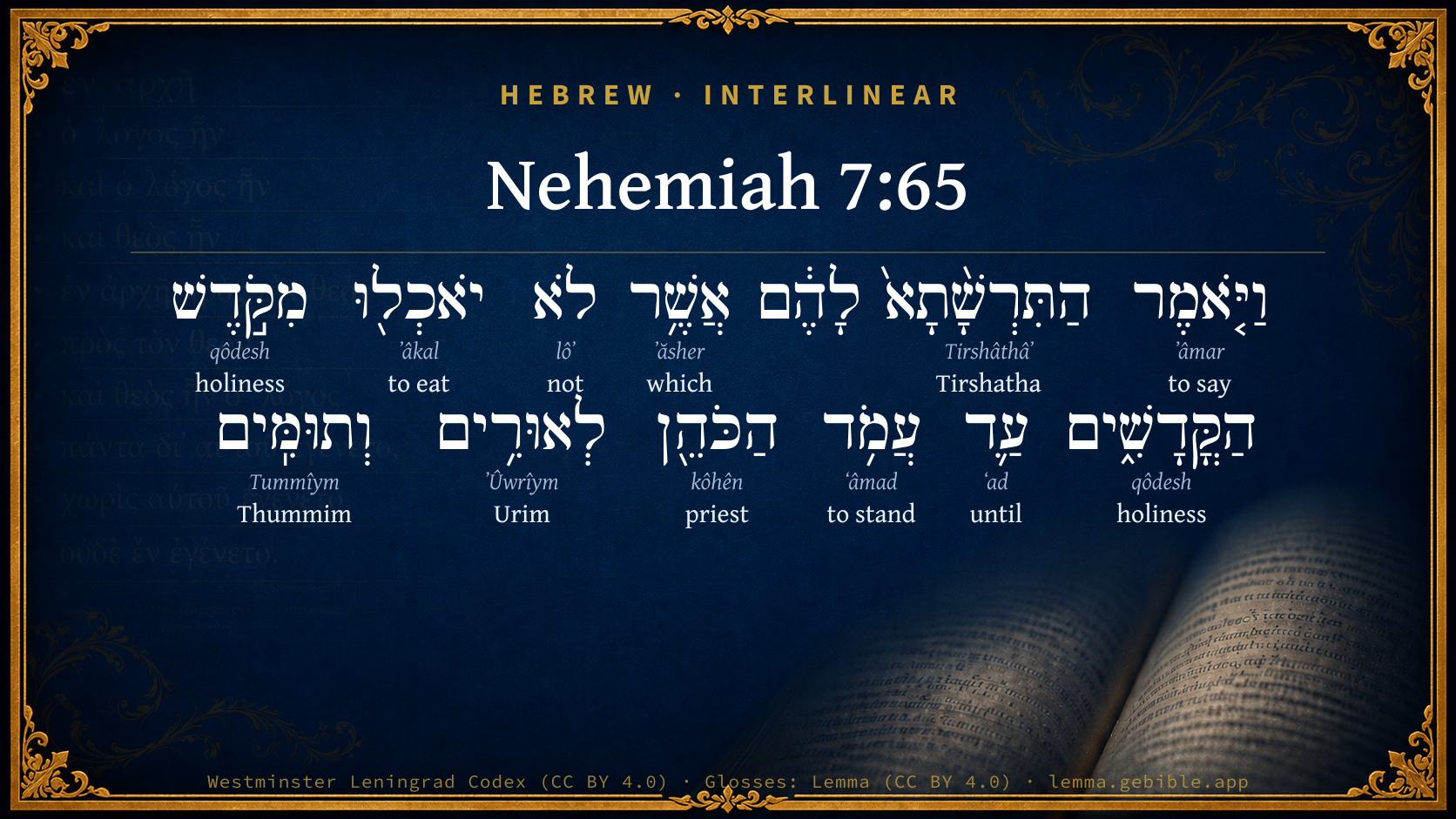
Hebrew (Westminster Leningrad Codex) Nehemiah 7:65 appears in the Hebrew Old Testament. The text above is from the Westminster Leningrad Codex. Each word links to its Strong’s number, a concise gloss, and parsing drawn from the Open Scriptures Hebrew Bible morphology. Click any word for its full Brown-Driver-Briggs (BDB) entry.
Download image
Cite this verse

Nehemiah 7:65 (World English Bible). Public Domain. Lemma interlinear Bible study tool, https://lemma.gebible.app/v/nehemiah/7/65.

Show BibTeX & RIS
BibTeX
RIS
English Translation
The governor said to them, that they should not eat of the most holy things, until there stood up a priest with Urim and Thummim.
World English Bible · Public Domain
Download a study sheet

One document with this verse’s original text, its word-by-word gloss line, the meaning frame, cross-references with their text, attributed commentary, and full source and license credits — printable, and it pastes into notes with its structure intact.

This verse Autodidact and up

Study sheet (.html) Plain text (.txt)

A passage Seminary Student

Up to 50 verses in one chapter. A passage sheet keeps up to 6 commentary sources and 12 cross-references per verse, in the order this page ranks them, and says so on the sheet whenever that leaves anything out. Ask for a single verse and you get the Autodidact verse sheet above.

Everything on this page stays free to read, with no account — the sheet is a download of what is already on screen, not access to it.

Want to remove ads? Support Godless Engineer
Compare translations 3

The same verse in 3 English versions, stacked beneath the original-language interlinear above. Click any original word for its lexicon entry.

Each is an independent rendering of the whole verse — the interlinear is not word-aligned to these translations.

Highlighted words mark where these versions differ — a whole-verse word diff, not a word-by-word alignment.

  • World English Bible Public Domain
    The governor said to them, that they should not eat of the most holy things, until there stood up a priest with Urim and Thummim.
  • King James Version Public Domain
    And the Tirshatha said unto them, that they should not eat of the most holy things, till there stood up a priest with Urim and Thummim.
  • unfoldingWord Literal Text CC BY-SA 4.0
    And the Tirshatha said to them that they must not eat from the holiest holy food until the priest stood with Urim and Thummim.

unfoldingWord Literal Text — © unfoldingWord, licensed CC BY-SA 4.0. Word-aligned USFM3 via Door43 (git.door43.org/unfoldingWord/en_ult).

Versions to compare (up to 4)

3 of 4 selected

Show all 18 translations

Every available English version of this verse, each an independent rendering of the whole verse.

  • World English Bible Public Domain
    The governor said to them, that they should not eat of the most holy things, until there stood up a priest with Urim and Thummim.
  • Berean Standard Bible Public Domain
    The governor ordered them not to eat the most holy things until there was a priest to consult the Urim and Thummim.
  • Majority Standard Bible Public Domain
    The governor ordered them not to eat the most holy things until there was a priest to consult the Urim and Thummim.
  • King James Version Public Domain
    And the Tirshatha said unto them, that they should not eat of the most holy things, till there stood up a priest with Urim and Thummim.
  • American Standard Version (1901) Public Domain
    And the governor said unto them, that they should not eat of the most holy things, till there stood up a priest with Urim and Thummim.
  • Revised Version (1885) Public Domain
    And the Tirshatha said unto them, that they should not eat of the most holy things, till there stood up a priest with Urim and Thummim.
  • Geneva Bible (1599) Public Domain
    And the Tirshatha sayd vnto them, that they should not eate of the most holy, till there rose vp a Priest with Vrim and Thummim.
  • Douay-Rheims (1899) Public Domain
    And Athersatha said to them, that they should not eat of the holies of holies, until there stood up a priest learned and skilful.
  • Young's Literal Translation Public Domain
    and the Tirshatha saith to them that they eat not of the most holy things till the standing up of the priest with Urim and Thummim.
  • Literal Standard Version CC BY-SA 4.0
    and the Tirshatha says to them that they do not eat of the most holy things until the standing up of the priest with [the] Lights and Perfections.
  • Unlocked Literal Bible CC BY-SA 4.0
    Then the governor said to them that they should not be allowed to eat the priests' share of food from the sacrifices until there rose up a priest with Urim and Thummim.
  • unfoldingWord Literal Text CC BY-SA 4.0
    And the Tirshatha said to them that they must not eat from the holiest holy food until the priest stood with Urim and Thummim.
  • Darby Bible Public Domain
    And the Tirshatha said to them that they should not eat of the most holy things, till there stood up the priest with Urim and Thummim.
  • World Messianic Bible Public Domain
    The governor told them not to eat of the most holy things until a priest stood up to minister with Urim and Thummim.
  • Webster's Bible Public Domain
    And the Tirshatha said to them, that they should not eat of the most holy things, till there should stand up a priest with Urim and Thummim.
  • Free Bible Version CC BY-SA 4.0
    The governor instructed them not to eat anything from the sanctuary sacrifices until a priest could ask the Lord about the issue by using the Urim and Thummim.
  • Bible in Basic English Public Domain
    And the Tirshatha said that they were not to have the most holy things for their food, till a priest came to give decision by the Urim and Thummim.
  • JPS Tanakh (1917) Public Domain
    And the Tirshatha said unto them, that they should not eat of the most holy things, till there stood up a priest with Urim and Thummim.

Literal Standard Version (2020), Covenant Press — licensed CC BY-SA 4.0. Text via the HelloAO Bible API (eBible.org). Unlocked Literal Bible (unfoldingWord) — licensed CC BY-SA 4.0. Text via the HelloAO Bible API (eBible.org). unfoldingWord Literal Text — © unfoldingWord, licensed CC BY-SA 4.0. Word-aligned USFM3 via Door43 (git.door43.org/unfoldingWord/en_ult). Free Bible Version, Dr. Jonathan Gallagher — licensed CC BY-SA 4.0. Text via the HelloAO Bible API (eBible.org).

Word by word

More ways to search: Search by grammar → Find every occurrence → Compare this word →

Practice this passage: Drill this verse → Learn its vocabulary →

הַתִּרְשָׁ֨תָא֙
Tirshâthâʼ
H8660
“the · Tirshatha”
Particle, Definite Article + Noun, Common, Masculine, Singular, Absolute
Part of Speech
Particle + Noun
Type
Common
Gender
Masculine
Number
Singular
State
Absolute
Full BDB Definition

Origin: of foreign derivation

TWOT: 2548

Tirshatha - governor - a title used by the Persian governor in Judea - Nehemiah used this title
  1. וַיֹּ֤אמֶר ʼâmar H559 “and · to say” Conjunction + Verb, Qal, Sequential Imperfect, 3rd Person, Masculine, Singular
  2. אֲשֶׁ֥ר ʼăsher H834 “which” Particle, Relative
  3. לֹא lôʼ H3808 “not” Particle, Negative
  4. יֹאכְל֖וּ ʼâkal H398 “to eat” Verb, Qal, Imperfect, 3rd Person, Masculine, Plural
  5. מִקֹּ֣דֶשׁ qôdesh H6944 “from · holiness of” Preposition + Noun, Common, Masculine, Singular, Construct
  6. הַקֳּדָשִׁ֑ים qôdesh H6944 “the · holy things” Particle, Definite Article + Noun, Common, Masculine, Plural, Absolute
  7. עַ֛ד ʻad H5704 “until” Preposition
  8. עֲמֹ֥ד ʻâmad H5975 “to stand” Verb, Qal, Infinitive Construct
  9. הַכֹּהֵ֖ן kôhên H3548 “the · priest” Particle, Definite Article + Noun, Common, Masculine, Singular, Absolute
  10. לְאוּרִ֥ים ʼÛwrîym H224 “to/for · Urim” Preposition + Noun, Common, Masculine, Plural, Absolute
  11. וְתוּמִּֽים Tummîym H8550 “and · Thummim” Conjunction + Noun, Common, Masculine, Plural, Absolute

About this verse

These counts appear in no published source. They are computed here, from the morphology-tagged text and Lemma’s own curated glosses. What Lemma adds →

13
words
11
distinct lemmas
Historical
section

Notable vocabulary

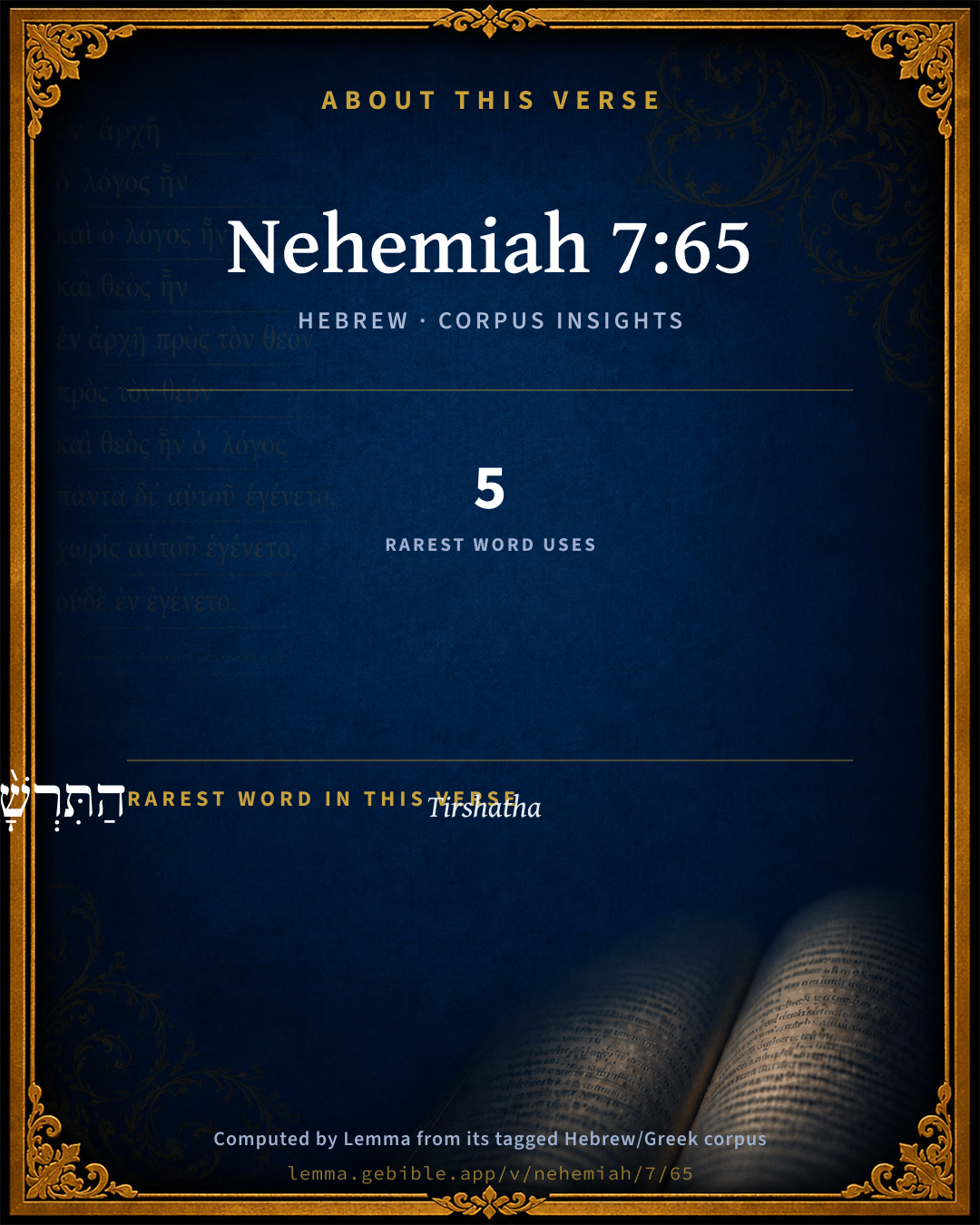
The rarest word here is הַתִּרְשָׁ֨תָא֙ Tirshatha H8660 — appearing just 5 times in the whole Hebrew Bible.

Shared distinctive vocabulary

הַתִּרְשָׁ֨תָא֙ Tirshatha H8660 occurs in 5 verses of the Hebrew Bible. Also found in:

Grammatical profile

  • 3 verbs
  • 6 nouns
  • 2 prepositions
  • 2 particles

Verb forms

  • וַיֹּ֤אמֶר Qal · Sequential Imperfect
  • יֹאכְל֖וּ Qal · Imperfect
  • עֲמֹ֥ד Qal · Infinitive Construct

Repetition

A word recurs within this verse — often emphatic in Hebrew:

  • מִקֹּ֣דֶשׁ holiness H6944 ×2

Cross-references

12

Topical passages linked to Nehemiah 7:65 in the Treasury of Scripture Knowledge — connected by theme and wording, ordered by reader-vote popularity; previews shown in the World English Bible.

  • Exodus 28:30 You shall put in the breastplate of judgment the Urim and the Thummim; and they shall be on Aaron's heart, when he goes in before Yahweh: and Aaron shall bear the judgment of the children of Israel on his heart before Yahweh continually.
  • Nehemiah 8:9 Nehemiah, who was the governor, and Ezra the priest the scribe, and the Levites who taught the people, said to all the people, This day is holy to Yahweh your God; don't mourn, nor weep. For all the people wept, when they heard the words of the law.
  • Deuteronomy 33:8 Of Levi he said, Your Thummim and your Urim are with your godly one, Whom you did prove at Massah, With whom you did strive at the waters of Meribah;
  • Ezra 2:63 The governor said to them, that they should not eat of the most holy things, until there stood up a priest with Urim and with Thummim.
  • Nehemiah 10:1 Now those who sealed were: Nehemiah the governor, the son of Hacaliah, and Zedekiah,
  • Numbers 27:21 He shall stand before Eleazar the priest, who shall inquire for him by the judgment of the Urim before Yahweh: at his word shall they go out, and at his word they shall come in, both he, and all the children of Israel with him, even all the congregation.
  • Leviticus 2:3 That which is left of the meal offering shall be Aaron's and his sons'. It is a most holy thing of the offerings of Yahweh made by fire.
  • Leviticus 2:10 That which is left of the meal offering shall be Aaron's and his sons'. It is a thing most holy of the offerings of Yahweh made by fire.
  • Leviticus 6:17 It shall not be baked with yeast. I have given it as their portion of my offerings made by fire. It is most holy, as the sin offering, and as the trespass offering.
  • Leviticus 7:19–20 "'The flesh that touches any unclean thing shall not be eaten. It shall be burned with fire. As for the flesh, everyone who is clean may eat it;
  • Leviticus 10:17–18 "Why haven't you eaten the sin offering in the place of the sanctuary, seeing it is most holy, and he has given it you to bear the iniquity of the congregation, to make atonement for them before Yahweh?
  • Leviticus 21:21–23 no man of the seed of Aaron the priest, who has a blemish, shall come near to offer the offerings of Yahweh made by fire. Since has a blemish, he shall not come near to offer the bread of his God.

Cross-references courtesy of OpenBible.info (CC BY 4.0).

Hebrew and Greek witnesses Masoretic Hebrew ↔ Greek Septuagint

The same verse in the two great witnesses to the Old Testament, shown verse-for-verse.

These are two independent witnesses, not word-aligned to each other, and the Septuagint is shown in lemma (dictionary) form.

Hebrew Nehemiah 7:65 Masoretic · Westminster Leningrad Codex

וַיֹּ֤אמֶר הַתִּרְשָׁ֨תָא֙ לָהֶ֔ם אֲשֶׁ֥ר לֹא יֹאכְל֖וּ מִקֹּ֣דֶשׁ הַקֳּדָשִׁ֑ים עַ֛ד עֲמֹ֥ד הַכֹּהֵ֖ן לְאוּרִ֥ים וְתוּמִּֽים

The governor said to them, that they should not eat of the most holy things, until there stood up a priest with Urim and Thummim.

World English Bible · Public Domain

Greek LXX Structure differs

The Septuagint has no separate book of Nehemiah. Its Greek text is the second half of Esdras B (2 Esdras), chapters 11–23; Ezra is the first half (1–10).

A verse-for-verse comparison isn’t shown here because the chapters and verses don’t line up. Switch to the LXX edition with the MT / LXX toggle above to read the Greek directly.

On this verse, The Cambridge Bible for Schools and Colleges discusses the Septuagint’s reading. Read the note in Commentary ↓

Hebrew: Westminster Leningrad Codex (CC BY 4.0). Greek: Septuagint (public domain); English from a public-domain English Septuagint. How the Septuagint differs from the Hebrew →

Commentary

Notes on Nehemiah 7:65 from classic Christian and Jewish commentators (each source and its license shown beneath its notes). The classic Christian expositions comment on the surrounding passage and are grouped to its opening verse, so a note may address several verses; the Jewish commentaries on the Tanakh (Rashi and others) are per-verse, so they appear only where the commentator wrote on this verse.

Lemma curates 59 commentaries, every one of them public domain or Creative Commons licensed, each selected and text-cleaned for this edition rather than reprinted as found. About our sources →

Tyndale Open Study Notes

Tyndale Open Resources

7:65 Urim and Thummim . . . sacred lots: See study notes on Exod 28:30; Lev 8:8.

Tyndale Open Study Notes — © Tyndale Open Resources, licensed CC BY-SA 4.0. Text via the HelloAO Bible API.

Geneva Bible (1599)

Geneva Bible translators

Meaning, Nehemiah: for Tirshatha in the Chaldean tongue signifieth a butler.

Geneva Bible (1599) marginal notes — public domain. Text via Bolls.life.

The Cambridge Bible for Schools and Colleges

gen. ed. J. J. S. Perowne

65. the Tirshatha] R.V. marg. Or, governor.

a priest] Literally ‘the priest.’ ‘With Urim and Thummim.’ LXX. ὁ ἱερεὺς φωτίσων. Vulg. ‘sacerdos doctus et eruditus.’

The Cambridge Bible for Schools and Colleges (gen. ed. J. J. S. Perowne; Cambridge University Press, 1878–1918) — public domain. Text from a community e-Sword module.

Haydock's Catholic Bible Commentary

Athersatha; Nehemias, (Calmet) as he is called in Chaldean, 1 Esdras ii. 63. (Menochius)

George Leo Haydock (1774–1849), Haydock's Catholic Family Bible and Commentary, 1859 edition — public domain. Excludes Psalms (Douay-Rheims chapter numbering differs from Protestant) and Deuterocanonical books (Catholic canon only).

Scofield Reference Notes

C. I. Scofield

Tirshatta i.e. governor, Neh 8:9.

Urim (See Scofield "Exo 28:30").

The Scofield Reference Bible (1917 edition), notes by C. I. Scofield — public domain. Text from a community e-Sword module.

Lesson kit

Teaching starters — assembled from the data on this page, not authored interpretation. Every prompt links to the verse data it draws on. Edit before teaching.

Nehemiah, in the Historical, opens this verse with 13 words (11 distinct Hebrew lemmas). Its most distinctive word is Tirshâthâʼ (“Tirshatha”). A historical commentator’s framing appears above. Read the whole chapter for the surrounding context.

Discussion questions

  1. How does “Tirshatha” (Tirshâthâʼ) shape what this verse is saying?
  2. How does Ezra 2:63, which shares the word «Tirshatha», read alongside this verse?
  3. What does the repetition of “holiness” (2× in this one verse) do in this verse?
  4. These translations render this verse differently. What is at stake in choosing one wording over another?
  5. «וַיֹּ֤אמֶר» is a Qal Sequential Imperfect verb. How does that grammatical form shape the action described?
  6. Compare how Tyndale Open Study Notes and Geneva Bible (1599) read this verse. Where do they agree or differ?

Things to notice

Reading settings

Reading text

Shown beneath each verse's original-language words.

Old Testament
Old Testament edition

Read the OT as the Masoretic Hebrew (MT) or the Greek Septuagint (LXX).

English shown for the Greek Septuagint (in the Hebrew ↔ Greek comparison).

Comparing translations? Open the Compare panel on any verse page to stack up to four side by side.