
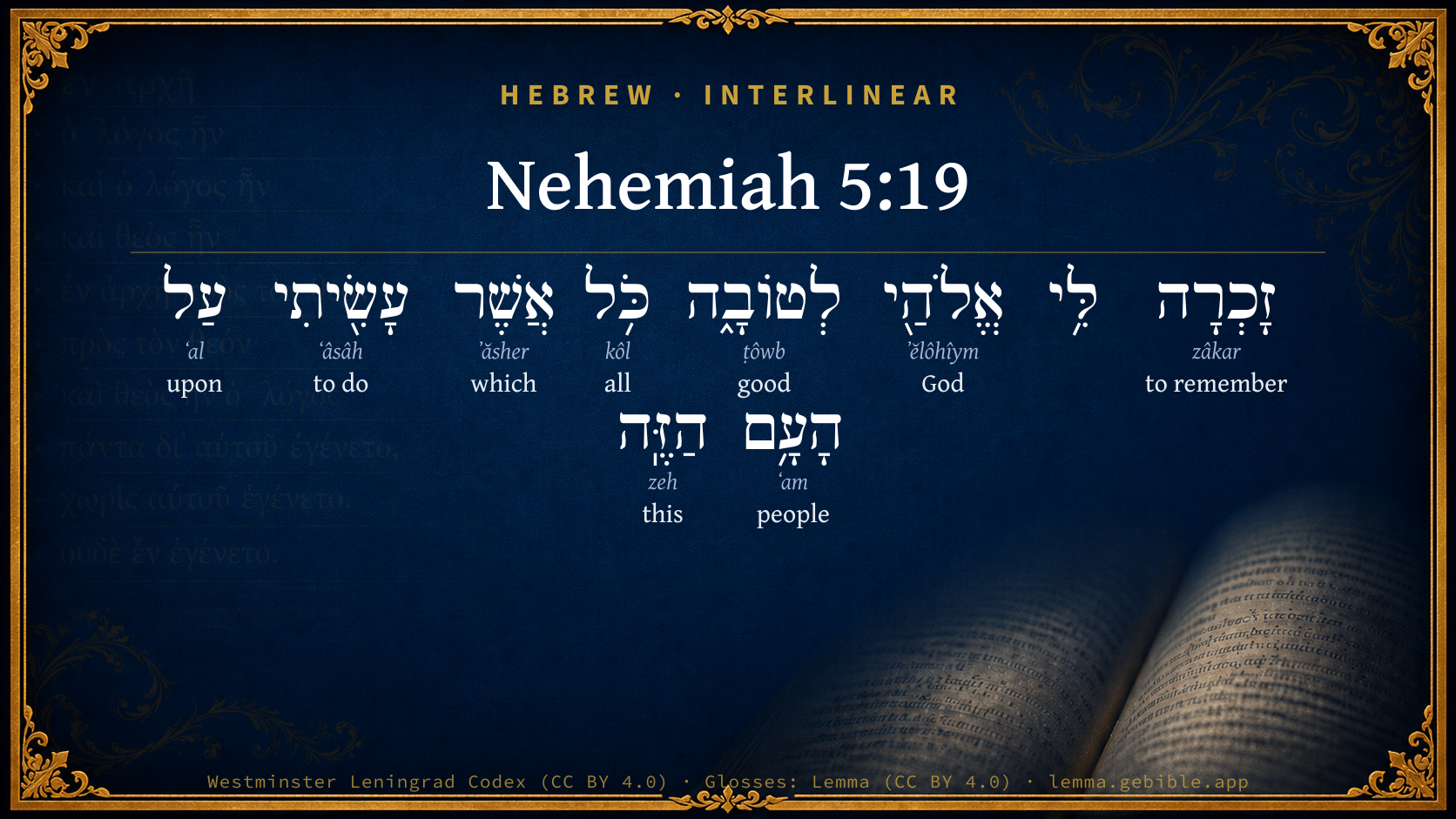
Nehemiah 5:19

Hebrew (Westminster Leningrad Codex) Nehemiah 5:19 appears in the Hebrew Old Testament. The text above is from the Westminster Leningrad Codex. Each word links to its Strong’s number, a concise gloss, and parsing drawn from the Open Scriptures Hebrew Bible morphology. Click any word for its full Brown-Driver-Briggs (BDB) entry.
Download image
Cite this verse

Nehemiah 5:19 (World English Bible). Public Domain. Lemma interlinear Bible study tool, https://lemma.gebible.app/v/nehemiah/5/19.

Show BibTeX & RIS
BibTeX
RIS
English Translation
Remember to me, my God, for good, all that I have done for this people.
World English Bible · Public Domain
Download a study sheet

One document with this verse’s original text, its word-by-word gloss line, the meaning frame, cross-references with their text, attributed commentary, and full source and license credits — printable, and it pastes into notes with its structure intact.

This verse Autodidact and up

Study sheet (.html) Plain text (.txt)

A passage Seminary Student

Up to 50 verses in one chapter. A passage sheet keeps up to 6 commentary sources and 12 cross-references per verse, in the order this page ranks them, and says so on the sheet whenever that leaves anything out. Ask for a single verse and you get the Autodidact verse sheet above.

Everything on this page stays free to read, with no account — the sheet is a download of what is already on screen, not access to it.

Want to remove ads? Support Godless Engineer
Compare translations 3

The same verse in 3 English versions, stacked beneath the original-language interlinear above. Click any original word for its lexicon entry.

Each is an independent rendering of the whole verse — the interlinear is not word-aligned to these translations.

Highlighted words mark where these versions differ — a whole-verse word diff, not a word-by-word alignment.

  • World English Bible Public Domain
    Remember to me, my God, for good, all that I have done for this people.
  • King James Version Public Domain
    Think upon me, my God, for good, according to all that I have done for this people.
  • unfoldingWord Literal Text CC BY-SA 4.0
    Remember me, my God, for good, all that I have done for this people.

unfoldingWord Literal Text — © unfoldingWord, licensed CC BY-SA 4.0. Word-aligned USFM3 via Door43 (git.door43.org/unfoldingWord/en_ult).

Versions to compare (up to 4)

3 of 4 selected

Show all 18 translations

Every available English version of this verse, each an independent rendering of the whole verse.

  • World English Bible Public Domain
    Remember to me, my God, for good, all that I have done for this people.
  • Berean Standard Bible Public Domain
    Remember me favorably, O my God, for all that I have done for this people.
  • Majority Standard Bible Public Domain
    Remember me favorably, O my God, for all that I have done for this people.
  • King James Version Public Domain
    Think upon me, my God, for good, according to all that I have done for this people.
  • American Standard Version (1901) Public Domain
    Remember unto me, O my God, for good, all that I have done for this people.
  • Revised Version (1885) Public Domain
    Remember unto me, O my God, for good, all that I have done for this people.
  • Geneva Bible (1599) Public Domain
    Remember me, O my God, in goodnesse, according to all that I haue done for this people.
  • Douay-Rheims (1899) Public Domain
    Remember me, O my God, for good according to all that I have done for this people.
  • Young's Literal Translation Public Domain
    Remember for me, O my God, for good, all that I have done for this people.
  • Literal Standard Version CC BY-SA 4.0
    Remember for me, O my God, for good, all that I have done for this people.
  • Unlocked Literal Bible CC BY-SA 4.0
    Call me to mind, my God, for good, because of all that I have done for this people.
  • unfoldingWord Literal Text CC BY-SA 4.0
    Remember me, my God, for good, all that I have done for this people.
  • Darby Bible Public Domain
    Remember for me, my God, for good, all that I have done for this people.
  • World Messianic Bible Public Domain
    Remember me, my God, for all the good that I have done for this people.
  • Webster's Bible Public Domain
    Think upon me, my God, for good, according to all that I have done for this people.
  • Free Bible Version CC BY-SA 4.0
    Please remember me positively, my God, for all that I've done for this people.
  • Bible in Basic English Public Domain
    Keep in mind, O my God, for my good, all I have done for this people.
  • JPS Tanakh (1917) Public Domain
    Remember unto me, O my God, for good, all that I have done for this people.

Literal Standard Version (2020), Covenant Press — licensed CC BY-SA 4.0. Text via the HelloAO Bible API (eBible.org). Unlocked Literal Bible (unfoldingWord) — licensed CC BY-SA 4.0. Text via the HelloAO Bible API (eBible.org). unfoldingWord Literal Text — © unfoldingWord, licensed CC BY-SA 4.0. Word-aligned USFM3 via Door43 (git.door43.org/unfoldingWord/en_ult). Free Bible Version, Dr. Jonathan Gallagher — licensed CC BY-SA 4.0. Text via the HelloAO Bible API (eBible.org).

Word by word

More ways to search: Search by grammar → Find every occurrence → Compare this word →

Practice this passage: Drill this verse → Learn its vocabulary →

זָכְרָה
zâkar
H2142
“remember”
Verb, Qal, Imperative, 2nd Person, Masculine, Singular + Suffix, h
Part of Speech
Verb
Stem
Qal
Form
Imperative
Person
2nd Person
Gender
Masculine
Number
Singular
Full BDB Definition

Origin: a primitive root

TWOT: 551

to remember, recall, call to mind - (Qal) to remember, recall - (Niphal) to be brought to remembrance, be remembered, be thought of, be brought to mind - (Hiphil) - to cause to remember, remind - to cause to be remembered, keep in remembrance - to mention - to record - to make a memorial, make remembrance
  1. אֱלֹהַ֖י ʼĕlôhîym H430 “God(s) · my” Noun, Common, Masculine, Plural, Construct + Suffix, Personal, 1st Person, Common, Singular
  2. לְטוֹבָ֑ה ṭôwb H2896 “to/for · good” Preposition + Adjective, Adjective, Feminine, Singular, Absolute
  3. כֹּ֥ל kôl H3605 “all” Noun, Common, Masculine, Singular, Absolute
  4. אֲשֶׁר ʼăsher H834 “which” Particle, Relative
  5. עָשִׂ֖יתִי ʻâsâh H6213 “to do” Verb, Qal, Perfect, 1st Person, Common, Singular
  6. עַל ʻal H5921 “upon” Preposition
  7. הָעָ֥ם ʻam H5971 “the · people” Particle, Definite Article + Noun, Common, Masculine, Singular, Absolute
  8. הַזֶּֽה zeh H2088 “the · this” Particle, Definite Article + Pronoun, Demonstrative, Masculine, Singular

About this verse

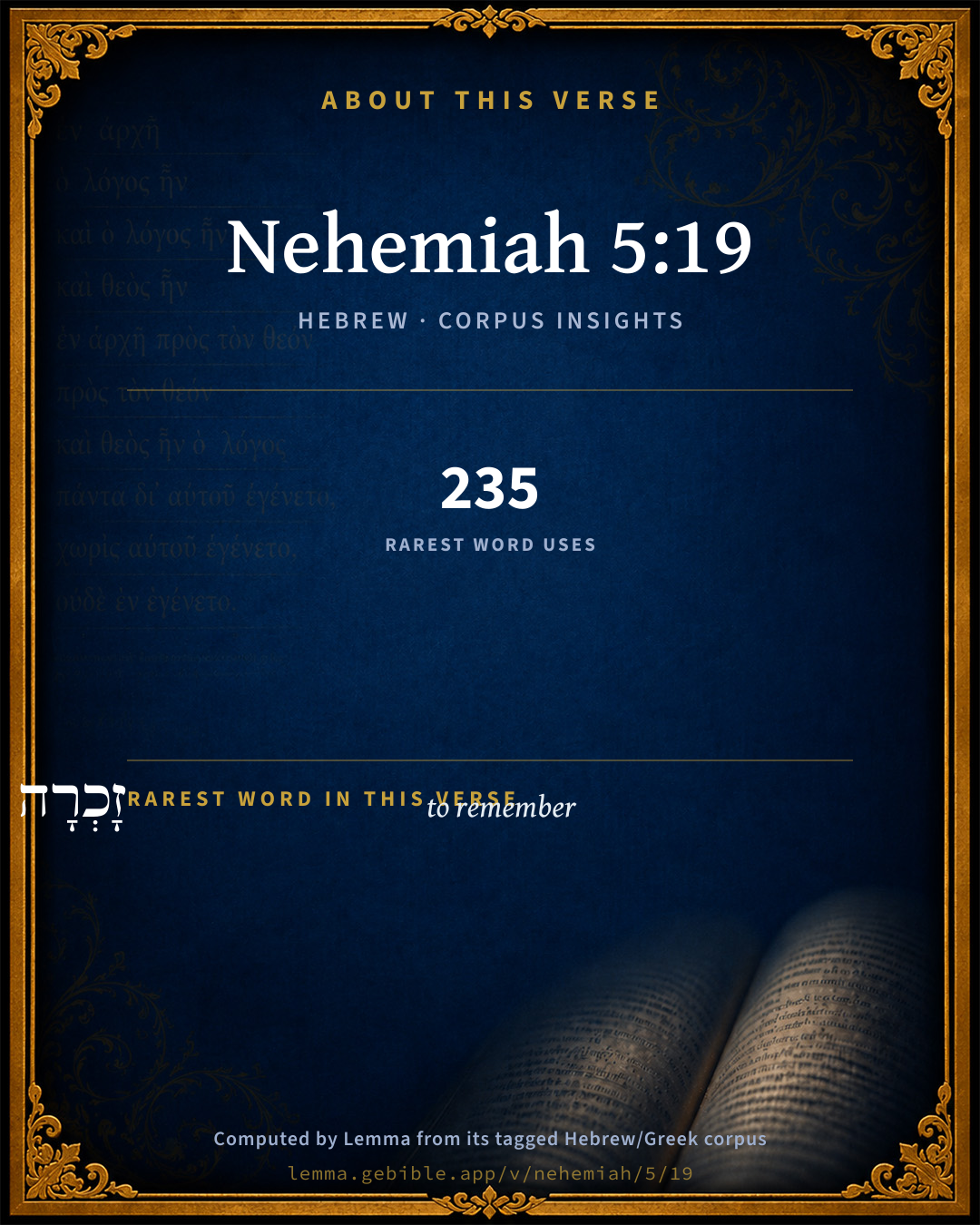
These counts appear in no published source. They are computed here, from the morphology-tagged text and Lemma’s own curated glosses. What Lemma adds →

10
words
9
distinct lemmas
Historical
section

Grammatical profile

  • 2 verbs
  • 3 nouns
  • 1 adjective
  • 1 pronoun
  • 2 prepositions
  • 1 particle

Verb forms

  • זָכְרָה Qal · Imperative
  • עָשִׂ֖יתִי Qal · Perfect

Cross-references

12

Topical passages linked to Nehemiah 5:19 in the Treasury of Scripture Knowledge — connected by theme and wording, ordered by reader-vote popularity; previews shown in the World English Bible.

  • Nehemiah 13:31 and for the wood-offering, at times appointed, and for the first fruits. Remember me, my God, for good.
  • Nehemiah 13:14 Remember me, my God, concerning this, and don't wipe out my good deeds that I have done for the house of my God, and for the observances of it.
  • Nehemiah 13:22 I commanded the Levites that they should purify themselves, and that they should come and keep the gates, to sanctify the Sabbath day. Remember to me, my God, this also, and spare me according to the greatness of your loving kindness.
  • Psalms 106:4 Remember me, Yahweh, with the favor that you show to your people. Visit me with your salvation,
  • Psalms 25:6–7 Yahweh, remember your tender mercies and your loving kindness, For they are from old times.
  • Jeremiah 29:11 For I know the thoughts that I think toward you, says Yahweh, thoughts of peace, and not of evil, to give you hope in your latter end.
  • Psalms 18:23–25 I was also blameless with him. I kept myself from my iniquity.
  • Psalms 40:17 But I am poor and needy; May the Lord think about me. You are my help and my deliverer. Don't delay, my God.
  • Matthew 10:42 Whoever gives one of these little ones just a cup of cold water to drink in the name of a disciple, most assuredly I tell you he will in no way lose his reward."
  • Mark 9:41 For whoever will give you a cup of water to drink in my name, because you are Christ's, most assuredly I tell you, he will in no way lose his reward.
  • Matthew 25:34–40 Then the King will tell those on his right hand, 'Come, blessed of my Father, inherit the Kingdom prepared for you from the foundation of the world;
  • Genesis 40:14 But remember me when it will be well with you, and show kindness, please, to me, and make mention of me to Pharaoh, and bring me out of this house.

Cross-references courtesy of OpenBible.info (CC BY 4.0).

Hebrew and Greek witnesses Masoretic Hebrew ↔ Greek Septuagint

The same verse in the two great witnesses to the Old Testament, shown verse-for-verse.

These are two independent witnesses, not word-aligned to each other, and the Septuagint is shown in lemma (dictionary) form.

Hebrew Nehemiah 5:19 Masoretic · Westminster Leningrad Codex

זָכְרָה לִּ֥י אֱלֹהַ֖י לְטוֹבָ֑ה כֹּ֥ל אֲשֶׁר עָשִׂ֖יתִי עַל הָעָ֥ם הַזֶּֽה

Remember to me, my God, for good, all that I have done for this people.

World English Bible · Public Domain

Greek LXX Structure differs

The Septuagint has no separate book of Nehemiah. Its Greek text is the second half of Esdras B (2 Esdras), chapters 11–23; Ezra is the first half (1–10).

A verse-for-verse comparison isn’t shown here because the chapters and verses don’t line up. Switch to the LXX edition with the MT / LXX toggle above to read the Greek directly.

Hebrew: Westminster Leningrad Codex (CC BY 4.0). Greek: Septuagint (public domain); English from a public-domain English Septuagint. How the Septuagint differs from the Hebrew →

Commentary

Notes on Nehemiah 5:19 from classic Christian and Jewish commentators (each source and its license shown beneath its notes). The classic Christian expositions comment on the surrounding passage and are grouped to its opening verse, so a note may address several verses; the Jewish commentaries on the Tanakh (Rashi and others) are per-verse, so they appear only where the commentator wrote on this verse.

Lemma curates 59 commentaries, every one of them public domain or Creative Commons licensed, each selected and text-cleaned for this edition rather than reprinted as found. About our sources →

Trapp's Complete Commentary

John Trapp

Neh 5:19 Think upon me, my God, for good, [according] to all that I have done for this people.

Ver. 19. Think upon me, my God, for good] i.e. Both of grace and glory, saith Lyra; a confluence of all comforts and contentments, especially spiritual blessings in heavenly things, Eph 1:3. He that first called riches goods was surely a better husband than divine, saith one. Ostendam tibi omne bonum, I will show thee all good, said God to Moses, when he gave him a glimpse of himself. Nil bonum absque summo Bone, saith Austin, There is no good without the chief Good. Say, therefore, with the Church, Hos 14:2, Take away all iniquity, and do good; and as here, Remember me, O my God, for good.

According to all that I have done for this people] Here is nothing for merit mongers. It is mercy in God to set his love on them that keep his commandments, Exo 20:6, to reward every man according to his works, Psa 62:12. A poor gardener, presenting a ripe root, being the best gift he had at hand, to the duke of Burgundy, was by him bountifully rewarded. His steward, observing this, and hoping for the like recompense, presented him with a very fair horse. The duke ( ut perspicaci erat ingenio, saith mine author, being a witty man) perceived the craft; and, therefore, thought good to receive the horse, and to give him nothing again. Let those that dream of merit expect the like disappointment; and let them learn from Nehemiah, Neh 13:22 (the best gloss upon this text), to urge, not their merits, with the Pharisee, but their miseries, with the publican, for obtaining mercy. So Psa 25:11.

John Trapp, A Commentary or Exposition upon All the Books of the Old and New Testament (1647–1656) — public domain. Text from a community e-Sword module.

The Biblical Illustrator

Joseph S. Exell

Neh_5:19

Think upon me, my God.

The saints support

I. The person petitioned.

1. General title: God.

2. Special relation: My.

II. The point prayed for. Lessons:

1. God the support of His saints.

2. Peculiar God to believer: My.

3. God hath remembrancers.

4. God is soonest drawn to His own.

5. Prayer proper for ones own good.

6. Works may be pleaded before God.

7. Mans works are the rule of Gods reward.

8. Everything well done shall be rewarded.

9. Good done to Gods people is most acceptable. (Wm. Gouge.)

The remembrance of good deeds a pillow of rest for a good man

I. Lifes review will be a review of the whole of life.

II. Lifes reward will be rendered according to its deeds. (Homiletic Commentary.)

.

The Biblical Illustrator, edited by Joseph S. Exell (c. 1880s–1900s) — public domain. Text from a community e-Sword module.

Joseph Benson's Commentary

Neh 5:19. Think upon me, my God, for good — As I have done thy people good for thy sake, so do me good for thine own sake, for thou art pleased, and hast promised, graciously to reward us according to our works, and to mete to men the same measure which they mete to others. Thus he shows that he expected his reward only from God, who, he hoped, would show him kindness, similar to that which he had shown for his people. There is no reason to think he here speaks too much of himself, and his own worthy acts; for it was no more than was necessary in such a state of things, that posterity might be furnished with an example of extraordinary virtue; and no more than St. Paul was constrained to speak of himself in his second epistle to the Corinthians, of whom he would take nothing, that he might stop the mouths of false apostles, and covetous people.

Joseph Benson's Commentary on the Old and New Testaments (1811–1818) — public domain. Text from a community e-Sword module.

Tyndale Open Study Notes

Tyndale Open Resources

5:19 Nehemiah’s prayer for God to remember and bless him was a sign of his dependence on God.

Tyndale Open Study Notes — © Tyndale Open Resources, licensed CC BY-SA 4.0. Text via the HelloAO Bible API.

Adam Clarke's Commentary

Verse 19. Think upon me, my God, for good] Nehemiah wishes for no reward from man; and he only asks mercy at the hand of his God for what his providence enabled him to do; and which, according to the good hand of his God upon him, he had done faithfully. He does not offer his good deeds to God in extenuation of his sins, or as a compensation for the heaven he expected. Nothing of the kind: he simply says, what any good man might say, My God, as I have done good to them, so do good to me; or as the poet has sung: -

"Teach me to feel another's wo,

To hide the fault I see:

The mercy I to others show,

That mercy show to me!" POPE.

This is according to the precept of Christ: "Forgive, and ye shall be forgiven; give, and it shall be given unto you."

Adam Clarke's Commentary on the Bible (1810–1826) — public domain. Text from a community e-Sword/MySword module.

Ellicott's Commentary for English Readers

(19) Think upon me, my God.—Inserting the present prayer far from this people, Nehemiah humbly asks his recompense not from them, but from God. Nothing was more distant from his thoughts than the fame of his good deeds.

A Bible Commentary for English Readers, edited by Charles John Ellicott (1878–1897) — public domain. Text from a community e-Sword module.

The Cambridge Bible for Schools and Colleges

gen. ed. J. J. S. Perowne

19. Think upon me, my God, for good, according to all, &c.] R.V. Remember unto me, O my God, for good, all, &c. ‘Remember’ is the natural translation here and in the similar passages, Neh_6:14, Neh_13:22; Neh_13:29; Neh_13:31. The A.V. unfortunately introduced the rendering ‘think upon’ as a variation. For the use of ‘remember’ in its application to the Deity, cf. 2Ch_6:42; Jdg_16:28; Psa_106:4; Jer_15:15. Nehemiah’s prayer differs in a measure from the appeal for ‘remembrance’ in the last three of these passages. In these the prayer is that the speaker may not be forgotten and so left in his present distress. Nehemiah prays with frank simplicity that God will recognize and reward his services to the people of Israel. In our ears the self-complacency of the petitions strikes a jarring note. But the words must not be judged by our modern standard. Their quaint candour quite disarms the charge of vanity. It is the ejaculation of a practical man, keenly alive to the responsibility of his position, very conscious of his loneliness, and sensible of the moral effort which it costs him at every fresh endeavour to please Jehovah in the service of the people.

To illustrate the thought cf. Sir_17:22, ‘The alms of a man are as a signet with him, and he will keep the good deeds of man as the apple of the eye.’ Heb_6:10, ‘For God is not unrighteous to forget your work and the love which ye showed toward his name, in that ye ministered unto the saints, and still do minister.’

The Cambridge Bible for Schools and Colleges (gen. ed. J. J. S. Perowne; Cambridge University Press, 1878–1918) — public domain. Text from a community e-Sword module.

Haydock's Catholic Bible Commentary

Good. A good conscience confidently hopeth for a reward. (Worthington)

George Leo Haydock (1774–1849), Haydock's Catholic Family Bible and Commentary, 1859 edition — public domain. Excludes Psalms (Douay-Rheims chapter numbering differs from Protestant) and Deuterocanonical books (Catholic canon only).

Matthew Poole's English Annotations

As I have done thy people good for thy sake, so do me good for thine own sake; for thou art pleased, and hast promised graciously to reward us according to our works, and to mete to men the same measure which they mete to others.

Matthew Poole's English Annotations on the Holy Bible (1683–1685) — public domain. Text from a community e-Sword/MySword module.

Whedon's Commentary on the Bible

Daniel D. Whedon

19. Think upon me, my God, for good — The prayer of conscious innocence and self-sacrifice, such as any pure and lofty soul might naturally write down in his diary, if he were beset with the difficulties that surrounded Nehemiah.

Daniel D. Whedon (gen. ed.), Commentary on the Old and New Testaments (1874–1909) — public domain. Text from a community e-Sword module.

The Pulpit Commentary

Think upon me, my God. Compare Neh_13:14, Neh_13:22, Neh_13:31. This is no "prayer for posthumous fame" (Stanley, "Lectures on the Jewish Church," Third Series, p. 135), but simply an appeal to God, beseeching him to bear in mind the petitioner"s good deeds, and reward them at his own good time and in his own way. As Butler observes ("Analogy," Part 1Ch 3), the sense of good and ill desert is inseparably connected with an expectation of reward or punishment, and so with the notion of a future life, since neither are the righteous adequately rewarded nor the wicked adequately punished in this life.

Prayer for Divine remembrance.

"Think upon me, O my God," etc. This and other similar prayers of good Nehemiah strike us at first as unseemly; and certainly they are more consonant with the spirit of the Old Testament than that of the New. Our Lord teaches us to say after our best works, "We are unprofitable servants, we have done that which was our duty to do." Besides which, the sense of sin on the one hand, and of entire indebtedness to Divine grace for all the good we have and do on the other, foster a humility which prevents the complacent thought of our good deeds, especially before God. Still the doctrine of reward according to works belongs to the Christian equally with the Mosaic religion. We are taught to hope for future recompense of the good we have done; and there can, therefore, be no essential impropriety in at times praying for it. It is a probable supposition (Ewald) that Nehemiah Wrote these prayers after he had learned by painful experience how little of appreciation, gratitude, or reward he could expect from men. "They forget or neglect me, or requite me evil, but do not thou be unmindful.

I WHO MAY OFFER SUCH A PRAYER. Those who have served God"s people, and therefore God himself

1. With sincere regard for God. His will, approval, recompense. They whose good works are done" to be seen of men" "have their reward," but may not look to God for it.

2. Disinterestedly. Not from selfishness or ambition.

3. Devotedly. With great zeal.

4. Abundantly. Rendering great service.

5. Self-denyingly. At considerable sacrifice of ease, time, strength, substance, etc.

6. Un-weariedly.

II WHEN SUCH A PRAYER IS SUITABLE.

1. When reward cannot be expected from men. Either on account of their want of appreciation of what is done for them, or inability from poverty or otherwise to requite it suitably.

2. When men show positive ingratitude, or return evil for good.

3. Even when men remember and reward. For the godly man feels that without the Divine favour all that man can give will be vain and unsatisfying.

III WHY A FAVOURABLE ANSWER MAY BE EXPECTED. Because of

1. The relation of God to his praying servant. "My God.

2. The Divine character. Righteous, and loving righteousness; good, and approving the good. (see Heb_6:10)

3. The union which exists between God and his people. So that he regards what is done to "this people" as done to himself.

4. The Divine promises. Such as Mat_10:42 Mat_25:34-40.

The Pulpit Commentary (1880–1919), ed. H.D.M. Spence-Jones & Joseph S. Exell — public domain. Text from a community e-Sword module.

John Wesley's Explanatory Notes

According - As I have done thy people good for thy sake, so do me good for thine own sake; for thou art pleased, and hast promised graciously to reward us according to our works, and to mete to men the same measure which they meet to others.

John Wesley, Explanatory Notes Upon the Whole Bible (1754–1765) — public domain. Text via the GEBible commentary corpus.

Lesson kit

Teaching starters — assembled from the data on this page, not authored interpretation. Every prompt links to the verse data it draws on. Edit before teaching.

Nehemiah, in the Historical, opens this verse with 10 words (9 distinct Hebrew lemmas). Its most distinctive word is zâkar (“to remember”). A historical commentator’s framing appears above. Read the whole chapter for the surrounding context.

Discussion questions

  1. How does “to remember” (zâkar) shape what this verse is saying?
  2. Nehemiah 13:31 shares this passage’s theme. How do the two illuminate each other?
  3. These translations render this verse differently. What is at stake in choosing one wording over another?
  4. The verb «זָכְרָה» is Qal Imperative. How does its form color the action?
  5. Reading how Trapp's Complete Commentary and The Biblical Illustrator read this verse, where do the two commentators agree and where do they part?

Things to notice

Reading settings

Reading text

Shown beneath each verse's original-language words.

Old Testament
Old Testament edition

Read the OT as the Masoretic Hebrew (MT) or the Greek Septuagint (LXX).

English shown for the Greek Septuagint (in the Hebrew ↔ Greek comparison).

Comparing translations? Open the Compare panel on any verse page to stack up to four side by side.