
Esther 9:31

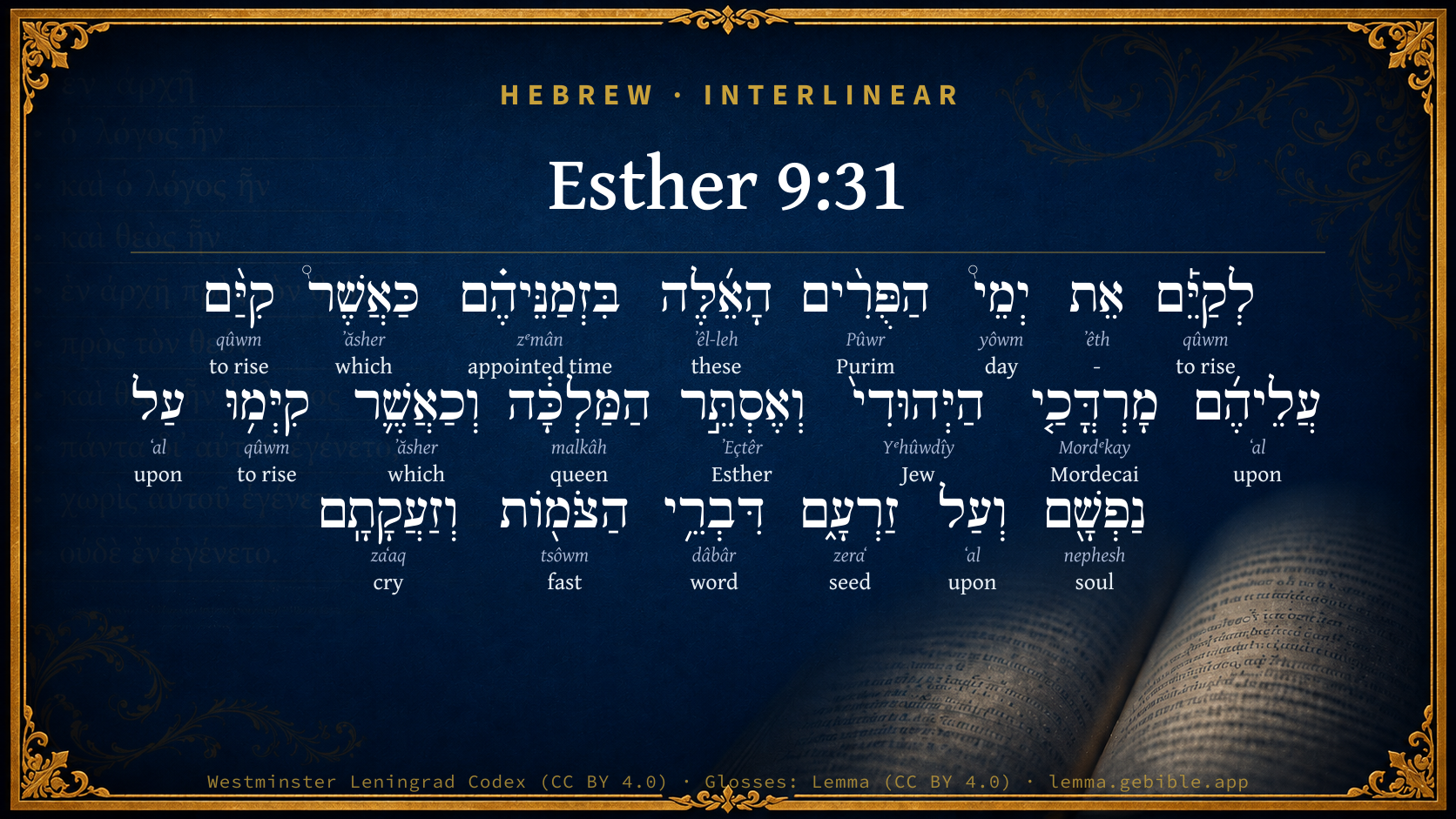
Hebrew (Westminster Leningrad Codex) Esther 9:31 appears in the Hebrew Old Testament. The text above is from the Westminster Leningrad Codex. Each word links to its Strong’s number, a concise gloss, and parsing drawn from the Open Scriptures Hebrew Bible morphology. Click any word for its full Brown-Driver-Briggs (BDB) entry.
Download image
Cite this verse

Esther 9:31 (World English Bible). Public Domain. Lemma interlinear Bible study tool, https://lemma.gebible.app/v/esther/9/31.

Show BibTeX & RIS
BibTeX
RIS
English Translation
to confirm these days of Purim in their appointed times, according as Mordecai the Jew and Esther the queen had enjoined them, and as they had ordained for themselves and for their seed, in the matter of the fastings and their cry.
World English Bible · Public Domain
Download a study sheet

One document with this verse’s original text, its word-by-word gloss line, the meaning frame, cross-references with their text, attributed commentary, and full source and license credits — printable, and it pastes into notes with its structure intact.

This verse Autodidact and up

Study sheet (.html) Plain text (.txt)

A passage Seminary Student

Up to 50 verses in one chapter. A passage sheet keeps up to 6 commentary sources and 12 cross-references per verse, in the order this page ranks them, and says so on the sheet whenever that leaves anything out. Ask for a single verse and you get the Autodidact verse sheet above.

Everything on this page stays free to read, with no account — the sheet is a download of what is already on screen, not access to it.

Want to remove ads? Support Godless Engineer
Compare translations 3

The same verse in 3 English versions, stacked beneath the original-language interlinear above. Click any original word for its lexicon entry.

Each is an independent rendering of the whole verse — the interlinear is not word-aligned to these translations.

Highlighted words mark where these versions differ — a whole-verse word diff, not a word-by-word alignment.

  • World English Bible Public Domain
    to confirm these days of Purim in their appointed times, according as Mordecai the Jew and Esther the queen had enjoined them, and as they had ordained for themselves and for their seed, in the matter of the fastings and their cry.
  • King James Version Public Domain
    To confirm these days of Purim in their times appointed, according as Mordecai the Jew and Esther the queen had enjoined them, and as they had decreed for themselves and for their seed, the matters of the fastings and their cry.
  • unfoldingWord Literal Text CC BY-SA 4.0
    to set up these days of Purim at their appointed times according to what Mordecai the Jew and Esther the queen had set up for them and according to what they had set up concerning their lives and concerning their seed, the matters of the fasts and their outcry.

unfoldingWord Literal Text — © unfoldingWord, licensed CC BY-SA 4.0. Word-aligned USFM3 via Door43 (git.door43.org/unfoldingWord/en_ult).

Versions to compare (up to 4)

3 of 4 selected

Show all 18 translations

Every available English version of this verse, each an independent rendering of the whole verse.

  • World English Bible Public Domain
    to confirm these days of Purim in their appointed times, according as Mordecai the Jew and Esther the queen had enjoined them, and as they had ordained for themselves and for their seed, in the matter of the fastings and their cry.
  • Berean Standard Bible Public Domain
    in order to confirm these days of Purim at their appointed time, just as Mordecai the Jew and Queen Esther had established them and had committed themselves and their descendants to the times of fasting and lamentation.
  • Majority Standard Bible Public Domain
    in order to confirm these days of Purim at their appointed time, just as Mordecai the Jew and Queen Esther had established them and had committed themselves and their descendants to the times of fasting and lamentation.
  • King James Version Public Domain
    To confirm these days of Purim in their times appointed, according as Mordecai the Jew and Esther the queen had enjoined them, and as they had decreed for themselves and for their seed, the matters of the fastings and their cry.
  • American Standard Version (1901) Public Domain
    to confirm these days of Purim in their appointed times, according as Mordecai the Jew and Esther the queen had enjoined them, and as they had ordained for themselves and for their seed, in the matter of the fastings and their cry.
  • Revised Version (1885) Public Domain
    to confirm these days of Purim in their appointed times, according as Mordecai the Jew and Esther the queen had enjoined them, and as they had ordained for themselves and for their seed, in the matter of the fastings and their cry.
  • Geneva Bible (1599) Public Domain
    To confirme these dayes of Purim, according to their seasons, as Mordecai the Iewe and Ester the Queene had appointed them, and as they had promised for them selues and for their seede with fasting and prayer.
  • Douay-Rheims (1899) Public Domain
    And observe the days of lots, and celebrate them with joy in their proper time: as Mardochai and Esther had appointed, and they undertook them to be observed by themselves and by their seed, fasts, and cries, and the days of lots,
  • Young's Literal Translation Public Domain
    to establish these days of Purim, in their seasons, as Mordecai the Jew hath established on them, and Esther the queen, and as they had established on themselves, and on their seed -- matters of the fastings, and of their cry.
  • Literal Standard Version CC BY-SA 4.0
    to establish these days of Purim, in their seasons, as Mordecai the Jew has established on them, and Esther the queen, and as they had established on themselves, and on their seed—matters of the fastings, and of their cry.
  • Unlocked Literal Bible CC BY-SA 4.0
    These letters confirmed the days of Purim at their appointed times, as Mordecai the Jew and Queen Esther obligated the Jews. The Jews accepted this obligation for themselves and their descendants, just as also they accepted times of fasting and lamenting.
  • unfoldingWord Literal Text CC BY-SA 4.0
    to set up these days of Purim at their appointed times according to what Mordecai the Jew and Esther the queen had set up for them and according to what they had set up concerning their lives and concerning their seed, the matters of the fasts and their outcry.
  • Darby Bible Public Domain
    to confirm these days of Purim in their fixed times, according as Mordecai the Jew and queen Esther had enjoined them, and as they had decreed for themselves and for their seed, as to the matters of the fastings and their cry.
  • World Messianic Bible Public Domain
    to confirm these days of Purim in their appointed times, as Mordecai the Jew and Esther the queen had decreed, and as they had imposed upon themselves and their descendants in the matter of the fastings and their mourning.
  • Webster's Bible Public Domain
    To confirm these days of Purim in their times appointed, according as Mordecai the Jew and Esther the queen had enjoined them, and as they had decreed for themselves and for their seed, the matters of the fastings and their cry.
  • Free Bible Version CC BY-SA 4.0
    They established these days of Purim at their given time as Mordecai the Jew and Queen Esther had ordered, committing themselves and their descendants to the times of fasting and mourning.
  • Bible in Basic English Public Domain
    Giving the force of law to these days of Purim at their fixed times, as they had been ordered by Mordecai the Jew and Esther the queen, and in keeping with the rules they had made for themselves and their seed, in connection with their time of going without food and their cry for help.
  • JPS Tanakh (1917) Public Domain
    to confirm these days of Purim in their appointed times, according as Mordecai the Jew and Esther the queen had enjoined them, and as they had ordained for themselves and for their seed, the matters of the fastings and their cry.

Literal Standard Version (2020), Covenant Press — licensed CC BY-SA 4.0. Text via the HelloAO Bible API (eBible.org). Unlocked Literal Bible (unfoldingWord) — licensed CC BY-SA 4.0. Text via the HelloAO Bible API (eBible.org). unfoldingWord Literal Text — © unfoldingWord, licensed CC BY-SA 4.0. Word-aligned USFM3 via Door43 (git.door43.org/unfoldingWord/en_ult). Free Bible Version, Dr. Jonathan Gallagher — licensed CC BY-SA 4.0. Text via the HelloAO Bible API (eBible.org).

Word by word

More ways to search: Search by grammar → Find every occurrence → Compare this word →

Practice this passage: Drill this verse → Learn its vocabulary →

בִּזְמַנֵּיהֶ֗ם
zᵉmân
H2165
“in/at · appointed times · their”
Preposition + Noun, Common, Masculine, Plural, Construct + Suffix, Personal, 3rd Person, Masculine, Plural
Part of Speech
Preposition + Noun
Type
Common
Gender
Masculine
Number
Plural
State
Construct
Full BDB Definition

Origin: from H2163

TWOT: 557a

a set time, appointed time, time
  1. לְקַיֵּ֡ם qûwm H6965 “to rise” Preposition + Verb, Piel, Infinitive Construct
  2. אֵת ʼêth H853 “-” Particle, Direct Object
  3. יְמֵי֩ yôwm H3117 “days of” Noun, Common, Masculine, Plural, Construct
  4. הַפֻּרִ֨ים Pûwr H6332 “the · Purim” Particle, Definite Article + Noun, Proper
  5. הָאֵ֜לֶּה ʼêl-leh H428 “the · these” Particle, Definite Article + Pronoun, Demonstrative, Common, Plural
  6. כַּאֲשֶׁר֩ ʼăsher H834 “like/as · which” Preposition + Particle, Relative
  7. קִיַּ֨ם qûwm H6965 “to rise” Verb, Piel, Perfect, 3rd Person, Masculine, Singular
  8. עֲלֵיהֶ֜ם ʻal H5921 “upon · them” Preposition + Suffix, Personal, 3rd Person, Masculine, Plural
  9. מָרְדֳּכַ֤י Mordᵉkay H4782 “Mordecai” Noun, Proper
  10. הַיְּהוּדִי֙ Yᵉhûwdîy H3064 “the · Jew” Particle, Definite Article + Noun, Gentilic, Masculine, Singular, Absolute
  11. וְאֶסְתֵּ֣ר ʼEçtêr H635 “and · Esther” Conjunction + Noun, Proper
  12. הַמַּלְכָּ֔ה malkâh H4436 “the · queen” Particle, Definite Article + Noun, Common, Feminine, Singular, Absolute
  13. וְכַאֲשֶׁ֛ר ʼăsher H834 “and · like/as · which” Conjunction + Preposition + Particle, Relative
  14. קִיְּמ֥וּ qûwm H6965 “to rise” Verb, Piel, Perfect, 3rd Person, Common, Plural
  15. עַל ʻal H5921 “upon” Preposition
  16. נַפְשָׁ֖ם nephesh H5315 “soul · their” Noun, Common, Both, Singular, Construct + Suffix, Personal, 3rd Person, Masculine, Plural
  17. וְעַל ʻal H5921 “and · upon” Conjunction + Preposition
  18. זַרְעָ֑ם zeraʻ H2233 “seed · their” Noun, Common, Masculine, Singular, Construct + Suffix, Personal, 3rd Person, Masculine, Plural
  19. דִּבְרֵ֥י dâbâr H1697 “words of” Noun, Common, Masculine, Plural, Construct
  20. הַצֹּמ֖וֹת tsôwm H6685 “the · fasts” Particle, Definite Article + Noun, Common, Masculine, Plural, Absolute
  21. וְזַעֲקָתָֽם zaʻaq H2201 “and · cry · their” Conjunction + Noun, Common, Feminine, Singular, Construct + Suffix, Personal, 3rd Person, Masculine, Plural

About this verse

These counts appear in no published source. They are computed here, from the morphology-tagged text and Lemma’s own curated glosses. What Lemma adds →

22
words
17
distinct lemmas
Historical
section

Notable vocabulary

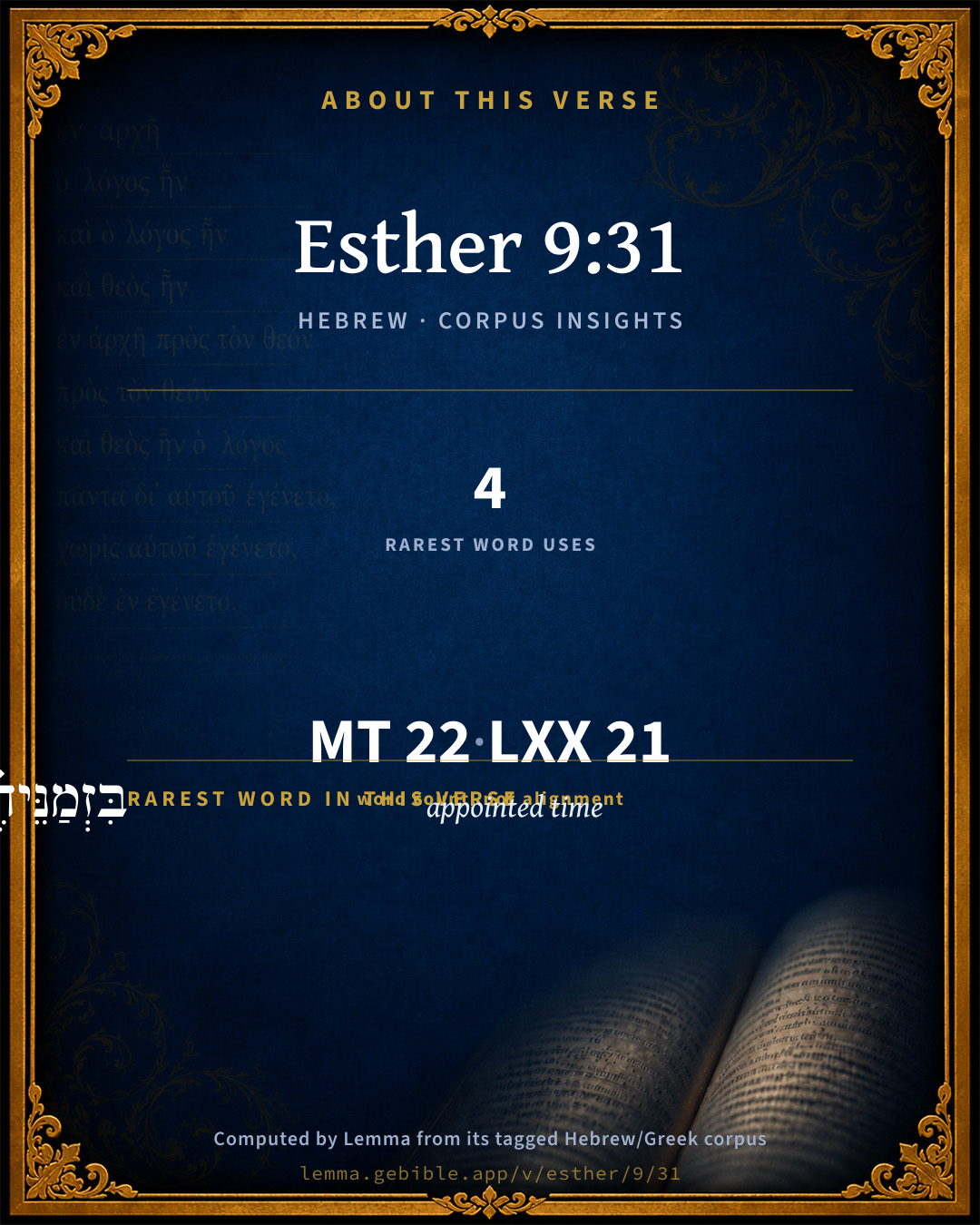
The rarest word here is בִּזְמַנֵּיהֶ֗ם appointed time H2165 — appearing just 4 times in the whole Hebrew Bible.

Shared distinctive vocabulary

בִּזְמַנֵּיהֶ֗ם appointed time H2165 occurs in 4 verses of the Hebrew Bible. Also found in:

Grammatical profile

  • 3 verbs
  • 12 nouns
  • 1 pronoun
  • 3 prepositions
  • 3 particles

Verb forms

  • לְקַיֵּ֡ם Piel · Infinitive Construct
  • קִיַּ֨ם Piel · Perfect
  • קִיְּמ֥וּ Piel · Perfect

Repetition

Words recur within this verse — often emphatic in Hebrew:

  • לְקַיֵּ֡ם to rise H6965 ×3
  • עֲלֵיהֶ֜ם upon H5921 ×3
  • כַּאֲשֶׁר֩ which H834 ×2

Hebrew & Septuagint length

In English translation the verse runs 42 words from the Hebrew and 25 from the Septuagint (LXX English) — the Septuagint runs noticeably shorter here. See the side-by-side →

A rough comparison of the two English renderings, which tokenize alike — not a word-level alignment.

Word counts can differ between the Hebrew and the Greek without any difference in meaning — e.g. the Hebrew direct-object marker אֵת has no separate Greek word, and Greek often adds the article ὁ.

In the original languages it is 22 Hebrew tokens and 21 Greek tokens — but the two are counted differently (Hebrew bundles its prefixes and suffixes into one token; the Greek is in lemma form), so that isn’t a like-for-like length.

Cross-references

3

Topical passages linked to Esther 9:31 in the Treasury of Scripture Knowledge — connected by theme and wording, ordered by reader-vote popularity; previews shown in the World English Bible.

  • Esther 4:3 In every province, wherever the king's commandment and his decree came, there was great mourning among the Jews, and fasting, and weeping, and wailing; and many lay in sackcloth and ashes.
  • Esther 4:16 Go, gather together all the Jews who are present in Shushan, and fast you for me, and neither eat nor drink three days, night or day: I also and my maidens will fast in like manner; and so will I go in to the king, which is not according to the law: and if I perish, I perish.
  • Jonah 3:2–9 "Arise, go to Nineveh, that great city, and preach to it the message that I give you."

Cross-references courtesy of OpenBible.info (CC BY 4.0).

Hebrew and Greek witnesses Masoretic Hebrew ↔ Greek Septuagint

The same verse in the two great witnesses to the Old Testament, shown verse-for-verse.

Here the Septuagint runs noticeably shorter than the Hebrew — LXX2012 (modern English Septuagint) 25 words vs World English Bible 42. A rough length comparison of the two English translations, not a word-level alignment — read both below.

These are two independent witnesses, not word-aligned to each other, and the Septuagint is shown in lemma (dictionary) form.

Hebrew Esther 9:31 Masoretic · Westminster Leningrad Codex

לְקַיֵּ֡ם אֵת יְמֵי֩ הַפֻּרִ֨ים הָאֵ֜לֶּה בִּזְמַנֵּיהֶ֗ם כַּאֲשֶׁר֩ קִיַּ֨ם עֲלֵיהֶ֜ם מָרְדֳּכַ֤י הַיְּהוּדִי֙ וְאֶסְתֵּ֣ר הַמַּלְכָּ֔ה וְכַאֲשֶׁ֛ר קִיְּמ֥וּ עַל נַפְשָׁ֖ם וְעַל זַרְעָ֑ם דִּבְרֵ֥י הַצֹּמ֖וֹת וְזַעֲקָתָֽם

to confirm these days of Purim in their appointed times, according as Mordecai the Jew and Esther the queen had enjoined them, and as they had ordained for themselves and for their seed, in the matter of the fastings and their cry.

World English Bible · Public Domain

Greek LXX Esther 9:31 Septuagint · lemma form

καί μαρδοχαῖος καί εσθηρ ὁ βασίλισσα ἵστημι ἑαυτοῦ κατά ἑαυτοῦ καί τότε ἵστημι κατά ὁ ὑγίεια αὐτός καί ὁ βουλή αὐτός

And Mardochaeus and Esther the queen appointed a fast for themselves privately, even at that time also having formed their plan against their own health.

LXX2012 (modern English Septuagint) · Public Domain

On this verse, Ellicott's Commentary for English Readers discusses the Septuagint’s reading. Read the note in Commentary ↓

Hebrew: Westminster Leningrad Codex (CC BY 4.0). Greek: Septuagint (public domain); English from LXX2012 (modern English Septuagint) (Public Domain). How the Septuagint differs from the Hebrew →

Commentary

Notes on Esther 9:31 from classic Christian and Jewish commentators (each source and its license shown beneath its notes). The classic Christian expositions comment on the surrounding passage and are grouped to its opening verse, so a note may address several verses; the Jewish commentaries on the Tanakh (Rashi and others) are per-verse, so they appear only where the commentator wrote on this verse.

Lemma curates 59 commentaries, every one of them public domain or Creative Commons licensed, each selected and text-cleaned for this edition rather than reprinted as found. About our sources →

Trapp's Complete Commentary

John Trapp

Est 9:31 To confirm these days of Purim in their times [appointed], according as Mordecai the Jew and Esther the queen had enjoined them, and as they had decreed for themselves and for their seed, the matters of the fastings and their cry.

Ver. 31. To confirm these days of Purim] That they might by no manner of means be neglected, but that, renewing their resolutions and their reasons for the same, they might remain constant and firm and peremptory in well doing, cleaving to God with full purpose of heart, and sitting close unto the Lord without distraction, 1Co 7:35.

And as they had decreed for themselves] Heb. For their souls; for the soul is the man, and the greatest thing in the least compass is a good mind in a man’s body.

The matters of the fastings and their cry] Heb. The words of fasting, &c., that is, the vows they then uttered when they fasted and cried; that, if God would hear and help them, they would not fail to praise him in all best manner. Now, therefore, sith the vows of God were upon them, they should by keeping these days offer unto him thanksgiving, and pay their vows unto the Most High. Some think that the fasting and crying here mentioned referreth to those in Zechariah, Zec 7:5, in remembrance of the desolation of Jerusalem; that, as they fasted then, so they should feast now (Aben Ezra); God having fulfilled his promise there made, of turning their fasting into feasting, and added, "Therefore love the truth and peace," Zec 8:19 : confer Mordecai’s words of peace and truth, supra, Est 9:30.

John Trapp, A Commentary or Exposition upon All the Books of the Old and New Testament (1647–1656) — public domain. Text from a community e-Sword module.

Joseph Benson's Commentary

Est 9:31. The matters of their fasting, and of their cry — For and concerning those great and overwhelming calamities which had been decreed to befall all the Jews, and for the removing of which, not only Esther and the Jews of Shushan, but all other Jews, in all places, as soon as they heard of those dismal tidings, did doubtless, according to the precepts of Scripture, and the constant practice of their godly predecessors in all ages, flee to that last and only refuge, of seeking to God by fasting and earnest prayers, and strong cries, which God was pleased graciously to hear, and in answer thereunto to give them this amazing deliverance. And this was that which they were now to remember, namely, the greatness of their danger, and of their rescue from it. And, accordingly, the Jews used to observe the first of those days with fasting, and crying, and other expressions of vehement grief, imitating herein the example of Esther and Mordecai, who had fasted and prayed in their distress, and the latter of the days with feasting, and thanksgiving, and all demonstrations of joy and triumph.

Joseph Benson's Commentary on the Old and New Testaments (1811–1818) — public domain. Text from a community e-Sword module.

Geneva Bible (1599)

Geneva Bible translators

Hebrew, souls.

That they would observe this feast with fasting and earnest prayer, which in Hebrew is signified by this word (they cry).

Geneva Bible (1599) marginal notes — public domain. Text via Bolls.life.

Adam Clarke's Commentary

Verse 31. As they had decreed for themselves and for their seed] There is no mention of their receiving the approbation of any high priest, nor of any authority beyond that of Mordecai and Esther; the king could not join in such a business, as he had nothing to do with the Jewish religion, that not being the religion of the country.

Adam Clarke's Commentary on the Bible (1810–1826) — public domain. Text from a community e-Sword/MySword module.

Ellicott's Commentary for English Readers

(31) To confirm . . . enjoined . . . decreed.—The same Hebrew verb stands for the three different English verbs; it is also the stablish of Est_9:21. To fix or settle represents the meaning.

The matters of the fastings and their cry.—These words come in rather awkwardly, and hence, and because they are passed over by the LXX., some have doubted their genuineness here. All Hebrew MSS., however, and all the other ancient versions, retain the words, and we must, therefore, suppose that the Jews throughout the empire had instituted fasts and lamentations, in addition to what Mordecai’s letter had enjoined, Thus we may probably connect this with the fast now observed on Adar 13.

A Bible Commentary for English Readers, edited by Charles John Ellicott (1878–1897) — public domain. Text from a community e-Sword module.

The Cambridge Bible for Schools and Colleges

gen. ed. J. J. S. Perowne

31. to confirm] It has been suggested that the former communications from Mordecai were only a recommendation, while this joint letter from him and Esther was intended to render the matter obligatory. Against such a view, however, is the fact that the word in the original here rendered ‘to confirm’ is the same as that translated ‘to enjoin’ in Est_9:21.

in the matter of the fastings and their cry] The words may be a gloss. They are not found in the LXX., and the Heb. word translated ‘fastings’ does not occur in this exact form elsewhere.

The Cambridge Bible for Schools and Colleges (gen. ed. J. J. S. Perowne; Cambridge University Press, 1878–1918) — public domain. Text from a community e-Sword module.

Albert Barnes' Notes on the Bible

The matters of the fastings and their cry - The Jews of the provinces had added to the form of commemoration proposed by Mordecai certain observances with respect to fasting and wailing, and Mordecai’s second letter sanctioned these.

Albert Barnes' Notes on the Bible (1834–1885) — public domain. Text from a community e-Sword/MySword module.

Haydock's Catholic Bible Commentary

Fasts and cries. See ver. 21. (Calmet) --- Protestants, "the matters of their fastings and their cry: and the decree of Esther confirmed these matters of Purim, and it was written in the book." (Haydock) --- This feast, instituted by Mardochai, was accepted and observed by the Jews as a constitution agreeable to, and not contrary to the law, Deuteronomy iv. 2., and xii. 32. (Worthington)

George Leo Haydock (1774–1849), Haydock's Catholic Family Bible and Commentary, 1859 edition — public domain. Excludes Psalms (Douay-Rheims chapter numbering differs from Protestant) and Deuterocanonical books (Catholic canon only).

Matthew Poole's English Annotations

For or about those great and overwhelming calamities which were decreed to all the Jews, and for the removing of which, not only Esther, and the Jews in Shushan, but all other Jews in all places, as soon as they heard those dismal tidings, did doubtless according to the precepts of Scripture, and the constant practice of their godly predecessors in all ages, fly to that last and only refuge of seeking to God by fasting, and earnest prayers, and strong cries unto God; which God was pleased graciously, to hear, and in answer thereunto to give them this amazing deliverance. And this was that which they were now to remember, to wit, the greatness of their danger, and of their rescue from it. And accordingly the Jews use to observe the first of those days with fasting, and crying, and other expressions of vehement grief and fear, and the latter with feasting, and thanksgiving, and all demonstrations of joy and triumph.

Matthew Poole's English Annotations on the Holy Bible (1683–1685) — public domain. Text from a community e-Sword/MySword module.

Whedon's Commentary on the Bible

Daniel D. Whedon

31. The matters of the fastings and their cry — Here it incidentally comes out that fasting and lamentation were also to be connected with the observance of Purim. The modern Jews observe the thirteenth of Adar, the anniversary of the day of slaughter, as a day of fasting, and call it the fast of Esther. This day of fasting and supplication is preliminary to the two days’ feast that follows. It is not improbable that Esther herself may have proposed this fast, as a memorial of the grief that preceded their joy, and that the people approved and sanctioned it, and called it Esther’s fast.

Daniel D. Whedon (gen. ed.), Commentary on the Old and New Testaments (1874–1909) — public domain. Text from a community e-Sword module.

The Pulpit Commentary

As they had decreed for themselves and their seed. "As theyi.e. the Jews generally had decreed" (see ver. 27). The matters of the fastings and their cry. These words stand in no clear grammatical relation to the preceding, and are otherwise very difficult to explain. They are thought to allude to the establishment by the provincial Jews, apart from Mordecai and Esther, of the 13th of Adar as a day of fasting and wailing; but if so, it is strange that nothing has been previously said of this ordinance. The plural form of the word for "fastings" is also suspicious, since it does not occur elsewhere in the Old Testament. Altogether, it is perhaps most probable that the words were originally the gloss of a commentator, written in the margin, and that they have been accidentally transferred to the text. They do not occur in the Septuagint.

Fasting and crying remembered amidst feasting and singing.

It is not good to banish from the mind perils and sorrows through which we have passed, and from which we have been delivered. In times of prosperity and rejoicing it is well to keep before us the mutability of all earthly things. Life is a chequered scene, a changing landscape. To-day is unlike yesterday, and unlike to-morrow. Undue elation and undue depression are alike unworthy of the Christian. By remembering past griefs, troubles, and dangers

I WE DISPOSE OURSELVES TO HUMILITY. Such was our lot, such our position, such our apprehensions and alarms but a short time since. Let us not then be puffed up with self-satisfaction because the cloud has blown over and the sky is blue again.

II WE ENCOURAGE GRATITUDE. Who has turned fasting to feasting, and crying to songs? God is our deliverer; he has "turned again our captivity." To him be praise.

III WE SEASON AND BRIGHTEN OUR JOYS. It is pleasant to look back upon the shipwreck from which we have been rescued, the battle out of which we have come unscathed; it gives a zest to the enjoyments of today when we remember the bitterness and the anguish of days gone by.

IV WE FOSTER A SPIRIT OF DEPENDENCE AND CONFIDENCE IN GOD. Unmixed prosperity is not favourable to spiritual life. "Sweet are the uses of adversity." Remember your complaints and prayers, and how they were heard and answered from above. "He drew you out of many waters." So shall your trust be steadfast and sustaining.

V WE ENJOY A FORETASTE OF SOME OF THE JOYS OF HEAVEN. When we come to the rest above, we shall look back wonderingly, gratefully, upon the scene of conflict from which we shall then be delivered; it will seem perhaps largely a scene of fasting and of crying. And the retrospect will surely enhance the "pleasures which are for evermore."

The Pulpit Commentary (1880–1919), ed. H.D.M. Spence-Jones & Joseph S. Exell — public domain. Text from a community e-Sword module.

John Wesley's Explanatory Notes

Cry - For those great calamities which were decreed to all the Jews, and for the removing of which, not only Esther, and the Jews in Shushan, but all other Jews in all places, did doubtless fly to God by fasting, and strong cries.

John Wesley, Explanatory Notes Upon the Whole Bible (1754–1765) — public domain. Text via the GEBible commentary corpus.

Lesson kit

Teaching starters — assembled from the data on this page, not authored interpretation. Every prompt links to the verse data it draws on. Edit before teaching.

Esther, in the Historical, opens this verse with 22 words (17 distinct Hebrew lemmas). Its most distinctive word is zᵉmân (“appointed time”). The Greek Septuagint runs shorter here. A historical commentator’s framing appears above. Read the whole chapter for the surrounding context.

Discussion questions

  1. What does “appointed time” (zᵉmân) contribute to the verse as a whole?
  2. Nehemiah 2:6 shares the word «appointed time» with this verse. How do the two illuminate each other?
  3. “to rise” occurs 3× in this one verse. What is the effect of the repetition?
  4. Compared with the Hebrew, the Septuagint runs shorter here. What questions does that raise?
  5. The translations on this page render this verse differently — a whole-verse word diff, not a word-by-word alignment. What might account for the different wordings?
  6. The verb «לְקַיֵּ֡ם» is Piel Infinitive Construct. How does its form color the action?
  7. Reading how Trapp's Complete Commentary and Joseph Benson's Commentary read this verse, where do the two commentators agree and where do they part?

Things to notice

Reading settings

Reading text

Shown beneath each verse's original-language words.

Old Testament
Old Testament edition

Read the OT as the Masoretic Hebrew (MT) or the Greek Septuagint (LXX).

English shown for the Greek Septuagint (in the Hebrew ↔ Greek comparison).

Comparing translations? Open the Compare panel on any verse page to stack up to four side by side.