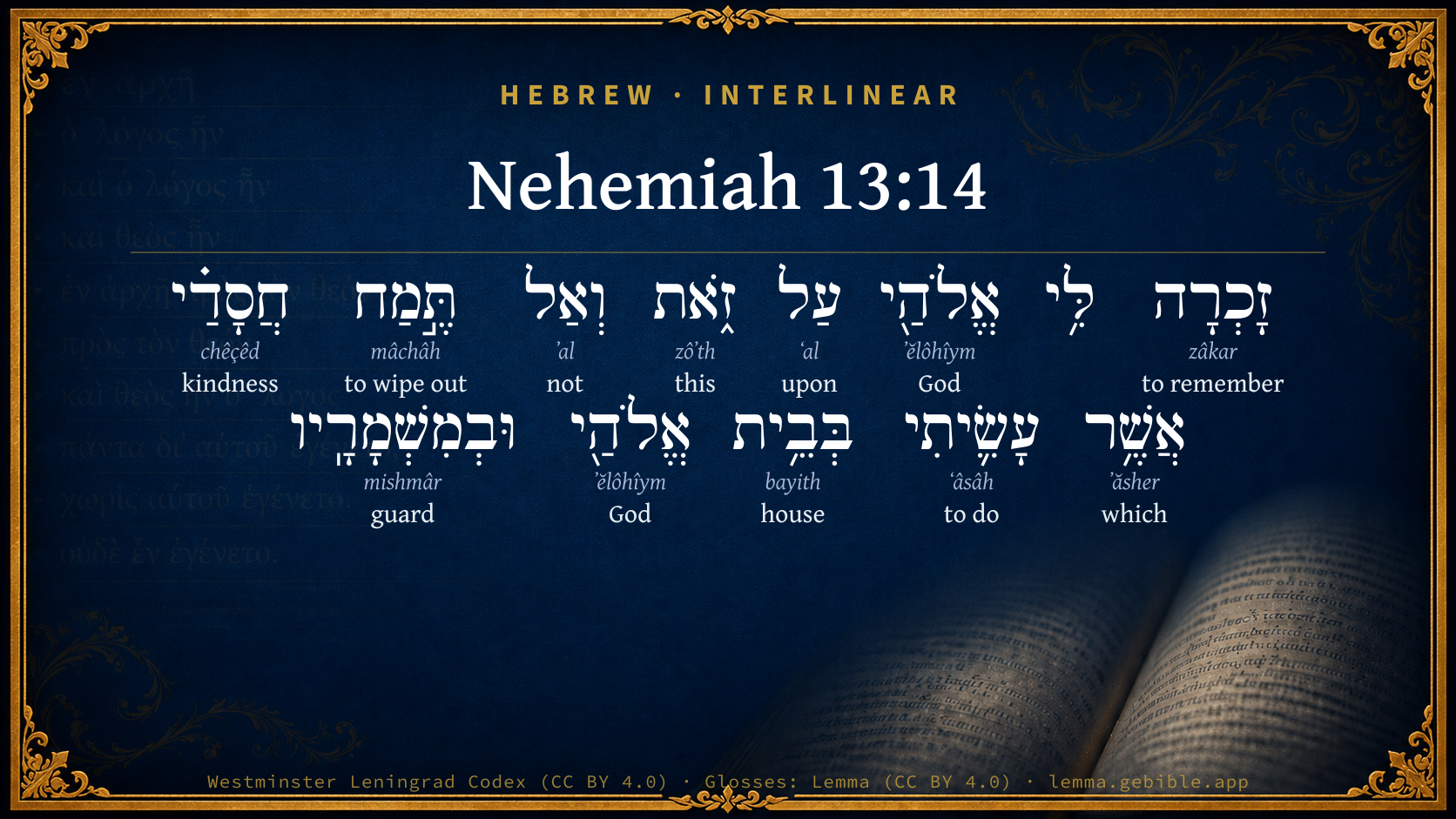
Nehemiah 13:14

Hebrew (Westminster Leningrad Codex) Nehemiah 13:14 appears in the Hebrew Old Testament. The text above is from the Westminster Leningrad Codex. Each word links to its Strong’s number, a concise gloss, and parsing drawn from the Open Scriptures Hebrew Bible morphology. Click any word for its full Brown-Driver-Briggs (BDB) entry.
Download image
Cite this verse

Nehemiah 13:14 (World English Bible). Public Domain. Lemma interlinear Bible study tool, https://lemma.gebible.app/v/nehemiah/13/14.

Show BibTeX & RIS
BibTeX
RIS
English Translation
Remember me, my God, concerning this, and don't wipe out my good deeds that I have done for the house of my God, and for the observances of it.
World English Bible · Public Domain
Download a study sheet

One document with this verse’s original text, its word-by-word gloss line, the meaning frame, cross-references with their text, attributed commentary, and full source and license credits — printable, and it pastes into notes with its structure intact.

This verse Autodidact and up

Study sheet (.html) Plain text (.txt)

A passage Seminary Student

Up to 50 verses in one chapter. A passage sheet keeps up to 6 commentary sources and 12 cross-references per verse, in the order this page ranks them, and says so on the sheet whenever that leaves anything out. Ask for a single verse and you get the Autodidact verse sheet above.

Everything on this page stays free to read, with no account — the sheet is a download of what is already on screen, not access to it.

Want to remove ads? Support Godless Engineer
Compare translations 3

The same verse in 3 English versions, stacked beneath the original-language interlinear above. Click any original word for its lexicon entry.

Each is an independent rendering of the whole verse — the interlinear is not word-aligned to these translations.

Highlighted words mark where these versions differ — a whole-verse word diff, not a word-by-word alignment.

  • World English Bible Public Domain
    Remember me, my God, concerning this, and don't wipe out my good deeds that I have done for the house of my God, and for the observances of it.
  • King James Version Public Domain
    Remember me, O my God, concerning this, and wipe not out my good deeds that I have done for the house of my God, and for the offices thereof.
  • unfoldingWord Literal Text CC BY-SA 4.0
    Remember me, my God, concerning this, and do not wipe out my faithful kindness that I have done for the house of my God and for its service watches.

unfoldingWord Literal Text — © unfoldingWord, licensed CC BY-SA 4.0. Word-aligned USFM3 via Door43 (git.door43.org/unfoldingWord/en_ult).

Versions to compare (up to 4)

3 of 4 selected

Show all 18 translations

Every available English version of this verse, each an independent rendering of the whole verse.

  • World English Bible Public Domain
    Remember me, my God, concerning this, and don't wipe out my good deeds that I have done for the house of my God, and for the observances of it.
  • Berean Standard Bible Public Domain
    Remember me for this, O my God, and do not blot out my deeds of loving devotion for the house of my God and for its services.
  • Majority Standard Bible Public Domain
    Remember me for this, O my God, and do not blot out my deeds of loving devotion for the house of my God and for its services.
  • King James Version Public Domain
    Remember me, O my God, concerning this, and wipe not out my good deeds that I have done for the house of my God, and for the offices thereof.
  • American Standard Version (1901) Public Domain
    Remember me, O my God, concerning this, and wipe not out my good deeds that I have done for the house of my God, and for the observances thereof.
  • Revised Version (1885) Public Domain
    Remember me, O my God, concerning this, and wipe not out my good deeds that I have done for the house of my God, and for the observances thereof.
  • Geneva Bible (1599) Public Domain
    Remember me, O my God, herein, and wipe not out my kindenes that I haue shewed on the house of my God, and on the offices thereof.
  • Douay-Rheims (1899) Public Domain
    Remember me, O my God, for this thing, and wipe not out my kindnesses, which I have done relating to the house of my God and his ceremonies.
  • Young's Literal Translation Public Domain
    Be mindful of me, O my God, for this, and do not blot out my kind acts that I have done, for the house of my God, and for its charges.
  • Literal Standard Version CC BY-SA 4.0
    Be mindful of me, O my God, for this, and do not blot out my kind acts that I have done, for the house of my God, and for its charges.
  • Unlocked Literal Bible CC BY-SA 4.0
    Call me to mind, my God, concerning this, and do not wipe out the good deeds that I have done for the house of my God and its services.
  • unfoldingWord Literal Text CC BY-SA 4.0
    Remember me, my God, concerning this, and do not wipe out my faithful kindness that I have done for the house of my God and for its service watches.
  • Darby Bible Public Domain
    Remember me, O my God, concerning this, and wipe not out my good deeds which I have done for the house of my God, and for the charges thereof!
  • World Messianic Bible Public Domain
    Remember me, my God, concerning this, and don’t wipe out my good deeds that I have done for the house of my God, and for its observances.
  • Webster's Bible Public Domain
    Remember me, O my God, concerning this, and wipe not out my good deeds that I have done for the house of my God, and for its offices.
  • Free Bible Version CC BY-SA 4.0
    My God, please remember me over this. Please don't forget my good deeds I have done for the Temple of my God and its services.
  • Bible in Basic English Public Domain
    Keep me in mind, O my God, in connection with this, and do not let the good which I have done for the house of my God and its worship go from your memory completely.
  • JPS Tanakh (1917) Public Domain
    Remember me, O my God, concerning this, and wipe not out my good deeds that I have done for the house of my God, and for the wards thereof.

Literal Standard Version (2020), Covenant Press — licensed CC BY-SA 4.0. Text via the HelloAO Bible API (eBible.org). Unlocked Literal Bible (unfoldingWord) — licensed CC BY-SA 4.0. Text via the HelloAO Bible API (eBible.org). unfoldingWord Literal Text — © unfoldingWord, licensed CC BY-SA 4.0. Word-aligned USFM3 via Door43 (git.door43.org/unfoldingWord/en_ult). Free Bible Version, Dr. Jonathan Gallagher — licensed CC BY-SA 4.0. Text via the HelloAO Bible API (eBible.org).

Word by word

More ways to search: Search by grammar → Find every occurrence → Compare this word →

Practice this passage: Drill this verse → Learn its vocabulary →

וּבְמִשְׁמָרָֽיו
mishmâr
H4929
“and · in/at · guards · his”
Conjunction + Preposition + Noun, Common, Masculine, Plural, Construct + Suffix, Personal, 3rd Person, Masculine, Singular
Part of Speech
Conjunction + Preposition + Noun
Type
Common
Gender
Masculine
Number
Plural
State
Construct
Full BDB Definition

Origin: from H8104

TWOT: 2414f

place of confinement, prison, guard, jail, guard post, watch, observance - jail, prison, guard-house - guard, guard post, act of guarding - observances
  1. זָכְרָה zâkar H2142 “remember” Verb, Qal, Imperative, 2nd Person, Masculine, Singular + Suffix, h
  2. אֱלֹהַ֖י ʼĕlôhîym H430 “God(s) · my” Noun, Common, Masculine, Plural, Construct + Suffix, Personal, 1st Person, Common, Singular
  3. עַל ʻal H5921 “upon” Preposition
  4. זֹ֑את zôʼth H2063 “this” Pronoun, Demonstrative, Feminine, Singular
  5. וְאַל ʼal H408 “and · not” Conjunction + Particle, Negative
  6. תֶּ֣מַח mâchâh H4229 “to wipe out” Verb, Hiphil, Jussive, 2nd Person, Masculine, Singular
  7. חֲסָדַ֗י chêçêd H2617 “kindnesses · my” Noun, Common, Masculine, Plural, Construct + Suffix, Personal, 1st Person, Common, Singular
  8. אֲשֶׁ֥ר ʼăsher H834 “which” Particle, Relative
  9. עָשִׂ֛יתִי ʻâsâh H6213 “to do” Verb, Qal, Perfect, 1st Person, Common, Singular
  10. בְּבֵ֥ית bayith H1004 “in/at · house of” Preposition + Noun, Common, Masculine, Singular, Construct
  11. אֱלֹהַ֖י ʼĕlôhîym H430 “God(s) · my” Noun, Common, Masculine, Plural, Construct + Suffix, Personal, 1st Person, Common, Singular

About this verse

These counts appear in no published source. They are computed here, from the morphology-tagged text and Lemma’s own curated glosses. What Lemma adds →

13
words
11
distinct lemmas
Historical
section

Notable vocabulary

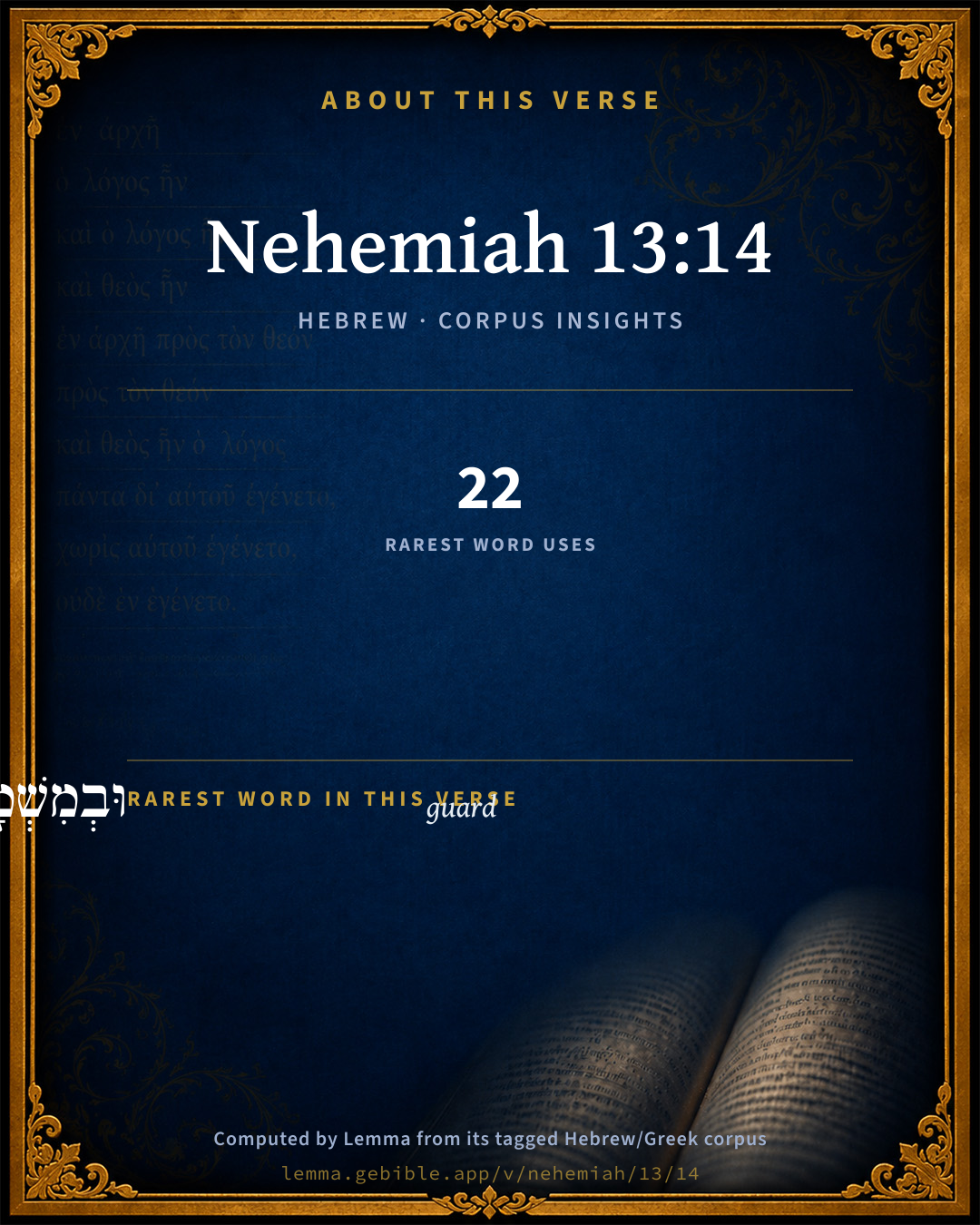
The rarest word here is וּבְמִשְׁמָרָֽיו guard H4929 — appearing just 22 times in the whole Hebrew Bible.

Shared distinctive vocabulary

וּבְמִשְׁמָרָֽיו guard H4929 occurs in 20 verses of the Hebrew Bible. Also found in:

Grammatical profile

  • 3 verbs
  • 5 nouns
  • 1 pronoun
  • 2 prepositions
  • 2 particles

Verb forms

  • זָכְרָה Qal · Imperative
  • תֶּ֣מַח Hiphil · Jussive
  • עָשִׂ֛יתִי Qal · Perfect

Repetition

A word recurs within this verse — often emphatic in Hebrew:

  • אֱלֹהַ֖י God H430 ×2

Cross-references

12

Topical passages linked to Nehemiah 13:14 in the Treasury of Scripture Knowledge — connected by theme and wording, ordered by reader-vote popularity; previews shown in the World English Bible.

  • Psalms 122:6–9 Pray for the peace of Jerusalem. Those who love you will prosper.
  • Nehemiah 13:22 I commanded the Levites that they should purify themselves, and that they should come and keep the gates, to sanctify the Sabbath day. Remember to me, my God, this also, and spare me according to the greatness of your loving kindness.
  • Nehemiah 13:31 and for the wood-offering, at times appointed, and for the first fruits. Remember me, my God, for good.
  • Hebrews 6:10 For God is not unrighteous, so as to forget your work and the labor of love which you showed toward his name, in that you served the saints, and still do serve them.
  • 2 Chronicles 31:20–21 Thus did Hezekiah throughout all Judah; and he worked that which was good and right and faithful before Yahweh his God.
  • Ezra 7:20 Whatever more shall be needful for the house of your God, which you shall have occasion to bestow, bestow it out of the king's treasure-house.
  • Nehemiah 5:19 Remember to me, my God, for good, all that I have done for this people.
  • 1 Chronicles 29:3 In addition, because I have set my affection on the house of my God, seeing that I have a treasure of my own of gold and silver, I give it to the house of my God, over and above all that I have prepared for the holy house,
  • 2 Chronicles 24:16 They buried him in the city of David among the kings, because he had done good in Israel, and toward God and his house.
  • Ezra 7:27 Blessed be Yahweh, the God of our fathers, who has put such a thing as this in the king's heart, to beautify the house of Yahweh which is in Jerusalem;
  • Ezra 7:24 Also we inform you, that touching any of the priests and Levites, the singers, porters, Nethinim, or servants of this house of God, it shall not be lawful to impose tribute, custom, or toll, on them.
  • Revelation 3:5 He who overcomes will be arrayed in white garments, and I will in no way blot his name out of the book of life, and I will confess his name before my Father, and before his angels.

Cross-references courtesy of OpenBible.info (CC BY 4.0).

Hebrew and Greek witnesses Masoretic Hebrew ↔ Greek Septuagint

The same verse in the two great witnesses to the Old Testament, shown verse-for-verse.

These are two independent witnesses, not word-aligned to each other, and the Septuagint is shown in lemma (dictionary) form.

Hebrew Nehemiah 13:14 Masoretic · Westminster Leningrad Codex

זָכְרָה לִּ֥י אֱלֹהַ֖י עַל זֹ֑את וְאַל תֶּ֣מַח חֲסָדַ֗י אֲשֶׁ֥ר עָשִׂ֛יתִי בְּבֵ֥ית אֱלֹהַ֖י וּבְמִשְׁמָרָֽיו

Remember me, my God, concerning this, and don't wipe out my good deeds that I have done for the house of my God, and for the observances of it.

World English Bible · Public Domain

Greek LXX Structure differs

The Septuagint has no separate book of Nehemiah. Its Greek text is the second half of Esdras B (2 Esdras), chapters 11–23; Ezra is the first half (1–10).

A verse-for-verse comparison isn’t shown here because the chapters and verses don’t line up. Switch to the LXX edition with the MT / LXX toggle above to read the Greek directly.

On this verse, The Cambridge Bible for Schools and Colleges discusses the Septuagint’s reading. Read the note in Commentary ↓

Hebrew: Westminster Leningrad Codex (CC BY 4.0). Greek: Septuagint (public domain); English from a public-domain English Septuagint. How the Septuagint differs from the Hebrew →

Commentary

Notes on Nehemiah 13:14 from classic Christian and Jewish commentators (each source and its license shown beneath its notes). The classic Christian expositions comment on the surrounding passage and are grouped to its opening verse, so a note may address several verses; the Jewish commentaries on the Tanakh (Rashi and others) are per-verse, so they appear only where the commentator wrote on this verse.

Lemma curates 59 commentaries, every one of them public domain or Creative Commons licensed, each selected and text-cleaned for this edition rather than reprinted as found. About our sources →

Trapp's Complete Commentary

John Trapp

Neh 13:14 Remember me, O my God, concerning this, and wipe not out my good deeds that I have done for the house of my God, and for the offices thereof.

Ver. 14. Remember me, O my God] See Neh 5:19.

And wipe not out my good deeds] Forget not my labour of love: God requireth us to be his remembrancers, who yet needeth it not, Heb 6:10; there is a book of remembrance written before him, Mal 3:16, and good Nehemiah would not be wiped out of that book, nor blotted out of the book of life, Rev 3:5. That wretched monk died blasphemously who said, Redde mihi aeternam vitam quam debes, Give me heaven which thou owest me.

That I have done] Sure it is, saith Austin, that we do what good we do; but it is God alone who causeth us so to do. Say, therefore, Not unto us, Lord, not to us; but to thy name be the praise.

John Trapp, A Commentary or Exposition upon All the Books of the Old and New Testament (1647–1656) — public domain. Text from a community e-Sword module.

The Biblical Illustrator

Joseph S. Exell

Neh_13:14-22

Remember me, O my God, concerning this

The mercy of God Chin origin of the reward of good works

Learn--

I.

That to make provision for maintenance of Gods worship and the ministers thereof is a worthy work, and of high esteem and favour with God (1Ch_29:17-18; Deu_12:19; 2Ki_4:1-44.; Luk_7:3-5; Mat_10:41; Php_4:18; 2Ti_1:16-18).

II. That God rewardeth these and all our other good deeds and works not for any merit or worthiness that is in them, but of His free mercy and goodness.

1. The Scriptures encourage us to work in hope of reward (Psa_19:11; Pro_11:18; Mat_5:11-12; Mat_10:41-42; Luk_6:35; 2Jn_1:8).

2. Whence this reward cometh. According to Thy great mercy (Hos_10:12; Rom_6:23; Psa_62:12).

III. That it is lawful to do good works with respect to the recompense of reward. It is plain Nehemiah here did so. So did Moses Heb_11:25-26). (Joseph Mede, B. D.)

The law of reward

Nehemiahs prayer occurs thrice in this chapter, at the close of each section recounting his reforming acts. In the first instance (verse 14) it is most full, and puts very plainly the merit of good deeds as a plea with God. The same thing is implied in its form in verse 22. But while, no doubt, the tone of the prayer is startling to us, and is not such as should be offered now by Christians, it but echoes the principle of retribution which underlies the law. This do, and thou shalt live, was the very foundation of Nehemiahs form of Gods revelation. We do not plead our own merits, because we are not under the law, but under grace, and the principle underlying the gospel is life by impartation of unmerited mercy and Divine life. But the law of retribution still remains valid for Christians in so far as that God will never forget any of their works, and will give them full recompense for their work of faith and labour of love. Eternal life here and hereafter is wholly the gift of God; but that fact does not exclude the notion of the recompense of reward from the Christian conception of the future. It becomes not us to present our good deeds before the Judge, since they are stained and imperfect, and the goodness in them is His gift. But it becomes Him to crown them with His gracious approbation and to proportion the cities ruled in that future world to the talents faithfully used here. We need not be afraid of obscuring the truth that we are saved not of works, lest any man should boast, though we insist that a Christian man is rewarded according to his works. (A. Maclaren, D. D.)

Nehemiahs sincerity

Paul assures the believing Hebrews that God will not forget their work of faith and labour of love, and this prayer of Nehemiahs is nothing more than a petition that God will be pleased to fulfil Hie own promise regarding him. It was not the dictate of a self-righteous spirit. There is no self-righteousness in the humble prayer that God would look upon him in love; that He would deign to accept of his feeble services as proof and evidences of a religious spirit; that He would be pleased to verify His promise, that it shall be well with them that fear the Lord, and that godliness is profitable unto all things, having the promise of the life that now is, as well as of that which is to come. Consider--

I. A sketch of Nehemiahs history.

II. Nehemiahs character.

1. His steady religious principle. Dwelling amid scenes very uncongenial to the progress of piety in the heart, he displayed a firmness of principle and an ardour of religious feeling truly admirable. Amidst the enticements of a splendid and licentious court he sought the glory of God and not the gratification of vanity, ambition, or worldly desire. Surrounded by the ensigns of a gross and impious superstition, he reared a standard for the true God, and stood forth as a witness for Him, in the midst of His enemies. Confidence in God kept him steady in the scene of danger; and the lofty aims of a devoted spirit raised him above the grovelling pursuits Of sense.

2. His self-denial. This is one of the best evidences of sound religious principle. When the will is subjugated to the will of God; when the mind feels itself completely satisfied with the wisdom and goodness of the Divine economy; when self is thrown into the background, and a noble disinterestedness gives its tone to the character, then we have some good proof that our religion is sincere. Nehemiah improved his advantages at the Persian court not for his individual good, but for the good of his countrymen. He lost sight of selfish considerations, and feeling for the humblest of the people, he gave them the full value of his labours, without the slightest remuneration. That which he asked not from man he knew God would bestow; hence the prayer of the text.

3. His zeal for the worship and ordinances of God. This is specially displayed in his anxiety to vindicate Gods ordinances from abuse, and to enforce their punctual observance. The public reading and expounding the law, for the edification of the people, testified his regard for Gods Holy Word. The exactness with which the appointed rites in the feasts of trumpets end tabernacles were gone about, under his superintendence, testified his reverence for the law, in all the minuteness of its requisitions. His zeal for the sanctification of the Sabbath proved the high sense he entertained of its value.

4. His enlightened and consistent perseverance in the discharge of personal and official duty. (Robert Burns, D. D.)

The Biblical Illustrator, edited by Joseph S. Exell (c. 1880s–1900s) — public domain. Text from a community e-Sword module.

Joseph Benson's Commentary

Neh 13:14. Remember me, O my God, concerning this — What I have done with an upright heart for thy house and service, be pleased graciously to accept, and remember for my good, according to thy promise. Nehemiah receiving no recompense, perhaps not even thanks, from those for whose benefit he did these things, he looks up to God as his paymaster, and refers himself and his actions to his consideration; not in pride, or as boasting of what he had done, much less depending upon it as his righteousness, or as if he thought he had made God his debtor, but in an humble appeal to him concerning his integrity and pure intention in all this service, and a believing expectation that God would not be unrighteous to forget his work and labour of love. And wipe not out my good deeds that I have done for the house of my God, &c. — Deeds done for the house of God, and the offices thereof, for the support of religion, and the encouragement of it, are good deeds; there is both righteousness and godliness in them; both mercy to men, and piety toward God; and God will certainly remember them, and not wipe them out. They shall in nowise lose their reward. Here again we find, (see Neh 5:19,) that Nehemiah was employed much in pious ejaculations; and on every occasion looked up to God, and committed himself and his affairs to him. He here reflects with comfort upon what he had done for the house and service of God, and it afforded him much satisfaction to think that he had been any way instrumental to revive and support religion in his country, and to reform what was amiss. In like manner the kindness which any show to God’s ministers and people, and the care and labour they take to aid his cause, shall be returned into their own bosoms, in the secret joy they shall have there, not only through a consciousness of having done well, but of having glorified God, and done good of the best kind, spiritual good, to the souls of men.

Joseph Benson's Commentary on the Old and New Testaments (1811–1818) — public domain. Text from a community e-Sword module.

Tyndale Open Study Notes

Tyndale Open Resources

13:14 Because he stood up for God, Nehemiah asked God to remember his deeds and not abandon him in his time of need. Perhaps he experienced opposition from those he had corrected. See similar refrains in 13:22, 29, 31.

Tyndale Open Study Notes — © Tyndale Open Resources, licensed CC BY-SA 4.0. Text via the HelloAO Bible API.

Geneva Bible (1599)

Geneva Bible translators

He protesteth that he did his duty with a good conscience, yet he doth not justify himself in therein, but desireth God to favor him and to be merciful unto him for his own goodness sake, as verse 22 and 31.

Geneva Bible (1599) marginal notes — public domain. Text via Bolls.life.

Adam Clarke's Commentary

Verse 14. Wipe not out my good deeds] If thou wert strict to mark what is done amiss, even my good deeds must be wiped out; but, Lord, remember me in thy mercy, and let my upright conduct be acceptable to thee!

Adam Clarke's Commentary on the Bible (1810–1826) — public domain. Text from a community e-Sword/MySword module.

Ellicott's Commentary for English Readers

(14) Remember me.—Once more the faithful servant of God begs a merciful remembrance of what he had done for the honour of God in the “observances” of His Temple.

A Bible Commentary for English Readers, edited by Charles John Ellicott (1878–1897) — public domain. Text from a community e-Sword module.

The Cambridge Bible for Schools and Colleges

gen. ed. J. J. S. Perowne

14. Remember me] For this ejaculation see note on Neh_5:19, and cf. Neh_13:22; Neh_13:31; Psa_106:4.

wipe not out my good deeds] R.V. marg. ‘Heb. kindnesses’. The actual phrase is not found elsewhere in the O.T. The metaphor, which is that of sponging off from the leathern roll of record, is familiar to us from Exo_17:14; Exo_32:32-33.

my good deeds] Literally, ‘my mercies or kindnesses’ (LXX. ἔλεος, Vulg. ‘miserationes’). At first sight the word seems scarcely appropriate. Does it signify Nehemiah’s acts of kindness on behalf of the Levites? or his acts of love and reverence, ‘good deeds,’ towards his God? The word in the Hebrew ‘khesed’ is the one commonly used of God’s mercy towards mankind and of the loving-kindness of man towards man. It occurs however also, though more rarely, of man’s love responding to the Divine mercy. In this sense probably it is found, as here, in the plural in 2Ch_32:32 ‘the rest of the acts of Hezekiah, and his good deeds,’ 2Ch_35:26 ‘the rest of the acts of Josiah and his good deeds.’ These ‘good deeds’ (the plur. of ‘khesed’) are clearly the efforts of these two kings to live in more thorough compliance with the ceremonial of the Law. We may remember too that the ‘pious’ Israelite was the ‘khasîd,’ and in the 2nd cent. b.c. ‘Asideans’ (khasidim) was the name given to the most fanatical of the forerunners of the Pharisees.

It is not likely that Hosea’s use of the word in the singular (Neh_6:4 ‘your goodness is as a morning cloud,’ 6 ‘I desire mercy and not sacrifice’) throws any light upon its usage in the present verse beyond showing that it was possibly applied in his time to man’s attitude towards God; but this interpretation is very doubtful. The Rabbinical teaching on the subject of khasadim made ‘the bestowal of kindness’ equivalent to ‘man’s duty to his neighbour.’ Compare the saying of Simon the Just quoted in the note on Neh_10:37, and see Taylor’s note in Sayings of the Jewish Fathers, pp. 26, 27.

the house of my God] See on Neh_2:8; Neh_2:12. As compared with ‘the house of our God’ in Neh_13:4, the phrase is appropriate to the writer’s change from narrative to soliloquy.

the offices] R.V. the observances. The word means literally ‘that which is or is to be kept,’ cf. Neh_13:30 and Neh_12:9; Neh_12:24 (= ‘ward’). Its meaning here is probably quite general, denoting ‘observances,’ ‘customs,’ and ‘usages,’ and not any particular functions as Vulg. ‘cærimoniis.’ LXX. omit.

The Cambridge Bible for Schools and Colleges (gen. ed. J. J. S. Perowne; Cambridge University Press, 1878–1918) — public domain. Text from a community e-Sword module.

John Gill's Exposition

There dwelt men of Tyre also therein, which brought fish,.... From Tyre and Zidon, and the parts adjacent: these they brought from Joppa, and from thence to Jerusalem, and had houses or lodgings near the fish gate or fish market, where they sold them:

and all manner of ware; or merchandise, which, being a trading city, they had from all nations:

and sold on the sabbath day unto the children of Judah, and in Jerusalem; or even in Jerusalem, the holy city, where stood the temple, and where the worship of God was kept, and where the magistrates lived, who should have been terrors to evildoers: indeed, the law of the sabbath was not binding on these Tyrians, but then they tempted the Jews to break it, by bringing their ware to sell.

John Gill's Exposition of the Whole Bible (1746–1763) — public domain (CC PDM 1.0). Text via the HelloAO Bible API.

Haydock's Catholic Bible Commentary

And his. Hebrew, "its offices," and for the good of the sacred ministers. (Haydock)

George Leo Haydock (1774–1849), Haydock's Catholic Family Bible and Commentary, 1859 edition — public domain. Excludes Psalms (Douay-Rheims chapter numbering differs from Protestant) and Deuterocanonical books (Catholic canon only).

Matthew Poole's English Annotations

Concerning this: what I have done with an upright heart for thy house and service be pleased graciously to accept, and remember for my good, according to thy promise.

Matthew Poole's English Annotations on the Holy Bible (1683–1685) — public domain. Text from a community e-Sword/MySword module.

Whedon's Commentary on the Bible

Daniel D. Whedon

14. Remember me — Comp. Neh_5:19, note.

Wipe not out — Nehemiah conceives of his work as recorded in a book, and prays that it may not be erased, nor blotted out and forgotten. Having been wrought and registered, he desired that it might stand. “He does not say, Publish to the world my good deeds, but, Wipe them not out; he does not say, Reward me, but, Remember me — the prayer of the penitent on the cross.”

— Wordsworth.

Good deeds — Hebrew, kindnesses; that is, pious acts, springing out of tender regard for the house of God.

Offices thereof — That is, its usages and rites.

Daniel D. Whedon (gen. ed.), Commentary on the Old and New Testaments (1874–1909) — public domain. Text from a community e-Sword module.

The Pulpit Commentary

Remember me, O my God, Or, "Think upon me, my God," as the same words are translated in Neh_5:19. Wipe not out my good deeds. i.e. "Blot not my good deeds out of thy remembrance forget them not, let them be remembered in my favour. For the offices thereof. Rather, as in the margin, "for the observances thereofi.e. for the maintenance of the rites, ceremonies, usages, etc. of the temple, which I have done my best to continue on the ancient footing.

The Pulpit Commentary (1880–1919), ed. H.D.M. Spence-Jones & Joseph S. Exell — public domain. Text from a community e-Sword module.

Lesson kit

Teaching starters — assembled from the data on this page, not authored interpretation. Every prompt links to the verse data it draws on. Edit before teaching.

Nehemiah, in the Historical, opens this verse with 13 words (11 distinct Hebrew lemmas). Its most distinctive word is mishmâr (“guard”). A historical commentator’s framing appears above. Read the whole chapter for the surrounding context.

Discussion questions

  1. What does “guard” (mishmâr) contribute to the verse as a whole?
  2. Genesis 40:3 shares the word «guard» with this verse. How do the two illuminate each other?
  3. “God” occurs 2× in this one verse. What is the effect of the repetition?
  4. These translations render this verse differently; the difference is in the English rendering, not the original. What questions does that raise?
  5. The verb «זָכְרָה» is Qal Imperative. How does its form color the action?
  6. Reading how Trapp's Complete Commentary and The Biblical Illustrator read this verse, where do the two commentators agree and where do they part?

Things to notice

Reading settings

Reading text

Shown beneath each verse's original-language words.

Old Testament
Old Testament edition

Read the OT as the Masoretic Hebrew (MT) or the Greek Septuagint (LXX).

English shown for the Greek Septuagint (in the Hebrew ↔ Greek comparison).

Comparing translations? Open the Compare panel on any verse page to stack up to four side by side.