Daniel 1:11

Hebrew (Westminster Leningrad Codex) Daniel 1:11 appears in the Hebrew Old Testament. The text above is from the Westminster Leningrad Codex. Each word links to its Strong’s number, a concise gloss, and parsing drawn from the Open Scriptures Hebrew Bible morphology. Click any word for its full Brown-Driver-Briggs (BDB) entry.
Download image
Cite this verse

Daniel 1:11 (World English Bible). Public Domain. Lemma interlinear Bible study tool, https://lemma.gebible.app/v/daniel/1/11.

Show BibTeX & RIS
BibTeX
RIS
English Translation
Then said Daniel to the steward whom the prince of the eunuchs had appointed over Daniel, Hananiah, Mishael, and Azariah:
World English Bible · Public Domain
Highlights
  • 1 first appearance in the Hebrew Bible
Full analysis ↓
Download a study sheet

One document with this verse’s original text, its word-by-word gloss line, the meaning frame, cross-references with their text, attributed commentary, and full source and license credits — printable, and it pastes into notes with its structure intact.

This verse Autodidact and up

Study sheet (.html) Plain text (.txt)

A passage Seminary Student

Up to 50 verses in one chapter. A passage sheet keeps up to 6 commentary sources and 12 cross-references per verse, in the order this page ranks them, and says so on the sheet whenever that leaves anything out. Ask for a single verse and you get the Autodidact verse sheet above.

Everything on this page stays free to read, with no account — the sheet is a download of what is already on screen, not access to it.

Want to remove ads? Support Godless Engineer
Compare translations 3

The same verse in 3 English versions, stacked beneath the original-language interlinear above. Click any original word for its lexicon entry.

Each is an independent rendering of the whole verse — the interlinear is not word-aligned to these translations.

Highlighted words mark where these versions differ — a whole-verse word diff, not a word-by-word alignment.

  • World English Bible Public Domain
    Then said Daniel to the steward whom the prince of the eunuchs had appointed over Daniel, Hananiah, Mishael, and Azariah:
  • King James Version Public Domain
    Then said Daniel to Melzar, whom the prince of the eunuchs had set over Daniel, Hananiah, Mishael, and Azariah,
  • unfoldingWord Literal Text CC BY-SA 4.0
    Then Daniel said to the steward whom the chief of the officials had assigned over Daniel, Hananiah, Mishael, and Azariah.

unfoldingWord Literal Text — © unfoldingWord, licensed CC BY-SA 4.0. Word-aligned USFM3 via Door43 (git.door43.org/unfoldingWord/en_ult).

Versions to compare (up to 4)

3 of 4 selected

Show all 18 translations

Every available English version of this verse, each an independent rendering of the whole verse.

  • World English Bible Public Domain
    Then said Daniel to the steward whom the prince of the eunuchs had appointed over Daniel, Hananiah, Mishael, and Azariah:
  • Berean Standard Bible Public Domain
    Then Daniel said to the steward whom the chief official had appointed over Daniel, Hananiah, Mishael, and Azariah,
  • Majority Standard Bible Public Domain
    Then Daniel said to the steward whom the chief official had appointed over Daniel, Hananiah, Mishael, and Azariah,
  • King James Version Public Domain
    Then said Daniel to Melzar, whom the prince of the eunuchs had set over Daniel, Hananiah, Mishael, and Azariah,
  • American Standard Version (1901) Public Domain
    Then said Daniel to the steward whom the prince of the eunuchs had appointed over Daniel, Hananiah, Mishael, and Azariah:
  • Revised Version (1885) Public Domain
    Then said Daniel to the steward, whom the prince of the eunuchs had appointed over Daniel, Hananiah, Mishael, and Azariah:
  • Geneva Bible (1599) Public Domain
    Then sayd Daniel to Melzar, whome the chiefe of the Eunuches had set ouer Daniel, Hananiah, Mishael, and Azariah,
  • Douay-Rheims (1899) Public Domain
    And Daniel said to Malasar, whom the prince of the eunuchs had appointed over Daniel, Ananias, Misael, and Azarias:
  • Young's Literal Translation Public Domain
    And Daniel saith unto the Meltzar, whom the chief of the eunuchs hath appointed over Daniel, Hananiah, Mishael, and Azariah,
  • Literal Standard Version CC BY-SA 4.0
    And Daniel says to the Meltzar, whom the chief of the eunuchs has appointed over Daniel, Hananiah, Mishael, and Azariah,
  • Unlocked Literal Bible CC BY-SA 4.0
    Then Daniel spoke to the steward whom the chief official had assigned over Daniel, Hananiah, Mishael, and Azariah.
  • unfoldingWord Literal Text CC BY-SA 4.0
    Then Daniel said to the steward whom the chief of the officials had assigned over Daniel, Hananiah, Mishael, and Azariah.
  • Darby Bible Public Domain
    And Daniel said to the steward, whom the prince of the eunuchs had set over Daniel, Hananiah, Mishael, and Azariah,
  • World Messianic Bible Public Domain
    Then Daniel said to the steward whom the prince of the eunuchs had appointed over Daniel, Hananiah, Mishael, and Azariah:
  • Webster's Bible Public Domain
    Then said Daniel to Melzar, whom the prince of the eunuchs had set over Daniel, Hananiah, Mishael, and Azariah,
  • Free Bible Version CC BY-SA 4.0
    Daniel then spoke with the guard that the chief eunuch had put in charge of Daniel, Hananiah, Mishael, and Azariah.
  • Bible in Basic English Public Domain
    Then Daniel said to the keeper in whose care the captain of the unsexed servants had put Daniel, Hananiah, Mishael, and Azariah:
  • JPS Tanakh (1917) Public Domain
    Then said Daniel to the steward, whom the chief of the officers had appointed over Daniel, Hananiah, Mishael, and Azariah:

Literal Standard Version (2020), Covenant Press — licensed CC BY-SA 4.0. Text via the HelloAO Bible API (eBible.org). Unlocked Literal Bible (unfoldingWord) — licensed CC BY-SA 4.0. Text via the HelloAO Bible API (eBible.org). unfoldingWord Literal Text — © unfoldingWord, licensed CC BY-SA 4.0. Word-aligned USFM3 via Door43 (git.door43.org/unfoldingWord/en_ult). Free Bible Version, Dr. Jonathan Gallagher — licensed CC BY-SA 4.0. Text via the HelloAO Bible API (eBible.org).

Word by word

More ways to search: Search by grammar → Find every occurrence → Compare this word →

Practice this passage: Drill this verse → Learn its vocabulary →

הַמֶּלְצַ֑ר
meltsâr
H4453
“the · officer”
Particle, Definite Article + Noun, Common, Masculine, Singular, Absolute
Part of Speech
Particle + Noun
Type
Common
Gender
Masculine
Number
Singular
State
Absolute
Full BDB Definition

Origin: of Persian derivation

TWOT: 1206

guardian, an officer of the court - meaning dubious
  1. וַיֹּ֥אמֶר ʼâmar H559 “and · to say” Conjunction + Verb, Qal, Sequential Imperfect, 3rd Person, Masculine, Singular
  2. דָּנִיֵּ֖אל Dânîyêʼl H1840 “Daniel” Noun, Proper
  3. אֶל ʼêl H413 “to” Preposition
  4. אֲשֶׁ֤ר ʼăsher H834 “which” Particle, Relative
  5. מִנָּה֙ mânâh H4487 “to count” Verb, Piel, Perfect, 3rd Person, Masculine, Singular
  6. שַׂ֣ר sar H8269 “prince of” Noun, Common, Masculine, Singular, Construct
  7. הַסָּֽרִיסִ֔ים çârîyç H5631 “the · eunuchs” Particle, Definite Article + Noun, Common, Masculine, Plural, Absolute
  8. עַל ʻal H5921 “upon” Preposition
  9. דָּנִיֵּ֣אל Dânîyêʼl H1840 “Daniel” Noun, Proper
  10. חֲנַנְיָ֔ה Chănanyâh H2608 “Hananiah” Noun, Proper
  11. מִֽישָׁאֵ֖ל Mîyshâʼêl H4332 “Mishael” Noun, Proper
  12. וַעֲזַרְיָֽה ʻĂzaryâh H5838 “and · Azariah” Conjunction + Noun, Proper

About this verse

These counts appear in no published source. They are computed here, from the morphology-tagged text and Lemma’s own curated glosses. What Lemma adds →

13
words
12
distinct lemmas
Prophets
section

Notable vocabulary

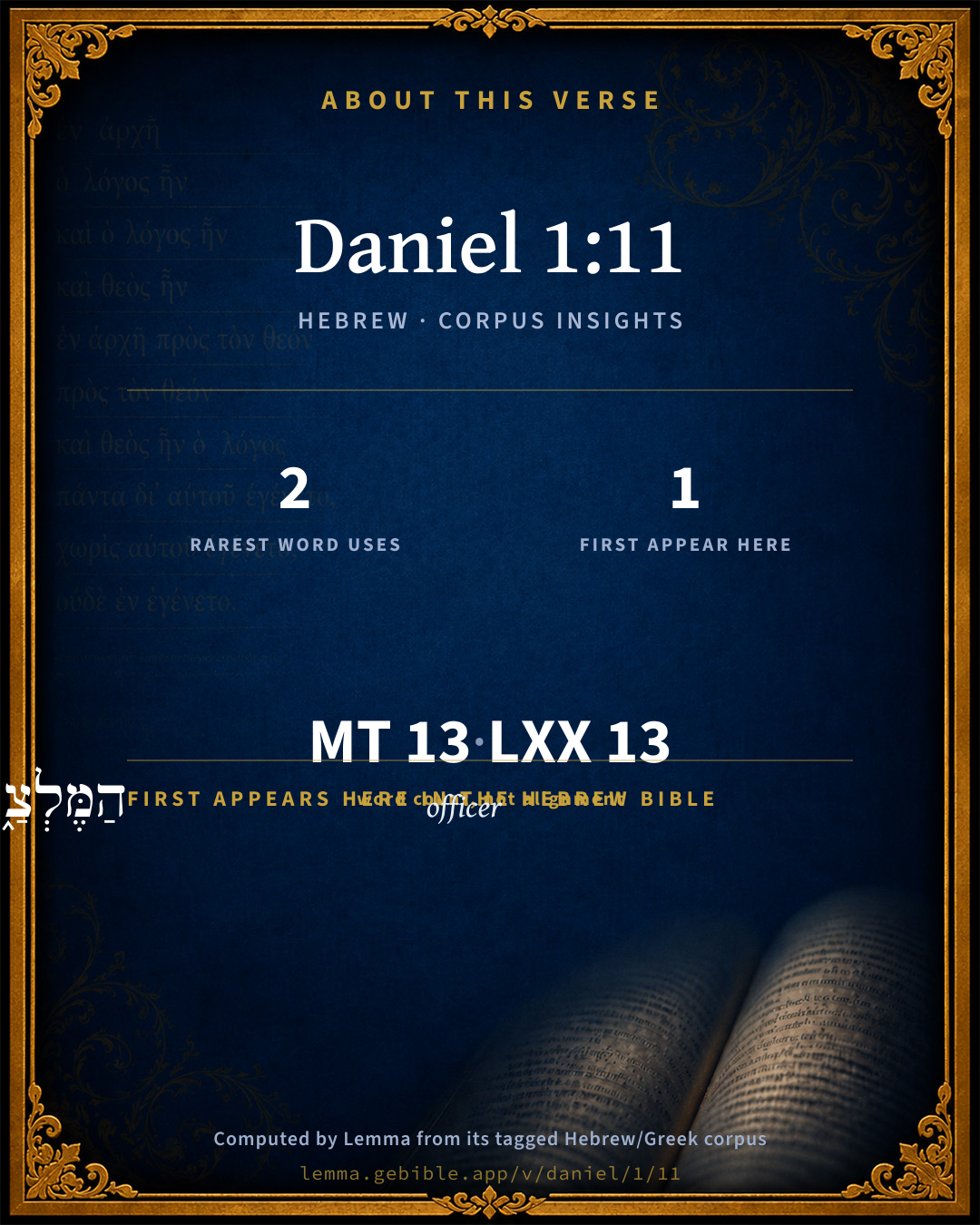
The rarest word here is הַמֶּלְצַ֑ר officer H4453 — appearing just 2 times in the whole Hebrew Bible.

First appearance in Scripture

This word makes its first canonical appearance in the Hebrew Bible here:

  • הַמֶּלְצַ֑ר officer H4453

Shared distinctive vocabulary

הַמֶּלְצַ֑ר officer H4453 occurs in 2 verses of the Hebrew Bible. Also found in:

Grammatical profile

  • 2 verbs
  • 8 nouns
  • 2 prepositions
  • 1 particle

Verb forms

  • וַיֹּ֥אמֶר Qal · Sequential Imperfect
  • מִנָּה֙ Piel · Perfect

Repetition

A word recurs within this verse — often emphatic in Hebrew:

  • דָּנִיֵּ֖אל Daniel H1840 ×2

Hebrew & Septuagint length

In English translation the verse runs 20 words from the Hebrew and 19 from the Septuagint (LXX English) — closely comparable.

A rough comparison of the two English renderings, which tokenize alike — not a word-level alignment.

Word counts can differ between the Hebrew and the Greek without any difference in meaning — e.g. the Hebrew direct-object marker אֵת has no separate Greek word, and Greek often adds the article ὁ.

In the original languages it is 13 Hebrew tokens and 13 Greek tokens — but the two are counted differently (Hebrew bundles its prefixes and suffixes into one token; the Greek is in lemma form), so that isn’t a like-for-like length.

Hebrew and Greek witnesses Masoretic Hebrew ↔ Greek Septuagint

The same verse in the two great witnesses to the Old Testament, shown verse-for-verse.

These are two independent witnesses, not word-aligned to each other, and the Septuagint is shown in lemma (dictionary) form.

Hebrew Daniel 1:11 Masoretic · Westminster Leningrad Codex

וַיֹּ֥אמֶר דָּנִיֵּ֖אל אֶל הַמֶּלְצַ֑ר אֲשֶׁ֤ר מִנָּה֙ שַׂ֣ר הַסָּֽרִיסִ֔ים עַל דָּנִיֵּ֣אל חֲנַנְיָ֔ה מִֽישָׁאֵ֖ל וַעֲזַרְיָֽה

Then said Daniel to the steward whom the prince of the eunuchs had appointed over Daniel, Hananiah, Mishael, and Azariah:

World English Bible · Public Domain

Greek LXX Daniel 1:11 Septuagint · lemma form

καί εἶπον δανιηλ αβιεσδρι ὁ ἀναδεικνύω ἀρχιευνοῦχος ἐπί ὁ δανιηλ ανανιας μισαηλ αζαριας

And Daniel said to Amelsad, whom the chief of the eunuchs had appointed over Daniel, Ananias, Misael, and Azarias.

LXX2012 (modern English Septuagint) · Public Domain

On this verse, Joseph Benson's Commentary discusses the Septuagint’s reading. Read the note in Commentary ↓

Hebrew: Westminster Leningrad Codex (CC BY 4.0). Greek: Septuagint (public domain); English from LXX2012 (modern English Septuagint) (Public Domain). How the Septuagint differs from the Hebrew →

Commentary

Notes on Daniel 1:11 from classic Christian and Jewish commentators (each source and its license shown beneath its notes). The classic Christian expositions comment on the surrounding passage and are grouped to its opening verse, so a note may address several verses; the Jewish commentaries on the Tanakh (Rashi and others) are per-verse, so they appear only where the commentator wrote on this verse.

Lemma curates 59 commentaries, every one of them public domain or Creative Commons licensed, each selected and text-cleaned for this edition rather than reprinted as found. About our sources →

Trapp's Complete Commentary

John Trapp

Dan 1:11 Then said Daniel to Melzar, whom the prince of the eunuchs had set over Daniel, Hananiah, Mishael, and Azariah,

Ver. 11. Then said Daniel to Melzar.] Or, To the steward, alimentator, the purveyor for the pages of honour. The prince of the eunuchs might haply give him a hint to go to this Melzar, who might do it with less danger.

John Trapp, A Commentary or Exposition upon All the Books of the Old and New Testament (1647–1656) — public domain. Text from a community e-Sword module.

Joseph Benson's Commentary

Dan 1:11-12. Then said Daniel, Prove thy servants, I beseech, thee — To satisfy him that there would be no danger of any ill consequence, Daniel desires the matter might be put to a trial for ten days; and let them give us pulse to eat — The word הזרעים, here used, seems to signify fruits or vegetables; or rather, according to the Greek interpreter, seeds in general. At the 16th verse the word is זרענים, seeds, and some MSS. read it so in this verse. The sense is doubtless the same in both places, and perhaps may be well enough expressed by that kind of nourishing seed called pulse. The LXX. render it, απο των σπερματων, of seeds. “Pliny, in his Natural History, p. 380, mentions a kind of pulse, that is said to affect the temper of those that feed upon it, and to produce equanimity and gentleness. Various sorts of grain were dried and prepared for food by the people of the East, as wheat, barley, rice, and pulse. Of some of these was the parched corn, mentioned in Scripture, and the chief food of the labourers and poorer sort of people; and perhaps something of this kind of preparation might have been the choice of Daniel.” — Wintle.

Joseph Benson's Commentary on the Old and New Testaments (1811–1818) — public domain. Text from a community e-Sword module.

The Preacher's Complete Homiletical Commentary

Joseph S. Exell (gen. ed.)

HOMILETICS

SECT. IV.—THE TRIAL (Chap. Dan_1:11-21).

God works by means, and in doing so deals with men’s minds as well as their bodies. Daniel was delivered out of his difficulty in regard to the food by a suggestion made upon his own mind, and favourably regarded by the person with whom he had to do. This suggestion was the proposal of a trial for ten days with pulse [20] instead of the king’s meat, and water instead of wine. Melzar [21], the subordinate officer, who could agree to the proposal with less risk to his head than his chief, and who was, no doubt, in the meantime, to reap the material advantage of it, consented to the proposed trial. The trial was made, and proved, by the divine blessing on the humbler fare, eminently successful. At the end of the period, no doubt could exist that the four Jewish youths were not only no worse in their looks for their pulse diet, but actually appeared fairer and plumper than those who had subsisted on the royal dainties [22]. Nor was this all; for at the end of the three years’ study and preparation prescribed for them by the king, they were found, on examination, to have made much greater proficiency than the rest, and, indeed, to possess a wisdom and understanding greatly superior to any of the magicians [23] and astrologers [24] within the realm. The result was, in the providence of God, an influential appointment to each of the young men about the king’s person as his attendants and councillors [25]; God, as Calvin observes, aiming at exalting Himself in and through the person of His servants. They “stood before the king,” an expression that finds its parallel in such passages as Luk_1:19; Mat_18:10; 1Sa_16:21; 1Ki_12:6; 1Ki_12:8. The purpose of Divine Providence in thus elevating Daniel is indicated in the closing words of the chapter, “Daniel continued even unto the first year of King Cyrus” [26]. Daniel was to acquire an influence which should operate on Cyrus to do what was already written of him in the Scripture of truth,—release the Jewish captives and restore the Holy City with its Temple and worship” (Isa_44:28; Isa_45:1-4) [27]. We observe from the passage—

[20] “Pulse,” מִן הַזֵּרֹעִים (min haz-zero’im), “out of the vegetables.” Dr. Rule observes that according to Buxtorf, Daniel and his companions would thus be allowed free use of grain, pulse, and spices, not necessarily excluding vegetable oils for the preparation of such food as they had been accustomed to at home, like their ancestors before entering the land of promise, and many of them afterwards (1Sa_17:17-18), living as do multitudes in the Levant at this day. He thinks it cannot be inferred that they suffered any severe privation. They were content to live moderately and humbly.

[21] “Melzar.” Hengstenberg thinks that Melzar was perhaps the official name of the sub-overseer of the royal attendants. Melzar, or “the Melzar,” observes Dr. Rule, whatever that may mean, being in a subordinate station, and therefore not directly responsible, like his chief, consented to make a brief trial by way of private experiment.

[22] “Fairer and fatter in flesh.” Dr. Pusey remarks that even now God protects religious abstinence, and quotes the words of Chardin: “I have remarked that the countenance of the Keshicks (Keshishim or monks) are in fact more rosy and smooth than those of others; and that those who fast much, I mean the Armenians and Greeks, are notwithstanding very beautiful, sparkling with health, and with a clear and lively complexion.”

[23] “Magicians,” הַחַרְטֻמִּים (ha-khartummim), from חֶרֶט (kheret), a writing or graving instrument, a pen or style. Persons skilled in writing, especially hieroglyphics.—Nork and Gesenius. According to Hengstenberg, persons skilled in mystic writing. The existence of such among the Babylonians confirmed by the fact that they are found among the Egyptians, whose religious system stands in the closest historical relation to the Babylonian. The existence of a mystic writing in Babylon supposed in the narration in chap, 5, where the king thinks of calling for the wise men to interpret the writing on the wall. According to Gesenius, they were persons among the ancient Egyptians who studied the interpretation of dreams and wrought miracles by magic (Gen_41:8; Gen_41:24; Exo_7:11; Exo_7:22, &c.); the name also applied to the Chaldean wise men similarly versed in the interpretation of dreams; sacred scribes, or persons skilled in interpreting sacred writing, especially hieroglyphics.

[24] “Astrologers,” הָאַשָּׁמִים (ha-ash-shaphim). Nork derives the name from אָשַׁף = אָסַף (ashaph = asaph), to “gather together,” and understands by it such persons as professed to foretell events by a contemplation of the stars in their situation relative to each other. According to Gesenius, they were enchanters or magicians, from אָשַׁף (ashaph), a root of uncertain meaning; but in Syriac, “to enchant.” Rendered by the Sept. and Theodotion, μαγοι (magic). So the Vulgate. The Venetian Bible has “astronomers.” So Abulwaled and Kimchi. Aben Ezra understands “physicians.” Hengstenberg thinks of “exorcists;” not “natural philosophers,” as Bertholdt and Münter suppose. According to Diodorus Siculus, the Babylonian wise men sought to avert misfortune by lustrations, sacrifices, and witchcraft. Isaiah (Isa_47:9; Isa_47:12) derides Babylon by saying that all the incantations of their wise men availed not to avert the threatened ruin from her. According to Claudian, a rain was ascribed to the incantations of the Chaldeans, by which the army of Antoninus was delivered from the threatened destruction. Dr. A. Clarke thinks the name may be derived from נפש (na-phash), “to breathe,” these men laying claim to inspiration; but supposes them to have been the philosophers and astronomers among the Babylonians. See further under chap. Dan_2:2.

[25] “Therefore stood they before the king.” Dr. Cox remarks that the king’s preference of the four young Jews was all the more remarkable from the fact that the Chaldeans boasted of their literature and science, and deemed all other nations to be barbarians; their superiority, which thus so greatly attracted the royal favour, being certainly from the Lord, who exalts and depresses according to His own good pleasure, and to subserve the purposes of His universal government. Keil observes that Daniel needed to be deeply versed in the Chaldean wisdom, as formerly Moses was in the wisdom of Egypt (Act_7:22), so as to be able to put to shame the wisdom of this world by the “hidden wisdom” of God. Gaussen notices that four benefits were bestowed by God on these faithful youths as a recompense for their fidelity: knowledge, skill in all learning, wisdom in the conduct of themselves, and, in the case of Daniel at least, something supernatural, prophetic gifts, a miraculous knowledge of the secrets of the Lord. Matthew Henry quaintly remarks that the king was soon aware that a little of their divinity was preferable to a great deal of the divinations he had been used to.

[26] “And Daniel continued even unto the first year of King Cyrus.” Hengstenberg remarks that the author considers it superfluous to describe more precisely the event which distinguished the “first year of Cyrus; “he takes it for granted that all his readers would of themselves remember it. He must, therefore, have written as a cotemporary for cotemporaries; a confirmation of the genuineness of the book. The year referred to, 536 b.c., exactly seventy years after the first captives were taken from Jerusalem to Babylon, of whom Daniel was one, being then probably fourteen or sixteen years of age.

[27] That the authority of Daniel had a very great share in bringing about the liberation of the Jews is generally admitted. Bertholdt, who opposes the genuineness of the book, says that Daniel without doubt very much contributed to obtain the permission from Cyrus for the exiled Jews to return to their fatherland, and to build Jerusalem and the Temple anew. Kleinert expresses the opinion that the immediate occasion of the edict of Cyrus was the reading of the prophecies of Isaiah concerning the liberation to be granted to the Jews by a person of his name. But this supposes another more remote cause—the influence of Daniel. Daniel influenced Cyrus to take the step partly by his great credit with the monarch, resulting from all the preceding miraculous events, even those which had occurred under the reign of the Chaldeans, partly by his laying before him the prophecies of Isaiah concerning him, which he attested with his own authority.—Hengstenberg.

1. Faith IN God and fidelity TO God sure to be rewarded. “They trusted and were not confounded.” “They shall not be ashamed that wait for me.” “Them that honour me I will honour.” God is a good paymaster, says Kitto; give what we may to Him of faith, or work, or trust, or love, or zeal, He gives back again with large interest. Trust in man or self may disappoint; trust in God never. “Better to trust in the Lord than to put confidence in princes.” “Even the youths shall faint and be weary, and the young men shall utterly fall; but they that wait upon the Lord shall renew their strength” (Isa_40:30-31). The trust reposed in God by these four youths, honoured by the blessing received from God on all their undertakings and pursuits.

2. Health and vigour often the result of God’s blessing on the humblest fare. Pulse and water, says Matthew Henry, shall be the most nourishing food, if God speak the word. The coarsest food with the divine blessing more conducive to health and good liking than the choicest diet without it. A natural connection with godliness and good looks not to be forgotten. Godliness promotes temperance, temperance health, and health a good complexion. Peace with God brings peace of conscience, serenity of mind, and sweetness of temper; and these the most certain means of bringing sweetness of countenance. One of the promises made to godliness, or godlikeness which is love—“The Lord shall make fat thy bones” (Isa_58:11). “A merry heart doeth good like a medicine.” A truly and abidingly merry heart the result of peace with God, trust in God, and obedience to God.

3. The divine blessing the best help to successful study. A sound intelligent mind as well as a sound and healthful body acknowledged even by the heathen to be given by the deity, and to be sought in prayer. One of the favourite gods of the Hindoos is one that is worshipped as the giver of wisdom and helper in study. That study likely to be barren enough that lacks the divine blessing. Daniel’s three years’ study with that blessing better than others’ ten without it. That blessing given in answer to prayer. Hence, bene orasse est bene studuisse,—to have prayed well is to have studied well. He studies to best purpose who has a closet for prayer as well as a study for his books, and who is much in the one as well as in the other. Godliness one of the best teachers. “I understand more than the ancients, because I keep Thy precepts,”—a sentiment of which Daniel himself may have been the author. The most prayerful and conscientious usually the most proficient student. Hence the knowledge even of difficult languages so readily acquired by missionaries to the heathen, enabling them not only to preach the gospel, but to translate the Scriptures in the vernacular language. The late William C. Burn enabled to converse and preach in Chinese in a wonderfully short time after his arrival in the country. “We count it reasonable,” says Kitto, “to look to the Lord for our daily bread, and to apply to Him for aid and guidance in the trials and emergencies of life. But how few are they who seek for the same aid from Him, and feel the same dependence upon Him, in matters of the intellect,—in learning, in study, in thought! It is very reasonable and becoming,—it is very necessary,—that when we go forth to the toil and business of the day, or when our affairs present perplexing difficulties, we should cast ourselves upon the Lord’s protection, and look to Him for counsel and guidance. But is it,—can it be,—less needful that, when we sit down to write, to study, to think, we should lift up our hearts trustingly to Him?” Kitto himself an eminent example of the truth he teaches.

4. True piety the frequent path to worldly promotion. “Length of days is in her right hand, and in her left hand riches and honour.” Daniel in Babylon and Joseph in Egypt distinguished examples. Worldly honour and advancement in God’s hand. “Promotion cometh neither from the east, nor from the west, nor from the south: but God is judge; He putteth down one and setteth up another” (Psa_75:6-7). God promotes His servants in the world as He sees to be most for His own glory and the good of themselves and others. Such promotion often a natural consequence of true piety. Godliness, even on natural grounds, “profitable unto all things.” Makes a man more faithful, conscientious, truthful, honest, unselfish; hence more trustworthy and reliable. True piety connected with the exercise of thought; hence tends to make a man intelligent and prudent, even though poorly educated. Makes him acquainted with the best and most elevating book, the Bible; and gives him the best and most efficient teacher, the Holy Spirit. Hence a man with true godliness, though less gifted by nature and providence, more likely to acquire advancement in the world than a man more highly gifted without it.

5. God’s purposes and promises sure of fulfilment. Means for accomplishing divine purposes never wanting. Daniel’s good appearance, proficiency in study, and superior intelligence, with their result, his elevation at court, part of the means for accomplishing the divine purpose and promise in regard to Israel’s restoration. The same true of Daniel’s longevity. His life extended to about ninety years, in order to accomplish the purpose for which God had raised him up and sent him an exile to Babylon. His influence with Cyrus to be the principal means of leading that monarch, in the very first year of his reign, to liberate the Jewish captives, then under his dominion. An easy thing with God to make slaves and exiles, like Joseph in Egypt and Daniel in Babylon, his honoured instruments in accomplishing His designs in reference to His people, His kingdom, and the world. “I will work, and who shall let it?”

6. A happy issue given to a believer out of all his troubles. Believers have troubles promised to them, but with the troubles a joyous deliverance out of them. The angel “that redeemed Jacob from all evil” still lives, and does the same for all Jacob’s faithful children. With the godly, the end better than the beginning. “Always better on before.” Their latter end peace, whatever their previous experience. Those who mourn with Zion in her sorrows sometimes spared to rejoice with her in her joys. Daniel, after all his sorrow for his people, spared to see the promise made by Jeremiah fulfilled,—to see, at least in its beginning, “the good of Jerusalem and peace upon Israel.” “Weeping may endure for a night; joy cometh in the morning.”

The Preacher's Complete Homiletical Commentary (gen. ed. Joseph S. Exell; Funk & Wagnalls, c. 1892) — public domain (pre-1929). A full-Bible homiletical/sermon-outline anthology covering 65 of 66 books (2 John is absent from the source module). Text from a community e-Sword module.

Tyndale Open Study Notes

Tyndale Open Resources

1:11-13 Daniel found a wise solution that would protect his spiritual integrity and Ashpenaz’s head.

Tyndale Open Study Notes — © Tyndale Open Resources, licensed CC BY-SA 4.0. Text via the HelloAO Bible API.

Ibn Ezra

Rabbi Abraham ibn Ezra

[Daniel 1:11] Vayomer... HaMeltsar (וַיֹּאמֶר... הַמֶּלְצַר - And Daniel said... The guard/steward): This [HaMeltsar] is a Chaldean word [meaning] the one who gives the portions/allotments (manot - מָנוֹת). And behold, the meaning of “whom [the chief officer] had appointed” (asher minnah - אֲשֶׁר מִנָּה) is like “appointed/overseer” (ha-pkid - הַפְּקִיד). And in the language of the Sages, [it is like] memuneh (מְמֻנֶּה - appointed one/overseer). And for it [the word Meltsar itself] to be derived from [the concept of] "one who appoints/apportions (minnah) the portions (manot)" is very difficult [linguistically], according to Ibn Ezra. And especially since it is written concerning Daniel [and his companions, implying a specific context that perhaps makes a simple etymological link less likely in Ibn Ezra's view].

Ibn Ezra on the Tanakh — English translations: “Sefaria Community Translation” (CC0 1.0 (public-domain dedication)); “Yalkut, Sifsei Chachomim Chumash, Metsudah Publications, 2009” (CC BY 4.0); and “Commentary of Ibn Ezra on Isaiah - trans. by M. Friedlander, 1873” (public domain). Text via Sefaria.

Jamieson, Fausset & Brown

Robert Jamieson, A. R. Fausset & David Brown

Melzar--rather, the steward, or chief butler, entrusted by Ashpenaz with furnishing the daily portion to the youths [GESENIUS]. The word is still in use in Persia.

Jamieson, Fausset & Brown — Commentary Critical and Explanatory on the Whole Bible (1871) — public domain (CC PDM 1.0). Text via the HelloAO Bible API.

Adam Clarke's Commentary

Verse 11. Then said Daniel to Melzar] Melzar was an officer under Ashpenaz, whose office it was to attend to the food, clothing, &c., of these royal captives. Others think מלצר meltsar, master of the inn or hotel, the name of an office.

Adam Clarke's Commentary on the Bible (1810–1826) — public domain. Text from a community e-Sword/MySword module.

John Calvin's Commentaries

Since Daniel understood from the answer of the prefect that he could not obtain his wish, he now addresses his servant. For the prefect had many servants under him, according to the custom of important stewardships. Most probably the steward’s duty was similar to that of the Chief Steward of the Household, as it exists at this time in France. Daniel and his companions were under the care of one of these servants; Daniel descends to this remedy and obtains his wish, though, as we shall see, not without some artifice. And here Daniel’s singular constancy is observable, who after trying the matter once in vain, did not cease to pursue the same object It is a clear and serious proof of our faith, when we are not fatigued when anything adverse occurs, and never consider the way closed against us. Then if we do not retrace our steps, but try all ways, we truly show the root of piety fixed in our hearts. It might have seemed excusable in Daniel, after he had met with his first repulse; for who would not have said he had discharged his duty, and that an obstacle had prevailed over him! But; since he did not prevail with the chief prefect, he goes to his servant. Thus voluntarily to incur risk was the result of no common prudence. For this servant could not make the same objection, as we have just heard the prefect did. Without doubt he had heard of Daniel’s request, and of his repulse and denial; hence Daniel is beforehand with him, and shows how the servant may comply without the slightest danger; as if he had said, — We, indeed, did not obtain our wish from the prefect because he was afraid of his life, but I have now thought of a new scheme by which you may both gratify us and yet not become chargeable with any crime, as the whole matter will be unknown. Try thy servants, therefore, for ten days, and prove them; let nothing but pulse be given us to eat and water to drink If after that time our faces are fresh and plump, no suspicion will attach to time, and no one will be persuaded that we are not treated delicately according to the king’s commandment. Since, then, this proof will be sufficiently safe for thee, and cautious enough for us both, there is no reason why you should reject our prayers. Besides, without the slightest doubt, when Daniel brought this forward, he was directed by God’s Spirit to this act of prudence, and was also impelled to make this request. By the singular gift of the Holy Spirit Daniel invented this method of bending the mind of the servant under whose care he was placed. We must hold, then, that this was not spoken rashly or of his own will, but by the instinct of the Holy Spirit. It would not have been duty but rashness, if Daniel had been the author of this plan, and had not been assured by the Lord of its prosperous issue. Without doubt he had some secret revelation on the subject; and if the servant allowed him and His associates to feed on pulse, it was a happy answer to his prayers. Hence, I say, he would not have spoken thus, except under the guidance and command of the Spirit. And this is worthy of notice, since we often permit ourselves to do many things which turn out badly, because we are carried away by the mere feelings of the flesh, and do not consider what is pleasing to God. It is not surprising, then, when men indulge in various expectations, if they feel themselves deceived at last, since every one occasionally imposes upon himself by foolish hopes, and thus frustrates his designs. Indeed, it is not our province to promise ourselves any success. Hence let us notice how Daniel had not undertaken or approached the present business with any foolish zeal; and did not speak without due consideration, but was assured of the event by the Spirit of God.

But he says, let pulse be put before us to eat, and water to drink We see, then, that the foul youths did not abstain from the royal food for fear of pollution; for there was no law to prevent any one drinking wine, except the Nazarites, (Numbers 6:2,) and they might eat of any kind of flesh, of which there was abundance at the royal table. Whence then sprang this scrupulousness? because, as we said yesterday, Daniel was unwilling to accustom himself to the delicacies of the palace, which would cause him to become degenerate. He wished, therefore, to nourish his body not only frugally, but abstemiously, and not to indulge in these tastes; for although he was raised to the highest honors, he was always the same as if still among the most wretched captives. There is no occasion for seeking other reasons for this abstinence of Daniel’s. For he might have fed on ordinary bread and other less delicate food; but he was content with pulse, and was continually lamenting and nourishing in his mind the remembrance of his country, of which he would have been directly forgetful if he had been plunged into those luxuries of the palace. It follows —

John Calvin's Commentaries (1540-1563) — public domain. Text from the Calvin Translation Society English edition (1840s-50s) via the Christian Classics Ethereal Library (ccel.org). Calvin's coverage is partial (roughly two-thirds of the Bible); uncommented books and verses are honest gaps, never fabricated. The 19th-century editor's footnotes and remarks are omitted so the notes are faithfully Calvin's own voice.

Ellicott's Commentary for English Readers

(11) Melzar.—(See Introduction, § VI.) Not a proper name (Hamelsar), but a cellarman. The appeal of Daniel to the chief chamberlain having proved insufficient, he applies to the man with whom he was on more familiar terms.

A Bible Commentary for English Readers, edited by Charles John Ellicott (1878–1897) — public domain. Text from a community e-Sword module.

The Cambridge Bible for Schools and Colleges

gen. ed. J. J. S. Perowne

11. Melzar] the melẓar,—‘melẓar’ being the title of some officer, or attendant, of the court. What officer is intended is, however, uncertain, as the word has not hitherto been satisfactorily explained. Friedr. Delitzsch thinks that melẓar may be the Ass. maẓẓaru, ‘keeper’ (as in maẓẓar bâbi, ‘keeper of the gate’), the l taking the place of the doubled ẓ (cf. βάλσαμον from bassâm); and Schrader agrees that this explanation is possible. The term evidently denotes some subordinate official, appointed by the chief of the eunuchs to be in personal charge of Daniel and his companions.

11–16. From the answer given by the chief of the eunuchs, Daniel gathers that he does not view his request unfavourably, though he declines the responsibility of acceding to it himself. He therefore applies to the subordinate officer who has the immediate charge of himself and his companions, and induces him to try them temporarily with vegetable diet. The result of the experiment being satisfactory, the royal food is withdrawn from the Jewish youths.

The Cambridge Bible for Schools and Colleges (gen. ed. J. J. S. Perowne; Cambridge University Press, 1878–1918) — public domain. Text from a community e-Sword module.

John Gill's Exposition

Then said Daniel to Melzar,.... The prince of the eunuchs, having put off Daniel with the above answer, seems to have left him; or, however, Daniel, finding he could not obtain of him what he sought for, applies to Melzar, a subordinate officer, whom he hoped to find more pliable; and it may be that Ashpenaz might suggest it to him to apply to this person, and signify that if he could prevail upon him to give him other food instead of the king's; who might be under a temptation from profit, being a meaner officer; he for his part would wink at it, so be it he came not into any danger himself; however, be it as it will, Daniel did apply to this man, whose name was Melzar, for so most take it to be the proper name of a man; which, according to Hillerus (b), signifies one "in full splendour". Josephus calls (c) him Aschanes; though some think it is the name of an office, as a steward, or the like; but whether it is expressive of his name, or his office, he is described as one

whom the prince of the eunuchs had set over Daniel, Hananiah, Mishael, and Azariah; to give them their food at proper time.

(b) Onomast. Sacr. p. 600. (c) Antiqu. l. 10. c. 10. sect. 2.

John Gill's Exposition of the Whole Bible (1746–1763) — public domain (CC PDM 1.0). Text via the HelloAO Bible API.

Albert Barnes' Notes on the Bible

Then said Daniel to Melzar, whom the prince of the eunuchs had set over Daniel ... - Margin, or, the “steward.” It is not easy to determine whether the word here used (מלצר meltsâr) is to be regarded as a proper name, or the name of an office. It occurs nowhere else, except in Dan 1:16, applied to the same person. Gesenius regards it as denoting the name of an office in the Babylonian court - master of the wine, chief butler. Others regard it as meaning a treasurer. The word is still in use in Persia. The Vulgate renders it as a proper name - Malasar; and so the Syriac - Meshitzar; and so the Greek - Ἀμελσὰδ Amelsad. The use of the article in the word (המלצר hameltsâr) would seem to imply that it denoted the name of an “office,” and nothing would be more probable than that the actual furnishing of the daily portion of food would be entrusted to a steward, or to some incumbent of an office inferior to that sustained by Ashpenaz, Dan 1:3.

Albert Barnes' Notes on the Bible (1834–1885) — public domain. Text from a community e-Sword/MySword module.

Haydock's Catholic Bible Commentary

Malassar, another inferior officer. It means also one appointed over the mouth or provisions, (Calmet) and might be Asphenez (ver. 3, 9.) (Haydock)

George Leo Haydock (1774–1849), Haydock's Catholic Family Bible and Commentary, 1859 edition — public domain. Excludes Psalms (Douay-Rheims chapter numbering differs from Protestant) and Deuterocanonical books (Catholic canon only).

The Pulpit Commentary

Then said Daniel to Melzar, whom the prince of the eunuchs had set over Daniel, Hananiah, Mishael, and Azariah. The reading of the Septuagint differs from the Massoretic in two particulars instead of "Melzar," the name given is "Abiesdri," as in the third verse; and the verb minnah (hNmi) is read hN; mu (munnoh), "set over." The Peshitta reads instead of "Melzar," in this verse, "Mashitzar" (but see ver. 16). This confirms the idea that this is a proper name, not an official title. If the assumption of the Septuagint is correct, then the name in the Massoretic text ought to be Hammelzar. This might indicate the name to be Amil-Assur, corresponding to Amil-Merodach. Theodotion renders the name jAmelsad. While a good deal can be said for making "Melzar" or "Hammelzar" a proper name, something may also be said for the idea which has gained ground that "Melzar," since it has the article before it, is the name of an official. Lenormant ("La Divination," p. 196) makes the name Amil-Ussur. Such, at any rate, is the name of an official in the court of a Ninevite king; it is supposed to mean "steward," but it may be doubted if this is the exact equivalent of such an official as the one here referred to. Hitzig suggests paidagwgov, and for this rendering there is much to be said. It is an indirect proof of the antiquity of the book, that an official is referred to by a title the exact force of which had been forgotten when the Septuagint translation was produced, not later certainly than the first century B.C. Theodotion and Jerome are as far at sea as is also the Peshitta. The critical hypothesis is that this Assyrian name for "steward" remained known among the Palestinian Jews from the fall of the Babyloniau Empire in B.C. 532 to B.C. 168, and then in less than a couple of centuries utterly disappeared. The reading of the Septuagint," Abiesdri," may be laid aside; it is a reading that would suggest itself to any one who appreciated the difficulty of the passage. In the previous verse we were made auditors to a conversation between Daniel and Ashpenaz, in which he does not consent to Daniel"s request. In the verse before us Daniel addresses another request to a new but subordinate official. As the request is one that might naturally follow the refusal, mild but to all appearance firm, of the prince of the eunuchs, what could be more natural than to imagine that Amelzar was a misreading for Abiesdri? The story has been condensed. Had we the full narrative, we most likely would have seen that Daniel had to go over the argument with the subordinate that he had already had with the superior. It is not unlikely that the prince of the eunuchs was not expressly informed of the experiment being tried,of which the verse which follows informs us. This would help to save him from the responsibility of the thing; it is not inconceivable that he intentionally kept himself uninformed. Not only has Daniel secured a personal influence over the prince of the eunuchs, but also over this Melzar, or steward. There are people in the world who have this magnetic power over their fellows which compels their liking. When with this are united abilities of a man to do exploits and leave his mark on the world, we have a national hero. Napoleon the Great was eminently a man of this kind.

The Pulpit Commentary (1880–1919), ed. H.D.M. Spence-Jones & Joseph S. Exell — public domain. Text from a community e-Sword module.

unfoldingWord translationNotes

Door43 World Missions Community

compare our appearance with the appearance

Daniel asked the steward to see if he and his friends looked worse than the other young men. AT: "compare our appearance to see if it is worse than the appearance"

translationWords

manager

chief

test

servant

unfoldingWord translationNotes — © Distant Shores Media and the Door43 World Missions Community, licensed CC BY-SA 4.0. Source: git.door43.org/Door43/en_tn.

Rashi

Rabbi Shlomo Yitzchaki (Rashi)

the steward Heb. הַמֶּלְצַר, the one who arranges the portions and the plates, called maestre sala, seneschal, steward.

Rashi on the Tanakh — English translations: “The Judaica Press complete Tanach with Rashi, translated by A. J. Rosenberg” (CC BY 4.0); “Pentateuch with Rashi's commentary by M. Rosenbaum and A.M. Silbermann, 1929-1934” (public domain); “The Metsudah Tanach series, Lakewood, N.J” (CC BY 4.0); and “The Book of Joshua, Metsudah Publications, 1997” (CC BY 4.0). Text via Sefaria.

Lesson kit

Teaching starters — assembled from the data on this page, not authored interpretation. Every prompt links to the verse data it draws on. Edit before teaching.

Daniel, in the Prophets, opens this verse with 13 words (12 distinct Hebrew lemmas). Its most distinctive word is meltsâr (“officer”). A historical commentator’s framing appears above. Read the whole chapter for the surrounding context.

Discussion questions

  1. What does “officer” (meltsâr) contribute to the verse as a whole?
  2. The word “officer” first appears here in Scripture. What is being introduced at this debut?
  3. Daniel 1:16 shares the word «officer» with this verse. How do the two illuminate each other?
  4. “Daniel” occurs 2× in this one verse. What is the effect of the repetition?
  5. These translations render this verse differently. What is at stake in choosing one wording over another?
  6. The verb «וַיֹּ֥אמֶר» is Qal Sequential Imperfect. How does its form color the action?
  7. Reading how Trapp's Complete Commentary and Joseph Benson's Commentary read this verse, where do the two commentators agree and where do they part?

Things to notice

Reading settings

Reading text

Shown beneath each verse's original-language words.

Old Testament
Old Testament edition

Read the OT as the Masoretic Hebrew (MT) or the Greek Septuagint (LXX).

English shown for the Greek Septuagint (in the Hebrew ↔ Greek comparison).

Comparing translations? Open the Compare panel on any verse page to stack up to four side by side.