Nehemiah 6:11

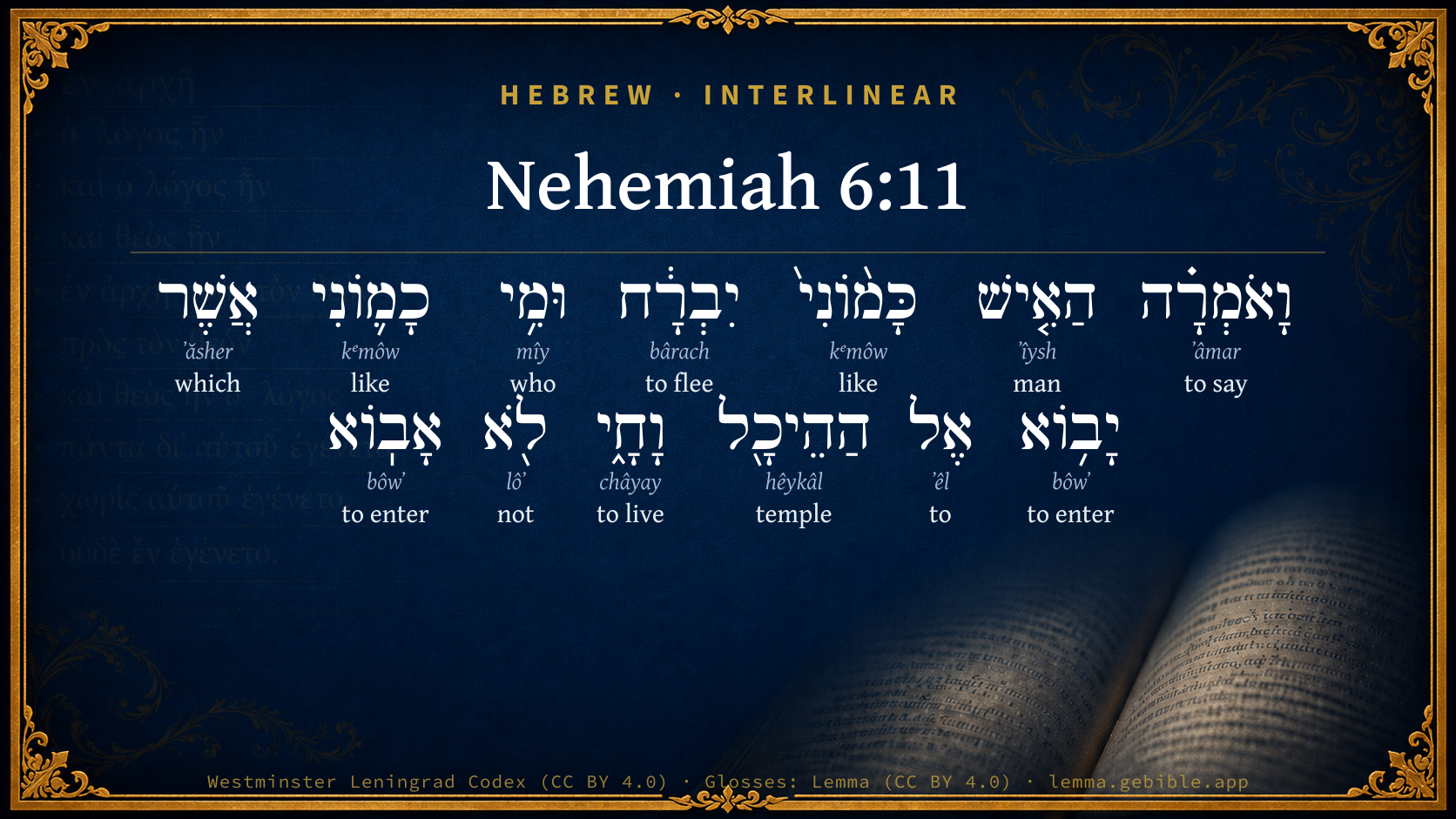
Hebrew (Westminster Leningrad Codex) Nehemiah 6:11 appears in the Hebrew Old Testament. The text above is from the Westminster Leningrad Codex. Each word links to its Strong’s number, a concise gloss, and parsing drawn from the Open Scriptures Hebrew Bible morphology. Click any word for its full Brown-Driver-Briggs (BDB) entry.
Download image
Cite this verse

Nehemiah 6:11 (World English Bible). Public Domain. Lemma interlinear Bible study tool, https://lemma.gebible.app/v/nehemiah/6/11.

Show BibTeX & RIS
BibTeX
RIS
English Translation
I said, Should such a man as I flee? and who is there that, being such as I, would go into the temple to save his life? I will not go in.
World English Bible · Public Domain
Download a study sheet

One document with this verse’s original text, its word-by-word gloss line, the meaning frame, cross-references with their text, attributed commentary, and full source and license credits — printable, and it pastes into notes with its structure intact.

This verse Autodidact and up

Study sheet (.html) Plain text (.txt)

A passage Seminary Student

Up to 50 verses in one chapter. A passage sheet keeps up to 6 commentary sources and 12 cross-references per verse, in the order this page ranks them, and says so on the sheet whenever that leaves anything out. Ask for a single verse and you get the Autodidact verse sheet above.

Everything on this page stays free to read, with no account — the sheet is a download of what is already on screen, not access to it.

Want to remove ads? Support Godless Engineer
Compare translations 3

The same verse in 3 English versions, stacked beneath the original-language interlinear above. Click any original word for its lexicon entry.

Each is an independent rendering of the whole verse — the interlinear is not word-aligned to these translations.

Highlighted words mark where these versions differ — a whole-verse word diff, not a word-by-word alignment.

  • World English Bible Public Domain
    I said, Should such a man as I flee? and who is there that, being such as I, would go into the temple to save his life? I will not go in.
  • King James Version Public Domain
    And I said, Should such a man as I flee? and who is there, that, being as I am, would go into the temple to save his life? I will not go in.
  • unfoldingWord Literal Text CC BY-SA 4.0
    And I said, “Should a man such as I run away? And who, such as I, is it that could go in to the temple and live? I will not go in!”

unfoldingWord Literal Text — © unfoldingWord, licensed CC BY-SA 4.0. Word-aligned USFM3 via Door43 (git.door43.org/unfoldingWord/en_ult).

Versions to compare (up to 4)

3 of 4 selected

Show all 18 translations

Every available English version of this verse, each an independent rendering of the whole verse.

  • World English Bible Public Domain
    I said, Should such a man as I flee? and who is there that, being such as I, would go into the temple to save his life? I will not go in.
  • Berean Standard Bible Public Domain
    But I replied, “Should a man like me run away? Should one like me go into the temple to save his own life? I will not go!”
  • Majority Standard Bible Public Domain
    But I replied, “Should a man like me run away? Should one like me go into the temple to save his own life? I will not go!”
  • King James Version Public Domain
    And I said, Should such a man as I flee? and who is there, that, being as I am, would go into the temple to save his life? I will not go in.
  • American Standard Version (1901) Public Domain
    And I said, Should such a man as I flee? and who is there, that, being such as I, would go into the temple to save his life? I will not go in.
  • Revised Version (1885) Public Domain
    And I said, Should such a man as I flee? and who is there, that, being such as I, would go into the temple to save his life? I will not go in.
  • Geneva Bible (1599) Public Domain
    Then I said, Should such a man as I, flee? Who is he, being as I am, that would go into the Temple to liue? I will not goe in.
  • Douay-Rheims (1899) Public Domain
    And I said: Should such a man as I Bee? and who is there that being as I am, would go into the temple, to save his life? I will not go in.
  • Young's Literal Translation Public Domain
    And I say, `A man such as I -- doth he flee? and who as I, that doth go in unto the temple, and live? -- I do not go in.'
  • Literal Standard Version CC BY-SA 4.0
    And I say, “A man such as I—does he flee? And who as I, that goes into the temple, and lives? I do not go in.”
  • Unlocked Literal Bible CC BY-SA 4.0
    I replied, “Would a man like me run away? Would a man like me go into the temple just so he could save his own life? I will not go in!”
  • unfoldingWord Literal Text CC BY-SA 4.0
    And I said, “Should a man such as I run away? And who, such as I, is it that could go in to the temple and live? I will not go in!”
  • Darby Bible Public Domain
    And I said, Should such a man as I flee? and who is there, that, being as I am, could go into the temple, and live? I will not go in.
  • World Messianic Bible Public Domain
    I said, “Should a man like me flee? Who is there that, being such as I, would go into the temple to save his life? I will not go in.”
  • Webster's Bible Public Domain
    And I said, Should such a man as I flee? and who is there, that, being as I am, would go into the temple to save his life? I will not go in.
  • Free Bible Version CC BY-SA 4.0
    I replied, “Should someone like me run away? Should someone like me go and hide in the Temple so I can survive? I'm not going!”
  • Bible in Basic English Public Domain
    And I said, Am I the sort of man to go in flight? what man, in my position, would go into the Temple to keep himself safe? I will not go in.
  • JPS Tanakh (1917) Public Domain
    And I said: 'Should such a man as I flee? and who is there, that, being such as I, could go into the temple and live? I will not go in.'

Literal Standard Version (2020), Covenant Press — licensed CC BY-SA 4.0. Text via the HelloAO Bible API (eBible.org). Unlocked Literal Bible (unfoldingWord) — licensed CC BY-SA 4.0. Text via the HelloAO Bible API (eBible.org). unfoldingWord Literal Text — © unfoldingWord, licensed CC BY-SA 4.0. Word-aligned USFM3 via Door43 (git.door43.org/unfoldingWord/en_ult). Free Bible Version, Dr. Jonathan Gallagher — licensed CC BY-SA 4.0. Text via the HelloAO Bible API (eBible.org).

Word by word

More ways to search: Search by grammar → Find every occurrence → Compare this word →

Practice this passage: Drill this verse → Learn its vocabulary →

וָחָ֑י
châyay
H2425
“and · to live”
Conjunction + Verb, Qal, Sequential Perfect, 3rd Person, Masculine, Singular
Part of Speech
Conjunction + Verb
Stem
Qal
Form
Sequential Perfect
Person
3rd Person
Gender
Masculine
Number
Singular
Full BDB Definition

Origin: a primitive root [compare H2421 ]

TWOT: 644

to live, have life, remain alive, sustain life, live prosperously, live for ever, be quickened, be alive, be restored to life or health - (Qal) - to live - to have life - to continue in life, remain alive - to sustain life, to live on or upon - to live (prosperously) - to revive, be quickened - from sickness - from discouragement - from faintness - from death - (Piel) - to preserve alive, let live - to give life - to quicken, revive, refresh - to restore to life - to cause to grow - to restore - to revive - (Hiphil) - to preserve alive, let live - to quicken, revive - to restore (to health) - to revive - to restore to life

  1. וָאֹמְרָ֗ה ʼâmar H559 “and · to say” Conjunction + Verb, Qal, Sequential Imperfect, 1st Person, Common, Singular + Suffix, h
  2. הַאִ֤ישׁ ʼîysh H376 “man” Particle, Interrogative + Noun, Common, Masculine, Singular, Absolute
  3. כָּמ֨וֹנִי֙ kᵉmôw H3644 “like · me” Preposition + Suffix, Personal, 1st Person, Common, Singular
  4. יִבְרָ֔ח bârach H1272 “to flee” Verb, Qal, Imperfect, 3rd Person, Masculine, Singular
  5. וּמִ֥י mîy H4310 “and · who” Conjunction + Particle, Interrogative
  6. כָמ֛וֹנִי kᵉmôw H3644 “like · me” Preposition + Suffix, Personal, 1st Person, Common, Singular
  7. אֲשֶׁר ʼăsher H834 “which” Particle, Relative
  8. יָב֥וֹא bôwʼ H935 “to enter” Verb, Qal, Imperfect, 3rd Person, Masculine, Singular
  9. אֶל ʼêl H413 “to” Preposition
  10. הַהֵיכָ֖ל hêykâl H1964 “the · temple” Particle, Definite Article + Noun, Common, Masculine, Singular, Absolute
  11. לֹ֖א lôʼ H3808 “not” Particle, Negative
  12. אָבֽוֹא bôwʼ H935 “to enter” Verb, Qal, Imperfect, 1st Person, Common, Singular

About this verse

These counts appear in no published source. They are computed here, from the morphology-tagged text and Lemma’s own curated glosses. What Lemma adds →

13
words
11
distinct lemmas
Historical
section

Notable vocabulary

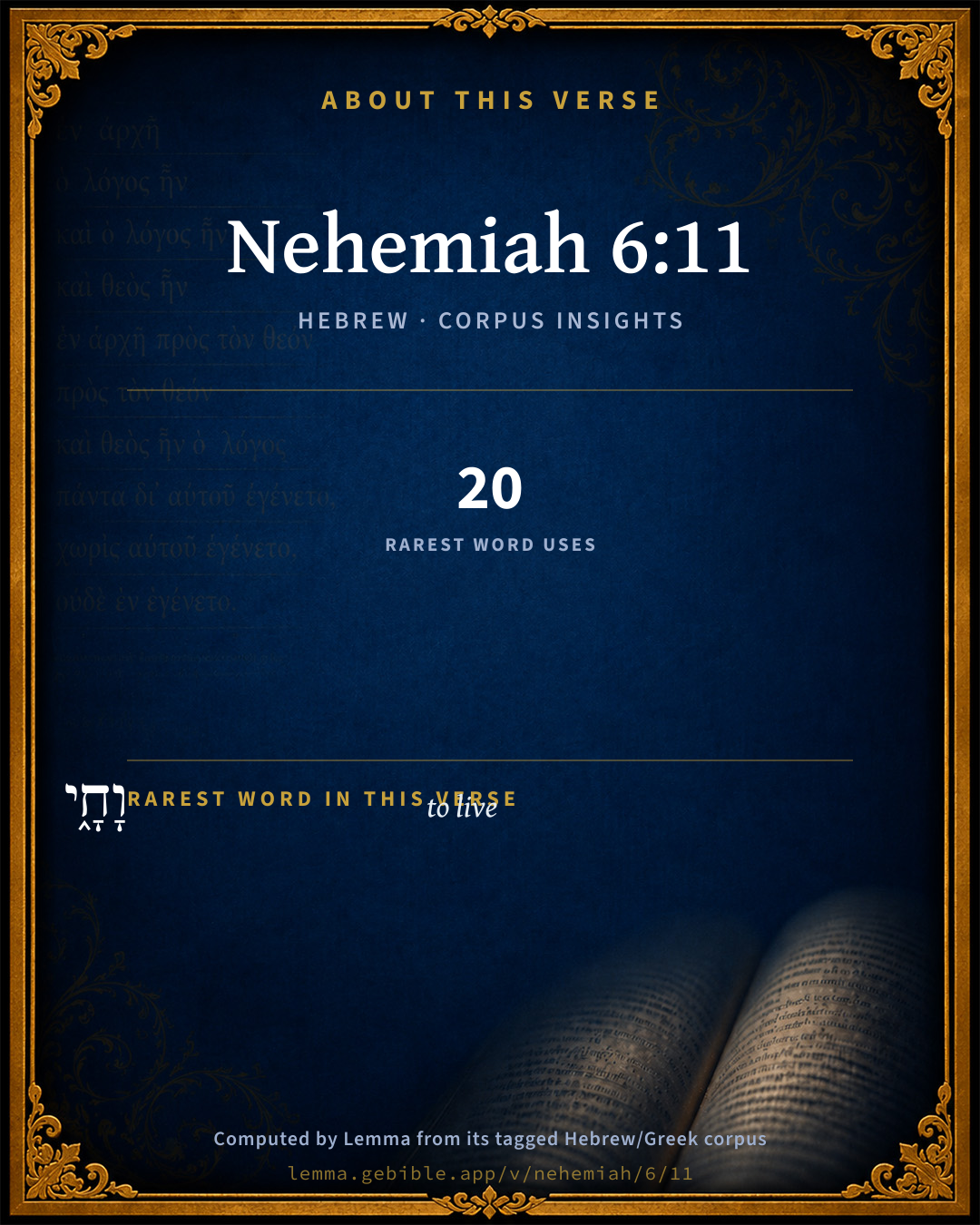
The rarest word here is וָחָ֑י to live H2425 — appearing just 20 times in the whole Hebrew Bible.

Shared distinctive vocabulary

וָחָ֑י to live H2425 occurs in 20 verses of the Hebrew Bible. Also found in:

Grammatical profile

  • 5 verbs
  • 2 nouns
  • 3 prepositions
  • 3 particles

Verb forms

  • וָאֹמְרָ֗ה Qal · Sequential Imperfect
  • יִבְרָ֔ח Qal · Imperfect
  • יָב֥וֹא Qal · Imperfect
  • וָחָ֑י Qal · Sequential Perfect
  • אָבֽוֹא Qal · Imperfect

Repetition

Words recur within this verse — often emphatic in Hebrew:

  • כָּמ֨וֹנִי֙ like H3644 ×2
  • יָב֥וֹא to enter H935 ×2

Cross-references

18

Topical passages linked to Nehemiah 6:11 in the Treasury of Scripture Knowledge — connected by theme and wording, ordered by reader-vote popularity; previews shown in the World English Bible.

  • Psalms 11:1–2 In Yahweh, I take refuge. How can you say to my soul, "Flee as a bird to your mountain!"
  • Proverbs 28:1 The wicked flee when no one pursues; But the righteous are as bold as a lion.
  • Acts 21:13 Then Paul answered, "What are you doing, weeping and breaking my heart? For I am ready not only to be bound, but also to die at Jerusalem for the name of the Lord Jesus."
  • Psalms 112:6 For he will never be shaken. The righteous will be remembered forever.
  • Psalms 112:8 His heart is established. He will not be afraid in the end when he sees his adversaries.
  • Luke 13:31–33 On that same day, some Pharisees came, saying to him, "Get out of here, and go away, for Herod wants to kill you."
  • Acts 20:24 But these things don't count; nor do I hold my life dear to myself, so that I may finish my race with joy, and the ministry which I received from the Lord Jesus, to fully testify to the Gospel of the grace of God.
  • Philippians 2:17 Yes, and if I am poured out on the sacrifice and service of your faith, I rejoice, and rejoice with you all.
  • Numbers 32:7–9 Why discourage you the heart of the children of Israel from going over into the land which Yahweh has given them?
  • 1 Samuel 19:5 for he put his life in his hand, and struck the Philistine, and Yahweh worked a great victory for all Israel: you saw it, and did rejoice; why then will you sin against innocent blood, to kill David without a cause?
  • Nehemiah 6:3 I sent messengers to them, saying, I am doing a great work, so that I can't come down: why should the work cease, while I leave it, and come down to you?
  • Nehemiah 6:9 For they all would have made us afraid, saying, Their hands shall be weakened from the work, that it not be done. But now, [God], strengthen you my hands.
  • Job 4:3–6 Behold, you have instructed many, You have strengthened the weak hands.
  • Ecclesiastes 10:1 Dead flies cause the oil of the perfumer to send forth an evil odor; so does a little folly outweigh wisdom and honor.
  • Philippians 2:30 because for the work of Christ he came near to death, risking his life to supply that which was lacking in your service toward me.
  • Hebrews 11:27 By faith, he left Egypt, not fearing the wrath of the king; for he endured, as seeing him who is invisible.
  • Isaiah 10:18 He will consume the glory of his forest, and of his fruitful field, both soul and body: and it shall be as when a standard-bearer faints.
  • Acts 8:1 Saul was consenting to his death. A great persecution arose against the assembly which was in Jerusalem in that day. They were all scattered abroad throughout the regions of Judea and Samaria, except for the apostles.

Cross-references courtesy of OpenBible.info (CC BY 4.0).

Hebrew and Greek witnesses Masoretic Hebrew ↔ Greek Septuagint

The same verse in the two great witnesses to the Old Testament, shown verse-for-verse.

These are two independent witnesses, not word-aligned to each other, and the Septuagint is shown in lemma (dictionary) form.

Hebrew Nehemiah 6:11 Masoretic · Westminster Leningrad Codex

וָאֹמְרָ֗ה הַאִ֤ישׁ כָּמ֨וֹנִי֙ יִבְרָ֔ח וּמִ֥י כָמ֛וֹנִי אֲשֶׁר יָב֥וֹא אֶל הַהֵיכָ֖ל וָחָ֑י לֹ֖א אָבֽוֹא

I said, Should such a man as I flee? and who is there that, being such as I, would go into the temple to save his life? I will not go in.

World English Bible · Public Domain

Greek LXX Structure differs

The Septuagint has no separate book of Nehemiah. Its Greek text is the second half of Esdras B (2 Esdras), chapters 11–23; Ezra is the first half (1–10).

A verse-for-verse comparison isn’t shown here because the chapters and verses don’t line up. Switch to the LXX edition with the MT / LXX toggle above to read the Greek directly.

Hebrew: Westminster Leningrad Codex (CC BY 4.0). Greek: Septuagint (public domain); English from a public-domain English Septuagint. How the Septuagint differs from the Hebrew →

Commentary

Notes on Nehemiah 6:11 from classic Christian and Jewish commentators (each source and its license shown beneath its notes). The classic Christian expositions comment on the surrounding passage and are grouped to its opening verse, so a note may address several verses; the Jewish commentaries on the Tanakh (Rashi and others) are per-verse, so they appear only where the commentator wrote on this verse.

Lemma curates 59 commentaries, every one of them public domain or Creative Commons licensed, each selected and text-cleaned for this edition rather than reprinted as found. About our sources →

Trapp's Complete Commentary

John Trapp

Neh 6:11 And I said, Should such a man as I flee? and who [is there], that, [being] as I [am], would go into the temple to save his life? I will not go in.

Ver. 11. And I said, Should such a man as I flee?] To the dishonour of God, and the discouraging of the people? to the scandal of the weak, and the scorn of the wicked? Et Turnum fugientem haec terra videbit? There is a Tο πρεπον, a comeliness, a seemliness, a suitableness, appertains to every calling and condition of life; and nature hath taught heathens themselves to argue from dignity to duty, and to scorn to do anything unworthy of themselves. Scipio, when a harlot was offered him, answered, Vellem, si non essem Imperator, I would, were I not a general. Antigonus being invited to a feast where a notable harlot was to be present, asked counsel of Menedemus, what he should do? No more but this, said he, remember that thou art a king’s son. Themistocles once, after a victory, viewing the spoils and pillage of the field, said to his friend that bare him company, Take thou these rich spoils to thyself; for thou art not Themistocles; it is below me to stoop to them, Aνελου σεαυτω συ γαρ ουκ ει Yεμιστοκλης. When Pompey had Caesar and Antony in a ship together, it was suggested to him by Metrodorus, to revenge himself for the death of his father and brother. To whom he replied, that so to do might happily befit Metrodorus, but in no wise Pompey. It is not for you to be fishing for small fish, but for towns, forts, and castles, said Cleopatra to Mark Antony. It is not for God’s saints to walk as men; since they are children of the kingdom, and must therefore regnum in pectore gerere, carry themselves accordingly. We usually say, such a man understands himself well; that is, he knows his place, his dignity, and walks accordingly. It is a pusillanimity to do otherwise; Nehemiah will never do it, to die for it.

And who is there, that, being as I am] So greatly beloved of God, Dan 9:23, so highly favoured of the king, Neh 2:2; Neh 2:4, so protected hitherto, so prospered, so intrusted with the government and safety of this people, more dear to me than my very life.

Would go into the temple] As a malefactor, to take sanctuary there; or as a coward, to save mine own life with the loss of the lives of many of the precious sons of life.

I will not go in] The heavens shall sooner fall than I will forsake the truth, said that martyr, William Flower (Acts & Mon. 1430). Omnia de me praesumas praeter fugam et palinodiam, said Luther to Staupicius, I will rather die than fly; burn than turn. Latimer was wondrous bold and stout in his dealing with Henry VIII, both before and after he was a bishop. So were Athanasius, Ambrose, Basil, the primitive confessors. This courage in Christians the heathen persecutors called obstinacy, and not faith. Sed pro hac obstinatione fidei morimur, saith Tertullian in his Apology, for this obstinacy of faith we gladly die; neither can we die otherwise; for the love of Christ constraineth us. Life in God’s displeasure is worse than death; as death in his true favour is true life; as Bradford told Gardiner.

John Trapp, A Commentary or Exposition upon All the Books of the Old and New Testament (1647–1656) — public domain. Text from a community e-Sword module.

Joseph Benson's Commentary

Neh 6:11. Should such a man as I flee? — I, who am governor, and ought to show a good example of undaunted courage? I, upon whose presence, counsel, and conduct, the very life and being of the whole city and nation, in a great measure, depend? I, who have professed such resolution and confidence in God, and have had such eminent experience of his gracious and powerful assistance, of his calling me to this employment, and carrying me through it when our danger was greater than now it is? Shall I now dishonour God and religion, and betray the people and city of God, by my cowardice? God forbid! Who is there that, being as I am, would go into the temple to save his life? — Even though his life depended upon it. Shall I go in as if I had a bad cause or an evil conscience? as if I were a malefactor, and fled thither for refuge? as if I durst not trust God with my preservation except I went into the temple, which it is not lawful for me to do, not being a priest?

Joseph Benson's Commentary on the Old and New Testaments (1811–1818) — public domain. Text from a community e-Sword module.

Tyndale Open Study Notes

Tyndale Open Resources

6:11 A good leader would not run from danger but would stand as an example to his people.

Tyndale Open Study Notes — © Tyndale Open Resources, licensed CC BY-SA 4.0. Text via the HelloAO Bible API.

Geneva Bible (1599)

Geneva Bible translators

He doubted not but God was able to preserve him, and knew that if he had obeyed this counsel he should have discouraged all the people: thus God giveth power to his to resist false prophecies, though they seem to have never so great probability.

Geneva Bible (1599) marginal notes — public domain. Text via Bolls.life.

Adam Clarke's Commentary

Verse 11. Should such a man as I flee?] Shall I, who am governor of the people, appointed both by God and the king, shall I betray my trust, and leave the flock without a shepherd? Shall I be a traitor, and abandon the office to which I am appointed? - No! Who, in my situation, with such responsibility, and such prospects, would go into the temple to save his life? I will not: I will stand at my post, and be ready to receive my enemies whensoever they come; so let Sanballat, Tobiah, and Geshem look to themselves.

Adam Clarke's Commentary on the Bible (1810–1826) — public domain. Text from a community e-Sword/MySword module.

Ellicott's Commentary for English Readers

(11) Should such a man as I flee?—First, the expression of personal dignity. Then of fear: “Who, being as I am” (a layman), “would go into the Temple to save his life?” Rather, and live? (Num_18:7).

A Bible Commentary for English Readers, edited by Charles John Ellicott (1878–1897) — public domain. Text from a community e-Sword module.

John Gill's Exposition

And I said, should such a man as I flee?.... The king's commissioner, who had the conducting and management of the whole affair of building the wall of Jerusalem, on whom it wholly depended; for, should he absent himself, the people would depart and leave their work, and the city and wall be left defenceless, which was what was hoped for from this scheme; and who had expressed such confidence in God, and had had such success:

and who is there, that, being as I am; in such a post, and in such circumstances, and on whom so much depended:

would go into the temple to save his life? or where there was little reason to believe it would be preserved long, should he take such a step as that:

I will not go in; as being neither lawful, nor honourable, nor safe.

John Gill's Exposition of the Whole Bible (1746–1763) — public domain (CC PDM 1.0). Text via the HelloAO Bible API.

Albert Barnes' Notes on the Bible

Would go into the temple to save his life - Rather “could go into the temple and live.” For a layman to enter the sanctuary was a capital offence (see Num 18:7).

Albert Barnes' Notes on the Bible (1834–1885) — public domain. Text from a community e-Sword/MySword module.

Haydock's Catholic Bible Commentary

Should. Literally, "Does one like me retire from his post? And who like me shall enter the temple and live?" (Haydock) --- It is unlawful for a layman to flee into the part of the temple assigned to the priests. Yet into this he had been invited, as the court of Israel was not perhaps yet secured. Those who suppose that Nehemias was a priest, say (Calmet) that he refused to flee, lest he should intimidate the people by his cowardly departure. (Tirinus) (Menochius) --- Semaia might also have a design upon his life, when they should be alone.

George Leo Haydock (1774–1849), Haydock's Catholic Family Bible and Commentary, 1859 edition — public domain. Excludes Psalms (Douay-Rheims chapter numbering differs from Protestant) and Deuterocanonical books (Catholic canon only).

Matthew Poole's English Annotations

Should such a man as I flee; I the chief governor, upon whose presence, and counsel, and conduct the very life and being of the whole city and nation in a great measure depends; I who have professed such resolution, and courage, and confidence in God; I who have had such eminent experience of God’s gracious and powerful assistances, of his calling me to this employment, and carrying me through it when our danger was greater than now it is. Shall I now dishonour God and religion, and betray the people and city of God by my cowardice? God forbid. This is not the counsel of God, nor of a friend; but a plot of mine enemies, as it here follows.

Who is there, that, being as I am, would go into the temple to save his life? as if I had an evil cause or conscience; as if I were a malefactor, who fled thither for refuge; as if I durst not trust God with my preservation except I went into the temple, which it is not lawful for me, being no priest, to do.

Matthew Poole's English Annotations on the Holy Bible (1683–1685) — public domain. Text from a community e-Sword/MySword module.

Whedon's Commentary on the Bible

Daniel D. Whedon

11. Should such a man as I flee — I, who have nothing to be ashamed of, and am in the path of obedience and duty? Nehemiah had anxiety and alarm, (Neh_6:9,) but no cowardice.

Daniel D. Whedon (gen. ed.), Commentary on the Old and New Testaments (1874–1909) — public domain. Text from a community e-Sword module.

The Pulpit Commentary

Should such a man as I flee? i.e. Should a man in my position, the head of the state, bound to set an example to others, fly from danger and hide myself? Surely not. And who is there, that, being as I am, would go into the temple to save his life? Rather, "could go into the temple and live?" Dean Stanley compares Becket"s noble words, will not turn the cathedral into a castle, but the parallel is not close. Nehemiah feels, not that he would profane the temple by making it into a place of refuge, but that he would break the law by simply entering it. Ewald shows that he has caught the point of the objection when he says, "Nehemiah thought that, as a layman, he must not break the Divine command by entering the sanctuary itself" ("History of Israel," vol. 5. p. 157).

Regard for special obligations.

"Should such a man as I flee?" Thus magnanimously Nehemiah gave one reason for not following the counsel of the lying prophet. The words remind us of the special obligations under which some are laid to avoid evil and practise good. Indeed every one of us has some specialty in his case which he should feel as binding him peculiarly to a right course.

I SOME SPECIAL OBLIGATIONS TO CHRISTIAN CONSISTENCY. May be expressed thus: "Should such a man as I?

1. So greatly favoured. By the providence or by the grace of God forgiven so much, so richly endowed, etc.

2. Occupying such a position, to which I have been so manifestly called. Position in the family, the Church, the world.

3. Who have made such professions.

4. Who have served the Lord so long, and done so much.

5. Whose influence is so great, for good or evil, upon others.

II SINS AGAINST WHICH THE THOUGHT of such obligations should be a defence. "Should such a man as I

1. Flee. From Christ. From his post of duty.

2. Act unworthily. By inconsistencies of any sort indifference, sloth, self-indulgence, intemperance, cowardice, parsimony, etc. Temptations to each and all may be met by this thought: "Should such a man as I be guilty of this sin?

III CONSIDERATIONS WHICH SHOULD DEEPEN THE SENSE OF OBLIGATION. If "such a man as I" fall, then I shall

1. Incur deserved disgrace.

2. Bring reproach on the name and cause of Christ.

3. Give joy to his enemies.

4. Discourage and enfeeble his friends.

5. Cause injury and ruin to others. "Such a man as I" cannot fall alone.

6. Insure a heavier doom.

The Pulpit Commentary (1880–1919), ed. H.D.M. Spence-Jones & Joseph S. Exell — public domain. Text from a community e-Sword module.

John Wesley's Explanatory Notes

As I - I the chief governor, upon whose presence, the very life of the whole city and nation in a great measure depends: I who have professed such resolution, and courage, and confidence in God. I, who have had such eminent experience of God's assistance, of his calling me to this employment, and carrying me through it when our danger was greater than now it is. Shall I now dishonour God and religion, and betray the people and city of God by my cowardice? Go in - Tho' his life depended upon it.

John Wesley, Explanatory Notes Upon the Whole Bible (1754–1765) — public domain. Text via the GEBible commentary corpus.

Rashi

Rabbi Shlomo Yitzchaki (Rashi)

Will a man like me flee This is a question: Will a man like me flee to enter the Temple?

I will not enter I will not enter there because of fear of death, and I will not transgress the commandments of the Holy One, blessed be He, that a stranger (a non-Kohen) may not enter His Temple.

Rashi on the Tanakh — English translations: “The Judaica Press complete Tanach with Rashi, translated by A. J. Rosenberg” (CC BY 4.0); “Pentateuch with Rashi's commentary by M. Rosenbaum and A.M. Silbermann, 1929-1934” (public domain); “The Metsudah Tanach series, Lakewood, N.J” (CC BY 4.0); and “The Book of Joshua, Metsudah Publications, 1997” (CC BY 4.0). Text via Sefaria.

Lesson kit

Teaching starters — assembled from the data on this page, not authored interpretation. Every prompt links to the verse data it draws on. Edit before teaching.

Nehemiah, in the Historical, opens this verse with 13 words (11 distinct Hebrew lemmas). Its most distinctive word is châyay (“to live”). A historical commentator’s framing appears above. Read the whole chapter for the surrounding context.

Discussion questions

  1. How does “to live” (châyay) shape what this verse is saying?
  2. How does Genesis 3:22, which shares the word «to live», read alongside this verse?
  3. What does the repetition of “like” (2× in this one verse) do in this verse?
  4. These translations render this verse differently. What is at stake in choosing one wording over another?
  5. «וָאֹמְרָ֗ה» is a Qal Sequential Imperfect verb. How does that grammatical form shape the action described?
  6. Compare how Trapp's Complete Commentary and Joseph Benson's Commentary read this verse. Where do they agree or differ?

Things to notice

Reading settings

Reading text

Shown beneath each verse's original-language words.

Old Testament
Old Testament edition

Read the OT as the Masoretic Hebrew (MT) or the Greek Septuagint (LXX).

English shown for the Greek Septuagint (in the Hebrew ↔ Greek comparison).

Comparing translations? Open the Compare panel on any verse page to stack up to four side by side.