
Ezekiel 33:27

Hebrew (Westminster Leningrad Codex) Ezekiel 33:27 appears in the Hebrew Old Testament. The text above is from the Westminster Leningrad Codex. Each word links to its Strong’s number, a concise gloss, and parsing drawn from the Open Scriptures Hebrew Bible morphology. Click any word for its full Brown-Driver-Briggs (BDB) entry.
Download image
Cite this verse

Ezekiel 33:27 (World English Bible). Public Domain. Lemma interlinear Bible study tool, https://lemma.gebible.app/v/ezekiel/33/27.

Show BibTeX & RIS
BibTeX
RIS
English Translation
Thus shall you tell them, Thus says the Lord Yahweh: As I live, surely those who are in the waste places shall fall by the sword; and him who is in the open field will I give to the animals to be devoured; and those who are in the strongholds and in the caves shall die of the pestilence.
World English Bible · Public Domain
Download a study sheet

One document with this verse’s original text, its word-by-word gloss line, the meaning frame, cross-references with their text, attributed commentary, and full source and license credits — printable, and it pastes into notes with its structure intact.

This verse Autodidact and up

Study sheet (.html) Plain text (.txt)

A passage Seminary Student

Up to 50 verses in one chapter. A passage sheet keeps up to 6 commentary sources and 12 cross-references per verse, in the order this page ranks them, and says so on the sheet whenever that leaves anything out. Ask for a single verse and you get the Autodidact verse sheet above.

Everything on this page stays free to read, with no account — the sheet is a download of what is already on screen, not access to it.

Want to remove ads? Support Godless Engineer
Compare translations 3

The same verse in 3 English versions, stacked beneath the original-language interlinear above. Click any original word for its lexicon entry.

Each is an independent rendering of the whole verse — the interlinear is not word-aligned to these translations.

Highlighted words mark where these versions differ — a whole-verse word diff, not a word-by-word alignment.

  • World English Bible Public Domain
    Thus shall you tell them, Thus says the Lord Yahweh: As I live, surely those who are in the waste places shall fall by the sword; and him who is in the open field will I give to the animals to be devoured; and those who are in the strongholds and in the caves shall die of the pestilence.
  • King James Version Public Domain
    Say thou thus unto them, Thus saith the Lord GOD; As I live, surely they that are in the wastes shall fall by the sword, and him that is in the open field will I give to the beasts to be devoured, and they that be in the forts and in the caves shall die of the pestilence.
  • unfoldingWord Literal Text CC BY-SA 4.0
    You will say this to them, ‘The Lord Yahweh says this: As I live, surely the ones in the ruins will fall by the sword, and I will give those in the fields to the living creatures as food, and those in fortresses and in caves will die of plagues.

unfoldingWord Literal Text — © unfoldingWord, licensed CC BY-SA 4.0. Word-aligned USFM3 via Door43 (git.door43.org/unfoldingWord/en_ult).

Versions to compare (up to 4)

3 of 4 selected

Show all 18 translations

Every available English version of this verse, each an independent rendering of the whole verse.

  • World English Bible Public Domain
    Thus shall you tell them, Thus says the Lord Yahweh: As I live, surely those who are in the waste places shall fall by the sword; and him who is in the open field will I give to the animals to be devoured; and those who are in the strongholds and in the caves shall die of the pestilence.
  • Berean Standard Bible Public Domain
    Tell them that this is what the Lord GOD says: ‘As surely as I live, those in the ruins will fall by the sword, those in the open field I will give to be devoured by wild animals, and those in the strongholds and caves will die by plague.
  • Majority Standard Bible Public Domain
    Tell them that this is what the Lord GOD says: ‘As surely as I live, those in the ruins will fall by the sword, those in the open field I will give to be devoured by wild animals, and those in the strongholds and caves will die by plague.
  • King James Version Public Domain
    Say thou thus unto them, Thus saith the Lord GOD; As I live, surely they that are in the wastes shall fall by the sword, and him that is in the open field will I give to the beasts to be devoured, and they that be in the forts and in the caves shall die of the pestilence.
  • American Standard Version (1901) Public Domain
    Thus shalt thou say unto them, Thus saith the Lord Jehovah: As I live, surely they that are in the waste places shall fall by the sword; and him that is in the open field will I give to the beasts to be devoured; and they that are in the strongholds and in the caves shall die of the pestilence.
  • Revised Version (1885) Public Domain
    Thus shalt thou say unto them, Thus saith the Lord GOD: As I live, surely they that are in the waste places shall fall by the sword, and him that is in the open field will I give to the beasts to be devoured, and they that be in the strong holds and in the caves shall die of the pestilence.
  • Geneva Bible (1599) Public Domain
    Say thus vnto them, Thus saieth the Lord God, As I liue, so surely they that are in the desolate places, shall fall by the sword: and him that is in the open field, will I giue vnto the beasts to be deuoured: and they that be in the forts and in the caues, shall die of the pestilence.
  • Douay-Rheims (1899) Public Domain
    Say thou thus to them: Thus saith the Lord God: As I live, they that dwell in the ruinous places, shall fall by the sword: and he that is in the field, shall be given to the beasts to be devoured: and they that are in holds, and caves, shall die of the pestilence.
  • Young's Literal Translation Public Domain
    Thus dost thou say unto them: Thus said the Lord Jehovah: I live -- do not they who `are' in the wastes by the sword fall? And they who `are' on the face of the field, To the beast I have given for food, And they who are in strongholds and in caves by pestilence die.
  • Literal Standard Version CC BY-SA 4.0
    Thus you say to them, Thus said Lord YHWH: [As] I live—do they who [are] in the ruins not fall by the sword? And they who [are] on the face of the field, || I have given for food to the beast, || And they who are in strongholds and in caves die by pestilence.
  • Unlocked Literal Bible CC BY-SA 4.0
    You will say this to them, 'The Lord Yahweh says this: As I live, surely the ones in the ruins will fall by the sword, and I will give those in the fields to the living creatures as food, and those in fortresses and in caves will die of plagues.
  • unfoldingWord Literal Text CC BY-SA 4.0
    You will say this to them, ‘The Lord Yahweh says this: As I live, surely the ones in the ruins will fall by the sword, and I will give those in the fields to the living creatures as food, and those in fortresses and in caves will die of plagues.
  • Darby Bible Public Domain
    Say thou thus unto them, Thus saith the Lord Jehovah: [As] I live, verily they that are in the waste places shall fall by the sword, and him that is in the open field will I give to the beasts to be devoured, and they that are in the strongholds and in the caves shall die of the pestilence.
  • World Messianic Bible Public Domain
    “You shall tell them, ‘The Lord GOD says: “As I live, surely those who are in the waste places will fall by the sword. I will give whoever is in the open field to the animals to be devoured, and those who are in the strongholds and in the caves will die of the pestilence.
  • Webster's Bible Public Domain
    Say thou thus to them, Thus saith the Lord GOD; As I live, surely they that are in the wastes shall fall by the sword, and him that is in the open field will I give to the beasts to be devoured, and they that are in the forts and in the caves shall die by the pestilence.
  • Free Bible Version CC BY-SA 4.0
    Tell them that this is what the Lord God says: As I live, the people living among the ruins will be killed by the sword. Those living in the countryside will be eaten by wild animals. Those living in the fortresses and caves will die from disease.
  • Bible in Basic English Public Domain
    This is what you are to say to them: The Lord has said, By my life, truly, those who are in the waste places will be put to the sword, and him who is in the open field I will give to the beasts for their food, and those who are in the strong places and in holes in the rocks will come to their death by disease.
  • JPS Tanakh (1917) Public Domain
    Thus shalt thou say unto them: Thus saith the Lord GOD: As I live, surely they that are in the waste places shall fall by the sword, and him that is in the open field will I give to the beasts to be devoured, and they that are in the strongholds and in the caves shall die of the pestilence.

Literal Standard Version (2020), Covenant Press — licensed CC BY-SA 4.0. Text via the HelloAO Bible API (eBible.org). Unlocked Literal Bible (unfoldingWord) — licensed CC BY-SA 4.0. Text via the HelloAO Bible API (eBible.org). unfoldingWord Literal Text — © unfoldingWord, licensed CC BY-SA 4.0. Word-aligned USFM3 via Door43 (git.door43.org/unfoldingWord/en_ult). Free Bible Version, Dr. Jonathan Gallagher — licensed CC BY-SA 4.0. Text via the HelloAO Bible API (eBible.org).

Word by word

More ways to search: Search by grammar → Find every occurrence → Compare this word →

Practice this passage: Drill this verse → Learn its vocabulary →

בַּמְּצָד֥וֹת
mâtsûwd
H4686
“in/at the · nets”
Preposition, Determined + Noun, Common, Both, Plural, Absolute
Part of Speech
Preposition + Noun
Type
Common
Gender
Both
Number
Plural
State
Absolute
Full BDB Definition

Origin: for H4685

TWOT: 1885g , 1885i

net, prey, net prey - net - prey - fastness, stronghold
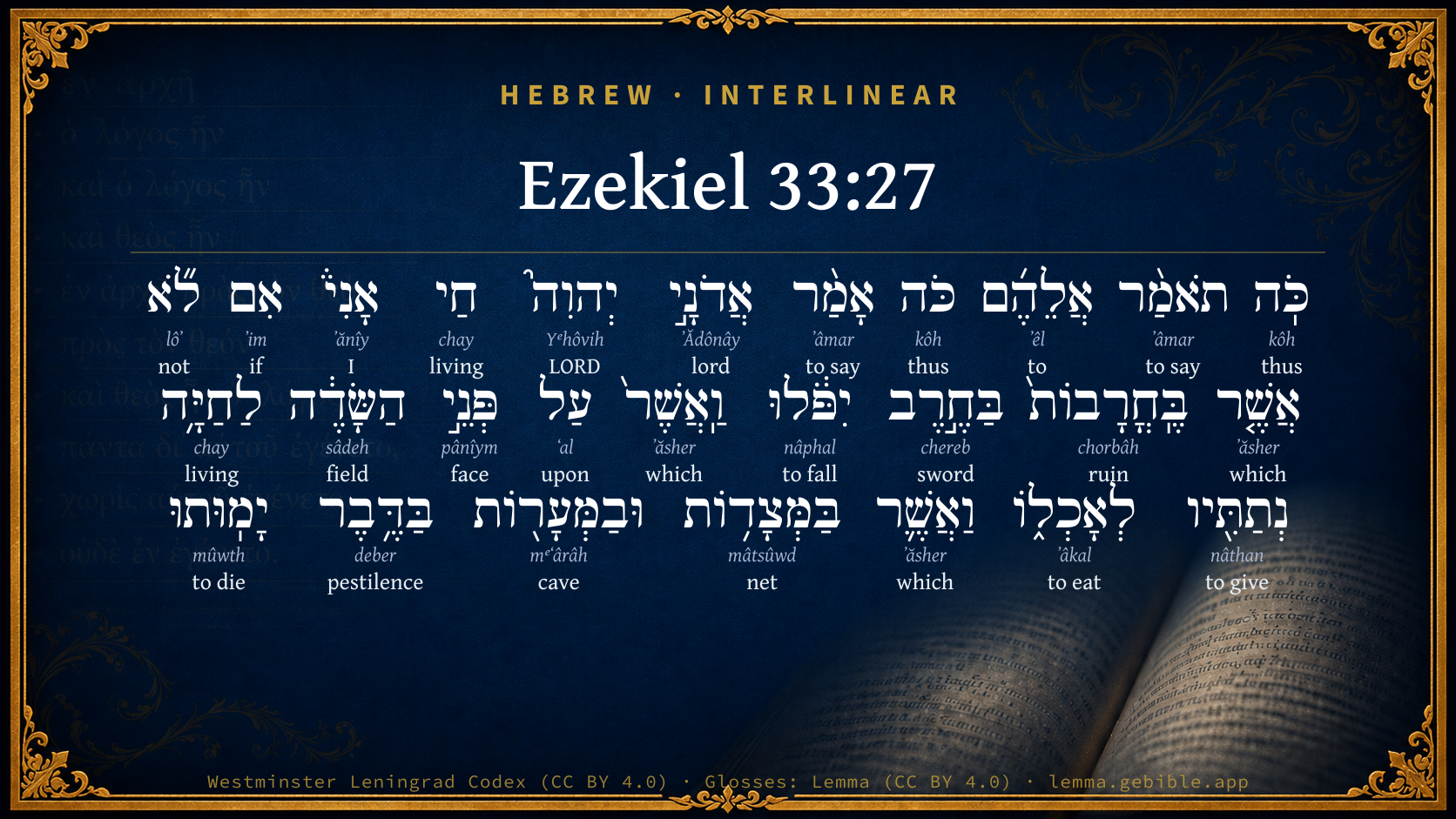
  1. כֹּֽה kôh H3541 “thus” Adverb
  2. תֹאמַ֨ר ʼâmar H559 “to say” Verb, Qal, Imperfect, 2nd Person, Masculine, Singular
  3. אֲלֵהֶ֜ם ʼêl H413 “to · them” Preposition + Suffix, Personal, 3rd Person, Masculine, Plural
  4. כֹּה kôh H3541 “thus” Adverb
  5. אָמַ֨ר ʼâmar H559 “to say” Verb, Qal, Perfect, 3rd Person, Masculine, Singular
  6. אֲדֹנָ֣י ʼĂdônây H136 “Lord · my” Noun, Common, Masculine, Plural, Construct + Suffix, Personal, 1st Person, Common, Singular
  7. יְהוִה֮ Yᵉhôvih H3069 “LORD” Noun, Proper
  8. חַי chay H2416 “living” Adjective, Adjective, Masculine, Singular, Absolute
  9. אָנִי֒ ʼănîy H589 “I” Pronoun, Personal, 1st Person, Common, Singular
  10. אִם ʼim H518 “if” Conjunction
  11. לֹ֞א lôʼ H3808 “not” Particle, Negative
  12. אֲשֶׁ֤ר ʼăsher H834 “which” Particle, Relative
  13. בֶּֽחֳרָבוֹת֙ chorbâh H2723 “in/at the · ruins” Preposition, Determined + Noun, Common, Feminine, Plural, Absolute
  14. בַּחֶ֣רֶב chereb H2719 “in/at the · sword” Preposition, Determined + Noun, Common, Feminine, Singular, Absolute
  15. יִפֹּ֔לוּ nâphal H5307 “to fall” Verb, Qal, Imperfect, 3rd Person, Masculine, Plural
  16. וַֽאֲשֶׁר֙ ʼăsher H834 “and · which” Conjunction + Particle, Relative
  17. עַל ʻal H5921 “upon” Preposition
  18. פְּנֵ֣י pânîym H6440 “face(s) of” Noun, Common, Both, Plural, Construct
  19. הַשָּׂדֶ֔ה sâdeh H7704 “the · field” Particle, Definite Article + Noun, Common, Masculine, Singular, Absolute
  20. לַחַיָּ֥ה chay H2416 “to/for the · living” Preposition, Determined + Noun, Common, Feminine, Singular, Absolute
  21. נְתַתִּ֖יו nâthan H5414 “to give · him” Verb, Qal, Perfect, 1st Person, Common, Singular + Suffix, Personal, 3rd Person, Masculine, Singular
  22. לְאָכְל֑וֹ ʼâkal H398 “to eat · him” Preposition + Verb, Qal, Infinitive Construct + Suffix, Personal, 3rd Person, Masculine, Singular
  23. וַאֲשֶׁ֛ר ʼăsher H834 “and · which” Conjunction + Particle, Relative
  24. וּבַמְּעָר֖וֹת mᵉʻârâh H4631 “and · in/at the · caves” Conjunction + Preposition, Determined + Noun, Common, Feminine, Plural, Absolute
  25. בַּדֶּ֥בֶר deber H1698 “in/at the · pestilence” Preposition, Determined + Noun, Common, Masculine, Singular, Absolute
  26. יָמֽוּתוּ mûwth H4191 “to die” Verb, Qal, Imperfect, 3rd Person, Masculine, Plural

About this verse

These counts appear in no published source. They are computed here, from the morphology-tagged text and Lemma’s own curated glosses. What Lemma adds →

27
words
22
distinct lemmas
Prophets
section

Notable vocabulary

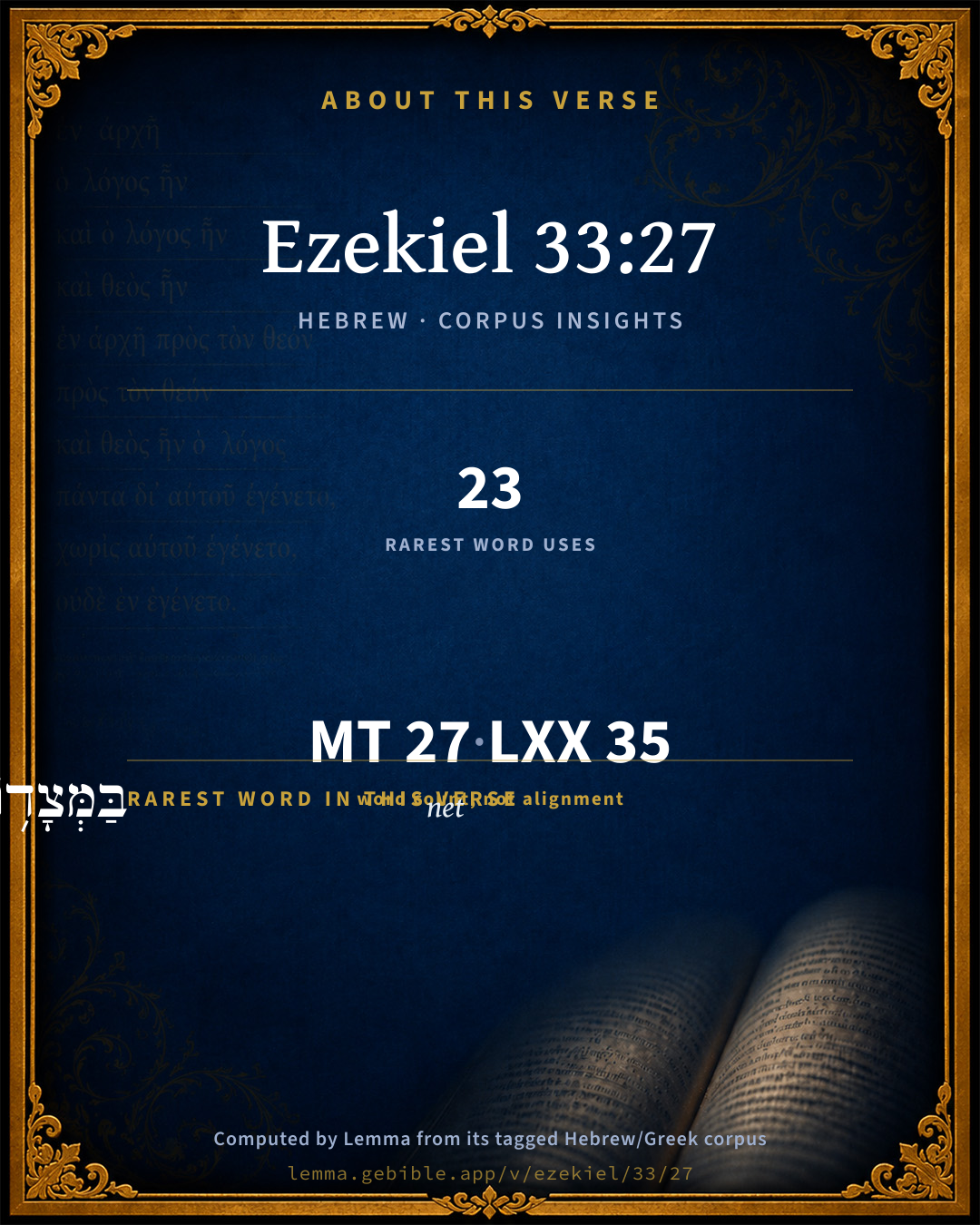
The rarest word here is בַּמְּצָד֥וֹת net H4686 — appearing just 23 times in the whole Hebrew Bible.

Shared distinctive vocabulary

בַּמְּצָד֥וֹת net H4686 occurs in 23 verses of the Hebrew Bible. Also found in:

Grammatical profile

  • 6 verbs
  • 10 nouns
  • 1 adjective
  • 1 pronoun
  • 2 prepositions
  • 1 conjunction
  • 2 adverbs
  • 4 particles

Verb forms

  • תֹאמַ֨ר Qal · Imperfect
  • אָמַ֨ר Qal · Perfect
  • יִפֹּ֔לוּ Qal · Imperfect
  • נְתַתִּ֖יו Qal · Perfect
  • לְאָכְל֑וֹ Qal · Infinitive Construct
  • יָמֽוּתוּ Qal · Imperfect

Repetition

Words recur within this verse — often emphatic in Hebrew:

  • כֹּֽה thus H3541 ×2
  • תֹאמַ֨ר to say H559 ×2
  • חַי living H2416 ×2
  • אֲשֶׁ֤ר which H834 ×3

Hebrew & Septuagint length

In English translation the verse runs 59 words from the Hebrew and 64 from the Septuagint (LXX English) — closely comparable.

A rough comparison of the two English renderings, which tokenize alike — not a word-level alignment.

Word counts can differ between the Hebrew and the Greek without any difference in meaning — e.g. the Hebrew direct-object marker אֵת has no separate Greek word, and Greek often adds the article ὁ.

In the original languages it is 27 Hebrew tokens and 35 Greek tokens — but the two are counted differently (Hebrew bundles its prefixes and suffixes into one token; the Greek is in lemma form), so that isn’t a like-for-like length.

Cross-references

14

Topical passages linked to Ezekiel 33:27 in the Treasury of Scripture Knowledge — connected by theme and wording, ordered by reader-vote popularity; previews shown in the World English Bible.

  • 1 Samuel 13:6 When the men of Israel saw that they were in a strait (for the people were distressed), then the people did hide themselves in caves, and in thickets, and in rocks, and in coverts, and in pits.
  • Jeremiah 42:22 Now therefore know certainly that you shall die by the sword, by the famine, and by the pestilence, in the place where you desire to go to sojourn there.
  • Ezekiel 39:4 You shall fall on the mountains of Israel, you, and all your hordes, and the peoples who are with you: I will give you to the ravenous birds of every sort, and to the animals of the field to be devoured.
  • Judges 6:2 The hand of Midian prevailed against Israel; and because of Midian the children of Israel made them the dens which are in the mountains, and the caves, and the strongholds.
  • 1 Samuel 22:1 David therefore departed there, and escaped to the cave of Adullam: and when his brothers and all his father's house heard it, they went down there to him.
  • 1 Samuel 23:14 David abode in the wilderness in the strongholds, and remained in the hill-country in the wilderness of Ziph. Saul sought him every day, but God didn't deliver him into his hand.
  • 1 Samuel 24:3 He came to the sheep pens by the way, where was a cave; and Saul went in to cover his feet. Now David and his men were abiding in the innermost parts of the cave.
  • Isaiah 2:19 Men shall go into the caves of the rocks, And into the holes of the earth, From before the terror of Yahweh, And from the glory of his majesty, When he arises to shake the earth mightily.
  • Jeremiah 15:2–4 It shall happen, when they tell you, Where shall we go forth? then you shall tell them, Thus says Yahweh: Such as are for death, to death; and such as are for the sword, to the sword; and such as are for the famine, to the famine; and such as are for captivity, to captivity.
  • Jeremiah 41:9 Now the pit in which Ishmael cast all the dead bodies of the men whom he had killed, by the side of Gedaliah (the same was who which Asa the king had made for fear of Baasha king of Israel), Ishmael the son of Nethaniah filled it with those who were killed.
  • Jeremiah 44:12 I will take the remnant of Judah, that have set their faces to go into the land of Egypt to sojourn there, and they shall all be consumed; in the land of Egypt shall they fall; they shall be consumed by the sword and by the famine; they shall die, from the least even to the greatest, by the sword and by the famine; and they shall be an object of horror, [and] an astonishment, and a curse, and a reproach.
  • Ezekiel 5:12–17 A third part of you shall die with the pestilence, and with famine shall they be consumed in the midst of you; and a third part shall fall by the sword round about you; and a third part I will scatter to all the winds, and will draw out a sword after them.
  • Ezekiel 6:11–14 Thus says the Lord Yahweh: Smite with your hand, and stamp with your foot, and say, Alas! because of all the evil abominations of the house of Israel; for they shall fall by the sword, by the famine, and by the pestilence.
  • Ezekiel 33:24 Son of man, they who inhabit those waste places in the land of Israel speak, saying, Abraham was one, and he inherited the land: but we are many; the land is given us for inheritance.

Cross-references courtesy of OpenBible.info (CC BY 4.0).

Hebrew and Greek witnesses Masoretic Hebrew ↔ Greek Septuagint

The same verse in the two great witnesses to the Old Testament, shown verse-for-verse.

These are two independent witnesses, not word-aligned to each other, and the Septuagint is shown in lemma (dictionary) form.

Hebrew Ezekiel 33:27 Masoretic · Westminster Leningrad Codex

כֹּֽה תֹאמַ֨ר אֲלֵהֶ֜ם כֹּה אָמַ֨ר אֲדֹנָ֣י יְהוִה֮ חַי אָנִי֒ אִם לֹ֞א אֲשֶׁ֤ר בֶּֽחֳרָבוֹת֙ בַּחֶ֣רֶב יִפֹּ֔לוּ וַֽאֲשֶׁר֙ עַל פְּנֵ֣י הַשָּׂדֶ֔ה לַחַיָּ֥ה נְתַתִּ֖יו לְאָכְל֑וֹ וַאֲשֶׁ֛ר בַּמְּצָד֥וֹת וּבַמְּעָר֖וֹת בַּדֶּ֥בֶר יָמֽוּתוּ

Thus shall you tell them, Thus says the Lord Yahweh: As I live, surely those who are in the waste places shall fall by the sword; and him who is in the open field will I give to the animals to be devoured; and those who are in the strongholds and in the caves shall die of the pestilence.

World English Bible · Public Domain

Greek LXX Ezekiel 33:27 Septuagint · lemma form

ζάω ἐγώ εἰ μήν ὁ ἐν ὁ ἐρημόω μάχαιρα πίπτω καί ὁ ἐπί πρόσωπον ὁ πεδίον ὁ θηρίον ὁ ἀγρός δίδωμι εἰς κατάβρωμα καί ὁ ἐν ὁ τειχίζω καί ὁ ἐν ὁ σπήλαιον θάνατος ἀποκτείνω

Therefore say to them, Thus says the Lord God, As I live, surely they that are in the desolate places shall fall by swords and they that are in the open plain shall be given for food to the wild beasts of the field, and them that are in the fortified cities and them that are in the caves I will kill with pestilence.

LXX2012 (modern English Septuagint) · Public Domain

Hebrew: Westminster Leningrad Codex (CC BY 4.0). Greek: Septuagint (public domain); English from LXX2012 (modern English Septuagint) (Public Domain). How the Septuagint differs from the Hebrew →

Targum (Aramaic paraphrase)

1

The Targum is the ancient Jewish Aramaic paraphrase of the Hebrew Scriptures — an interpretive translation, not the Hebrew text itself. Onkelos (literal) and Pseudo-Jonathan (expansive) render the Torah, and Jonathan the Prophets. Coverage is partial: where no permissively-licensed English translation exists for a verse, only the Aramaic is shown. This is verse-level text, not a word-by-word alignment to the Hebrew.

  1. Targum Jonathan Prophets (Joshua–Malachi)
    כִּדְנַן תֵּימַר לְהוֹן כִּדְנַן אֲמַר יְיָ אֱלֹהִים קַיָם אֲנָא אִם לָא דִי בְּחָרְבָא בְּחַרְבָּא יִתְקַטְלוּן וְדִי עַל אַפֵּי בָּרָא לְחַיְתָא מְסַרְתֵּיהּ לְשֵׁיצָיוּתְהוֹן וְדִי בִּמְצָדְתָא וּבִמְעֲרָתָא בָּמוֹתָא יְמוּתוּן:

    (no public-domain English translation for this verse)

    Targum Jonathan — Aramaic: “Mikraot Gedolot” (public domain). English: “Sefaria Community Translation” (CC0 1.0 (public-domain dedication)); “London "Chaldee Paraphrase," 1871” (public domain). Text via Sefaria.

Commentary

Notes on Ezekiel 33:27 from classic Christian and Jewish commentators (each source and its license shown beneath its notes). The classic Christian expositions comment on the surrounding passage and are grouped to its opening verse, so a note may address several verses; the Jewish commentaries on the Tanakh (Rashi and others) are per-verse, so they appear only where the commentator wrote on this verse.

Lemma curates 59 commentaries, every one of them public domain or Creative Commons licensed, each selected and text-cleaned for this edition rather than reprinted as found. About our sources →

Trapp's Complete Commentary

John Trapp

Eze 33:27 Say thou thus unto them, Thus saith the Lord GOD; [As] I live, surely they that [are] in the wastes shall fall by the sword, and him that [is] in the open field will I give to the beasts to be devoured, and they that [be] in the forts and in the caves shall die of the pestilence.

Ver. 27. They that are in the wastes.] Eze 33:4.

Shall die of the pestilence.] Or else of the famine, which is worse. When, where, and how this was fulfilled upon them, we read not; in Egypt likely, whither they went after Gedaliah’s death; if not sooner at home, as Jeremiah also had before prophesied. {Jer 42:13-14}

John Trapp, A Commentary or Exposition upon All the Books of the Old and New Testament (1647–1656) — public domain. Text from a community e-Sword module.

Joseph Benson's Commentary

Eze 33:27. Surely they that are in the wastes — They who continue to dwell among the desolations of Jerusalem and Judea; shall fall by the sword — This they accordingly did, both through the civil dissensions among them, in the conspiracy formed against Gedaliah, and likewise by the Chaldeans revenging his death. And him that is in the open field will I give to the beasts — He shall be a prey to lions and other ravenous beasts, that will multiply in the ruined country. And they that be in the forts and caves — Out of the reach of men and beasts; shall die of the pestilence — My hand shall reach them, and send among them those destructive disorders which shall sweep them away. These three judgments here mentioned, the sword, destructive beasts, and the pestilence, together with famine, are often threatened as the last and finishing strokes of divine vengeance upon the Jewish nation: see Eze 5:12; Eze 5:17; Eze 6:12; Eze 14:21; Jer 15:3. By the forts and caves here spoken of, are meant the strong holds formed by nature in the rocks, or cut out in the sides of the mountains. Many of them were so large that men might secure themselves, their families, and their goods in them. So David is said, 1Sa 23:14, to abide in strong holds, and remain in a mountain in the wilderness of Ziph. Such was the cave of Adullam, where David had his residence for some time, and was there resorted to by his relations, (1Sa 22:1,) and at another time by his principal officers, 2Sa 23:15.

Joseph Benson's Commentary on the Old and New Testaments (1811–1818) — public domain. Text from a community e-Sword module.

Tyndale Open Study Notes

Tyndale Open Resources

33:27-29 The rebels in Jerusalem would continue to inherit the curses of the Mosaic covenant—the sword, wild animals, and disease (see Lev 26:22-25)—until the mountains of Israel were desolate and these sinners were utterly destroyed.

Tyndale Open Study Notes — © Tyndale Open Resources, licensed CC BY-SA 4.0. Text via the HelloAO Bible API.

Jamieson, Fausset & Brown

Robert Jamieson, A. R. Fausset & David Brown

shall fall by the sword--The very object of their confidence would be the instrument of their destruction. Thinking to "stand" by it, by it they shall "fall." Just retribution! Some fell by the sword of Ishmael; others by the Chaldeans in revenge for the murder of Gedaliah (Jer. 40:1-44:30).

caves-- (Jdg 6:2; Sa1 13:6). In the hilly parts of Judea there were caves almost inaccessible, as having only crooked and extremely narrow paths of ascent, with rock in front stretching down into the valleys beneath perpendicularly [JOSEPHUS, Wars of the Jews, 1.16.4].

Jamieson, Fausset & Brown — Commentary Critical and Explanatory on the Whole Bible (1871) — public domain (CC PDM 1.0). Text via the HelloAO Bible API.

Adam Clarke's Commentary

Verse 27. They that are in the wastes] He seems to speak of those Jews who had fled to rocks, caves, and fortresses, in the mountains; whose death he predicts, partly by the sword, partly by wild beasts, and partly by famine.

Adam Clarke's Commentary on the Bible (1810–1826) — public domain. Text from a community e-Sword/MySword module.

Ellicott's Commentary for English Readers

(27) In the forts—is rather, in the natural fastnesses in which the land abounded.

A Bible Commentary for English Readers, edited by Charles John Ellicott (1878–1897) — public domain. Text from a community e-Sword module.

The Cambridge Bible for Schools and Colleges

gen. ed. J. J. S. Perowne

27. The “wastes” are the desolate cities; those that still hover about these ruins shall be slain by the enemy. The “open field” is the country, now depopulated and “the possession of wild beasts;” and the “forts,” coupled with caves, are the natural fastnesses of the land. Those taking refuge there shall die of the pestilence, due to crowding and famine. The remnant shall be exterminated from the land.

The Cambridge Bible for Schools and Colleges (gen. ed. J. J. S. Perowne; Cambridge University Press, 1878–1918) — public domain. Text from a community e-Sword module.

John Gill's Exposition

Then shall they know that I am the Lord,.... An omniscient Being, that could foresee and foretell what would come to pass; and omnipotent, able to do whatever he pleased, and true and faithful to his word; and a sovereign Lord, whose will cannot be resisted; this they should see, own, and acknowledge:

when I have laid the land most desolate, because of all their abominations which they have committed: for though he is a sovereign Lord, yet he does not execute his judgments in an arbitrary way, merely cause it is his will, but because of the abominable sins committed by men, which provoke the eyes of his glory.

John Gill's Exposition of the Whole Bible (1746–1763) — public domain (CC PDM 1.0). Text via the HelloAO Bible API.

Matthew Poole's English Annotations

The wastes; the ruinous heaps of cities or towns, in which some sorry habitations might possibly be found by them.

Shall fall; the Chaldean soldier ransacking all places, and either expecting or by chance finding them there, shall kill in revenge of Gedaliah’s death and Ishmael with others shall destroy some of them.

That is in the open field; that wanders in the fields, shall be a prey to lions, or other ravenous beasts, that will multiply in that ruined country.

In the forts; out of the reach of men and beasts my hand shall reach, I will send the pestilence, that shall sweep them away.

Matthew Poole's English Annotations on the Holy Bible (1683–1685) — public domain. Text from a community e-Sword/MySword module.

The Pulpit Commentary

They that are in the wastes. The words paint, with a terrible vividness, what was passing in Ezekiel"s fatherland. Did the fugitives of Judah seek the open country? they were exposed to the sword of the Chaldeans or of marauding outlaws. Did they seek safety in fortresses or caves? they were exposed, crowded together as they were under the worst possible conditions, to the ravages of pestilence.

The Pulpit Commentary (1880–1919), ed. H.D.M. Spence-Jones & Joseph S. Exell — public domain. Text from a community e-Sword module.

unfoldingWord translationNotes

Door43 World Missions Community

General Information:

Yahweh continues speaking to Ezekiel about the people who were living in the ruins of Israel.

As I live

"As surely as I am alive." Yahweh uses this expression to show that what he says next is certainly true. This is a way of making a solemn promise. See how you translated this in Ezekiel 5:11. AT: "I solemnly swear" (See: Idiom)

the ones in the ruins will fall by the sword

The phrase "fall by the sword" is an idiom. AT: "enemies will kill the ones living in the ruins" (See: Idiom)

those in fortresses and in caves will die of plagues

"plagues will kill the people who live in fortresses and caves"

fortresses

A fortress is a building that people build to protect themselves from enemies who attack them.

caves

Caves are natural holes in the side of a mountain or down in the ground. They are usually made of rock.

the pride of its might will end

The word "it" refers to the land, which refers to the people of the land. AT: "the people of the land will not be proud anymore that they are strong" (See: Metonymy)

the mountains of Israel will be deserted

This can be stated in active form. AT: "no one will live in the mountains of Israel" (See: Active or Passive)

there will be no one to pass through them

"there will be no one left to travel through the land or over the mountains"

know that I am Yahweh

When Yahweh says that people will know that he is Yahweh, he is implying that they will know that he is the one true God who has supreme authority and power. See how you translated this in Ezekiel 6:7. AT: "understand that I am Yahweh, the one true God" or "realize that I, Yahweh, have supreme power and authority" (See: Assumed Knowledge and Implicit Information)

all the abominations that they have done

The abstract noun "abominations" can be stated as "things I hate." AT: "all the things they have done that I hate" (See: Abstract Nouns)

they have done

"the people have done"

translationWords

ruin

life

creature

plague

desolate

waste

proud

might

Israel

abomination

unfoldingWord translationNotes — © Distant Shores Media and the Door43 World Missions Community, licensed CC BY-SA 4.0. Source: git.door43.org/Door43/en_tn.

Rashi

Rabbi Shlomo Yitzchaki (Rashi)

those who are in the ruins in the fortified cities that will ultimately become ruins.

and those who are in the strongholds in a hideout, to hide from the sword - I shall send the pestilence upon them.

Rashi on the Tanakh — English translations: “The Judaica Press complete Tanach with Rashi, translated by A. J. Rosenberg” (CC BY 4.0); “Pentateuch with Rashi's commentary by M. Rosenbaum and A.M. Silbermann, 1929-1934” (public domain); “The Metsudah Tanach series, Lakewood, N.J” (CC BY 4.0); and “The Book of Joshua, Metsudah Publications, 1997” (CC BY 4.0). Text via Sefaria.

Lesson kit

Teaching starters — assembled from the data on this page, not authored interpretation. Every prompt links to the verse data it draws on. Edit before teaching.

Ezekiel, in the Prophets, opens this verse with 27 words (22 distinct Hebrew lemmas). Its most distinctive word is mâtsûwd (“net”). A historical commentator’s framing appears above. Read the whole chapter for the surrounding context.

Discussion questions

  1. How does “net” (mâtsûwd) shape what this verse is saying?
  2. 1 Samuel 22:4 shares the word «net» with this verse. How do the two illuminate each other?
  3. “thus” occurs 2× in this one verse. What is the effect of the repetition?
  4. These translations render this verse differently. What is at stake in choosing one wording over another?
  5. The verb «תֹאמַ֨ר» is Qal Imperfect. How does its form color the action?
  6. Reading how Trapp's Complete Commentary and Joseph Benson's Commentary read this verse, where do the two commentators agree and where do they part?

Things to notice

Reading settings

Reading text

Shown beneath each verse's original-language words.

Old Testament
Old Testament edition

Read the OT as the Masoretic Hebrew (MT) or the Greek Septuagint (LXX).

English shown for the Greek Septuagint (in the Hebrew ↔ Greek comparison).

Comparing translations? Open the Compare panel on any verse page to stack up to four side by side.