Nehemiah 1:10

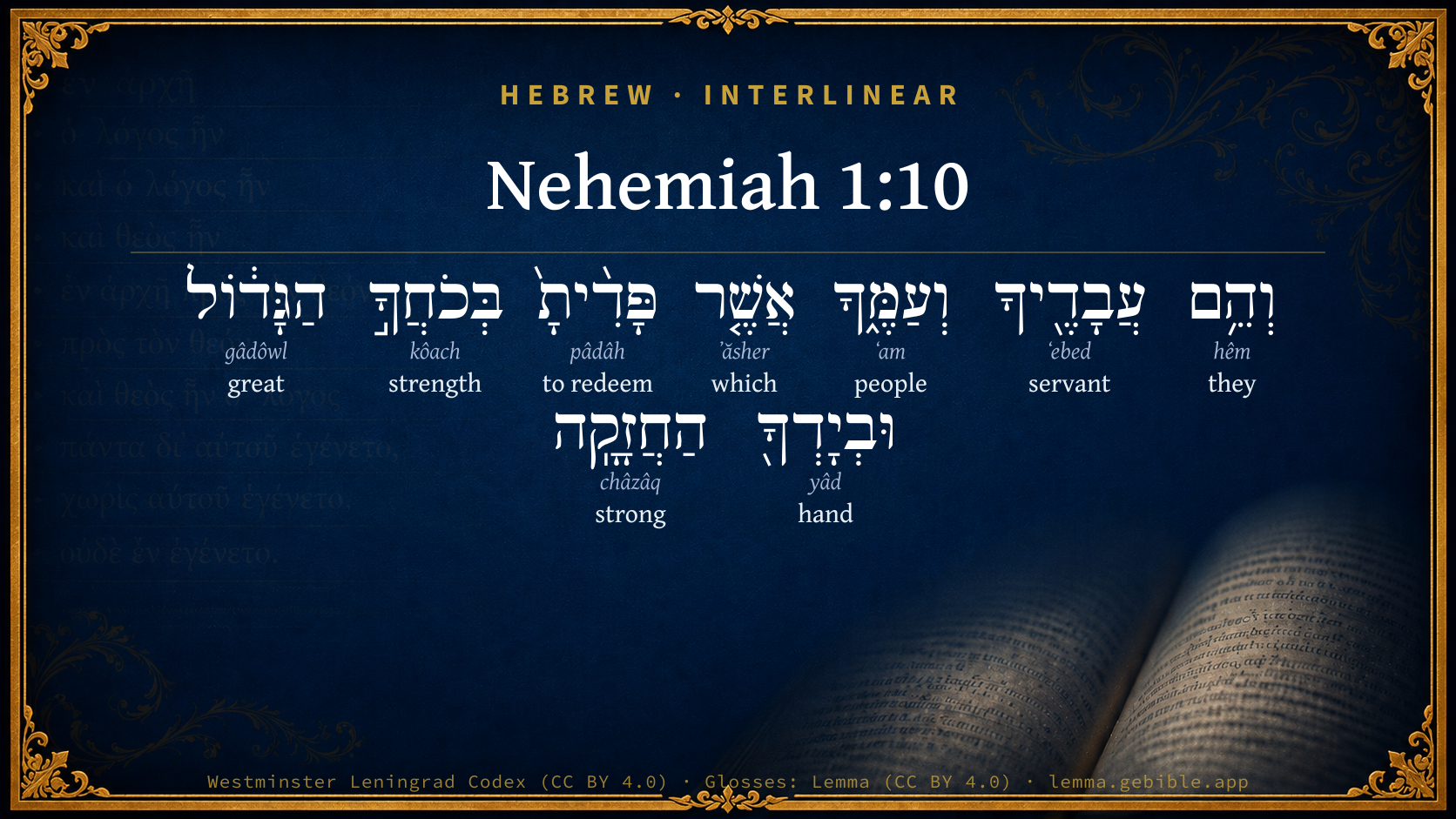
Hebrew (Westminster Leningrad Codex) Nehemiah 1:10 appears in the Hebrew Old Testament. The text above is from the Westminster Leningrad Codex. Each word links to its Strong’s number, a concise gloss, and parsing drawn from the Open Scriptures Hebrew Bible morphology. Click any word for its full Brown-Driver-Briggs (BDB) entry.
Download image
Cite this verse

Nehemiah 1:10 (World English Bible). Public Domain. Lemma interlinear Bible study tool, https://lemma.gebible.app/v/nehemiah/1/10.

Show BibTeX & RIS
BibTeX
RIS
English Translation
Now these are your servants and your people, whom you have redeemed by your great power, and by your strong hand.
World English Bible · Public Domain
Download a study sheet

One document with this verse’s original text, its word-by-word gloss line, the meaning frame, cross-references with their text, attributed commentary, and full source and license credits — printable, and it pastes into notes with its structure intact.

This verse Autodidact and up

Study sheet (.html) Plain text (.txt)

A passage Seminary Student

Up to 50 verses in one chapter. A passage sheet keeps up to 6 commentary sources and 12 cross-references per verse, in the order this page ranks them, and says so on the sheet whenever that leaves anything out. Ask for a single verse and you get the Autodidact verse sheet above.

Everything on this page stays free to read, with no account — the sheet is a download of what is already on screen, not access to it.

Want to remove ads? Support Godless Engineer
Compare translations 3

The same verse in 3 English versions, stacked beneath the original-language interlinear above. Click any original word for its lexicon entry.

Each is an independent rendering of the whole verse — the interlinear is not word-aligned to these translations.

Highlighted words mark where these versions differ — a whole-verse word diff, not a word-by-word alignment.

  • World English Bible Public Domain
    Now these are your servants and your people, whom you have redeemed by your great power, and by your strong hand.
  • King James Version Public Domain
    Now these are thy servants and thy people, whom thou hast redeemed by thy great power, and by thy strong hand.
  • unfoldingWord Literal Text CC BY-SA 4.0
    And they are your servants and your people, whom you redeemed by your great power and by your strong hand.

unfoldingWord Literal Text — © unfoldingWord, licensed CC BY-SA 4.0. Word-aligned USFM3 via Door43 (git.door43.org/unfoldingWord/en_ult).

Versions to compare (up to 4)

3 of 4 selected

Show all 18 translations

Every available English version of this verse, each an independent rendering of the whole verse.

  • World English Bible Public Domain
    Now these are your servants and your people, whom you have redeemed by your great power, and by your strong hand.
  • Berean Standard Bible Public Domain
    They are Your servants and Your people. You redeemed them by Your great power and mighty hand.
  • Majority Standard Bible Public Domain
    They are Your servants and Your people. You redeemed them by Your great power and mighty hand.
  • King James Version Public Domain
    Now these are thy servants and thy people, whom thou hast redeemed by thy great power, and by thy strong hand.
  • American Standard Version (1901) Public Domain
    Now these are thy servants and thy people, whom thou hast redeemed by thy great power, and by thy strong hand.
  • Revised Version (1885) Public Domain
    Now these are thy servants and thy people, whom thou hast redeemed by thy great power, and by thy strong hand.
  • Geneva Bible (1599) Public Domain
    Now these are thy seruants and thy people, whome thou hast redeemed by thy great power, and by thy mightie hand.
  • Douay-Rheims (1899) Public Domain
    And these are thy servants, and thy people: whom thou hast redeemed by thy great strength, and by thy mighty hand.
  • Young's Literal Translation Public Domain
    And they `are' Thy servants, and Thy people, whom Thou hast ransomed by Thy great power, and by Thy strong hand.
  • Literal Standard Version CC BY-SA 4.0
    And they [are] Your servants, and Your people, whom You have ransomed by Your great power, and by Your strong hand.
  • Unlocked Literal Bible CC BY-SA 4.0
    Now they are your servants and your people, whom you have rescued by your great power and by your strong hand.
  • unfoldingWord Literal Text CC BY-SA 4.0
    And they are your servants and your people, whom you redeemed by your great power and by your strong hand.
  • Darby Bible Public Domain
    And they are thy servants and thy people, whom thou hast redeemed by thy great power and by thy strong hand.
  • World Messianic Bible Public Domain
    “Now these are your servants and your people, whom you have redeemed by your great power and by your strong hand.
  • Webster's Bible Public Domain
    Now these are thy servants and thy people, whom thou hast redeemed by thy great power, and by thy strong hand.
  • Free Bible Version CC BY-SA 4.0
    They are your servants and our people. You saved them by your great power and incredible ability.
  • Bible in Basic English Public Domain
    Now these are your servants and your people, whom you have made yours by your great power and by your strong hand.
  • JPS Tanakh (1917) Public Domain
    Now these are Thy servants and Thy people, whom Thou hast redeemed by Thy great power, and by Thy strong hand.

Literal Standard Version (2020), Covenant Press — licensed CC BY-SA 4.0. Text via the HelloAO Bible API (eBible.org). Unlocked Literal Bible (unfoldingWord) — licensed CC BY-SA 4.0. Text via the HelloAO Bible API (eBible.org). unfoldingWord Literal Text — © unfoldingWord, licensed CC BY-SA 4.0. Word-aligned USFM3 via Door43 (git.door43.org/unfoldingWord/en_ult). Free Bible Version, Dr. Jonathan Gallagher — licensed CC BY-SA 4.0. Text via the HelloAO Bible API (eBible.org).

Word by word

More ways to search: Search by grammar → Find every occurrence → Compare this word →

Practice this passage: Drill this verse → Learn its vocabulary →

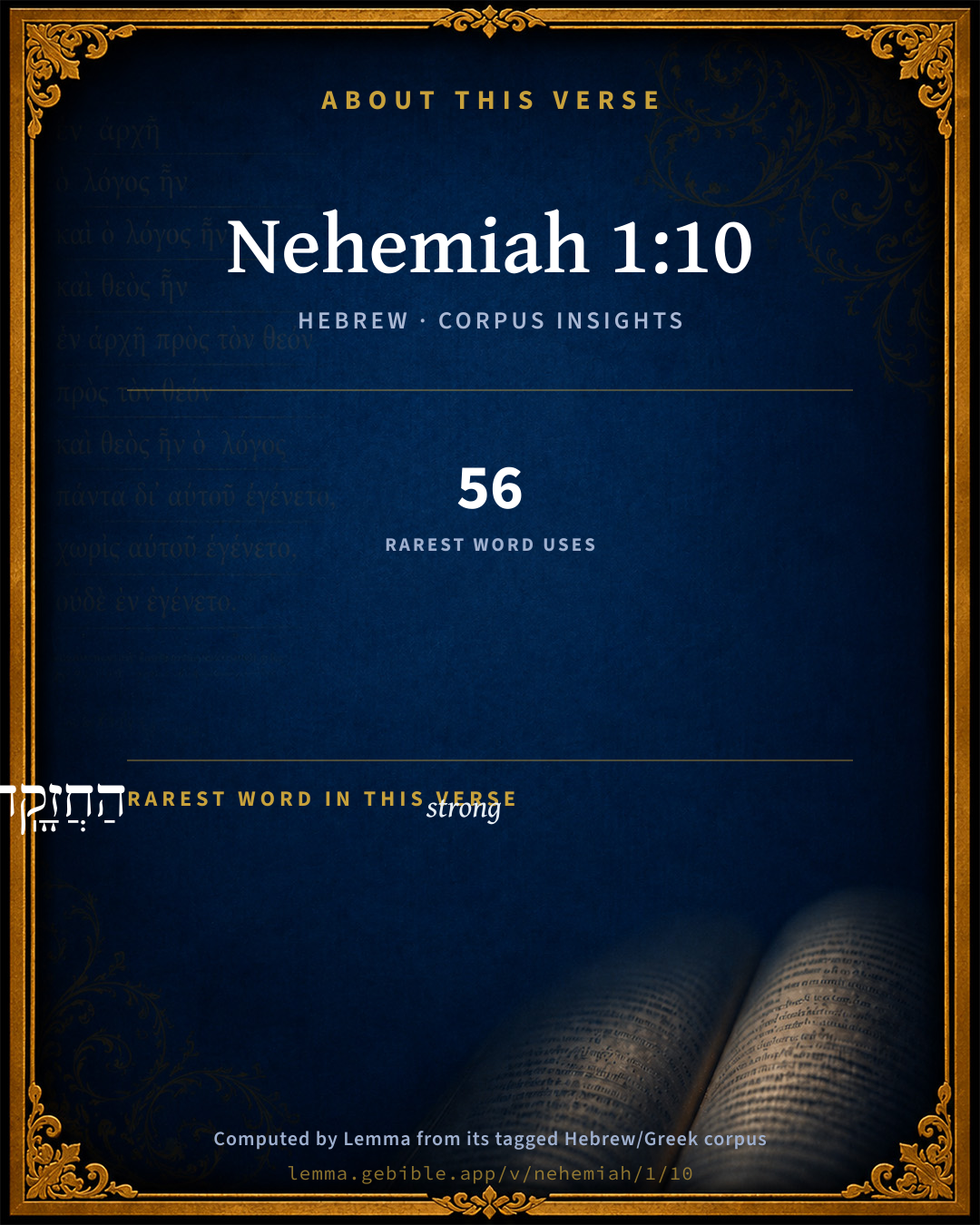
הַחֲזָקָֽה
châzâq
H2389
“the · strong”
Particle, Definite Article + Adjective, Adjective, Feminine, Singular, Absolute
Part of Speech
Particle + Adjective
Type
Adjective
Gender
Feminine
Number
Singular
State
Absolute
Full BDB Definition

Origin: from H2388

TWOT: 636a

strong, stout, mighty - strong - severe, sharp, hot - firm, hard - a strong one (substantive)
  1. וְהֵ֥ם hêm H1992 “and · they” Conjunction + Pronoun, Personal, 3rd Person, Masculine, Plural
  2. עֲבָדֶ֖יךָ ʻebed H5650 “servants · your” Noun, Common, Masculine, Plural, Construct + Suffix, Personal, 2nd Person, Masculine, Singular
  3. וְעַמֶּ֑ךָ ʻam H5971 “and · people · your” Conjunction + Noun, Common, Masculine, Singular, Construct + Suffix, Personal, 2nd Person, Masculine, Singular
  4. אֲשֶׁ֤ר ʼăsher H834 “which” Particle, Relative
  5. פָּדִ֨יתָ֙ pâdâh H6299 “to redeem” Verb, Qal, Perfect, 2nd Person, Masculine, Singular
  6. בְּכֹחֲךָ֣ kôach H3581 “in/at · strength · your” Preposition + Noun, Common, Masculine, Singular, Construct + Suffix, Personal, 2nd Person, Masculine, Singular
  7. הַגָּד֔וֹל gâdôwl H1419 “the · great” Particle, Definite Article + Adjective, Adjective, Masculine, Singular, Absolute
  8. וּבְיָדְךָ֖ yâd H3027 “and · in/at · hand · your” Conjunction + Preposition + Noun, Common, Both, Singular, Construct + Suffix, Personal, 2nd Person, Masculine, Singular

About this verse

These counts appear in no published source. They are computed here, from the morphology-tagged text and Lemma’s own curated glosses. What Lemma adds →

9
words
9
distinct lemmas
Historical
section

Shared distinctive vocabulary

הַחֲזָקָֽה strong H2389 occurs in 54 verses of the Hebrew Bible. Also found in:

Grammatical profile

  • 1 verb
  • 4 nouns
  • 2 adjectives
  • 1 pronoun
  • 1 particle

Verb forms

  • פָּדִ֨יתָ֙ Qal · Perfect

Cross-references

11

Topical passages linked to Nehemiah 1:10 in the Treasury of Scripture Knowledge — connected by theme and wording, ordered by reader-vote popularity; previews shown in the World English Bible.

  • Deuteronomy 9:29 Yet they are your people and your inheritance, which you brought out by your great power and by your outstretched arm.
  • Daniel 9:15–27 Now, Lord our God, who has brought your people forth out of the land of Egypt with a mighty hand, and have gotten you renown, as at this day; we have sinned, we have done wickedly.
  • Exodus 32:11 Moses begged Yahweh his God, and said, "Yahweh, why does your wrath burn hot against your people, that you have brought forth out of the land of Egypt with great power and with a mighty hand?
  • Exodus 6:1 Yahweh said to Moses, "Now you shall see what I will do to Pharaoh, for by a strong hand he shall let them go, and by a strong hand he shall drive them out of his land."
  • Exodus 13:9 It shall be for a sign to you on your hand, and for a memorial between your eyes, that the law of Yahweh may be in your mouth; for with a strong hand Yahweh has brought you out of Egypt.
  • Exodus 15:13 "You, in your loving kindness, have led the people that you have redeemed. You have guided them in your strength to your holy habitation.
  • Deuteronomy 15:15 You shall remember that you were a bondservant in the land of Egypt, and Yahweh your God redeemed you: therefore I command you this thing today.
  • Psalms 74:2 Remember your congregation, which you purchased of old, Which you have redeemed to be the tribe of your inheritance; Mount Zion, in which you have lived.
  • Psalms 136:12 With a strong hand, and with an outstretched arm; For his loving kindness endures forever:
  • Isaiah 63:16–19 For you are our Father, though Abraham doesn't know us, and Israel does not acknowledge us: you, Yahweh, are our Father; our Redeemer from everlasting is your name.
  • Isaiah 64:9 Don't be angry very sore, Yahweh, neither remember iniquity forever: see, look, we beg you, we are all your people.

Cross-references courtesy of OpenBible.info (CC BY 4.0).

Hebrew and Greek witnesses Masoretic Hebrew ↔ Greek Septuagint

The same verse in the two great witnesses to the Old Testament, shown verse-for-verse.

These are two independent witnesses, not word-aligned to each other, and the Septuagint is shown in lemma (dictionary) form.

Hebrew Nehemiah 1:10 Masoretic · Westminster Leningrad Codex

וְהֵ֥ם עֲבָדֶ֖יךָ וְעַמֶּ֑ךָ אֲשֶׁ֤ר פָּדִ֨יתָ֙ בְּכֹחֲךָ֣ הַגָּד֔וֹל וּבְיָדְךָ֖ הַחֲזָקָֽה

Now these are your servants and your people, whom you have redeemed by your great power, and by your strong hand.

World English Bible · Public Domain

Greek LXX Structure differs

The Septuagint has no separate book of Nehemiah. Its Greek text is the second half of Esdras B (2 Esdras), chapters 11–23; Ezra is the first half (1–10).

A verse-for-verse comparison isn’t shown here because the chapters and verses don’t line up. Switch to the LXX edition with the MT / LXX toggle above to read the Greek directly.

On this verse, The Cambridge Bible for Schools and Colleges discusses the Septuagint’s reading. Read the note in Commentary ↓

Hebrew: Westminster Leningrad Codex (CC BY 4.0). Greek: Septuagint (public domain); English from a public-domain English Septuagint. How the Septuagint differs from the Hebrew →

Commentary

Notes on Nehemiah 1:10 from classic Christian and Jewish commentators (each source and its license shown beneath its notes). The classic Christian expositions comment on the surrounding passage and are grouped to its opening verse, so a note may address several verses; the Jewish commentaries on the Tanakh (Rashi and others) are per-verse, so they appear only where the commentator wrote on this verse.

Lemma curates 59 commentaries, every one of them public domain or Creative Commons licensed, each selected and text-cleaned for this edition rather than reprinted as found. About our sources →

Trapp's Complete Commentary

John Trapp

Neh 1:10 Now these [are] thy servants and thy people, whom thou hast redeemed by thy great power, and by thy strong hand.

Ver. 10. Now these are thy servants and thy people] And therefore thou art concerned, in point of honour, to see to them, and to work for them, as every master will do for his servants, and king for his subjects. Otherwise, the neighbouring nations our enemies may possibly say as Aigoland, king of Saragossa, in Aragon, did; of whom it is reported, that he long time made Charlemagne believe that he would be baptized. And when he came for that purpose to the French court, and saw many diseased and poor people expecting alms from the emperor’s table, he asking what they were? was answered, that they were the servants and people of God. On these words he speedily returned, desperately protesting that he would not serve that God which could keep his servants no better.

Whom thou hast redeemed by thy great power] And wilt thou part with thy purchase, or obscure the glory of thy conquest over the gods and people of Egypt, by leaving this thy people destitute?

John Trapp, A Commentary or Exposition upon All the Books of the Old and New Testament (1647–1656) — public domain. Text from a community e-Sword module.

Joseph Benson's Commentary

Neh 1:10. Whom thou hast redeemed by thy great power, &c. — In days of old, and thy power is still the same; wilt thou not therefore still redeem them, and perfect their redemption? Let not them be overpowered by the enemy that have a God of infinite power on their side.

Joseph Benson's Commentary on the Old and New Testaments (1811–1818) — public domain. Text from a community e-Sword module.

Tyndale Open Study Notes

Tyndale Open Resources

1:10 Nehemiah alludes to God’s long-standing covenant relationship with the Israelites: He had rescued them in the Exodus (Deut 9:29) and made them his servants.

Tyndale Open Study Notes — © Tyndale Open Resources, licensed CC BY-SA 4.0. Text via the HelloAO Bible API.

The Cambridge Bible for Schools and Colleges

gen. ed. J. J. S. Perowne

10. This verse states the ground on which the privilege of the promise is claimed.

Now these are thy servants, &c.] The connexion of thought, which is not very obvious at first sight, seems to be as follows. Having stated the Divine promise, Nehemiah returns in thought to ‘the children of thy servants’ of Neh_1:6. They, by their confession of sin, had fulfilled the condition, they had ‘returned’ unto their God. They could claim the fulfilment of His promise. They were not aliens. They were His own people whom He Himself had redeemed.

whom thou hast redeemed] Of the two Hebrew words, rendered by the English ‘redeem,’ i.e. ‘ga’al’ and ‘padah,’ the word here used is ‘padah.’ It is noteworthy that in the similar expression, Exo_6:6, ‘redeem you with a stretched out arm,’ the word ‘ga’al’ is used, while here, as always in Deuteronomy (Deu_7:8, Deu_9:26, Deu_13:5, Deu_15:15, Deu_21:8, Deu_24:18), the word ‘redeem’ is ‘padah.’ LXX. ἐλυτρώσω; Vulg. redemisti. The redemption, here spoken of, looks back, beyond the recent restoration from Babylon, to the original deliverance from Egypt, which sealed for ever the relation between Jehovah and His people.

by thy great power, and by thy strong hand] Nehemiah combines two familiar phrases which do not seem to be elsewhere combined except in Exo_32:11 ‘thy people which thou hast brought forth out of the land of Egypt with great power and with a mighty hand.’ Along with ‘great power’ we frequently find ‘a stretched out arm,’ as in Deu_9:29; 2Ki_17:36; Jer_27:5; Jer_32:17 : and again ‘a stretched out arm’ following upon ‘a strong (or mighty) hand,’ as in Deu_4:34; Deu_5:15; Deu_7:19; Deu_11:2; 1Ki_8:42; 2Ch_6:32; Psa_136:12; Jer_32:21; Eze_20:33-34.

It is possible that Nehemiah here has the Jehovist Exo_32:11 in his thoughts. But as the reading there is doubtful, both the Samaritan and the LXX. texts having ‘a stretched out arm’ instead of ‘a mighty hand,’ we cannot be confident that we have here a quotation.

The words ‘yad hakhezakah’ are rendered by the R.V. ‘strong hand’ here and Exo_3:19; Exo_6:1; Exo_13:9; Num_20:20; Psa_136:12; Jer_32:21 (Eze_30:22), and ‘mighty hand’ in Exo_32:11; Deu_4:34; Deu_5:15; Deu_6:21; Deu_7:8; Deu_7:19; Deu_9:26; Deu_11:2; Deu_26:8; Deu_34:12; Jos_4:24; 1Ki_8:42; 2Ch_6:32; Eze_20:33-34.

The Cambridge Bible for Schools and Colleges (gen. ed. J. J. S. Perowne; Cambridge University Press, 1878–1918) — public domain. Text from a community e-Sword module.

John Gill's Exposition

Now these are thy servants, and thy people,.... Meaning those that were in Jerusalem and Judah, gathered out of several countries, and returned to Jerusalem:

whom thou hast redeemed by thy great power, and by thy strong hand; touching and moving the heart of Cyrus to proclaim liberty to them.

John Gill's Exposition of the Whole Bible (1746–1763) — public domain (CC PDM 1.0). Text via the HelloAO Bible API.

Haydock's Catholic Bible Commentary

Redeemed, or liberated from great evils. (Menochius)

George Leo Haydock (1774–1849), Haydock's Catholic Family Bible and Commentary, 1859 edition — public domain. Excludes Psalms (Douay-Rheims chapter numbering differs from Protestant) and Deuterocanonical books (Catholic canon only).

The Pulpit Commentary

Thy people whom thou hast redeemed by thy great power. It would be better to translate, "Whom thou didst redeem." The reference is especially to the deliverance from Egypt, which is so constantly spoken of as effected "with a mighty hand and with an outstretched arm". (Deu_9:29 Deu_26:8, etc.)

A powerful plea with God.

"Now these are thy servants," etc.

I When such an appeal is SUITABLE. When praying for a Church

(1) declining,

(2) divided,

(3) distressed, or

(4) persecuted.

II The NATURE of the appeal. It is an appeal to God"s

(1) relation to his people a relation he has himself established;

(2) love for them;

(3) regard for his own honour as involved in their welfare; (Deu_9:26-29 Jer_14:21)

(4) pity in view of their condition;

(5) past deeds on their behalf showing kindness; a pledge of more; manifesting purposes not yet completed. The appeal is suitable for individual Christians, praying for themselves. (see Psa_119:94)

The Pulpit Commentary (1880–1919), ed. H.D.M. Spence-Jones & Joseph S. Exell — public domain. Text from a community e-Sword module.

Scofield Reference Notes

C. I. Scofield

redeemed

(See Scofield "Exo 14:30").

The Scofield Reference Bible (1917 edition), notes by C. I. Scofield — public domain. Text from a community e-Sword module.

unfoldingWord translationNotes

Door43 World Missions Community

General Information:

Nehemiah continues his prayer.

Now

This word is used here to mark a break in Nehemiah's prayer. Here he begins to make his request based on Yahweh's promise.

they are your servants

The word "they" refers to the Israelite people.

by your great power and by your strong hand

Here "hand" represents strength or power. Together, these two phrases form a doublet that emphasizes the intensity of Yahweh's power. AT: "by your great power and by your mighty strength" or "by your very powerful strength" (See: Metonymy and Doublet)

the prayer of your servant

Here "servant" refers to Nehemiah. This is how a person would address his superior in order to show humility and respect. See how you translated this in Nehemiah 1:6.

the prayer of your servants

Here "servants" refers to the rest of the Israelite people who would have been praying for Yahweh to act on behalf of his people and on behalf of Jerusalem.

who delight to honor your name

Here "name" represents Yahweh himself. AT: "who delight to honor you" (See: Metonymy)

grant him mercy in the sight of this man

Here "him" refers to Nehemiah, who refers to himself in the third person to express his humility before God, and "this man" refers to Artaxerxes, the king of Persia.

in the sight of this man

Nehemiah speaks of the king's attitude or disposition as if it were how the king viewed something. AT: "grant that the king will have mercy on me" (See: Metaphor)

I served as cupbearer to the king

This is background information about Nehemiah's role in the king's court. Your language may have a special way to mark background information. (See: Background Information)

translationWords

servant

people of God

power

hand

Yahweh

beg

pray

honor

name

mercy

servant

cupbearer

king

unfoldingWord translationNotes — © Distant Shores Media and the Door43 World Missions Community, licensed CC BY-SA 4.0. Source: git.door43.org/Door43/en_tn.

Lesson kit

Teaching starters — assembled from the data on this page, not authored interpretation. Every prompt links to the verse data it draws on. Edit before teaching.

Nehemiah, in the Historical, opens this verse with 9 words (9 distinct Hebrew lemmas). Its most distinctive word is châzâq (“strong”). A historical commentator’s framing appears above. Read the whole chapter for the surrounding context.

Discussion questions

  1. How does “strong” (châzâq) shape what this verse is saying?
  2. How does Exodus 3:19, which shares the word «strong», read alongside this verse?
  3. These translations render this verse differently. What is at stake in choosing one wording over another?
  4. «פָּדִ֨יתָ֙» is a Qal Perfect verb. How does that grammatical form shape the action described?
  5. Compare how Trapp's Complete Commentary and Joseph Benson's Commentary read this verse. Where do they agree or differ?

Things to notice

Reading settings

Reading text

Shown beneath each verse's original-language words.

Old Testament
Old Testament edition

Read the OT as the Masoretic Hebrew (MT) or the Greek Septuagint (LXX).

English shown for the Greek Septuagint (in the Hebrew ↔ Greek comparison).

Comparing translations? Open the Compare panel on any verse page to stack up to four side by side.