
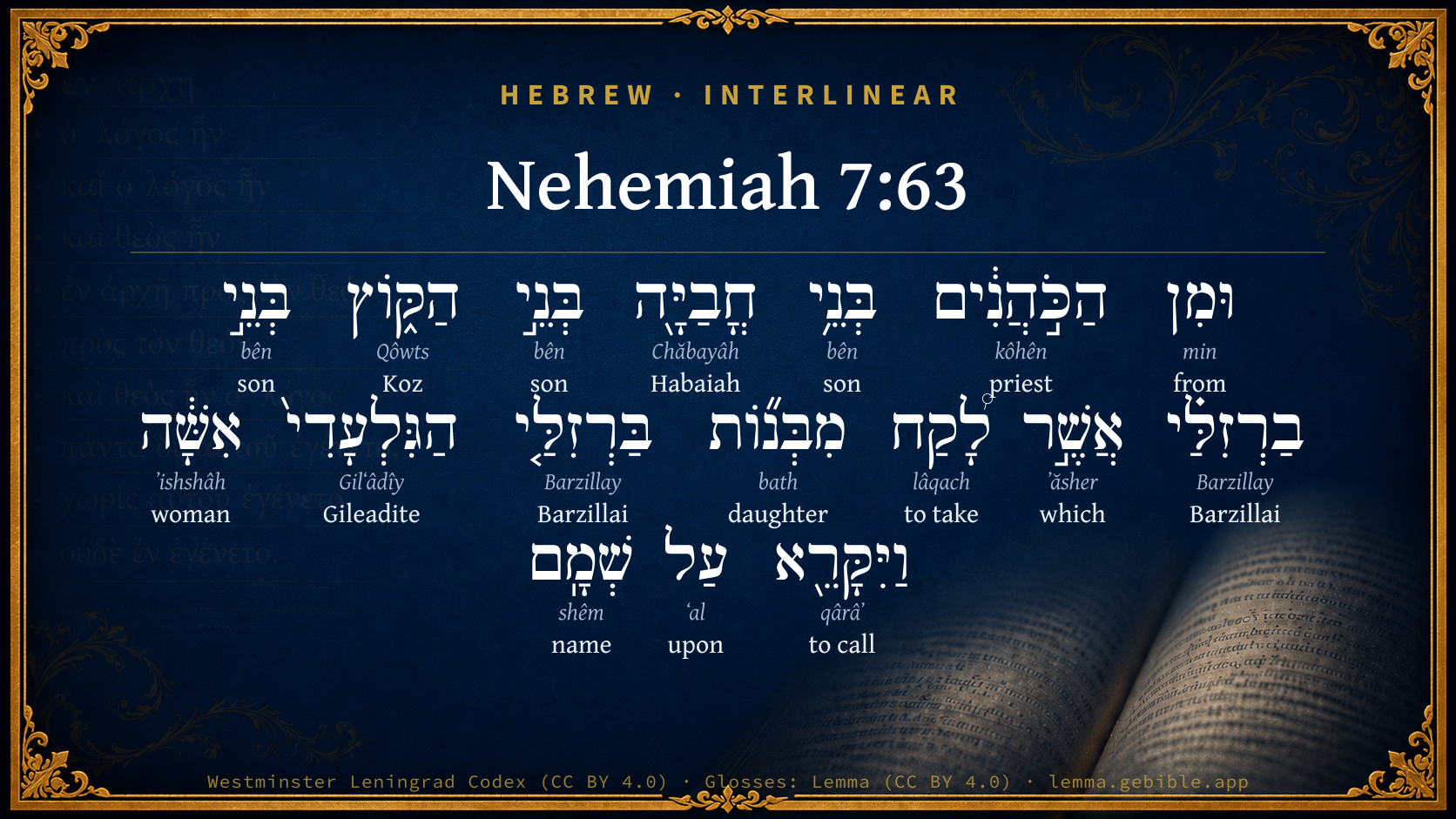
Nehemiah 7:63

Hebrew (Westminster Leningrad Codex) Nehemiah 7:63 appears in the Hebrew Old Testament. The text above is from the Westminster Leningrad Codex. Each word links to its Strong’s number, a concise gloss, and parsing drawn from the Open Scriptures Hebrew Bible morphology. Click any word for its full Brown-Driver-Briggs (BDB) entry.
Download image
Cite this verse

Nehemiah 7:63 (World English Bible). Public Domain. Lemma interlinear Bible study tool, https://lemma.gebible.app/v/nehemiah/7/63.

Show BibTeX & RIS
BibTeX
RIS
English Translation
Of the priests: the children of Hobaiah, the children of Hakkoz, the children of Barzillai, who took a wife of the daughters of Barzillai the Gileadite, and was called after their name.
World English Bible · Public Domain
Download a study sheet

One document with this verse’s original text, its word-by-word gloss line, the meaning frame, cross-references with their text, attributed commentary, and full source and license credits — printable, and it pastes into notes with its structure intact.

This verse Autodidact and up

Study sheet (.html) Plain text (.txt)

A passage Seminary Student

Up to 50 verses in one chapter. A passage sheet keeps up to 6 commentary sources and 12 cross-references per verse, in the order this page ranks them, and says so on the sheet whenever that leaves anything out. Ask for a single verse and you get the Autodidact verse sheet above.

Everything on this page stays free to read, with no account — the sheet is a download of what is already on screen, not access to it.

Want to remove ads? Support Godless Engineer
Compare translations 3

The same verse in 3 English versions, stacked beneath the original-language interlinear above. Click any original word for its lexicon entry.

Each is an independent rendering of the whole verse — the interlinear is not word-aligned to these translations.

Highlighted words mark where these versions differ — a whole-verse word diff, not a word-by-word alignment.

  • World English Bible Public Domain
    Of the priests: the children of Hobaiah, the children of Hakkoz, the children of Barzillai, who took a wife of the daughters of Barzillai the Gileadite, and was called after their name.
  • King James Version Public Domain
    And of the priests: the children of Habaiah, the children of Koz, the children of Barzillai, which took one of the daughters of Barzillai the Gileadite to wife, and was called after their name.
  • unfoldingWord Literal Text CC BY-SA 4.0
    And from the priests: the sons of Habaiah; the sons of Hakkoz; the sons of Barzillai, who took a wife from the daughters of Barzillai the Gileadite, and he was called by their name.

unfoldingWord Literal Text — © unfoldingWord, licensed CC BY-SA 4.0. Word-aligned USFM3 via Door43 (git.door43.org/unfoldingWord/en_ult).

Versions to compare (up to 4)

3 of 4 selected

Show all 18 translations

Every available English version of this verse, each an independent rendering of the whole verse.

  • World English Bible Public Domain
    Of the priests: the children of Hobaiah, the children of Hakkoz, the children of Barzillai, who took a wife of the daughters of Barzillai the Gileadite, and was called after their name.
  • Berean Standard Bible Public Domain
    And from among the priests: the descendants of Hobaiah, the descendants of Hakkoz, and the descendants of Barzillai (who had married a daughter of Barzillai the Gileadite and was called by their name).
  • Majority Standard Bible Public Domain
    And from among the priests: the descendants of Hobaiah, the descendants of Hakkoz, and the descendants of Barzillai (who had married a daughter of Barzillai the Gileadite and was called by their name).
  • King James Version Public Domain
    And of the priests: the children of Habaiah, the children of Koz, the children of Barzillai, which took one of the daughters of Barzillai the Gileadite to wife, and was called after their name.
  • American Standard Version (1901) Public Domain
    And of the priests: the children of Hobaiah, the children of Hakkoz, the children of Barzillai, who took a wife of the daughters of Barzillai the Gileadite, and was called after their name.
  • Revised Version (1885) Public Domain
    And of the priests: the children of Hobaiah, the children of Hakkoz, the children of Barzillai, which took a wife of the daughters of Barzillai the Gileadite, and was called after their name.
  • Geneva Bible (1599) Public Domain
    And of the Priestes: the sonnes of Habaiah, the sonnes of Hakkoz, the sonnes of Barzillai, which tooke one of the daughters of Barzillai the Gileadite to wife, and was named after their name.
  • Douay-Rheims (1899) Public Domain
    And of the priests, the children of Habia, the children of Accos, the children of Berzellai, who took a wife of the daughters of Berzellai the Galaadite, and he was called by their name.
  • Young's Literal Translation Public Domain
    And of the priests: sons of Habaiah sons of Koz, sons of Barzillai, who hath taken from the daughters of Barzillai the Gileadite a wife, and is called by their name.
  • Literal Standard Version CC BY-SA 4.0
    And of the priests: sons of Habaiah, sons of Koz, sons of Barzillai (who has taken a wife from the daughters of Barzillai the Gileadite, and is called by their name).
  • Unlocked Literal Bible CC BY-SA 4.0
    Those who were from the priests: the descendants of Habaiah, Hakkoz, and Barzillai (who took his wife from the daughters of Barzillai of Gilead and was called by their name).
  • unfoldingWord Literal Text CC BY-SA 4.0
    And from the priests: the sons of Habaiah; the sons of Hakkoz; the sons of Barzillai, who took a wife from the daughters of Barzillai the Gileadite, and he was called by their name.
  • Darby Bible Public Domain
    And of the priests: the children of Hobaiah, the children of Koz, the children of Barzillai, who took a wife of the daughters of Barzillai the Gileadite and was called after their name.
  • World Messianic Bible Public Domain
    Of the priests: the children of Hobaiah, the children of Hakkoz, the children of Barzillai, who took a wife of the daughters of Barzillai the Gileadite, and was called after their name.
  • Webster's Bible Public Domain
    And of the priests: the children of Habaiah, the children of Koz, the children of Barzillai, who took one of the daughters of Barzillai the Gileadite for a wife, and was called after their name.
  • Free Bible Version CC BY-SA 4.0
    In addition there were three priestly families, sons of Hobaiah, Hakkoz, and Barzillai. (Barzillai had married a woman descended from Barzillai of Gilead, and he was called by that name.)
  • Bible in Basic English Public Domain
    And of the priests: the children of Hobaiah, the children of Hakkoz, the children of Barzillai, who was married to one of the daughters of Barzillai the Gileadite, and took their name.
  • JPS Tanakh (1917) Public Domain
    And of the priests: the children of Habaiah, the children of Hakkoz, the children of Barzillai, who took a wife of the daughters of Barzillai the Gileadite, and was called after their name.

Literal Standard Version (2020), Covenant Press — licensed CC BY-SA 4.0. Text via the HelloAO Bible API (eBible.org). Unlocked Literal Bible (unfoldingWord) — licensed CC BY-SA 4.0. Text via the HelloAO Bible API (eBible.org). unfoldingWord Literal Text — © unfoldingWord, licensed CC BY-SA 4.0. Word-aligned USFM3 via Door43 (git.door43.org/unfoldingWord/en_ult). Free Bible Version, Dr. Jonathan Gallagher — licensed CC BY-SA 4.0. Text via the HelloAO Bible API (eBible.org).

Word by word

More ways to search: Search by grammar → Find every occurrence → Compare this word →

Practice this passage: Drill this verse → Learn its vocabulary →

חֳבַיָּ֖ה
Chăbayâh
H2252
“Habaiah”
Noun, Proper
Part of Speech
Noun
Type
Proper
Full BDB Definition

Origin: from H2247 and H3050

TWOT: None

Habaiah = "Jehovah has hidden" - head of a priestly family who returned from exile with Zerubbabel
  1. וּמִן min H4480 “and · from” Conjunction + Preposition
  2. הַכֹּ֣הֲנִ֔ים kôhên H3548 “the · priests” Particle, Definite Article + Noun, Common, Masculine, Plural, Absolute
  3. בְּנֵ֥י bên H1121 “sons of” Noun, Common, Masculine, Plural, Construct
  4. בְּנֵ֣י bên H1121 “sons of” Noun, Common, Masculine, Plural, Construct
  5. הַקּ֑וֹץ Qôwts H6976 “Koz” Noun, Proper
  6. בְּנֵ֣י bên H1121 “sons of” Noun, Common, Masculine, Plural, Construct
  7. בַרְזִלַּ֗י Barzillay H1271 “Barzillai” Noun, Proper
  8. אֲשֶׁ֣ר ʼăsher H834 “which” Particle, Relative
  9. לָ֠קַח lâqach H3947 “to take” Verb, Qal, Perfect, 3rd Person, Masculine, Singular
  10. מִבְּנ֞וֹת bath H1323 “from · daughters of” Preposition + Noun, Common, Feminine, Plural, Construct
  11. בַּרְזִלַּ֤י Barzillay H1271 “Barzillai” Noun, Proper
  12. הַגִּלְעָדִי֙ Gilʻâdîy H1569 “the · Gileadite” Particle, Definite Article + Noun, Gentilic, Masculine, Singular, Absolute
  13. אִשָּׁ֔ה ʼishshâh H802 “woman” Noun, Common, Feminine, Singular, Absolute
  14. וַיִּקָּרֵ֖א qârâʼ H7121 “and · to call” Conjunction + Verb, Niphal, Sequential Imperfect, 3rd Person, Masculine, Singular
  15. עַל ʻal H5921 “upon” Preposition
  16. שְׁמָֽם shêm H8034 “name · their” Noun, Common, Masculine, Singular, Construct + Suffix, Personal, 3rd Person, Masculine, Plural

About this verse

These counts appear in no published source. They are computed here, from the morphology-tagged text and Lemma’s own curated glosses. What Lemma adds →

17
words
14
distinct lemmas
Historical
section

Notable vocabulary

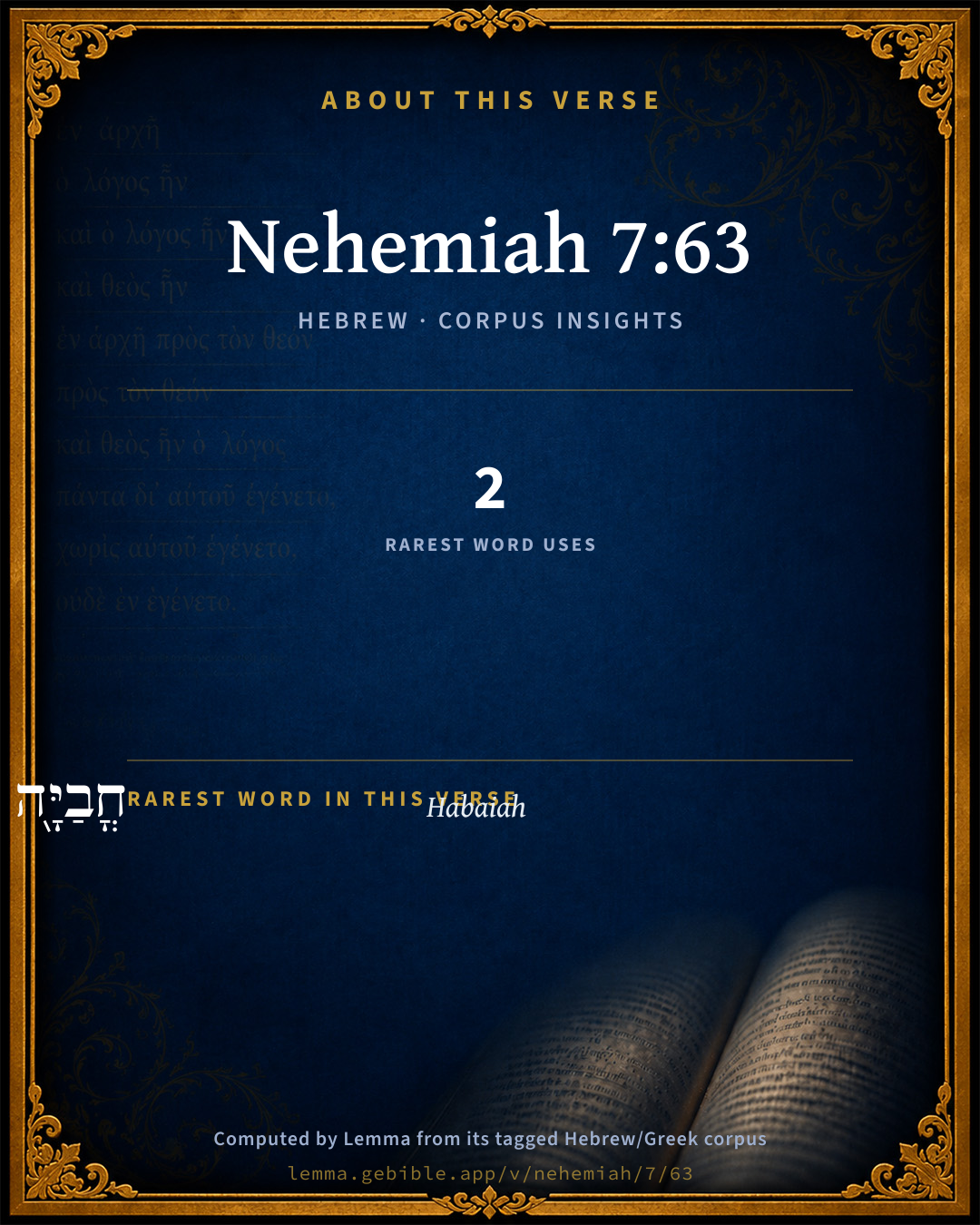
The rarest word here is חֳבַיָּ֖ה Habaiah H2252 — appearing just 2 times in the whole Hebrew Bible.

Shared distinctive vocabulary

חֳבַיָּ֖ה Habaiah H2252 occurs in 2 verses of the Hebrew Bible. Also found in:

Grammatical profile

  • 2 verbs
  • 12 nouns
  • 2 prepositions
  • 1 particle

Verb forms

  • לָ֠קַח Qal · Perfect
  • וַיִּקָּרֵ֖א Niphal · Sequential Imperfect

Repetition

Words recur within this verse — often emphatic in Hebrew:

  • בְּנֵ֥י son H1121 ×3
  • בַרְזִלַּ֗י Barzillai H1271 ×2

Cross-references

4

Topical passages linked to Nehemiah 7:63 in the Treasury of Scripture Knowledge — connected by theme and wording, ordered by reader-vote popularity; previews shown in the World English Bible.

  • 2 Samuel 17:27 It happened, when David was come to Mahanaim, that Shobi the son of Nahash of Rabbah of the children of Ammon, and Machir the son of Ammiel of Lodebar, and Barzillai the Gileadite of Rogelim,
  • 2 Samuel 19:31–33 Barzillai the Gileadite came down from Rogelim; and he went over the Jordan with the king, to conduct him over the Jordan.
  • 1 Kings 2:7 But show kindness to the sons of Barzillai the Gileadite, and let them be of those who eat at your table; for so they came to me when I fled from Absalom your brother.
  • Ezra 2:61–63 Of the children of the priests: the children of Habaiah, the children of Hakkoz, the children of Barzillai, who took a wife of the daughters of Barzillai the Gileadite, and was called after their name.

Cross-references courtesy of OpenBible.info (CC BY 4.0).

Hebrew and Greek witnesses Masoretic Hebrew ↔ Greek Septuagint

The same verse in the two great witnesses to the Old Testament, shown verse-for-verse.

These are two independent witnesses, not word-aligned to each other, and the Septuagint is shown in lemma (dictionary) form.

Hebrew Nehemiah 7:63 Masoretic · Westminster Leningrad Codex

וּמִן הַכֹּ֣הֲנִ֔ים בְּנֵ֥י חֳבַיָּ֖ה בְּנֵ֣י הַקּ֑וֹץ בְּנֵ֣י בַרְזִלַּ֗י אֲשֶׁ֣ר לָ֠קַח מִבְּנ֞וֹת בַּרְזִלַּ֤י הַגִּלְעָדִי֙ אִשָּׁ֔ה וַיִּקָּרֵ֖א עַל שְׁמָֽם

Of the priests: the children of Hobaiah, the children of Hakkoz, the children of Barzillai, who took a wife of the daughters of Barzillai the Gileadite, and was called after their name.

World English Bible · Public Domain

Greek LXX Structure differs

The Septuagint has no separate book of Nehemiah. Its Greek text is the second half of Esdras B (2 Esdras), chapters 11–23; Ezra is the first half (1–10).

A verse-for-verse comparison isn’t shown here because the chapters and verses don’t line up. Switch to the LXX edition with the MT / LXX toggle above to read the Greek directly.

Hebrew: Westminster Leningrad Codex (CC BY 4.0). Greek: Septuagint (public domain); English from a public-domain English Septuagint. How the Septuagint differs from the Hebrew →

Commentary

Notes on Nehemiah 7:63 from classic Christian and Jewish commentators (each source and its license shown beneath its notes). The classic Christian expositions comment on the surrounding passage and are grouped to its opening verse, so a note may address several verses; the Jewish commentaries on the Tanakh (Rashi and others) are per-verse, so they appear only where the commentator wrote on this verse.

Lemma curates 59 commentaries, every one of them public domain or Creative Commons licensed, each selected and text-cleaned for this edition rather than reprinted as found. About our sources →

The Cambridge Bible for Schools and Colleges

gen. ed. J. J. S. Perowne

63. Habaiah] R.V. Hobaiah.

Koz] R.V. Hakkoz.

one of the daughters] R.V. a wife of the daughters.

The Cambridge Bible for Schools and Colleges (gen. ed. J. J. S. Perowne; Cambridge University Press, 1878–1918) — public domain. Text from a community e-Sword module.

Lesson kit

Teaching starters — assembled from the data on this page, not authored interpretation. Every prompt links to the verse data it draws on. Edit before teaching.

Nehemiah, in the Historical, opens this verse with 17 words (14 distinct Hebrew lemmas). Its most distinctive word is Chăbayâh (“Habaiah”). Read the whole chapter for the surrounding context.

Discussion questions

  1. What does “Habaiah” (Chăbayâh) contribute to the verse as a whole?
  2. How does Ezra 2:61, which shares the word «Habaiah», read alongside this verse?
  3. What does the repetition of “son” (3× in this one verse) do in this verse?
  4. These translations render this verse differently. What is at stake in choosing one wording over another?
  5. «לָ֠קַח» is a Qal Perfect verb. How does that grammatical form shape the action described?

Things to notice

Reading settings

Reading text

Shown beneath each verse's original-language words.

Old Testament
Old Testament edition

Read the OT as the Masoretic Hebrew (MT) or the Greek Septuagint (LXX).

English shown for the Greek Septuagint (in the Hebrew ↔ Greek comparison).

Comparing translations? Open the Compare panel on any verse page to stack up to four side by side.